The state of Kievan Rus' was the first East Slavic state, existing from the late ninth to the mid-thirteenth century as the largest polity in Europe. From the White Sea to the Black Sea and the Carpathians east to the Taman, it gathered the East Slavic tribes and Norse and Finnic populations under a dynasty founded by Varangian prince Rurik.
Belarus, Russia and Ukraine all claim it as their cultural ancestor and two of the three take their names from it. This has contributed significantly to the difficulty of writing on Kievan Rus' being substantially more than the subject warrants. The foundational questions of who the Rus' actually were and where the name came from have been fought over not only by historians, but by governments, for the better part of two centuries.
The state itself is fascinating in its own right. It was reliant on river trade, converted to Byzantine Christianity with a decision with permanent implications for Eastern Europe, produced a written legal code and fragmented over a succession system that proved a consistent failure, just before the Mongols arrived.
The Name of Rus'
While it existed it was called rusĭskaja zemlja, the land of Rus'. Foreigners rendered it variously: Rhosia in Greek, Russie and Rossie in Old French, Rusia or Russia in Latin with German variants Ruscia and Ruzzia and from the twelfth century also Ruthenia.
The prevailing etymology traces Rus' to an Old Norse term for men who row on the sensible grounds that rowing was how you moved anywhere in Eastern Europe, possibly connected to the Swedish coastal region of Roden, later Roslagen. On that reading Rus' shares an origin with the Finnish and Estonian names for Sweden, Ruotsi and Rootsi. An alternative is from Ros, a tribe of the middle Dnieper valley.
The name also changed its meaning as the state grew; when the Varangian princes arrived it was attached to them and to the territory they held. Initially Kiev, Chernigov and Pereyaslavl with their surroundings. From the late tenth century Vladimir the Great and Yaroslav the Wise worked to extend it to all of the princely domains, with both senses coexisting in the sources until the Mongol conquest: the narrow triangle east of the middle Dnieper, and everything under the hegemony of Kiev's grand princes. The Varangians themselves used the Old Norse name Garðaríki, commonly read as "land of towns".
"Kievan Rus'" is not a medieval term at all. Russian historians coined Kiyevskaya Rus' in the 19th century to label the period when the center was at Kiev, and it entered English in the early twentieth, appearing in the 1913 translation of Klyuchevsky's A History of Russia, as a way to distinguish this early polity from later states also called Rus'.
The Normanist Debate Over the Origins of the Rus'
The question of whether the Rus' were Varangians or Slavs was once a live controversy. Scholarly attention has moved on to a narrower and more answerable question: how quickly an ancestrally Norse group assimilated into Slavic culture.
This uncertainty exists because contemporary sources are thin, forcing reliance on archaeology, foreign observers and legends written down centuries later. Some of the heat comes from elsewhere; the debate is tangled with the foundation myths of modern states and has repeatedly collapsed into competing nationalist narratives promoted directly by government bodies. Soviet historiography under Stalin worked to sever any Rus' connection to Germanic peoples in part to counter Nazi propaganda claiming that the Russian state owed its existence to racially superior Norse tribes. More recently resurgent post-Soviet nationalism has led to conferences and publications questioning Norse origins with direct state backing, and the resulting foundation stories have made it into Russian school textbooks.
On the substantive arguments on the anti-Normanist side, there isn't much that's worthless. Only a handful of Scandinavian words survive in Russian, and Scandinavian names in the early chronicles were replaced by Slavic ones quickly. Against that sits extensive evidence of Scandinavian settlement across Belarus, Russia and Ukraine, along with Slavic influence on Swedish.
The consensus outside of nationalist historiography is neatly encapsulated by F. Donald Logan: "in 839, the Rus were Swedes; in 1043 the Rus were Slavs".
Outside observers offer fragments. The Arab traveler Ahmad ibn Fadlan, writing in the tenth century described the Rus' as tall as date palms, blond and ruddy in appearance, wearing garments covering only half the body and leaving one hand free. Liutprand of Cremona, twice an envoy to Byzantium, identified the Russi with the Norse but explained the name as a Greek term describing their physical features. Leo the Deacon called them Scythians and noted a tendency to adopt Greek ritual and custom.
The Calling of the Varangians and the Rurik Dynasty
The Primary Chronicle has the East Slavic territories of the ninth century divided between Varangians and Khazars with the Varangians first recorded as imposing tribute on the northern tribes in 859. Various tribes rebelled, drove them back across the sea and set out to govern themselves.
What happens next is the founding legend. Finding that they could not manage without order, the Chuds, Slavs, Krivichs and Ves apparently went back across the sea to invite the Varangian Rus' to come and rule over them, on the grounds that their land was great and rich but had no order in it. Three brothers - Rurik, Sineus and Truvor - came with their kin and established themselves at Novgorod, Beloozero and Izborsk. Two died; Rurik ruled alone and founded the dynasty.
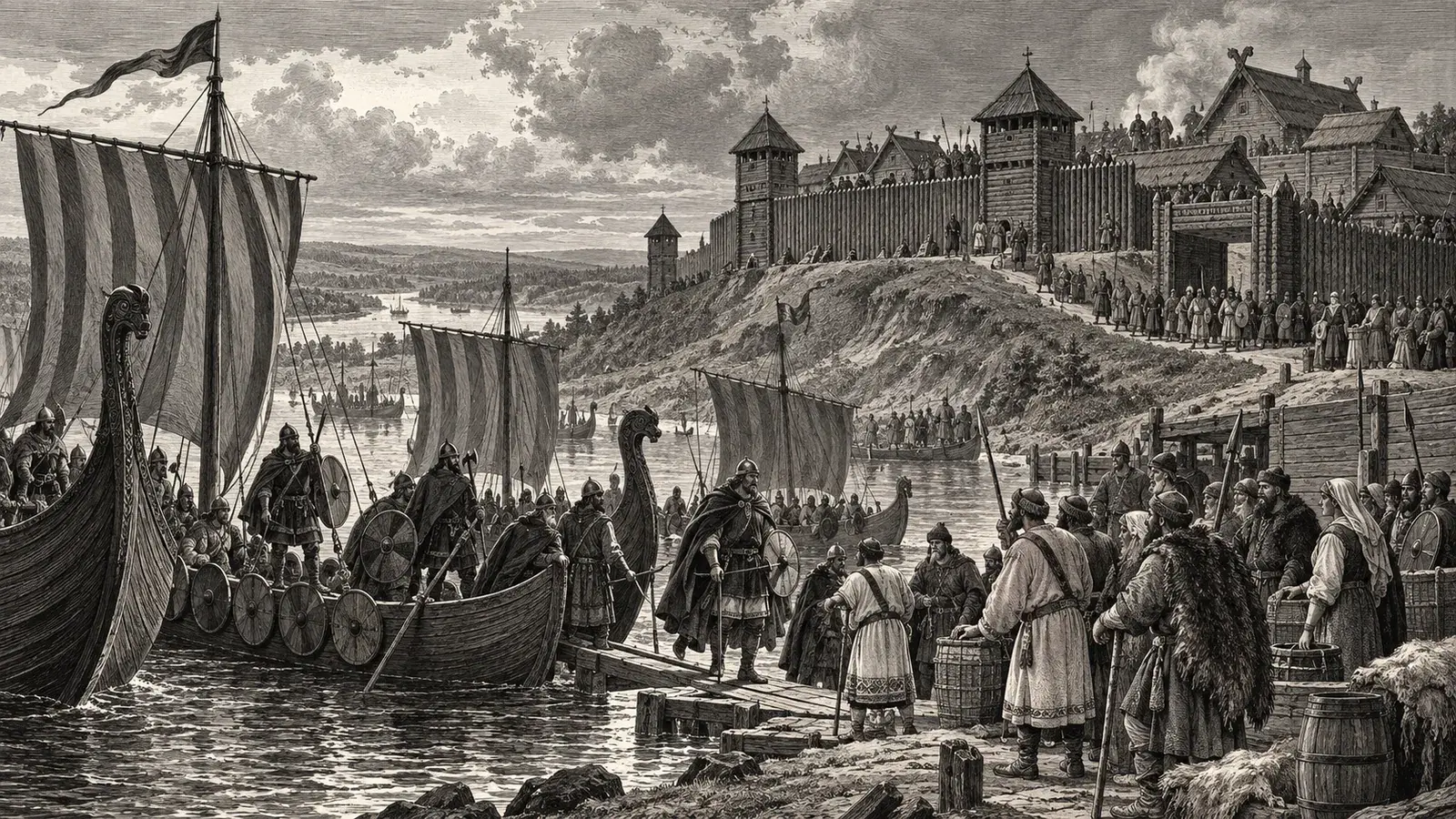
According to the Primary Chronicle, the Varangian Rus' arrived at the invitation of the feuding northern tribes around 862.
Modern scholars treat this as invention. The Chronicle was compiled in the twelfth century by Orthodox priests who had two apparent motives: explaining how easily the Vikings conquered the lands along the Varangian route and establishing the legitimacy of the Rurikid dynasty that employed them.
Shortly afterwards, two of Rurik's men, Askold and Dir asked leave to go to Constantinople. On the way south they came across a small city on a hill - Kiev, then a Khazar tributary - stayed, and established their dominion over the Polyanians. From there, the Chronicle says, they attacked Constantinople with a navy in 866, catching the Byzantines by surprise and devastating the surrounding area, although other accounts date the raid to 860. Patriarch Photius described the devastation of the suburbs and nearby islands in vivid detail. The Rus' turned back before their assaults on the city itself - due to a storm, or the Emperor's return, or in later tradition a miracle following a ceremonial appeal to the Virgin. The lasting consequence was that the Patriarch began sending missionaries north.
Oleg, Kiev and the Route From the Varangians to the Greeks
Rurik died around 879, leaving his kingdom to his kinsman Oleg as regent for his young son Igor. Oleg took Smolensk and then Kiev in 882, killed Askold and Dir and made Kiev his capital - though this last claim sits oddly with Latin and Greek sources for the following century, which still seem to treat Kiev as an outpost of Novgorod and Gorodische.
Consolidation followed quickly. Oleg subdued the Drevlians in 883 and imposed a fur tribute, and by 885 had brought the Poliane, Severiane, Vyatichi and Radimichs under control, forbidding them to keep paying the Khazars. He extended the network of Rus' forts through the Slavic lands begun in the north by Rurik.
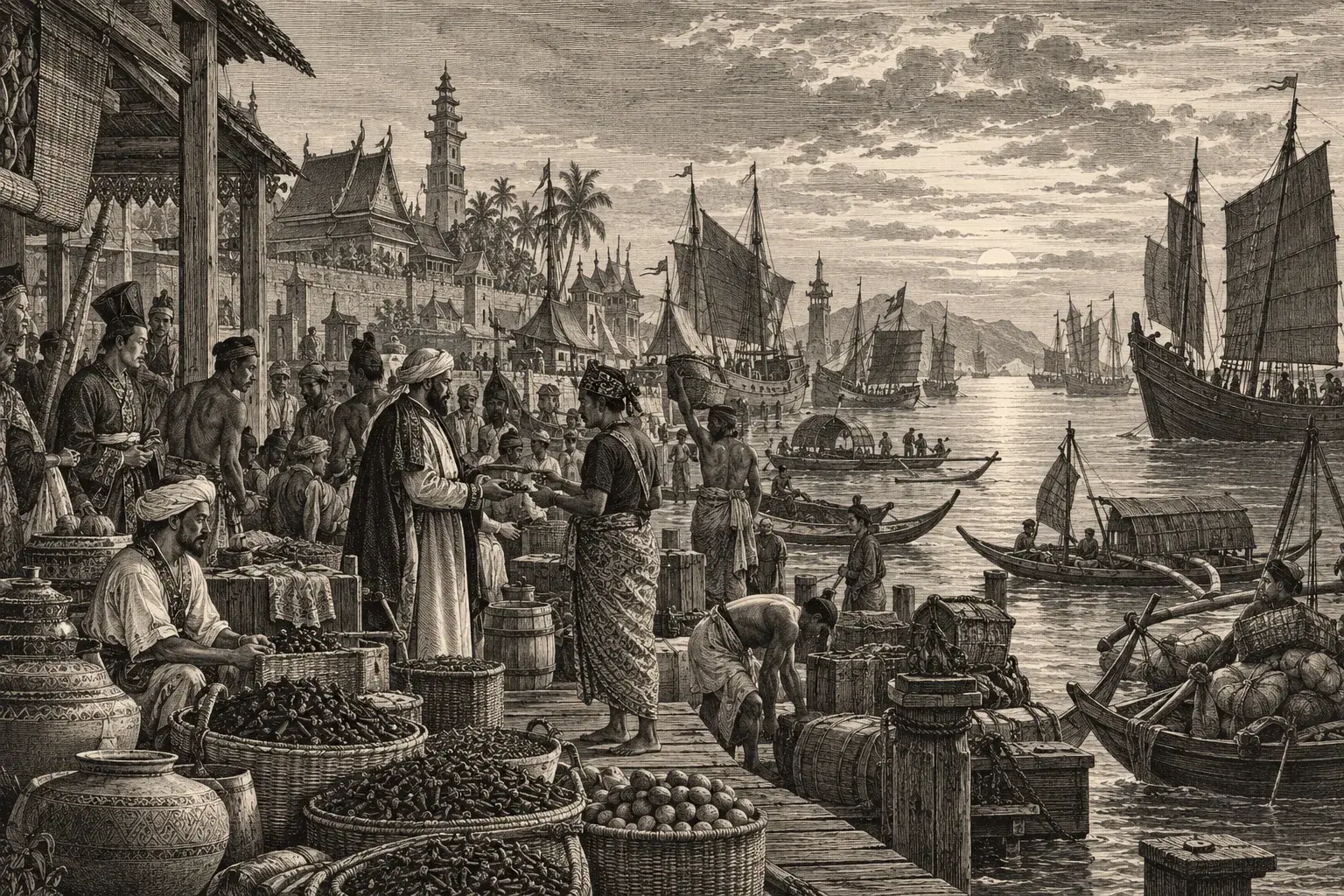
The state's wealth came from furs, beeswax, honey and slaves, and the siting on three major trade routes. Novgorod linked the Baltic to the Volga route, reaching the Volga Bulgars, the Khazars and across the Caspian as far as Baghdad. Traffic also ran south along the Dnieper on the route from the Varangians to the Greeks, down to the Black Sea and Constantinople. Kiev sat on this route and on the route east-west overland between the Khazars and Germanic Central Europe and may have been a staging post for Radhanite Jewish traders working between Western Europe, Itil and China.
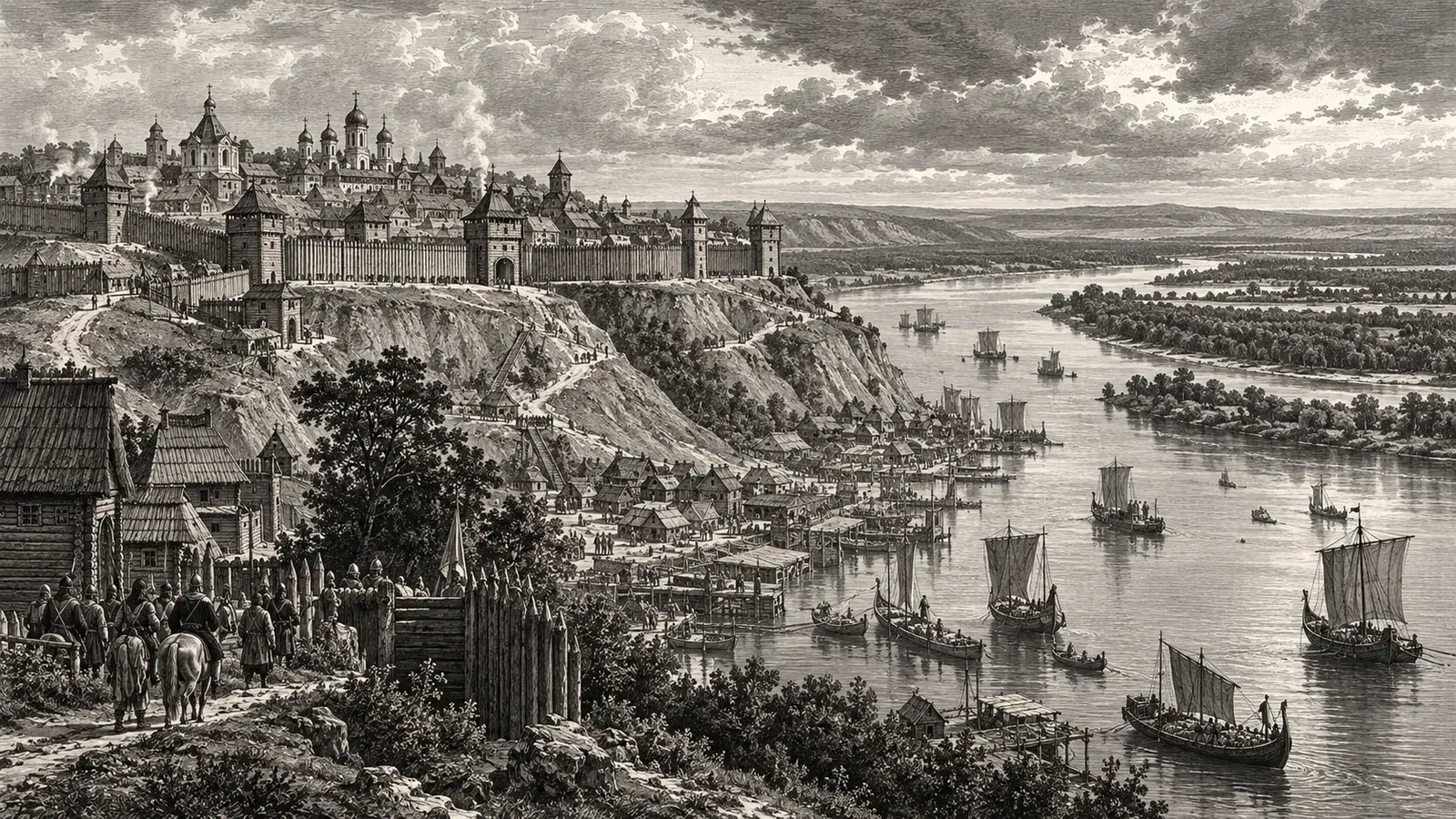
Kiev's position on the river route from the Varangians to the Greeks made it the linchpin of Rus' trade with Constantinople.
Trade paid for everything else: military forces, churches, palaces, fortifications and new towns. Demand for luxury goods produced local jewelry and religious wares for export, and potentially an advanced system of credit and money-lending may have operated alongside.
Rus' Relations With the Khazars and the Pechenegs
Pushing south meant colliding with the steppe. The Khazars had dominated trade from the Volga-Don steppes to eastern Crimea and the northern Caucasus through the eighth century, a period historians call the Pax Khazarica, trading with Byzantium and frequently allying with it against Persians and Arabs.
This order broke down when the Göktürk Khaganate collapsed in the late eighth century and pushed the Magyars and Pechenegs west out of Central Asia, bringing conflict, trade disruption and instability to the Khaganate. The Rus' and Slavs had previously allied with the Khazars against Arab raids on the Caucasus; now they worked against them for control of the routes.
Byzantium profited from the turmoil. It established the Theme of Cherson in Crimea in the 830s to defend against Rus' raids and to protect grain shipments to Constantinople, with Cherson becoming both the center of Black Sea commerce and a key diplomatic link to the Khazars. The Byzantines also helped the Khazars build the fortress at Sarkel on the Don to guard their northwest frontier and to control the Don-Volga portage.
Around 890 Oleg fought an indecisive war on the lower Dniester and Dnieper against the Tivertsi and Ulichs, probably Magyar vassals blocking Rus' access to the Black Sea. This blockage cleared itself with another's war, in 894 the Byzantines arranged for the Magyars to attack Bulgaria from the north, Bulgaria persuaded the Pechenegs to hit the Magyars from behind, and the boxed-in Magyars migrated west over the Carpathians into the Hungarian plain. This cost the Khazars an important ally and a buffer, and opened the sea to the Rus' who promptly began raiding Khazar territory along the coast, up the Don and into the lower Volga. Caspian raiding began by 864, with the first large expedition in 913 reaching Baku, Gilan and Mazandaran and penetrating into the Caucasus.
Relations with the Pechenegs were complicated throughout due to both needing each other. The Pechenegs were nomad herders whose livestock traded with the Rus' for agricultural goods, and Rus' trade with Byzantium had to pass through their territory. This made peace essential and did not make it permanent - the Chronicle records Pechenegs entering Rus' territory in 915 and making peace, then war again in 920. Pechenegs appear assisting Rus' campaigns against Byzantium and all allied with Byzantium against the Rus'.
Rus'–Byzantine Wars and the Treaties of 911 and 944
The relationship with Constantinople was the central foreign relationship, and alternated between lucrative trade and outright war, usually over trading terms.
The Chronicle records a Rus' attack on Constantinople in 907, glorifying Oleg's military cunning with terms clearly legendary. Byzantine sources don't mention it. However, treaties in 907 and 911 do establish a trade agreement with terms suggesting real pressure on the Byzantines, granting Rus' merchants quarters, supplies and tax free trading privileges in the capital.
Oleg's death gets the Chronicle's best story. A sorcerer prophesies that a particular horse will be the death of him. Oleg has it sequestered; it eventually dies, he visits the carcass and stands over it gloating that he outlived the threat, at which point a snake strikes him from among the bones and he sickens and dies.
Igor succeeded him in 913 and, after brief conflicts with the Drevlians and Pechenegs presided over two decades of peace. In 941 he attacked Constantinople again, probably over trading rights. A fleet reportedly numbered ten thousand vessels, with Pecheneg allies, landed on the Bithynian coast and devastated the Asiatic shore of the Bosphorus. The timing was excellent, possibly from intelligence - the Byzantine fleet was busy with the Arabs in the Mediterranean and the army was stationed east. The Rus' burned towns, churches and monasteries.
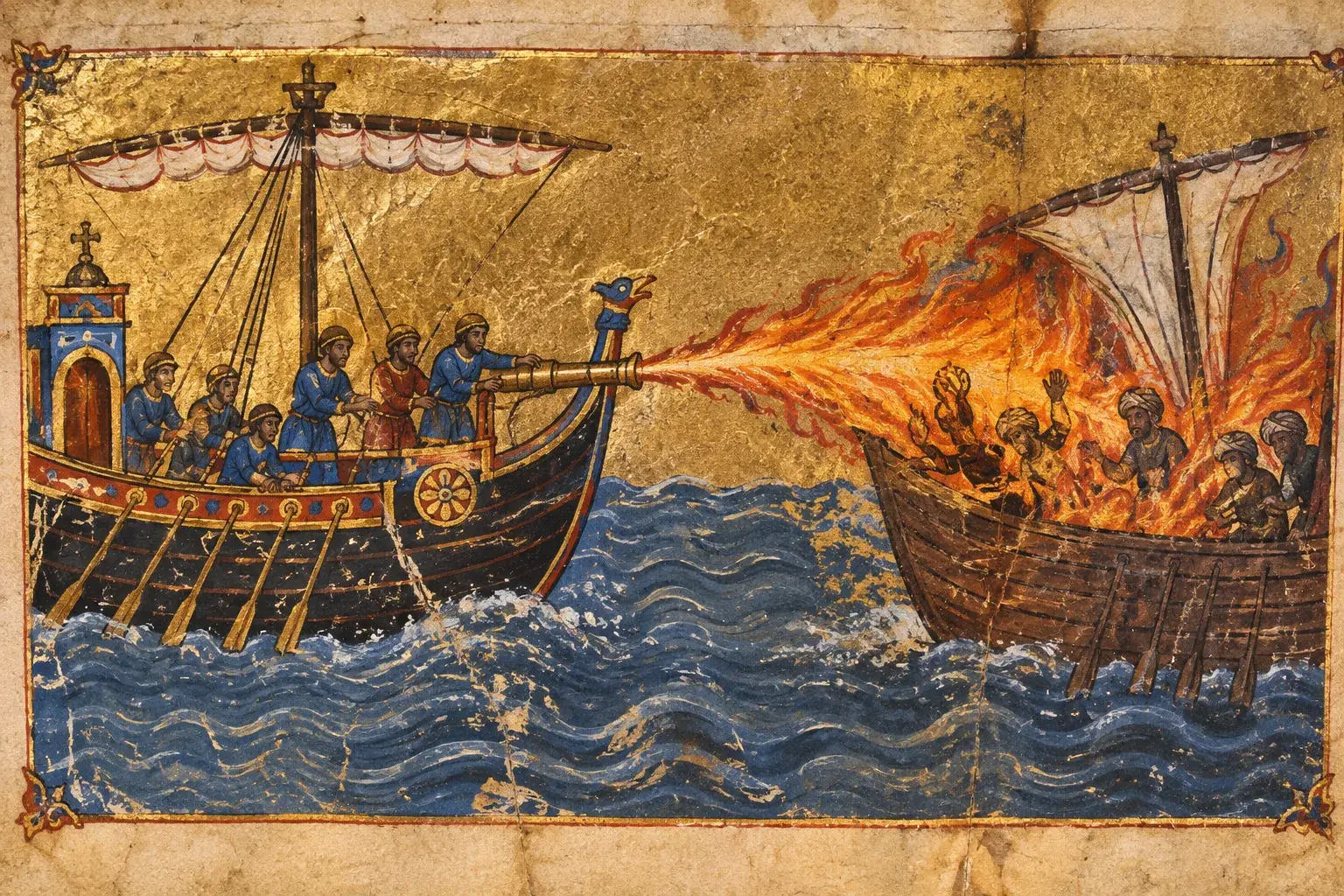
The counter was Greek fire. The emperor equipped a group of retired ships with fire throwers, lured the Rus' into surrounding them, and unloaded it. Liutprand of Cremona records that the Rus' jumped overboard preferring water to fire, with some sinking under the weight of their own breastplates and helmets. Captives were beheaded. The fleet scattered, though raiding continued inland as far as Nicomedia with considerable atrocity before a Byzantine army arrived from the Balkans.
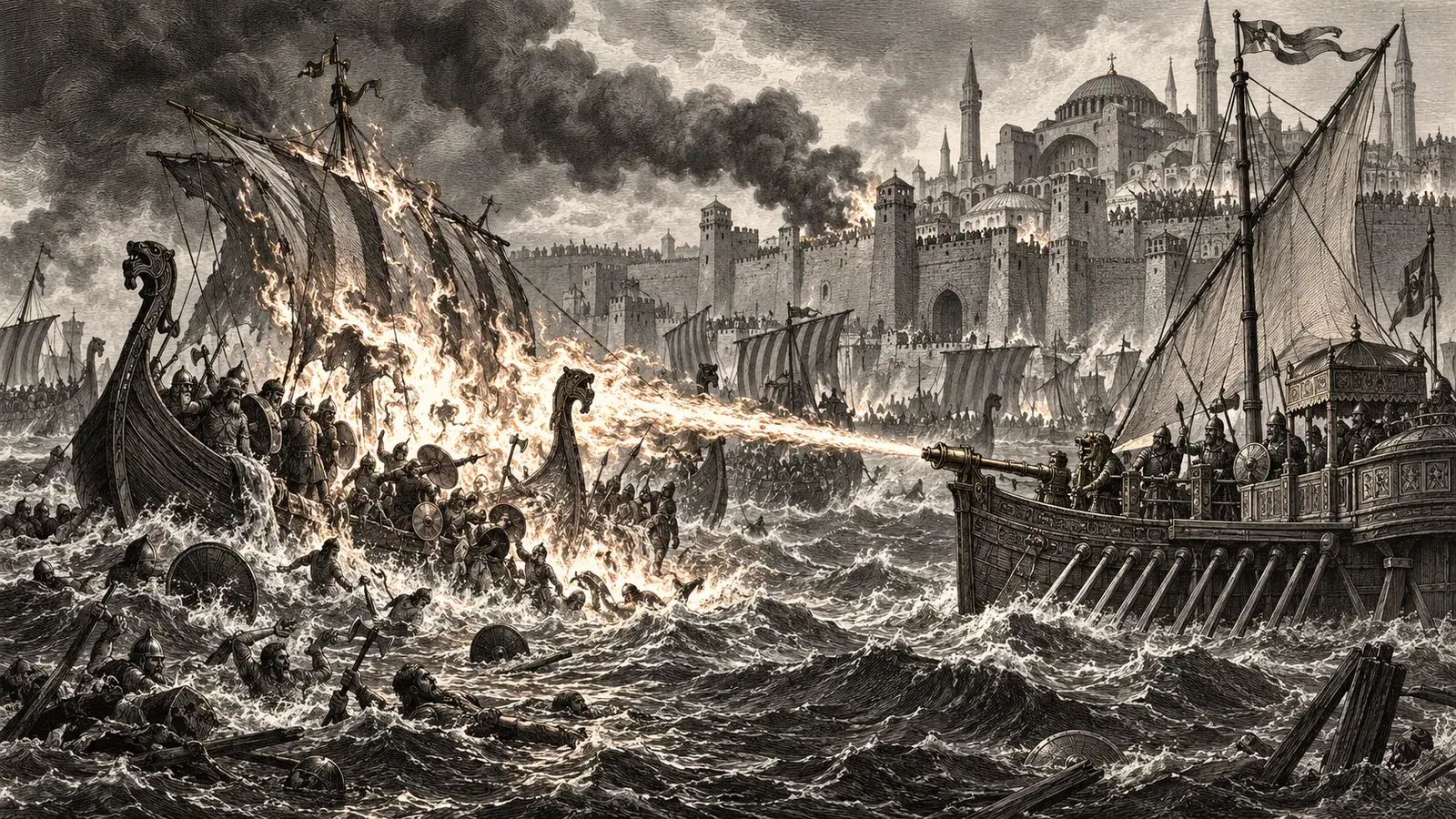
Greek fire broke Igor's siege of Constantinople in 941, driving surviving Rus' crews to leap into the Bosphorus rather than burn.
Igor went home and assembled a larger force - neighboring Slavs, Pecheneg allies, Varangian reinforcements from beyond the sea - and advanced again by land and sea in 944. This time the Emperor sent gifts and offered tribute instead of fighting, and the Rus' took it. The resulting treaty of 945 again centered on trade, but on terms markedly less favorable to the Rus', with tight regulation of merchant conduct in Cherson and Constantinople and specified punishments for violations. Whatever the Byzantines feared from a prolonged Rus'-Pecheneg-Bulgarian alliance, the terms suggest that the balance of power had shifted.
Sviatoslav's Conquests and the Fall of the Khazars
Igor died in 945, and his wife Olga ruled as regent until their son Sviatoslav came of age around 963. His decade in power was the most militarily expansive in the state's history.
Sviatoslav destroyed the Khazars of the Pontic steppe in a war of conquest and invaded the Balkans, carving out the largest state in Europe and moving his capital from Kiev to Pereyaslavets on the Danube in 969. Unlike his mother who had converted to Christianity, he and his druzhina remained firmly pagan.
The conquests did not consolidate. He was killed in an ambush in 972, having made no stable arrangements for succession, and the fratricidal feud among his sons killed two of the three.
Vladimir the Great and the Christianization of Kievan Rus'
Vladimir was prince of Novgorod when Sviatoslav died and fled to Scandinavia in 977 after his half-brother Yaropolk killed their half-brother Oleg. He returned with a host of Varangian warriors, subdued the Principality of Polotsk, then defeated and killed Yaropolk to take the whole realm.
Christianization is often credited entirely to him, and should not be. Greeks in the Black Sea colonies converted as early as the first century AD, and the Chronicle preserves a legend of Andrew the Apostle preaching in those settlements and blessing the future site of Kyiv. Goths moving through in the third century adopted Arian Christianity in the fourth, leaving churches that have been excavated in Crimea, before the Hunnic invasion of the 370s halted the process for centuries. Askold and Dir and Olga of Kiev are all reported to have converted, while Oleg, Igor and Sviatoslav remained pagan.
The Chronicle's account of Vladimir's decision is one of the best-known passages in medieval Slavic literature. He sends advisors across Europe to inspect the available faiths. They reject Islam partly because it forbids alcohol, and Judaism on the grounds that the God of the Jews had allowed his chosen people to lose their country. Roman ceremonies strike them as dull. Then at Constantinople the beauty of Hagia Sophia and the liturgy held there settles the matter on the spot, and Vladimir travels there to arrange a marriage with Princess Anna, sister of the emperor Basil II.
The likelier explanation is diplomatic. Byzantine Christianity strengthened relations with Constantinople, which dominated the Black Sea and therefore the Dnieper, Kiev's most vital commercial artery. Vladimir was baptized around 987 and ordered Kiev's population baptized in August 988, with the strongest resistance coming from the northern towns of Novgorod, Suzdal and Belozersk.
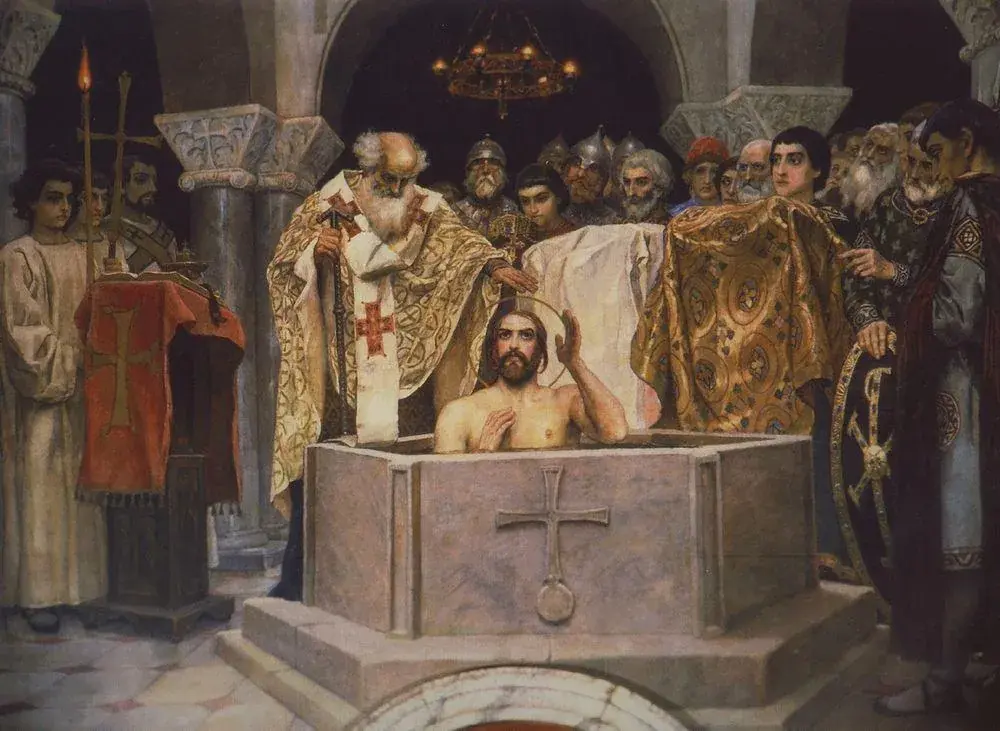
Vladimir ordered Kiev's population baptized in the Dnieper in August 988, with the north putting up the stiffest resistance.
Image Credits: Viktor Vasnetsov, via Wikimedia Commons (Public domain)
There is a detail that complicates the tidy conversion story. Christianity, Judaism and Islam had all long been known in these lands, and when Vladimir took the throne he first set up idols of Norse, Slav, Finn and Iranian gods on a hilltop in Kiev, apparently trying to build a single unified pantheon for his mixed population, before abandoning it for Christianity for reasons that remain unclear.
The consequences were cultural as much as religious. The Eastern church arrived with a liturgy in Cyrillic and a body of Greek translations already prepared for Slavic peoples. Cyril and Methodius, sent as missionaries in 863 at the request of Prince Rastislav of Moravia, had devised the Glagolitic alphabet - later replaced by Cyrillic - and standardized what became Old Church Slavonic, translating portions of the Bible and drafting the first Slavic civil code. This literature enabled the Eastern Slavs to reach rudimentary Greek philosophy, science and historiography without learning Greek. After the Great Schism of 1054 the Kievan church remained in communion with both Rome and Constantinople for a while before following the rest of the Eastern churches into Orthodoxy - though notably unlike much of the Greek world Kievan Rus' never developed strong hostility toward the West.
Yaroslav the Wise and the Russkaya Pravda
Yaroslav, a son of Vladimir, was prince of Novgorod when his father died in 1015. He established his rule over Kiev in 1019 but did not hold all of Kievan Rus' uncontested until 1036.
His reign is the state's high point by most measures. He promulgated the Russkaya Pravda, the first law code, built the Saint Sophia cathedrals in both Kiev and Novgorod, patronized local clergy and monasticism and is credited with founding a school system. His sons developed the Kiev Pechersk Lavra.
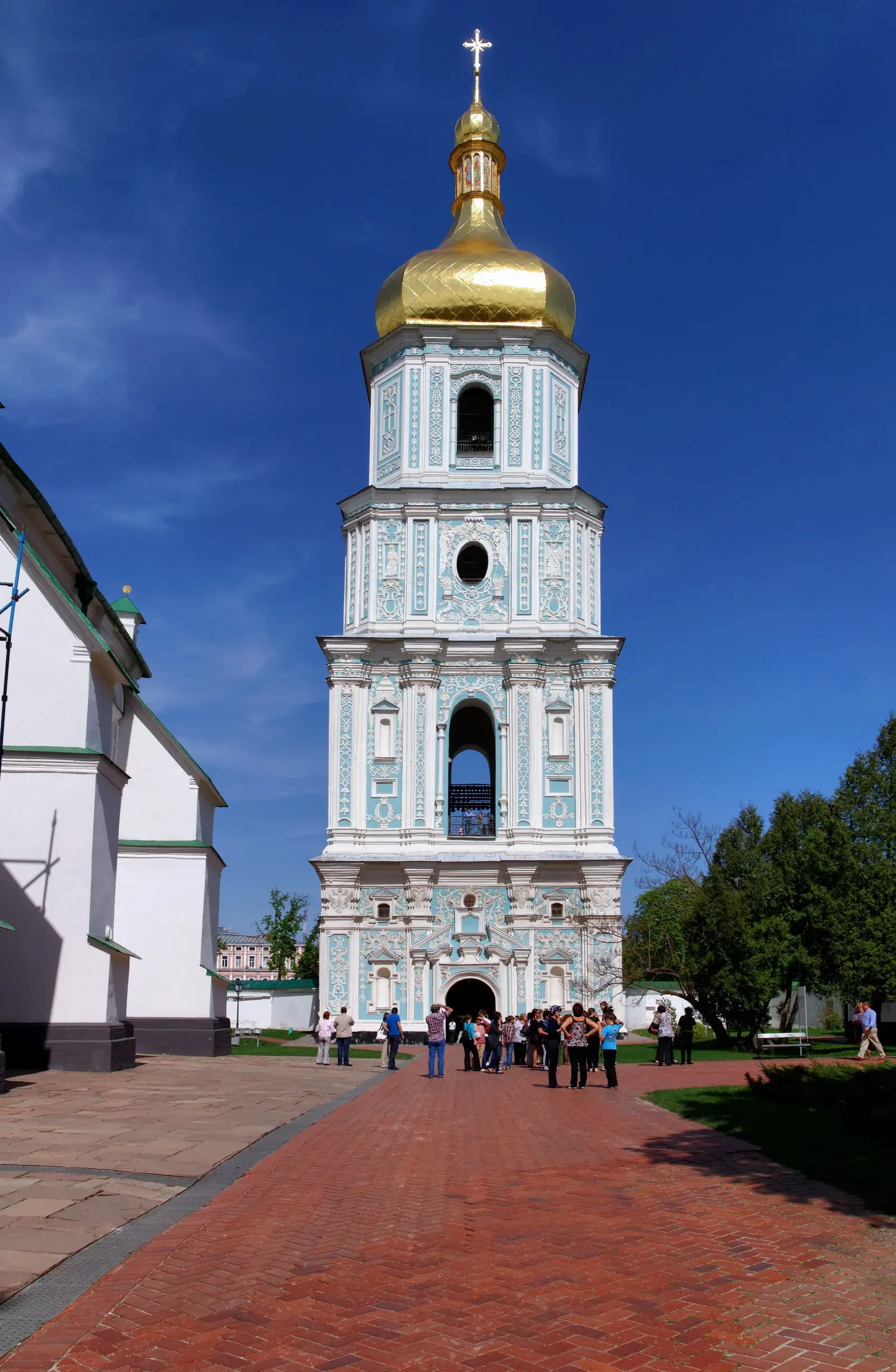
Yaroslav the Wise built Saint Sophia cathedrals in both Kiev and Novgorod during the state's high point.
Image Credits: Alexxx1979, via Wikimedia Commons (CC BY-SA 3.0)
He was also an exceptionally effective dynastic operator. His stepmother belonged to the Macedonian dynasty that ruled Byzantium from 867 to 1056; he married Ingegerd Olofsdotter, the only legitimate daughter of the Swedish king who Christianized Sweden. His daughters became queens of Hungary, France and Norway. His sons married daughters of a Polish king and a Byzantine emperor and a niece of the Pope. His granddaughters included a German empress and, on one theory, a queen of Scotland; his granddaughter Eupraxia married Henry IV, Holy Roman Emperor. Another grandson married the only daughter of the last Anglo-Saxon king of England.
Succession Disputes and the Fragmentation of Kievan Rus'
How exactly did the power in Kievan Rus' used to pass from one Rurikid to another, Paul Magocsi points out, is disputable; scholars differ as to whether there was an order to the process or not.
Nancy Shields Kollmann, on the other hand, believes that there was a certain order, namely, a rota: succession used to run from elder to younger, from uncle to nephew and from father to son, while junior princes used to start their career in the province and then move on to more profitable lands, namely, Kiev.
Yaroslav tried to establish order by allocating the largest cities between his sons to avoid bloodshed, with Iziaslav, the eldest, receiving Kiev and Novgorod, Sviatoslav – Chernigov and Tmutarakan, Vsevolod – Pereyaslavl and Rostov-Suzdal, Vyacheslav – Smolensk, Igor – Volhynia, while Polotsk was left to his older brother's descendants and Galicia – to his grandson Rostyslav.
It did not last long, as Ivan Katchanovski points out, since no proper order was established in Kievan Rus' after Yaroslav's death in 1054, leading to the further fragmentation of the state.
What's more, the system of succession led to the permanent family feuds, with familicide being a common and dreadful practice, especially during the reign of Yaroslav's sons, when Vladimir II Monomakh was elected to the post of the grand prince in Kiev, leaving the princes of Chernigov, Pereyaslavl, Turov-Volhynia and Polotsk at each other's throats.
The situation only grew worse with Polotsk vying with Rostislav Vladimirovich for the hegemony in Novgorod, while three of Yaroslav's sons – Iziaslav, Sviatoslav and Vsevolod – turned against each other after the disastrous campaign against the Cumans at the Alta River in 1068, with Iziaslav having to flee to Poland for help and later returning to Rus' to re-establish order.
Monomakh held the Council of Liubech near Chernigov in 1097 to solve the feuds between his sons, while in 1130 all the descendants of Vseslav the Seer had to leave for Constantinople.
Mstislav was the last grand prince to rule a united Kievan Rus', which quickly started to fragment after his death in 1132. His successor, Yaropolk II, got involved in the endless feuds with the Novgorod Republic, while the Cumans continued to harry the borders of Kievan Rus'. In March 1169, the combined forces of the Suzdalian princes, led by Andrei Bogolyubsky, sacked Kiev for the first time, which significantly contributed to the shifting of the capital to Vladimir. By the end of the 12th century, Kievan Rus' had split into twelve states or so.
Trade Decline, the Crusades and the Mongol Invasion
The political fragmentation of Kievan Rus' ran parallel to the state's economic decline, with the diminutive role of Constantinople as the key trading partner undermining the commercial potential of the Dnieper route from Varangians to Greeks. In addition, the growing interest of the West in Byzantium and the Silk Road decreased the need for transit through the lands of Kievan Rus'.
The impact of the Crusades should also be noted in this respect, as the Fourth Crusade's participants had little interest in getting through the lands of Rus' after sacking Constantinople in 1204. At the same time, the regional Livonian and Teutonic knights started to make incursions into the Baltic Province and the borders of Novgorod.
The latter continued to develop even when the principalities of Kiev and Vladimir – Suzdal – fragmented, as control over the trade routes from the Volga to the Baltic Sea made Novgorod virtually independent from the early 12th century and later gave it the opportunity to turn itself into a fully-fledged city-state, known as the Lord Novgorod the Great. In the southwest, Galicia-Volhynia was created by the prince of Galicia, Roman Mstislavych, in 1199, who then promoted his son Daniel to the west and even got him crowned by the Pope.
The arrival of the Mongols in the east led to the end of Kievan Rus' as a political entity, as the princes of Rus' had to sue for peace with the invading forces after the Mongols had overrun the territory of the Cuman Khanate. The latter had already suffered a devastating campaign by the troops of Batu Khan, and the fleeing Köten, the ruler of the Cumans, was forced to seek refuge in Rus'. After the Mongols gained control of Vladimir, Yaroslav, Ryazan, Kolomna, Moscow, and Kiev, the siege of the capital city of Rus', Kiev, which is widely considered the end of Kievan Rus', took place in 1240. The Mongols went on to conquer Galicia and Volhynia, as well as Poland and Hungary, with Batu founding the capital of the Golden Horde state, Sarai, in 1242, from where he returned to Mongolia upon the death of his uncle Ögedei.
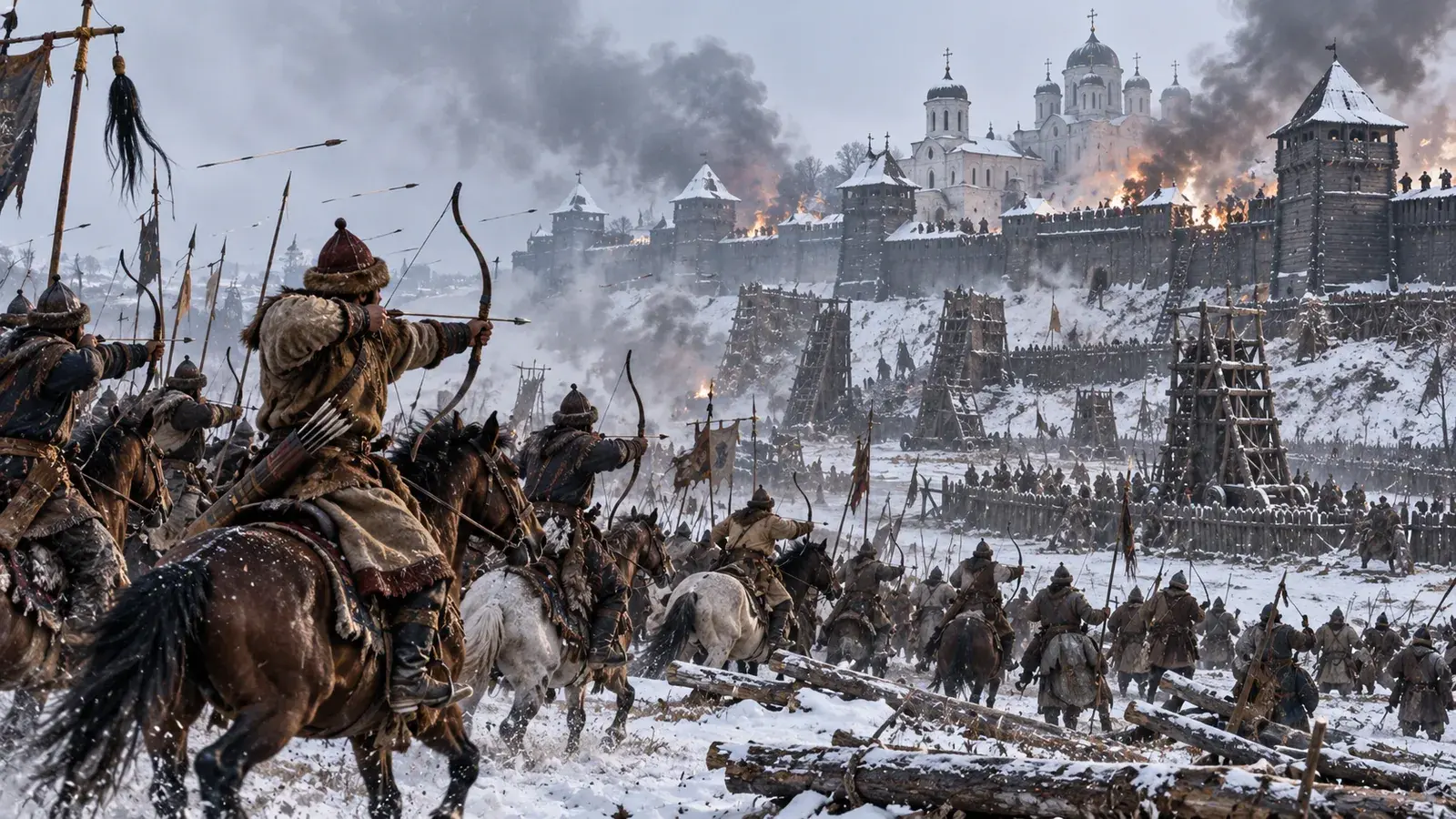
The 1240 siege of Kiev is generally treated as the effective end of Kievan Rus' as a single political entity.
Prior to the Mongol invasion, the principalities of Kievan Rus' were relatively prosperous trading nations. The export of goods produced in the settlements of Kiev, Novgorod and other cities continued, with Novgorod's merchants leading the way in terms of both trade and art. The cities had relatively good infrastructure, including sewage systems and paving stones, which surpassed that of European cities. The Russkaya Pravda code punished mainly fines, while practically no one was sentenced to death, while women in Kievan Rus' were granted many rights, including the right to inherit property. The population of Kiev at the turn of the 12th and 13th centuries is estimated at 36,000 to 50,000, compared to 50,000 in Paris, and surpassing London, with 30,000. The population of Novgorod reached 10,000 – 15,000 in 1000 and 20,000 – 30,000 in 1200, while Chernigov, in turn, was larger in area than either of these capitals. According to Mikhail Tikhomirov, approximately 300 cities and towns existed in Kievan Rus' before the Mongol invasion.
| City | Estimated population, c. 1200 |
|---|---|
| Kiev | 36,000–50,000 |
| Paris | about 50,000 |
| Novgorod | 20,000–30,000 |
| London | about 30,000 |
This leads us to the rather contentious issue raised by Serhii Plokhy in his article "Denationalizing Kievan Rus'", published in 2006. He suggests that the very concept of Kievan Rus' should be denationalized by regarding it as a multiethnic state, not a Russian or Ukrainian one, with the theory also including the separation of the concept of Rus' and Rus' Land. According to Charles Halperin, this idea does not negate the validity of historical analysis of the claims of the Muscovite, Lithuanian, and Ukrainian princes to the legacy of Kievan Rus', but rather shifts it to the realm of ideological arguments.