In 1510, an old man stepped off a ship into the sand at the head of Table Bay, near the Salt River on what is now the Woodstock beach. He had been the most powerful Portuguese official in the East. He had won the greatest naval battle the Indian Ocean had yet seen. And he had been warned not to come ashore. His name was Francisco d'Almeida, the first Viceroy of Portuguese India. He was going home in disgrace, stripped of his command, sailing in a rotten old ship his rivals had assigned him. And he was about to become the first European of distinction to die in South Africa.
Portugal's War in the Indian Ocean
To understand Almeida's story, you have to understand what the Portuguese were doing in the Indian Ocean in the early sixteenth century. They had burst in like a famished lion into a fold — that's how their own writers described it. The Arab traders who had peacefully sailed the Indian Ocean for centuries, carrying silk from China and spices from the Spice Islands and ivory from Africa, had no guns on their ships and no armour on their backs. The Portuguese had both. In just a few years, the Portuguese destroyed the Arab naval dominance that had ruled the ocean for generations. They burned fleets. They sacked cities. They seized the spice islands. They cut off the flow of goods to Egypt and Turkey that had funded the Mamluk and Ottoman war machines. One Portuguese commander flogged the chief of Egyptian merchants and sent him home to show his master what Christians thought of the power of the Crescent. This was not trade. It was war — a continuation of the Crusades fought in a new ocean. Francisco d'Almeida was sent to lead this war. He was the son of the Count of Abrantes, a valiant knight and good commander. With him came his son Lourenço, a giant of a man, said to be the best sword-fighter in all Portugal.
The Battle of Diu and a Father's Revenge
The Sultan of Egypt, alarmed by Portuguese attacks on his trade, built a fleet in the Red Sea, carried the timber overland on camels, launched it into the Indian Ocean, and sent it against the Portuguese. This combined fleet caught young Lourenço d'Almeida off the bar of Chaul and sank his ship. Our last glimpse of the young captain is extraordinary: sitting in a chair by the mainmast after his leg had been blown off by a cannonball, shouting at his men to fight for Portugal and the Cross. When the old Viceroy heard that his son was dead, he said only: "He who has eaten the cockerel must eat the cock." He sailed with eighteen ships, caught the enemy fleet at Diu, and utterly destroyed it — firing the limbs of his captives over every town on the Malabar coast to make his vengeance clear. That was Almeida: a fighter for love of it, ruthless and magnificent. But power in the East was complicated. His great rival Albuquerque arrived with orders from the king, and Almeida — unwilling to give up his command — actually had Albuquerque imprisoned in a fort. He lost that battle. The king forced him to release Albuquerque and surrender his command. Stripped of his victory and his authority, the old man got into the worst ship his rivals could find him and sailed for home.
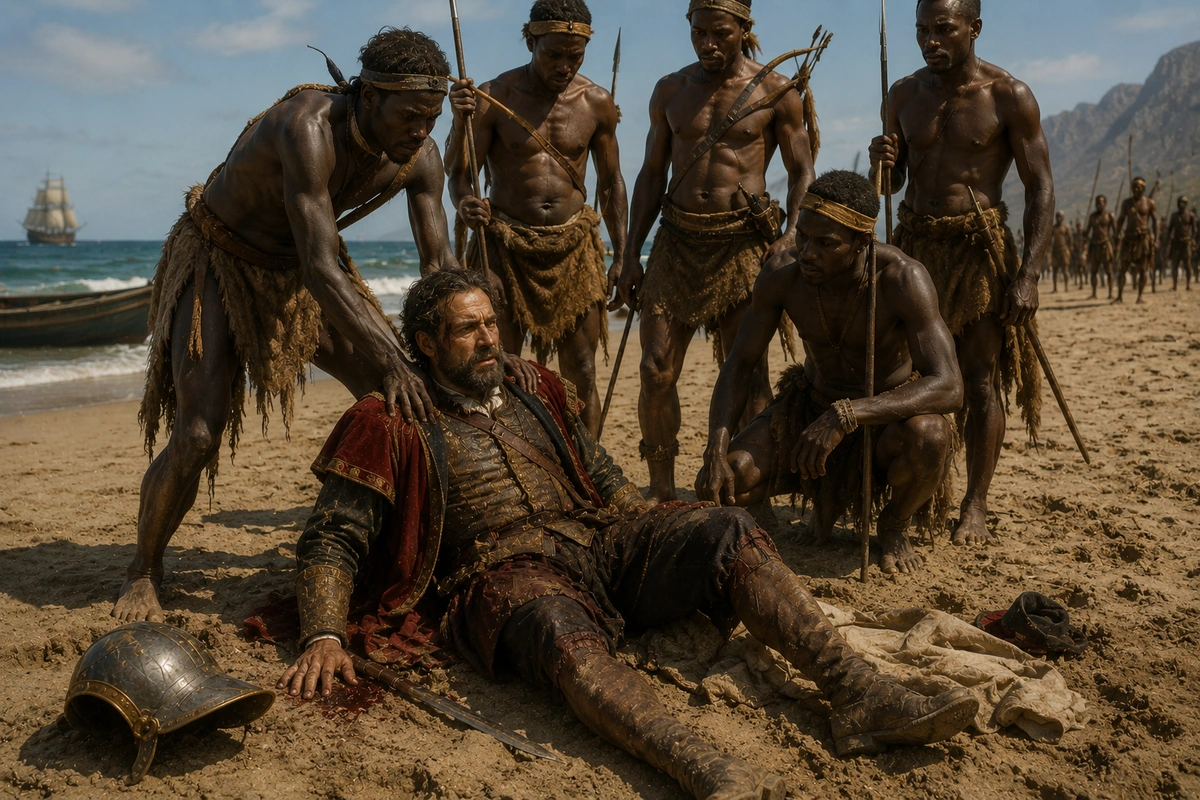
Almeida had defeated the Egyptian fleet at Diu in one of the Indian Ocean's greatest battles — but he could not survive a fatal afternoon on a beach in South Africa.
The Afternoon That Killed a Viceroy
The old man was haunted by bad omens the whole voyage home. He is said to have muttered prophecies to himself. When his fleet swung into Table Bay, he said: "Now God be praised — the sorcerers of Cochin are liars." He had thought he would never round the Cape. But he had. He spoke too soon. A quarrel broke out between some of his servants and the local Khoikhoi people. In an evil moment, he was persuaded to go ashore and punish the savages. "Where are you taking these sixty years?" he said as he stepped into the boat — one of history's more haunting last words. He landed with a hundred and fifty men. They gathered children and cattle and began driving them towards the boats. But the cattle were the key to the disaster. From behind the herd, small naked warriors threw their javelins — charred wooden points, but hurled with such force they pierced like steel. The sky rained spears and stones. The Portuguese stumbled in the sand. When a man fell, a swarm of warriors was on him instantly, pounding his head with stones. Those who could, staggered to the shore. But the boats were gone — they had sought shelter from the wind near the ships. Men plunged into the sea. Others ran along the beach. Almeida was left with almost no one. His standard-bearer said: "Where are those to whom you have done honour now? This is the time to repay benefits!" Almeida turned on him: "'Tis no time for evil-speaking. Those who owe me any favour lie behind me on the sand. Save the king's flag. It is being dishonoured." A javelin pierced him in the throat. He said no more. He fell. Fifty men fell with him. So died the man who had given the king an empire. He was buried in the nameless sand-hills near the Salt River. Fifty more men lay with him, the first significant European casualties on South African soil.
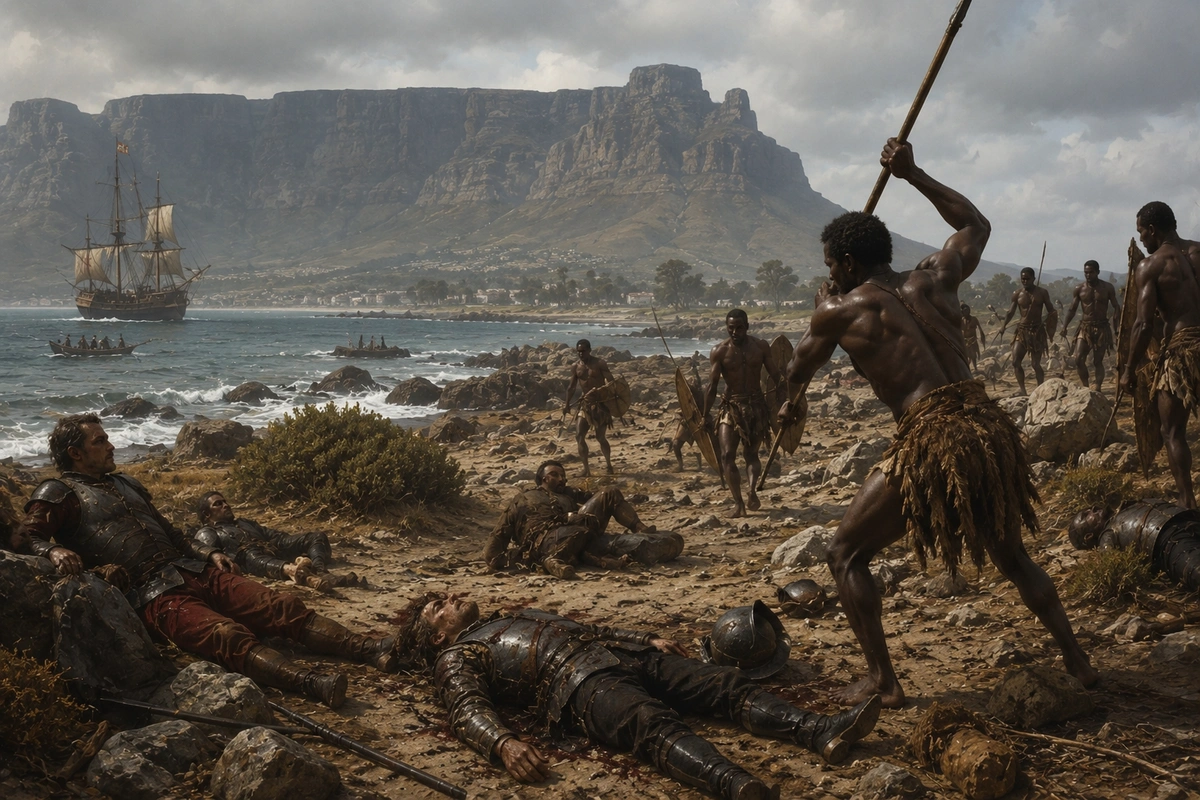
The same bay that would later become Cape Town's harbor was, in 1510, the scene of the first major confrontation between Europeans and the people of South Africa.
The death of Almeida had a strange consequence. Portuguese sailors, remembering what had happened to one of their greatest men, developed a deeply bad opinion of Table Bay. For the next hundred and forty years, they would stop there as rarely as possible — and when they did, they approached with great caution. This gave the Dutch their opening. But that's a story for another chapter.