When the king of Portugal needed someone to complete the most important voyage in his nation's history, he didn't pick a scholar or a nobleman with a taste for adventure. He picked a man who scared people. Vasco da Gama was a poor gentleman of his court, the son of the mayor of a tiny fishing village on the Atlantic coast. He was blunt, practical, and had a fiery temper that made even experienced sailors nervous. He thought nothing — as the records put it — of dipping a Moor in boiling oil. He had thrown compass and astrolabe overboard once to force his pilots to keep going forward when they wanted to turn back. These were the qualities the king wanted. Bartolomeu Dias had proved Africa could be rounded. Cavilhão's letter had shown the way to India. What was needed now was someone who absolutely would not stop.
Sailing from Lisbon — A Nation Holds Its Breath
The departure from Lisbon in July 1497 was a solemn and magnificent occasion. The night before they sailed, da Gama, his brother Paul, and all their officers prayed through the night in the hermitage that Prince Henry himself had built — the Chapel of Our Lady of Bethlehem. In the morning, the whole company walked through the streets of the city in a procession, with candles in their hands and priests chanting the litany ahead of them. The entire city followed behind. It must have been a remarkable sight — the consecrated banner of the king streaming in the breeze, the bright vestments of the priests, the helmets and breastplates of the soldiers glittering in the morning light. Portugal knew what this voyage meant. And the sailors knew the risk. Of the one hundred and seventy brave souls who sailed out of Lisbon that fair day, only fifty-five would see it again. Bartholomew Dias himself came along to see them safely past the coast of Guinea. He watched them go — presumably with the same grief he'd felt when he said goodbye to his own cross on the island he'd named after the Fountains, years before.
The First Meeting — Honey-Hunters at the Cape
The fleet anchored in St. Helena Bay, south of the Cape, and da Gama went ashore to take the sun's height with his astrolabe. His sailors were glad of the rest after the long confinement of the voyage — some went to catch crayfish on the rocks, others went whale-fishing in the bay. And here came the first encounter with the people of South Africa. Two small men were spotted crouching behind a hillock, digging out honeycomb with lighted torches to keep off the bees. The sailors spread out quietly through the low scrub and surrounded them. One escaped, dodging through the bushes like a hare. The other was caught. The man was so frightened he wouldn't speak or eat until the sailors moved away, leaving only two cabin boys to sit beside him and try to make friends. When he did finally begin to relax, not even the men who knew the language of Guinea could understand a word he said — his language was full of clicks quite unlike anything they'd heard before. He was given toy bells and glass beads and went off in high glee, and came back with a large number of his people. Then came trouble. A sailor named Fernão Veloso, who was always boasting about his courage, went inland with the Bushmen. He came back running. The Bushmen gave chase. When the sailors rowed to rescue him, a shower of bone-tipped arrows came from the shore. Da Gama himself was wounded in the foot. Two other sailors were also hit. The Portuguese shot back with crossbows and made for the ships. So ended the first meeting between Europeans and the people of South Africa — badly for both sides.
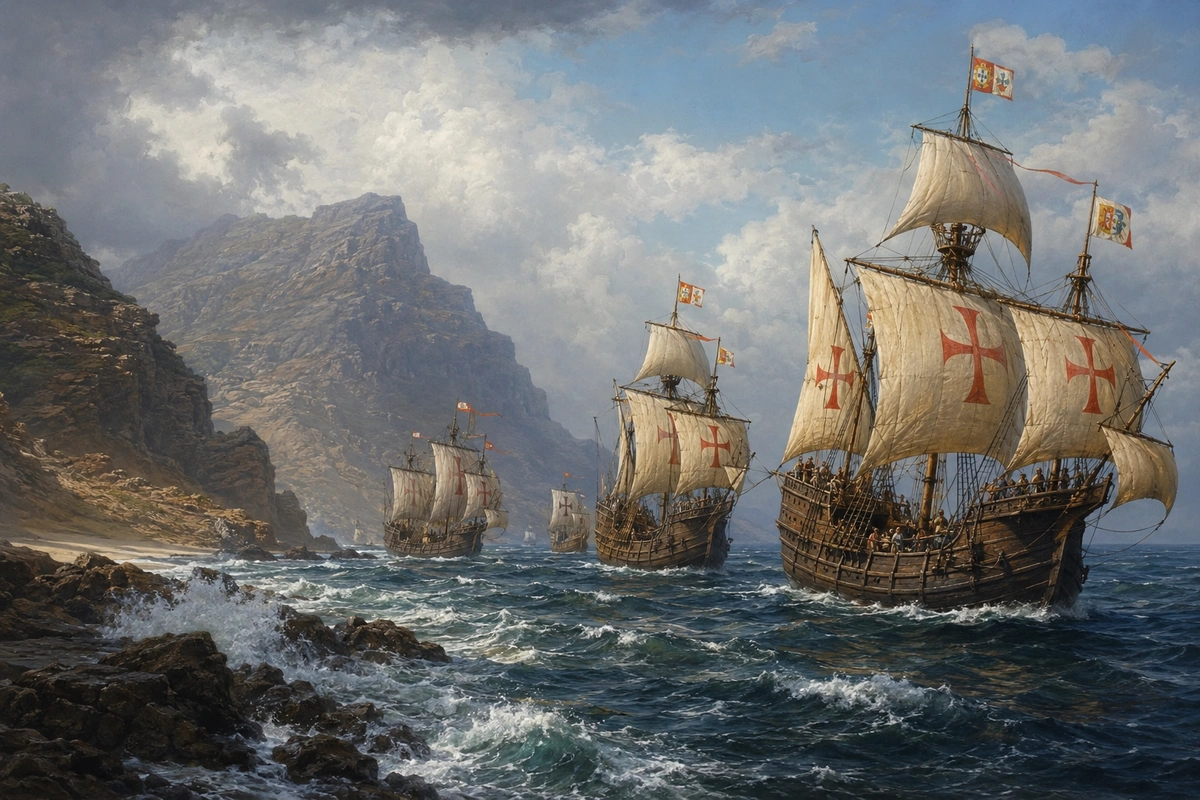
Da Gama's fleet rounded the Cape with, in the sailors' own words, 'less storm and peril than they had expected, playing of trumpets and making merry along the coast.'
Around the Cape and Up the East Coast
After the trouble at St. Helena Bay, the ships rounded the Cape with surprisingly little difficulty — the sailors had dreaded that passage, and this time it cooperated. Rounding it, they kept close to the land and sailed east, watching the coast become green and fertile, with herds of cattle and sheep visible from the sea. At Mossel Bay they landed on the Sunday of Saint Catherine's feast day and found a very different welcome. Cattle-herders came down to meet them, riding on oxen saddled with packs of reeds in the Spanish fashion. They were hospitable and friendly, fond of music and dancing. The sailors had great pleasure from these people. But quarrels broke out over the barter of cattle, and the fleet sailed on. They passed an island covered with thousands of seals so savage they attacked men like bulls, and marveled at penguins the size of wild geese that couldn't fly because their wings were only covered with skin like bats. They celebrated the Nativity off a coast they named after that feast — Natal. Meanwhile, scurvy was eating through the crew. The flesh of men's gums swelled until their mouths could barely contain it, then decayed so badly the sailors had to cut it away like dead flesh. Da Gama pressed on.
The Arab World — And a New Enemy
Far up the east coast, past the fevers of the mangrove swamps and the shoals of a great river that turned out to be the Zambezi, the ships finally came upon something that made the crew shout with joy. Turbaned men in blue mantles and bright silk vests. Arab traders. In this dramatic way the Cross and the Crescent met again on a new battlefield — the Indian Ocean. The Portuguese had come round Africa like a hungry lion coming round a fold. They were now inside it. At Mozambique, the sheikh entertained the visitors with great courtesy, thinking they were Muslim traders. When he discovered they were Christians, everything changed. He tried to destroy or entrap the ships. Da Gama used boiling oil to discover the plot, kept a stick-armed sailor over the pilot, and pressed on. At Malindi he finally found a pilot willing to help him reach India — and the fleet crossed the Indian Ocean in twenty-three days to reach Calicut on the Malabar coast.
The Terrible Voyage Home
Da Gama returned from Calicut with a cargo of spices that would pay for the cost of the whole expedition sixty times over. But the homeward voyage was a nightmare. The monsoon was against them. The sailors sickened and died of scurvy faster than they had on the way out, their flesh turning black and putrid. The crews of two ships were barely enough to sail one. One ship was abandoned and burned on the east coast of Africa. Paul da Gama — Vasco's brother, as much loved by the sailors as his brother was feared — comforted the sick and dying until he himself was struck down. As the months passed and the sea went from cold to hot and back to cold again, Paul grew weaker and weaker. Vasco sat over him, barely caring what happened to the ship or whether it was day or night. A great storm hit. They barely survived it. Then Vasco found a small caravel at Santiago island, transferred his brother to it, and sent him to the quiet island of Terceira, hoping the clean air would revive him. Paul died in the monastery of St. Francis and was buried by the good fathers there. When da Gama finally reached Lisbon — without entering the city, going straight to the hermitage where he had prayed before the voyage — the great men of the kingdom found him there, kneeling before the image of the Virgin.
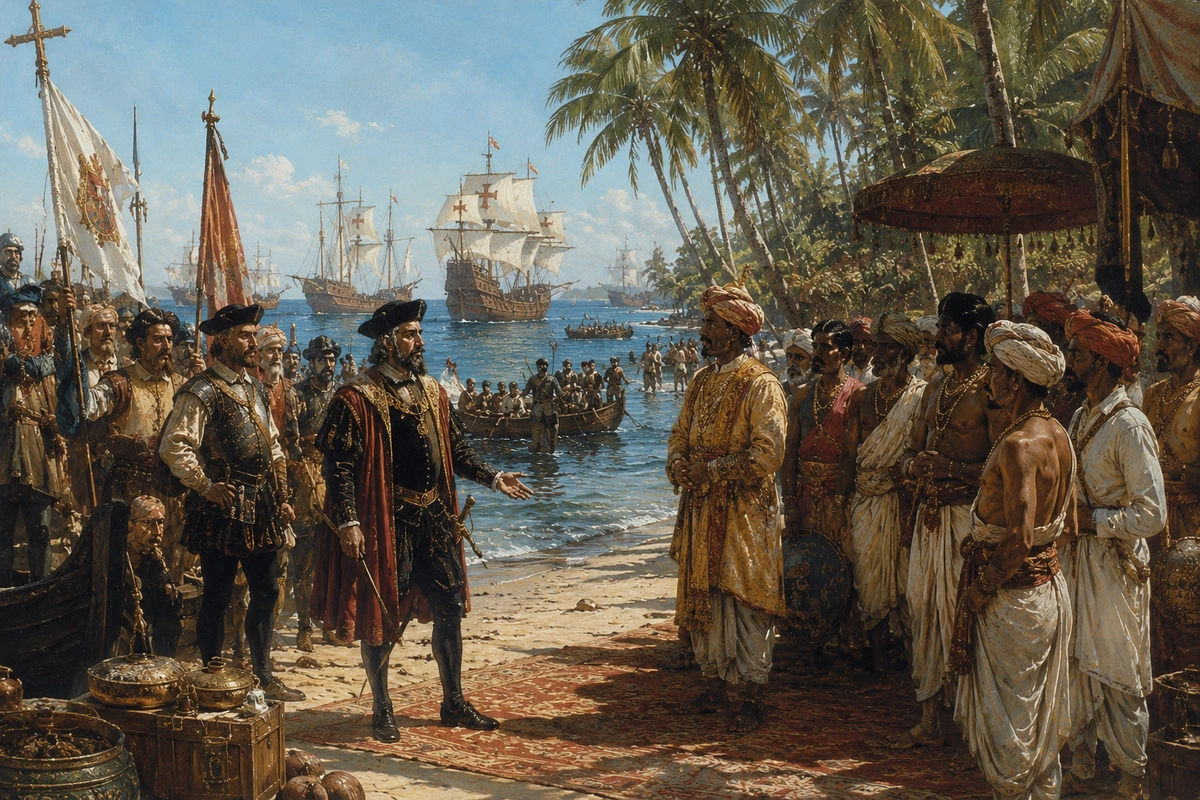
The arrival in Calicut changed the world's trade routes permanently — and made Portugal the dominant naval power in the Indian Ocean within a generation.
The voyage of Vasco da Gama was not just a Portuguese achievement. It was one of the hinge-points of world history. The Arab monopoly on the spice trade was broken. The Indian Ocean was no longer a Muslim lake. Portugal's century of empire in the East was beginning. And for South Africa — still unnamed, still barely touched — it meant that the Cape of Good Hope had just become the most important stretch of coastline in the world.