The Oghuz Turks form the ancestral group of the modern Turkish people of Turkey, the Azerbaijanis and the Turkmen. Almost all Turkic dynasties which ruled over different regions of the Middle East in the medieval and early modern periods belonged to this group, namely the Seljuks, the Ottomans, the Khwarazmians, the Qara Qoyunlu and Aq Qoyunlu, the Afsharids and the Qajars of Iran.
Despite their name, the Oghuz had largely dropped out of usage by the thirteenth century in favour of "Turkmen". This is in part a reflection of the change from Tengrist nomads on the steppes north of the Aral Sea to the Muslim warriors who subsequently played an important role in the Muslim world from Central Asia to Spain.
What the Name Oghuz Means
"Oghuz" is a Common Turkic word meaning "tribe". By the eighth century it appeared in the Orkhon inscriptions as a collective designation of the people of the Göktürk Khaganate, of which the Oghuz community formed a part which grew rapidly through incorporating other tribes.
A feature which has led to confusion among later historians is that various different confederations appear to have borne the name, often with a number in front - the Üch-Oghuz ("three Oghuz"), Altï Oghuz ("six"), Sekiz-Oghuz ("eight") and Tokuz-Oghuz ("nine") all originally lived around the Altai Mountains. The historian Peter Golden points out that the Transoxianan Oghuz who founded the Oghuz Yabgu State should not be confused with the Toquz Oghuz who produced the Uyghur Khaganate, although the distinction is not always drawn in the inscriptions.
The name "Oghuz" appears to have been largely replaced by the word "Turkmen" in Islamic sources by the tenth century, used to distinguish Muslim Oghuz from Turks who followed Tengrism or Buddhism. The Byzantines adopted the name by the twelfth century, calling the Oghuz Uzes; by the thirteenth century "Turkmen" or "Turcoman" had largely replaced "Oghuz".
The Oghuz Language
Linguistically, the Oghuz belong to the Common Turkic branch of the Turkic family, as opposed to the Oghuric branch - the two can be distinguished by regular substitutions of certain sounds, for instance Common Turkic /z/ for Oghuric /r/. Within Common Turkic, the Oghuz languages contain distinctive innovations, such as voicing certain sounds at the beginning of words.
The eleventh-century Karakhanid scholar Mahmud al-Kashgari, who compiled the great Diwan Lughat al-Turk, considered the Oghuz language to be the simplest for all Turkic tongues, and noted that prolonged separation had led to noticeable differences between the western Oghuz and Kipchak speech and that of the eastern Turks. The modern descendants of that language are Turkish, Azerbaijani and Turkmen.
The Oghuz shifted from the Old Turkic runic alphabet to the Arabic script in the eleventh century.
Origins of the Oghuz: From the Altai to Transoxiana
Proto-Turkic speakers are thought to have originated in Central-East Asia, perhaps in the Altai-Sayan region, Mongolia or Tuva. The early Turkic peoples showed a wide range of physical types and genetic admixture, with both East Asian and West Eurasian ancestry reflecting extensive contacts with the Iranian, Mongolic, Tocharian, Uralic and Yeniseian neighbours.
It is more challenging to determine the early history of the Oghuz in particular. The nineteenth-century scholar Bichurin linked the legendary founder Oghuz Khagan with the Xiongnu ruler Modu Shanyu, as their biographies show some similarities, although the Oghuz Khan legends were actually compiled much later by the Ilkhanid historian Rashid al-Din in the early fourteenth century. Golden has suggested that a people mentioned by the Chinese historian Sima Qian near the Irtysh River may have been early Oghuz, but this is uncertain. The Russian scholar Yury Zuev connected the Oghuz with a Western Turkic tribe mentioned in an eighth-century Chinese encyclopaedia, locating the Oghuz west of the Altai near Lake Issyk-Kul and in the Talas and Syr Darya basins.
By the 700s the Oghuz, having travelled west from the Altai through the Siberian steppes, had settled between the Caspian and Aral Seas and in northwest Transoxiana along the Syr Darya. They migrated from the Jetisu region after a conflict with the Karluk allies of the Uyghurs. In the ninth century the Oghuz drove the Pechenegs westwards from the Emba and Ural rivers, and by the tenth century they inhabited the steppe along the Sari-su, Turgai and Emba rivers north of Lake Balkhash.
The Arab historian Ibn al-Athir located the Oghuz mainly in Transoxiana by the time of the caliph al-Mahdi, after 775. By 780 the Karluks controlled the eastern Syr Darya with the Oghuz to their west and the region became known as the "Oghuz Steppe". References to the Oghuz begin to appear in Islamic writing during the reign of al-Ma'mun in the early ninth century.
Oghuz Society, Yurts and the Book of Dede Korkut
The Oghuz were largely herders, although not exclusively nomadic. The traveller Ahmad ibn Fadlan noted that they also engaged in cultivation and lived a semi-pastoral life.
Their military prowess was directly related to that way of life. A herding society has one great advantage over sedentary societies in terms of mobility. Society was held together by marriage alliances, kinship and "social distance" based upon family relationships. In Oghuz tradition, society was seen as the proliferation of individual families, expanding through marriage and alliance. Patrilineal groups had rights to particular territories, with marriages between neighbouring groups acting as binding mechanisms. Each community was part of a larger network of near and distance relatives, which is what tribal allegiance meant.
Wealth did not play a particularly prominent role; most Oghuz remained herders and those who settled took up farming. Status was based upon age, gender, blood relationships and marriageability. Men dominated leadership, but women were active in society, and the Book of Dede Korkut - the great Oghuz epic - depicts them as expert riders, archers and athletes. Elders were respected as stores of both practical and spiritual wisdom. Ceremonies for birth, coming of age, marriage and death were times when dispersed kin gathered together and provided outlets for tensions.
They lived in tents on wooden frames covered with felt, skins or woven textiles known as yurts. They ate stews and kebabs, a "wedding soup", kumis made from fermented mare's milk, grape molasses, halva, noodle soup, flatbread, layered pastry, cheese, yoghurt and ayran.
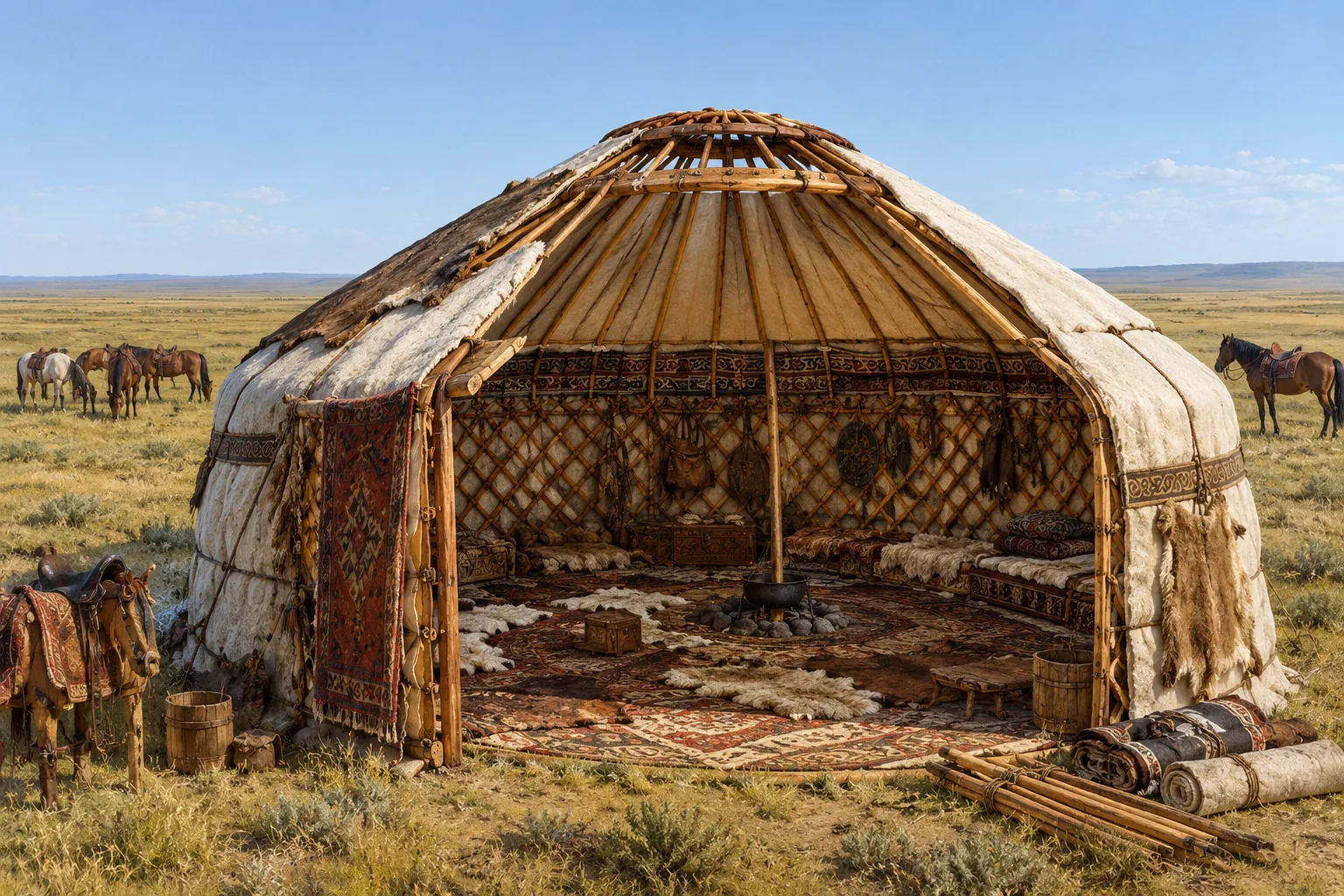
The yurt, a wooden-framed tent covered in felt, skins or woven textiles, was the home of the herding Oghuz.
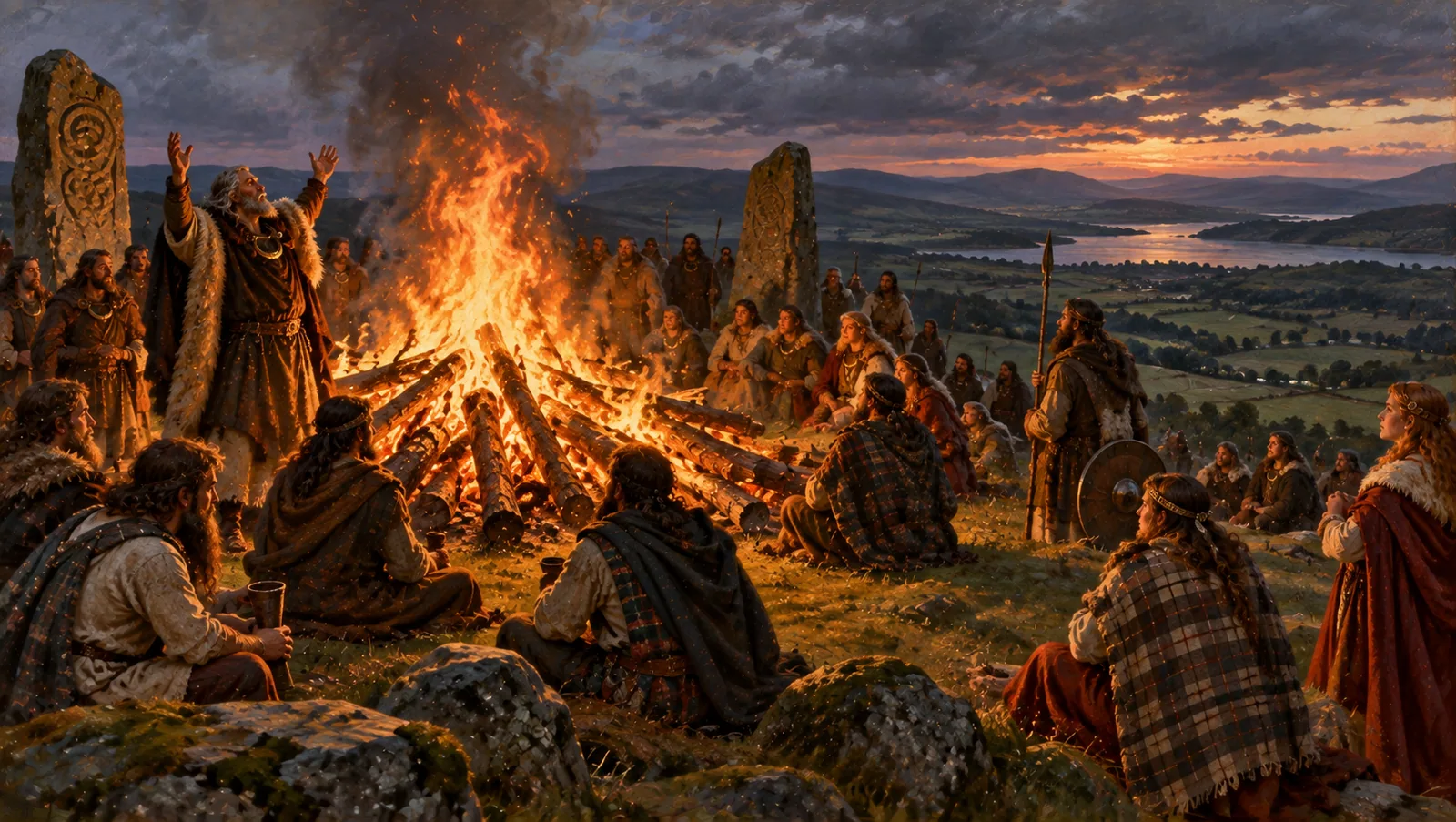
They originally practiced Tengrism, erecting carved wooden funerary statues surrounded by simple stone monoliths called balbals, and held elaborate hunting and banqueting rituals.
The Book of Dede Korkut, a collection of epics which contain echoes of the ninth and tenth centuries although written down later, is the richest source of information about the Oghuz language, customs and values. UNESCO designated it as a literary work of the year in 2000. Along with the Oghuzname, Battalname, Danishmendname and the Köroğlu epics it is part of a common literary heritage for Turks, Azerbaijanis and Turkmen.
Physical Appearance and the Word Turkmen
Medieval sources describe how the Oghuz changed in appearance over generations, and had a theory as to why they did so.
The historian al-Masudi described the people of Yangikent as distinguished from other Turks by their courage, slanted eyes and small stature; stone heads of Seljuk elites in New York's Metropolitan Museum show East Asian features. Subsequent writers noticed a change: Rashid al-Din claimed their features gradually resembled those of the Tajiks - from which the word "Turkmen" is derived, the Tajiks calling them turk-mānand ("Turk-like"). This is a folk etymology rather than a formal one, but it is a reflection of an observed change: the seventeenth-century Khivan ruler Abu al-Ghazi Bahadur wrote that within five or six generations their chins had narrowed, their eyes and noses grown larger and their faces smaller.
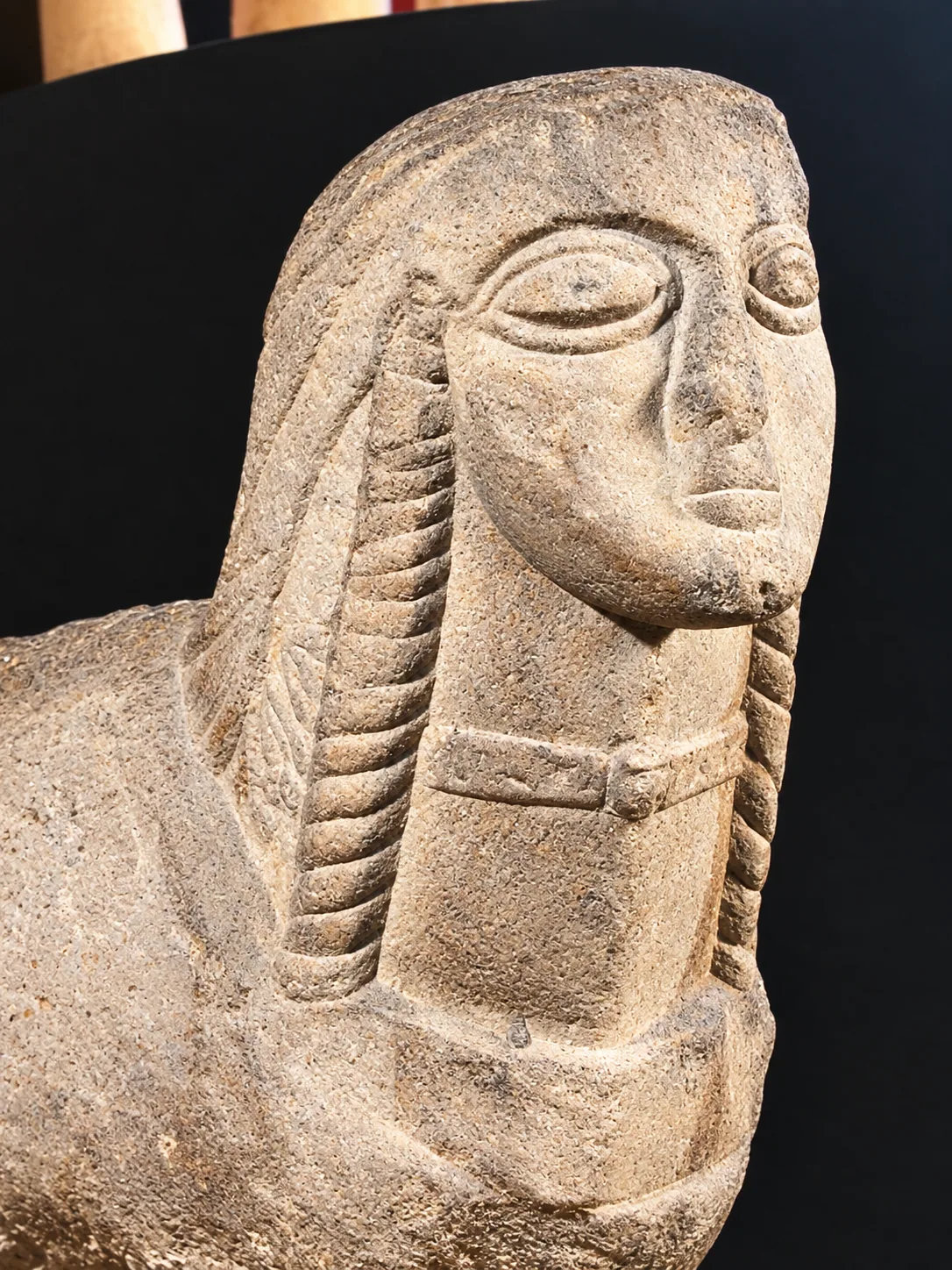
Stone heads of Seljuk elites kept in New York's Metropolitan Museum of Art show the East Asian features described by medieval writers.
The cause of this change was intermarriage with the settled peoples of Transoxiana, Iran and Anatolia. The Ottoman historian Mustafa Âlî wrote that most people in Anatolia were of mixed origin, and few notables had a lineage which did not have a convert to Islam.
Conversion to Islam and the Oghuz as Empire-Builders
The decisive change occurred on the Oghuz Steppe. From their lands stretching from the Karachuk Mountains towards the Caspian, which included five towns named by al-Kashgari, the Oghuz traded and made religious and cultural contacts with the Abbasid Caliphate to the south. Approximately this time they began to convert to Islam and to abandon Tengrism, and were described by Arab historians as being ruled by numerous kings and chieftains.
Conversion brought the Oghuz into the Islamic world, and they adapted their traditions and institutions to fit in. Oghuz warriors can be found in almost every Islamic army in the Middle East from the eleventh century onwards, as far west as Spain and Morocco.
In the eleventh century the Seljuk clan of the Oghuz entered Persia and established the Great Seljuk Empire. Not all Oghuz groups followed the same path: a Tengrist group known in the west as the Uzes or Torks overthrew Pecheneg dominance on the frontier of the Russian steppes; the Oghuz who settled on the frontier were gradually Slavicised, forming the Black Hat principality with its own military aristocracy. Others, driven before the Kipchak Turks, crossed the lower Danube into the Balkans, where a plague halted their advance and they became mercenaries for the Byzantine army in 1065.
The Ottomans and the Oghuz Legacy
Following the fall of the Seljuks, the Ottoman dynasty gradually conquered Anatolia in the late thirteenth century with an army chiefly composed of Oghuz, defeating various other Oghuz Turkish states in the process. Ottoman legend traced its founder Osman's lineage back to Oghuz Khagan himself, the legendary ancestor of the Turks, giving the Ottoman sultans a claim to primacy among Turkish rulers.
Many other dynasties claimed descent from particular Oghuz tribes: the Khwarazmians, Qara Qoyunlu, Aq Qoyunlu, Ottomans and Afsharids are believed to descend from the Begdili, Yiva, Bayandur, Kayi and Afshar tribes respectively.
| Dynasty | Believed Oghuz tribe |
|---|---|
| Khwarazmians | Begdili |
| Qara Qoyunlu | Yiva |
| Aq Qoyunlu | Bayandur |
| Ottomans | Kayi |
| Afsharids | Afshar |
The Oghuz way of life did not cease with empire-building. The Yörüks, a Turkish subgroup of Oghuz origin, include semi-nomadic communities herding sheep and goats in the Taurus Mountains of southern Anatolia and in parts of the Balkans, including the Pindus in Greece, the Šar Mountains in North Macedonia and the Pirin and Rhodope ranges in Bulgaria. The term itself was a political invention, devised by Ottoman governors to distinguish their own loyal Sunni Turkmen from the Shiite Kızılbaş Turkmen of eastern Anatolia and Azerbaijan who were loyal to the Persian shah. Ethnically and linguistically the two groups were the same people, differing in only minor ways.
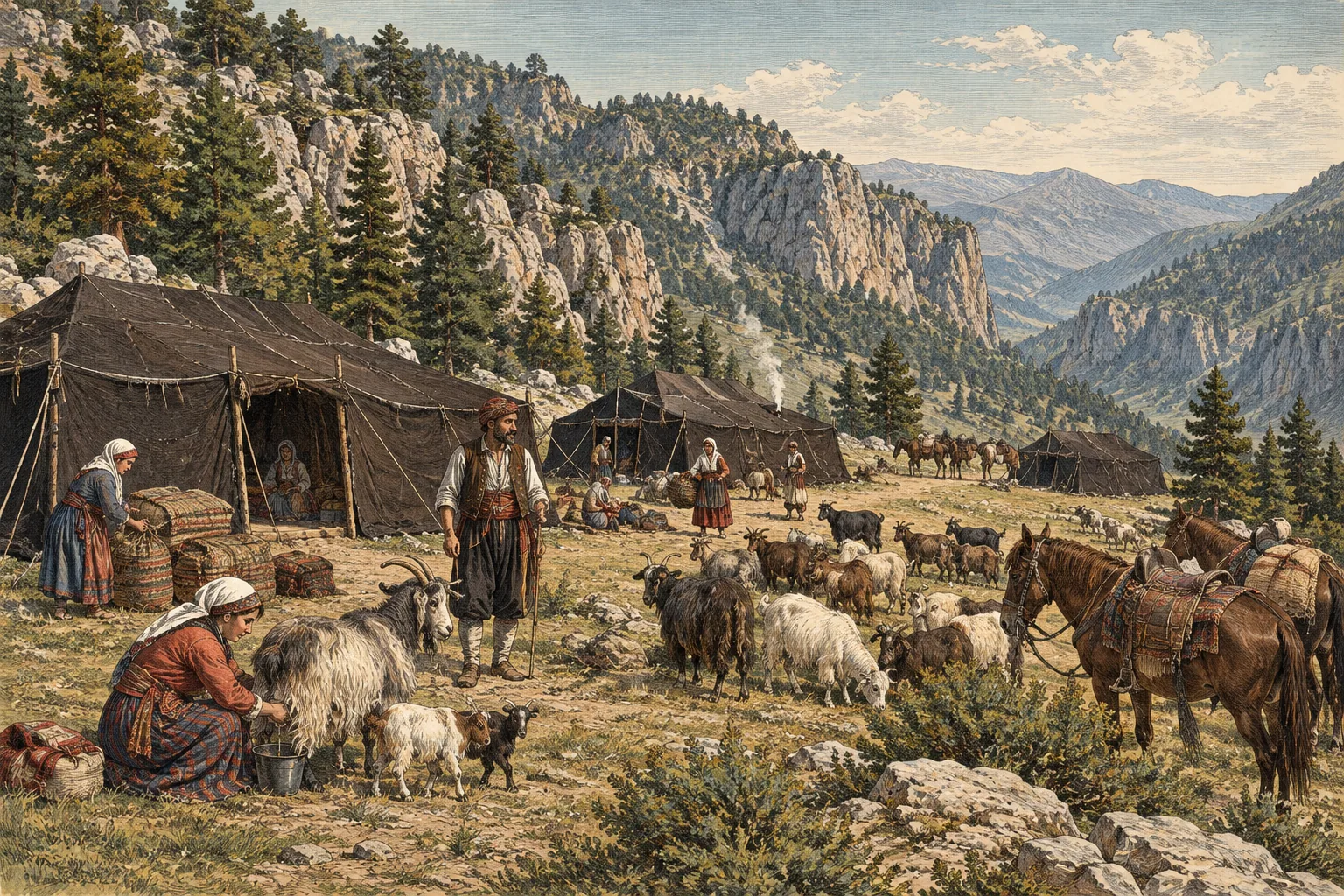
Yörük communities still follow seasonal pastures with their sheep and goats in the Taurus Mountains of southern Anatolia.
Yörüks settled in Macedonia and Thrace as early as the fourteenth century, and settled communities remained near Kozani in Greece until 1923. It is an appropriate afterlife for a people defined by movement: centuries after their descendants built empires, some of them continue to follow the herds across the mountains.