For almost two and a half centuries, the Mongol state known as the Golden Horde controlled Russia and the Eurasian steppe, deciding who ruled Moscow and collecting tribute from princes who dared not refuse. Here's how it rose, thrived, and eventually came apart.
Ask most people to name a great empire from history, and you'll hear Rome, maybe Egypt, maybe the Ottomans. Almost nobody says the Golden Horde. And yet for close to two and a half centuries, this was the power that decided who sat on the throne in Moscow. Russian princes traveled hundreds of miles across open steppe to beg for permission to rule their own cities. Tribute wagons rolled south every year, loaded with silver, furs, and grain. A prince who refused could lose his throne. Some lost their lives. The Golden Horde grew out of the Mongol Empire, the same fighting force that had swept across Asia under Genghis Khan. But the branch that settled along the Volga River became something different from the Mongolia most people picture. It built cities instead of just camps. It ran a postal system, collected taxes through local governors, and eventually became so wealthy that a Moroccan traveler who visited its capital in the 1330s described wide streets, thirteen mosques, and markets that felt endless. Its rulers converted to Islam, married into the Byzantine royal family, and struck deals with the Pope and the Sultan of Egypt in the same decade. It also fell apart, slowly and then all at once, torn by family feuds, a plague that emptied whole regions, and a final crushing blow from one of history's most terrifying conquerors. Here's how it happened.
One of Genghis Khan's Sons Got the Far Edge of the Map
Before Genghis Khan died in 1227, he split his empire among his four sons, following Mongol custom. Under that custom, the oldest son received the land farthest from home. That son was Jochi, and the territory he was handed stretched out toward the western edge of everything the Mongols had conquered so far — a distant, half-mapped stretch of steppe around the Irtysh River. Jochi never got the chance to expand it. He died in 1225, two years before his father, leaving the job to his own son, Batu. Genghis Khan's grandson Batu turned out to be exactly the right person for an assignment nobody else particularly wanted. Where the land was thin and undefined, Batu saw opportunity. In 1235, at a gathering of Mongol leaders, it was decided that Batu would lead the push west. Along with the legendary general Subutai, he set out the following year to bring the Kipchak steppe and everything beyond it under Mongol control.
Batu Khan inherited the farthest reaches of his grandfather's empire and turned them into a new center of power.
Batu Khan's Armies Reach Russia and Europe
The campaign moved fast. Batu's forces overran the Bashkir lands, then Volga Bulgaria in 1236. From there they turned toward the Russian principalities, and the city of Ryazan fell in December 1237 after refusing to surrender. City after city followed. Novgorod was spared only because the surrounding land had turned to mud and the Mongols couldn't get their horses through it. Kiev, one of the great cities of medieval Russia, was destroyed in the winter of 1240 to 1241. From Russia, Batu and Subutai pushed into Europe. In the spring of 1241, Mongol forces crushed a combined army of Poles, Germans, and Hungarian knights at the twin battles of Legnica and Mohi. For a moment, it looked like nothing between the steppe and the Atlantic coast could stop them. Mongol riders reached as far as the outskirts of Vienna. Then, in December 1241, word arrived that the Great Khan Ögedei had died back in Mongolia. Under Mongol law, that meant every senior prince needed to return home to help choose his successor. Subutai gave the order to withdraw. Europe never learned how close it had come. Batu, for his part, didn't go home at all.
A New Capital on the Volga
Batu had little interest in the political games playing out in the Mongol capital of Karakorum. He stayed on the steppe, choosing a location on the lower Volga River as his new base. It was a smart pick. The site sat at a crossroads of land and river trade routes, far enough from Lithuanian raiders to the west and rebellious mountain clans to the south that it was reasonably safe to build something permanent. That settlement became Sarai, and it would grow into one of the great cities of the medieval world. Batu died in 1256. His brother Berke took over a couple of years later and made a decision that would shape the Horde for generations: he converted to Islam. Berke also broke with the rest of the Mongol Empire over a matter of family honor, going to war against a cousin, Hulagu, who ruled the Mongol territories in Persia. It was the first time two branches of Genghis Khan's family had fought each other directly, and it wouldn't be the last.
How the Mongols Actually Governed Russia
Here's something that surprises a lot of people: the Mongols rarely bothered to run Russian cities directly. Most Russian princes kept their titles and their local power. What changed was who they answered to. Every prince who wanted to rule needed a yarliq, a patent of authority issued by the khan in Sarai. Getting one meant a long trip east, gifts, and a show of loyalty. Local Mongol officials called basqaqs were posted around the principalities to collect tribute and keep an eye on things, though by the early 1300s, the Russian princes themselves had mostly taken over tax collection on the khan's behalf. That system ended up reshaping Russian politics in a way nobody could have predicted. Princes who cooperated with the Horde and proved useful as tax collectors — especially the princes of a small, unremarkable town called Moscow — gained wealth, favor, and eventually enough strength to outgrow their rivals. Mongol rule, in a strange way, helped build the very state that would one day throw the Mongols out.
The Golden Age Under Öz Beg Khan
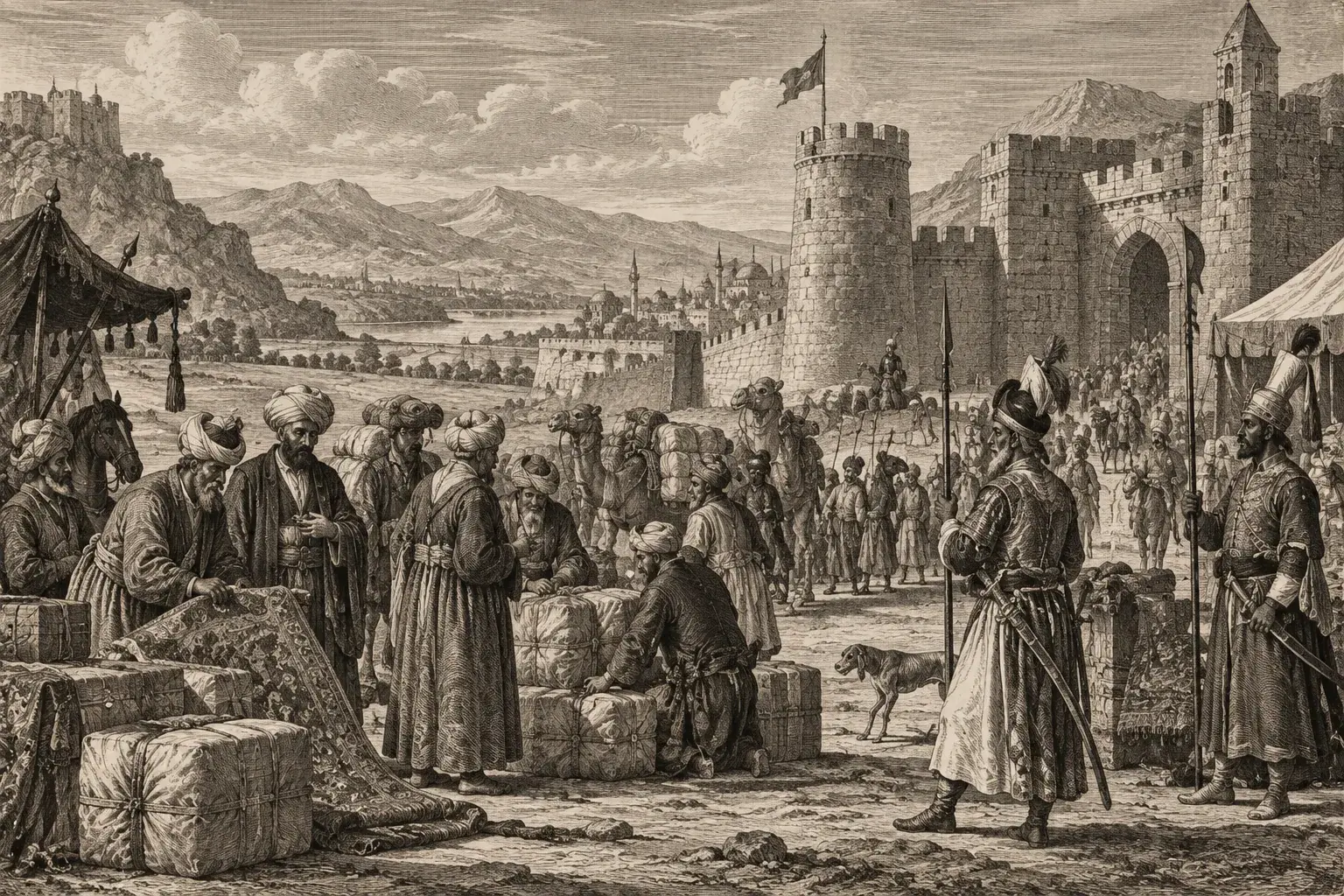
The Golden Horde reached its peak under Öz Beg Khan, who ruled from 1313 to 1341. Öz Beg made Islam the official state religion and pushed hard to spread it through the khanate, but he also kept the empire remarkably open for business. Merchants moved freely. Trade boomed. When the famous traveler Ibn Battuta visited Sarai in 1333, he described a beautiful, sprawling city filled with people from six different nations, each with its own quarter — Mongols, Russians, Greeks, Circassians, Kipchaks, and Alans, all living side by side. Genoese and Venetian merchants ran trading posts along the Black Sea coast with the khan's blessing. Silk, slaves, furs, and grain moved through Sarai on their way to Egypt, Byzantium, and beyond. Öz Beg also played careful politics with his neighbors. He kept up friendly relations with the Mamluk Sultanate in Egypt, sent regular tribute exchanges with the Mongol court in China, and married his sister off to strengthen ties with Moscow's ruling family. His army, by some estimates, topped 300,000 warriors — a force large enough that few of his neighbors dared test it directly.
Under Öz Beg Khan, Sarai grew into one of the largest and busiest cities in the medieval world.
Plague, Murder, and the Great Troubles
The good years didn't last. In the 1340s, the Black Death swept through the Horde's territory, likely spreading first from Central Asia and then tearing through Sarai and other major cities. Nobody knows exactly how many people died, but entire regions lost enough population that trade routes collapsed and never fully recovered. Some historians think this outbreak, carried west along Mongol trade networks, was part of what eventually brought the plague to Europe through the besieged Genoese port of Caffa. Then came the succession crisis. When Khan Jani Beg was murdered by his own son in 1357, the Horde entered a period Russian chroniclers later called the Great Troubles. More than twenty different khans claimed the throne over the next two decades, several of them ruling for only months before being assassinated or overthrown. The empire that had once projected total control over Russia was, for a while, barely able to control itself.
One Last Comeback — and Timur
Out of that chaos rose Tokhtamysh, who briefly pulled the fractured khanate back together in the 1380s. He didn't waste time reasserting authority. In 1382 he marched on Moscow, tricked the city into opening its gates under a false truce, and sacked it. For a moment, it looked as though the old order had returned. But Tokhtamysh made a fatal mistake: he went to war with his former ally, the Central Asian conqueror Timur, better known in the West as Tamerlane. Timur crushed him twice, and the second time, in 1395, he didn't hold back. His army destroyed Sarai, wrecked the Horde's trading cities in Crimea, and marched the region's most skilled craftsmen off to Timur's own capital at Samarkand. The Golden Horde never recovered its former strength. It had been dealt a wound it couldn't heal.
Standing on the Ugra — the End of the Tatar Yoke
Through the early 1400s, the Golden Horde kept splintering. New, smaller khanates broke off one after another — Sibir, Kazan, Crimea, Astrakhan, and eventually the Kazakh Khanate — each carving out its own territory from what used to be a single, unified power. What remained of the original Horde around the Volga became known simply as the Great Horde. Meanwhile, Moscow kept getting stronger. In 1480, Khan Ahmed of the Great Horde marched an army to the Ugra River to force Grand Prince Ivan III back into line after Moscow stopped paying tribute. The two armies faced off across the river for weeks. Neither side attacked. Eventually, as winter closed in and Ahmed got word that his own capital was under threat from a rival, he turned around and marched home. No great battle was fought. No dramatic victory speech was given. But that quiet standoff, remembered in Russian history as the Great Stand on the Ugra River, marked the end of Mongol authority over Russia for good. The Great Horde itself didn't last much longer — it was finished off in 1502 by the Crimean Khanate, one of its own former territories.
The standoff at the Ugra River in 1480 ended without a battle, but it marked the end of Mongol rule over Russia.
What the Golden Horde Left Behind
Two hundred and forty years of Mongol rule didn't just disappear once the tribute stopped. It left fingerprints all over the country that grew out of it. Words for treasury, customs house, and money in modern Russian all trace back to Mongol or Turkic roots. The tax and postal systems the Muscovite state eventually built borrowed heavily from Mongol models. Even the shift of Russia's political and religious center from Kiev to Moscow — a change that still shapes the region's history today — happened largely because Moscow's princes made themselves useful to the khans in Sarai. Historians still argue about how to weigh all of this. Some see the Mongol period as a story of pure exploitation, a couple of centuries when Russia was cut off from the rest of Europe and held back economically. Others, including the historian Charles Halperin, argue for a more complicated picture — one where Mongol rule reshaped Russian institutions in ways that outlasted the Horde itself, for better and worse. What's clear either way is that you can't really explain how Moscow became the center of a future empire without explaining the empire that ruled over it first.
The Golden Horde doesn't get remembered the way Rome or the Mongol homeland does. It left no epic poems in the Western canon, no ruins tourists line up to photograph. But for almost two and a half centuries, it was one of the most powerful states on Earth — a place where Mongol horsemen, Turkic herders, Russian princes, Genoese traders, and Muslim scholars all built something together, on the banks of a river most people today couldn't point to on a map.