In the early seventeenth century, Dom Stephen d'Ataide held the tiny coral island of Mozambique against two major Dutch assaults with little more than a hundred and fifty men and a set of guns that weren't even properly mounted. His story is one of the most remarkable defensive stands in colonial history — ending in the painful irony that the very king he served so brilliantly sent a judge to try him for treason.
Dom Stephen d'Ataide had a problem that would have broken most men. He commanded the Portuguese fort of San Sebastian on the coral island of Mozambique with a garrison of a hundred and fifty men — many of them sick, most of them barely trained. His cannons weren't mounted on proper carriages. Some pointed uselessly at the sky. Some pointed into the sea. A few of the gun emplacements had no guns at all. And coming over the horizon, bearing down on the little island with its palms and orange groves and white square houses, was a Dutch fleet of eight ships and a thousand soldiers.
A Changed World — Portugal vs the Dutch
By the early seventeenth century, Portugal's time at the top was over. The country had sunk into a province of Spain, under King Philip the Third of Castile. And Spain itself had lost the sea. Seventeen years had passed since English sailors shattered the great Armada. Now the Dutch sea-beggars and the men of Devon were everywhere, and when they met a Spaniard they fought him. The Dutch were sailing into the Indian Ocean in their light, fast little galliots, running rings around the slow Spanish sea-castles. They had driven the Portuguese out of the Spice Islands, they were fighting them at Goa and Ceylon and Diu. Whenever Dutch and English met in the East Indies, they fought the Portuguese — and won. Dom Stephen was a subject of Spain. He wore a corselet of steel made by the skilled armourers of Milan, all inlaid with traceries of gold. He wore a white ruff of point lace and a Spanish helmet embossed with figures of Hercules and Neptune. Under it his black eyes shone like a hawk's. He was a fighting man born, and he was completely alone in the middle of the Indian Ocean with a ruinous fort and a hundred and fifty miserable soldiers.
The First Siege — Van Caerden
The Dutch commander van Caerden had a thousand men and had learned siege warfare from Prince Maurice of Orange, one of the great military minds of the age. He landed at the convent opposite the fort, turned it into a forward base, and began working toward the walls with professional efficiency. He threw up batteries, filled earth-bags, disguised his guns in khaki-coloured calico so the Portuguese couldn't tell them from the dirt. He cut trenches and zigzags. He burrowed closer and closer to the walls like a mole. Finally his sailors rigged up a wooden platform, floor above floor, all faced with bags of earth, until it was level with the fort's ramparts. Now they could fire directly into the fort from musket range. D'Ataide wasn't finished. He immediately ordered his men to push long poles out from the parapets and lay planks across them, making scaffolds that jutted out on either side of the platform. They crept along these hanging between sky and sea and fired into the Dutch from both sides. Strange, is it not, to think of men in helmets and breastplates fighting on planks suspended between a coral island and the African sky, like cats on a roof. The Dutch told d'Ataide that no help was coming — Spain's fleet was blockaded in Lisbon harbour, the Viceroy in the Indies was fighting for his life in the Spice Islands. D'Ataide only laughed. When van Caerden demanded surrender and threatened to destroy everything on the island, d'Ataide wrote back: "I have no other orders from my king, nor any other wish, than to carry on the war with all my might." So van Caerden burned every tree and every house on the island and sailed away. As he went over the bar, d'Ataide tilted his gun and blew holes in one of the departing ships, leaving her blazing on the water.
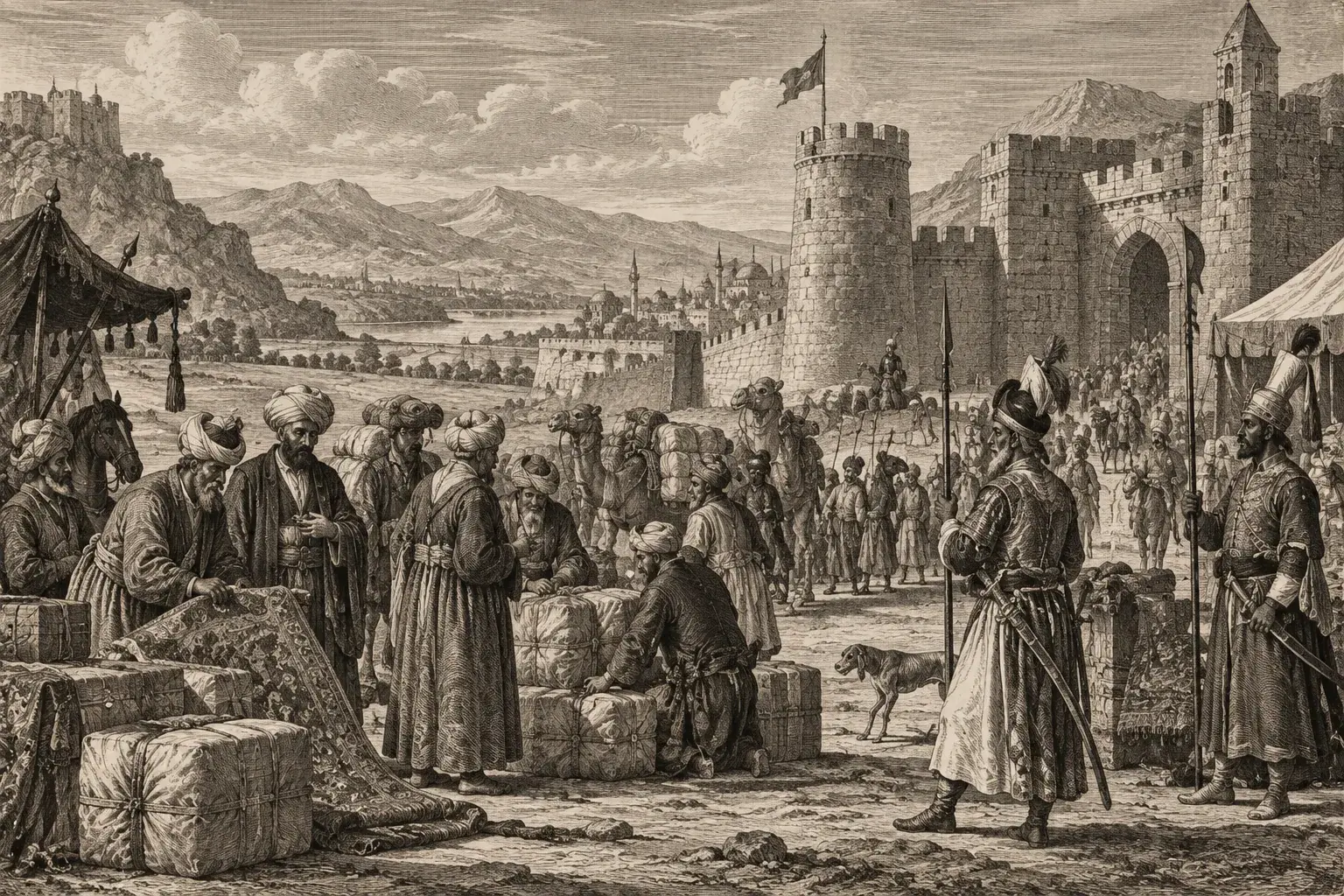
The tiny coral island of Mozambique — Fort San Sebastian on one end, the convent on the other — was the stage for one of the most extraordinary defensive stands in African colonial history.
The Second Siege — Verhoeff and the Prisoners
Only a year later came Pieter Willemzoon Verhoeff, a man who made van Caerden look gentle. He had thirteen ships and nearly two thousand men. He had waded in blood up to his scuppers and killed more Spaniards than anyone could count. He attacked Mozambique with everything he had — battering the walls, blowing a breach through them, and still d'Ataide built the breach back up as fast as it was thrown down. Verhoeff was furious. Then he got his chance. A great Spanish galleon sailed innocently into Mozambique harbour, not knowing the Dutch were there. The Dutch galliots surrounded it like dogs around a deer and raked it fore and aft until it struck its flag. One hundred and sixty Portuguese prisoners. Now Verhoeff sent word to d'Ataide: give back my four Dutch deserters who had joined the garrison, or I'll shoot every Portuguese on that ship. D'Ataide faced the worst dilemma of his life. One hundred and sixty of his own countrymen — against four Dutch deserters to whom he had given the king's word of protection. He walked his ramparts all night. He read the prisoners' desperate letter — "Tell him of our wives... remind the captain how I fought by his side in the Low Countries... tell him there is one here of his own blood." And in the end he gave the same answer he had given about everything else: No. He had given his word — the king's word. That was truth enough for him. All night he waited for the rattle of the firing squad. But no sound came. In the darkness, the Dutch ships silently hoisted sail and crept out over the bar. As they passed the island of St. George, Verhoeff landed all one hundred and sixty Portuguese prisoners safely on the beach — the gift of one brave man to another. And there the story should end. But it didn't. The king, greedy and suspicious, sent a judge to try d'Ataide for mismanaging the campaign. The captain's brave heart broke at the indignity, and he died on his island. His bones still lie there, under the coral sand, beneath the green waving palms of Mozambique.
D'Ataide drove a flock of sheep through his gateway to show Verhoeff how little he thought of the threat of starvation. The Dutch commander stormed and fumed — and d'Ataide just smiled from his ramparts.