For nearly two centuries, Slachter's Nek has been cited as proof of British tyranny over the Boers — a righteous uprising, five martyrs hanged on a mountain pass in 1815. The original court records tell a different story: a border farmer who refused to appear in court over a servant's complaint, a conspiracy to invite Xhosa warriors to murder fellow colonists, and an execution carried out largely by Dutch officials. The true story of South Africa's most contested historical episode.
The name Slachter's Nek has been used for nearly two hundred years as a symbol of English tyranny over the Boers. Writers have pointed to the gallows on that wild mountain pass, where five men were hanged in the year of Waterloo, and said: there is the proof that the British oppressed the Dutch settlers. The problem is that the evidence doesn't support this story. The evidence suggests something quite different.
The Border World Before the Rebellion
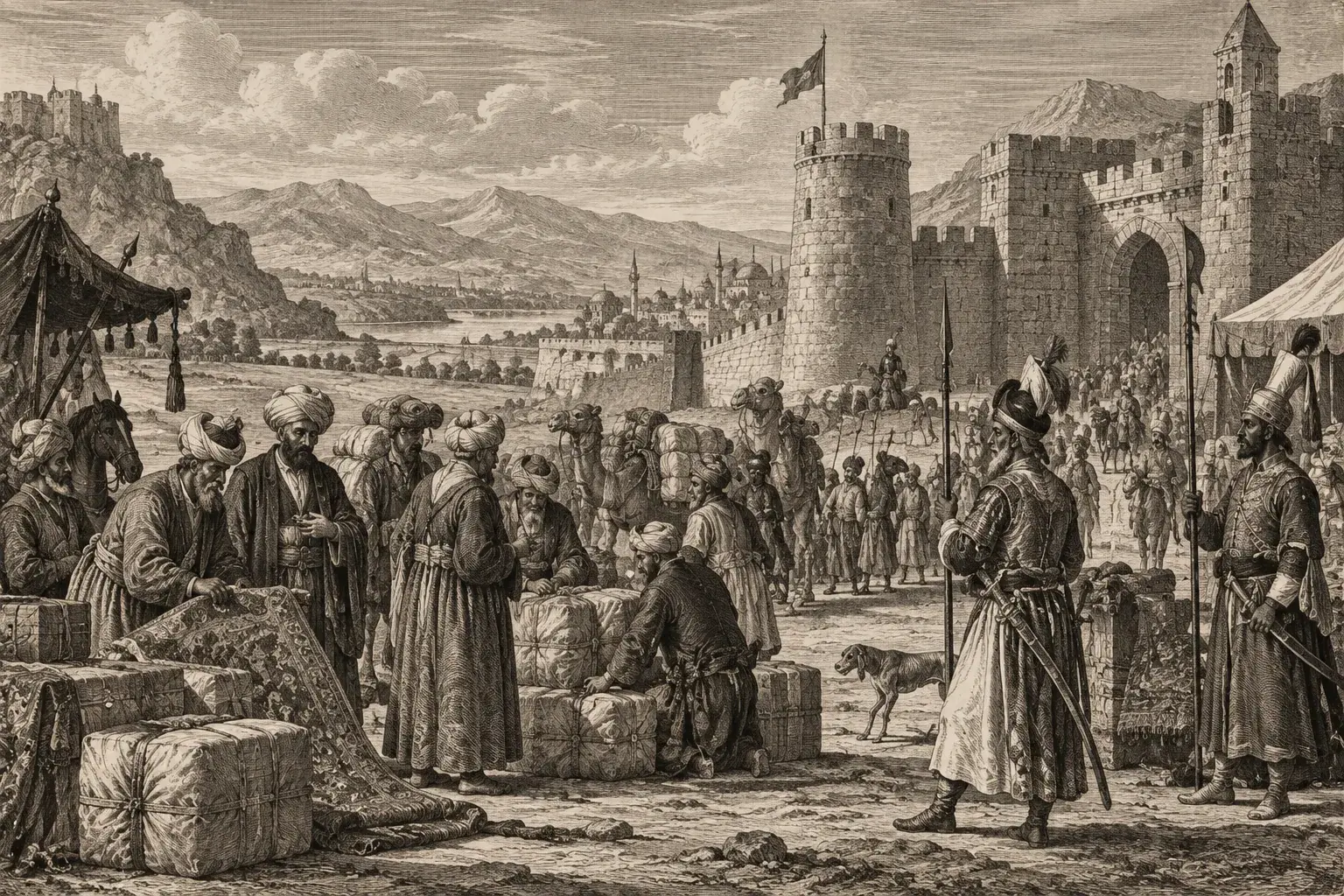
The eastern frontier of Cape Colony in the early nineteenth century was a rough and violent place. Frontier Boers had been raiding Khoikhoi and Xhosa herds for generations before the British arrived. Expeditions of forty or fifty armed burghers would go deep into the interior, murder the herders, and come back with cattle to sell. The British tried to stop this. They put good magistrates in place, backed by the law. If Boers were caught killing or enslaving their servants — or making illegal raids — they were prosecuted. The frontier Boers hated this. Under Dutch Company rule, they had done as they pleased. They were not used to any interference, and they looked on the magistrates with fury. The trouble at Slachter's Nek began with a farmer named Frederick Bezuidenhout. He was a dangerous and turbulent character who kept a Khoikhoi servant against his will — or so the servant alleged. The servant complained to the magistrate. Bezuidenhout was summoned to appear. He refused. Summoned again. Refused again. The magistrate ordered him arrested.
A Farmer Who Died Rather Than Surrender
The deputy Landdrost sent Lieutenant Rousseau with a Dutchman, a Scotsman, a sergeant, and fourteen men. When they arrived, Bezuidenhout was waiting behind some rocks with two others and a pile of loaded guns. He told them to get out or he'd shoot. Rousseau ordered his men to fix bayonets and advance. Don't fire, he said. The soldiers rushed forward. Bezuidenhout and his men fired ten or twelve shots. The soldiers reached the rocks and found the defenders had retreated to a cave above the river — accessible through only one hole in the rock face. From there, a cat-and-mouse siege began. The two officers climbed to the top of the cliff, called down repeatedly, promised Bezuidenhout he could come to court in his own wagon and wouldn't be harmed. He refused with creative profanity. Finally the soldiers rushed the cave. The sergeant — a brave man named Joseph — went first, hauling himself up to the entrance. The soldiers below saw a rifle barrel poke out. They shouted a warning. The sergeant fired a split second faster, and the bullet went through Bezuidenhout's arm and chest and out his back. Bezuidenhout died. His brother and friends held a grand funeral, at which Johannes Bezuidenhout made a speech and swore revenge. And then came the conspiracy.
The wild mountain pass of Slachter's Nek — literally 'Butcher's Neck' — gave its name to the most controversial episode of the early British period in South Africa.
The Plot — What It Actually Was
The conspiracy that followed Bezuidenhout's funeral was not a principled stand against oppression. It was a plan to murder people. The ringleaders sent messengers to Gaika, the great Xhosa chief, asking him to help. Their plan was to attack all the military posts in a single night. Lieutenant Rousseau was to be murdered. The deputy Landdrost van der Graaff was to be murdered. The troops were to be driven from the country. The Xhosa were to be allowed to take the cattle of the killed soldiers and any burghers who remained loyal to the Government. The Xhosa were to be given back the Zuurveld — the disputed borderland. The rebels were to be given a piece of Xhosa territory in exchange. In other words, the rebels planned to unleash thousands of Xhosa warriors on a peaceful colony to murder their fellow colonists and officials, in exchange for help getting rid of British rule. This was not English tyranny being resisted. It was one of the most dangerous conspiracies white settlers had ever hatched against their own neighbours. Fortunately, the authorities were wide awake. A Dutchman named van der Graaff intercepted a rebel letter and passed it to the right people. The ringleader Prinsloo was arrested before the plans were ripe. When the rebels came in arms to demand his release, they found soldiers waiting for them.
The Bloodless Battle and the Gallows
Colonel Cuyler — a brave and loyal Dutchman who had always been a good friend to the Boers — advanced on the rebel position without showing any hesitation. The rebels knelt and pointed their guns at the approaching soldiers, shouting to the burghers to move aside so they could fire at the dragoons. Then came the news that finished them. Their envoys to Gaika returned with the chief's polite message: if they wanted to fight, they could do so themselves. He wasn't coming. The panic was instant. Old Willem Kruger — who had been made commander with a pistol at his head and had been weeping copiously for days — cried out "Let me go down, in God's name, and receive my punishment." Nearly twenty others agreed. The rest fled. The second and final holdout was Johannes Bezuidenhout, who retreated to a kloof in the Winterbergs with his wife keeping him supplied with loaded muskets. Several commanders called on him to surrender. He and his wife fired back. He was eventually shot through the body. The prisoners, thirty-nine in number, got a fair trial. The judge who sentenced them was Dutch. The magistrate who prosecuted was Dutch. The commander who arrested them was Dutch. Six were condemned to death; one was pardoned by Lord Charles Somerset. Five were hanged. At the hanging, the rope broke on several men, repeatedly, in a technical failure that was horrible to see and was long used as evidence of British brutality. It was horrifying, but it was not deliberate. The execution was carried out by Dutch officials under British oversight. The whole business was, as South African historian Leibbrandt documented from the original records, a rebellion of border ruffians plotting mass murder — not a patriotic uprising. That this truth has been mostly suppressed for the sake of a better story says something about how history gets written.
The real story of Slachter's Nek is not a simple tale of oppressed patriots — it is the complicated story of a frontier society where law was new, trust was rare, and violence was always just below the surface.