Athens in 600 BCE was heading for a bloodbath. Not a war — a class war. A large part of the free population had fallen into debt to a small number of aristocratic landowners, and in Attica the security you gave for a loan was your own body. Default and you were sold. Some were sold abroad. Some were working land they had once owned as tenants handing over a fixed share, marked out by stone pillars driven into the fields recording what they owed. The city was one bad harvest from a revolution, and both sides knew it. So the Athenians did something almost unheard of. Instead of fighting, they gave one man authority to redesign the state, and agreed in advance to accept whatever he came up with.
Draco First
Before Solon there had been Draco, around 621 BCE, who produced Athens' first written law code. Writing the laws down was a genuine advance. Until then the law was whatever the aristocratic magistrates said it was, remembered orally and applied by the people it benefited. Putting it on public display meant anyone could check. The problem was the content. Draco prescribed death for an enormous range of offences, including petty theft. Plutarch records the joke that his laws were written in blood rather than ink, and quotes a defence attributed to Draco himself: that small crimes deserved death and he had nothing worse available for the large ones. Draconian has meant exactly this ever since. Solon repealed all of it except the homicide law, which was good enough to keep — it distinguished intentional from unintentional killing, which was a real piece of legal thinking.
The Crisis
By 594 BCE the situation had these components. Debt bondage: loans secured on the person, with default meaning enslavement, sometimes export. The hektemoroi, the "sixth-parters" — tenant farmers handing over a sixth of their produce, though whether it was a sixth paid or five-sixths paid is argued about. Either way they were locked in. The horoi — stone markers set in fields recording the encumbrance; Solon's own poetry describes pulling them out, and it's the most vivid image we have of what he did. And a closed ruling class, with office restricted by birth to the eupatridae, the well-fathered. Solon was chosen because both sides could accept him — an aristocrat by birth, a merchant by trade, and, crucially, not rich. He had also made a reputation writing poetry urging the Athenians to take Salamis back from Megara, which gave him standing as a patriot rather than a partisan. He was made archon with extraordinary powers to reform. Then he refused to do what either side wanted.
The Shaking Off of Burdens
The headline measure was the seisachtheia — the shaking-off of burdens. All existing debts were cancelled. Everyone enslaved for debt was freed, including those sold abroad, whom the state bought back at public expense. Debt bondage was abolished permanently — no Athenian could ever again pledge his own body as security. And the horoi were pulled out of the fields. That last provision is the one that matters most and it's the one usually skipped. Cancelling debts is a one-off; abolishing the mechanism means the crisis cannot recur in the same form. Athens never again had a population of citizens who could be sold by other citizens.
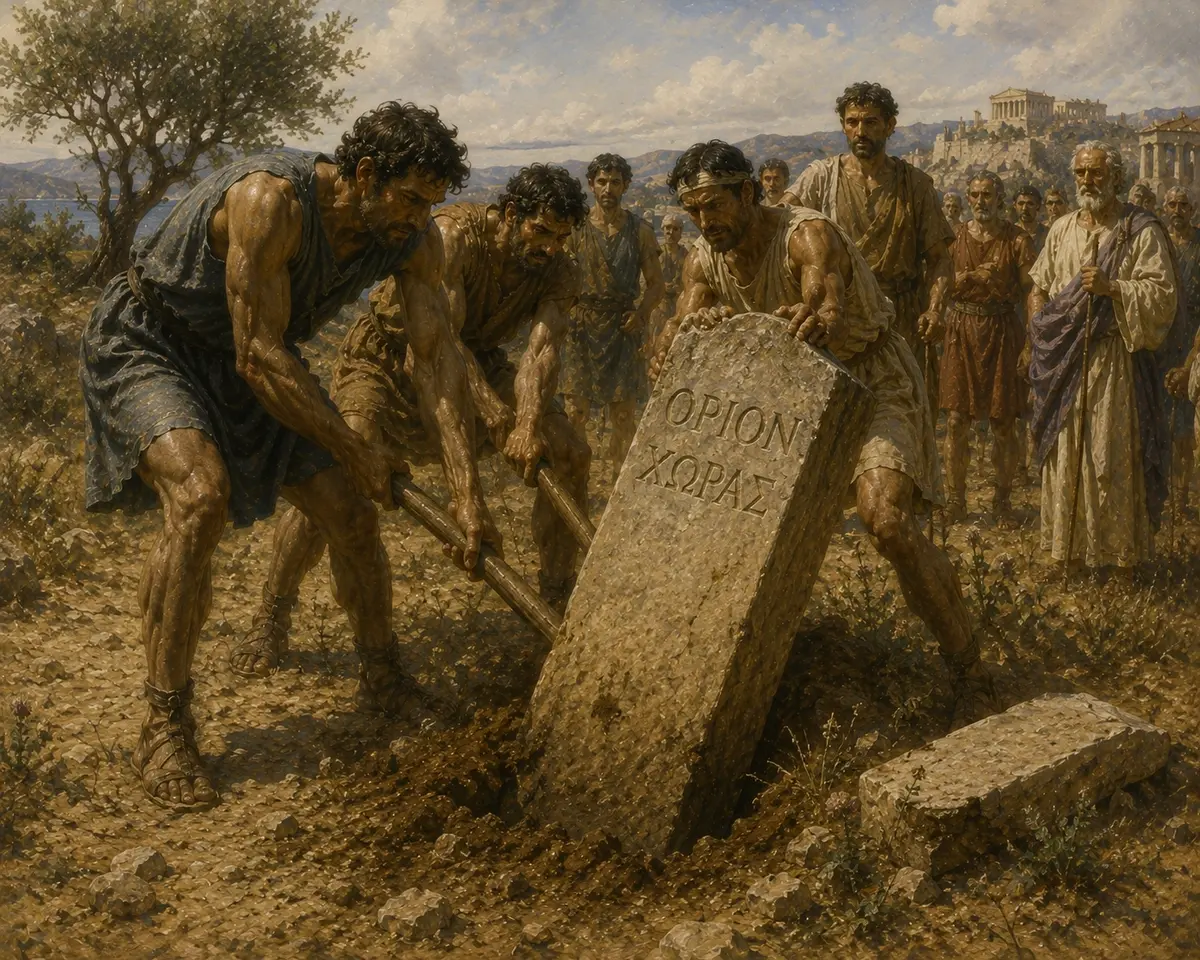
Solon's own poetry describes pulling them out. Cancelling debts is a one-off. Abolishing the mechanism means the crisis cannot recur in the same form.
And then he stopped. He refused to redistribute land. The poor had wanted the estates broken up and shared out — the standard demand in every Greek revolution of the period, and the standard outcome when a tyrannos seized power on a populist platform. Solon wouldn't do it. His own verse on the subject is unusually clear-eyed: he says he gave the people as much as was their due, neither taking away their honour nor holding out more, and that he stood covering both sides with a strong shield and let neither win unjustly. Both sides hated it. The rich thought he'd robbed them; the poor thought he'd bottled it. He recorded that too, with what reads like grim satisfaction — a man who has annoyed everybody equally has probably found the line.
The Constitution
The political reforms are less dramatic and did more. He created four property classes, defined by annual agricultural output rather than birth. At the top, the pentakosiomedimnoi, producing 500 measures, who could hold the highest offices including treasurer. Below them the hippeis, the knights, at 300 measures, eligible for most offices and serving as cavalry. Then the zeugitai, the yoke-men, at 200 measures, eligible for lower offices and serving as hoplites. And at the bottom the thetes, below 200 measures, who could attend the assembly and sit on juries but hold no office, and who served as rowers in the fleet. This looks like a hierarchy, and it is. The point is what it replaced. Under the old system, office was determined by who your father was, permanently, with no route in. Under Solon's, it was determined by what you produced — and production can change. A man who did well could move up a class. His sons could inherit the new position. It converted a closed caste into an open, if steeply graded, ladder. Aristotle thought this was the beginning of Athenian democracy, and he was broadly right.
He also created a Council of Four Hundred — a boule of 100 from each of the four old tribes, which prepared business for the Assembly. This mattered because it meant the Assembly voted on a prepared agenda rather than whatever an aristocrat chose to raise. The Assembly itself, the ekklesia, was open to all citizens including the thetes. And then the courts. This is the sleeper reform and Aristotle singled it out as the most democratic thing Solon did. He created the heliaia, a popular court, and gave it two powers with enormous consequences. Any citizen could appeal a magistrate's decision to it. And — this is the radical part — any citizen could bring a prosecution on behalf of someone who had been wronged, not just the victim. Before this, if you injured a poor man with no powerful relatives, nothing happened. Afterwards, any Athenian who felt like it could take you to court about it. It made the legal system a genuine constraint on the powerful for the first time. The laws were inscribed on rotating wooden tablets called axones, set up in public where anyone could turn them and read.
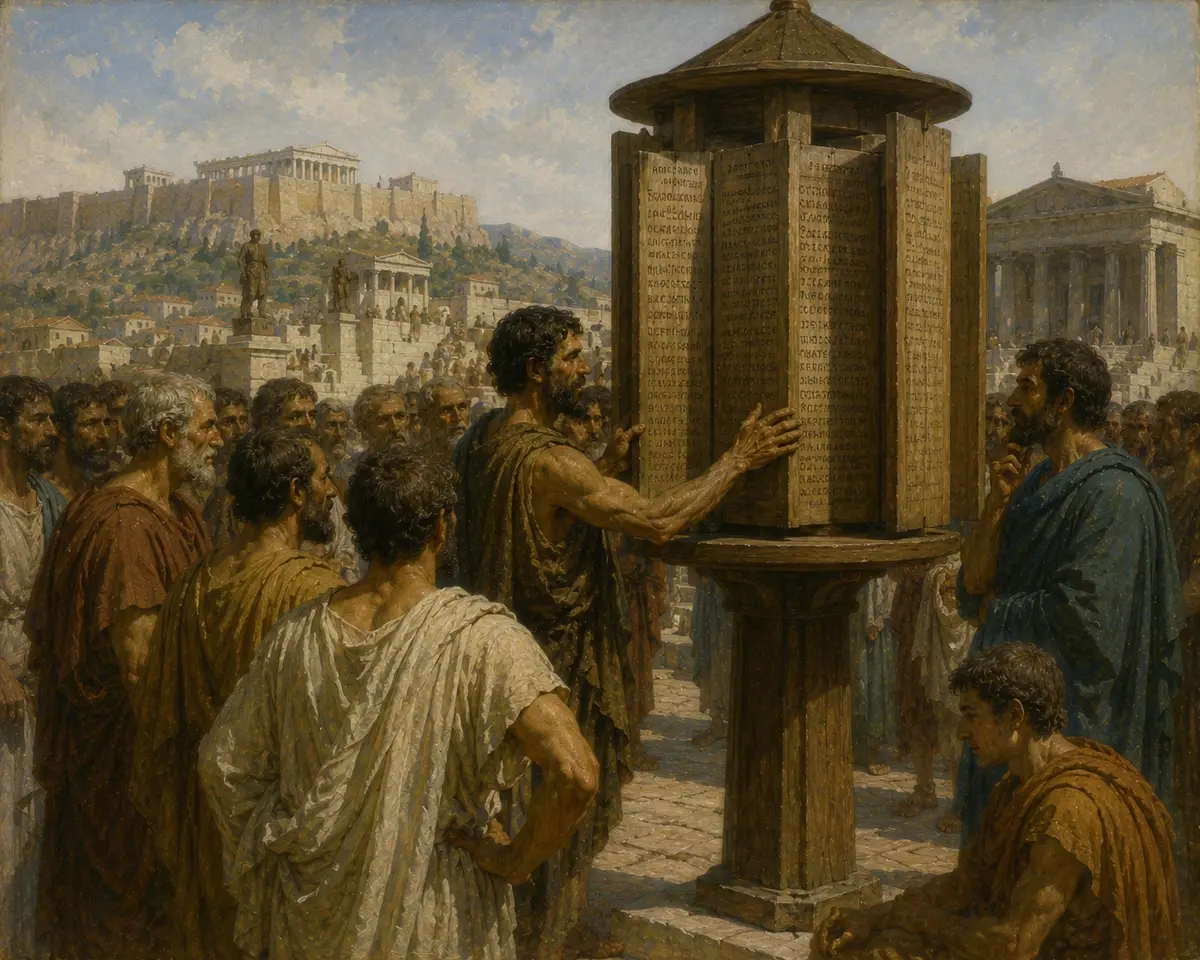
The axones were set up in public where anyone could turn them and read. The law stopped being whatever the magistrates said it was.
Then He Left
Here is the part I find genuinely admirable. Solon made the Athenians swear to keep his laws unchanged for ten years. Then he got on a ship and left the country for ten years. His stated reason, according to both Herodotus and Plutarch, was that people kept coming to him wanting explanations and amendments, and that as long as he was available they would keep asking, and eventually he would give in. If he wasn't there, they would have to work it out themselves. A man with absolute authority to write a constitution, who then deliberately removed himself so that his constitution would have to survive without him. It is the opposite of what almost everyone in that position does. He travelled — Egypt, Cyprus, and, in Herodotus's famous account, Lydia, where he met Croesus and told him that no man can be called happy until he is dead. That episode is a story in its own right and Herodotus uses it as the thesis statement for his entire history.
Did It Work?
Yes and no, and the honest answer is more interesting than either. Short term, it failed. Athens remained factional. Within thirty years Peisistratus had seized power as tyrant — and Solon, by then a very old man, lived to see it and publicly opposed it, reportedly putting his armour outside his door and telling anyone who passed that he had done what he could. Plutarch says nobody joined him. Long term, it was the foundation of everything. Peisistratus, notably, kept Solon's laws and governed through them. When the tyranny was overthrown and Cleisthenes built the democracy in 508/507 BCE, he built it on Solonian ground: a citizen body that could not be enslaved, a graded rather than closed access to office, an assembly open to the poorest, and courts anyone could use. None of that existed before 594 BCE. All of it was still there in 400 BCE. Solon also produced something else: poetry. His verses survive in fragments quoted by later writers, and they are the earliest Athenian voice we have — a politician explaining and defending his own decisions in his own words, roughly 2,600 years ago. He was counted among the Seven Sages of Greece, and of the seven he is the one whose actual work we can still examine.