Herodotus opens his history with this story, and he opens with it for a reason. Everything he wants to say about power, luck and the limits of human understanding is in it. Croesus was the richest man in the known world. He asked a visiting Athenian to confirm that he was therefore the happiest, was told no, and lost his temper. Within about fifteen years he had lost his son, his kingdom and his freedom, and was standing on a pyre waiting to be burned alive. At which point he understood what he'd been told, and said so out loud, and that is what saved his life.
The Man With the Money
Croesus ruled Lydia, in western Asia Minor, from about 560 to 546 BCE, from a capital at Sardis. His wealth was not a legend. Lydia sat on the river Pactolus, which carried gold in its sands — the same river the Midas story is attached to — and controlled the trade routes between the Aegean coast and the interior. The Lydians are also generally credited with inventing coinage: standardised stamped lumps of electrum, a natural gold-silver alloy, in the late 7th century BCE. Croesus is thought to have introduced the first true bimetallic system, with separate pure gold and pure silver coins at a fixed rate. He was, in other words, extremely rich in a genuinely new way — liquid, portable, countable wealth rather than land and herds. Rich as Croesus has been a phrase in English since the 16th century and in Greek since his own lifetime. He also conquered most of the Greek cities on the Ionian coast, and — this matters for what follows — was a lavish donor to Delphi, sending gold and silver on a scale that made him the sanctuary's most important benefactor.
Solon's Answer
According to Herodotus, Solon came to Sardis during his ten-year self-imposed exile from Athens. Croesus had him shown round the treasuries, everything laid out, and then asked the question he'd been building to: who is the happiest man you have ever seen? Solon said Tellus of Athens. Croesus, who had expected a different answer, asked why. And Solon's reasoning is completely unsentimental. Tellus lived in a prosperous city. He had good sons who lived to have children of their own. He had enough to live on. And he died at the end of a successful battle, winning, and was buried at public expense on the spot where he fell. Fine, said Croesus. And second? Cleobis and Biton, two young men from Argos. Their mother, a priestess, needed to get to the temple and the oxen hadn't come back from the fields. So the two of them put themselves in the yoke and pulled the cart five miles to the sanctuary. The crowd praised them, their mother prayed for them to be given the best thing a human can receive — and they went to sleep in the temple and never woke up.
Croesus lost patience. He wanted to know how his own happiness could be worth so little that he ranked below a couple of provincial farmhands. And Solon gave the answer. He said he could see that Croesus was enormously rich and ruled many people, but that he could not answer the question until he knew how the man ended — because the god shows many men a glimpse of happiness and then ruins them utterly. He works through the arithmetic — the number of days in seventy years, and how many of them bring something different from the day before — and lands on the principle: count no man happy until he is dead. Not because death is good. Because a life can only be judged as a whole, and until it's over you don't have the whole. Croesus dismissed him as a fool. (Chronologically this meeting is very unlikely — the dates for Solon's travels and Croesus's reign don't overlap comfortably. Herodotus almost certainly knew that. He included it anyway, because it's the thesis of his book.)
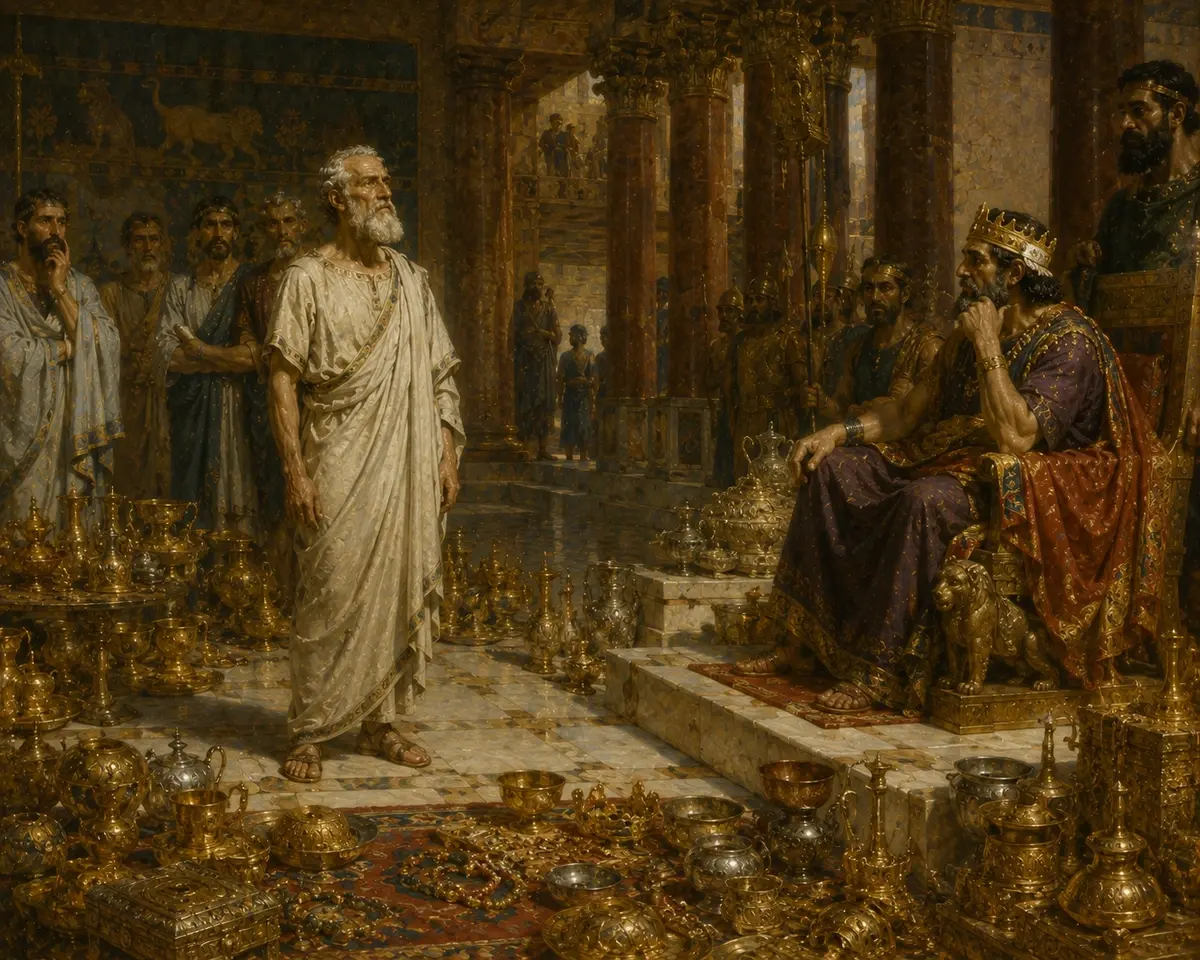
He had him shown round the treasuries, everything laid out, and then asked who was the happiest man Solon had ever seen. Solon named a farmer from Athens.
The Son
The first blow came in a form Croesus couldn't have argued with. He had two sons. One was mute. The other, Atys, was everything a king wants, and Croesus dreamed that Atys would be killed by an iron spearpoint. So he took precautions with a thoroughness that is almost comic. He got the boy married to keep him at home. He removed every javelin and spear from the men's quarters and had them stacked in a storeroom, in case one fell off a wall. Then a great boar started destroying the farmland on Mount Olympus in Mysia, and a deputation came asking for a hunting party, and Atys wanted to go. Croesus refused, and his son argued him down — reasonably. The dream said a spearpoint. Boars don't carry spears. What am I supposed to do, never go anywhere? Croesus gave in and sent a bodyguard with him: a Phrygian exile named Adrastus, whom Croesus had taken in and purified after Adrastus had accidentally killed his own brother. A man with a proven record of accidental killing, assigned as protection. Herodotus does not comment. At the hunt, Adrastus threw at the boar, missed, and hit Atys. He came back to Sardis and offered his own throat over the body. Croesus, in one of the more remarkable moments in Herodotus, forgave him — said the guilt lay with whichever god had warned him of this and let it happen anyway. Adrastus waited until the funeral was over and everyone had gone, and then killed himself on the grave.
The Oracle He Misread
Two years later, with Cyrus the Great consolidating Persian power to the east, Croesus decided to attack before Persia grew stronger. But first, he tested the oracles. This is the best-organised piece of research in ancient literature. He sent messengers to every major oracle in the Greek world and to Ammon in Libya, with instructions to ask, on a specified day exactly a hundred days after leaving Sardis, what the king of Lydia was doing at that moment. He then made sure to be doing something nobody could guess: chopping up a tortoise and a lamb and boiling them together in a bronze pot with a bronze lid. Only Delphi got it right. The verse reply described the smell of tortoise and lamb boiling together in bronze. So Croesus sent Delphi an enormous thank-offering and asked his real question: should he go to war with Persia? The answer: if Croesus crosses the river Halys, he will destroy a great empire. He crossed. He also asked a second question — how long his rule would last — and was told: until a mule becomes king of the Medes. Which sounded like forever, and he took it that way.
The Fall
The first battle, at Pteria, was hard and indecisive. Croesus had the smaller army, so he withdrew to Sardis and disbanded his forces for the winter, intending to call up allies from Egypt, Babylon and Sparta and try again in spring. Cyrus did not stop for winter. He followed him straight to Sardis, which is exactly the thing Croesus's whole plan assumed nobody would do. At the battle outside the city, Cyrus is said to have put his baggage camels at the front of his line, on the advice that horses cannot stand the smell of camels. The Lydian cavalry — the best in Asia — found their mounts unmanageable, dismounted, and fought on foot. They lost. Sardis was besieged and fell in fourteen days, when a Persian soldier watched a Lydian climb down an unguarded stretch of cliff to retrieve a dropped helmet, and reported that there was a way up. Herodotus adds one detail from the sack. A Persian soldier came at Croesus not knowing who he was, and the mute son — who had never spoken in his life — shouted don't kill Croesus. He spoke for the rest of his life afterwards.
The Pyre
Cyrus had Croesus put on a pyre with fourteen Lydian boys, bound, to be burned. And standing there, Croesus said, three times: Solon. Cyrus asked what it meant. Croesus told him — the whole story, the visit, the question, the answer, and that he now understood the Athenian had been talking about every human being alive and not just about him. Cyrus, who was himself a king with everything, listened to a man who had recently had everything and now had nothing, and thought about the position he was currently in. He ordered the fire put out. It was already burning too hard. So Croesus called on Apollo, reminding him of all that gold, and a cloudless sky broke into a downpour that put it out. Cyrus made him an advisor and kept him for the rest of his life. Croesus later sent his chains to Delphi with a message asking whether the god was in the habit of deceiving his benefactors. The priestess replied that the god had told him the exact truth. A great empire had indeed been destroyed. He had never asked which one.
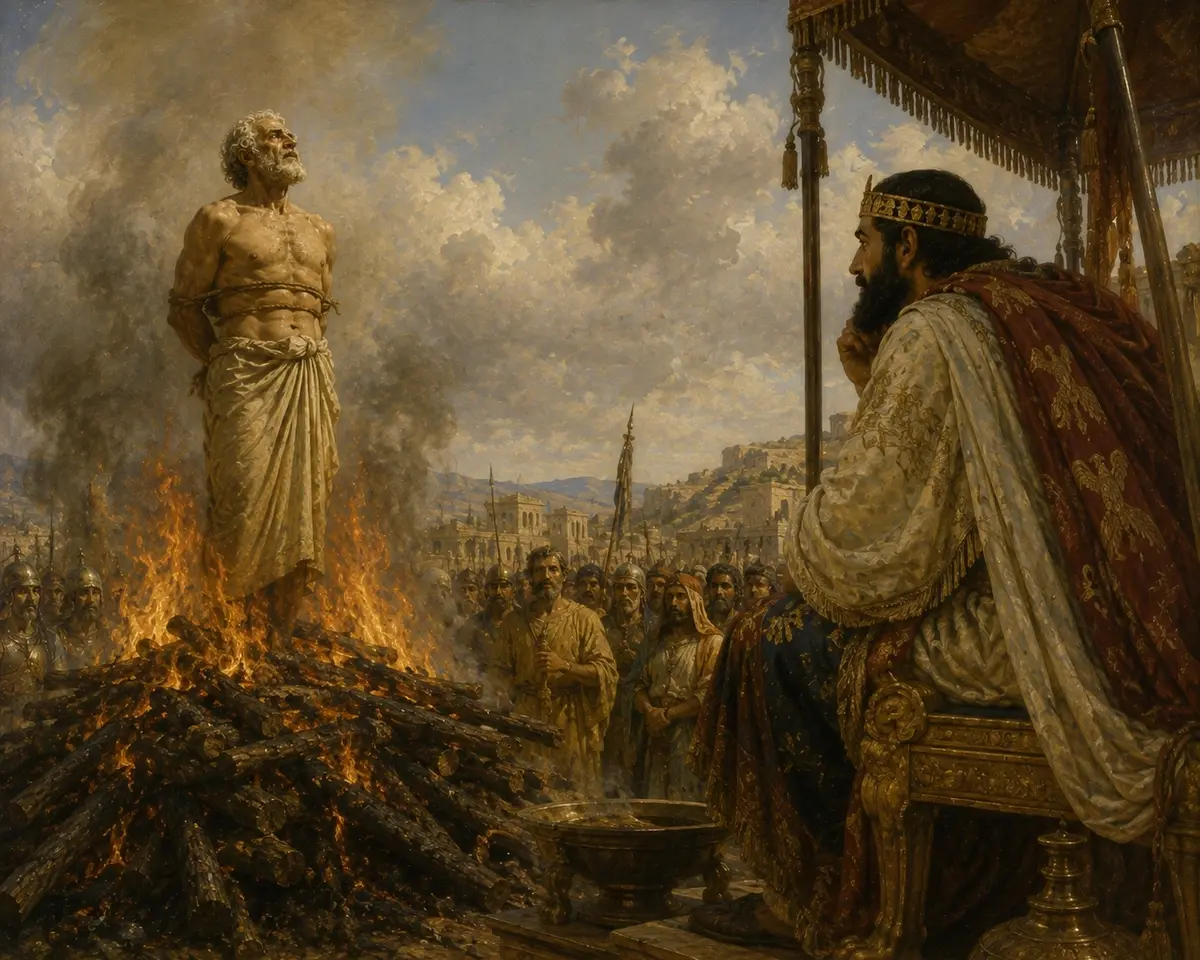
He said, three times: Solon. Cyrus, who was himself a king with everything, listened to a man who had recently had everything, and thought about his own position. He ordered the fire put out.
What Herodotus Is Doing
This story sets up the entire Histories, and the pattern it establishes runs all the way through to Xerxes at Salamis. The gods resent excess. The Greek concept is phthonos theon, divine envy — the idea that outstanding good fortune attracts correction. Solon states it explicitly: the divine is jealous and disruptive. Prophecy is true and useless. Delphi never lies to Croesus. It tells him a tortoise is boiling. It tells him an empire will fall. It tells him about the mule — and Cyrus, whose mother was Median and father Persian, was a mule in exactly the sense meant. Every word was accurate and every word was heard wrong, because Croesus heard what he wanted. And happiness cannot be assessed from inside. You are always in the middle of your own life. That's why Solon says wait until the end. There's also a hard question underneath, which Herodotus leaves open. Is Croesus punished for arrogance, or is he simply a man whose luck ran out? He isn't cruel. He's generous to Delphi and forgiving to Adrastus. He is merely successful, and confident about it, and that turns out to be enough. (A caution: Herodotus's version is a moral tale, not a report. The Babylonian Nabonidus Chronicle may record the Lydian king being killed, though the text is damaged and the reading contested. Bacchylides has Apollo carry Croesus off to the Hyperboreans. What happened to the real man is unknown.)