The 1206 assembly that founded the Mongol empire was held on open grassland at the source of the Onon river, and it settled four things at once: who ruled, how the army was organised, who decided legal disputes, and what the ruler was to be called.
It mattered more than most of the battles that preceded it. Temujin had spent twenty years building a following held together by his personal reputation, and every previous confederation on the steppe assembled that way had come apart when its leader died. The assembly existed to build something that would not.
One caution belongs at the front. The law code promulgated there is generally called the yassa, and the familiar picture of it, a written constitution drafted in one winter and issued at the kurultai, has been under serious challenge since 1986. No text survives. What the sources actually describe is thinner and stranger than that, and the provisions quoted below should be read as the tradition of what Mongol law contained rather than as clauses anybody has seen.
The result is a state that is difficult to categorise. It had a professional army organised on decimal arithmetic, a chief judge under orders to write his rulings into a register, and a formal policy of religious freedom. It did not have a capital city.
What a Kurultai Was For
A kurultai was an assembly of those loyal to the leader of a nomadic confederation, called to confirm acceptance of some major change the leader wanted to make. It was not a parliament and it was not quite an election either. Attendance was the vote.
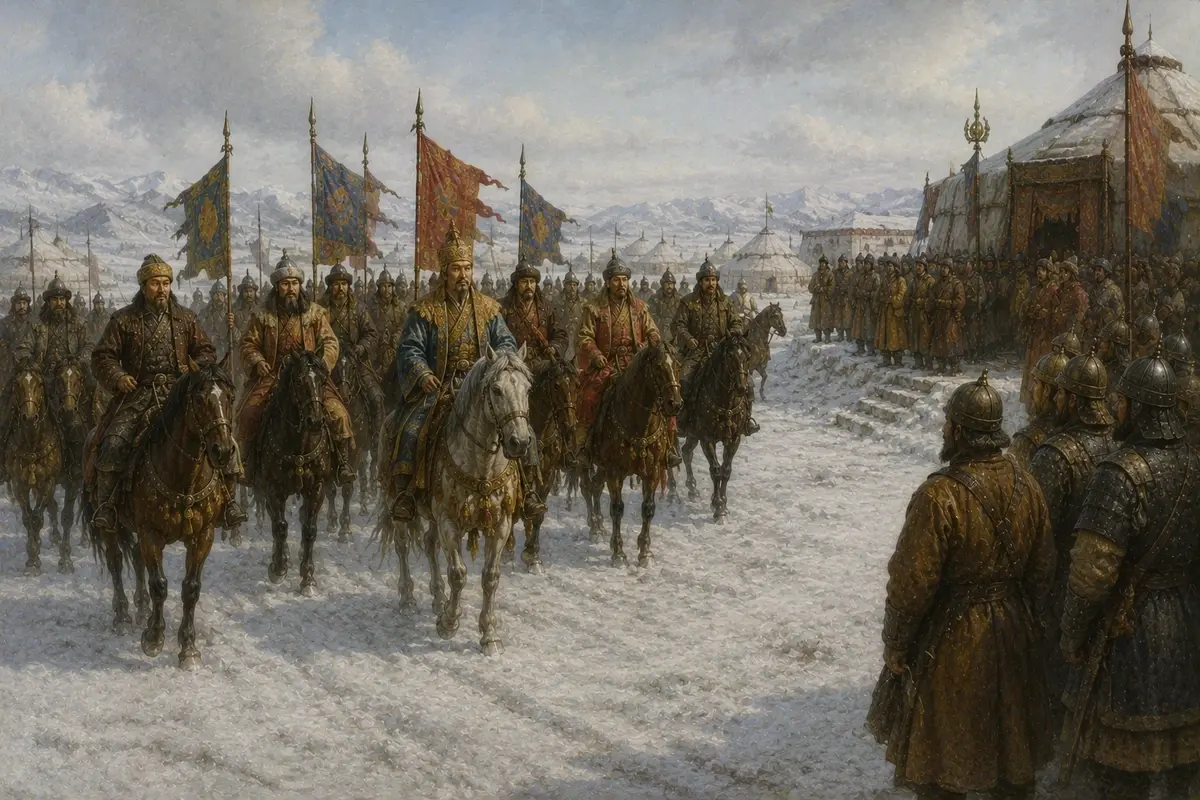
Turning up signalled acceptance. Staying away signalled disagreement, and possibly the withdrawal of loyalty altogether.
Coming signalled that you accepted the change. Staying away signalled that you did not, and could amount to withdrawing your loyalty entirely. That is why the guest list mattered as much as anything said once everyone arrived.
Temujin waited before calling one. The Naiman confederation had been broken in 1204, the Merkit scattered, and his old sworn brother and rival Jamukha executed in 1205. He let two years pass after the last of the fighting, apparently to allow the bitterness of a long civil war to settle, before summoning everyone to a single place.
The Assembly at the Onon
The gathering took place in 1206 at the source of the Onon, in what is now north-eastern Mongolia, and its scale had no precedent. The Secret History of the Mongols records that nearly the whole of what it calls the People of the Felt Walls came, something close to a million people, setting up encampments that spread for miles across the surrounding country.
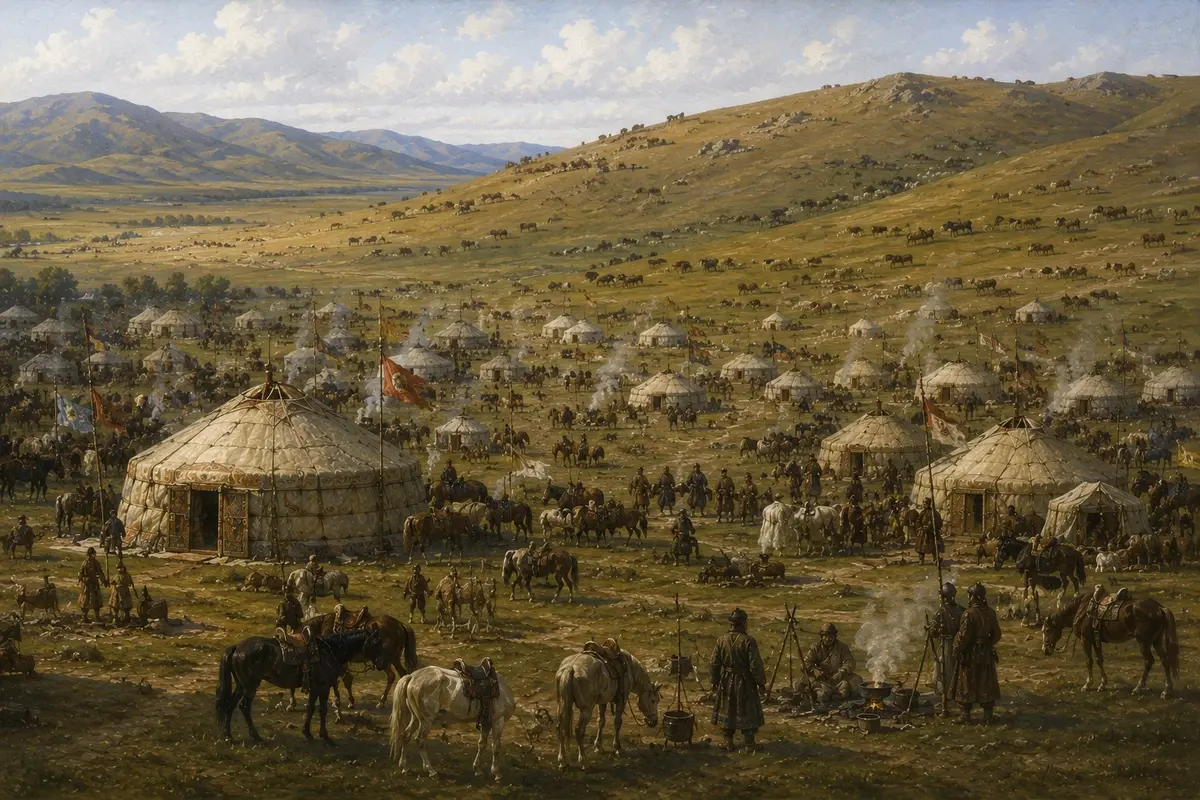
Khans travelled with their herds, so the founding of the empire needed pasture rather than a hall.
It had to be held on pasture. Khans did not travel without their horses and their animals, and no town in the region could have fed a gathering on that scale for the days it took. There is a second consequence of that constraint worth noticing: unlike nearly every coronation in recorded history, this one was not confined to an elite and the population of a capital. Ordinary herding families were camped within sight of it.
A standard of nine white yak tails was raised, the emblem of supreme authority among the Mongols, and Temujin was elevated on a felt carpet by the assembled chiefs, which was the traditional Inner Asian rite for making a khan.
A Name From a Shaman
The name did not come from the assembly. It came from a holy man, and the choice of holy man was not accidental.
Kokochu belonged to the Khongkhotan clan and went by the religious title Teb Tengri, meaning something like the Spokesman of Heaven. He was widely believed to travel to the sky and return with messages, and his standing among ordinary Mongols was enormous. He was also the son of Munglig, the old retainer of Yesugei's who had married Temujin's mother, which made him family rather than an outsider.
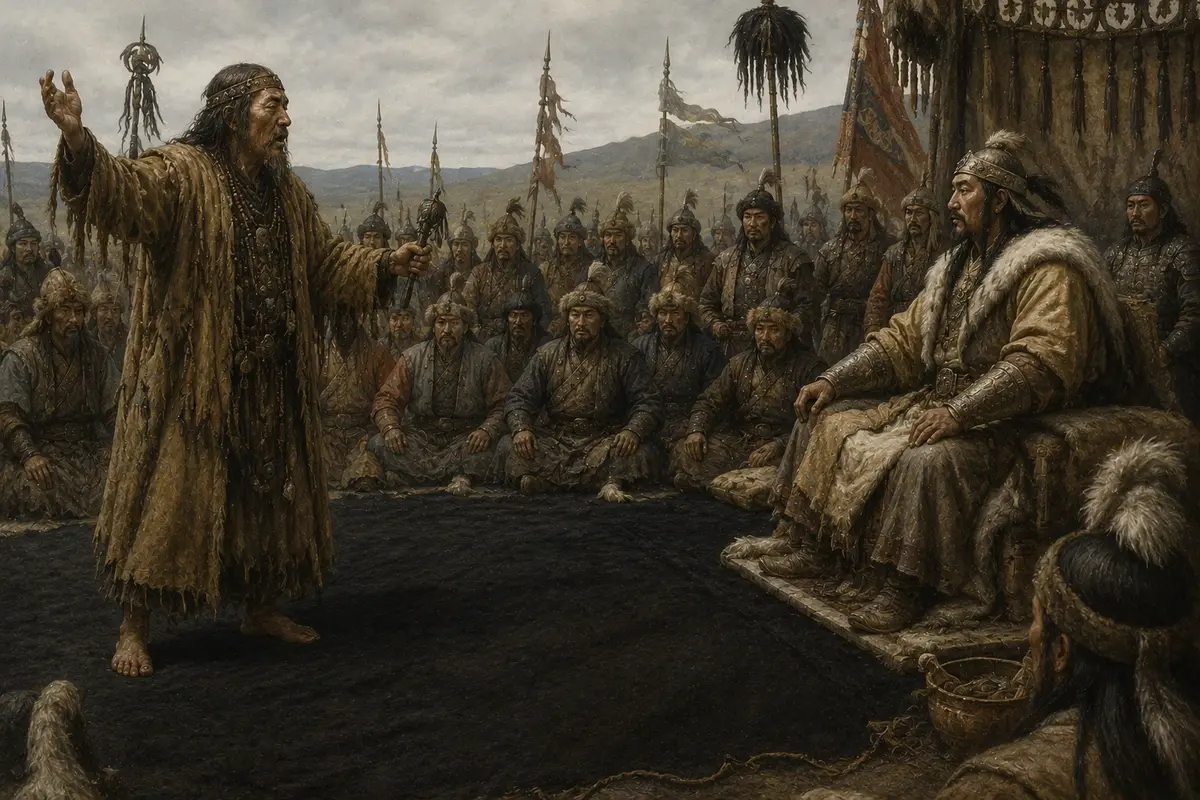
The chiefs conferred the rule. The shaman conferred the name, and with it the claim that Heaven had already decided.
He announced that every ruler on earth had now been subdued, that Tengri, the sky god, had granted Temujin authority over the world, and that by the decree of Heaven his title should be Chinggis Khan. The assembled princes and commanders conferred it.
What the title means is still argued. The usual renderings are universal ruler and oceanic ruler, with fierce or powerful khan also proposed, and no one is certain. What it did politically is clearer: it put the claim beyond the reach of the men who had just made it, by sourcing it from Heaven rather than from the assembly.
There is a sequel that gets left out of the founding story. Teb Tengri's own influence grew on the strength of what he had done, and within a few years he was confident enough to humiliate the khan's brothers in public. Genghis Khan had him killed, his back broken, and the killing was arranged so that no blood was shed. The sacred authority had been borrowed, and it was taken back.
The Decimal Army and the Keshig
The army was rebuilt on a strict decimal scheme: units of ten called arban, hundreds called jagun, thousands called minghan and ten-thousands called tumen, with officers appointed at every level.
The arithmetic is the least interesting part of it. The minghan was not only a military formation. It was a household and taxation unit as well, and its membership was deliberately drawn across the old tribal lines. Men who had been Tayichiud, Kereit, Merkit or Tatar found themselves serving in units alongside former enemies, under officers appointed by the khan rather than inherited from their clan.
That is the mechanism by which the army stopped being a coalition of clans and became an institution. Around ninety-five thousand-commanders were appointed at the assembly, and members of the ruling family, the altan urugh or Golden Kin, were allotted minghans of their own.
Alongside it came the keshig, an imperial bodyguard eventually ten thousand strong, recruited from the sons of his commanders. It protected the khan and gave him a corps of trained officers. It also kept the sons of every powerful man in the empire permanently at court, which was not an accident.
What the Yassa Actually Was
Yasa is a Mongol word meaning law, order, decree or judgement. Used as a verb it could mean a death sentence: to be delivered to the yasa was to be officially executed.
The traditional account holds that Genghis Khan laid down a comprehensive legal code, the Great Yasa, at the kurultai of 1206, and that written copies were kept in the treasuries of the Mongol princes for consultation. The reason no copy survives, in this account, is that the text was taboo to outsiders.
David Morgan challenged that picture in 1986, arguing that the thirteenth- and fourteenth-century Mongol and Persian references to yasa do not describe a codified law book at all, but separate decrees that were never gathered into a codification. The argument has not settled the matter; Igor de Rachewiltz pushed back by pointing to Chinese sources where the yasa is treated as a code. The dispute has largely reached a stalemate, because both sides are reading the same handful of texts differently.
What is solid is what happened to the judiciary. At the 1206 assembly Genghis Khan gave judicial authority to his adopted brother Shigi Qutuqu and told him to write his decisions down. The Secret History preserves the instruction: record all judgements and all decisions about the distribution of the people in a blue-script register, make it into a book, and let no one among his descendants alter what is written there. That register, the koko debter or blue book, produced a growing body of recorded rulings in Uighur script that were treated as binding.
So the institution that came out of 1206 was case law with a chief judge, not a constitution. Most of what later writers quote as the yassa traces back to the Persian historian Juvayni, writing decades afterwards, and everything below should be read in that light.
Crimes, Slaves and Punishments
The penalties reported in the tradition are severe, and the severity has a logic. A society with no prisons, no police force and a population scattered across thousands of miles cannot enforce law by supervision. It enforces it by making the consequences unmissable and widely known.
Stealing livestock carried death, which follows in an economy where the herds were the entire capital stock and a stolen animal could be walked over a horizon in a morning. Lesser thefts were punished by restitution at multiples of the value of what was taken, and by beating.
The provisions on slavery are harsh and should not be softened. Harbouring a runaway slave, or giving him food, drink, clothing or shelter without his owner's permission, is reported as a capital offence. So is coming across a fugitive and failing to seize him and return him.
Marriage and the Dead
Men could take as many wives as their position could support. Wives were ranked, and the sons of the senior wife took precedence in inheritance, which is why the standing of a first wife was a matter of imperial politics rather than domestic arrangement. Women taken in war became property and were distributed with the rest of the plunder.
One provision in the reconstructed lists is genuinely unlike anything else in them. Two families could bind themselves together by contracting a marriage between children who had died. The agreement was drawn up exactly as if both children were alive, the full ceremony was performed, and afterwards the two families were held to be allied by every obligation a real marriage would have created.
The belief behind it was that a wedding solemnised on earth by the parents of dead children takes effect on the children themselves in the world of spirits, so that a union arranged here is completed there. It is a striking thing to find in a legal code, and it makes the point that the yassa tradition was not a rationalist's document. It was custom being written down.
One God and Religious Freedom
The religious position was set at the assembly itself, in the shaman's proclamation: authority came from Tengri, the sky god. Beyond acknowledging that, nothing was required of anybody.
What makes the policy remarkable is that it went well past leaving people alone. Religious leaders and their institutions were granted exemptions from taxation and from labour service, a privileged status extended to monks, preachers and mosque criers alike. Physicians received the same treatment on the same reasoning, that their work was too useful to burden with public duties.
The practical result was that Muslims, Christians of the Church of the East, Buddhists and shamanists all operated unmolested inside a single empire at a moment when most of the states around it were doing the opposite.
It is worth being clear about what this was and was not. It is not a theory of individual conscience. It is a governing decision made by a man about to rule an enormous number of people who believed different things, and it worked because it made a multi-religious empire cheap to administer. That does not make it less real for the people who benefited from it.
Hunting as a Substitute for War
With the wars of unification finished, Genghis Khan had a new problem: a large army with nothing to do and a population whose military habits had been formed by constant raiding that had now stopped.
The answer was to regulate hunting rather than leave it alone. The tradition includes seasonal restrictions confining hunting largely to the winter months, which conserved the game through the breeding season and, not coincidentally, put the whole exercise into the part of the year when the army was idle.

The nerge was run exactly like a campaign: a perimeter hundreds of miles across, closed inward over weeks, with orders against letting anything through the line.
The great winter hunt, the nerge, was conducted as a military operation in everything but name. Detachments were deployed around an enormous perimeter and closed inward over a period of weeks, under orders that nothing was to be allowed through the line. It trained precisely the things a battle needed: communication across long distances, keeping formation over rough ground, holding a cordon under pressure, and obeying an order to do nothing when doing nothing was the order.
An Empire With No Capital
The Mongol capital is often placed at Karakorum, and in 1206 it did not exist. Karakorum was built on Ogedei Khan's orders in 1235, nearly thirty years after the assembly and eight years after Genghis Khan's death. For the whole of his reign the empire had no capital city at all.
What it had instead was the ordu, the imperial camp, which moved. The ground was laid out like a town in quarters, squares and streets, and a great encampment could run close to a mile in each direction.
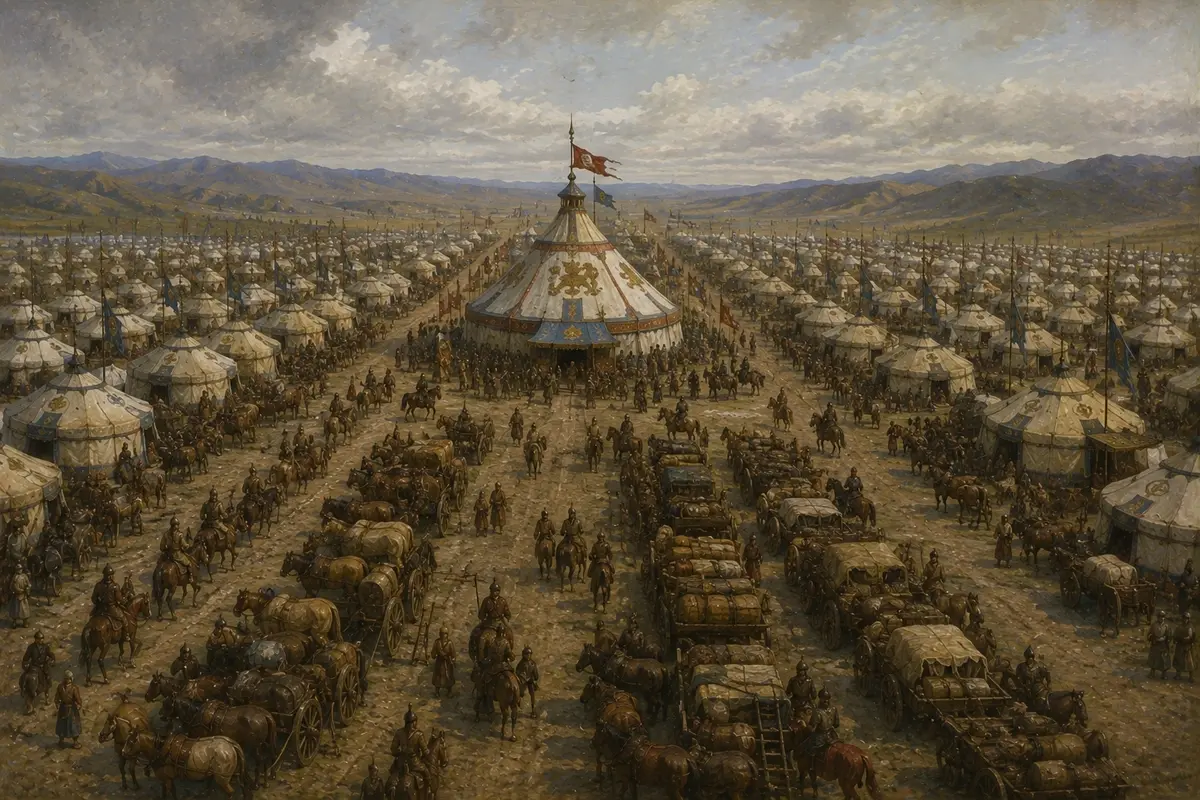
Laid out in quarters and streets and running nearly a mile across, the moving camp was the functioning capital of an empire that had no city.
The khan's tent stood at the centre of a reserved space, pitched high enough to be visible above everything else and painted in bright colours. Around it were the smaller tents of his wives and the women of his household, and rows of carts holding provisions, clothing, arms and valuables. Some of the surrounding structures were light wooden huts rather than tents, built so they could be taken apart at short notice and loaded onto carts whenever the establishment moved.
This is not an eccentricity. It follows from what the empire was. A Mongol ulus meant authority over people rather than over mapped ground, which is why the state could function without a fixed seat, and also why it had no natural frontier to stop at. It ended wherever the obedience ended, and the only way to make it bigger was to find more people to make obey.
Five years after the assembly on the Onon, that logic took the army south through the Great Wall.