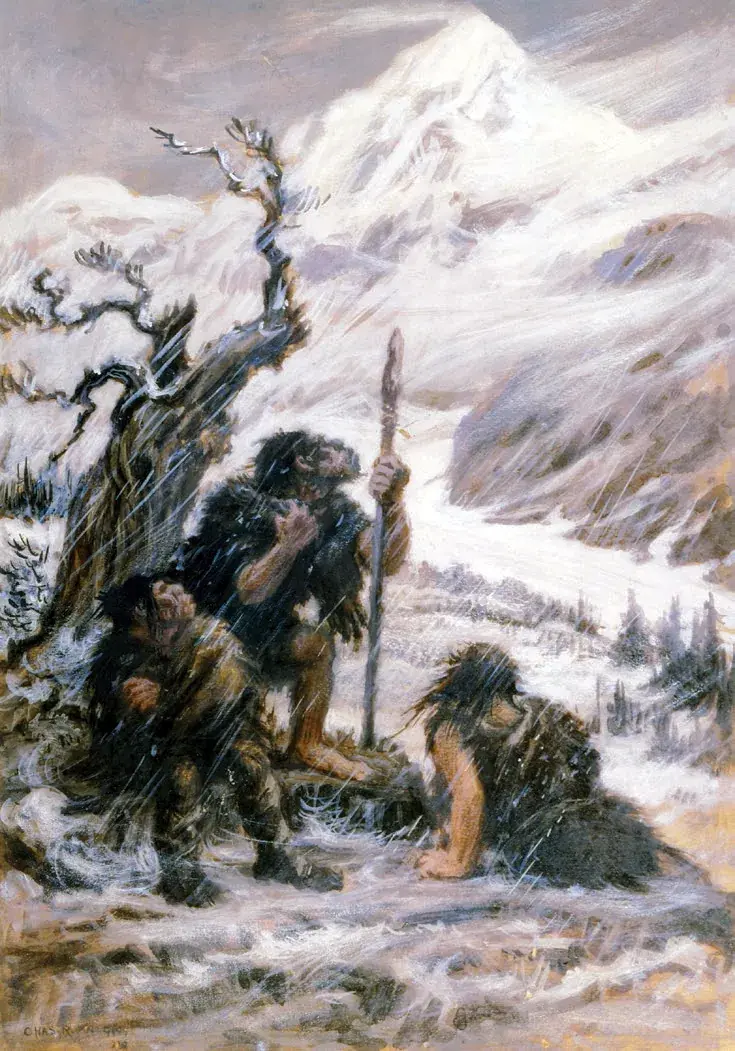
Jamukha spent two years working on the one man whose opinion could ruin Temujin: his patron's son. It worked. In 1203 the alliance broke, Temujin was comprehensively beaten and reduced to a few thousand men at a muddy watering hole, and the oath he swore there outranked every loyalty offered afterwards for the rest of the empire's history.
Jamukha's conspiracy against Temujin, sometimes written Jamuka, worked. It took roughly two years, it was aimed at the one man whose opinion could ruin him, and in the spring of 1203 it broke the most important alliance on the Mongolian steppe.
What is usually left out is how badly it went for Temujin. He was not the winner of that confrontation. He was ambushed, run down, comprehensively beaten in the field, and reduced to a few thousand men camped at a muddy watering place near the Jin frontier, waiting to see whether anyone else would come. His seventeen-year-old son was carried off the battlefield with an arrow in his neck. The recovery took about six months, and it was done with letters rather than cavalry.
The sources disagree about motive more than about events. The Secret History of the Mongols has Wang Khan torn between his affection for Temujin and his loyalty to his son, giving way only under an ultimatum. Rashid al-Din's Persian chronicle and the oral traditions Marco Polo picked up have him hostile from the start. And the most famous episode in the whole story, the oath at the muddy water, does not appear in the Secret History at all.
Why Steppe Alliances Broke So Easily
The country was not divided into territorial states with borders. It was one vast undivided region occupied by enormous confederations, each roughly stationary within its own range but with no permanent settlement anywhere. Groups drifted according to the state of the pasture, the fortunes of war, and the pressure of whoever was camped next to them.
Where several tribes were united under one khan, the bond holding them was feeble, and the line between submission and rebellion was barely drawn at all outside an actual war. A tribe could drift out of obedience without anyone declaring anything, and drift back the same way.
That single structural fact explains most of what follows. Loyalty on the steppe was a running calculation about who was likely to win, and it could be revised at any time. It is also why the oath sworn at the end of this story mattered so much: it was an attempt to build something that calculation could not dissolve.
Jamukha, Senggum and the Case Against Temujin
Jamukha had been Temujin's anda, his sworn brother, before he became his rival, and by 1201 he was the figurehead of the opposition. In that year a collection of dissatisfied tribes including the Onggirat, the Tayichiud and the Tatars swore to break the Mongol-Kereit alliance and elected him gurkhan, their overall leader. The coalition was beaten, and Jamukha ended up back inside Wang Khan's camp, where he was considerably more dangerous.
His target was Senggum, Wang Khan's son, who expected to inherit the Kereit khanate and could see perfectly well that his father's protege now commanded a following that rivalled it. That grievance needed no manufacturing.
What Jamukha added was an argument the whole steppe aristocracy could feel. Temujin had a habit of promoting commoners to high position on the basis of loyalty and ability, over the heads of men with better birth. To a nobility whose entire claim rested on descent, that was not an eccentricity but a threat, and Jamukha was quite right to say so.
It is worth knowing how freely atrocity stories travelled in this environment. A famous one describes seventy captives boiled alive in cauldrons after a battle, and it is sometimes attached to Temujin. The Mongol tradition puts it after the Battle of Dalan Baljut around 1187 and attributes it to Jamukha, who won that battle, and says it cost him support. Reputations on the steppe were built and demolished by exactly this sort of story, and it moved between men easily.
The Four Steeds and the Four Dogs
Against that, Temujin had built something no Kereit chieftain had: a permanent command group that answered to him personally rather than to any clan.
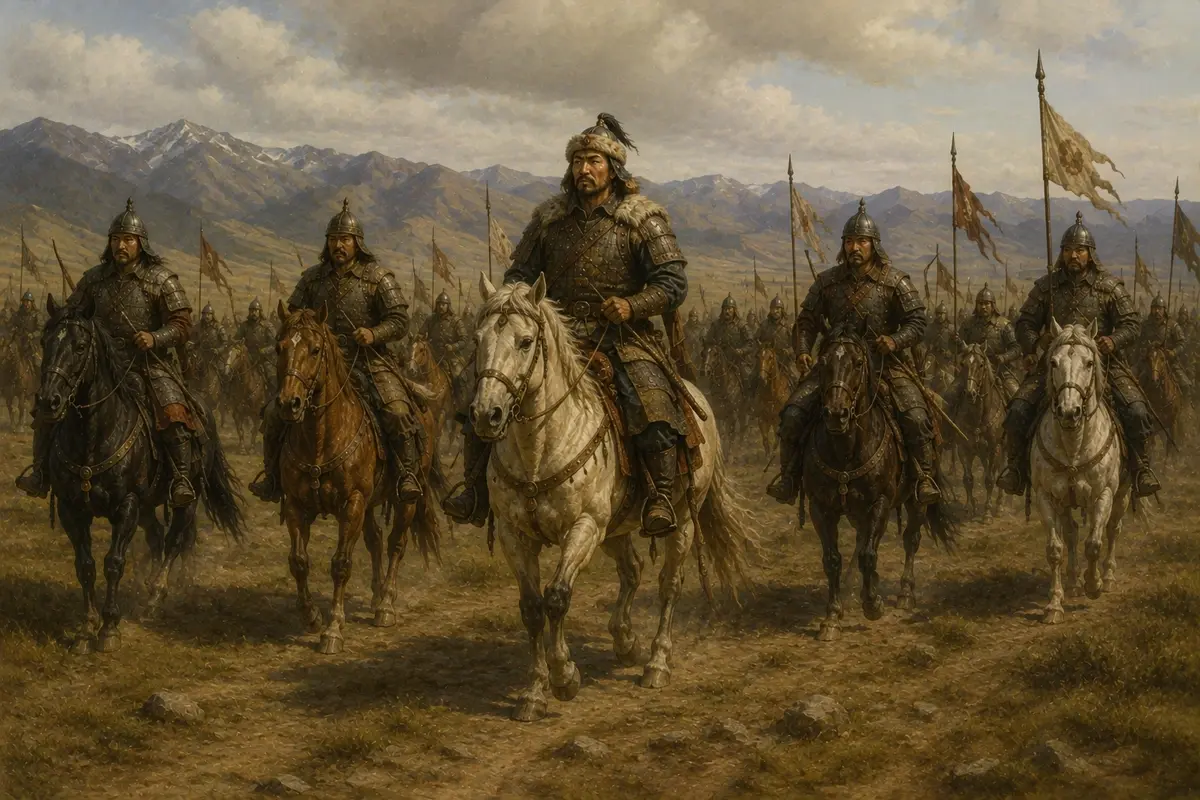
The Secret History groups his closest commanders into two sets of four, the steeds and the dogs, and most of them were men of no birth at all.
The Secret History sorts his inner circle into two groups of four. The four steeds were Bo'orchu, Muqali, Boroqul and Chila'un. The four dogs were Jebe, Qubilai, Jelme and Subutai. Several of them came from nowhere in particular. Jebe had shot Temujin's horse from under him in battle, admitted it when asked, and was promoted for the honesty. Chila'un was the son of the herdsman who had hidden Temujin in a wool cart years earlier.
This is the same fact seen from two sides. To Temujin it was a meritocracy that produced better commanders. To Senggum and Jamukha it was proof that the man was dismantling the order they lived by, and they were not wrong.
The Marriage That Was Refused
The break came over a wedding that never happened, and the proposal ran in the opposite direction from the way it is usually told.
Early in 1203 Temujin proposed a double marriage between the two houses: his eldest son Jochi to a daughter of the Kereit royal family, and one of his own daughters to Senggum's son. Such matches were the standard instrument for turning an alliance into kinship, and on paper it was an ordinary piece of steppe diplomacy.
Senggum refused, and read the request as presumption. A marriage would have given Temujin's line a claim inside the Kereit succession, which was precisely what he could not allow. He is also recorded as objecting to Jochi personally, on account of the long-running doubt about whether Temujin was his father, which was a wound the family carried for decades.
Wang Khan's own position is where the sources part company. The Secret History presents an old man pulled between his affection for the protege he called son and his love for his actual son, giving way only when Senggum forced the choice. Rashid al-Din and the traditions behind Marco Polo present a khan who was already hostile and who reacted to the proposal with anger. Either way, the refusal is what turned a rivalry into a war.
Munglig's Warning and the Betrothal Feast
Then Senggum changed tack, and the deception in this story belongs to the Kereit rather than to Temujin.
He sent word that he had reconsidered and accepted the marriages after all, and that a betrothal feast would be held to seal them. Temujin, taking the reversal at face value, set out for it with a minimal escort. The conspirators intended to kill him there.
He was stopped by Munglig, an old retainer of his father's who had married his mother. Munglig had heard enough of the rumours around the invitation to be alarmed, and warned him on the road. Temujin found a reason to postpone, sent a civil answer back, and turned around.
Badai, Kishlik and the Night Ride
With the ambush wasted, the Kereit took the field in force under Senggum, intending to fall on Temujin's camp at dawn. That plan was betrayed too, and by the least likely people in it.
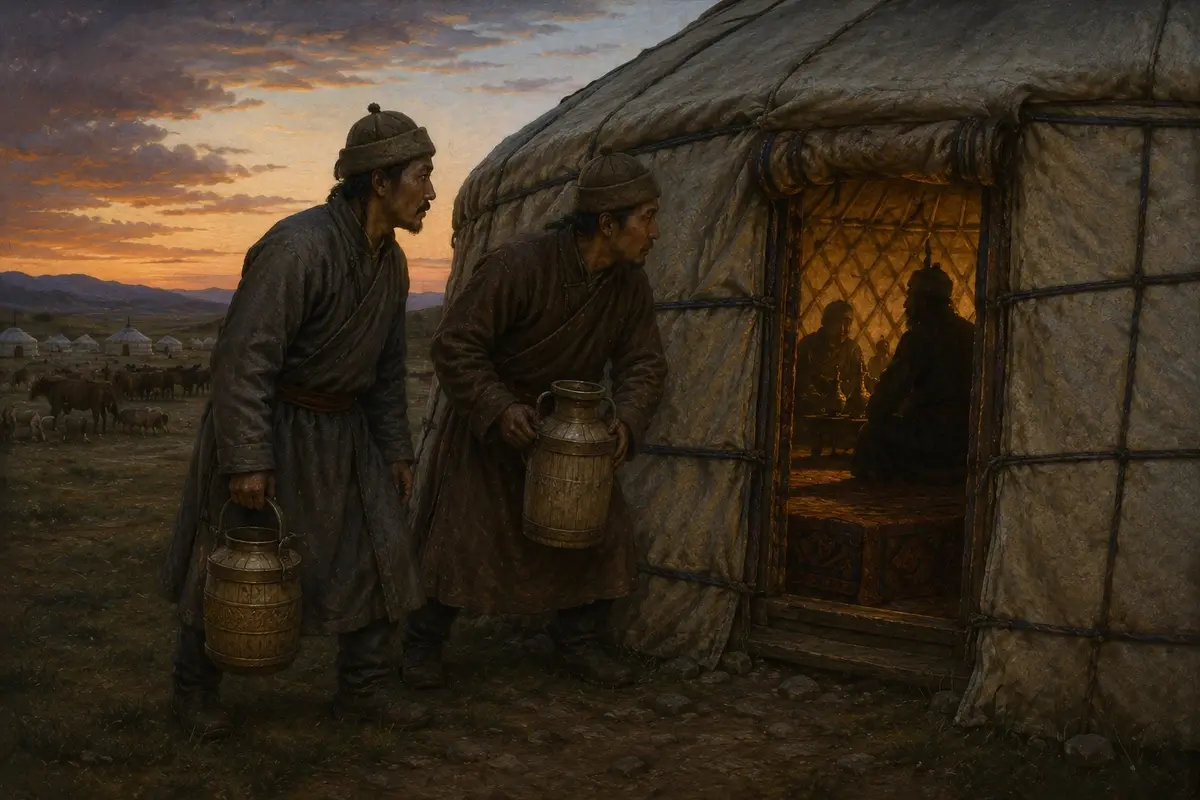
Badai and Kishlik heard the plan from outside the tent and rode all night. Both were still being honoured for it decades later.
Two herdsmen named Badai and Kishlik overheard the attack being discussed and rode through the night to reach Temujin's camp. There is a practical reason such things happened. Tents, and even the more permanent houses these people used, were built of felt and canvas over light frames. Almost nothing said indoors was private, and everybody knew it except, apparently, the people making plans indoors.
Neither man was ever forgotten. Both later swore the oath at Baljuna, and when Temujin was proclaimed Genghis Khan in 1206 both were made darkhan, a status carrying hereditary exemptions and privileges that passed down their descendants.
Defeat at Qalaqaljid Sands
The warning bought him hours rather than safety. Temujin abandoned his camp, gathered what forces he could reach, and rode.
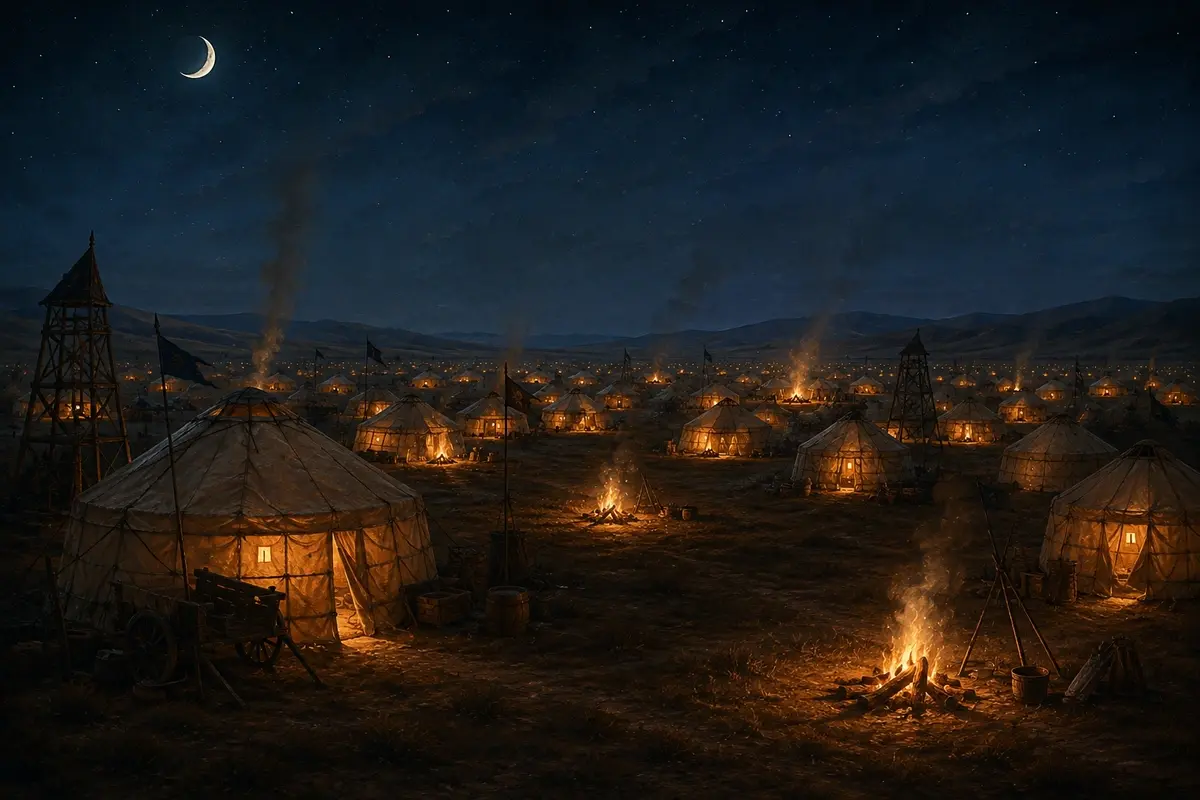
He left the camp standing and went. What he could not do was outrun a Kereit force that had already mobilised.
He escaped two successive attempts to trap him and was run down anyway, at a place called Qalaqaljid Sands, in the spring of 1203. One reckoning of the numbers gives him around 2,500 men against 3,000, and every account agrees he was outmatched.
It was a comprehensive Kereit victory. His forces were scattered and many followers left him, having concluded that backing him now meant certain destruction. His son Ogedei, seventeen years old, was severely wounded and lost on the field; Borokhula found him and tended the wound. Bo'orchu had his horse killed under him and got out on foot.
What saved Temujin was two men who had come over from the other side. Kuildar of the Manghud and Jurchedei of the Uru'ud had defected to him shortly before, and in the fighting Jurchedei put an arrow into Senggum. The wound threw the Kereit into confusion long enough for Temujin to break contact. Wang Khan then declined to pursue, on the reasoning that his enemy was finished anyway.
Temujin retreated east along the Khalkha river, gathering the scattered remnant as he went. The figures given for what was left range from about 2,600 to 4,600 horsemen, out of a following that had recently numbered in the tens of thousands.
The Baljuna Covenant
He halted at a muddy water source called Baljuna, somewhere near the Jin frontier, and its exact location is still argued over. He had gone that way partly hoping for reinforcements and partly because sanctuary across the Chinese border was a real option if everything failed.
What happened there is the most celebrated episode of his early life. A horse was killed, and Temujin drank the foul water and swore that if he regained his position he would share the sweet and the bitter with the men beside him for as long as he lived. Every man present drank it after him.
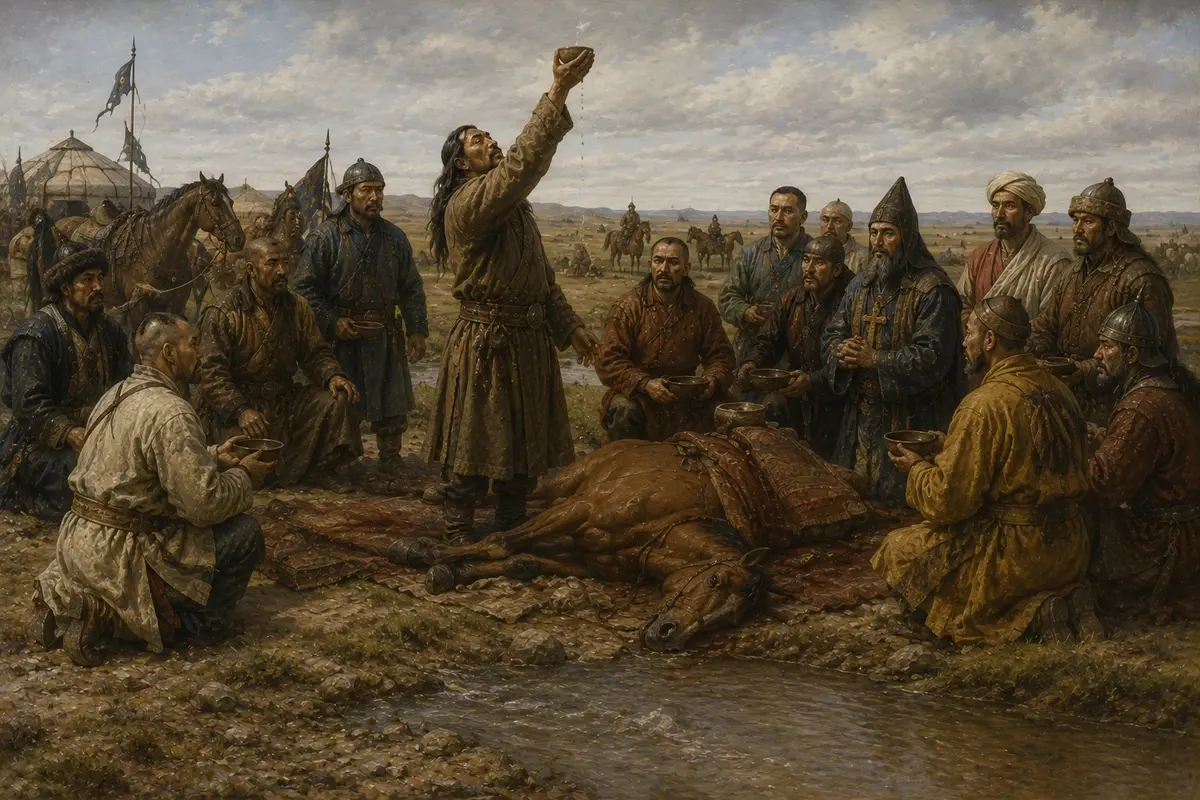
Fourteen to nineteen men from nine tribes drank the water with him, among them Christians, Muslims and Buddhists.
The composition of that group is the point. Accounts give between fourteen and nineteen men, drawn from nine different tribes, and they included Christians, Muslims and Buddhists, held together by nothing except loyalty to Temujin and to each other. Muslim merchants were supplying the camp with sheep at the time. One historian has called it a proto-government of a proto-nation, and the description fits: it is the empire's later habit of ignoring origin in favour of loyalty, in miniature and under duress.
The Secret History leaves the whole episode out, almost certainly because the group was largely non-Mongol and the author wanted a Mongol story. For a long time that omission led scholars to treat it as legend, until Francis Woodman Cleaves published a study in the Harvard Journal of Asiatic Studies in 1955 assembling the Chinese and Persian evidence for it. Its historicity is still not universally accepted, but the men themselves clearly believed in it.
They became known as the Baljunatu, and having been there outranked every loyalty offered afterwards. When Temujin distributed honours in 1206 the Baljunatu took the highest of them. Yuan-dynasty memorial inscriptions written generations later still name a man's ancestor as one who drank the black water of Baljuna, and treat it as the highest thing that could be said about him.
The Messages That Broke the Coalition
The reconquest began with correspondence. From Baljuna, Temujin sent envoys out across the whole hostile coalition with long, carefully differentiated messages.
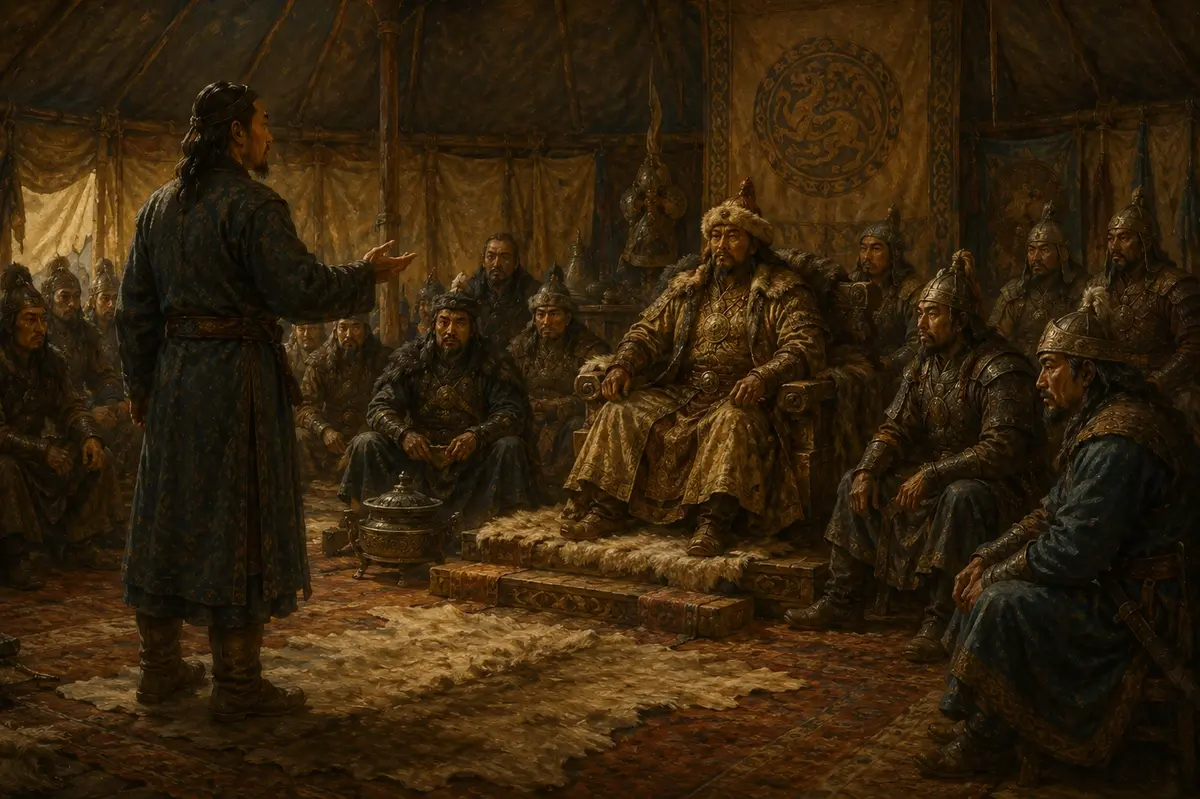
The message to Wang Khan was an itemised account of everything the two families had done for him over forty years.
The one to Wang Khan reads like a ledger. It set out, item by item, what Temujin's family had done for him: his father Yesugei's intervention when Wang Khan had been driven off his throne, and the restoration that followed; the campaigns Temujin had fought to put him back a second time after his own brother took the khanate; the flocks shared when he had nothing; the wars won on his behalf. Then the question the whole message existed to ask. After all of that, how had it come to this?
Other messages went to Senggum, to Jamukha and to the lesser khans in the coalition, some reproachful, some threatening, all of them designed to make men reconsider which side they were on.
As diplomacy it failed. As politics it worked completely. Through the summer the coalition began coming apart: Jamukha and a large part of Wang Khan's allies split away, Wang Khan attacked them for it, and a number of them came over to Temujin instead. By the autumn of 1203 the position had reversed. Temujin had more than forty thousand men. Wang Khan had roughly half that.
Qasar's Ruse and the Jej'er Heights
The end came through a deception involving Temujin's brother Qasar, who was presented to the Kereit as a man separated from his family and looking for Wang Khan's protection. The story was convincing enough to lower the Kereit guard.
Wang Khan was at Jej'er Undur, on the upper Kherlen, holding a feast and taking no precautions. Temujin marched, surrounded the camp and attacked. The fighting went on for three days and nights before it ended decisively in his favour.
Wang Khan fled west into Naiman country, where a border commander who did not recognise him, or did not believe him, killed him. He was around seventy-three. Senggum escaped south and died in exile some time afterwards; the accounts disagree about where, some saying Tibet and others placing his death much further west.
The Kereit were not destroyed but absorbed, and Temujin did it through exactly the marriages he had been refused. He took the Kereit princess Ibaqa as a wife and married her sister Sorghaghtani and their niece Doquz into his own family. Sorghaghtani went to his youngest son Tolui and became the mother of Mongke, Kublai and Hulagu. He also took over the keshig, the Kereit royal bodyguard, and made it the institution at the centre of his own government.
Jamukha's conspiracy did what it set out to do. It broke the alliance, and it came within one arrow of ending Temujin's career in the field. What it could not do was outlast him. Three years later he was proclaimed Genghis Khan, and Jamukha was executed shortly afterwards.