Two years finished every rival Temujin had. The Kereit fell in three days after a night attack; the Naiman a year later, abandoned mid-battle by their own ally; and Jamukha was handed over by his last five companions. What Temujin did with the betrayers, and with the man they betrayed, explains how he decided who to forgive.
Wang Khan's fall took a single night attack in the autumn of 1203, and it began a run of two years in which every independent power on the Mongolian plateau was destroyed. The Kereit went first. The Naiman followed in 1204. Jamukha, the sworn brother who had spent two decades opposing Temujin, was handed over by his own men and executed in 1205 or 1206.
This is the hinge of the whole story. Everything before it is a talented commander operating inside somebody else's kingdom. Everything after it is an emperor, because the assembly that made Temujin into Genghis Khan in 1206 was only possible once these three men were gone.
The sources disagree in places, and two of the disagreements matter. What happened to Wang Khan's severed head is told very differently by different chroniclers, and the year of Jamukha's death is given as either 1205 or 1206. Where the accounts split, this article says so.
Qasar's Ruse and the Camp at Jeje'er Undur
The quarrel that ended the Kereit had begun that spring over a wedding. Temujin, who had been Wang Khan's protege for two decades and had twice put him back on his throne, proposed a double marriage between the two families. Wang Khan's son Senggum refused it, seeing a claim on his own inheritance, and the refusal turned into a plot: an invitation to a betrothal feast that was in fact an ambush.
Temujin was warned in time, but not well enough. The Kereit ran him down at Qalaqaljid Sands and beat him comprehensively. He fell back east toward the Jin frontier with a few thousand men and swore the covenant at Baljuna with the handful who stayed, which is the low point of his entire career.
By the autumn the balance had reversed. Over the summer his envoys and letters pulled the enemy coalition apart, defections came in, and by autumn he had more than forty thousand men while Wang Khan had barely half that.
What he needed was to find him. The solution was a deception involving his brother Qasar, who was presented to the Kereit as a man separated from his family and seeking Wang Khan's protection. It worked well enough to establish exactly where the Kereit camp lay and to lower their guard.
Temujin's army rode through the night and surrounded the camp at Jeje'er Undur, on the upper Kherlen, where Wang Khan was holding a feast. The Kereit fought for three days before they gave in. It was the largest and best-established confederation on the eastern steppe, and it ceased to exist inside seventy-two hours.
Wang Khan's Death and the Head Brought to Tayang
Wang Khan escaped the battle and fled west into Naiman country with almost nobody. He was around seventy-three years old and had ruled the Kereit, with two interruptions, since the 1160s.
What killed him was anonymity. A Naiman border guard named Qori Subechi stopped him, did not recognise him, and did not believe him when he said who he was. He was killed on the spot. His son Senggum got away south into Western Xia and died in exile some time later, the accounts disagreeing about where.
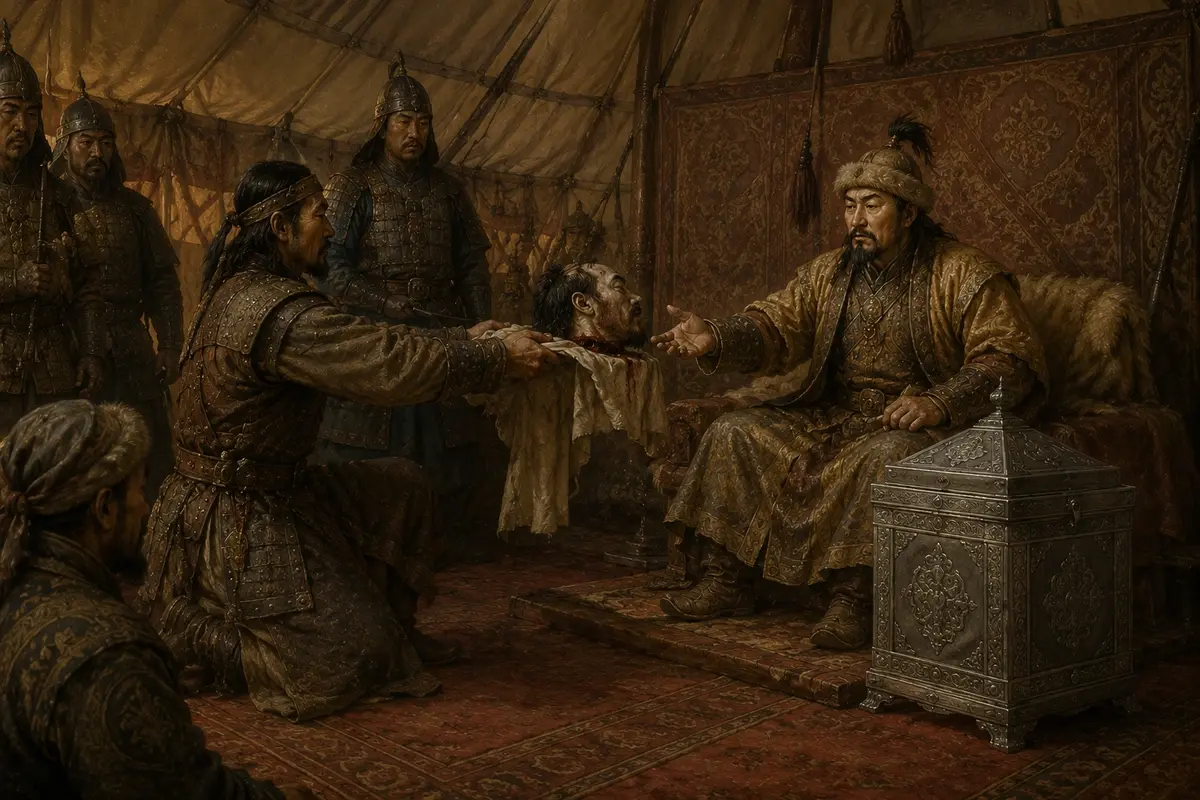
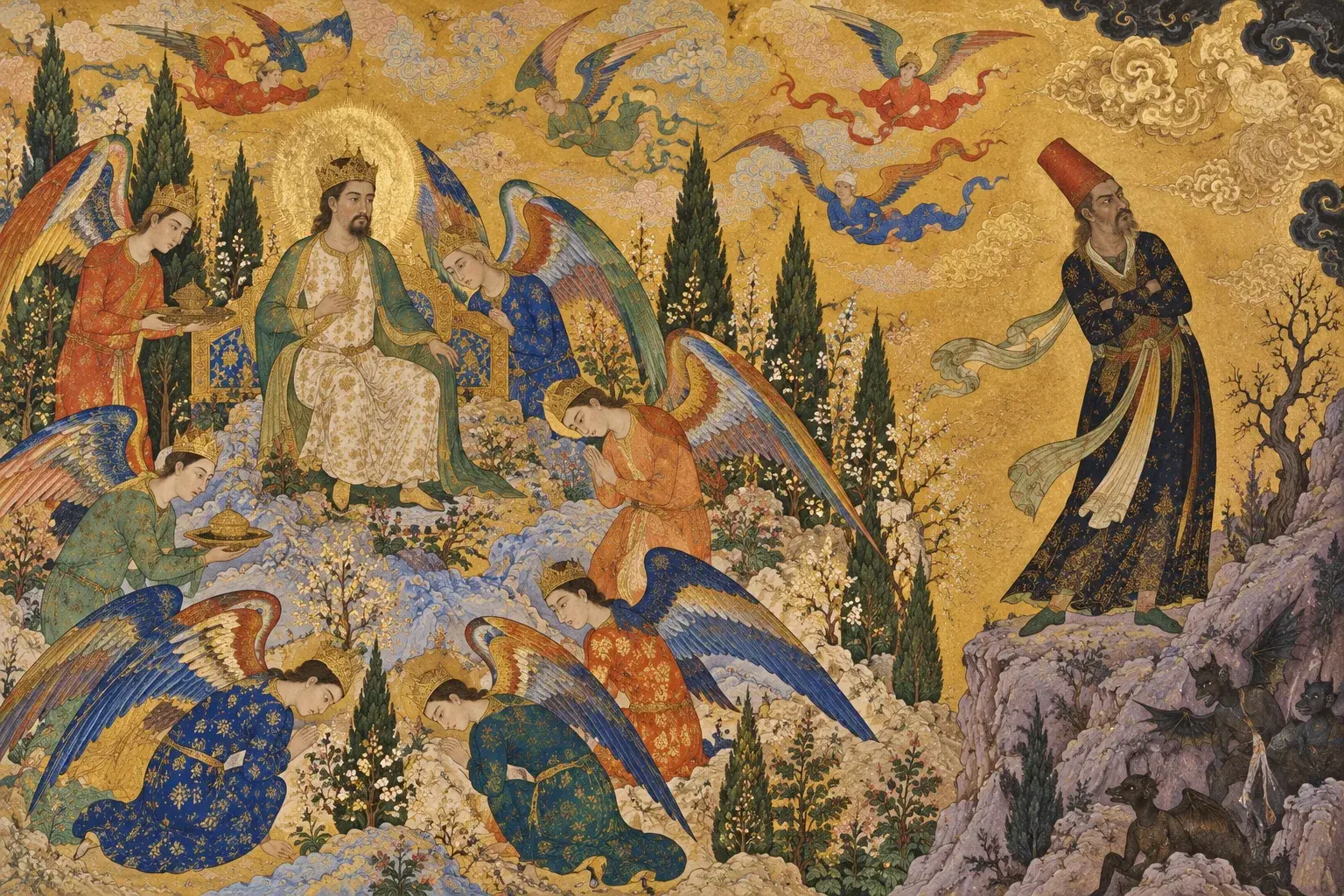
The scene was famous enough that a Mughal workshop was still painting it for a manuscript of Rashid al-Din's chronicle in 1596.
The head was cut off and carried to Tayang Khan of the Naiman, and what happened next is one of the strangest passages in the Persian tradition. Rashid al-Din has the head laid out on white cloth and honoured formally, with a wine ceremony and music, as befitted a great khan.
During the ceremony the head appeared to move. Some versions have it grin. Tayang lost his nerve completely, flung it to the ground and trampled it, and was rebuked on the spot by his own senior general for the sacrilege. It is a far uglier scene than the reverent preservation sometimes described, and it tells you something about how frightening the omen was taken to be.
What Happened to the Kereit
The Kereit were not exterminated. They were absorbed, and the mechanism was marriage.
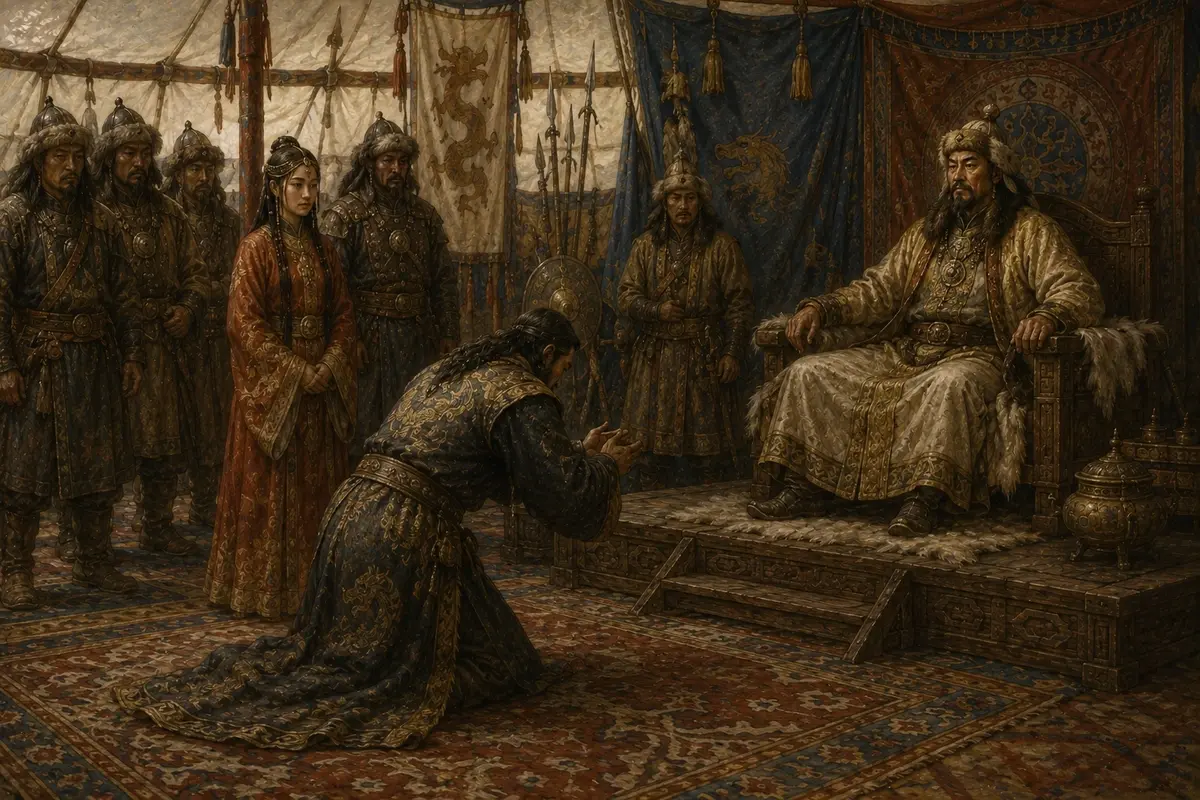
Submission came with a gift, and among the Kereit royal family the gift was daughters, which turned out to matter more than anyone intended.
Wang Khan's younger brother Jaqa Gambu had favoured Temujin over his own brother, and he gave his daughters into Temujin's family. One, Ibaqa, married Temujin himself. Another, Sorghaghtani Beki, was married to his youngest son Tolui.
That second marriage reshaped world history. Sorghaghtani became the mother of Mongke, Kublai, Hulagu and Ariq Boke, four of the most powerful rulers the empire ever produced. The Christian Kereit royal line that Temujin destroyed in 1203 was supplying the men who ruled from Beijing to Baghdad within two generations.
Jaqa Gambu himself did not enjoy it for long. He was killed around 1204, during a Kereit revolt.
Temujin also took the institution. The keshig was the Kereit royal bodyguard, and he adopted it wholesale, later expanding it to ten thousand men drawn from the sons of his own commanders. It became the corps at the centre of his government, supplying officers, guarding his person, and keeping the heir of every powerful man in the empire permanently at court. The confederation he destroyed supplied both the machinery of his household and, through Sorghaghtani, the men who eventually ruled it.
Badai, Kishlik and the Rank of Darkhan
Among the rewards distributed after the campaign, two went to men who had no business receiving anything.
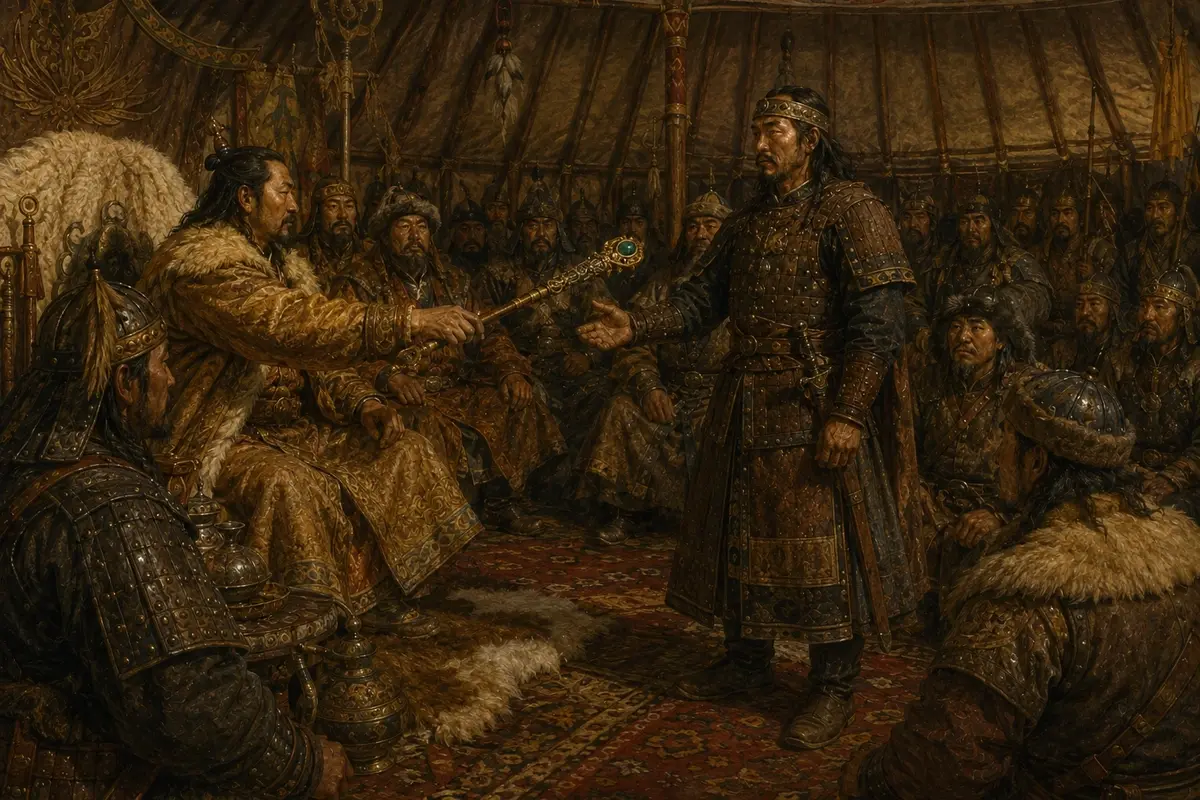
Honours were conferred in front of the whole coalition, which was the point: everyone watching learned what service was worth.
Badai and Kishlik were herdsmen in the Kereit camp. They had overheard the plan to attack Temujin earlier that year and ridden through the night to warn him, which is very probably the reason he survived at all. Both had also been among the men who swore the covenant with him at Baljuna when he was reduced to almost nothing.
They were given the rank of darkhan, and the privileges attached to it were extraordinary. A darkhan paid no taxes and was exempt from requisitioning. When plunder was divided he kept his share undeducted while everyone else surrendered a portion. He could enter the ruler's presence at any time without waiting for permission. And he was entitled to a standing pardon for nine offences, so that only on a tenth was he in any danger. The status was hereditary, though the accounts differ on how many generations it ran for.
The motive was mixed and the theatre was deliberate. Two herdsmen were made hereditary aristocrats in front of the entire coalition, and nobody watching needed the lesson explained.
The Naiman Alliance and the Intercepted Warning
The survivors of the Kereit collapse went west. Jamukha, the Merkit and what remained of the Kereit attached themselves to Tayang Khan of the Naiman, the last great power still standing, and began assembling a coalition against Temujin.
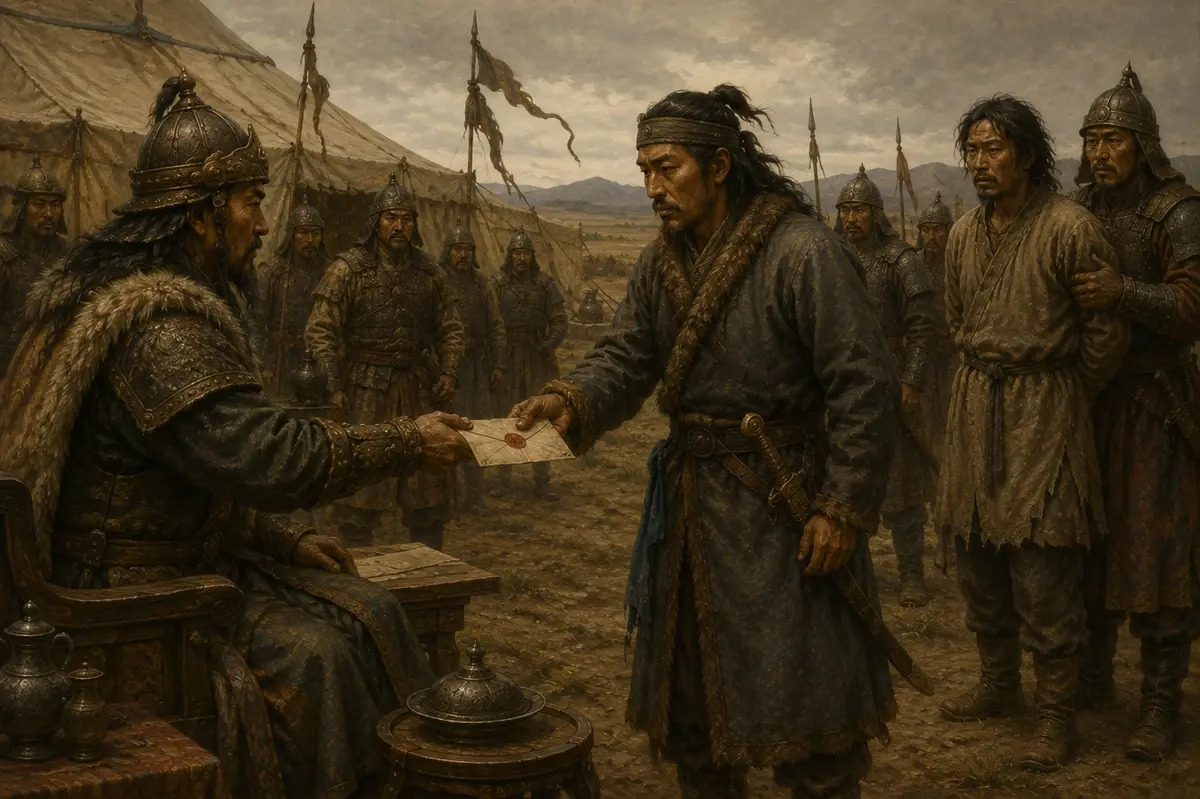
The Ongut chieftain was invited to join the alliance. He forwarded the invitation to the man it was aimed at.
Building it required recruiting, and the recruiting went wrong at the eastern end. Tayang approached Alaqush Digit Quri, who led the Ongut, a Nestorian Christian people holding the country along the Jin frontier, and invited him into the coalition.
Alaqush passed the warning straight to Temujin instead. It is difficult to overstate what that was worth: it told him the alliance existed, who was in it, and roughly what it intended, before it was ready to move.
He was rewarded after the victory with a marriage alliance, his son betrothed to Genghis Khan's daughter Alakhai Bekhi in 1207. His own end was less fortunate. He was killed in 1211 when his own people revolted against him.
Tayang Khan's Fatal Argument
In May 1204 Temujin moved most of his sixty-six thousand men west.
The Naiman had the larger army, and their scouts came back unimpressed with what was coming, reporting the Mongol horses as thin and poor. Tayang's own instinct was nonetheless to withdraw beyond the Altai and fight a war of attrition, drawing the Mongols deep into difficult country and wearing them down.
It was probably the right call. His son Kuchlug and his senior officer talked him out of it, calling the plan cowardice, and pushed him into offering battle instead. The two armies met at the foot of Mount Naqu in the Altai foothills, at a place remembered as Chakirmaut.
The Battle of Chakirmaut
Temujin opened by making the Naiman believe he was going around their flank, then went straight at them frontally, with the main body under his brother Qasar coming up behind the assault. The Naiman were pushed back toward the mountain.
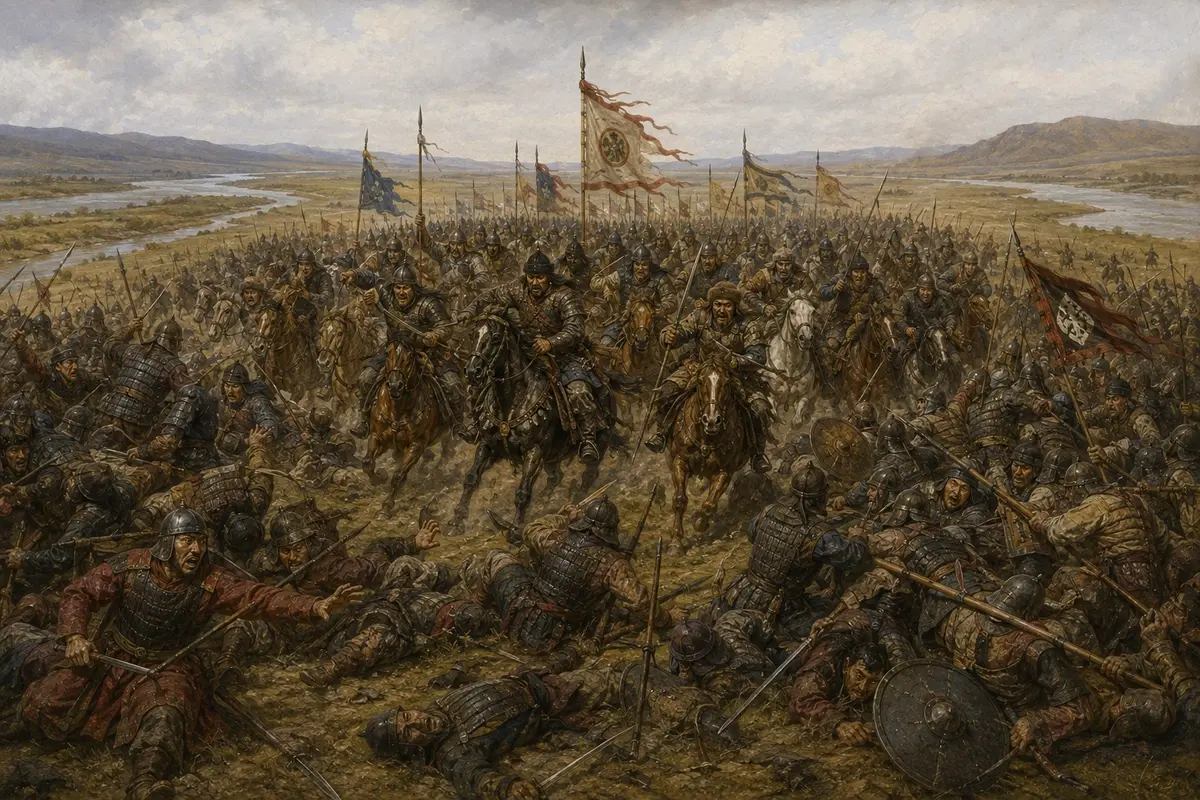
A feint at the flank, then a frontal assault with the main body behind it, and a Naiman army backed onto a mountain in the dark.
Then Jamukha left. Standing beside Tayang and watching the Mongol formations come on, he described them to his ally in terms designed to terrify him, and then pulled his own troops off the field before the fighting was decided. Whether this was calculation or simple recognition that the day was lost, it removed the Naiman numerical advantage at the worst possible moment.
Tayang, badly shaken, pulled his men into a defensive formation, which let the Mongol cavalry work around the flanks and envelop him. The Naiman refused an offer of surrender and fought on. In the dark, retreating up the mountain, large numbers of them fell to their deaths in the ravines of Naqu.
Tayang was killed. Kuchlug had been left holding a rear camp and got away with a small following when the Mongols reached him, which is the beginning of a pursuit that would run for the next fourteen years and end in the mountains of what is now Afghanistan. Tayang's wife Gurbesu was taken and became one of Temujin's wives.
One small episode from the same campaign is worth recording because of where it led. An enemy archer had earlier shot Temujin's horse out from under him. When the man was taken and questioned, he admitted it rather than denying it, and instead of being executed he was promoted. He is remembered as Jebe, meaning arrow, and he became one of the finest commanders the empire produced. It is the clearest single illustration of what alarmed the steppe aristocracy about Temujin: he would rather have a talented enemy than a well-born ally.
The Last Meeting of Temujin and Jamukha
Jamukha spent the following year on the run with his following steadily draining away to the winner. By the end he was down to five companions, hiding in the Tannu mountains.
Those five turned on him. Accounts have them binding him with a rope and delivering him to Temujin, hoping for reward, and one version says the quarrel that triggered it was Jamukha reprimanding them over a roasted ibex.
Temujin executed all five in front of him. His stated reason was that men who would betray their own lord had no place in his army, which is the same principle that had made Badai and Kishlik rich for the opposite behaviour.
Then he offered Jamukha his life. The Secret History gives the speech at length, and it is not the language of a conqueror disposing of a prisoner: let us be companions again, remind each other of what we have forgotten, wake each other from sleep. Even apart, he says, you were my blessed sworn brother.
Jamukha refused. There was room for only one sun in the sky, he said, and only one lord over the Mongols. He asked instead for a noble death, meaning execution without the spilling of blood, which was the manner reserved for aristocrats and which mattered because blood spilled on the ground was an offence in itself.
His back was broken. He was given a proper burial, and by one tradition Temujin buried him wearing the golden belt he had given him when the two of them swore the anda bond as boys.
Two Deaths and One Principle
Set the two executions side by side and the logic is unmistakable. The men who handed over their own leader were killed immediately. The leader they handed over was offered a place in the empire and, when he declined it, was given the death he asked for and buried with honour.
It looks like chivalry and it was policy. Rewarding a betrayer teaches every follower that betrayal pays; killing him teaches the opposite in front of witnesses. Honouring a defeated enemy who fought openly costs nothing and buys the loyalty of everyone who followed him. Temujin applied that calculation for the rest of his life, from the Altai to northern China, and it was never really about honour.
There is one more thing worth drawing out of these two years. Every rival Temujin removed left him something he kept. From the Kereit he took the keshig and the marriages that produced Mongke and Kublai. From the Naiman he took Jebe. From Jamukha he took, by his own account, nothing at all except the end of the argument, which is perhaps why the Secret History lets that scene run so long.
Two years later, at a great assembly on the Onon, the tribes of the plateau confirmed him as Genghis Khan.