In the spring of 334 BCE a twenty-one-year-old crossed from Europe into Asia with something like 40,000 men and no navy worth the name, going up against an empire that stretched from the Aegean to the Indus and could out-recruit and out-spend him without noticing. Eight years later that empire didn't exist. It came down to three battles. And what's striking, reading them together, is how much the same thing happens each time — Alexander finds one gap, goes at it personally at the head of the cavalry, and aims himself directly at the Persian king.
What He Inherited
Alexander did not start from nothing. His father, Philip II of Macedon, had spent twenty years turning a marginal northern kingdom into the dominant power in Greece. Philip rebuilt the army from the ground up — professional, year-round, drilled, and built around the sarissa, a pike up to six metres long, held in both hands. A phalanx of these presented five ranks of spearpoints to anyone approaching from the front. It was effectively unbreakable head-on and dangerously clumsy anywhere else. Philip paired it with heavy shock cavalry, the Companions, and the combination was the thing that won every battle Alexander fought. The phalanx pins the enemy line and holds it; the cavalry finds or makes a gap and drives through it. Philip beat the Greek city-states at Chaeronea in 338 BCE — Alexander, aged eighteen, commanded the left wing — and was planning the invasion of Persia when he was assassinated in 336 BCE. Alexander took the throne at twenty, secured the north, destroyed Thebes, and then went east with his father's army and his father's plan. He'd also been taught for three years by Aristotle, and slept with a copy of the Iliad under his pillow. He believed he was descended from Achilles. That mattered more to how he fought than anyone comfortable with modern strategy would like.
Battle One: Granicus, 334 BCE
The first encounter was at the river Granicus in north-west Asia Minor, against the Persian satraps of the region rather than the king himself. The Persian force positioned its cavalry along a steep, muddy far bank — specifically to make a crossing suicidal. His veteran general Parmenion advised waiting until dawn and crossing elsewhere. Alexander went straight at it. He led the Companion cavalry across the river and up the bank personally, wearing conspicuous armour and a helmet with two white plumes — exactly what he wanted the enemy to be looking at. It nearly ended the whole campaign on day one. A Persian noble got a blow in on Alexander's helmet and split it. He was raising his arm for the second when Cleitus the Black cut it off. The Persian cavalry broke, and a large body of Greek mercenary infantry in Persian service were left behind. Alexander, who had come as the appointed leader of a Greek crusade against Persia, treated them as traitors. Most were cut down. He sent 300 sets of captured armour back to Athens — dedicated to the goddess, with an inscription noting the gift was made by Alexander and the Greeks, except the Spartans, who had refused to join. Petty, precise, and very effective propaganda.
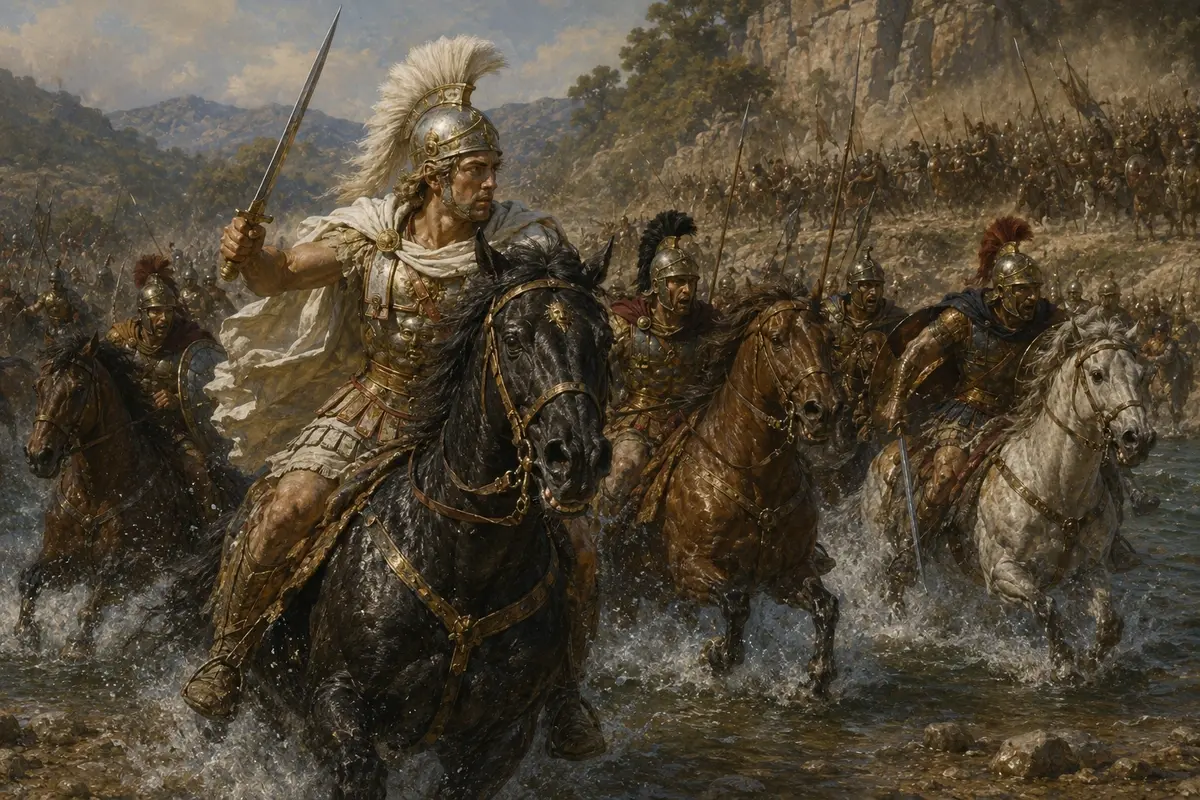
He wore the most conspicuous armour in the army on purpose. It nearly ended the campaign on day one — a Persian noble split his helmet before Cleitus the Black cut off the arm on the backswing.
The Gordian Knot
Later that year, at Gordium, he came across the wagon of the legendary King Midas with its yoke fastened by an intricate knot of cornel bark, and a prophecy that whoever undid it would rule Asia. Everybody knows he cut it. The sources are actually split — Aristobulus says he pulled out the pin holding the yoke and slid the knot off, which is arguably a better story. Either way the point is the same: he refused to accept the terms of the problem.
Battle Two: Issus, 333 BCE
Now Darius III came in person. Darius deserves better than his reputation, which was written by the winners. He assembled a large army and then did something clever that backfired: he got behind Alexander, moving through a mountain pass to his rear and cutting his supply line. It should have been decisive. Instead, it put his enormous army into the narrow coastal plain by the Pinarus river, hemmed between mountains and sea — a frontage of perhaps three kilometres. He had put himself somewhere his numbers were worthless. Alexander turned around and marched back, delighted. The pattern repeated. The phalanx engaged and struggled — the riverbank was steep and a gap opened that cost heavy casualties. But Alexander took the Companions in a wedge against the Persian left, broke it, and then wheeled inward straight at Darius's chariot in the centre. And Darius fled. He turned his chariot and ran, and when the ground got rough he abandoned it for a horse. His army, seeing the royal standard leaving, disintegrated. He left behind his mother, his wife and his children, captured in the Persian camp. Alexander treated them with conspicuous courtesy — kept their royal status, their household, their titles. It was decent, and it was also strategy: he was positioning himself as the legitimate successor rather than a foreign conqueror.
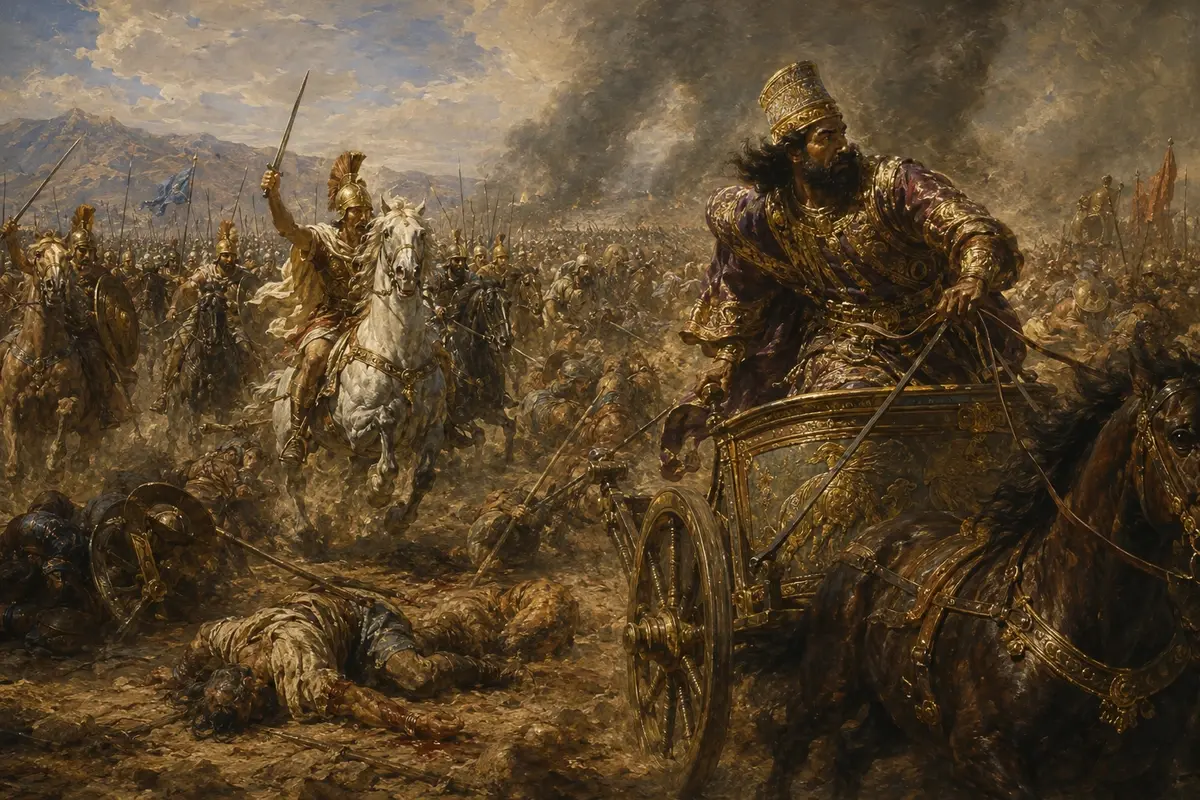
He turned his chariot and ran. His army, seeing the royal standard leaving, disintegrated. In the Persian system the king's survival was the state's survival — and this was what it looked like.
The Detour That Won the War
Instead of chasing Darius, Alexander spent nearly two years going south — down the coast through Phoenicia and into Egypt. This looks like a delay and it was the decisive strategic move of the campaign. Persia's fleet was overwhelmingly Phoenician and Cypriot, and Alexander had no navy to fight it. So rather than beat the fleet at sea, he took away its home ports. Tyre cost him a seven-month siege — the city was on an island and he built a causeway out to it, which is still there and has silted into a permanent isthmus. When it fell he was brutal. Gaza cost him two more months. Egypt surrendered without a fight and welcomed him as a liberator from Persian rule. He was made pharaoh, founded Alexandria, and made a long desert journey to the oracle of Ammon at Siwa, where the priest apparently addressed him as son of the god. What he was told there he never fully disclosed.
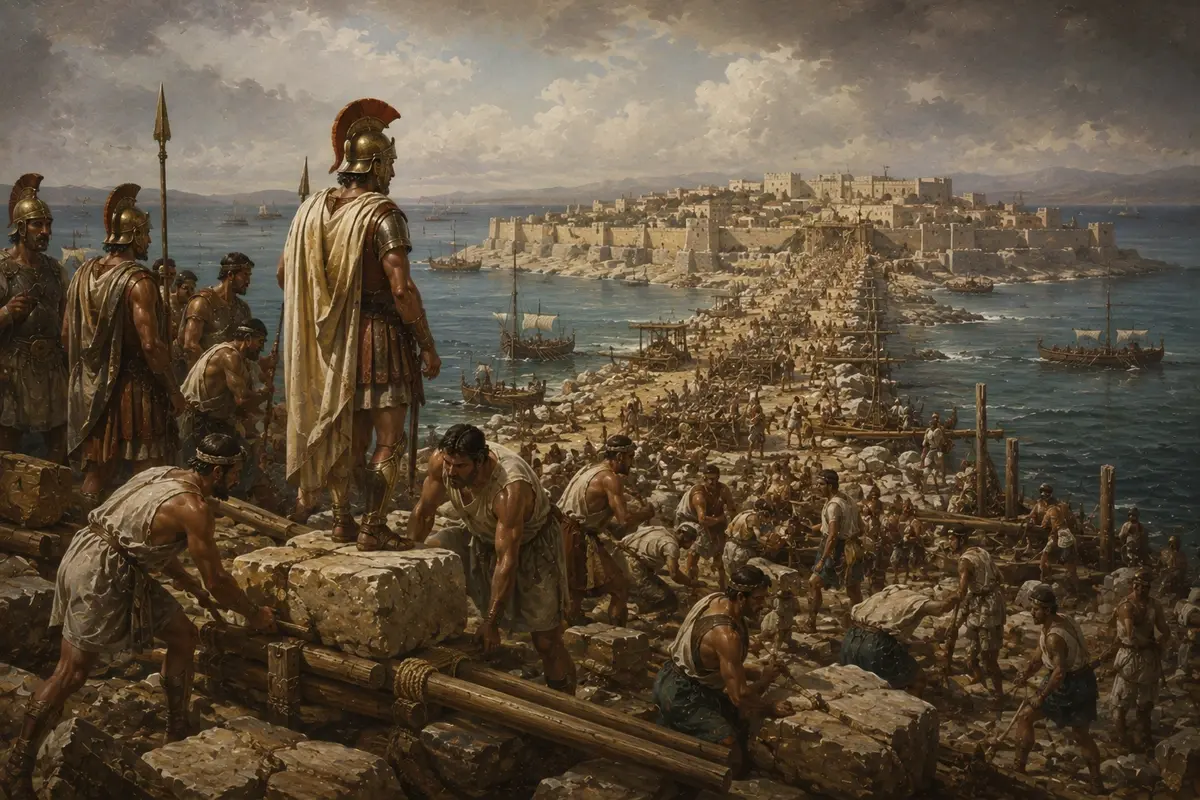
He built a causeway out to the island city. It took seven months. The causeway silted into a permanent isthmus that is still there. By taking Phoenicia he neutralised the entire Persian fleet without fighting it at sea.
Battle Three: Gaugamela, 331 BCE
The final one, and the one to know. Darius had two years to prepare and prepared properly. He picked the ground himself — a wide plain near Gaugamela in northern Iraq — and had it levelled and cleared so his chariots could run and his cavalry deploy. He recruited across the eastern empire: heavy cavalry from Bactria and Scythia, war elephants, and 200 scythed chariots. Modern estimates: perhaps 100,000 Persians against 47,000 Macedonians. The night before, Parmenion advised a night attack. Alexander refused — Plutarch has him say he would not steal a victory — and then slept so soundly he had to be woken. Darius, expecting exactly that night attack, kept his entire army standing under arms all night. By dawn they'd had no sleep and the Macedonians had. Alexander refused the standard deployment. He angled his whole line obliquely, weighted the right, and posted a second line facing backwards to handle the envelopment he knew was coming. Then he began marching to his right, at an angle, away from the cleared ground. Darius had to respond, or Alexander's right would slide past his flank entirely onto broken terrain where the chariots were useless. So he sent his left-wing cavalry out to head them off. And that pulled his line apart. Alexander watched a gap open between the Persian left and centre, waited, then formed the Companions and the nearest phalanx units into an enormous wedge and drove it straight into the gap — aimed, again, directly at Darius. The scythed chariots had already failed: the Macedonians simply opened lanes in their ranks and let them through, then dealt with them from behind. On the left Parmenion was hard pressed and a gap opened in the Macedonian centre, and Persian and Indian cavalry poured through — and then rode straight to loot the Macedonian baggage camp instead of turning to attack the rear. And Darius fled again.
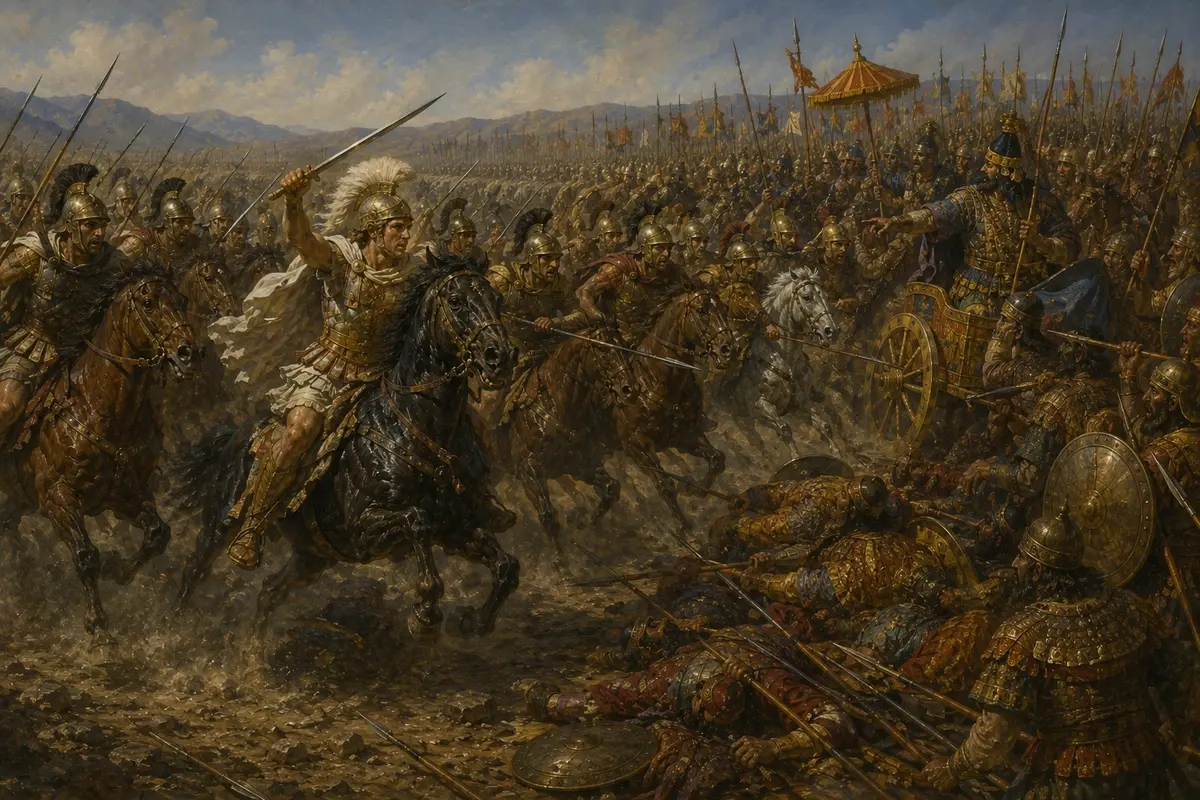
He watched a gap open, waited, then formed the cavalry into a wedge and drove it straight through — aimed, as always, directly at Darius.
How Darius Actually Died
Not in battle, and not by Alexander. He fled east trying to raise another army, and his own satraps concluded he was finished. Bessus, satrap of Bactria and a relative, arrested him, put him in chains, and dragged him along as a prisoner. With Alexander's cavalry closing on the column in the summer of 330 BCE, they stabbed him and left him in a wagon by the road. The Macedonians found him dying, or already dead. Alexander covered the body with his own cloak and sent it to Persepolis for royal burial. Then he hunted Bessus for two years, caught him, and had him executed in the Persian manner for regicide — which is exactly what a legitimate successor to the throne would do, and precisely the point he was making.
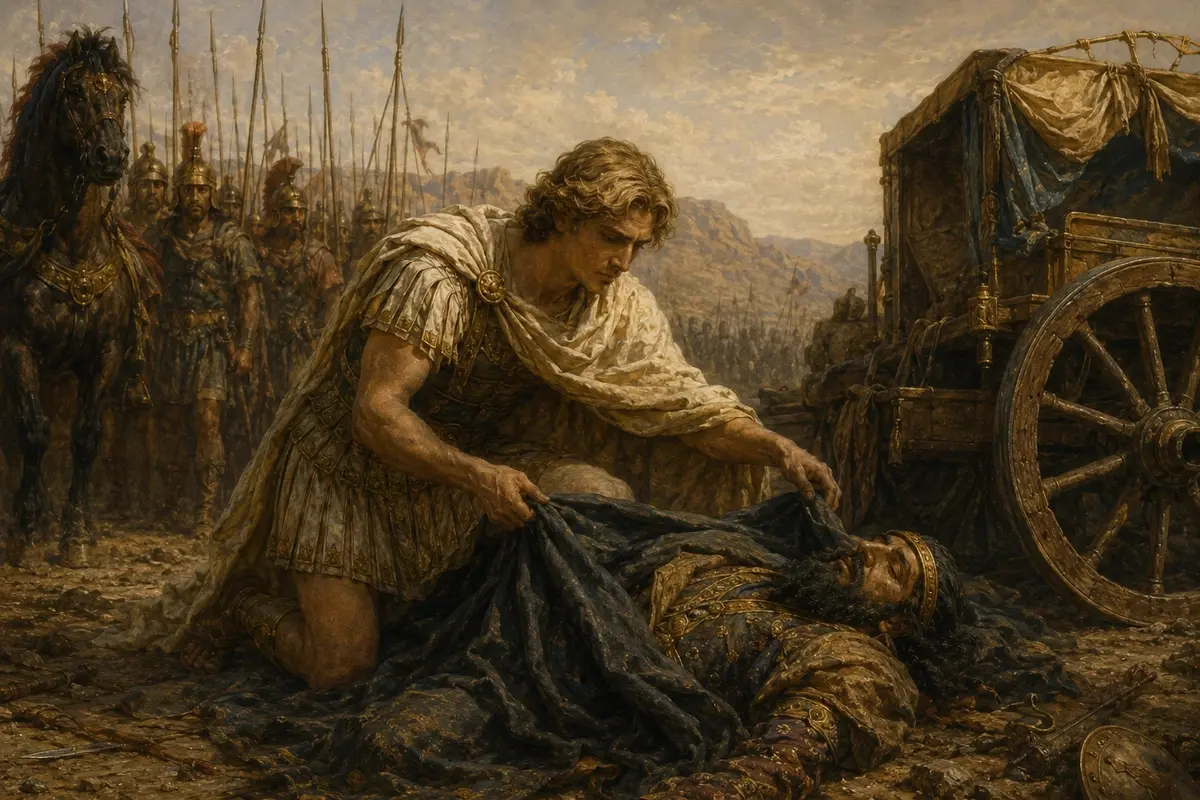
He covered the body with his own cloak and sent it to Persepolis for royal burial. Then he hunted Bessus and had him executed for regicide — which is exactly what a legitimate successor to the throne would do.
Why Alexander Won
Not because Persians were poor soldiers. Persian cavalry was excellent and at Gaugamela very nearly broke through. That reading is Greek propaganda. Better system. The sarissa phalanx plus heavy shock cavalry was a combined-arms machine nothing in the Persian order of battle had an answer to. Persia's own best infantry were Greek mercenaries, which tells you what everyone already knew. One decision-maker. Alexander commanded in person and could commit instantly. Darius ran a coalition of satraps speaking different languages, whose loyalty was to the throne rather than the man on it. When he fled, there was nothing holding it together. He aimed at the king. All three battles are the same idea: pin the line, find the gap, drive at Darius. Persia's structure made the king a single point of failure and Alexander understood it. And logistics. The two-year detour to take the Phoenician ports rather than fight a fleet he couldn't beat is the most underrated thing he ever did. He died at Babylon in 323 BCE, aged 32, of a fever — or something else; the argument has run for 2,300 years. He left no viable heir, and his generals spent the next forty years tearing the empire apart.
Sources
Nothing written by anyone who was there survives. Everything comes through later authors working from lost eyewitness accounts. Arrian, Anabasis of Alexander (2nd century CE) is the most reliable, because he used Ptolemy and Aristobulus, both of whom served on the campaign. Plutarch, Life of Alexander covers character and anecdote rather than tactics. Quintus Curtius Rufus, Diodorus Siculus and Justin are more colourful, less trustworthy. For modern work: Robin Lane Fox's Alexander the Great (1973) is the great narrative; A. B. Bosworth's Conquest and Empire (1988) is the sceptical scholarly counterweight.