Thermopylae is the famous one. Salamis is the one that won the war. A few weeks after Leonidas died in the pass, the Persian fleet was destroyed in a strait about 1,200 metres wide, Xerxes went home, and the invasion of Greece effectively ended. The whole thing was engineered by one Athenian politician who spent a decade preparing for it, reinterpreted an oracle to get his own way, and then won the battle by deliberately feeding false intelligence to the enemy. Themistocles is not an especially likeable figure. He was also, on the evidence, the most consequential strategist of the classical Greek world.
The Silver and the Ships
The story starts about three years before the invasion, with a lucky strike. Athens owned silver mines at Laurium in southern Attica, and around 483 BCE a rich new seam was opened. The state had a surplus, and the conventional proposal was to distribute it directly to the citizens — ten drachmas each. Themistocles argued for spending the lot on a navy instead. His stated reason was the ongoing squabble with the neighbouring island of Aegina, which was a genuine irritant and, crucially, an argument Athenians would actually accept. Herodotus strongly implies he was really thinking about Persia and knew that saying so would lose the vote. The Assembly backed him. Athens built around 200 triremes — going from a minor naval power to the largest fleet in Greece in about three years. Those ships were never used against Aegina. They saved Greece.
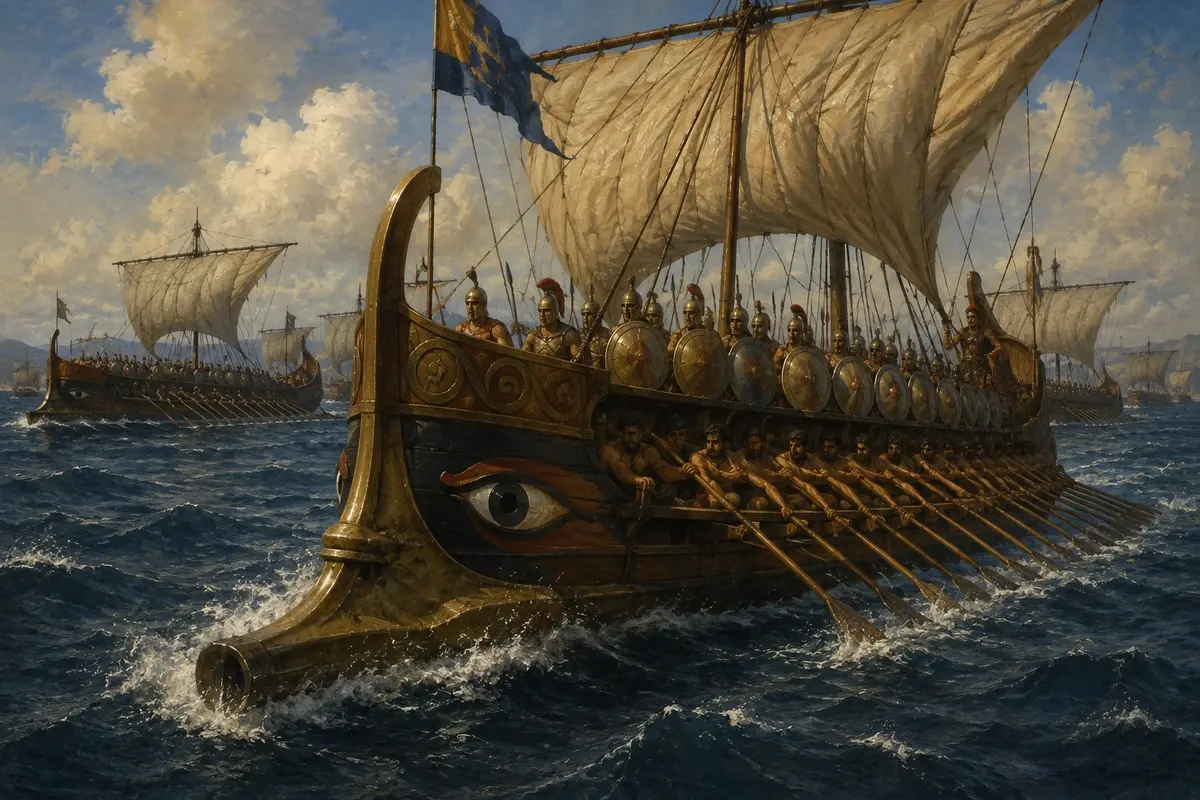
Athens built around 200 triremes in three years. The stated reason was Aegina. The real reason was Persia. Those ships never fought Aegina. They saved Greece.
The Riddle
When Xerxes crossed into Europe, Athens sent to Delphi. The first answer was as bad as anything the oracle ever produced: leave your land and your city and flee to the ends of the earth. The envoys refused to take that home and went back as suppliants until they got something better. The second answer was a riddle: when everything else is taken, Zeus grants that the wooden wall alone shall remain unconquered. Do not stand and wait for the horse and foot from the mainland. O divine Salamis, you too shall destroy the children of women, at seed-time or harvest. Athens argued about it publicly, which is the most Athenian thing in this entire story. The old and conservative said the wooden wall meant the thorn hedge that had once surrounded the Acropolis — stay and defend the citadel. The official interpreters said it meant the ships, but pointed at that last line: divine Salamis shall destroy the children of women. That sounded like a prophecy of Greek defeat at sea — so take to the ships, but sail away and found a new Athens somewhere else. Themistocles took it apart on a single word. If the god meant the Greeks would die there, he argued, he'd have said wretched Salamis, or hateful Salamis. He said divine Salamis. The children of women who die there are the enemy's. It is an outrageous piece of reasoning, and it worked. The Assembly voted to fight at sea.
Abandoning Athens
Then they did something almost no ancient city ever did voluntarily. They gave up their city. After Thermopylae fell there was nothing between the Persians and Attica. The Athenians evacuated — women, children and the elderly across to Troezen, Aegina and Salamis — and every man of fighting age onto the ships. A handful of the old and poor stayed on the Acropolis, having decided the thorn hedge reading was correct. The Persians took the rock, killed them, and burned the temples on the summit. The scorched column drums are still visible today, built into the north wall of the Acropolis — the Athenians used their own ruined temples as rubble when they rebuilt, deliberately, as a memorial. Athens was gone. The state now consisted of about 200 ships and the people standing on them, looking across the water at the smoke.
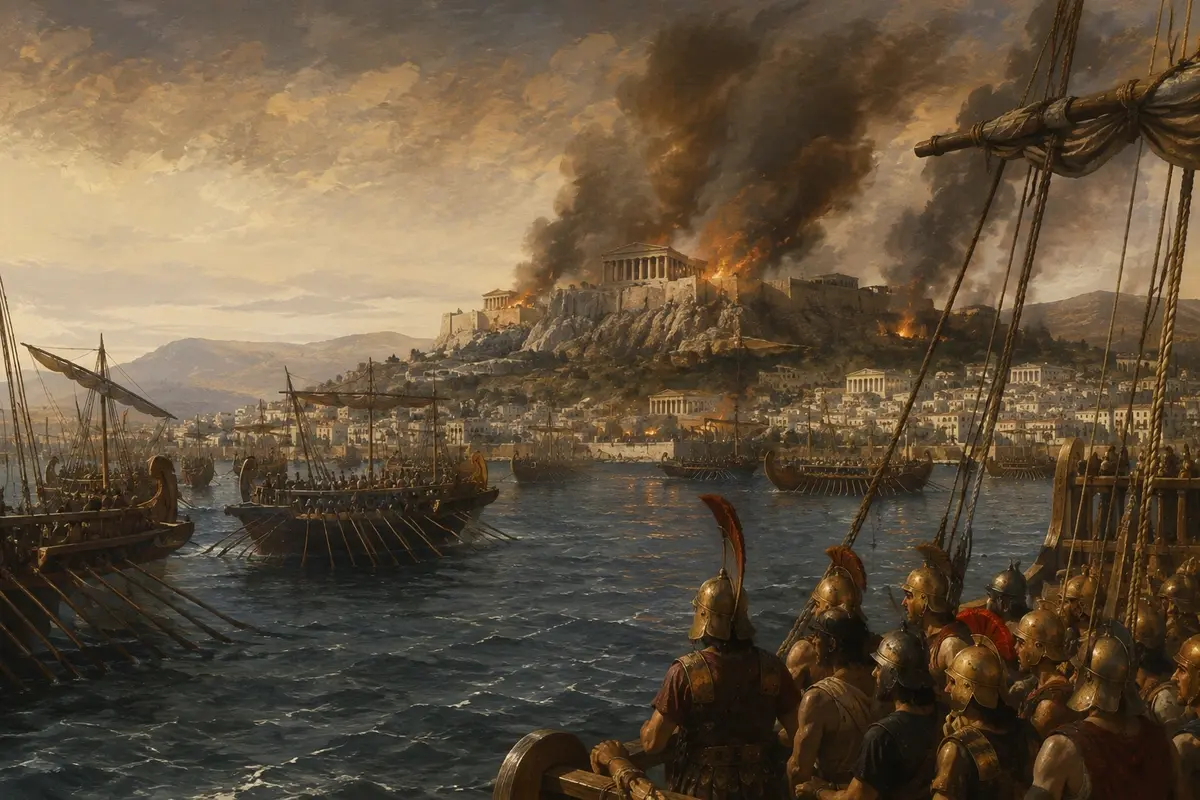
Athens was gone. The state now consisted of about 200 ships and the people standing on them, looking across the water at the smoke.
The Argument in the Fleet
The allied Greek fleet — roughly 370 triremes, of which Athens supplied around 180 — was anchored in the strait between Salamis and the mainland. It was commanded by the Spartan Eurybiades, because the Peloponnesians would not serve under an Athenian. And most of the commanders wanted to leave. Their reasoning was solid: Attica had fallen, the next defensible line was the Isthmus of Corinth, and fighting in a narrow strait next to a captured coastline looked like a good way to be trapped. Themistocles wanted to fight at Salamis for one reason: the narrowness. In open water off the Isthmus, superior Persian numbers and better-handled ships would tell. In a strait about a kilometre wide, numbers would be a liability — a big fleet can't deploy, and ships foul each other. He lost the argument. The council voted to withdraw. So he cheated.
The Message
That night Themistocles sent his slave Sicinnus across to the Persian fleet with a private message for Xerxes. The message said: Themistocles is secretly on your side. The Greek fleet is demoralised and about to slip away in the night. Block both ends of the strait now and you can destroy the entire allied navy in one action, and they'll fight each other rather than you. Xerxes believed it. It was consistent with everything his intelligence was telling him, and Greeks changing sides was routine. He sent a squadron to seal the western exit and moved the main fleet to close the eastern entrance, and the Persian crews spent the whole night at their oars holding position. By dawn the Greeks could not leave even if they'd wanted to. Themistocles had forced his own allies into the battle he wanted by handing the enemy a plan to trap them.
The Battle
Xerxes had a throne set up on the slopes of Mount Aegaleos to watch, with scribes beside him recording which of his captains distinguished themselves. He expected to watch a massacre. The Persians came into the strait in the early morning in column, and had to turn to form line as they entered. The Greeks, who had had a night's sleep, backed water at first — drawing them further in — and then attacked while the Persian line was still forming and following ships were still pushing in behind. After that it was chaos, and chaos favoured the smaller fleet. Greek triremes were heavier and slower, which mattered enormously in open water and not at all here. There was no room to manoeuvre, no room for the Persian speed advantage, and every ship destroyed at the front became an obstacle for ships behind it. A morning breeze off the sea caught the higher Persian decks. Aeschylus describes the strait so packed with wreckage that the water couldn't be seen. And most Persian sailors could not swim. Most Greeks could — and were fighting a few hundred metres from a friendly shore.
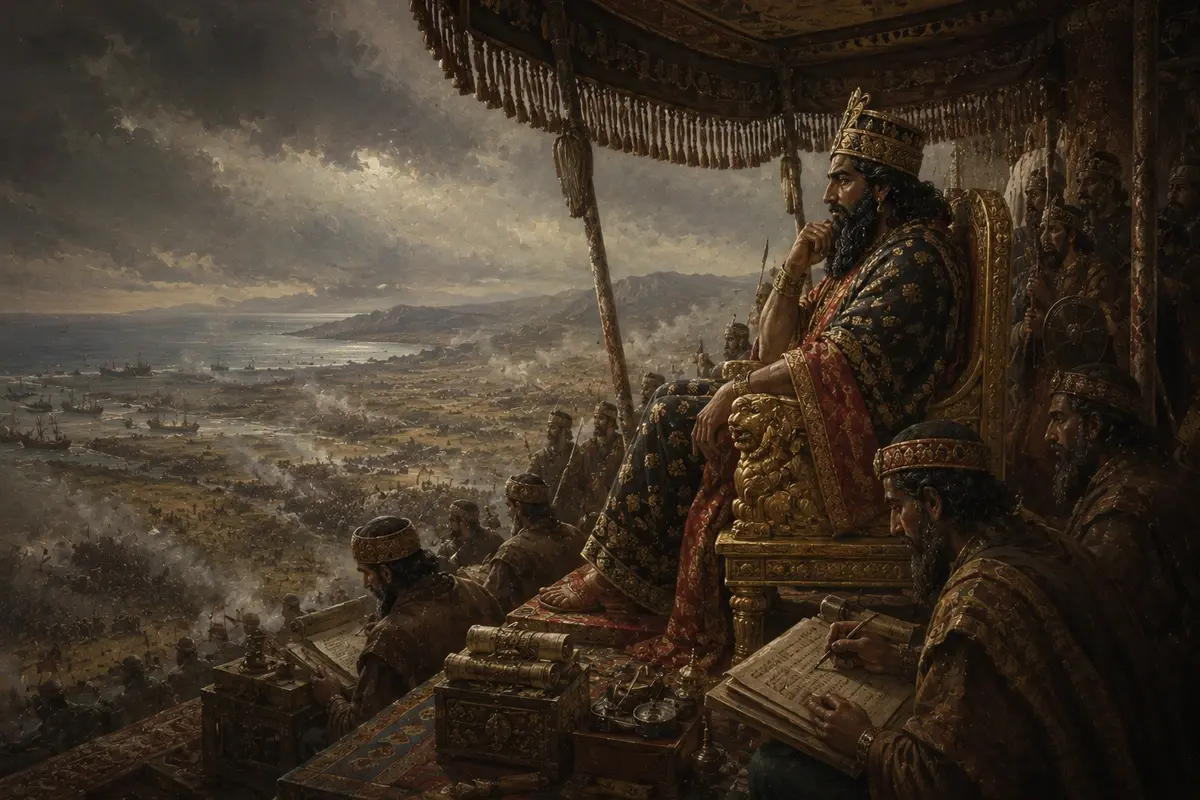
He expected to watch a massacre. He watched it — just not the one he had planned.
Artemisia
One episode is too good to leave out. Artemisia of Halicarnassus was a queen of a Carian city fighting on the Persian side, and one of Xerxes' ablest commanders. She had advised him against fighting at Salamis at all. In the rout, with a Greek ship chasing her and her escape blocked by her own side, she rammed and sank a friendly ship — a Calyndian vessel — and got clear. The pursuing Athenian captain, seeing her attack a Persian ship, assumed she'd defected and broke off. Xerxes, watching from the hillside, saw her sink a ship and assumed it was Greek. Herodotus reports his reaction: my men have become women and my women men. Nobody on the sunken ship survived to correct the record. Herodotus, who came from Halicarnassus himself, clearly enjoyed writing this down.
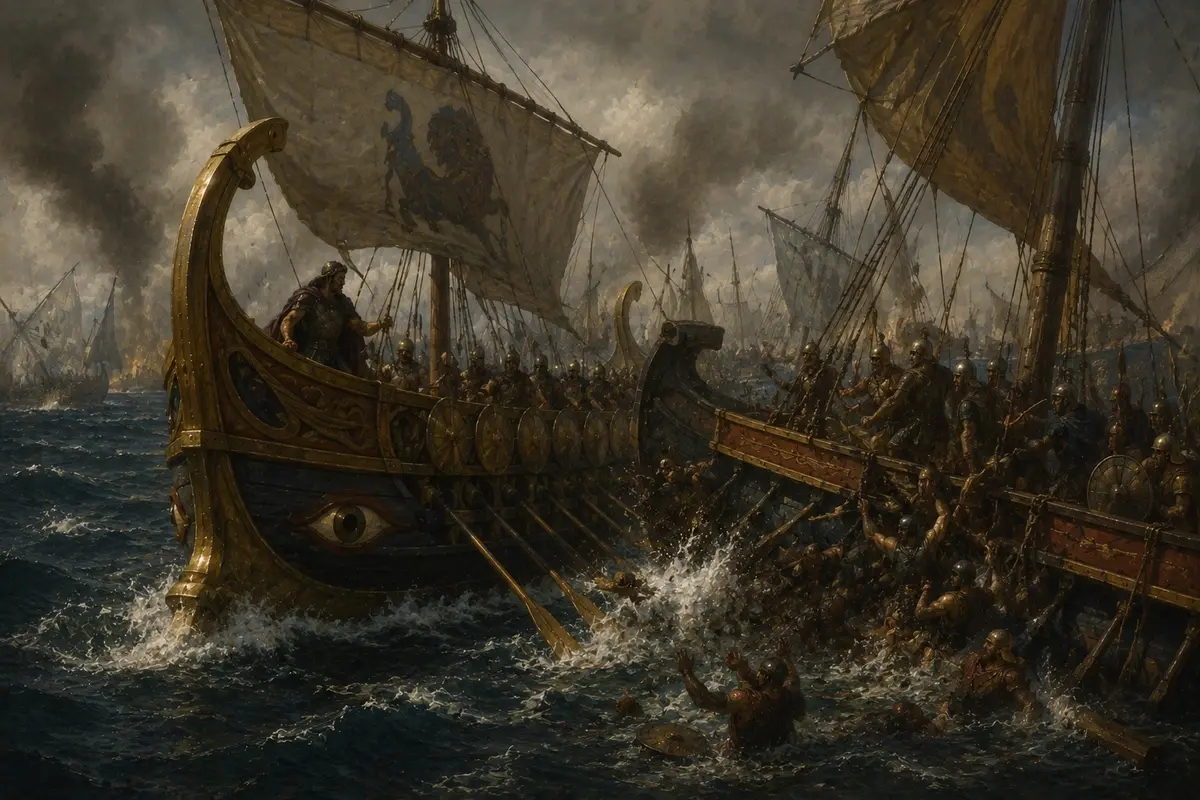
Nobody on the sunken ship survived to correct the record. Xerxes assumed she'd sunk a Greek ship. The pursuing Athenian assumed she'd defected. Herodotus, from her own city, clearly enjoyed writing this down.
What Happened Next
Persian losses were catastrophic — perhaps 200 ships or more, against around 40 Greek. Xerxes went home — not immediately in panic, but he left his general Mardonius in Greece with a substantial force and took the rest back across the Hellespont. The following year, 479 BCE, that army was destroyed at Plataea and the remaining Persian fleet at Mycale, and the invasion was over. But Salamis was the hinge. Without control of the sea, Xerxes couldn't supply an army in Greece over winter, couldn't outflank the Isthmus wall, and couldn't hold what he'd taken. As for Themistocles: he was the most celebrated man in Greece for about five years. Then Athens ostracised him, around 471 BCE. He was later accused of treason, fled, and ended his life as a governor in the service of the Persian king, drawing revenue from three cities in Asia Minor. The man who saved Greece from Persia died a Persian official.
Sources
Aeschylus, The Persians (472 BCE) is the extraordinary one — a tragedy about the battle staged in Athens eight years afterwards, written by a man who fought in it, and told entirely from the Persian point of view. There is nothing else like it in ancient literature. Herodotus, Histories, Book 8 (around 430 BCE) is the full narrative. Plutarch's Life of Themistocles adds later detail. For a modern treatment: Barry Strauss, The Battle of Salamis (2004).