For about a thousand years, every four years, a large part of the Greek world stopped what it was doing — including, sometimes, its wars — and travelled to a valley in the western Peloponnese that had no city, no port and almost no permanent population. There was no prize money. The winner got a wreath cut from a wild olive tree. That combination — enormous effort, trivial reward, and the whole thing organised around a religious sanctuary rather than a state — is the thing to hold on to. The ancient Olympics weren't a sporting event that acquired religious trappings. They were a festival of Zeus at which the worship took the form of athletics.
Where and When
The site was Olympia, in Elis, a sanctuary in a river valley with a sacred olive grove and, eventually, one of the Seven Wonders of the ancient world inside it — Phidias's forty-foot gold-and-ivory seated Zeus, so large that ancient critics complained that if he stood up he'd take the roof off. The traditional first games are dated to 776 BCE, which is when the surviving victor lists begin. Almost certainly there was something happening there before that. They ran every four years without a recorded interruption for over a millennium — through wars, plagues, the fall of Athens, the Macedonian conquest and the Roman annexation of Greece. The four-year interval, the Olympiad, became the standard way Greeks dated events across the whole Mediterranean, because it was the one calendar everybody shared.
The Truce
The ekecheiria — literally the holding of hands — was announced by heralds who travelled out from Elis to every Greek state before each games. Here's what it did and didn't do. It did not stop wars — that's the popular version and it's wrong. What it guaranteed was safe passage: anyone travelling to or from Olympia, and the sanctuary itself, was inviolable. Armies could not enter Elis. Athletes and spectators crossing hostile territory could not be touched. And it largely held. States at war with each other sent competitors who trained side by side and then went home to fight. It was breached occasionally, and when it was, everybody remembered. Sparta was fined and barred in 420 BCE for sending troops into Elean territory during the truce. In 364 BCE the Eleans and Arcadians actually fought a battle inside the sanctuary while the pentathlon was going on, and the spectators reportedly stayed in their seats and watched. That the truce worked as well as it did, across a thousand years and hundreds of mutually hostile states, is genuinely remarkable and arguably the most interesting thing about the ancient games.
The Events
The programme grew over centuries. At its fullest it ran roughly five days. Running: the stadion, a single length of the track at about 192 metres, was the oldest event and for the first fifty-odd years the only one; the diaulos, two lengths; the dolichos, somewhere between 18 and 24 lengths; and the hoplitodromos, two lengths in armour, carrying a shield and wearing a helmet and greaves. Added in 520 BCE and, by all accounts, hilarious to watch. Combat: wrestling, with three throws to win; boxing, no rounds, no weight classes, no ring, leather thongs wrapped round the hands, ending when a man stayed down or raised a finger to concede; and pankration — boxing and wrestling combined, with almost everything permitted. No biting and no gouging; everything else, including strangulation and joint breaks, was fair. It was the marquee event. The pentathlon combined discus, javelin, long jump, stadion and wrestling. The long jump was done from a standing start holding stone or lead weights swung forward at take-off. Equestrian events — four-horse chariot racing, two-horse, and mounted races, held in the hippodrome. Twelve laps, hairpin turns, and regular catastrophic crashes.
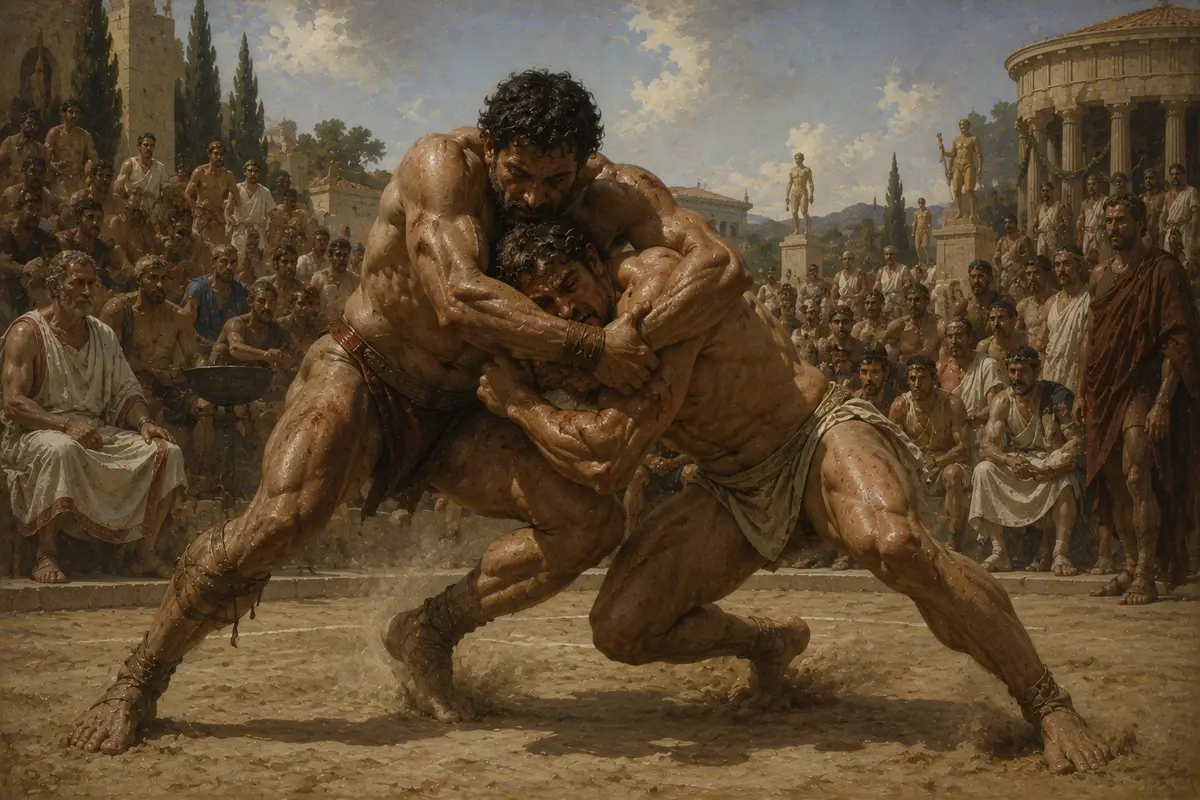
No rounds, no weight classes. Wrestling and boxing combined, with strangulation and joint breaks permitted. The pankration was the marquee event.
The Prize
An olive wreath. That's it, at Olympia. But the wreath was the start rather than the end. A victor's home city typically gave him free meals for life at public expense, front-row seats at festivals, cash, tax exemptions and sometimes a statue. Athens paid 500 drachmas — several years' wages for a labourer. Some cities knocked a hole in the walls for a returning Olympic victor to enter through, on the reasoning that a city with a man like that in it doesn't need walls. So the amateurism is a myth invented in the 19th century. Greek athletes were full-time professionals who trained for years and made careers out of the circuit.
Why They Competed Naked
Gymnos means naked; a gymnasion is a place where you are naked. It's built into the vocabulary. The ancient explanations are all a bit unconvincing — one story says a runner named Orsippus lost his loincloth mid-race in 720 BCE and won anyway, so everyone copied him. The more useful reading is that nudity was doing cultural work. It advertised the trained body as something to be looked at and admired, which is the same instinct that produces Greek sculpture. It also functioned as a boundary marker — Greeks did this and non-Greeks found it shocking. And it made cheating and concealed weapons impossible, which mattered in the combat events. Athletes oiled themselves and dusted with fine powder, and afterwards scraped it all off with a curved bronze tool called a strigil.
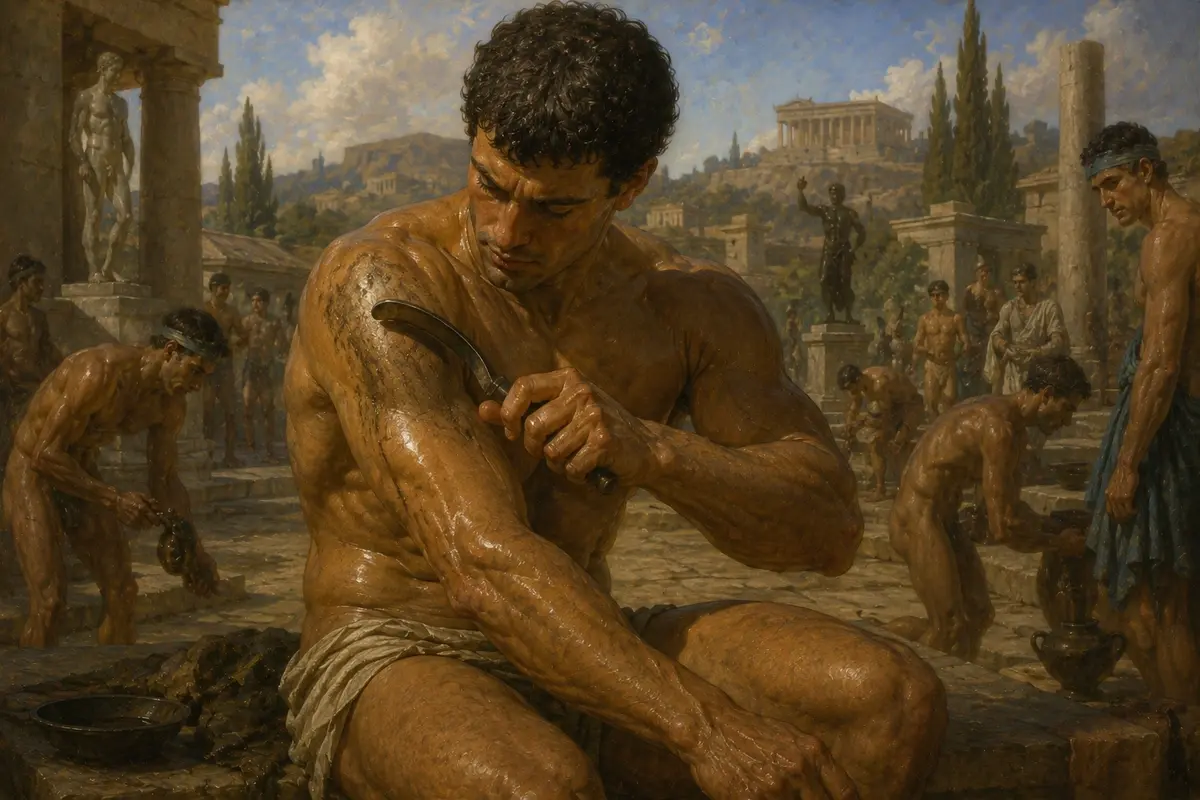
Athletes oiled themselves, dusted with fine powder, and afterwards scraped it all off with a strigil. The amateurism rule has no ancient basis — they were full-time professionals.
Women
The rules were narrower than usually stated, so it's worth being precise. Married women were barred from attending — on pain of being thrown off a nearby cliff, according to Pausanias, who also notes that nobody was ever recorded as having suffered it. Unmarried women's status is genuinely unclear and scholars disagree. One woman always attended: the priestess of Demeter Chamyne, who had a seat of honour. But women could win. In chariot racing the owner of the team was crowned as victor, not the driver — and there was no rule preventing a woman from owning horses. Kyniska of Sparta, sister of a Spartan king, entered and won the four-horse chariot race in 396 BCE and again in 392 BCE. She was the first female Olympic victor, put up a monument at Olympia, and her inscription pointedly claimed to be the only woman in Greece to have won the crown. Others followed. Spartan women, who trained physically and owned property in a way no other Greek women did, were behind several of these wins. Other Greeks found this scandalous, which was one of the reasons the Spartans kept doing it. There were also separate games for women at Olympia — the Heraea, in honour of Hera, with foot races for unmarried girls over a shortened track.
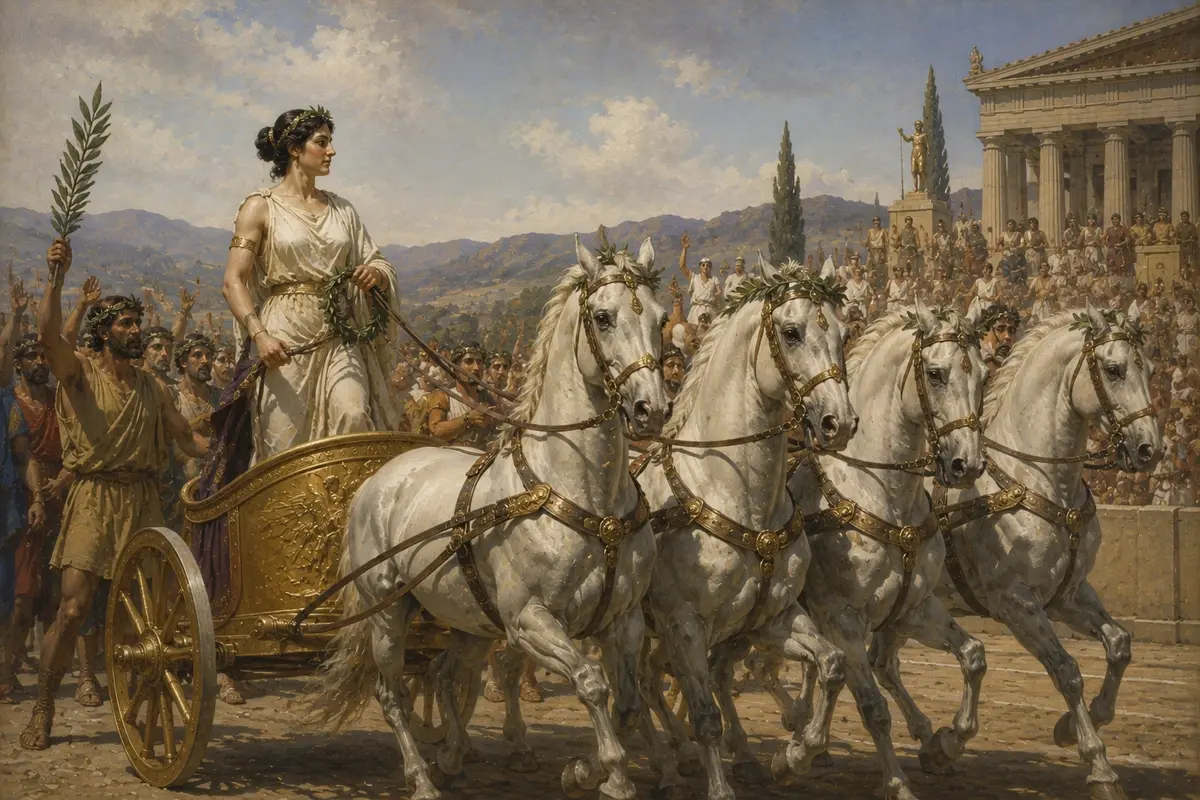
Kyniska won in 396 and 392 BCE. Her inscription pointedly claimed to be the only woman in Greece to have won the Olympic crown. The chariot owner was crowned, not the driver — there was no rule against a woman owning horses.
Cheating
There was plenty, and the Greeks left a permanent record of it. Fines levied on cheats paid for a row of bronze statues of Zeus called Zanes, which lined the walkway into the stadium. Every athlete entering to compete had to walk past a line of statues paid for by cheats, inscribed with their names and their cities. The bases are still there. The first recorded case is from 388 BCE: a boxer named Eupolus bribed three opponents. In 332 BCE an Athenian pentathlete bribed his rivals and Athens was so incensed at the fine that it threatened to boycott — and backed down when Delphi refused to give it any oracles until it paid. The most extraordinary cheat was Nero, who in 67 CE had the games rescheduled to fit his tour of Greece, added music competitions, entered a ten-horse chariot race, fell out of the chariot, failed to finish, and was awarded the victory anyway. After he died his name was struck from the records and the games he'd interfered with were annulled.
The Famous Names
Milo of Croton, 6th century BCE, is the one everybody's heard of — six-time Olympic wrestling champion, subject of stories about carrying a full-grown bull around the stadium. The training story about lifting a calf every day until it grew is almost certainly a fable about progressive overload invented later, which hasn't stopped it being repeated in gyms for 2,500 years. Leonidas of Rhodes won the stadion, diaulos and hoplitodromos at four consecutive games between 164 and 152 BCE — twelve victories. His record of individual event wins stood for 2,168 years until Michael Phelps passed it in 2016. Theagenes of Thasos reportedly won over 1,300 crowns across his career on the wider festival circuit.
How They Ended
The traditional answer is that the Christian emperor Theodosius I banned pagan festivals in 393 CE and the games stopped. The reality is messier. There's no surviving edict specifically abolishing the Olympics. The decline was long: Roman looting of the sanctuary, the diversion of funds, earthquakes, the silting of the river, a general collapse in the money and civic pride that had paid for it all. What finished the site was geology. Earthquakes brought the temples down and the rivers flooded and buried the whole valley under several metres of silt — which is precisely why so much of it survived. German archaeologists began systematic excavation in 1875. The revival came in 1896, largely through Pierre de Coubertin, who was inspired partly by the German digs, partly by English public-school athletics, and partly by a Greek businessman named Evangelos Zappas who had already been staging revived games in Athens since 1859.
Sources
Pausanias, Description of Greece, Books 5 and 6 (2nd century CE) is the single most valuable text — a traveller's account of Olympia written while it was still functioning. Pindar's Olympian Odes (5th century BCE) are victory poems commissioned by winners, and the best evidence for what a victory actually meant socially. Philostratus, Gymnasticus covers training. Herodotus, Thucydides and Xenophon supply the political context and the truce disputes. Modern: Nigel Spivey's The Ancient Olympics (2004) is a good starting point.