The American Revolutionary War raged on for eight years, from the shot heard round the world in April 1775 to the signing of a peace treaty in Paris in September 1783. At the start, Britain had the strongest navy in the world, and a professional army that had just finished winning a world war. The other side had no army, navy or country.
Then there was a new country on the map.
That victory was never guaranteed. Washington lost more battles than he won, and his army nearly fell apart more than once. Cities fell. Troops were mustered and then sent home when their enlistment was up. At one point Washington's army had fewer than 5,000 men.
How did it happen? The short answer is Washington kept his army intact long enough for Britain to lose patience, and for France to decide they would help. A longer answer would include taxation, tea, a general who marched the wrong way, a spy ring, thousands of enslaved people who fled toward whichever side promised them freedom, and a French fleet that appeared at just the right moment.
What was the American Revolutionary War?
The American Revolutionary War, also known as the American War of Independence, was the war between Great Britain and thirteen of its colonies in North America. The colonies wanted independence, and Britain wanted it the other way around.
The revolutionaries, who wanted independence, were called Patriots. They raised up an army, the Continental Army, and elected George Washington as their commander. The loyal supporters of King George III were called Loyalists, and because there were many of them, this was a civil war as much as a war between two countries.
The war was not just fought in North America either. It spread to the Caribbean, Europe and the Atlantic Ocean. For Britain, America was just another front in a much larger war.
Taxes, the Stamp Act and colonial anger
The problem began when Britain won a war. In 1763, Britain won the Seven Years' War from France, which Americans call the French and Indian War. Britain gained huge territories in North America, and was left with a lot of debt.
British taxpayers were not happy with paying this off, and so they began to impose taxes on the colonies to pay for the costs of the war. That sounds reasonable enough until you look at how it landed in America.
First came tighter enforcement of old trade laws. The Royal Navy began to crack down on smuggling, and actually collected the customs duties that had long been ignored. One of the old laws was the Molasses Act, which was very important because roughly 85 percent of New England's rum was made from imported molasses. Then came the Sugar Act and the Stamp Act, which placed new direct taxes on the colonies. The Stamp Act, which affected poor people especially, was met with fierce opposition.
Britain quickly rescinded the Stamp Act and cut the molasses tax, but at the same time they passed the Declaratory Act, which said Parliament could make laws for the colonies. This is the part people remember. The money came back, but the principle stood.
That principle became the whole argument. The fact that the colonies did not elect anyone to Parliament meant they did not have representation, and so they could not be taxed. "No taxation without representation." That was the argument.
The Boston Massacre and the Boston Tea Party
Tension continued to rise, especially in Boston. In 1768, a riot broke out when authorities boarded the Liberty on suspicion of smuggling. The British stationed troops in the city, to no one's satisfaction.
On March 5, 1770, a group of citizens began to throw stones at British soldiers, who fired in response, killing five colonists. Patriots immediately called this the Boston Massacre, and it was widely reported in the press.
At the same time, Parliament repealed most of the Townshend duties, although it kept the tax on tea. Lord North insisted on it, not for the reason he stated, but to assert Parliament's right to tax the colonies. He completely missed the point. The right was exactly what Americans were objecting to.
Smaller revolts broke out. In April 1772, New Hampshire colonists fought back against royal authority in what became known as the Pine Tree Riot, which inspired the Pine Tree Flag. That June, a British customs ship called the Gaspee was burned in Rhode Island.
Then came 1773. The East India Company, which was massive in the British economy, was near insolvency as a result of a banking crisis. To save it, Parliament passed the Tea Act, which gave it a monopoly on the sale of tea in the colonies. Most of the tea consumed in America was smuggled in from the Dutch, so this act was met with universal derision by merchants who were engaged in this trade, and was seen as an attempt to tax them unfairly.
In December 1773, a group known as the Sons of Liberty, dressed as Mohawks, boarded ships in Boston Harbor and dumped out crates of tea. This was the Boston Tea Party.
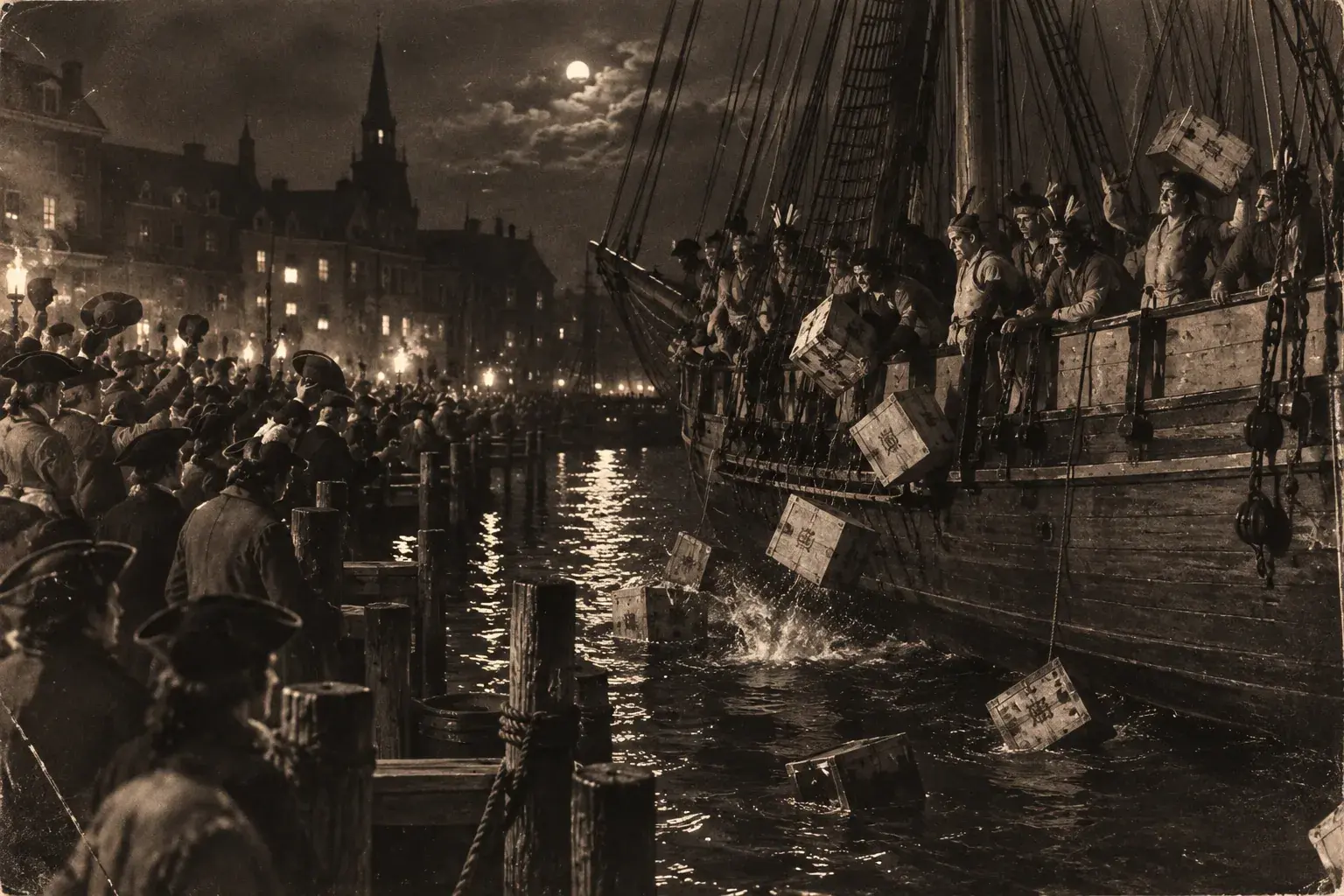
The Sons of Liberty destroyed the East India Company's tea in December 1773, and Parliament's punishment turned a local protest into a colonial crisis.
The Intolerable Acts and the First Continental Congress
In response to the Boston Tea Party, Parliament punished Massachusetts heavily - it closed the port, took away much of the colony's self-government and expanded the powers of the royal governor. Colonists called these laws the Intolerable Acts.
This punishment backfired, instead of deterring other colonies from rebelling it convinced them that their own freedoms were next. Even some Whigs in Britain and London's newspapers believed the government had gone too far.
In September 1774, twelve colonies sent delegates to the First Continental Congress. Georgia stayed home. They argued about how far to go, and feared that a boycott would lead to war. They wrote a petition to the king to repeal the Intolerable Acts, then passed the Continental Association, which cut off Britain from its trade.
This boycott was much more successful than expected. Imports to the colonies dropped by about 97 percent between 1774 and 1775.
Britain responded by declaring Massachusetts to be in rebellion in February 1775 and blockading the colony. Restrictions later that year prevented colonial trade with the British West Indies and prohibited New England ships from the rich cod fishing grounds off Newfoundland. Each side scrambled to control the militia weapons stored in the towns.
Lexington and Concord: The Shot Heard Round the World
General Thomas Gage, the British commander in North America and Massachusetts governor, got orders in April 1775 to act against the Patriots. He decided to seize the militia weapons stored at Concord, and arrest John Hancock and Samuel Adams, who Britain saw as the ring leaders.
The plan relied on surprise, which failed. Patriots had already discovered roughly what Gage intended, and riders left Boston hours before midnight on April 18 to warn Lexington, Concord and the towns along the route.
On the morning of April 19, 1775, British troops and colonial militia faced each other on Lexington green. Someone fired. No one knows who, and it's part of the reason the moment got the name the shot heard round the world.
What happened next was much worse for the British than anyone expected. After a running fight at Concord, the redcoats had to march back to Boston, with militia firing at them from behind walls and trees the entire way. They lost around 300 men killed, wounded or captured. When they got back, the militia surrounded the city and the Siege of Boston began.
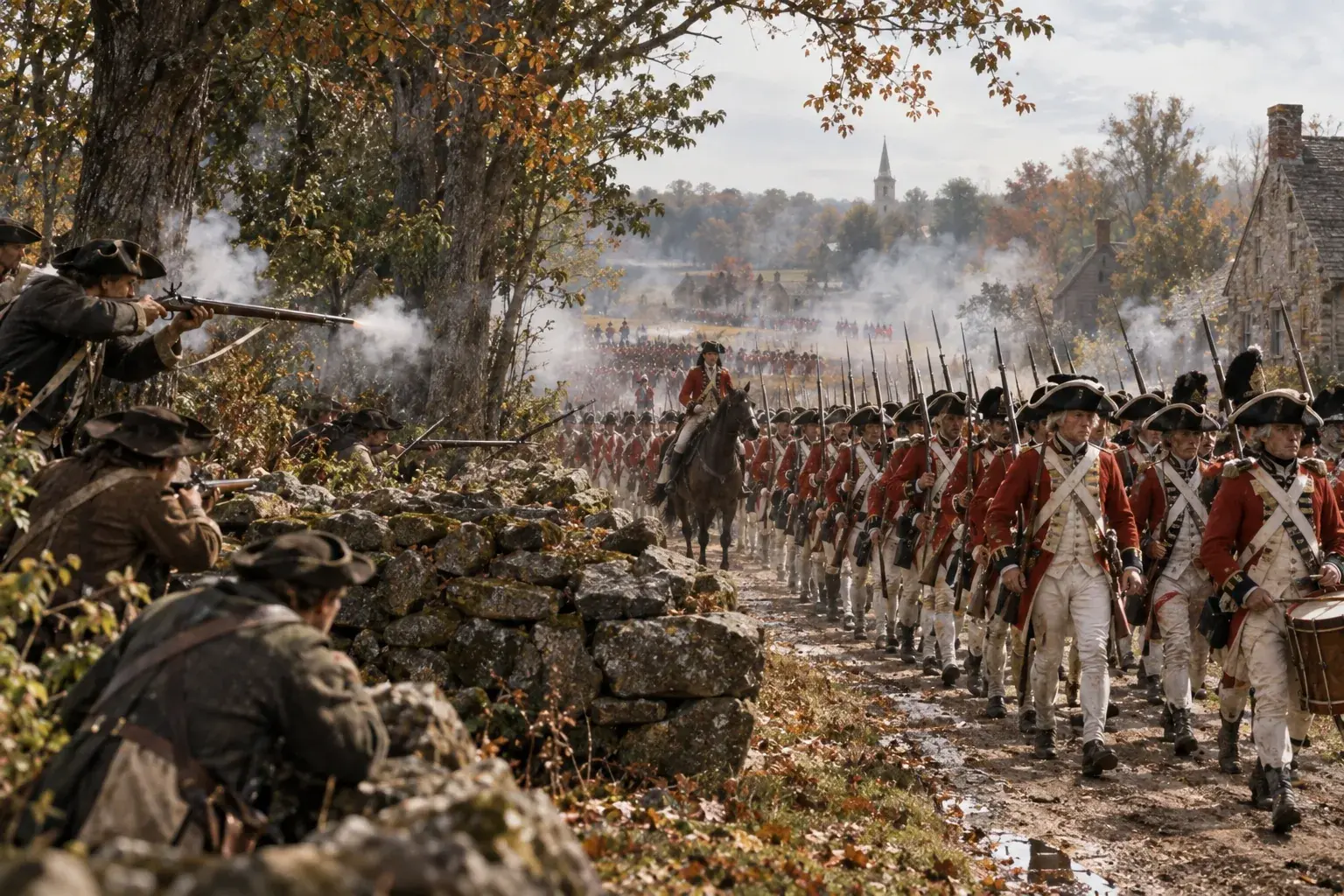
The march back from Concord cost the British around 300 men and turned a raid on a weapons store into the opening battle of the war.
Bunker Hill and Washington's appointment as Commander
British reinforcements arrived in May 1775, sending generals William Howe, John Burgoyne and Henry Clinton to America. On June 17, they attacked American positions on the Charlestown Peninsula in the Battle of Bunker Hill.
The British took the ground, but it cost them more than 1,000 casualties. Gage had gained a hill but lost a third of his army, and was blamed by London for the whole affair. He was replaced by Howe.
Bunker Hill did something else. It seems to have shaken Howe up, and he was cautious about frontal attacks for the rest of his time in America, and repeatedly held back when he had the opportunity to finish off Washington's army.
Meanwhile, Congress was raising an army. On June 14, 1775, it took control of the forces outside Boston and raised the Continental Army. John Adams nominated George Washington to command it, and on June 16 Hancock officially named him commander in chief. Washington took over on July 3.
He did not order an assault on Boston, instead he held back and fortified the high ground.
The Siege of Boston and the British Retreat to Halifax
The wait paid off in March 1776. Colonel Henry Knox had hauled heavy cannons all the way from Fort Ticonderoga in upstate New York, which sounds impossible when you read about it. On the night of March 5, under cover of darkness, Washington had those guns placed on Dorchester Heights, overlooking Boston and the British ships in the harbor.
Howe had a choice to attack uphill into fortified artillery, which is what Bunker Hill had been, or to leave. He left. On March 17, 1776, the British sailed out of Boston for Halifax, Nova Scotia.
It was Washington's first real victory, and he'd won it without fighting a battle.
Not everything went so well. An American invasion of Canada ended in disaster at the Battle of Quebec on December 31, 1775, and the survivors withdrew the following spring. Another defeat at Trois-Rivières in June 1776 finished the campaign for good. In Virginia, the royal governor Lord Dunmore ordered the burning of Norfolk on New Year's Day 1776 after being driven onto ships offshore. In the South, things went better for the Patriots, who pushed Loyalists out of South Carolina, and beat back a British attack on Charleston at Sullivan's Island in June 1776.
Common Sense and the Declaration of Independence
Most colonists were not clamoring for independence for a long time. They wanted their rights as British subjects respected.
Two things changed that. The first was a pamphlet. Thomas Paine published Common Sense in January 1776, arguing clearly that Americans should govern themselves, and kings were a ridiculous concept to begin with. It was reprinted everywhere, and it moved public opinion quickly.
The second was Britain's decision to hire German soldiers. Britain signed treaties with several German states, most importantly Hesse-Kassel, to supply troops. Americans generally called all of them Hessians, even though they came from many different places. Within a year Britain had over 32,000 men in America, the largest force it had ever sent outside Europe.
Americans were genuinely shocked by this. They felt the king had hired foreigners to attack his own subjects. Copies of the treaties were smuggled out of London and printed in American newspapers in 1776, and the effect was enormous. Historians often say the German troops pushed more colonists toward independence than the taxes ever did.
Congress appointed a committee of five men to draft a declaration: Thomas Jefferson, John Adams, Benjamin Franklin, Roger Sherman and Robert Livingston. Jefferson wrote most of it. On July 2, 1776, Congress voted for independence, and on July 4 adopted the Declaration.
This document did two things at once. It cut the political ties to Britain, and listed a long series of things George III had supposedly done wrong. Hiring foreign soldiers was one of the charges.
The Battle of Long Island and the Loss of New York
Howe did not stay in Halifax. In summer 1776, he sailed for New York and began landing troops on Staten Island on July 2, the same day Congress voted for independence.
Washington knew the attack was coming but not where. He divided his army between Manhattan and Long Island, which was a risky thing to do when you were outnumbered. On August 27, at the Battle of Long Island, Howe went around the American line instead of charging them and drove Washington back to Brooklyn Heights.
Washington should have lost his whole army that week. He did not because Howe stopped instead of surrounding him, and because on the night of August 29 Washington ferried his entire force across the East River to Manhattan on flat-bottomed boats without losing a man.
It was a brilliant escape, and still a retreat.
Howe took New York City on September 15, and Washington continued to withdraw, with the worst of it coming on November 16 when the British took Fort Washington and about 3,000 Americans became prisoners. It was the most disastrous defeat of Washington's career.
By December, his army had shrunk to fewer than 5,000 men, with more enlistments about to expire. Congress fled Philadelphia for Baltimore. In London, people celebrated and predicted the war would be over within a year.
Knowlton's Rangers and the Culper Spy Ring
A quiet decision from that terrible summer turned out to matter a great deal.
In August 1776, Washington ordered Thomas Knowlton to form an elite unit for scouting and secret missions. Knowlton's Rangers became the army's first intelligence unit. One of its members was Nathan Hale, a young schoolteacher who volunteered to spy behind British lines that September, was caught almost immediately, and was hanged.
Hale's failure taught Washington something. Sending one untrained man with no cover story wasn't intelligence work. Working on it with Benjamin Tallmadge, Washington created the Culper Spy Ring, a small network operating inside British-held New York, using code names and secret writing.
Washington took this seriously. Over the course of the war, he spent more than ten percent of his military funds on intelligence.
Washington's Crossing of the Delaware and the Battle of Trenton
On the night of December 25, 1776, Washington took a column of troops across the ice-choked Delaware River from Pennsylvania into New Jersey. It was an ordeal, and exactly the kind of gamble a losing commander has to take.
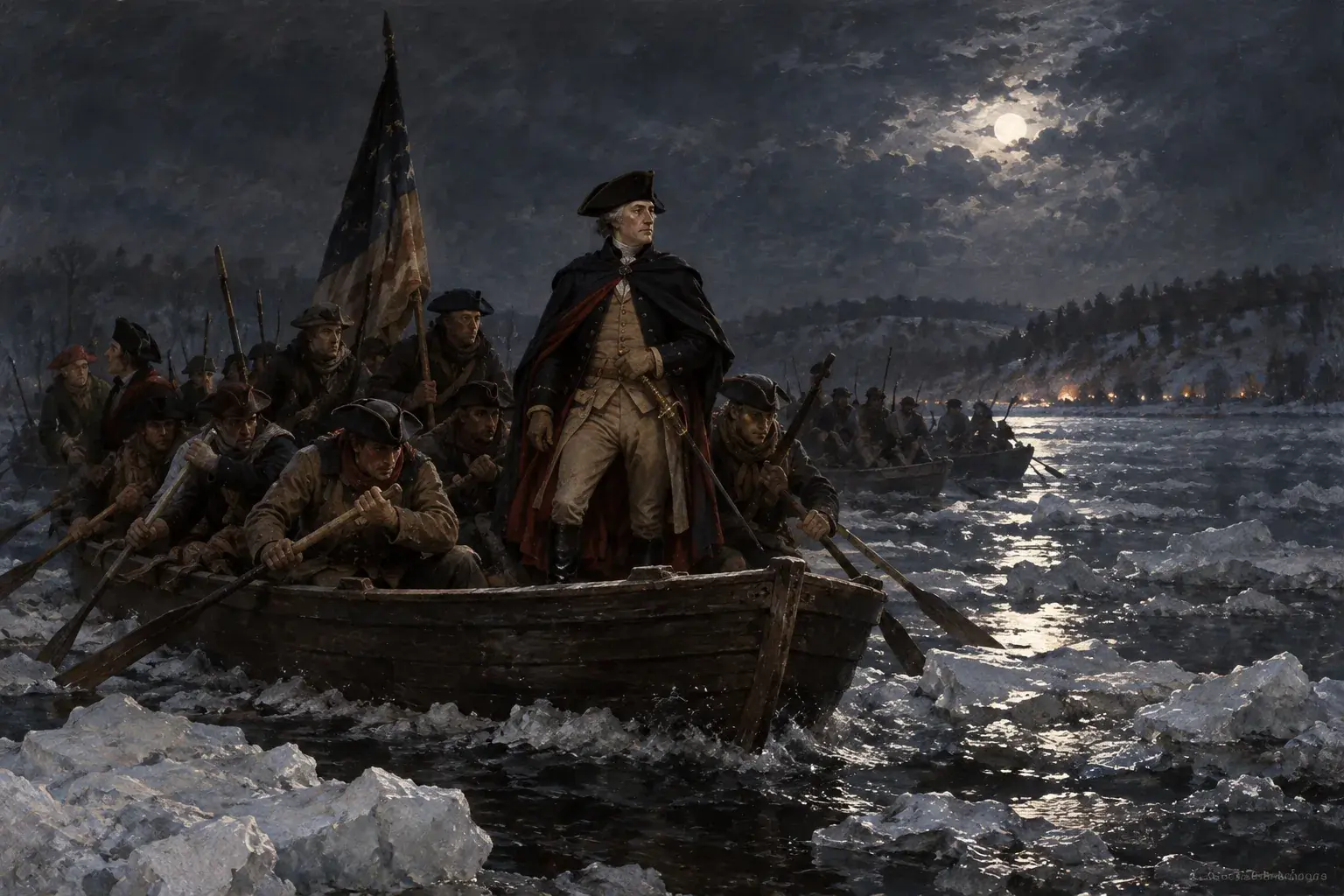
The crossing on Christmas night 1776 was a gamble by a commander who had spent the autumn losing.
The German garrison at Trenton had spent weeks being harassed by small Patriot bands, and woke up to false alarms. Their commander, Colonel Johann Rall, figured a heavy snowstorm on Christmas meant no one would attack. At daybreak on December 26, Washington's men hit them.
Rall was killed along with more than 20 of his soldiers, and about 900 were captured, along with cannons and supplies.
Trenton was a small battle with an outsized effect. It raised the army's morale and revived public support. It broke the fear that German professionals were unbeatable. When the British tried to retake the town, Washington held them off at Assunpink Creek on January 2, then slipped around Cornwallis in the dark and beat his rear guard at Princeton the next day.
France was watching. Those two victories helped convince the French that these Americans might actually be worth backing.
The Saratoga Campaign and Burgoyne's Surrender
Britain's plan for 1777 was to cut New England off from the rest of the colonies by controlling the Hudson River. General Burgoyne would lead an army south from Canada, a smaller force under Barry St. Leger would come east from Lake Ontario, and they would meet at Albany. Howe might join them.
The plan had a hole in it. It was not clearly stated that Howe was required to help, and Lord Germain in London never made it clear either. So Howe went and attacked Philadelphia instead.
Burgoyne set out in June 1777 and captured Fort Ticonderoga on July 5. Then everything slowed down. American troops retreating ahead of him blocked roads, wrecked bridges, dammed streams and stripped the countryside of food. Burgoyne had to send out large foraging parties, and one of them, over 700 men, was captured at Bennington in August. St. Leger's force got stuck besieging Fort Stanwix, lost its Native allies, and turned back to Quebec.
Burgoyne was now alone, outnumbered by the American army under Horatio Gates, and in hostile country. He pushed on to Saratoga anyway, and asked Clinton for help.
He lost 600 men trying to break through at Freeman's Farm on September 19. Clinton wrote back that he could not reach him. A second attempt on October 7 at Bemis Heights was thrown back with heavy losses. Rain turned the camp into a swamp, food ran out, and on October 17 Burgoyne surrendered. Around 6,222 soldiers laid down their arms.
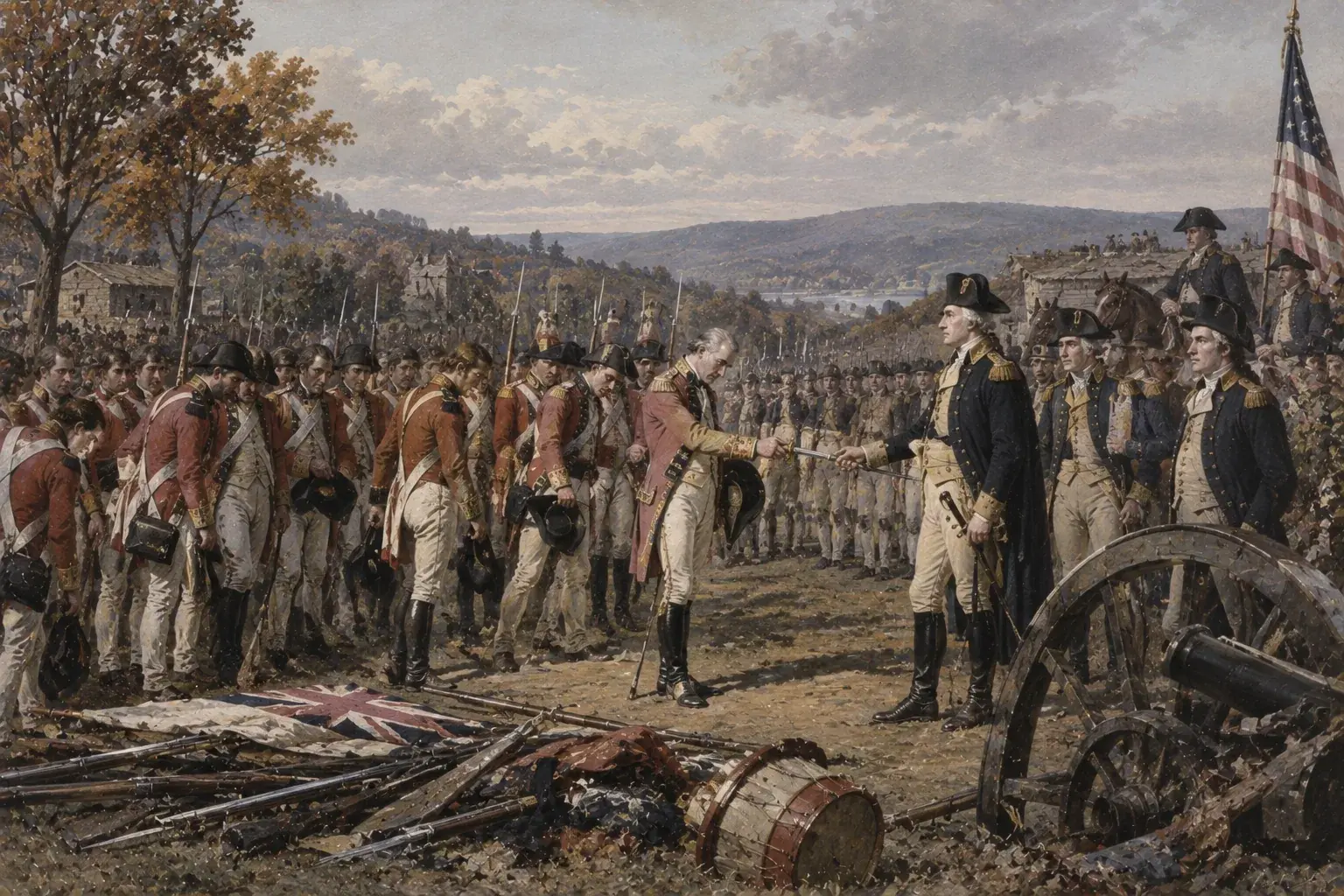
Around 6,222 soldiers surrendered at Saratoga, and the defeat convinced France that the Americans were worth an alliance.
Saratoga is usually called the turning point of the war, and for once the cliché is accurate. It didn't end the fighting. It changed who was fighting.
France, Spain and the Dutch Republic Enter the War
France had been quietly supporting the Americans for some time. The foreign minister, Vergennes, had never forgiven his defeat by Britain in 1763, and decided that the opportunity to avenge France was at hand. He convinced the king, Louis XVI, to fund a clandestine front company that bought arms for the Patriots, and funneled them through the Caribbean.
Saratoga changed matters, however. Once Britain appeared to be on the verge of negotiating a settlement with the Americans, Vergennes realized that only an alliance would prevent a rapprochement between the two English-speaking countries.
On February 6, 1778, a trade treaty and a military alliance were signed between France and the U.S. France guaranteed the independence of the U.S., and the Americans pledged to protect French interests in the West Indies, and both parties agreed to eschew any separate peace negotiations. By that summer, France and Britain were openly at war.
Not everyone in Congress was enthusiastic, however. Over twenty percent voted against it, fearing that they would simply replace one master for another.
Spain's involvement was more nuanced. King Charles III refused to ally with the Americans, since an independent U.S. would jeopardize Spain's colonial holdings, and American settlers were already encroaching on Spanish territory. Instead, in 1779, Spain signed a treaty with France alone, pledging to fight Britain in exchange for France's help in recovering Gibraltar, Menorca and Florida.
There was, however, a catch that Congress did not realize. France had promised not to make a separate peace without Spanish consent, and that Spain would not withdraw its troops from the war until it recovered Gibraltar. Effectively, American independence was tied to a fortress in the Mediterranean. Americans only found this out later, which may help explain why the U.S. avoided foreign alliances for the next century and a half.
The Dutch Republic mattered too, in a less dramatic but very economic way. Dutch merchants made fabulous profits shipping French arms to the Patriots. Britain's declaration of war on the Dutch Republic in December 1780 was disastrous to the Dutch economy.
Valley Forge and Baron von Steuben's Training
While diplomatic and military preparations were underway, the Continental Army was in dire straits.
Howe had defeated Washington at Brandywine in September 1777, and taken possession of Philadelphia. Washington's revenge at Germantown in October, although fruitless, impressed foreign observers, including Frederick the Great of Prussia, since the Americans had attacked at all. In December, the army wintered at Valley Forge and suffered greatly.
About 2,000 men died of exposure, and another 3,000 were rendered unfit for service because they had no shoes. Meanwhile, the British wintered twenty miles away in Philadelphia, and did not attack. Some historians believe that if they had attacked, they would have finished off the army.
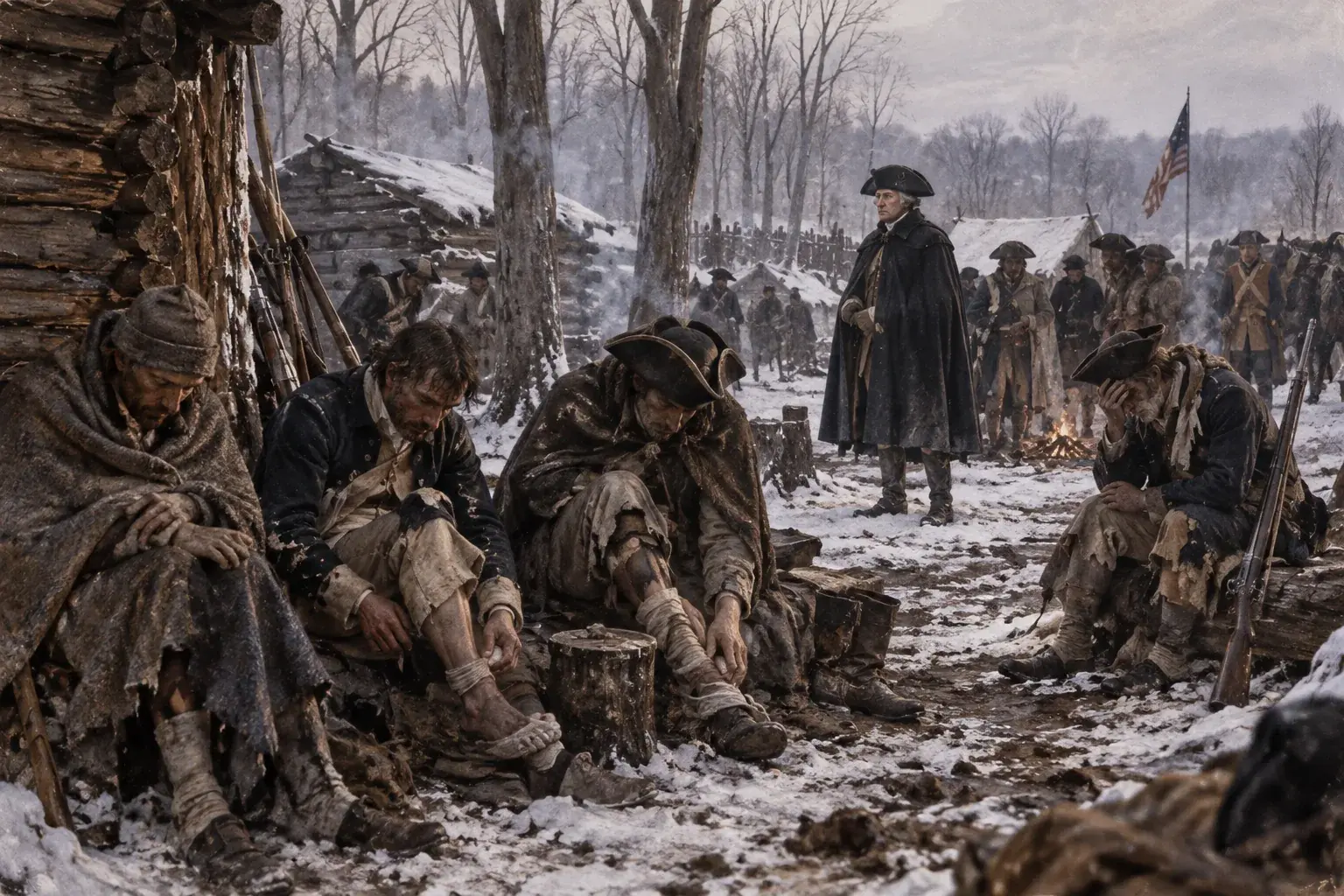
About 2,000 men died at Valley Forge, and thousands more could not serve because they had no shoes.
It was at Valley Forge that Baron Friedrich Wilhelm von Steuben, a Prussian veteran, arrived, and trained the army in proper formations. Steuben trained model companies in each regiment, and they in turn trained the rest of their units. He wrote a drill manual that the army used for years.
The effect was dramatic. When the army marched out for the campaign in June 1778, and met the British at Monmouth, it stood its ground against British regulars for the first time. The units that fought at Monmouth included a Rhode Island regiment with black soldiers, who stopped a bayonet charge by the British, and counterattacked.
The Southern Strategy: Savannah, Charleston and Camden
After France became involved, Britain changed tactics. Lord Germain, under the advice of Loyalists residing in London, believed that fighting in New England was not paying dividends. The South was a more profitable theater, due to its tobacco duties, and, they believed, the South was full of Loyalists who would do the fighting for them.
The latter proved to be a faulty assumption that shaped the rest of the war.
The British began their campaign well. British forces were able to capture Savannah in December 1778. They raised a Loyalist militia of about 1,100, although many reportedly joined only because a British officer threatened to take their property otherwise. These forces fought poorly, and were soundly defeated by Patriot militias at Kettle Creek in February 1779.
The biggest British success came in May 1780, when Cornwallis captured Charleston, and took over 5,000 prisoners. It was the Americans' worst defeat of the war, and was effectively the end of the Continental Army in the South. Later that month, Banastre Tarleton's mostly Loyalist British Legion crushed an overwhelmingly larger American force at the Waxhaws, in a battle that the Patriots claimed was a massacre and used in recruitment for years afterwards. In August, Gates was badly defeated at Camden.
The British continued to win battles, but they kept losing the countryside. Partly it was British policy, as captured Patriots who had sworn not to fight again were forced to fight for the king. Plantations were confiscated. People who had been indifferent to the war chose a side, and it was rarely Britain's.
Kings Mountain, Cowpens and Nathanael Greene's Campaign
The reversal in the South, however, was due in part to militias, and in part a brilliant general.
In October 1780, Loyalist militias under Patrick Ferguson were destroyed at Kings Mountain, which ended organized Loyalist resistance in the region, and was fought almost exclusively by Americans on both sides.
In December, Washington sent Nathanael Greene to command the southern department, and Greene executed a maneuver that appears reckless on paper. Against a stronger enemy, he split his army in half, and sent Daniel Morgan south-west, where in January 1781, Morgan shattered Tarleton's British Legion at Cowpens. Meanwhile, Greene led the other half of his army, and led Cornwallis on a chase back-and forth over North Carolina.
By March, the British were tired, and low on supplies. Greene finally engaged Cornwallis at Guilford Court House on March 15. Cornwallis won, technically, and lost enough men to make him retreat to the coast.
This was the pattern all over the South. The British could win battles that they could not afford. Greene lost battles but gained territory. By the summer, the British in Georgia held little more than Charleston and Savannah.
The War in the West and the Sullivan Expedition
The war west of the Appalachians was a different and bloodier affair.
Most Native nations east of the Mississippi were affected, and many were split on the issue. About 13,000 Native fighters fought on the side of Britain, which makes sense, since colonial settlers were immediately threatening their lands. The Haudenosaunee Confederacy, also known as the Iroquois, were fractured, with the Seneca, Onondaga and Cayuga backing Britain, while many Oneida and Tuscarora backed the Americans. The Mohawk were split, with Thayendanegea, known as Joseph Brant, leading fighters on the British side.
In 1779, Washington sent over 4,000 soldiers under John Sullivan on a scorched-earth campaign through Iroquois country, burning over 40 villages and about 160,000 bushels of corn. The campaign left the communities destitute, and ended the Haudenosaunee Confederacy as an independent power, though about 5,000 people fled to Canada and continued raiding with British support.
Further west, Virginia militia under George Rogers Clark captured Kaskaskia and Vincennes in the Illinois Country, lost Vincennes to Quebec's governor Henry Hamilton, and took it back in early 1779, capturing Hamilton himself.
Spain played a major part out west, even without an alliance. Bernardo de Gálvez, the governor of Spanish Louisiana, allowed Americans to ship supplies up the Mississippi from New Orleans, getting around the British blockade of the Atlantic coast. Later, he launched an offensive, clearing British posts along the Gulf Coast, and capturing Mobile and Pensacola.
The violence between settlers and Native nations did not end with the war. About seven percent of Kentucky settlers were killed in fighting during this period, compared to about one percent of the population in the thirteen colonies. When the land between the Great Lakes and the Ohio River was given to the U.S. in the peace treaty, it did not ask the people who lived there, leading to the Northwest Indian War.
The Siege of Yorktown and Cornwallis's Surrender
By 1781, the British command structure had broken down. Clinton sat in New York without any coherent plan, and Cornwallis, down in Charleston, laid out his own plan for a campaign into Virginia and had it approved by Germain in London, who did not tell Clinton.
Washington wanted to attack New York, while his French counterpart Rochambeau wanted to attack Cornwallis in Virginia. Washington gave in, and Lafayette led a combined French and American force into Virginia.
Clinton misinterpreted this as a buildup to attack New York, and ordered Cornwallis to set up a fortified base on the coast where the navy could pick up troops. Cornwallis chose Yorktown, and waited for help to arrive by sea.
Different vessels arrived. Admiral de Grasse brought the French fleet up from the Caribbean, landed troops and supplies for the besiegers, and remained in Chesapeake Bay. When a British fleet under Thomas Graves came down from New York to relieve Cornwallis, de Grasse met them at sea on September 5. The fighting at the Chesapeake was not particularly bloody, but Graves turned back, and that was the whole ballgame. Cornwallis was cut off by sea.
He made his position worse, by never attacking Lafayette before the siege lines were dug, and by abandoning his defenses on the edges, expecting to be evacuated within days. The besiegers simply walked into them.
An attempt to escape across the York River failed in bad weather. Under constant bombardment and depleted of all supplies, Cornwallis sent officers to parley on October 16, and the surrender was carried out on October 19, 1781. The combined French and American army at Yorktown numbered about 19,000.
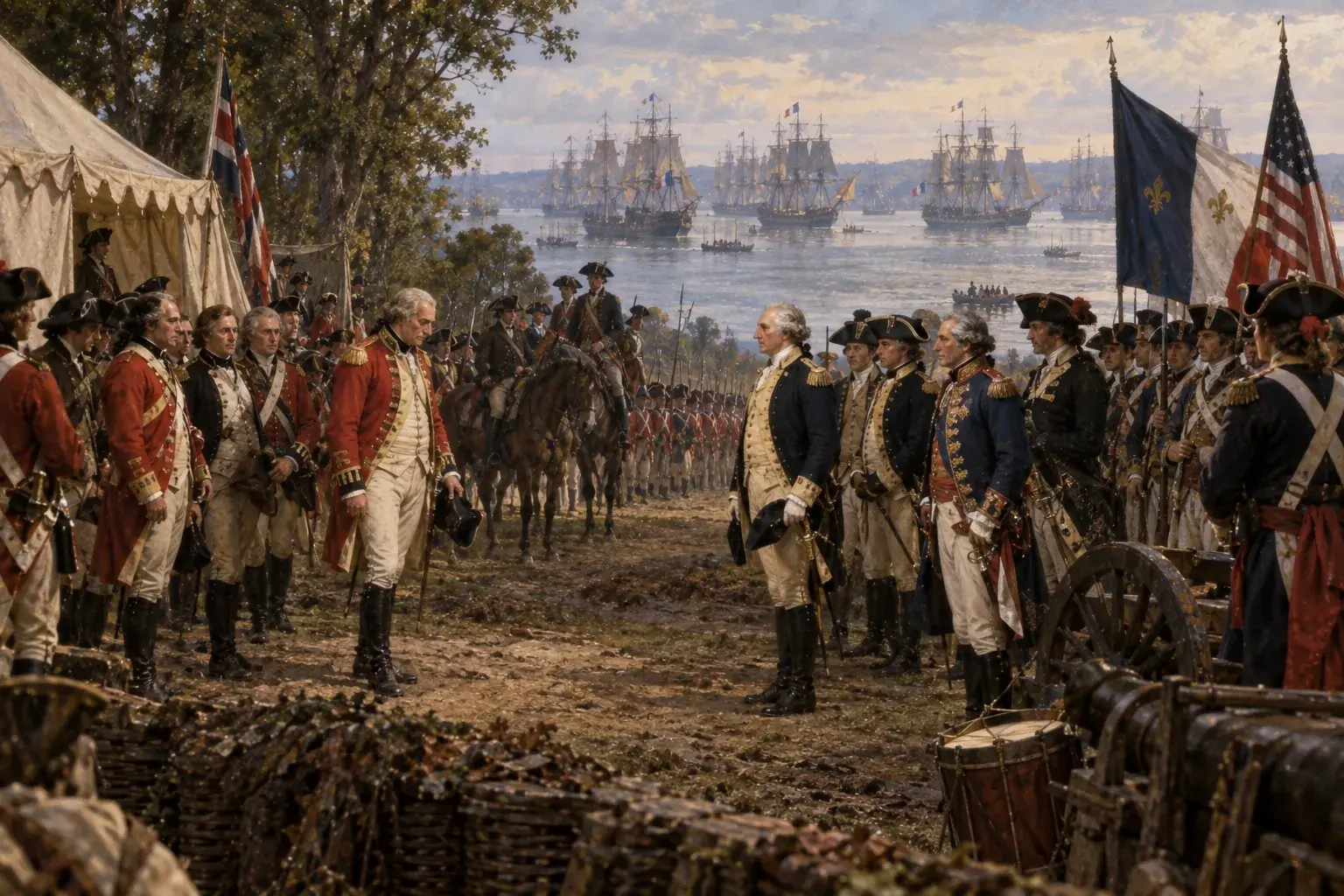
Cornwallis was trapped once the French fleet took control of Chesapeake Bay, and the surrender on 19 October 1781 effectively ended the fighting.
Afterwards, Cornwallis, Clinton and Germain spent years blaming each other publicly. Clinton took the most criticism, and spent the rest of his life in obscurity.
The Treaty of Paris and the British Evacuation
Yorktown did not officially end the war, but it ended Britain's incentive to continue. In February 1782, Parliament voted to cease offensive operations in America. Lord North resigned, and the king reluctantly brought in Lord Rockingham, who had long supported the American cause and independence was a condition of his taking the post. Rockingham died in July, and Lord Shelburne took over, and accepted American independence as well.
Congress sent a strong delegation to Paris, including Benjamin Franklin, who was a celebrity in the French court, John Adams, John Jay, and Henry Laurens.
The negotiations grew complicated, since America's allies had their own ideas. France floated the idea of limiting the United States to the land to the east of the Appalachian Mountains. Spain wanted concessions along the Mississippi, and even suggested giving up Georgia. Neither of these were acceptable, so Jay told the British that the Americans would negotiate directly with them, without the involvement of France and Spain. Shelburne agreed.
The preliminary agreement signed on November 30, 1782, gave the Americans the four things that they wanted most: independence, territory west to the Mississippi River, navigation rights towards the Gulf of Mexico, and fishing rights off Newfoundland.
The final Treaty of Paris was signed on September 3, 1783. Separate treaties settled Britain's wars with France and Spain, costing Britain Tobago, Senegal, and some territory in India to France, and Menorca and both Floridas to Spain.
Washington ordered all hostilities to cease on April 9, 1783. The army was disbanded over the following months. On November 25, 1783, the last British troops left New York City, and Washington rode in, and shortly thereafter resigned his commission, which was a genuinely startling thing for a victorious general to do.
Loyalists, Neutrals and the Revolution as a Civil War
It's tempting to think that the entire American population was behind the revolution. It wasn't.
Estimates vary, but one commonly accepted breakdown comes to roughly 40 percent Patriots, 20 percent Loyalists, and the remainder attempting to keep from expressing any opinion at all. Roughly 25,000 Loyalists fought for the British. Battles in the South, in particular, were often American Patriots and American Loyalists fighting against each other with no British soldiers present, and the conflict continued to linger long after American independence was secured.
Loyalists also faced organizational problems, being limited to areas where British regulars were present to protect them. Britain simply did not have enough regulars to be everywhere at once. Patriot militias repeatedly bloodied Loyalist militias, and after Kings Mountain, the Loyalist military power in the South was never fully recovered.
The Patriots and the Loyalists both had an effect on neutral parties. Patriot tarring and feathering and destruction of property drove some to the British. British looting of homes around Charleston in 1779 outraged both Loyalists and Patriots, driving the opposite direction. When the war ended, tens of thousands of Loyalists left for Nova Scotia and the British West Indies.
African Americans in the Revolutionary War
At the start of the war, there were approximately 500,000 enslaved people in the thirteen colonies. For them, the issue was not which side was right, but rather which side offered freedom.
Britain acted first, and in November 1775, Lord Dunmore announced that any enslaved person owned by a Patriot who joined the British would be given their freedom. In 1779, Clinton's Philipsburg Proclamation expanded this to include all of the colonies, and families flocked to the British lines.
The British objective was to deprive Patriot plantation owners of their labor, rather than an interest in ending slavery. Enslaved people owned by Loyalists were returned to their owners. Nevertheless, those who reached British lines received the promise of freedom, and a huge number took them up on the offer. Thomas Jefferson estimated that Virginia lost 30,000 people to escape. In South Carolina, close to 25,000, or 30 percent of the enslaved population, fled, moved, or died.
Initially, the Continental Army forbade black soldiers, but this changed in early 1778, when Washington convinced Congress that he had no other option to fill the holes left by disease and desertion. The 1st Rhode Island Regiment was formed in February, and included formerly enslaved men whose owners were reimbursed. Recruitment ended by that summer. Over the course of the war, approximately 5,000 African Americans served in the Continental Army and Navy, and approximately 4,000 served as militia, privateers, or drivers, servants, and spies.
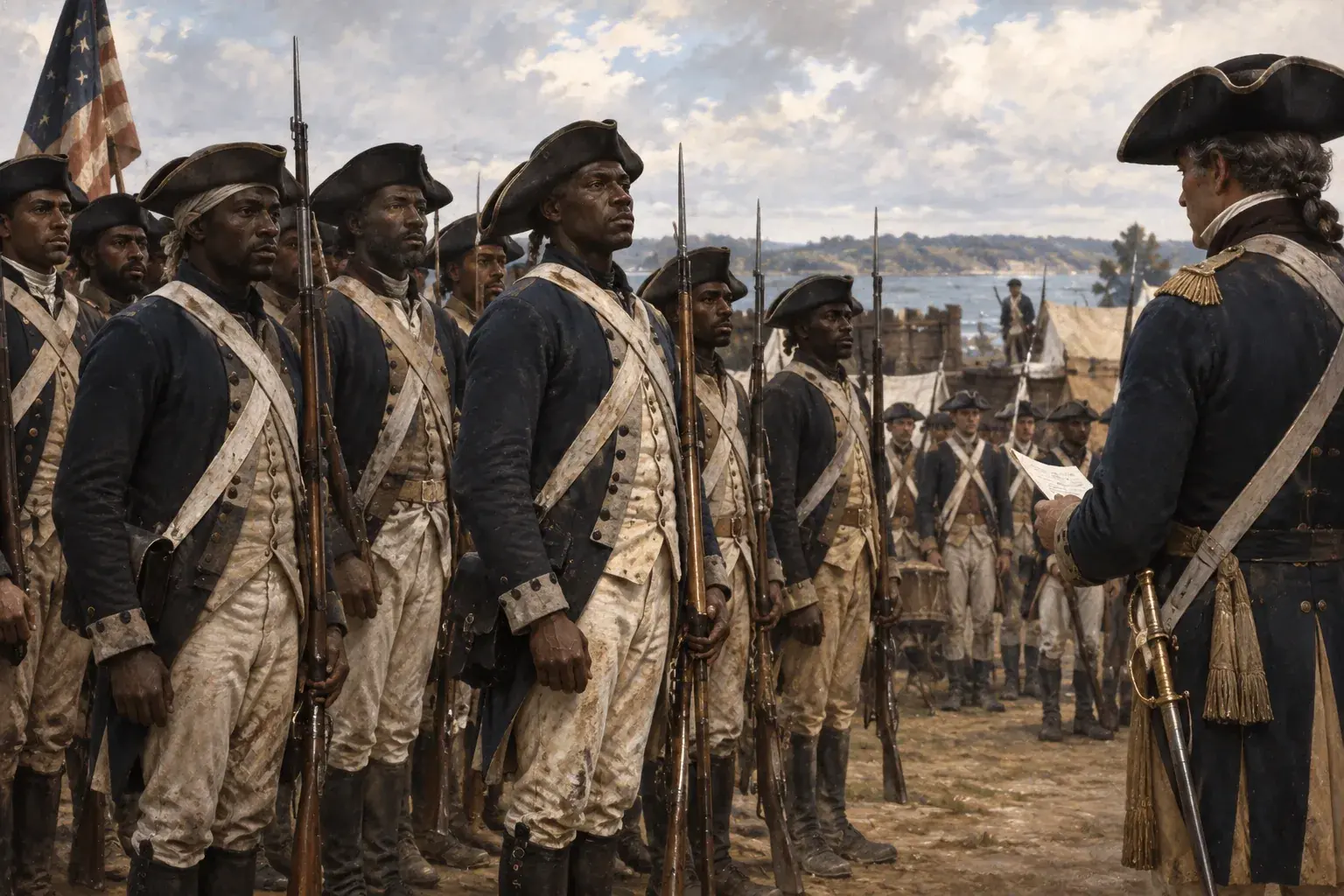
The 1st Rhode Island Regiment, formed in 1778, included formerly enslaved men whose owners were paid compensation.
The ending was hardly pretty. Following Yorktown, Washington demanded that all who had escaped be returned to their owners, but Cornwallis refused. Between 1782 and 1783, somewhere between 8,000 and 10,000 free black people were evacuated by the British from Charleston, Savannah, and New York, and several thousand settled in Nova Scotia. At the same time, white Loyalists took approximately 15,000 enslaved people with them to Jamaica and the Bahamas. Many black Patriots who had fought for promised freedom were simply returned to their owners.
Women in the American Revolution
Thousands of women accompanied the armies. In addition to selling goods, they cooked, performed laundry, and worked within the camps and hospitals, and the armies simply could not have functioned without them. Martha Washington visited her husband's camps multiple times during the war.
Some women went beyond this, accompanying their husbands as soldiers, dressed as men. Anna Maria Lane fought alongside her husband at Germantown, and was badly wounded. Virginia's legislature officially recognized that she had fought with a soldier's heart. Deborah Sampson served until her identity was discovered and she was discharged. Sally St. Clair was killed in action.
Sybil Ludington is often called the Female Paul Revere for riding out and calling out the militia in April 1777. It's a good story, and historians have questioned several aspects of it.
Women did all of this, and the Revolution changed almost nothing about their legal status afterward.
Disease, Prison Ships and the Human Cost of the War
Most soldiers who died in this war did not perish on a battlefield. Disease took its toll on the living as well.
An estimated 130,000 people died from a smallpox epidemic between 1775 and 1782. Washington's decision to have his men inoculated against it is considered by many historians to be one of the best decisions of his career.
The most comprehensive study of Patriot losses counts approximately 25,324 deaths among the army, navy, and militia. Approximately 6,800 died in combat. The remaining, or 18,500 were lost to disease or other causes, including approximately 8,500 who died as prisoners of war. Many of those prisoners died aboard British prison ships in New York Harbor, in conditions that could be described as both lethal by design or neglect, depending on who you ask. Another 8,000 to 25,000 Americans were seriously injured or disabled.
Other armies suffered as well. France suffered 2,112 combat deaths in the United States. Counting all theaters, British military deaths from 1775 to 1783 came to 43,633, not including officers. Of approximately 30,000 German soldiers sent to America, approximately 7,774 died in British service, and nearly 5,000 deserted.
All of this happened across 1,311 separate engagements on land, and another 215 at sea.
Why Did Britain Lose the American Revolutionary War?
Britain had more soldiers, more funding, and the best navy in the world. So why did it lose?
The main obstacle was distance. Reinforcements had to cross the Atlantic, which was an undertaking that took about three months. Orders from London were frequently outdated by the time they arrived. Armies that large are difficult to feed at such a distance, and British commanders frequently complained of insufficient supplies.
The second obstacle was that there was no capital to capture. In Europe, capturing an enemy's capital often ended the war. In America, the British captured Philadelphia, New York, and Charleston, and the war continued. The colonies were spread out along a thousand-mile coastline, with most of the population being farmers, all with their own local supply chain. Capturing four or five ports did not give Britain control of the interior.
The third obstacle was the miscalculation of the Loyalists. The entire southern strategy assumed that local Loyalists would hold the territory captured by the army. They did not, and Britain never had the manpower to fight and occupy at the same time.
Then there was Washington himself. He lost a number of battles, and he never lost his army. He recognized early on that it was important to be in the field, and he wrote to Congress that as long as the Americans had an army in the field, capturing towns would not do the British much good. That was the entire strategy in one sentence.
Finally, there was France. French money, weapons, troops, and most importantly, the French navy turned a colonial rebellion into a global war that Britain could not afford. Yorktown happened because a French fleet controlled Chesapeake Bay for a few crucial weeks.
Historians continue to argue whether the outcome was inevitable. Some, like John Ferling, claim that the American victory was a miracle. Others, like Joseph Ellis, believe that the odds were always in favor of the Americans, especially with Howe missing his opportunity in 1776. One British statesman summed up the entire problem by saying it was like trying to conquer a map.
What the Revolution Changed and What It Didn't
The American Revolution became a pattern. The United States produced the world's oldest written constitution still in use, and other countries copied it, sometimes nearly word for word. Revolutions in France, Haiti, and throughout Latin America drew on the same ideas.
However, the Revolution left an enormous number of things undone, and it's worth examining them.
It did nothing to further women's legal rights. It did not end slavery, and that was by design. Many people at the time recognized the hypocrisy of demanding liberty while denying it to half a million people, but the reliance on enslaved labor in the South outweighed any potential benefit. Some progress was made: most states banned importing enslaved people between 1774 and 1780, Virginia legalized voluntary freeing of slaves in 1782 and more than 10,000 people were freed over the next eight years, and by 1804 every northern state had outlawed slavery. The institution endured in the South, and the question it raised would eventually have to be answered by another war.
The Native Nations had the most to lose and the least to say. They were not parties to the peace negotiations, their land was given away without their consent, and British forts occupied American land for another ten years while Britain secretly supplied allies for raids along the frontier.
The Revolutionary War's Long Shadow
There is a phrase on the back of the American one-dollar bill that translates to "a new order of the ages." The motto is usually traced back to Thomas Paine's line in Common Sense, that Americans had it in their power to begin the world over again.
This is what the people who lived through it thought it was. Not only the ability to win a war, but to prove that a country could be argued into existence and then defended.
Whether or not they truly began the world over again is a good question. They created a republic that relied on enslaved labor, drove Native Nations off land they had not agreed to give up, and left a contradiction in the founding documents that would have to be confronted by another war and 600,000 more deaths.
Whatever they did, it did provide proof that an empire could be defeated by people who refused to quit and had good enough friends at the time. The lesson was spread quickly, and many other people around the world were listening.