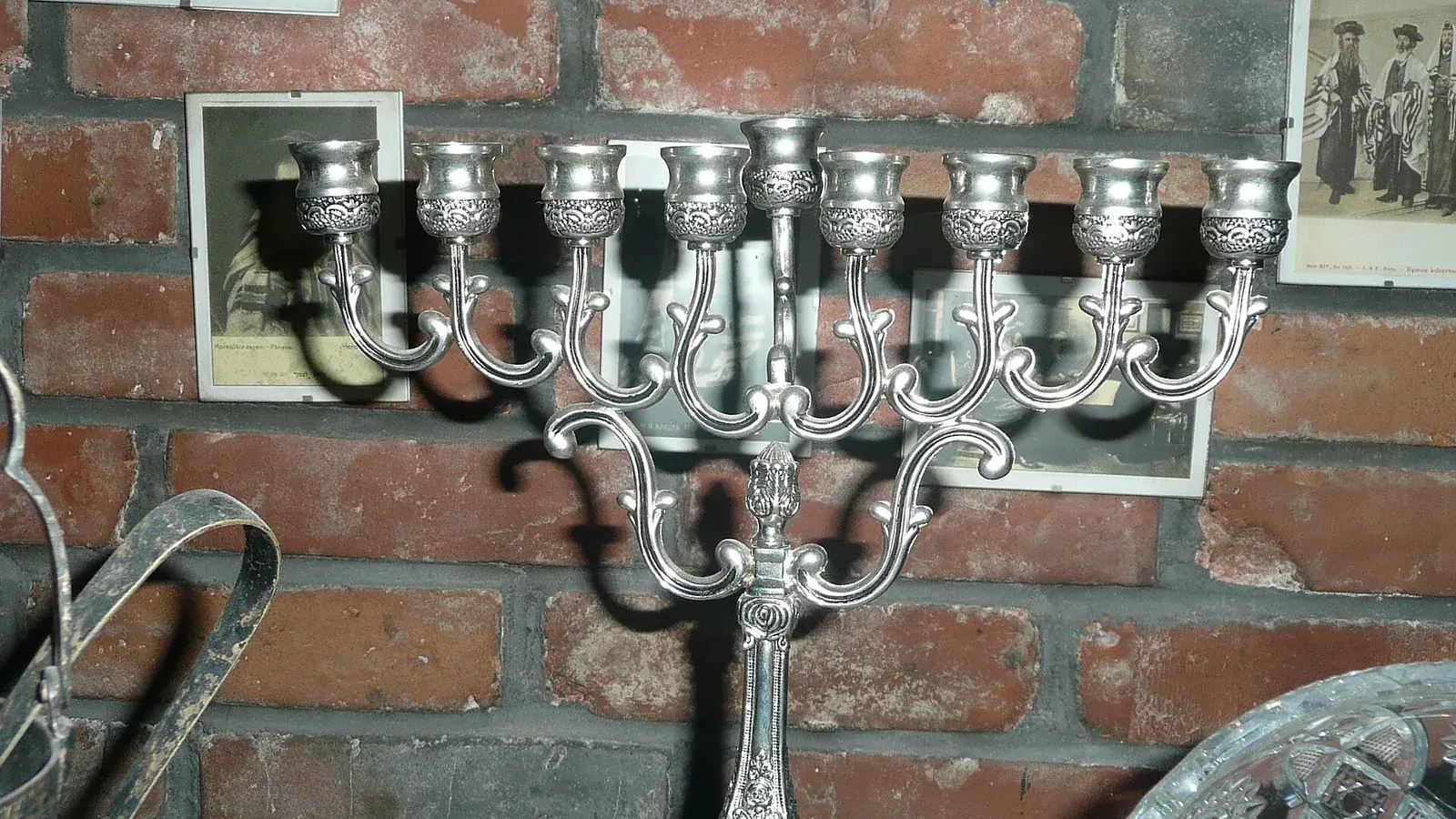
Every year between 1806 and 1813 all of France celebrated a holiday dedicated to Saint Napoleon. Churches held special services for him. Artists painted him. Cities held fireworks displays in his honor.
There was only one problem. Saint Napoleon almost certainly did not exist.
Saint Napoleon was not a mistake or a mix-up that nobody caught. Church officials searched their records for him, found nothing, and had to make up a life story for him from scratch, because the most powerful man in Europe just happened to be named Napoleon and emperors were supposed to have patron saints.
Who Was Saint Napoleon?
Saint Napoleon was a Christian martyr adopted as the personal patron saint of Napoleon Bonaparte, the emperor of France.
A martyr is someone killed for refusing to give up their faith. A patron saint is a particular saint you ask to help you. Mostly, Catholic saints have a feast day, a day on the calendar set aside to honor them.
According to the official story written in 1806, Saint Napoleon was an early Christian who was tortured and killed in Egypt about 1,500 years before Napoleon Bonaparte was born.
According to modern historians, that story was cobbled together out of a misreading of old records and a name that may have belonged to a city.
Why Napoleon Needed A Saint
You can understand why anyone would have thought up a saint if you know a bit about France at the time.
The French Revolution of 1789 turned the country upside down. Among other things, revolutionaries attacked the Catholic Church, stole its property, and banned most of its public worship. When Napoleon took over, he made a deal with the pope in 1801 called the Concordat, allowing Catholic worship in France again, with a good deal of government control over it.
Napoleon wasn't a huge fan of religion personally, but he knew that religion bound communities together and that he wanted the Church to work with him.
He also wanted what French kings had. For centuries, France had celebrated Saint Louis, the patron saint of the old royal family, as a kind of national holiday. If the monarchy could have a royal saint's day, why couldn't the Empire?
There was only one problem. There was no Saint Napoleon.
The name Napoleone had already existed in Italy, so it wasn't made up. But nobody had ever been a saint with that name, and Napoleon knew it personally. When he was confirmed as a boy, the bishop of Ajaccio in Corsica is reported to have told him plainly that he knew of no saint by that name. Years later, when he was on the island of Saint Helena in exile, Napoleon remembered the moment and joked that not every saint in heaven had been in the calendars.
The Saint That Quietly Appeared In A Calendar
There's the first weird twist. Before anybody officially made one up, Saint Napoleon appeared in a calendar.
Around 1802 or 1803, the Almanach National, a kind of official yearbook for France, listed Saint Napoleon on August 16. He had taken the place of Saint Roch, a real and well-known saint. The entry made no statement about who this Napoleon was, or what his life story was, or where the claim came from.
Nobody knows for sure who added him or why. But once he was in print, people began to treat him as real. By 1805, the clergy of the city of Nice thought he was established enough that they asked Napoleon's permission to dedicate an altar to him.
That's how it works sometimes. Write something down confidently enough, and others will believe that it must be real.
The Feast Of Saint Napoleon Becomes Official In 1806
In January 1806, a government minister, Jean-Étienne-Marie Portalis, who was in charge of religious affairs, decided to make things official. He pointed out that the old monarchy had celebrated Saint Louis, and argued the Empire should have its own Saint Napoleon.
Portalis gave the emperor a choice. Saint Napoleon could get his own separate day on the calendar, or his feast could be combined with an existing one.
Napoleon picked the combination, and here's why that's so important. He had been born on August 15, 1769. August 15 is also the Feast of the Assumption, one of the most important days in the Catholic calendar, a day that honors the Virgin Mary.
So on February 12, 1806, Napoleon ordered that August 15 would honor three things at once: Saint Napoleon, the emperor's birthday, and the return of Catholic worship to France. An imperial decree on February 19 made it official across the whole Empire. On March 3, Cardinal Giovanni Battista Caprara, the pope's representative in France, gave the Church's approval to the plan.
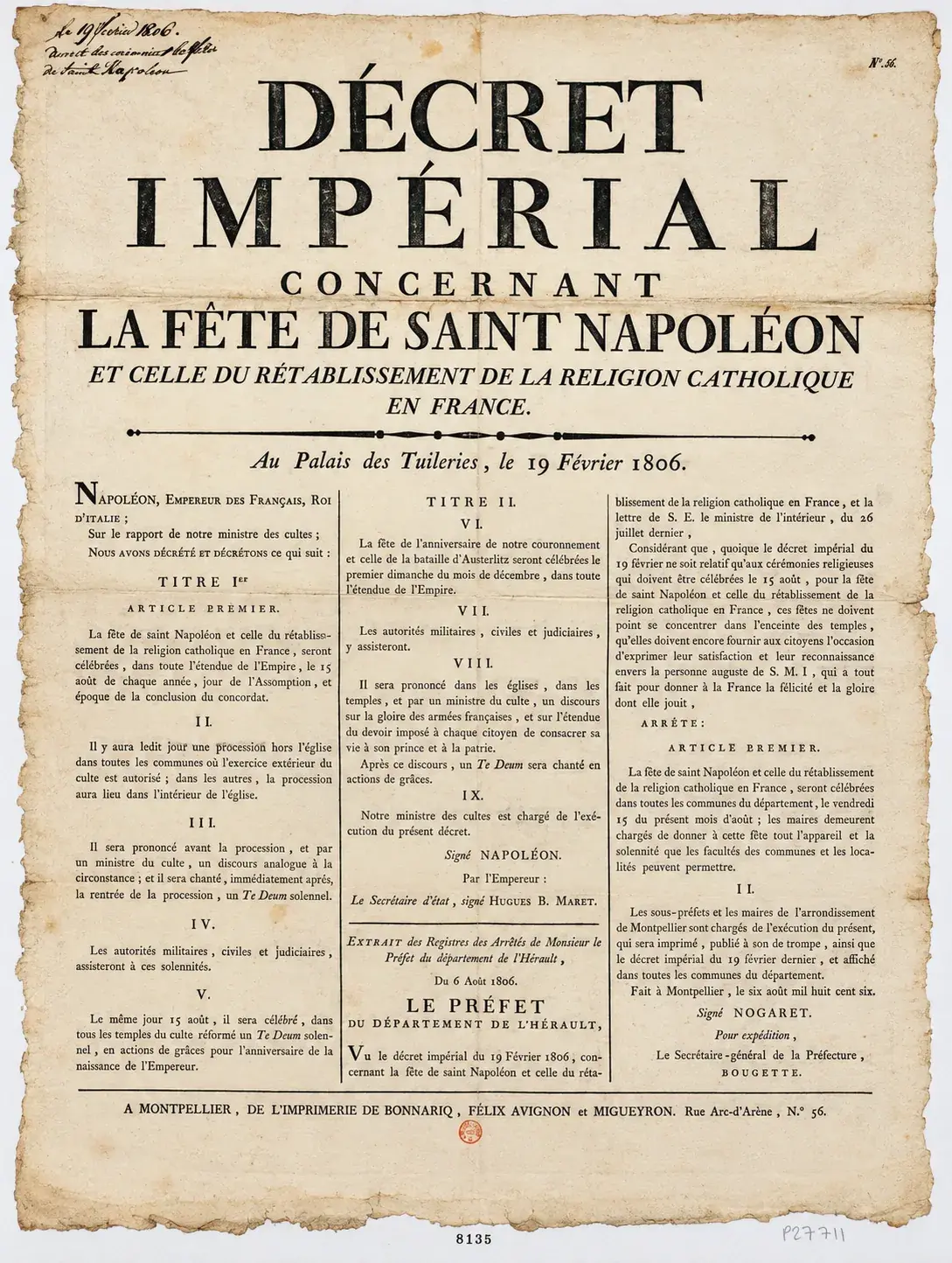
The decree of 19 February 1806 folded Saint Napoleon, the emperor's birthday and the return of Catholic worship into a single day.
Think how neatly that turned out. On a single day, French Catholics would attend church to honor Mary, and while they were doing that, they would also be celebrating their emperor.
Rome Pushes Back
Not everyone in the Catholic Church was pleased.
Cardinal Michele di Pietro in Rome raised a couple of big objections. First, he said Saint Napoleon was not in the Roman Martyrology, the official list of martyrs and their feast days in the Church. A saint who wasn't on the list had no business sharing a day with a major feast such as the Assumption. Second, and possibly more importantly, he argued that the government had no business deciding what went into the Church's calendar. That was the Church's job.
Pope Pius VII did not overrule Caprara, though. The relationship between France and the Church was delicate, and French bishops were making a lot of effort to reach a truce with Napoleon. Screaming the deal down over a questionable saint was not worth it.
Bishops Search For A Saint Named Napoleon
Now came the awkward part. The holiday existed, the saint did not. Somebody had to find him.
Bishops all over the Empire dug through old books, and one by one, they came up with nothing.
In April 1806, Antoine-Eustache d'Osmond, bishop of Nancy, wrote to Portalis to report failure. He said that to the shame of every library in Nancy, his people had searched and found nothing. The Roman Martyrology said nothing, and the Bollandists, a group of scholars well known for their careful research of the lives of saints, said nothing too.
The bishop of Ghent searched the same scholarly collections, and came up with nothing.
Then there was François-Joseph Hirn, the bishop of Tournai, formerly a librarian. He announced that he had found a bishop named Napoleon. He made no statement about where. He simply issued instructions in May 1806 for a particular prayer to be added to the Mass on August 15.
Historians note that Hirn offered nothing at all to prove his discovery. But his take had a big advantage. It kept the Assumption as the first thing, and made Saint Napoleon into an addition.
Neopolus: The Name That Solved The Problem
Meanwhile, Cardinal Caprara and his staff searched too, and they found something they could use.
Buried in old martyrologies, there was an obscure figure remembered on May 2. His name had variously appeared in different spellings in different manuscripts: Neopolus, Neopolis, Neapolis, Neapolus. Nobody knew much about him.
A scholar named Pietro Mazzucchelli, working at a famous library in Milan, suggested a fix. Over hundreds of years, he argued, the name Neopolus shifted in Italian speech to Napoleo, and then to Napoleone. In other words, this ancient figure and the emperor might still have the same name.
It's worth noting that Mazzucchelli himself seemed to be more comfortable with Neopolo in the Church services, at least, as it could actually appear in the old records.
Caprara went ahead with it. In May 1806, he sent the bishops of the Empire a short official reading about Saint Napoleon, written by a priest named Étienne-Alexandre Bernier, to be added to church calendars.
The Invented Life Story Of Saint Napoleon
Bernier's reading gave Saint Napoleon the life story he was lacking.
It placed him in Alexandria, Egypt, during the reign of the Roman emperors Diocletian and Maximian, a period famous for its brutal persecution of Christians. It described him as a man distinguished by his family or position. It said he was horribly tortured, and then thrown half-dead into a prison, where he died of his wounds without renouncing his faith.
It's a touching story. It's also, according to the researchers who looked it over later, mostly borrowed.
The scholar Antonio Niero traced much of the text to earlier writings. The descriptions of the suffering of Christians at Alexandria were largely pulled from an ancient account of a bishop named Phileas, preserved by the early church historian Eusebius. Other bits came from notes made by the Bollandists about two other figures.
In other words, the life of Saint Napoleon was pieced together from bits of other people's stories.
How Historians Figured Out The Truth
The most thorough takedown was by Hippolyte Delehaye, a Bollandist scholar who studied the saints' records in the early 1900's.
Delehaye examined the oldest surviving versions of an ancient list of martyrs. What he found was a mess that got messier with time. For May 2, the earliest sources mention a martyr named Saturninus at Alexandria. Later copies add words such as Neopoli and Neapoli. Even later copies turn Neopolus into a person, describing him as the companion of Saturninus.
Then Delehaye offered the explanation that turned the whole thing around. What if Neapoli was never a person's name at all?
Neapoli is Latin for "at Naples." Delehaye suggested that the original entry probably read something like "at Naples, Saint Sossius," referring to a real saint from that city. Over centuries of hand copying, the words were jumbled up and moved around, slowly turning a place name into a person.
Niero added that the leap from Neopolus to Napoleone just doesn't work linguistically. He called it folk etymology, which is the process by which people link two words that only sound similar and assume they must be related.
Delehaye's conclusion was blunt. The legend of Saint Napoleon was not an old tradition passed down through time, but rather a manufactured legend, and Neopolus may have never been anything at all.
Saint Napoleon's Day Across The Empire
None of that stopped the party, of course. From 1806 until 1813, August 15 was France's national day.
Celebrations were held throughout the Empire, including in the parts of Italy controlled by France. They were modest affairs, mostly, and didn't generate as much energy as the celebrations surrounding military victories. People will always cheer more enthusiastically for a won battle than for a saint's day.
Napoleon himself enjoyed the holiday. In 1809, he traveled in disguise to the city of Vienne just to see the festival lights without being recognized by anyone.
Different areas took the religious part differently. Some printed the official reading about the saint in their local church calendars. Some printed a whole set of prayers about him. Some didn't bother too much.
A Saint's Day In Venice
The city of Venice, as part of the French controlled Kingdom of Italy, had particularly detailed records, and so we know exactly what happened there.
Saint Napoleon first appeared in the Venetian church calendar in 1808. He did not displace the Assumption, but instead, a short reading about him was added to the regular service for Mary, plus brief mentions about him at other places in the service, and a prayer for Napoleon as the ruler. The church part was only the beginning. A grand hymn of thanks called the Te Deum was sung at St Mark's Basilica and in local churches, and sometimes on board a warship anchored in the harbor. After that, there was an official dinner for city officials and military officers, hot air balloon launches, a lottery drawing, an evening when the whole city was lit up, and a free ball (sometimes with masks) at the famous La Fenice opera house. Some years included military exercises too.
It sounds like a genuine good time, no matter what you thought about the saint.
The religious part was the first to fade away. Saint Napoleon vanished from the Venetian church calendar in 1811, although the Te Deum and prayers for the emperor continued until 1814.
One surviving copy of the 1814 Venetian calendar captures how quickly things turn. Shortly after the first abdication of Napoleon, some clergyman scribbled a note in the margin. Translated, it reads: "Napoleon to Elba." You can almost feel the sarcasm stretching back over two centuries.
Interestingly, the saint spread beyond the Catholic world too. During this era, a Masonic lodge in Paris operated under the name of Saint Napoleon, and used a glowing star around a book as its emblem.
The Feast Is Abolished, Then Refuses To Die
Napoleon fell from power in 1814, the French monarchy returned. On July 16, 1814, King Louis XVIII issued an order canceling the decree that created the imperial holiday. Officially, Saint Napoleon was done.
Unofficially, he wasn't going anywhere.
Between 1815 and 1848, supporters of Napoleon, called Bonapartists, continued to celebrate August 15. Sometimes as a genuine tribute, sometimes as a protest against the government without saying so.
Some stories are particularly fascinating. In the city of Lyon, Bonapartist prisoners marked the anniversary by arranging bits of candle on their cell gates in the shape of an "N" and lighting them. They were punished with days in solitary confinement. In one small town, the local government and church celebrated the day openly year after year. In Lille in 1841, authorities banned a workers' Saint-Napoleon society, accusing them of plotting against the government.
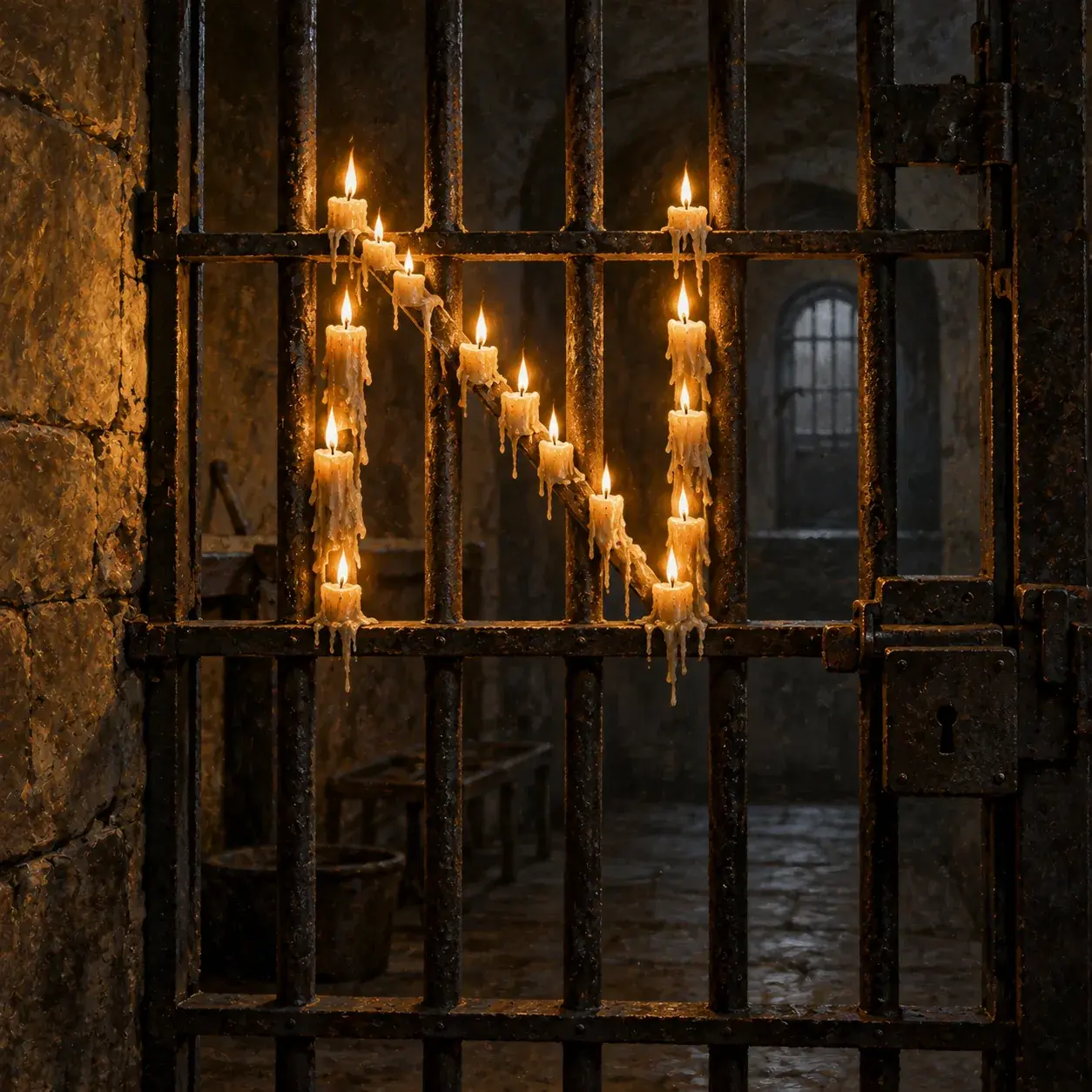
Bonapartist prisoners in Lyon marked 15 August with a burning letter N and were punished with solitary confinement.
A holiday for an invented saint had turned into a political tool.
Napoleon III Brings The Holiday Back
Then the Bonapartes returned to power. Louis-Napoleon Bonaparte, nephew of the first Napoleon, seized control of France through a coup in December 1851. In February 1852, months before declaring himself Emperor Napoleon III, he brought back August 15 as France's national festival.
The day had personal meaning to him. He had celebrated Saint Napoleon's day with parties and fireworks as a young man. At one such celebration in Baden in 1834, he had vowed to overthrow the French monarchy and restore his family to power. Eighteen years later, he had done exactly that.
From 1852 through 1869, eighteen official Saint-Napoleon celebrations were held in France. The pattern followed was set by the government: charity for the poor, a Te Deum attended by local officials, a military review, games and amusements in the afternoon, and then fireworks, bonfires, banquets, music, and dancing at night.
One thing that didn't return, however, was the Church's religious service for Saint Napoleon. The holiday continued without the saint.
That created a peculiar tension every August 15. For Catholic priests, the Assumption was the real feast of the day, and many of them concentrated on it and quietly ignored announcing the government's celebration. On the other hand, those who opposed the emperor found it awkward attending Assumption services without appearing to support the imperial party.
What Saint Napoleon Looked Like In Art
Since nobody knew anything real about Saint Napoleon, artists had to invent his appearance as well. Researcher Raffaele Argenziano has categorized the results into three main types.
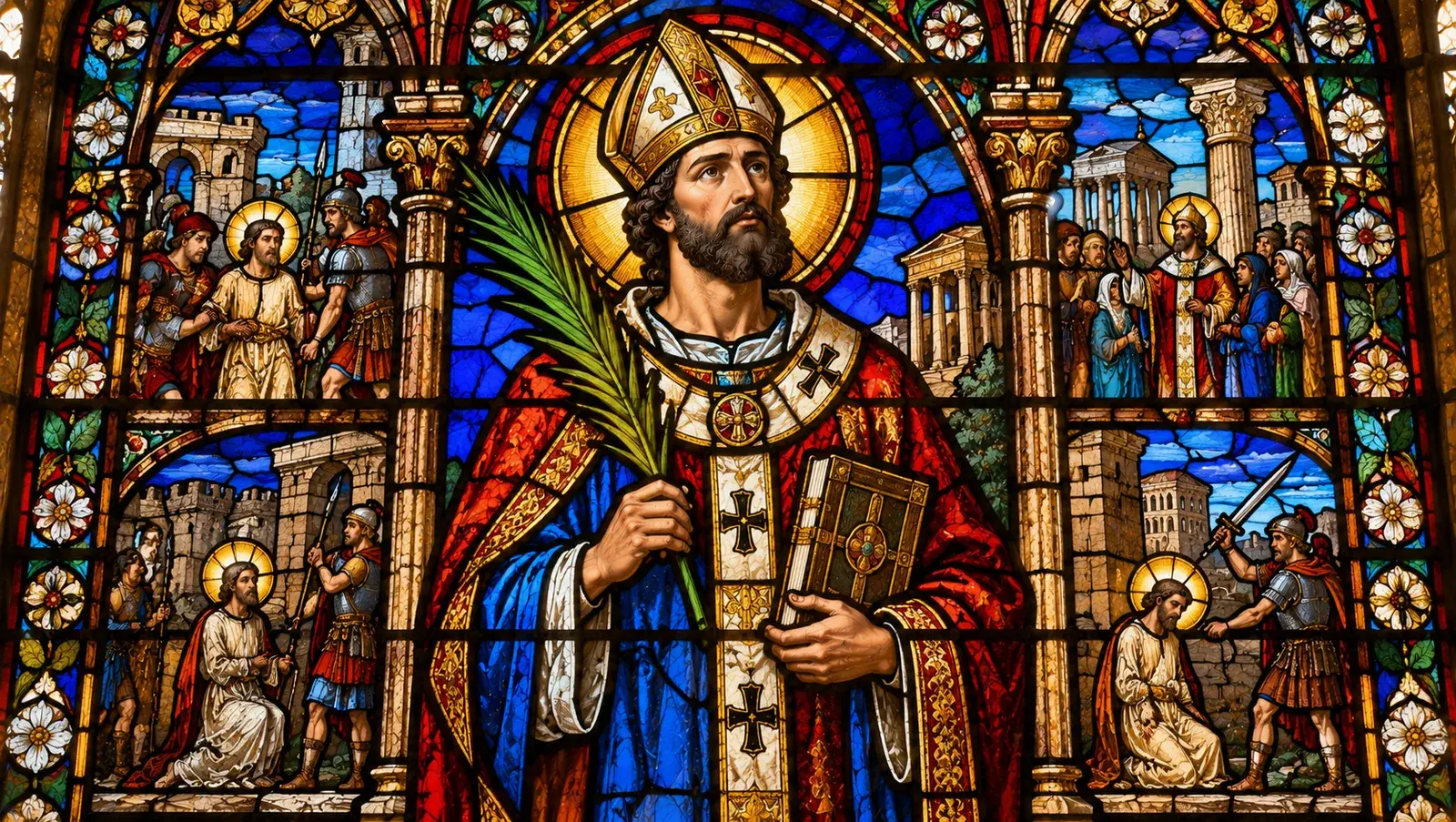
The first shows him as an older bearded martyr, chained up in prison, usually with a palm branch, the traditional symbol for martyrdom, and the tools used to torture him.
The second shows him as a young Roman soldier or officer. It likely came from the official reading, which described martyrs as "soldiers of Christ." It also fit an emperor who was famous for being a general.
The third type, which appeared later, shows him as a medieval crusader knight.
Some pieces were openly political. One painting from 1818 shows Saint Napoleon standing while a real living person, one of Napoleon's relatives by marriage, knelt before him.
After 1852, the artwork got stranger still. The line between the saint and the emperor started to disappear altogether. A lithograph made in 1852 shows the martyr being tortured with the unmistakable face of Napoleon Bonaparte. A marble statue made for the Milan Cathedral between 1858 and 1860 did the same thing, giving the emperor's features to Saint Napoleon, dressed in an ancient tunic with a chain around his ankle.
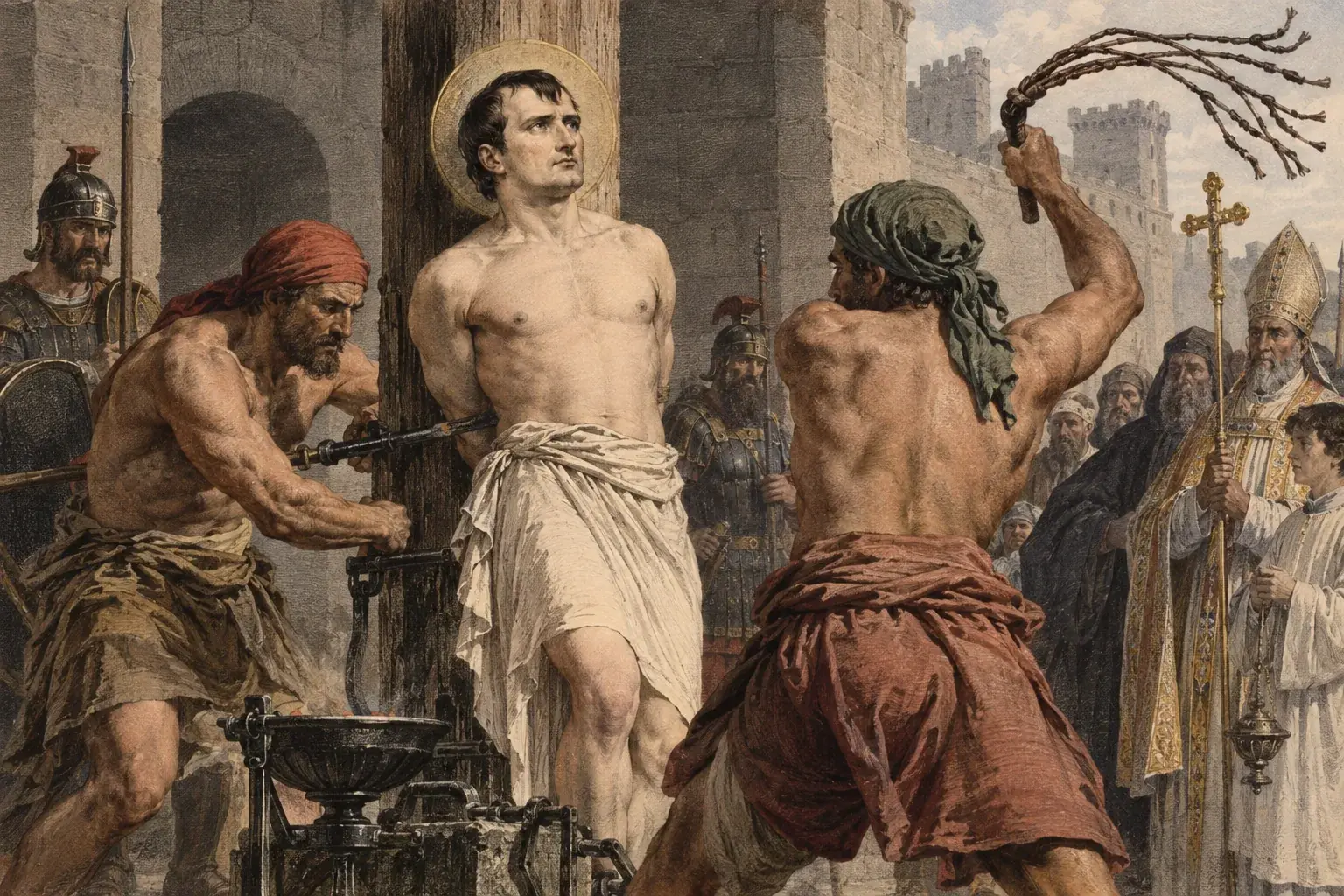
Philippe de Frondat's 1852 lithograph gave the martyr the unmistakable features of Napoleon I.
At this point, the pretense had collapsed totally. The saint had become a portrait of the emperor.
The Crusader Legend
One more layer was added after the death of Napoleon in 1821. A short pamphlet appeared claiming to give the true life story of Saint Napoleon, and it told a completely different story from the 1806 version.
In this version, Saint Napoleon was born in Corsica on August 15 in the year 1208. He fought in the crusading army of King Louis IX of France, was captured, was imprisoned on an island in the Sea of Marmara, and died there about 1260.
Look at those details closely. Born in Corsica. Born on August 15. A great soldier. Imprisoned on an island until his death.
Napoleon Bonaparte was born in Corsica, on August 15, became one of history's great generals, and died a prisoner on the island of Saint Helena. The "saint" had simply become the emperor with a medieval costume on.
The End of the Saint-Napoleon Holiday
The last Saint-Napoleon holiday was celebrated in 1869. The following year, in August 1870, as France was losing the Franco-Prussian War, the holiday was replaced by a public prayer for the success of Napoleon III and his army. The emperor's empire was soon defeated.
It is not that the feast day was entirely forgotten – in Paris, the Bonapartist societies continued to hold banquets in the name of Saint Napoleon through the 80s and 90s of the 19th century. And in the southwest of France, as well as in Marseille and Corsica, the feast day still drew together supporters of the Napoleonic tradition in the early years of the Third Republic.
Saint Napoleon's holiday eventually disappeared from the calendars, but the August 15th holiday in France is still a public holiday – the Feast of the Assumption of the Virgin Mary, which is what it always was.
What the Story of Saint Napoleon Teaches Us
One might dismiss this episode in the history of France as simply an amusing sideshow. And it is largely that – bishops hunting for any mention of a saint Napoleon in libraries, a scholar quietly suggesting they use a different spelling of the name, not because it proved anything about the man, but because that version at least turned up in records that really existed. A priest hastily noting "Napoleon to Elba" in the margins of the document when it is finally deemed safe to do so.
But it seems to me that this farce has a deeper meaning.
The first lesson to be learned here is the influence of people on the world around them. Napoleon did not invent the Feast of the Assumption or the idea of a patron saint. But he took what people held dear – a holiday – and made it his own, twisting it to fit his needs.
The second lesson is how far a small mistake can travel. A slip of the pen in a medieval manuscript turned the name of a city into the name of a man. Centuries later, that phantom was handed a face, a life story, statues, and the biggest holiday in an empire.
But the final lesson I think this story teaches us is one of the importance of historical research.
Scholars such as Hippolyte Delehaye dedicate their lives to meticulously comparing different medieval manuscripts. This type of work, boring and unglamorous as it may be, is essential to untangling history and restoring long-overlooked figures and events to their proper place in history. Thanks to this type of research, we can follow the trail of the phantom saint, from the margins of medieval manuscripts to the very heart of an empire – and the statues, portraits, and feast days that were built around it.