Ancient Israelite religion is often taken to be the world's first monotheism, and for the centuries during which the Hebrew Bible was written down, this is a reasonable position to adopt. If you look further back, however, the picture reconstructed by historians and archaeologists becomes much more crowded.
The evidence comes primarily from inscriptions found in the ground rather than from the bible, and what it suggests is a reconstruction rather than a settled view. Religious traditions have long interpreted these same texts very differently from the historical perspective taken below.
What follows is the historians' account of how the religion was formed, how it was practised, and when the switch to strict monotheism appears to have been made.
Henotheism in Israel and Judah
Between roughly the 10th and 7th centuries BCE, the religion practised in Israel and Judah appears to have accepted the existence of many gods while focusing worship on one. Yahweh was that central deity as the national god of both kingdoms, an understanding that reaches back into earlier bronze age traditions. Other deities were not denied, just not the focus.
Scholars have a name for the belief system that takes one god as its focus while not denying the existence of others, and it isn't monotheism. It's henotheism, and it's important to keep in mind the practices of people inscribing formulae onto walls and pottery during this period.
Rituals, Festivals and Everyday Devotion
The everyday life of Israelites and Judeans was governed by ritual, sacrifice, and a programme of festivals, of which Yom Kippur, the new moon celebrations, and Passover are just three. All these days had specific offerings attached to them, and they each had particular expectations regarding who made them.
Alongside these official rituals, practices that appear less formal also took place, including divination and prophecy. These are not marginal elements, either, but ones that occupied a genuinely central space in the religion.
It wasn't just offerings that demonstrated one's devotion, however, and the performance of good deeds was seen as an expression of it in much the same way. Being an upright and fair person wasn't a moral category running parallel to the religious one, but an element of it. This is one of the more distinctive features of the religion, and one that turns out to occur fairly often in its texts.
Israelite Religion and Canaanite Culture
It isn't an isolated development but part of a broader religious context that began to take shape around the 10th century BCE. The religion of Israel and Judah was one current flowing within a far greater religious culture, the West Semitic one more commonly known as Canaanite.
This is an important correction, and one that helps to explain many of the details. Vocabulary, rituals, assumptions about the relationships between gods and people, and even the occasional shared deity all came from this common cultural stock rather than being invented in isolation.
Because of this, later evidence from this region becomes easier to interpret. When inscriptions turn up that refer to Yahweh in the company of other deities, or when a biblical passage describes him doing the same, these aren't aberrations but are exactly what you would expect to find.
Household Gods and Ancestor Offerings
Prior to the existence of the kingdoms of Israel and Judah, religion operated on a smaller scale, and the family was the primary unit of organisation.
Households preserved their own traditions, and ancestors were remembered through carefully worded invocations or offerings made in their memory. They also appear frequently to have focused their devotion on a particular deity, and occasionally referred to the god of the house.
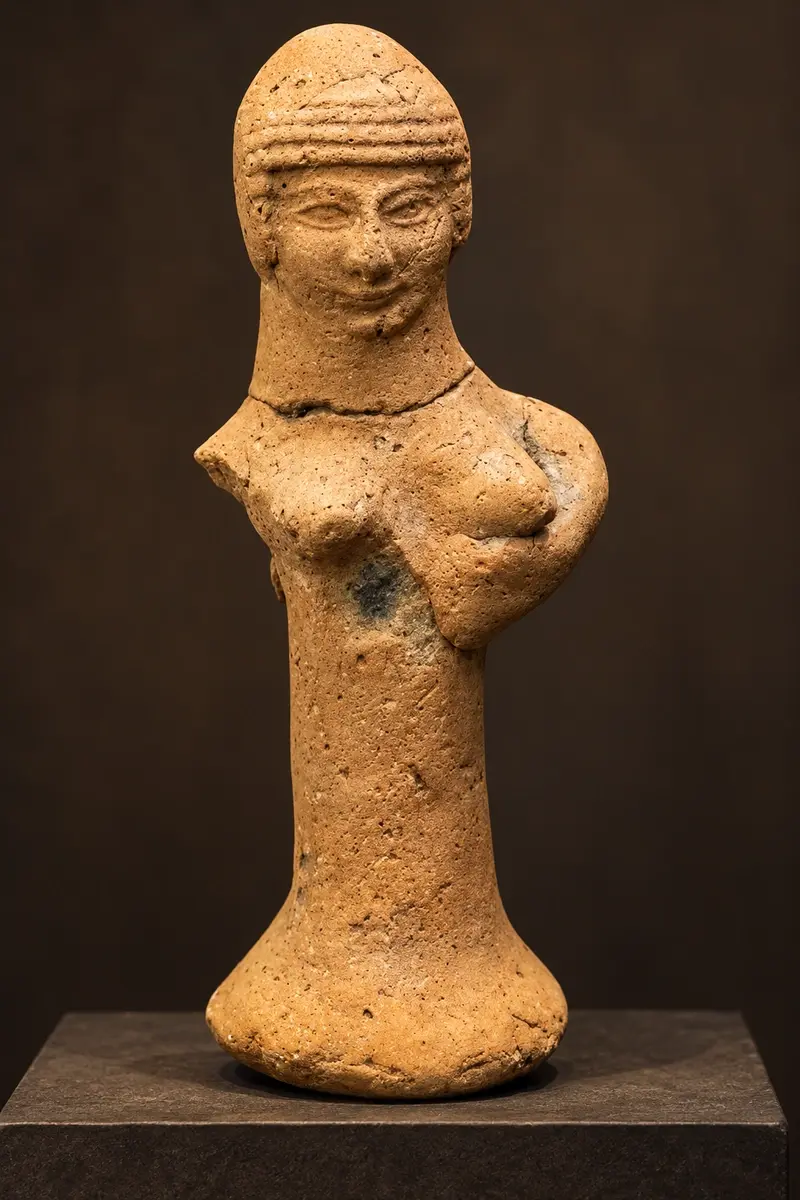
Figurines like this one turn up constantly in domestic contexts and are often linked by scholars to the household devotion described in this section.
The function served by this sort of belief should be obvious even three thousand years later, and that is to bind the family together around their own origins. Whatever was happening on the great scale of gods and kings, it was the household religion of this sort that was most familiar to most people.
Inscriptions Naming Yahweh and Asherah
The most striking pieces of evidence for the beliefs of early Israelites and Judeans are not found in a book but were inscribed at archaeological sites.
Inscriptions found at Kuntillet 'Ajrud mention "YHWH of Samaria and Asherata," thus invoking both a national deity and a goddess in a single sentence. Another inscription found at Khirbet el-Qom speaks of a person blessed by YHWH through Asherata and so makes the goddess the means of conveying a blessing from the national deity.
This sort of passage doesn't make the authors sound like heretics or dissidents, however, since neither of these is what they appear to be taking themselves to be doing. Yahweh was clearly considered the more significant of the two, but no one appears to think this is in any way remarkable.
The reason for this interest in Asherah is likely because she served a role as helper or assistant to Yahweh and one scholar believes she performed a similar one elsewhere. In Ugaritic writings, the goddess Athirat appears to have a comparable relationship with the god El.
Psalm 82 and the Other Gods
The bible itself preserves some material that fits in with this understanding and explains why the historians' account has held up.
Psalm 82 describes Yahweh standing among other gods and admonishing them for their failure to protect the vulnerable. It also depicts him exercising power over them and so represents a very different understanding of the relationships between gods than one would find among later readers of this passage.
Other passages depict the worship of specific deities as matters of routine, as is the case with 1 Kings 16: which mentions the erection of a shrine to Asherah by King Ahab, or 2 Kings 17 which speaks of the people of Israel worshipping both Asherah and Baal. The fact that either practice is mentioned at all is further evidence that they were common enough to have been considered worth condemning.
Deuteronomy 32:8 in the Septuagint
One textual detail deserves special attention because of the insight it provides into the chronology of this shift.
The Septuagint is among the earliest translations of the Hebrew Bible into Greek, and at Deuteronomy 32:8, it speaks of the Most High dividing off the nations to various gods, with Yahweh's share being Israel. The verse is henotheistic rather than monotheistic, speaking of the existence of multiple gods and the allocation of portions to each of them.
Its very presence in a text of this date is further evidence that the older religious system hadn't been wholly replaced at this point.
Five Types of Sacrifice in Leviticus
Turning to the question of practice, sacrifices were the central religious activity and Leviticus preserves records of five types: burnt offerings, grain offerings, those of well-being, sin offerings, and guilt offerings. Each has its own requirements and procedures, but what's most interesting about them is the sliding scale.
The offerings appear to be calibrated to the wealth of the giver, with the most affluent providing a bull, and the least able a pigeon or a dove. These were the sorts of practices that ensured the participation of the poor in the central rituals of the religion.
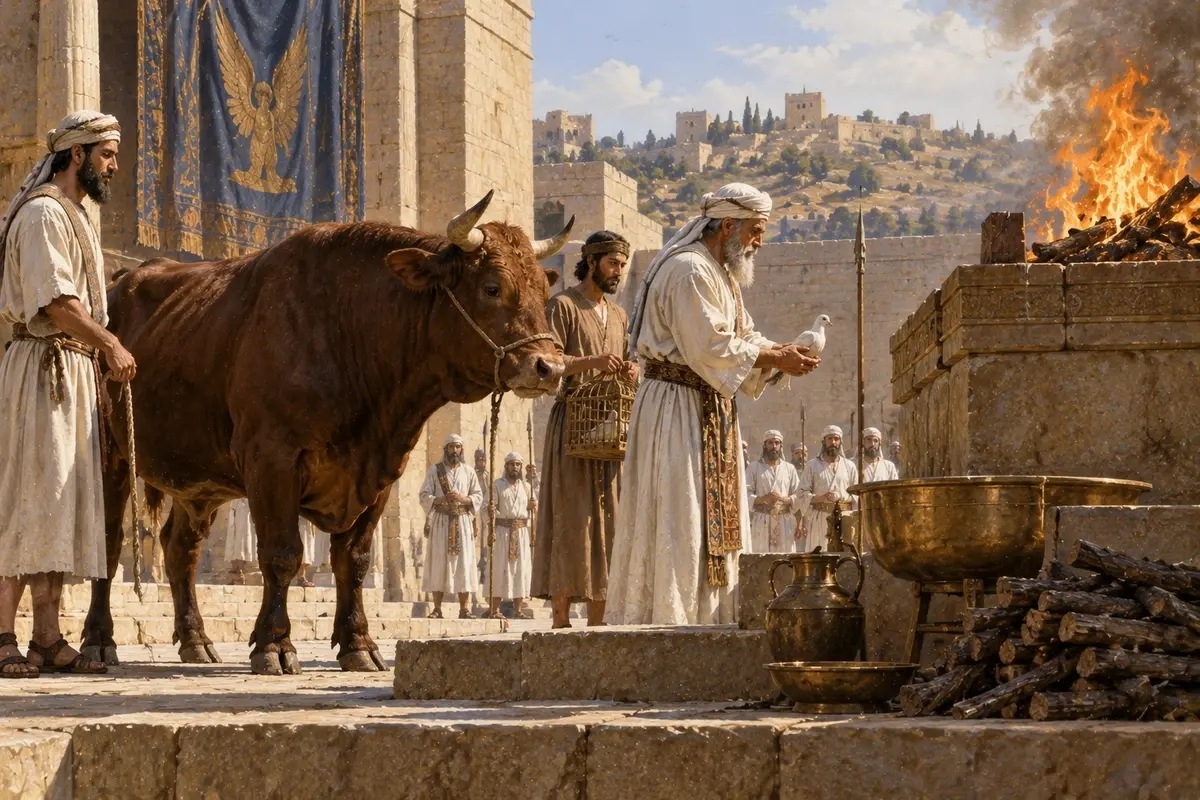
Leviticus scaled the required offering to what a household could actually afford, from a bull down to a single dove.
That's not a feature of all ancient religions that employed sacrifices, but it is of this one. It didn't matter whether someone could only afford a dove when the instructions called for a bull, or not; within the system, they were perfectly equal offerings.
The Day of Atonement Ritual
The single most important day in the year was the Day of Atonement, or Yom Kippur, and it was dedicated to a particular purpose: cleansing the sanctuary of accumulated impurities resulting from the previous twelve months.
The importance of this objective accounts for the complexity of the procedure associated with it. If the accumulated sins were not fully removed, Yahweh would abandon the sanctuary and the community that had allowed it to happen would be in great danger.
The high priest performed a series of actions designed to accomplish this end, sacrificing an animal and sprinkling its blood on the altar. He then placed his hands on the head of a goat, a gesture that transferred the sins of the people onto the animal, which was then sent out into the wilderness. A final burnt offering completed the procedure and restored the relationship between the people and their god.
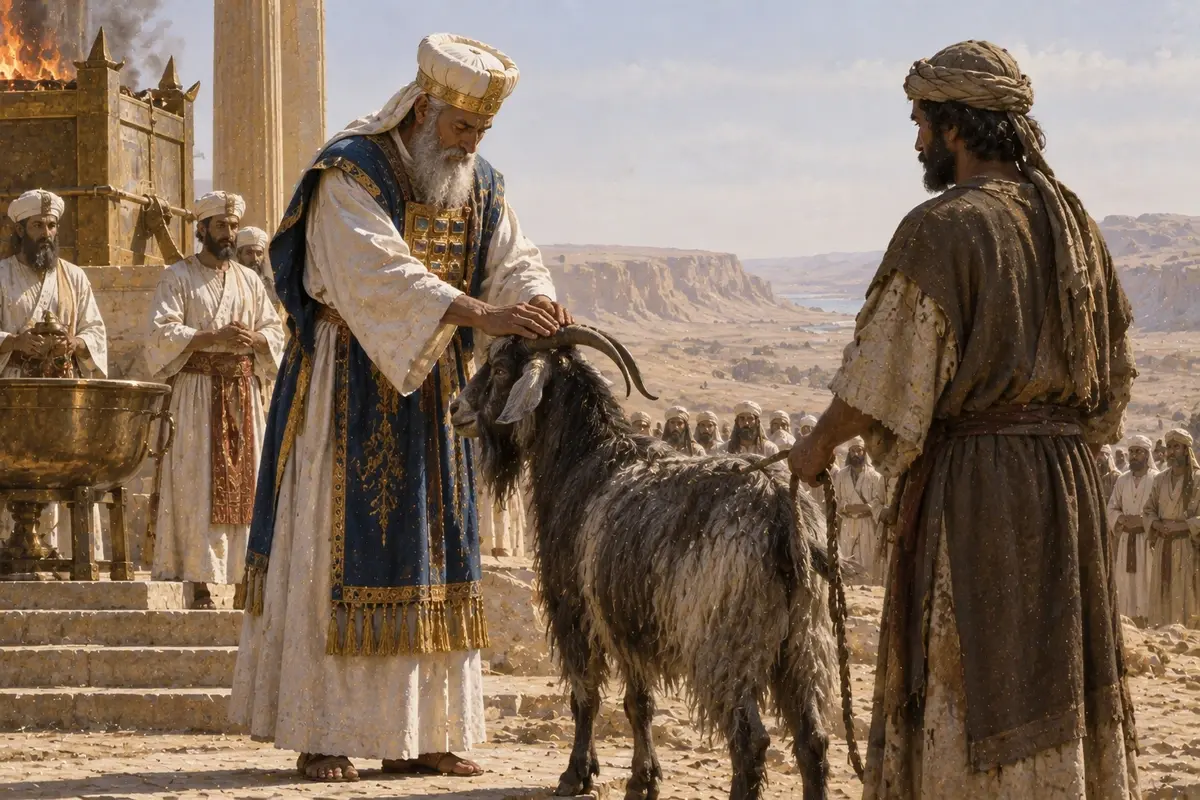
The gesture of transferring the community's sins onto the animal was the emotional center of the entire Yom Kippur procedure.
A similar ritual appears in Ugaritic texts from around the 13th century BCE, which is further evidence that the Israelites were following a procedure with deep roots in the region. The difference between the two is worth emphasising, however, since the Ugaritic one was performed across several temples while the Israelite one was restricted to one, which is a significant statement to make about either.
Passover and New Moon Festivals
The remainder of the religious year was organised on the same principles but to a lesser degree, Passover (Pesach) and the new moon festivals being the most important. Sacrifices were made during these occasions as well, and always with the same purposes in mind.
They fulfilled a dual function by renewing the relationship between the community and Yahweh while also marking the passage of time in a way that everyone understood. It's the sort of calendar that most agricultural societies tend to share.
Divination and the Woman of En-dor
Not all practices were endorsed by religious authorities, and the bible preserves this disagreement rather than pretending it doesn't exist.
The famous story of the woman of En-dor in 1 Samuel 28 is the well-known example, involving King Saul seeking her out for her ability to summon the dead. This was apparently not a crime in the eyes of the narrator, however, since he simply tells the story without passing any judgment on it.
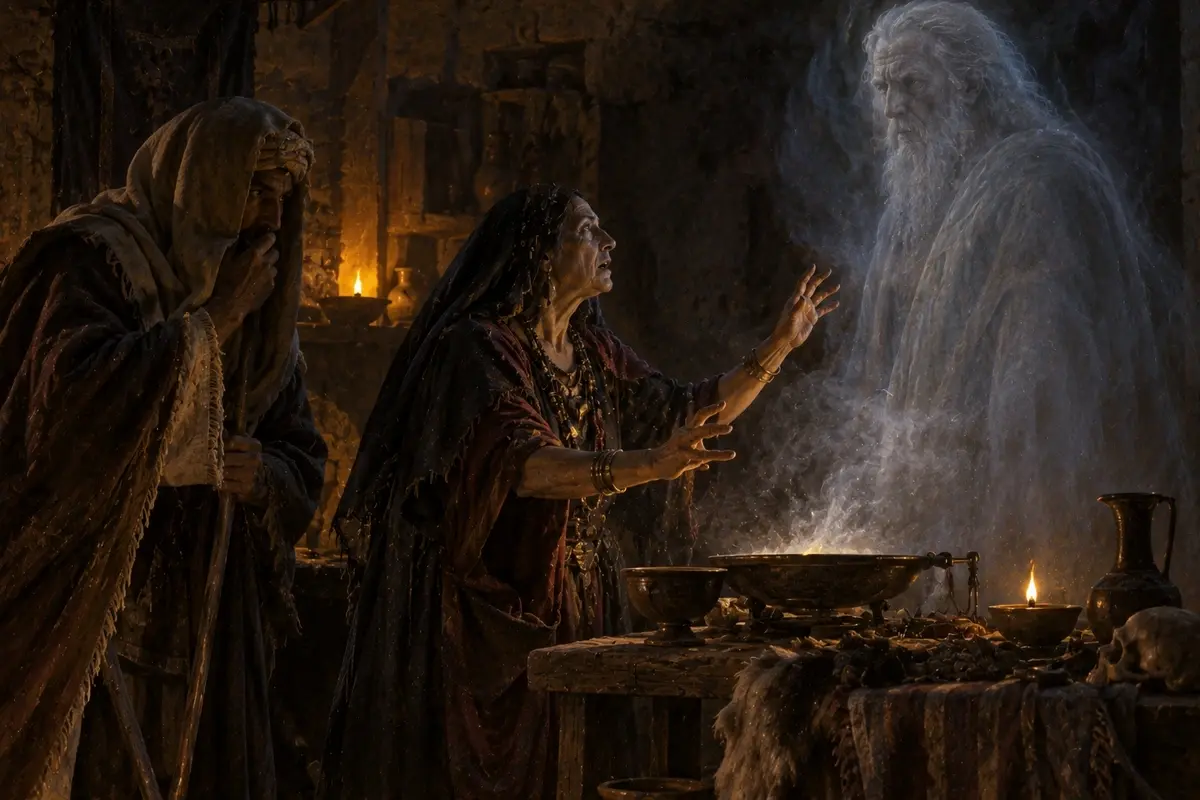
The narrator recounts Saul's visit to the medium of En-dor matter-of-factly, without the condemnation found elsewhere in the text.
It's interesting to contrast this with Deuteronomy 18:10 to 11, which forbids fortune-telling, consulting the dead, or casting spells in the strongest terms. These two passages appear in the same collection of writings but represent views that couldn't be more opposed, and the reasons why aren't hard to understand. Some Israelites clearly believed in the efficacy of divination. Others clearly believed that it was an abomination.
Ethics, Justice and Yahweh's Presence
The moral teachings of this religion were inseparable from the relationship between its people and their god, which explains why ethical failings were treated as matters of considerable seriousness.
The prophet Amos warned those who exploited the poor that they would suffer the consequences in the form of a drought, and in 1 Samuel 4, Yahweh's presence leaves the temple due to the misbehaviour of Eli's sons. There's no suggestion in either passage that the actions of the guilty parties were only a concern to them, however, only that they threatened everyone.
This teaching can be seen as the moral arm of the religion, but it was inseparable from the other practices. The laws found in Leviticus 18 to 22 make this clear, for they specify that those who commit ethical wrongs risk being cut off from the community, and the reasoning behind this punishment is instructive.
It wasn't only a matter of punishment, but of protection, since the community had to remain pure in order for Yahweh's presence to remain with them. The purity of the sanctuary was in turn necessary so that Yahweh himself might not depart.
When Monotheism Became the Standard
The Hebrew Bible as it now exists describes a religion far more monotheistic than any of the evidence presented above would suggest. It isn't wrong to take this view, but it's also significantly later.
Scholars generally attribute the writing of these texts to authors active between the 7th and 3rd centuries BCE, a period during which exclusive devotion to a single god was definitely the norm. It's a perfectly valid position to take, but it reflects the beliefs of people who lived at the end of a long process rather than the beginning.
What makes the Hebrew Bible so valuable to the historian is the fact that the editing process was never complete, and so passages like Psalm 82 survived alongside the later insistence on monotheism. The same is true of the reference to Asherah in Deuteronomy 32:8 in the Septuagint and the accounts of sacrifices to Asherah and Baal. All were retained precisely because they represented the earlier system.
What Scholars Still Debate About Yahweh
The details that remain contested are precisely those that are of most interest to historians. Two inscriptions from two sites don't go very far towards establishing the beliefs of an entire population across four centuries, and the same can be said of the biblical texts, since they were written by people with their own theological agendas.
There's a great deal more to be said about the extent to which henotheism was actually practised rather than merely mentioned, and precisely what the nature of the relationship between Yahweh and Asherah was believed to be. There is also a great deal of discussion to be had about when and why the shift to monotheism occurred, and how much of it had to do with politics rather than theology.
What the evidence does establish is the general shape of this development. This was a religion that originated in a Canaanite context, continued to share elements with it for centuries, and then became something else entirely over a long period of time. The form most people are familiar with is the end result of this process, and so it's easy to overlook what came before and considerably more interesting than it might appear at first glance.