The Roman Empire is best known for its emperors and gladiators, both of which were real. But that's like describing a country by its president and its sports stadiums - you're leaving out the actual face of the civilization. What the empire really had going for it was a busy mix of trade routes, bustling cities, and steady movement of goods and people from one end to the other.
At its peak the empire stretched from the Atlantic Ocean in the west to the Euphrates River in the east, but the boundary lines are less important than you might think. Ancient Egypt was defined by the Nile River, as was Mesopotamia with its twin rivers, the Tigris and Euphrates. But in other ways, Rome was different - it didn't have a river at its heart, but a sea.
Here's what the empire looked like from the inside out: its borders, where they stopped, and what its major cities contained. Here's why the distances weren't a problem back then, and why they would be for another millennium.
Where the Roman Empire Ended
Each of the four borders of the empire was defined by a natural danger to the Romans, and the fact that the expansion stopped where it did shows that the expansion was more about logistics than conquest or discovery.
There was nothing to the west of the empire but the Atlantic Ocean, which naturally stopped any further expansion there. To the south, the Sahara Desert was too hot and too rough to get very far through, and the civilizations on the other side of it (in sub-Saharan Africa) were content to stay put. To the north the boundary was formed by two major rivers, the Rhine and the Danube, which provided natural defences as well as clear borders to mark where the empire ended and the wilderness began. And to the east the Euphrates River marked the border in much the same way, though there was a major civilization across the river instead of empty land.
The empire didn't cover every corner of the map, but it did get pretty far. Most of Africa, large chunks of Asia, and significant portions of Europe were all left outside of Rome's borders, though. The empire was big, but it wasn't everything.
Why Rome Grew Around the Mediterranean Sea
The Mediterranean Sea was a feature unlike any other in the empire, and it defined the shape of the empire in ways that a river valley would have. Instead of having a trade route going up and down a river, the Romans could put goods on a ship and float them across an entire sea, faster and more efficiently than on land.
It's impossible to say how much the Mediterranean contributed to the riches of the empire, but it was clearly important. Look at the goods that shipped across the sea from one end to the other: grain, oil, wine, stone, soldiers, and government officials. It connected the major cities of the empire - not just Rome, but places like Spain, Syria and North Africa as well. It spread the Roman culture out from the capital city and built wealth and power there. There's a reason why this sea is sometimes called the “civilizing sea”.
Older civilizations that had developed along rivers had a different look to them, one imposed on them by the landscape. Civilizations that grow next to open water have a different feel, and look different on a map. A river makes a narrow stretch of land that's easy to defend, while a ring of coastline is broader, and has many vulnerable points. These are two very different types of government, connected by something much larger than themselves.
Roman Trade With India and Sri Lanka
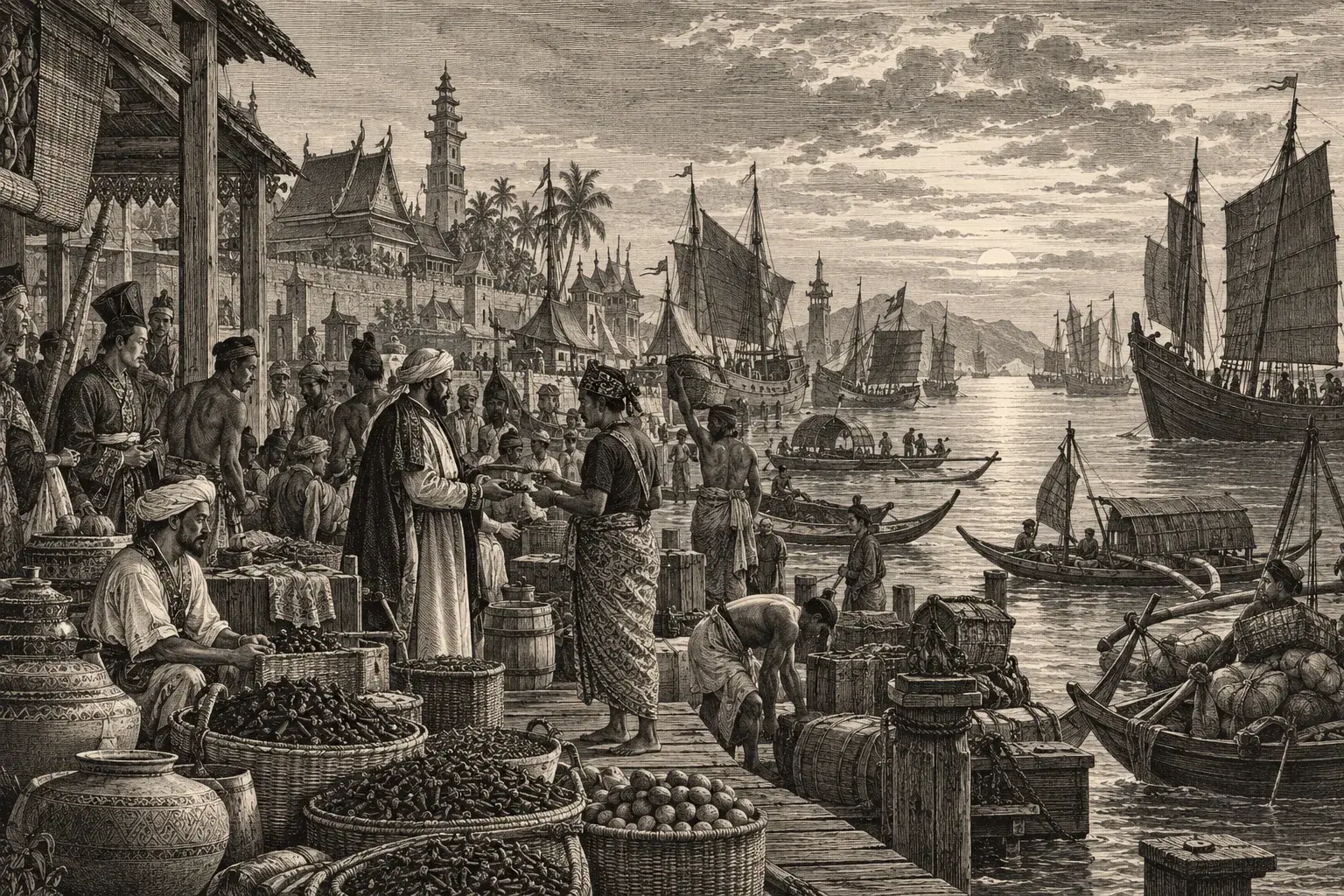
The Roman merchants didn't stop at the edge of the empire, but travelled down the Red Sea and across the Indian Ocean to the island nation of Ceylon, modern day Sri Lanka. This was a trading post for goods from even further away, and they included some very coveted items. Spices, jewels, silk that was finer and softer than anything found anywhere near the Mediterranean, bright textiles, and exotic animals like apes and peacocks were all part of the cargo.
Sri Lanka wasn't the only stop along the way, but it was a key point. These goods were incredibly popular with the upper class of the empire, who couldn't afford to buy them lightly. Luxury items were a way to show off both your power and your wealth, and the riches of the empire could be seen in the display of strange and exotic goods. The Romans' reputation as conquerors and power brokers around the world was burnished by association with these goods, and that reputation was important to maintaining the empire.
One interesting note about this trade is that the people selling these goods were themselves older and more sophisticated than the Romans. India and China, the two great powers closest to the empire, both had been around for much longer than Rome and were somewhat independent from them. Rome traded with both as if they were a single entity, but they were actually quite separate.
Rome's Long Fight With Persia
To the east of the Euphrates River was the one power that the Romans could never seem to get past, and that was Persia. The Persians had been a great empire in their time, and they seemed to be aiming at nothing less than conquering all of their neighbors, including the Romans. The two powers fought a series of expensive wars to try and get past one another, without much success.
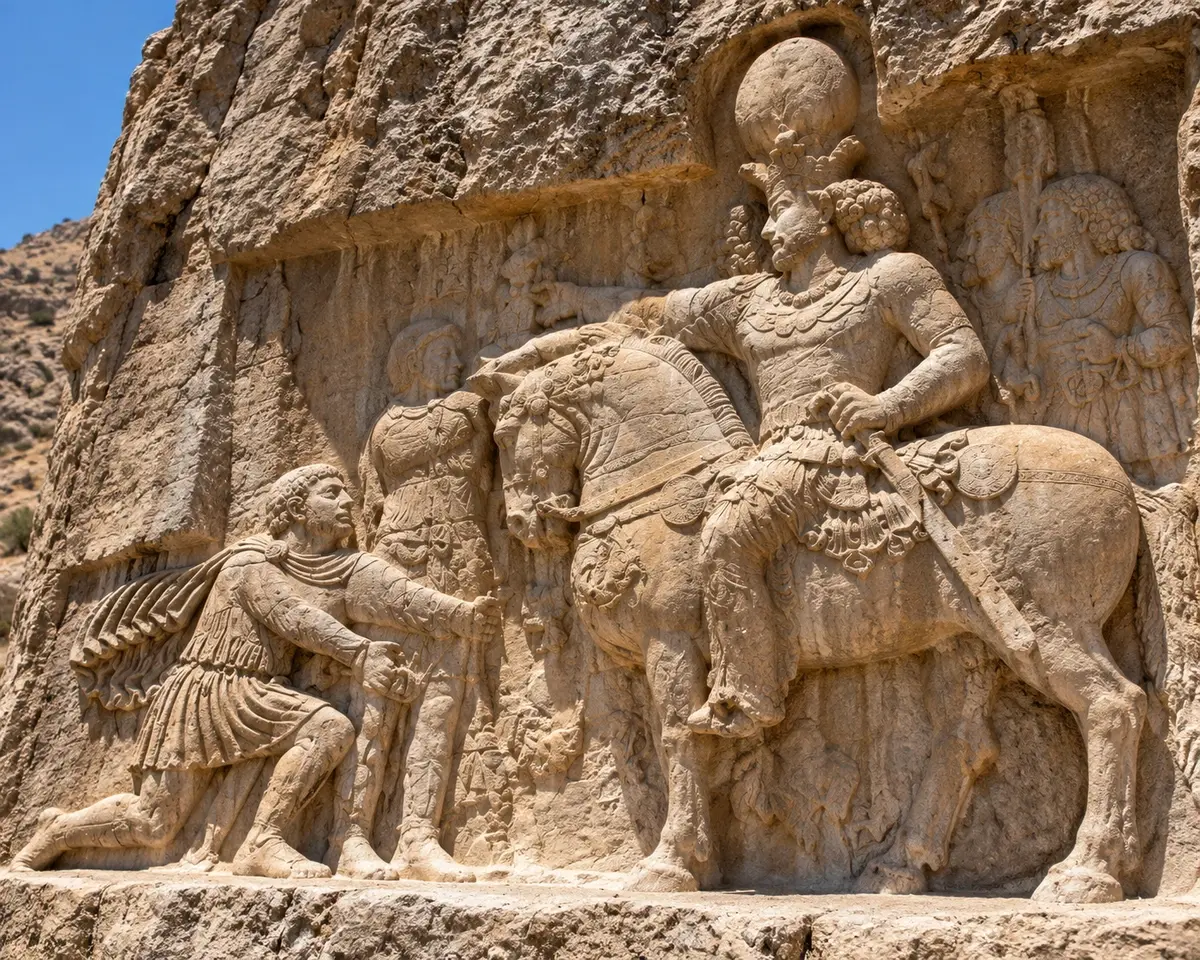
Sasanian rock reliefs celebrating the capture of a Roman emperor were carved as public monuments, which is part of why the story travelled so far.
Neither of the two empires had much success in conquering the other, which is probably why both were still around for such a long time. The campaigns went back and forth for years, but it was all a standoff - the Persian kings could claim a Roman emperor as a prisoner, but they couldn't turn that capture into lasting conquest, and the captured emperor never returned to Rome.
One especially famous story from this period tells of the disgrace and indignity suffered by a captured Roman emperor. According to the tale, when the Persian king met his prisoner he ordered the man to kneel so that the king could use his back as a seat to mount his horse. It's probably not true, but it makes for a good story and there has never been a definitive answer about whether it happened or not. There's a very real reason that the ancient historians would have taken the tale seriously if it had happened, and why the story has survived across more than a millennium.
Forts Along the Rhine and Danube
The border on the northern edge of the empire wasn't as clearly defined as the one on the east, and that led to problems. Across the lands of Germany, and through the open plains of what is now Russia, groups of people were migrating, though it's unclear exactly why. Some historians point to food shortages caused by climate changes, and others believe it was simple greed. Whatever the reason, it appears that the tribes wanted to enter the lands held by the empire, and they became a persistent problem for centuries.
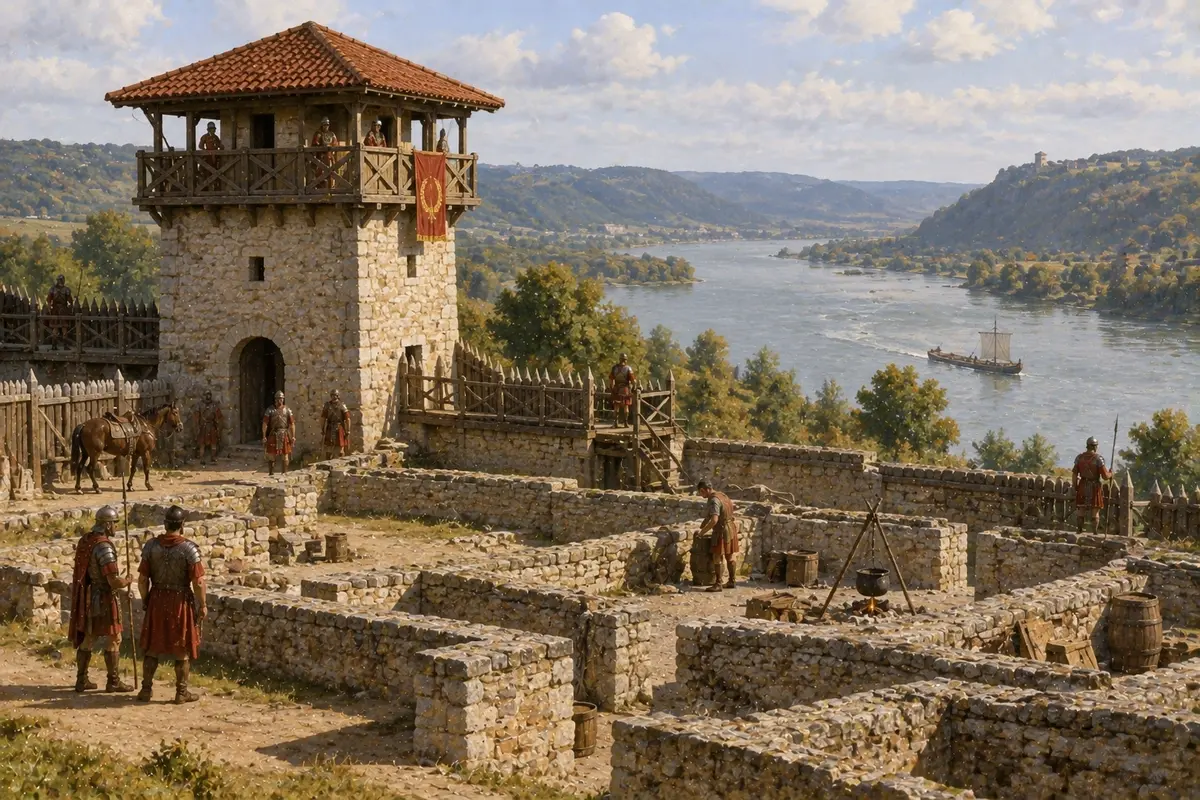
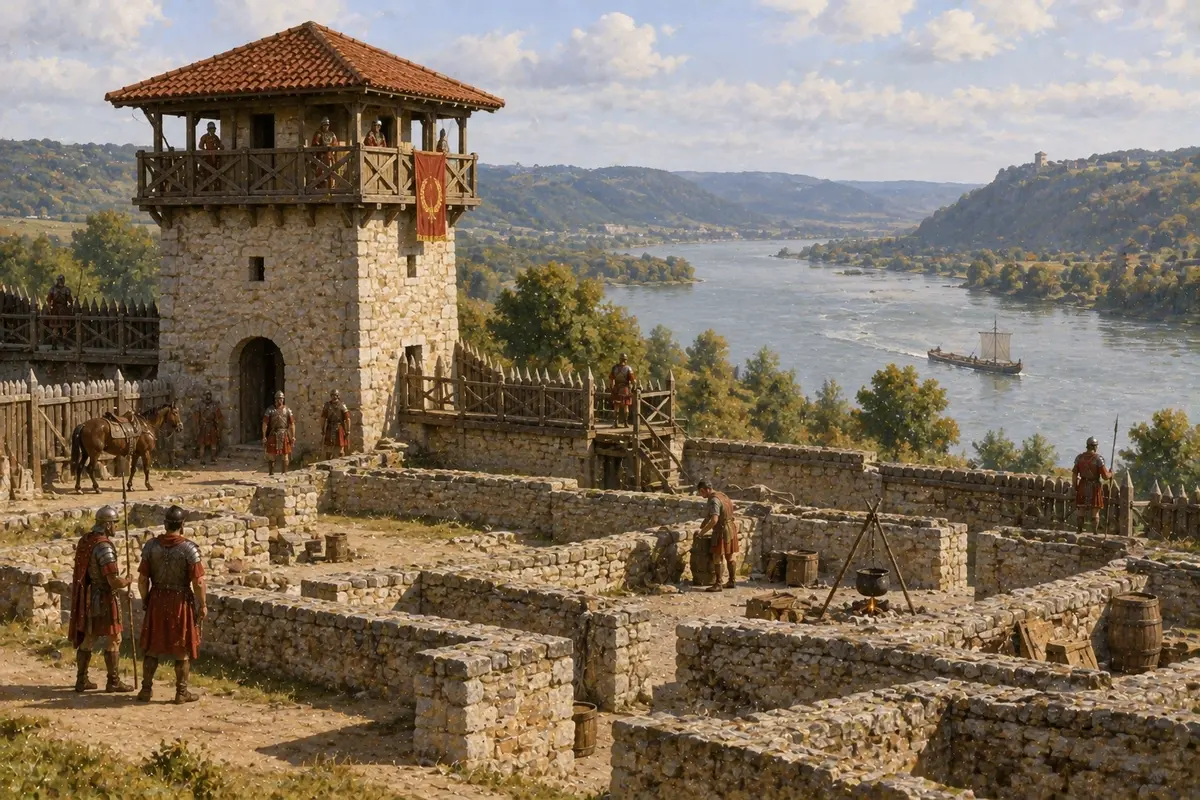
Forts and watchtowers along the Rhine and Danube were spaced roughly 10 to 30 kilometres apart and garrisoned year-round.
Groups from what is now Russia were especially troublesome, as some of them were believed to have names also listed in the Bible. The threat eventually forced the Romans to build a series of small forts and military bases along the Rhine and Danube rivers, which were large enough to make a real difference. The rivers themselves were fortified in several places, providing natural defences against invaders. It's fair to say that these two rivers formed the most important line of defence in the entire empire. And for a long time, it served its purpose. It didn't serve it forever.
How the Empire Split Into Two Halves
The empire was split in two on the inside, along the Adriatic Sea between Italy and Greece. To the east of that line were some of the oldest and most influential civilizations around, including Greece, Egypt and Syria. None of those cultures were really overrun by the Romans, even after the Romans took over governing them. They had large-scale governments and public works projects like Roman ones, only with different languages and old histories.
To the west of that line were less developed areas, like Gaul (modern day France) and Spain, and what would become Italy. Because those areas didn't have much in the way of existing government, the Romans pretty much had to implant their own culture in order to govern them. That's actually quite a different situation, and it's one reason that there were problems later with the empire splitting in two. These two very different parts of the empire only seemed like they should be ruled by a single government, and the government didn't have a coherent plan for handling that.
Why Educated Romans Spoke Greek
The language spoken by the average educated person was another sign of the split, and it wasn't Latin. It was Greek, another tongue that was much older than the Roman language and had once been very influential. The Roman upper class was educated in Greek literature, and it shows - the most influential Roman emperor, Marcus Aurelius, wrote his personal journal in Greek.
The Roman tongue, Latin, was considered below Greek, and not fit for educated men. It took very few centuries for that to change, as people began to abandon Greek in favor of the old language of the battlefield. Latin spread throughout the western half of the empire, while Greek continued to be spoken in the east. Eventually the two sides of the empire became so unaccustomed to the other's language that they couldn't follow each other's ideas or writings. The cultural distance between the two was enough to cause serious, lasting splits in the empire.
What Roman Cities Were Like
The government of Rome promoted the idea of living in cities and urban areas, as opposed to scattered villages. That meant villages were less able to raise taxes and troops, and the state invested in making cities appealing to regular people. That strategy paid off, and the cities spread throughout the empire in a fractal pattern that filled more space than any other design.
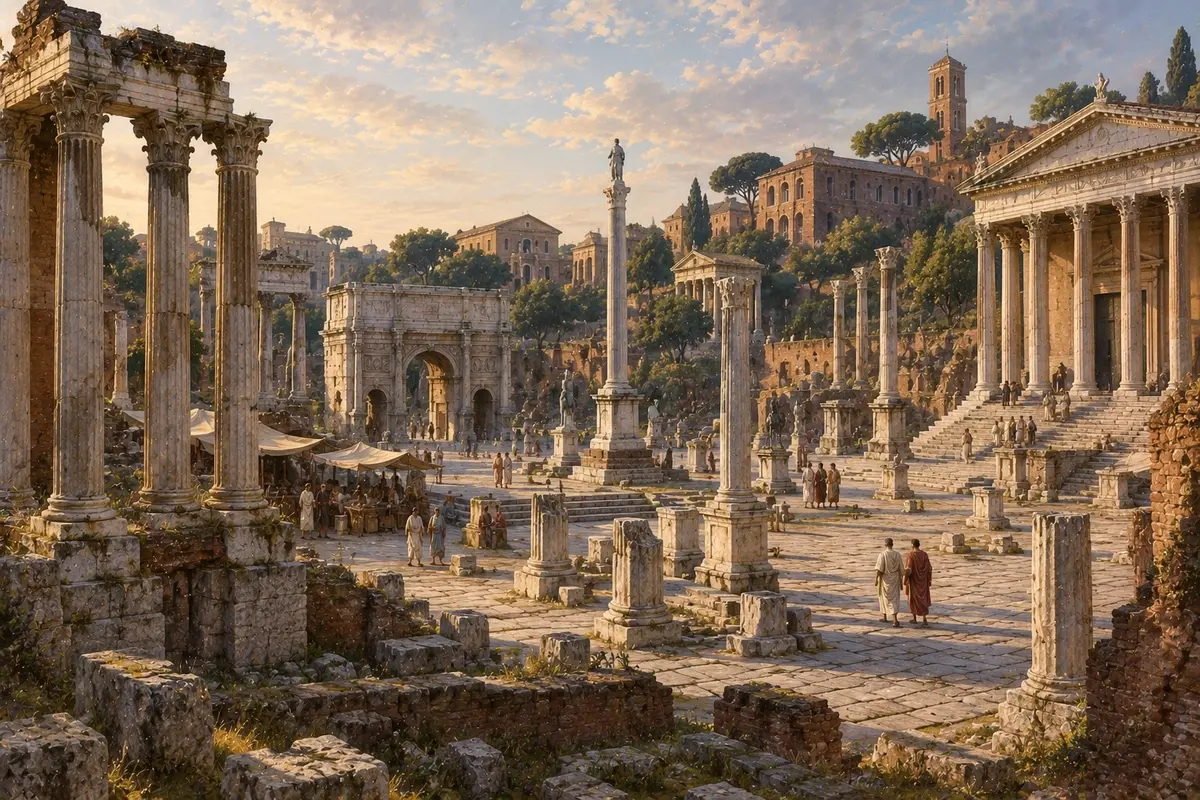
The forum sat at the centre of nearly every Roman town, combining marketplace, law court and civic meeting ground in one space.
At the center of most of these cities was the forum, a meeting place where citizens gathered and government business was conducted. Most Roman cities had public buildings, including temples, huge bathhouses that served as social clubs, libraries, and outdoor theaters. It's a long list of amenities for one small settlement, but that's exactly what a town of this size needed to support itself. These kinds of buildings weren't limited to the capital city, but were standard across the empire.
The flow of goods in and out of a city dictated the pace of life, from the bustling markets to the quieter streets near the center of town. The people of the town would leave their homes and businesses to travel to the fields and farms, and return in the evenings. If you visit central Europe, North Africa, or the Middle East today you can see the remnants of these civilizations. Just walking around the ruins gives a good idea of what life in a Roman city was like.
Aqueducts, Walls and City Design
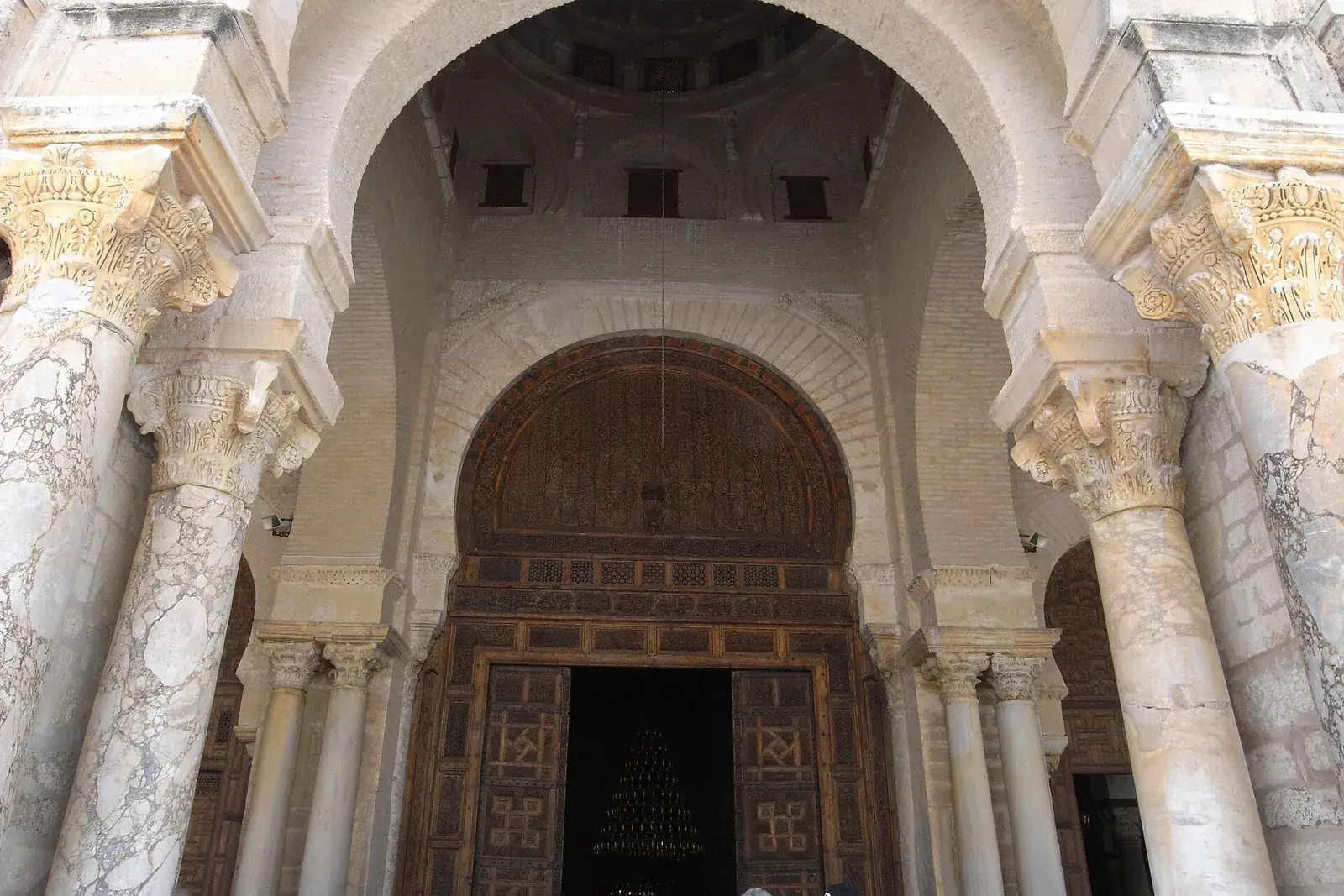
The whole design and construction of the cities themselves can be seen as an investment in the prosperity of the empire. There were similarities between most of the big cities, outlined by massive stone walls that could be closed off to protect the people inside. The streets within the walls were broad and well spaced out, with grand columns marking the entrances and exits. Water was piped in through huge aqueducts that snake through the modern cities of today. Freshwater fountains dotted these cities, and many homes had running water inside.
Some of the most influential cities were built on high ground looking out over their territory, including Rome itself, Milan, Carthage, Alexandria, and Antioch in Syria. Later, Constantinople (modern day Istanbul) would join that list as well. These were major centers of trade and culture, though a traveler would have had to go a long way to visit all of them at once. The list includes only two cities within the borders of modern day Italy, and none in modern day Greece; the rest sit in what are now Tunisia, Egypt and Turkey.
Roman Roads and the Golden Milestone
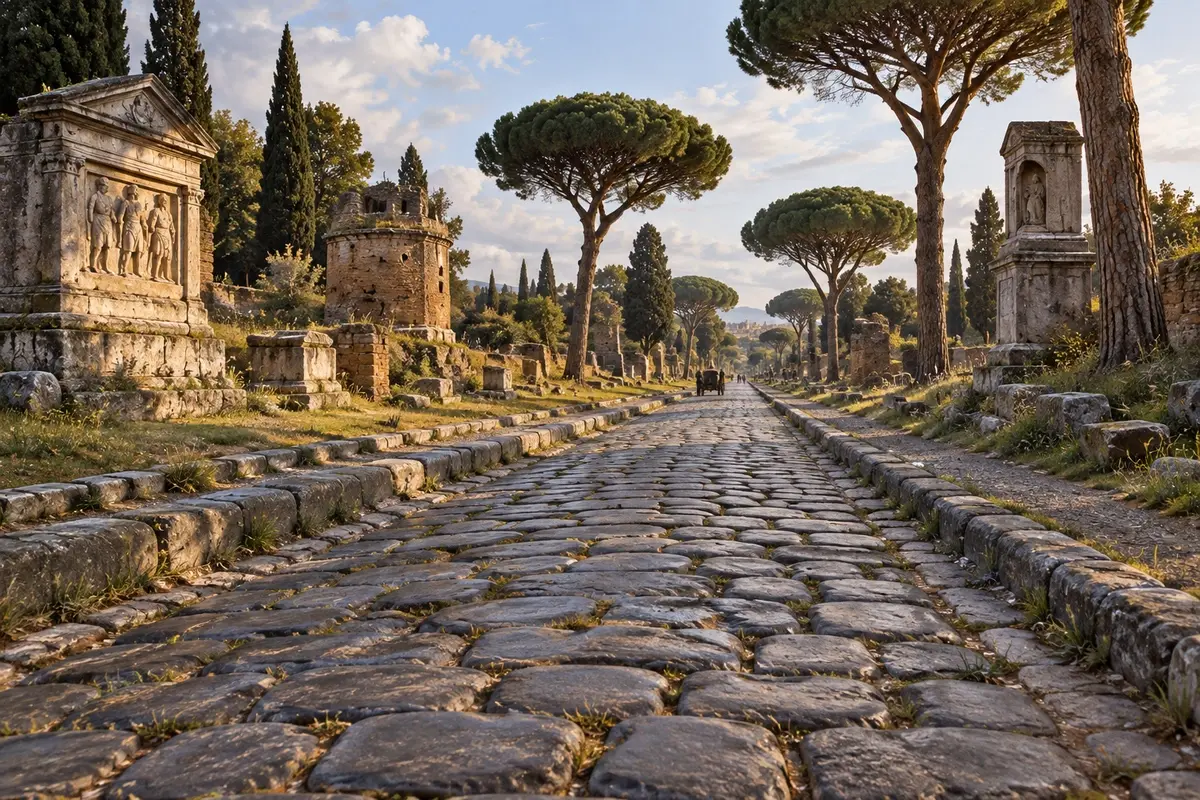
Major Roman roads ran about 4.2 metres wide, enough for two wheeled vehicles to pass, and were cambered so rainwater drained to the kerbs.
One of the most important aspects of the city planning was the road system, and the roads in turn were built around a single founding stone called the golden milestone. This road system extended north to Britain, south to Egypt, and east as far as Damascus. The roads were made of stone and as durable as the modern roads that use concrete and tar. Some of them are still in use today, two-thousand years after their construction.
It's hard to overstate the importance of these roads, and their effect on trade and communication. A road built to last more than one lifetime could be used by merchants and soldiers, and that security made them very valuable. The road system as a whole made up one of the largest parts of the Roman economy.
Who Travelled on Roman Roads
The merchants were only a small part of the people who used these roads, and the traffic was much broader and more varied than you might expect. Religious figures were among the most constant travelers, since the rise of Christianity created a need to spread ideas around the empire, and Paul the Apostle took advantage of the road network as he travelled. Government officials had to travel to conduct meetings and issue orders, and they were backed up by soldiers and servants. Families of wealthy Roman citizens would travel from their city homes to their country estates and back again as the seasons changed, and the merchants were always willing to sell goods to those who could afford to buy. Philosophers hiked from one town to the next, giving sermons and selling their ideas. It was an active era for transportation, and the choices varied widely from person to person - some people walked from one town to the next, while the wealthy climbed aboard horse-drawn carriages. The road system was large enough that there were many places to stop and get food, and to stable a horse if needed.
Two sets of stories are worth telling about the roads, because they show how the system was more than just stone and dirt. One messenger rode from Rome to Spain, bringing the news that the Emperor Nero was dead, something that required getting the message to as many people as possible as quickly as possible. Another bishop rode eight-hundred miles to get to Constantinople in only a week of travel, and that included riding through snowy mountain passes. The roads and the security they provided made it possible for these kinds of travel to be done, and it's hard to believe that modern Europe would be able to match these kinds of efforts a millennium later.
Silk, Spices and Long-Distance Trade
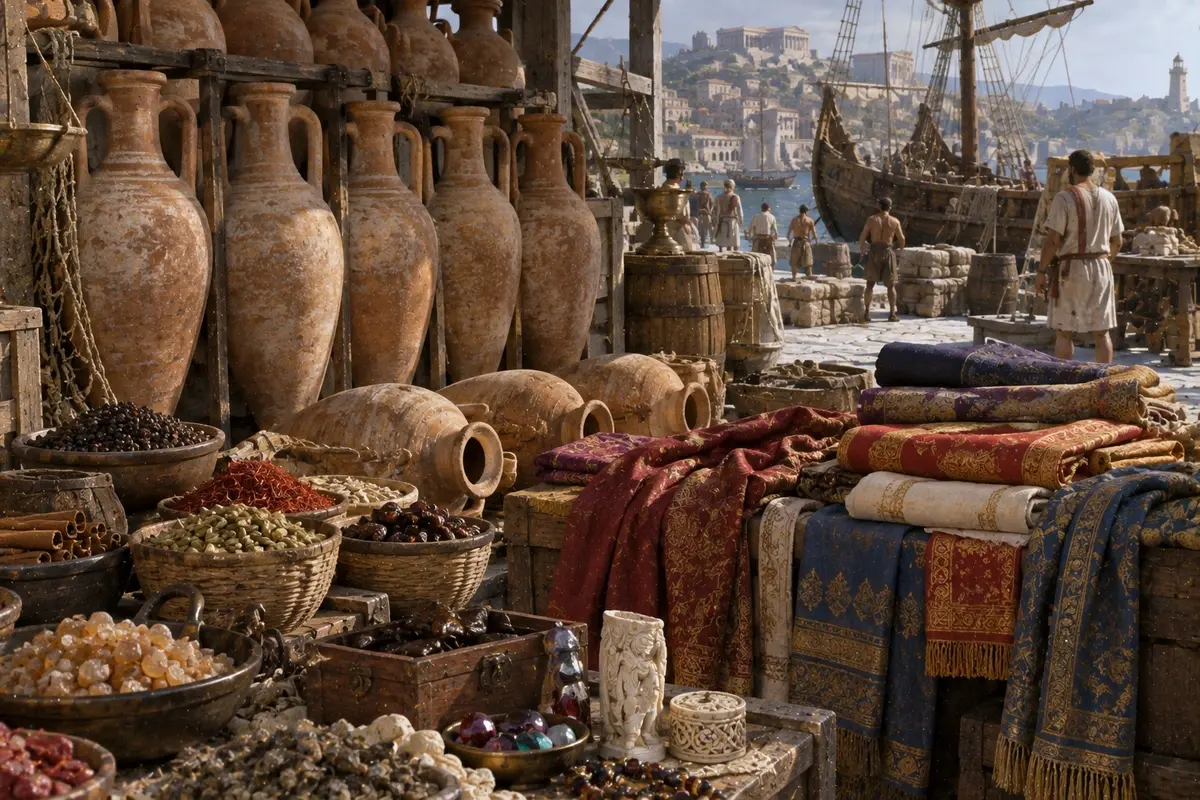
Amphorae carried the bulk goods of Mediterranean trade, while spices, silk and gemstones arrived from much further east.
The goods being transported along the roads were just as varied as the people who used them, and an inventory of what one wealthy family owned would tell you almost everything you need to know about the empire. Goods like linen from Egypt, carpets from Persia (a region that Rome was always at war with), silk from China, fur from the north, and spices from India and Sri Lanka were all regularly transported from one end of the empire to the other.
It's impossible to separate the flow of goods from the flow of people, but that doesn't tell you what might have been the most important part of this long distance trade. And that would be the merchants, since they were the people responsible for making the whole thing happen.
Books and Letters Across the Empire
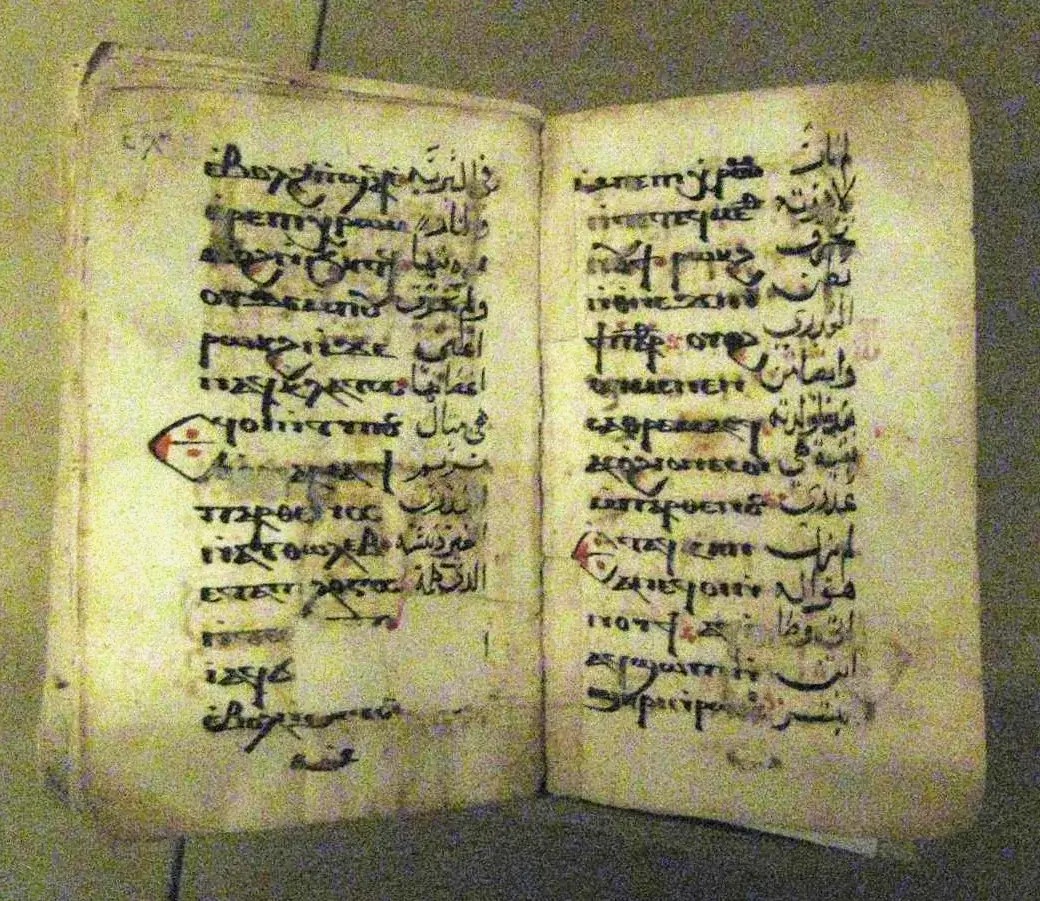
The written word was another major part of the Roman economy and their culture, and that's a fact that's rarely included in surveys or other summaries. The books were being copied and published in Rome, and then sold in libraries and book stores across the empire. That meant the people who read them could get just as good a copy of a work by a Roman author without having to travel all the way to the capital. Writing from one person to another was a daily activity, done with as much care as the writing between friends. The letters were often quite long, and included mentions of business dealings as well as complaints about how long it took to get the letter in the first place. One writer, Symmachus, left behind nearly a thousand letters, and they include both examples of everyday life and discussions of more important and public matters - sometimes in the same letter.
How Christianity Spread Through the Empire
The ease and fluidity of this trade network had an unexpected effect, as it created opportunities for people to spread their ideas to a much wider audience than ever before. This is one of the reasons why Christianity was able to gain such a foothold in the empire, and why it became one of the most influential movements in history. There were several reasons why this was possible, and they combined to give Christianity quite an advantage. Jewish communities existed in many of the cities, which meant that there were people who were already interested in learning about a new religion. There was widespread interest and fluency in Greek, which meant that the preacher wouldn't have to struggle through a language barrier to explain the ideas of Christianity. And finally the roads allowed travel to spread the ideas more quickly and more reliably than any other method. The combination of these things made Christianity a major force in Roman history.
Why Roman Connections Still Matter
The whole point of this summary is to provide a contrast to the images most people have about Rome, and of these comparisons the most surprising is this - travel across the empire was more efficient and reliable in Roman times than it would be for another millennium. The roads and other transportation networks were maintained until they were no longer useful, and then the economy and trade collapsed. Communication wasn't quick or easy either, but it was more reliable than the systems used in Europe a long time later. The written word could cross vast distances and still have meaning, and regular people could make that kind of journey with some certainty of making it safely to their destination. It took several centuries for that efficiency to be regained, and even then it was accomplished with newer technologies like the telegraph.
It's a sad thing to admit, but the popularity of knights and kings and merchants and gladiators says more about what we want to see than what actually happened. The reality is more mundane but more impressive, because it shows how the empire really did accomplish what it set out to do. The people who lived in this time and place didn't have the luxury of traveling across landmasses with planes or ships powered by internal combustion engines. They had to make do with what they had, and what they had was enough to create a system of trade and communication that lasted for centuries.