Genghis Khan died on 18 August 1227. He was somewhere between sixty and sixty-five, and he was on campaign at the time, in a tent, with an army around him that was not told he was dead until it had finished the job.
The last years of his life contain two enormous ceremonies and one decision that mattered more than either of them. The ceremonies were a hunt run like a military invasion and an assembly held in a temporary city built out of tents. The decision was about who would rule after him.
What a Nerge Was
The Mongols had a kind of hunt called a nerge, and calling it a hunt undersells it.
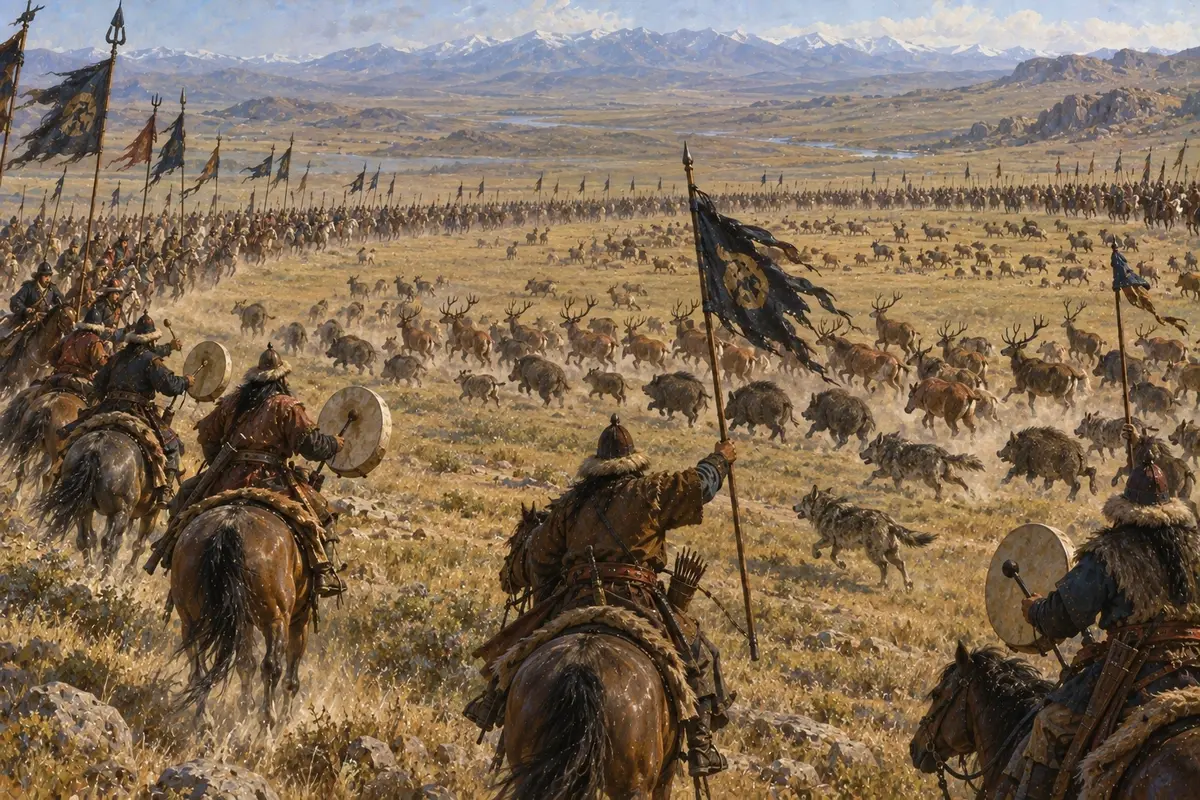
Nobody in the line was allowed to kill anything. Their only job was to keep the animals moving inward, for weeks.
The whole army marched out in war formation. Detachments were sent to points spread around an enormous area of empty country, and each one spread out sideways until the units linked up and the entire region was inside a ring of soldiers. The line could stretch as far as eighty miles.
Then, on a set morning, the ring began to close. The men moved inward a few miles a day, with drums and trumpets, searching every thicket and ravine as they went.
The animals inside had no idea what was happening. They ran ahead of the noise the way they always did, expecting the disturbance to pass and the next patch of cover to be safe. It was not. The line arrived there too, and if they broke sideways they found more riders waiting.
Nobody was allowed to kill anything. Their job was to push the animals inward, and men carried picks and spades to dig out anything that hid in a burrow. Letting an animal slip back through the line was punished severely. This went on for weeks.
Inside the Ring
As the circle shrank, the animals inside it were pressed closer and closer together. Frightened and exhausted, they began attacking each other, and many died without a soldier touching them.
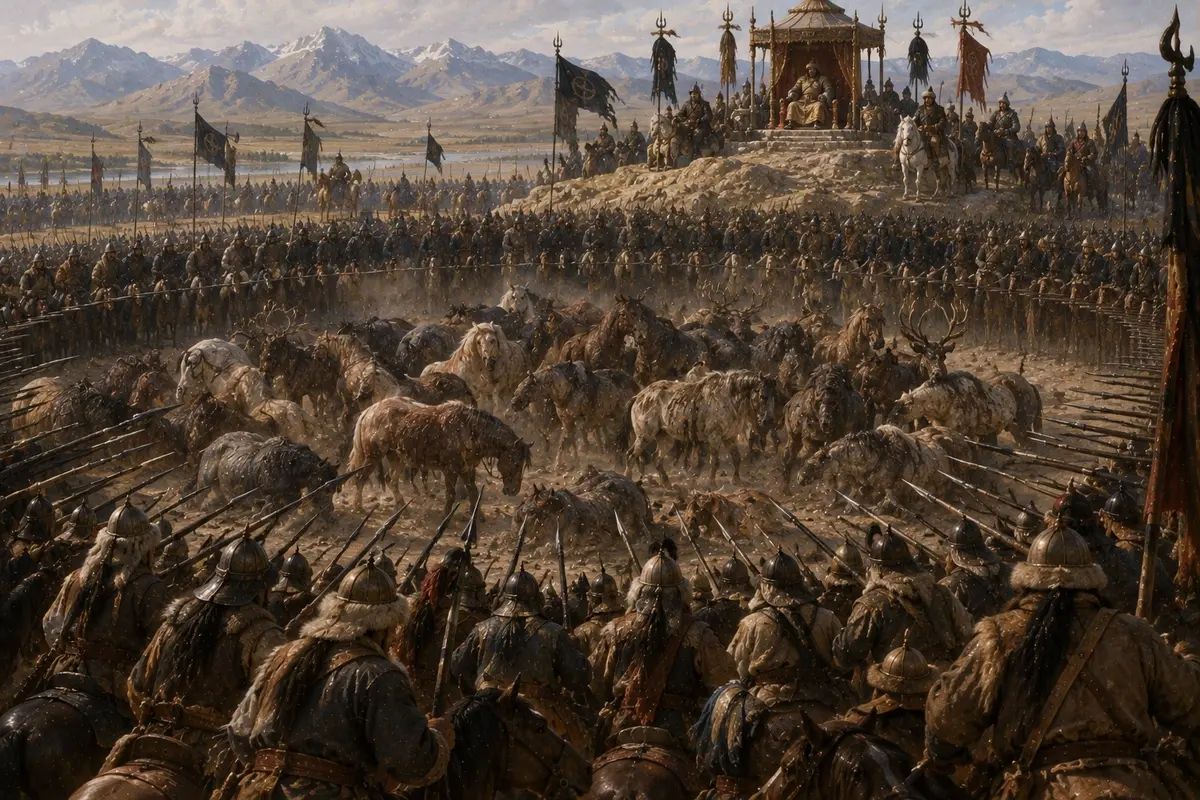
By the time the great men rode in, the animals had been driven for weeks with almost no food or rest.
At the end, everything left alive was penned into a small circle surrounded by ranks of soldiers holding spears pointed inward.
Genghis Khan entered first. That rule was absolute: nobody took a shot before the khan, and starting early could get you executed. After him came the princes and the senior commanders, to show their courage by killing the fiercest animals.
It is worth being honest about how much courage that took. The animals had been driven for weeks with barely any food or rest, and many of them were too worn out to fight. The ordinary soldiers did weeks of hard, dangerous work, and the important men rode in at the end for the glory.
It ended in a way people rarely expect. Some of Genghis Khan's grandsons came to him and asked him to stop and let the survivors go. He agreed. The lines opened, the remaining animals ran back into the wild, and the whole thing finished with a long feast. Releasing animals was normal practice, because killing every animal in a region meant nothing to hunt next year.
Why an Army Went Hunting
The point of all this was not meat, and it was not sport.
A large army with no war to fight is a problem. Discipline slips, and bored soldiers cause trouble. The nerge gave the whole army something to do that looked exactly like a campaign.
More importantly, it was training in the one manoeuvre the Mongols used most. Surrounding a huge area with a thin line of riders, keeping that line unbroken over rough ground for weeks, and closing it steadily without letting anything escape is precisely what they did to enemy armies. The animals were practice.
A City Made of Tents
Two or three years after the great hunt, Genghis Khan called all his sons and commanders to a grand assembly on an open plain.
His sons arrived first, bringing gifts, which really meant the treasure they had taken from the cities they had captured.
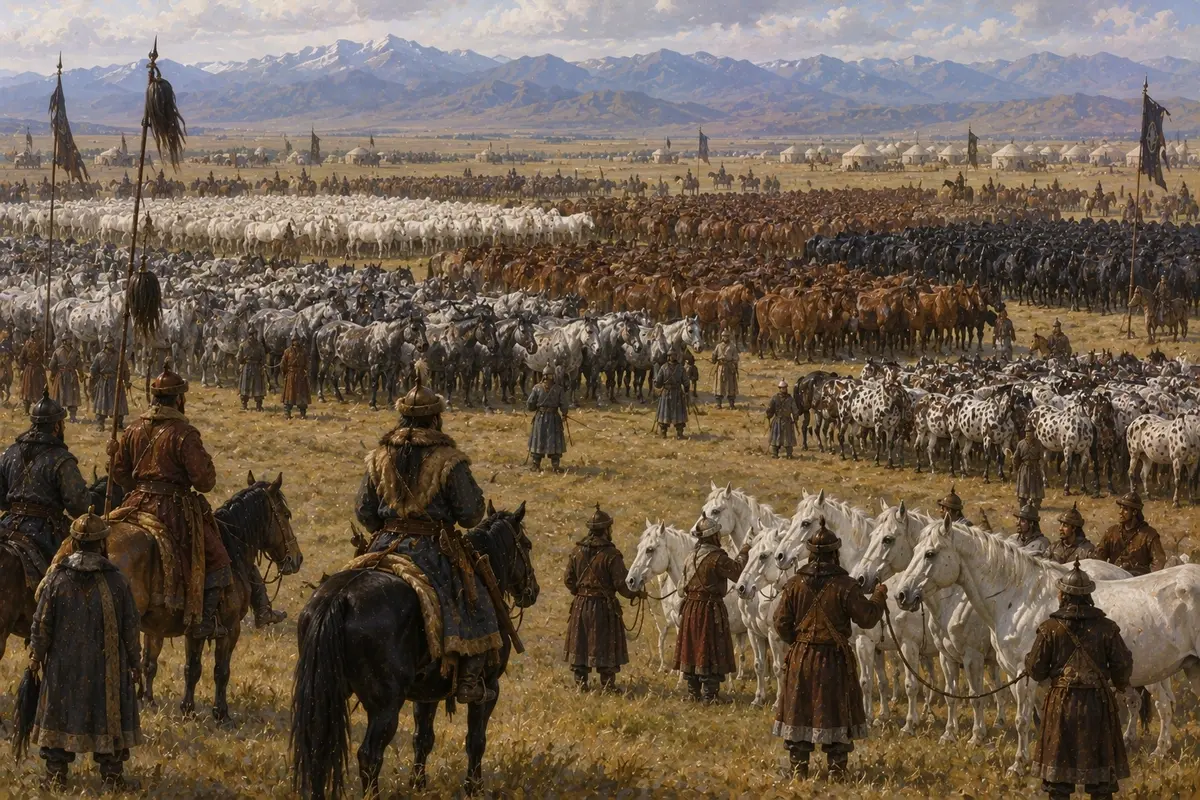
White, grey, bay, black and spotted, in equal numbers. Someone sorted a hundred thousand animals so the gift would look right.
Jochi's gift was the largest: a hundred thousand horses, taken from the pastures of conquered countries. They had been sorted into groups by colour, with equal numbers of white, dappled grey, bay, black and spotted animals.
Stop and think about that for a second. A hundred thousand horses were gathered across a ruined empire, and then somebody spent days arranging them by colour so the presentation would look impressive. It tells you what these ceremonies were actually for.
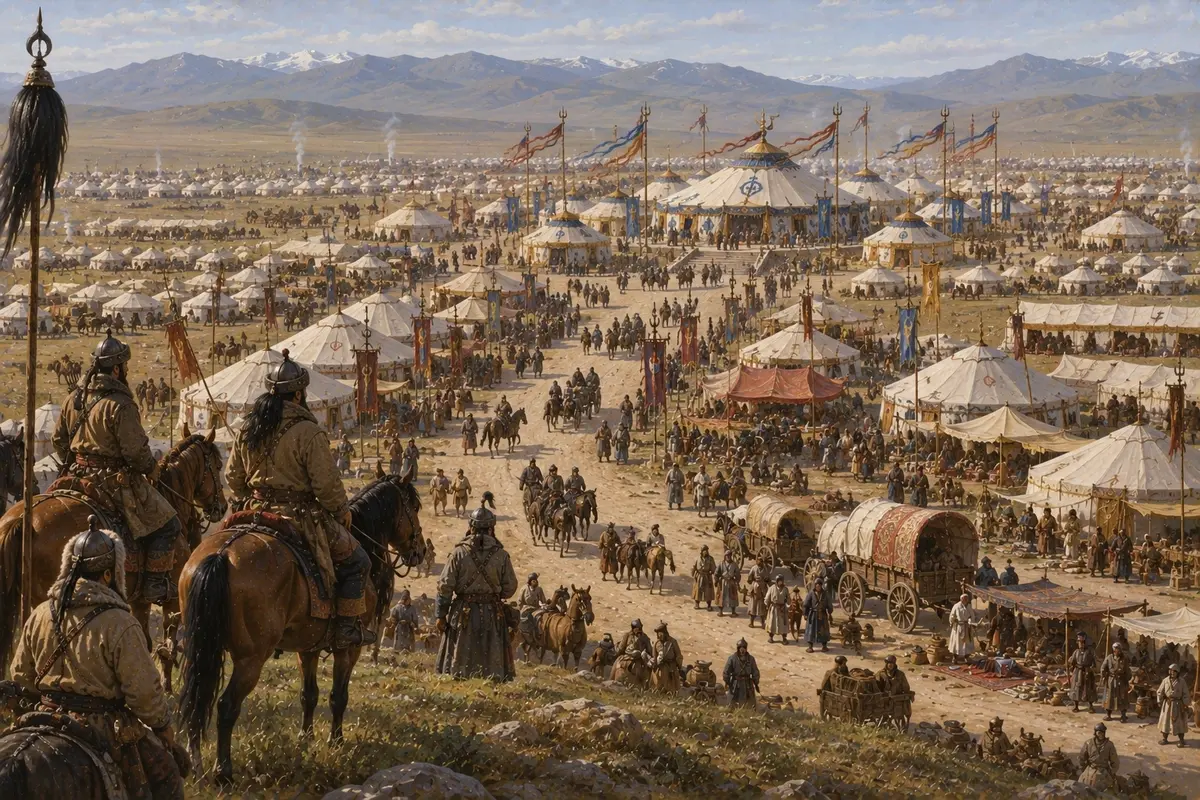
The middle of the camp was laid out like a town, with streets, squares and markets, and silk streamers over the khans' tents.
The camp that grew up around the assembly was enormous. The middle of it was laid out like a town, with proper streets, squares and market places. The khans' tents were made of rich cloth with coloured silk streamers flying from the tops.
The assembly itself met in a white tent big enough to hold two thousand people. It had two doors: one for the emperor alone, and one for everyone else. Inside, the empire's laws were read out again and arrangements were made for governing the provinces.
There was a smaller hunt during the gathering, and feasting that went on for days. The drinks on the tables included wine from the southern countries, beer, mead, and sherbet, a sweet cold drink the army had learned to make in Persia. That last detail is a small thing, but it says something real: an empire built by people who had lived on milk and meat was already bringing home other people's food.
At the end the emperor gave a private audience to every prince, khan and governor who had come, so that each of them could take his leave properly. Then the tents came down and the whole city disappeared off the plain.
The Truth About Jochi
Jochi was Genghis Khan's eldest son, and this is the part of the story most often told wrong.
He is frequently described as his father's favourite. He was not, at least not by the end. The two men fell out badly after the siege of Gurganj in 1221, partly over how the loot was divided and partly because Jochi had become more interested in his own lands than in his father's plans.
Around 1224 Genghis Khan summoned him home. Jochi said he was too ill to travel. His father suspected he was simply refusing, and decided to bring him into line by force.
It is not clear that the two of them ever saw each other again. Jochi died before the confrontation happened, either in 1225 or 1227, depending on which source you follow.
Genghis Khan grieved hard. But the relationship he was grieving had been broken for years, which makes it sadder rather than simpler.
What He Was Doing When He Died
This is the second thing usually told wrong. Genghis Khan was not preparing to invade southern China when he died.
He was in the north-west, besieging Zhongxing, the capital of the Western Xia. That kingdom had refused to send troops for his campaign in the west, and he had come back to settle it.
He fell ill in the spring of 1227 and got worse through the summer. The cause has never been established. One account says it followed a fall from his horse while hunting some months earlier.
He died on 18 August 1227. His commanders kept the death secret from their own army until the city had surrendered, because they did not want the defenders to hear that the man besieging them was gone.
The Deathbed and the Naming of Ögedei
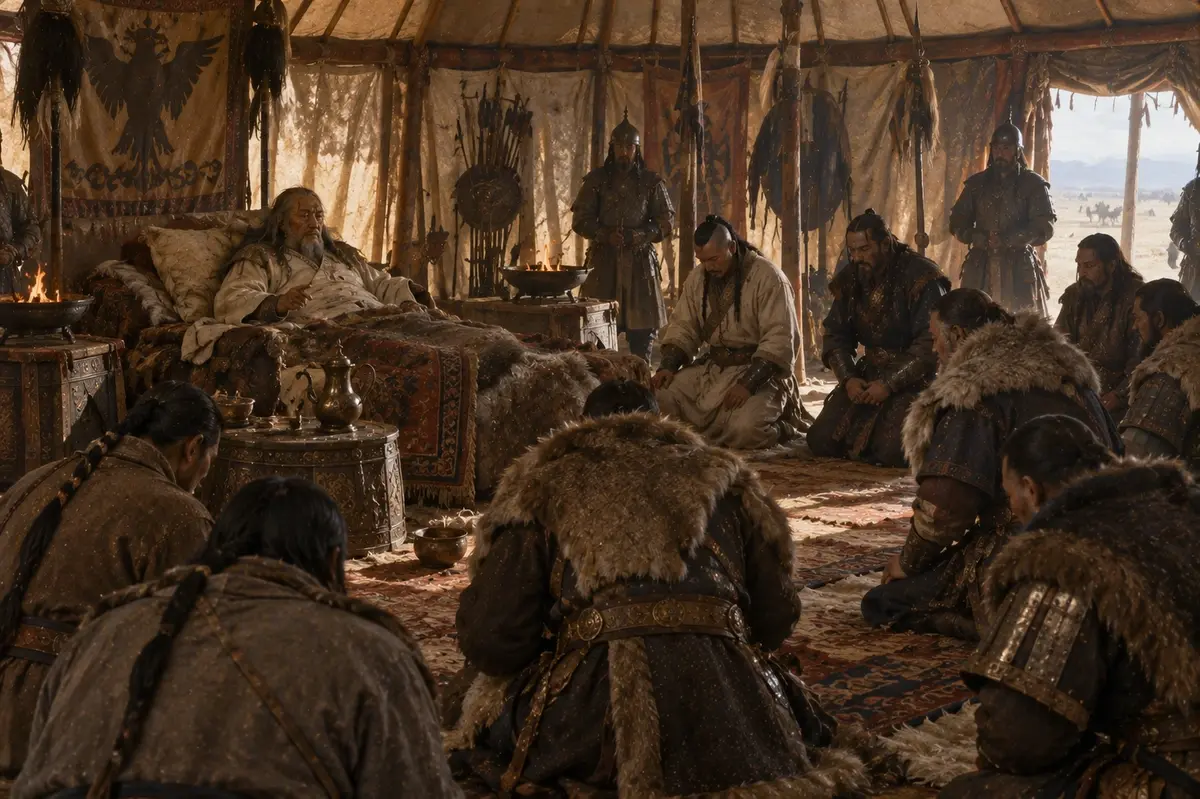
He asked the men in the tent whether the founder of an empire might name its next ruler, and every one of them said yes.
He knew he was dying, and he had one thing he wanted to settle. He called his sons and the princes of his family to his bedside and had himself propped up to speak.
He told them he was leaving them the largest empire in the world, and that keeping it depended entirely on them staying united. If they started fighting each other, he said, they would lose all of it.
Then he asked the chieftains a question. Was it not fair that the man who had built an empire from nothing should be allowed to name who would inherit it?
They all said yes. So he named his third son, Ögedei, and made his youngest son Tolui regent until Ögedei, who was away, could return.
Here is why that question mattered. Twenty years earlier, at the assembly that made him Genghis Khan, he had built a rule into his own laws: the next ruler would be chosen by a vote of the khans, and anyone who seized the throne without being properly elected would be put to death. He had written that rule because he had watched steppe empires tear themselves apart over succession his whole life.
On his deathbed he asked to be let out of it, and everyone in the tent agreed.
Did the System Actually Work?
The answer is more interesting than a simple yes or no, and it is usually skipped.
Ögedei did not become emperor when his father died. Tolui held the regency, and Ögedei was not enthroned until an assembly of the khans met and elected him in 1229, about two years later.
So the deathbed nomination did not replace the voting system. It instructed it. The assembly still had to meet, and it still had to confirm the choice. What Genghis Khan set aside was the independence of that vote, not the vote itself.
The empire also did not fall apart quickly. Ögedei ruled until 1241 and pushed the conquests further than his father had, finishing off the Jin dynasty at Kaifeng in 1234 and sending armies into Iran, Iraq, Russia and central Europe.
The real break came later, over exactly the thing Genghis Khan had warned about. Arguments about who should rule next grew worse with each succession, and by the second half of the century the empire had split into rival khanates run by different branches of the family, sometimes at war with each other.
So he was right and wrong at the same time, which is the honest ending. He was right that discord among his descendants would tear the empire apart, and it did. He was wrong to think that naming an heir himself would prevent it, because the problem was never one succession. It was every succession after that, and no deathbed instruction could reach far enough to fix them.
The Grave Nobody Has Found
Some older accounts describe a magnificent tomb built over his grave, with trees planted around it and landscaped grounds, called one of the finest monuments in the world.
The opposite is what actually happened. The body was carried back to Mongolia and buried in secret, and the burial was deliberately hidden so that nobody would find it. The location has never been confirmed. Medieval sources point toward the sacred mountain Burkhan Khaldun, which is believed to be the place where he was both born and buried, but nobody has ever proved it.
It is a strange ending for the most famous conqueror in history, and in a way a fitting one. He spent his life making sure everyone knew exactly where he was. Then he arranged to disappear.