Marathon, Thermopylae and Salamis get all the attention. Between them they gave the tradition a heroic victory, a heroic defeat and a brilliant piece of deception — everything a story needs. None of them ended the war. After Salamis, Xerxes went home with part of the army, and left a substantial force in Greece under Mardonius to finish the job. That army spent the following summer trying to break the Greek alliance by diplomacy, burned Athens for a second time, and was finally destroyed in a single day at Plataea in 479 BCE. It's the largest hoplite battle ever fought, and it's the one that actually decided the thing. It also happens to be the battle whose victory monument you can still go and look at.
The Winter Between
After Salamis, Athens was in ruins and its population still evacuated. Mardonius wintered in Thessaly and spent the spring of 479 BCE doing something cleverer than fighting. He sent Alexander I of Macedon — a Greek-speaking king who was also a Persian vassal, and an ancestor of Alexander the Great — to Athens with an offer. The terms were extraordinarily generous. Athens would keep its independence, get its territory back, receive additional land, have its temples rebuilt at Persian expense, and be Persia's ally rather than its subject. Athens was destroyed, exhausted, and had been fighting for a decade. And the Spartans, hearing about the embassy, panicked badly enough to send their own envoys to argue against it.
Herodotus gives the Athenian reply, and it is the best answer anyone gives in the whole war. They told the Spartans they knew perfectly well that Persian power was many times greater than theirs and did not need to be reminded of it, and that they would resist anyway for as long as they lasted. And they told them why — because of the burned and broken images of their gods, which demanded revenge rather than agreement, and because of the Greek thing: shared blood, shared language, shared temples and sacrifices, and a common way of life, which it would not be right for Athens to betray. That passage, in Herodotus Book 8, is the earliest surviving statement of Greek identity as something that exists above the individual city. It is being made by a city that had every material reason to take the deal. Mardonius invaded Attica again and burned what was left of Athens.
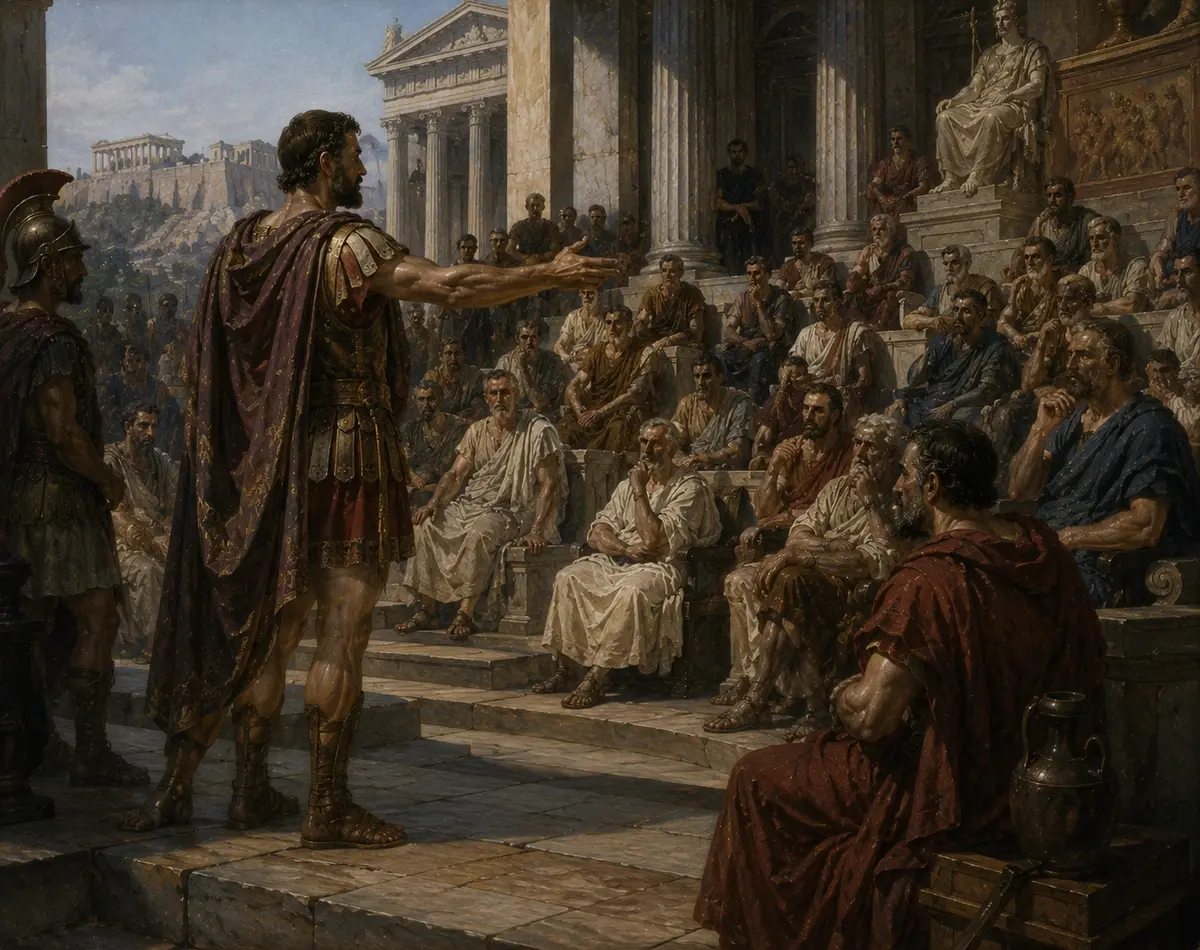
Independence, territory, extra land, temples rebuilt at Persian expense. Athens was in ruins and had been fighting for a decade. It refused — citing its burned gods and "the Greek thing".
The Armies
The Greek alliance finally mobilised properly, and Plataea is the only battle of the war where nearly everyone turned up. The Greeks put perhaps 38,000 hoplites in the field, plus lightly armed troops and helots — Herodotus gives a total of 110,000, which is too high. Sparta sent 5,000 Spartiates, the largest force it ever fielded, under the regent Pausanias, who commanded the whole army. Athens sent 8,000 under Aristides, back from ostracism. The Persians under Mardonius numbered perhaps 70,000–120,000 by modern estimate — Herodotus says 300,000 plus 50,000 Greek allies. The Persian force included medising Greeks: Thebes fought on the Persian side, which is why Thebes spent the next century being reminded of it. Mardonius had strong cavalry. The Greeks had almost none, and that shaped everything.
Eleven Days of Not Fighting
The two armies faced each other across the Asopus river for over a week, and neither would attack. The reason was terrain. Mardonius had built a fortified camp on the plain, where his cavalry could work. The Greeks held the higher, broken ground at the foot of Mount Cithaeron, where it couldn't. Neither would come down or go up. Both sides took omens saying they would win if they defended and lose if they attacked, which is either genuine or a convenient way of describing a stalemate that suited both commanders. Meanwhile Persian cavalry raided the Greek supply lines through the mountain passes, cut off a convoy of 500 pack animals, and — critically — fouled and captured the Gargaphian spring, the Greeks' main water source. That settled it. The Greek army had to move, and Pausanias ordered a night withdrawal to a new position with better water. The withdrawal went wrong in the dark, as night moves do. The contingents ended up scattered across several kilometres in three separate groups, out of contact with each other, at dawn. Mardonius saw a broken, retreating enemy and attacked.
The Battle
What he had actually found was a Greek army in awkward positions but entirely intact, and the ground where the Spartans stood was rough. The Persians came on and formed a wall of wicker shields, from behind which their archers shot into the Spartan and Tegean lines. Pausanias would not let his men advance — he was still taking omens, and the sacrifices were unfavourable, and Spartans were killed standing still under archery while he waited. Herodotus says he looked toward the temple of Hera at Plataea and prayed, and the omens turned. Then the Spartans and Tegeans went forward, and the wicker screens went down, and it became what the Greeks always wanted: close-quarters fighting between armoured spearmen and lightly armoured troops.
Herodotus is generous to the Persians here, and it's worth quoting the substance. He says they were not inferior in courage or strength, but were without armour, untrained, and no match for their opponents in skill — rushing forward singly or in small groups into the Spartan ranks and being destroyed. The bravery wasn't the problem. The equipment and the formation were. Mardonius was killed — struck down by a Spartan named Arimnestus, in the middle of his household guard of a thousand picked men, who died around him. Once he fell, the Persian army broke. Most of it fled to the fortified camp, which the Athenians — who had experience of siegework that the Spartans lacked — broke into. The killing inside was very heavy. A large contingent under Artabazus, who had disagreed with the plan from the start, withdrew intact and marched all the way back to the Hellespont.
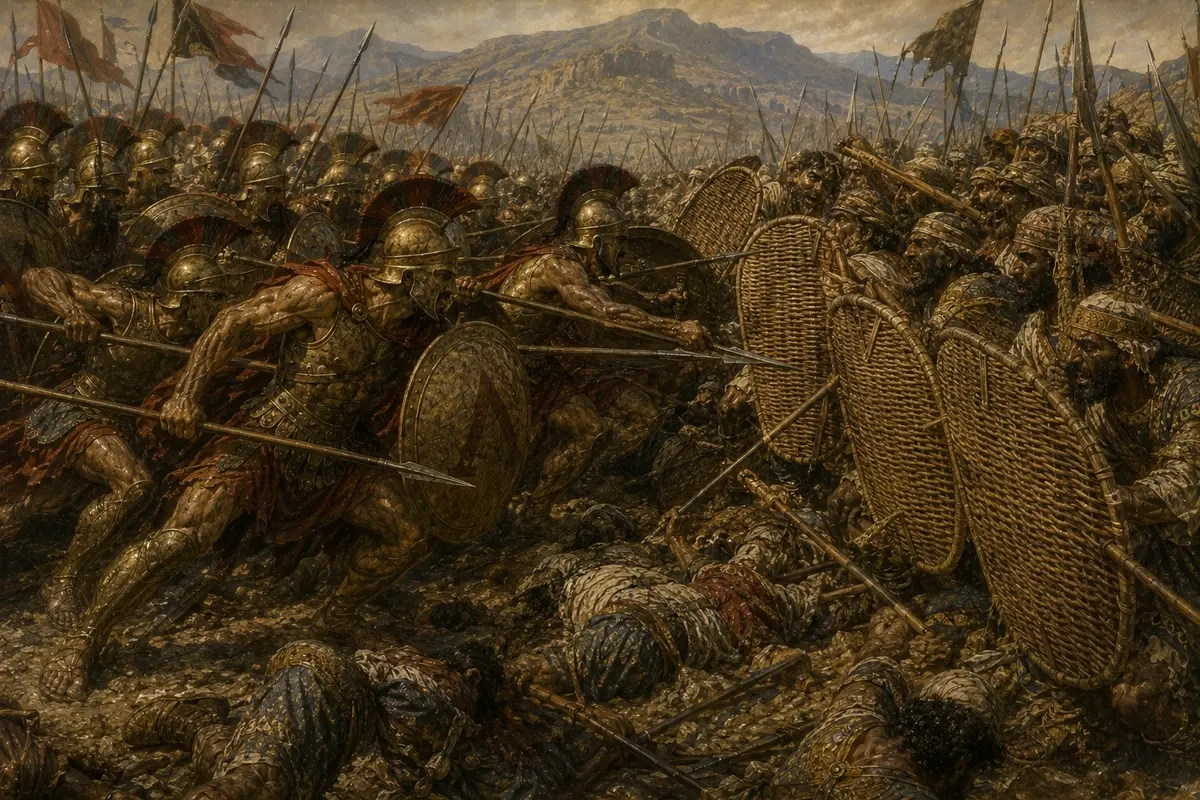
Herodotus is generous to them: not inferior in courage or strength, but without armour and untrained. The bravery wasn't the problem. The equipment and the formation were.
Mycale, the Same Day
Traditionally on the same day, the Greek fleet under the Spartan king Leotychidas landed at Mycale, on the coast of Asia Minor opposite Samos, where the remaining Persian ships had been beached and a defensive stockade built. The Greeks landed, stormed the stockade, and burned the fleet. The Ionian Greeks in the Persian force changed sides during the fighting, which reopened the Ionian revolt that had started the whole conflict twenty years earlier — this time successfully. Herodotus says a rumour of the victory at Plataea reached the men at Mycale before they fought. Whether that's true or a good story, the effect was real: the Persian fleet was gone and the Aegean was open. The invasion was over.
The Monument That Still Exists
Here's the detail that makes this battle worth writing about even for people who don't care about hoplite tactics. From the Persian spoils, the victorious Greeks made a dedication at Delphi: a bronze column of three intertwined serpents, about eight metres high, supporting a golden tripod. Carved into the coils were the names of the thirty-one Greek states that had fought the Persians. Sparta first, then Athens, then Corinth, then the rest, down to cities of a few hundred men. The gold tripod was looted by the Phocians during the Sacred War in the 4th century BCE. But the bronze column survived — and around 324 CE the emperor Constantine had it moved to his new capital and set up in the Hippodrome. It is still there. In the middle of Istanbul, in what is now Sultanahmet Square, sunk a few metres below modern street level in its own excavated pit. The serpent heads are gone — one upper jaw is in the Istanbul Archaeological Museum — but the column stands, and the names of the thirty-one cities are still legible on it. It is the oldest surviving monument in Istanbul, it was made from the weapons of the men who lost this battle, and it has been standing continuously for about 2,500 years.
What Happened to the Winners
Pausanias, who commanded the largest Greek army ever assembled and won, came to a bad end almost immediately. He was accused of adopting Persian dress and manners, of negotiating with Xerxes, and of intriguing with the helots. Recalled to Sparta, he took refuge in a temple, and the Spartans walled up the doors and left him to starve, taking him out only when he was about to die so the sanctuary wouldn't be polluted. He had also had an inscription put on the Serpent Column claiming the victory personally. The Spartans had it erased and the names of the cities put on instead. The erasure is still visible. Aristides, who commanded the Athenians, went on to organise the assessment of tribute for the Delian League — the alliance that became the Athenian Empire — and was so scrupulous about it that the first assessment was remembered as fair for generations. He died poor. Plataea, the small city whose territory the battle was fought on, was granted independence and inviolability in perpetuity, and an annual commemoration was established there. Fifty years later, Sparta and Thebes besieged Plataea, executed every surviving defender and razed it.
Why It Gets Forgotten
Plataea has everything a famous battle needs — the largest hoplite army ever, a decisive result, a dead enemy commander, a surviving monument — and almost nobody outside the field can name it. Partly it's structural. Thermopylae is a last stand, Salamis is a trick, Marathon is an underdog. Plataea is eleven days of manoeuvring over water supply followed by a competent set-piece engagement. It's the least narratable of the four. Partly it's Herodotus, who is visibly less interested in it and whose account of the battle itself is confusing enough that historians still argue about the sequence. And partly it's that the Athenians wrote the tradition, and at Plataea the Spartans did the decisive work. Athens got Marathon and Salamis. It had no reason to promote the one where Pausanias won.