Sparta won the Peloponnesian War in 404 BCE and was the leading power in Greece. Thirty-three years later it had lost a pitched battle for the first time in its history, lost the enslaved population its entire society was built on, and was finished permanently as a serious state. The man who did it was a Theban philosopher who lived in deliberate poverty, only held supreme command for about nine years, and is barely known outside the field — partly because the main surviving historian of the period was a Spartan sympathiser who could hardly bring himself to write his name. To understand why the victory was so total, you have to start about three hundred years earlier, with a people nobody remembers.
First, the Messenians
Sparta's entire system rested on the helots — the conquered population of Messenia, next door, held as state-owned serfs farming the land that fed the Spartan citizen body. They had been free once, and they knew it. The First Messenian War (traditionally around 743–724 BCE) was the conquest. The Second (around 685–668 BCE) was the great revolt, and it produced the one Messenian hero anybody remembered: Aristomenes. The stories about him are extravagant and mostly come from Pausanias, writing 800 years later from sources composed after Messenia was refounded — so treat them as national legend rather than history. He raided Laconia repeatedly. He hung a shield in a Spartan temple as a taunt. Captured and thrown into the Ceadas, the pit where Sparta disposed of criminals, he survived the fall and escaped by following a fox out through a crevice. The revolt was crushed. The Spartan poet Tyrtaeus wrote marching verses for that war that Spartans were still reciting three centuries later. And Messenia stayed enslaved. For three hundred years. Whatever else is true about Aristomenes, the memory was real and it was maintained. That matters enormously for what Epaminondas eventually did, because it means there was still a Messenian identity available to be restored.
The Night the Exiles Came Back
Thebes, in Boeotia, had a poor record. It medised in the Persian Wars — fighting on the Persian side at Plataea — and spent the next century being reminded of it. In the Peloponnesian War it was Sparta's ally, and it had been among the states demanding that Athens be destroyed in 404 BCE. Then Sparta turned on it. In 382 BCE, a Spartan force marching through Boeotia seized the Cadmea, the Theban citadel, in peacetime and during a religious festival, installed a garrison and a puppet government, and killed or exiled its opponents. It was a flagrant breach of every convention, and even Sparta's allies were shocked. The exiles went to Athens. In 379 BCE, seven of them came back. They entered the city separately in disguise, coming in through the gates on a wet December evening among farm workers. That night the pro-Spartan polemarchs were holding a banquet, having been promised the company of some fashionable women of the city. The conspirators arrived at the door in women's clothes and veils, were shown in, and killed them at the table. (Xenophon and Plutarch differ on the details of the disguise. Both agree it was a dinner party and that the killers came in dressed as the expected female guests.) Pelopidas was among the seven. By morning the city was in revolt, an Athenian force had arrived to help, and the Spartan garrison on the Cadmea negotiated its way out. Thebes was free, and now had to deal with the consequences.
The Sacred Band
The Thebans understood that they would have to fight Sparta and that the Spartan army had never been beaten in a full pitched battle by anybody. So they built a professional unit — the first standing, full-time, state-funded corps in mainland Greece. 300 men, housed and trained at public expense in the Cadmea, with no other occupation. And it was made up of 150 pairs of male lovers. The reasoning is given by Plutarch and it's entirely practical. An army built of tribes and clans has weak points in it. A unit made of couples has none, because no man in it will break formation and leave a lover to die, or do anything shameful in front of him. Plutarch quotes the idea that a handful of such men could beat the world. It was founded around 378 BCE, credited to Gorgidas, who initially distributed the 300 through the front rank of the whole phalanx. Pelopidas later concentrated them as a single shock unit, which was the decisive change. At Tegyra in 375 BCE, Pelopidas with the Sacred Band and a small cavalry force ran into a Spartan army perhaps twice the size. Told the enemy had them, he replied that on the contrary, they had the enemy — and attacked straight at the Spartan commanders, killed both, broke the line and marched through. It was a small action. Its significance was enormous: it was the first time a Spartan force had been beaten by a smaller Greek one in open field. Everybody in Greece heard about it.
Epaminondas
Epaminondas was Pelopidas's closest friend and completely unlike him. He came from a good family that had lost its money, and he chose not to fix that. He lived in genuine poverty, studied Pythagorean philosophy under a teacher who lived in his father's house, never married, owned almost nothing, and reportedly refused every bribe offered to him in a career full of opportunities. Contemporaries who disliked his politics conceded the character. He was also, on the evidence of the four years he had, one of the most original military minds in history. He and Pelopidas had fought together at Mantinea in 385 BCE — on the Spartan side, before the break — where Epaminondas stood over the wounded Pelopidas and refused to leave him. That's the same story told about Socrates and Alcibiades at Potidaea, and it may well be a formula. It's also the kind of thing that happened.
Leuctra, 371 BCE
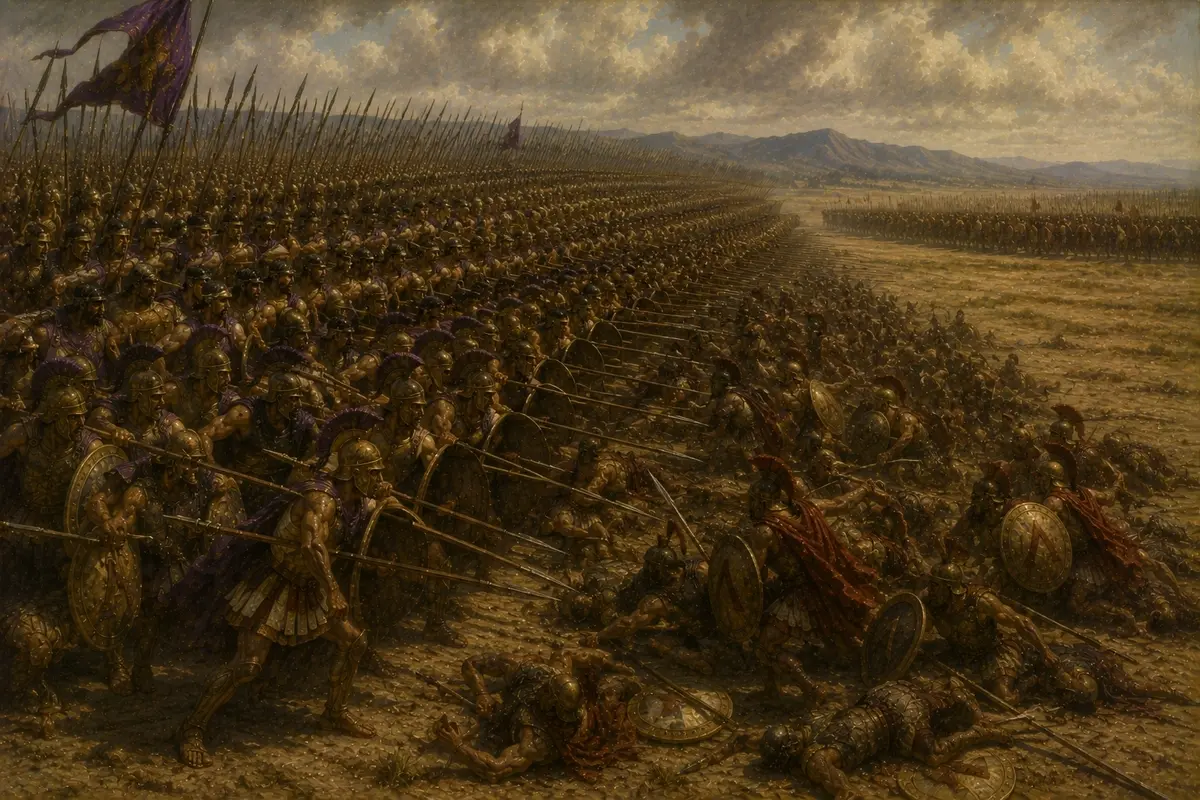
At a peace conference in Sparta in 371 BCE, Epaminondas insisted on signing for all of Boeotia rather than for Thebes alone. The Spartan king Agesilaus struck Thebes from the treaty. Within weeks a Spartan army under Cleombrotus invaded. They met at Leuctra, and Epaminondas did three things that had never been done together. One: he massed his left instead of his right. Every Greek army in history had put its best troops on the right wing — partly because each man's shield covered his left-hand neighbour, so the right was the exposed flank and needed the strongest men. Which meant, in practice, that both armies' best troops faced each other's weakest, and battles were decided by which strong right wing wheeled first. Epaminondas put his best troops, including the Sacred Band under Pelopidas, on his left — directly opposite the Spartan king and the Spartiates on their right. Two: he stacked it fifty deep. Standard hoplite depth was eight to twelve ranks. He made his attacking wing fifty ranks deep, at the cost of thinning everything else. Three: he attacked obliquely. He advanced the massed left and held the rest of the line back, echeloned away, so that the weakened Theban centre and right never engaged. The whole battle was decided at one point before the rest of the two armies made contact. The Spartan right could not absorb the weight. The line buckled, Cleombrotus was killed, and around 400 of the 700 Spartiates present died — an unthinkable proportion for a citizen body of that size. The Spartans asked for a truce to collect their dead, which is the formal admission of defeat.
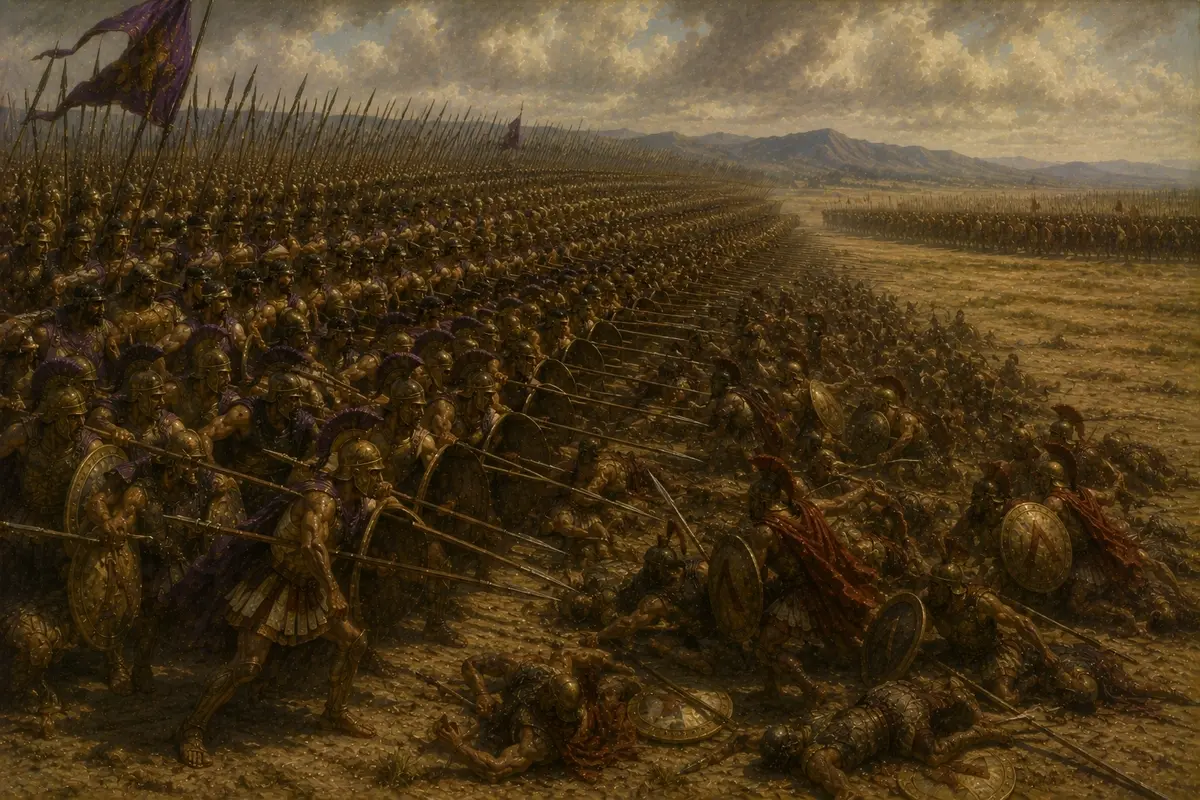
Best troops on the left instead of the right, fifty ranks deep instead of eight, advancing obliquely so the rest of the line never engaged. Cleombrotus was killed and 400 of 700 Spartiates died.
Plutarch records the reaction at home. The news reached Sparta during a festival, and the ephors let the choruses finish. Then they read out the names of the dead and told the families not to mourn — and the next day the relatives of the dead went about congratulating each other, while the relatives of the survivors stayed indoors.
The Thing That Actually Finished Sparta
Winning the battle was not what destroyed Sparta. What Epaminondas did next was. In the winter of 370/369 BCE he invaded the Peloponnese with a large allied army — the first hostile force to enter Laconia in living memory. He came within sight of Sparta itself, which had no walls, on the traditional grounds that its men were its walls. Agesilaus held the city by refusing to be drawn out. Epaminondas didn't need to take it. He went past it, into Messenia. And he freed the helots. He founded a new city, Messene, at the foot of Mount Ithome, built a circuit of walls around it — some of the finest fortifications in the Greek world, and substantial stretches still stand — and invited Messenian exiles from all over the Mediterranean to come home. Descendants of people who had fled generations earlier came back to a country most of them had never seen. He also founded Megalopolis as a fortified federal capital for Arcadia, to box Sparta in from the north. That was the end. Sparta's entire economy, and the whole point of the agoge and the messes and the krypteia, rested on Messenian labour. Take it away and there is nothing left. The Spartiate population, already collapsing from perhaps 8,000 at the Persian Wars to under 1,500 by Leuctra, had no basis to recover. Sparta never recognised Messenian independence. It also never got it back.
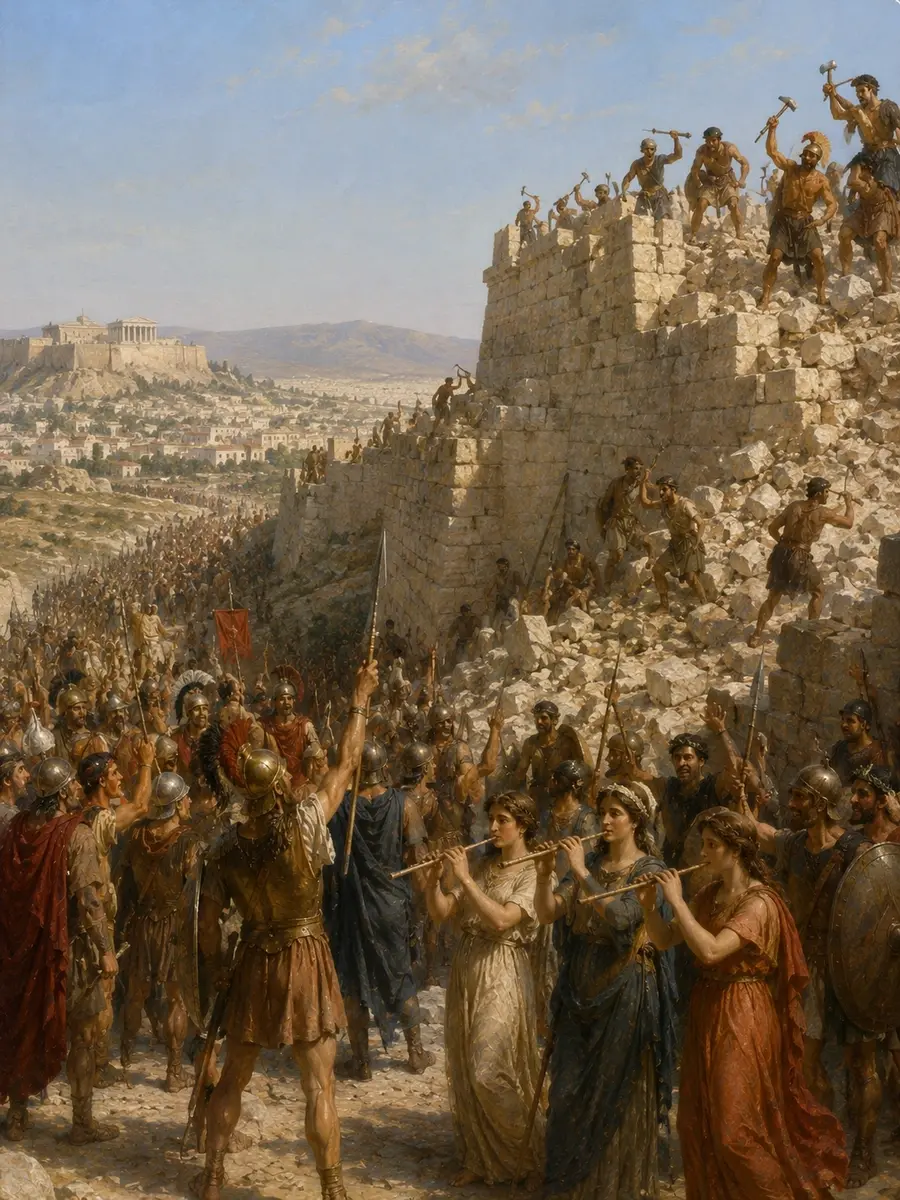
Descendants of people who had fled generations earlier came back. Sparta's entire economy rested on their labour — and the walls Epaminondas built around them still stand in places.
What Happened to Them
Pelopidas was killed in 364 BCE in Thessaly, charging at a tyrant he hated across a battlefield he had already effectively won. Epaminondas was killed at Mantinea in 362 BCE, in a battle he won using the same oblique tactics, struck by a spear at the moment of victory. Told that he was dying and that the spearhead should not be pulled out or he would go immediately, he asked first whether his shield was safe and whether the Boeotians had won. Told yes to both, he pulled it out himself. He had no sons. When someone remarked on it, he is supposed to have said that he left two daughters — the victories of Leuctra and Mantinea. And Theban supremacy died with him, almost exactly. Xenophon ends his entire history at Mantinea, noting that there was more confusion and disorder in Greece after the battle than before it, and simply stops. The Sacred Band lasted another twenty-four years. It was destroyed at Chaeronea in 338 BCE by the eighteen-year-old Alexander, and it did not break. Philip is said to have wept looking at the bodies. In 1818 the Lion of Chaeronea was rediscovered on the site. Excavation in the 1880s found a burial enclosure beneath it containing 254 skeletons, laid out in rows.
Why Epaminondas Is Forgotten
Three reasons, and the first is the biggest. Xenophon. Our main narrative source for these decades is his Hellenica, and Xenophon was a friend of Agesilaus and a Spartan partisan. His account of Leuctra manages to barely mention Epaminondas. He does not record the founding of Messene at all — one of the most consequential events of the century, simply left out. The refounding of a nation is not in the main contemporary history because the historian didn't want to write it down. The window was short. Nine years of supremacy, ending with the man's death. And Philip of Macedon was watching. Philip spent three years in Thebes as a hostage in the 360s, in the household of one of Epaminondas's associates, at exactly the moment the Theban army was the best in Greece. Everything he built afterwards — the massed decisive wing, the oblique advance, the professional standing corps, the combined use of cavalry as a hammer — is Theban doctrine developed further. Epaminondas's ideas won. They just won under somebody else's name, and were then used to end the independence of every Greek city including his own.