Fifty years before this war started, Athens and Sparta had fought side by side against the largest empire on earth and won. Then they spent twenty-seven years dismantling each other, and by the end neither was strong enough to stop what came next. A Macedonian king finished the job sixty-six years after the surrender, and the classical Greek world was over. Thucydides watched it happen, was exiled halfway through for losing a command, and wrote the account that made history a discipline. His book is the reason we can talk about this war in the detail we can — and also the reason we tend to see it exactly the way one Athenian aristocrat saw it. This is the whole thing, in order.
Why It Started
Thucydides gives two answers and is explicit that one matters more. The stated grievances were a series of disputes. Corcyra, in 433 BCE, where Athens allied with Corcyra against Corinth, a Spartan ally, and Athenian ships ended up fighting Corinthian ones. Potidaea, in 432 BCE, where Athens besieged a tribute-paying city that was also a Corinthian colony. And the Megarian Decree, which barred Megara, another Spartan ally, from every market and harbour in the Athenian empire — an economic blockade, and arguably the first recorded use of sanctions as a weapon. The real cause, in Thucydides' famous judgement, was different and structural: the growth of Athenian power, and the fear this caused in Sparta. That single sentence has done more work in international relations theory than any other line from antiquity. The idea that a rising power and an established one are pushed toward conflict by the dynamic itself, regardless of anyone's intentions, now gets called the Thucydides Trap — a term coined by the political scientist Graham Allison in 2012 and applied ever since to the United States and China. Whether it's a good model is argued about. It's certainly a good reading of 431 BCE.
Two States That Couldn't Fight Each Other
The war lasted as long as it did because neither side could reach the other. Sparta had the best infantry in Greece and no fleet worth mentioning. It could march into Attica whenever it liked and burn everything, and could do nothing about Athens itself. Athens had the largest navy in the world, an empire of tribute-paying states, money, and walls it could not be starved behind — the Long Walls connecting the city to its port at Piraeus made Athens effectively an island. It could raid anywhere on the coast and could not beat a Spartan army in the field. Pericles' strategy followed from this with brutal logic: give up the countryside. Let the Spartans burn the farms, bring the entire rural population inside the walls, import grain by sea, and wear them down. It was correct, and it very nearly killed the city in the second year.
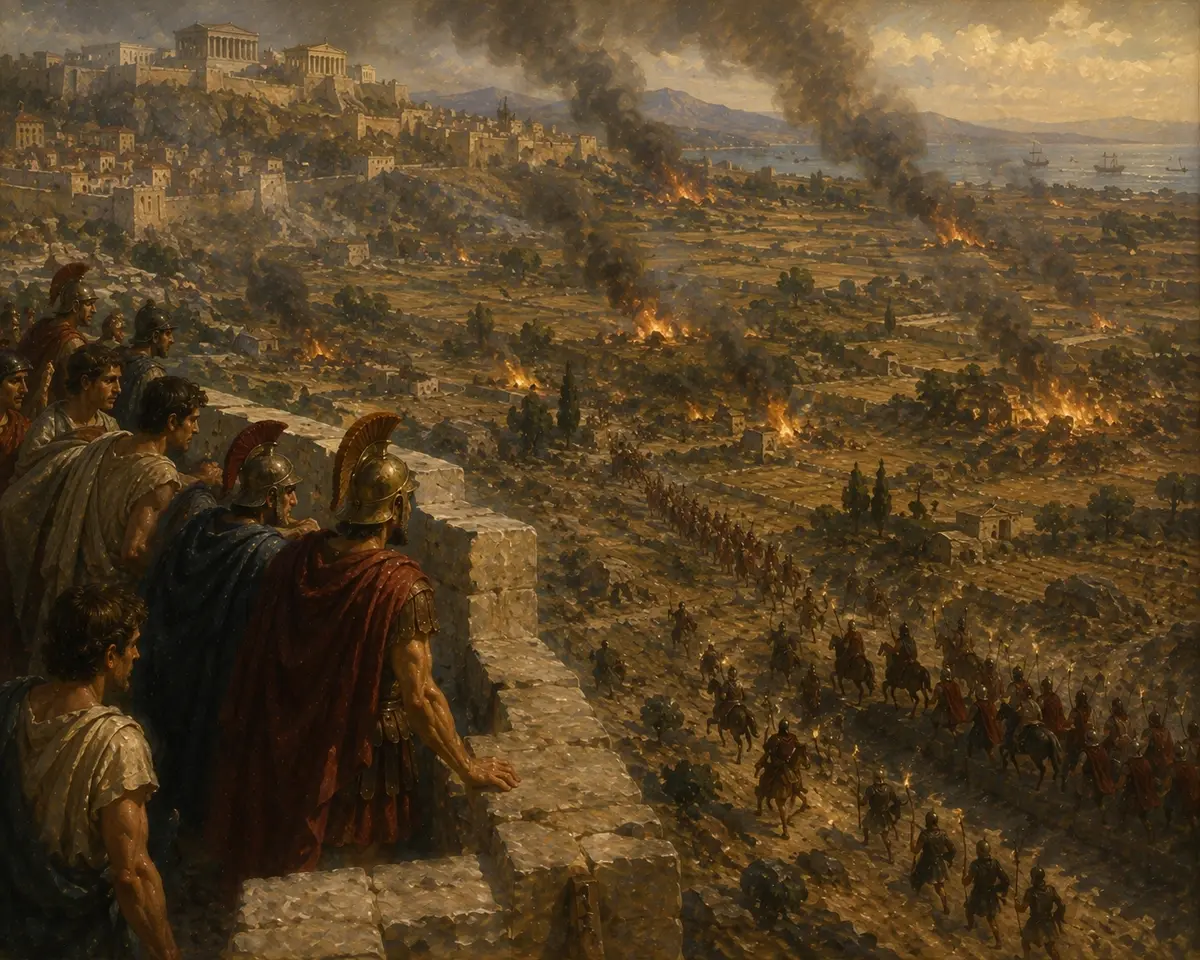
Pericles' strategy was to give up the countryside entirely. Let them burn it. Athens could not be starved behind the Long Walls as long as the fleet held the sea.
Phase One: The Archidamian War, 431–421 BCE
Named after the Spartan king Archidamus, who invaded Attica annually and achieved nothing durable. In 430 BCE, with the whole population of Attica packed inside the walls in summer, an epidemic arrived at Piraeus. It killed perhaps a quarter to a third of Athens over three waves, and in 429 BCE it killed Pericles. Athens lost its strategist at the start of a twenty-seven-year war and never replaced him. Thucydides puts his account of it immediately after Pericles' Funeral Oration, and the juxtaposition is deliberate.
The Mytilene Debate, 427 BCE
The best single episode in the whole war, and the one that tells you most about what a democracy at war does to itself. Mytilene, the main city of Lesbos, revolted from the Athenian empire. Athens put the revolt down, and the Assembly voted to make an example: execute every adult male in the city and enslave the women and children. A trireme was dispatched to carry the order. The next day, Athens had second thoughts, and reopened the debate — which was itself unusual — and Thucydides gives us both speeches. Cleon, the leading populist of the period, argued for going through with it. His case is uncomfortably coherent. An empire is a tyranny, held by force, and mercy is read as weakness. If rebellion carries no certain penalty, every subject city will calculate that the odds are worth it. And — this is the part that stings — he attacks the Athenians for treating politics as entertainment, for being spectators of speeches rather than men making decisions, and for enjoying the cleverness of a debate more than the consequences of it.
Diodotus argued against. And what makes this the great set piece it is: he does not argue for mercy. He says explicitly that pity and decency are irrelevant to the question, and that he is arguing purely about Athenian self-interest. His case: the death penalty deters nobody, because people in desperate situations always believe they'll succeed. And if Athens kills everyone in a city that revolts, then every future rebel city will fight to the last man rather than surrender — since surrendering gains them nothing. Whereas if the ordinary population knows it will be spared, it has a reason to hand over its leaders and open the gates. Killing the demos in Mytilene also destroys the one group in every allied city that is naturally sympathetic to Athens. He won, narrowly. A second trireme was sent. The crew rowed in shifts, ate barley and wine at the oar, and were promised a large reward if they arrived in time. The first ship had been in no hurry, its crew disliking their errand. The second arrived as the decree was being read out. The killings were stopped. About a thousand men judged most responsible were executed anyway, and Lesbos lost its land. Thucydides gives that in one flat sentence, having spent pages on the debate about whether to be merciful.
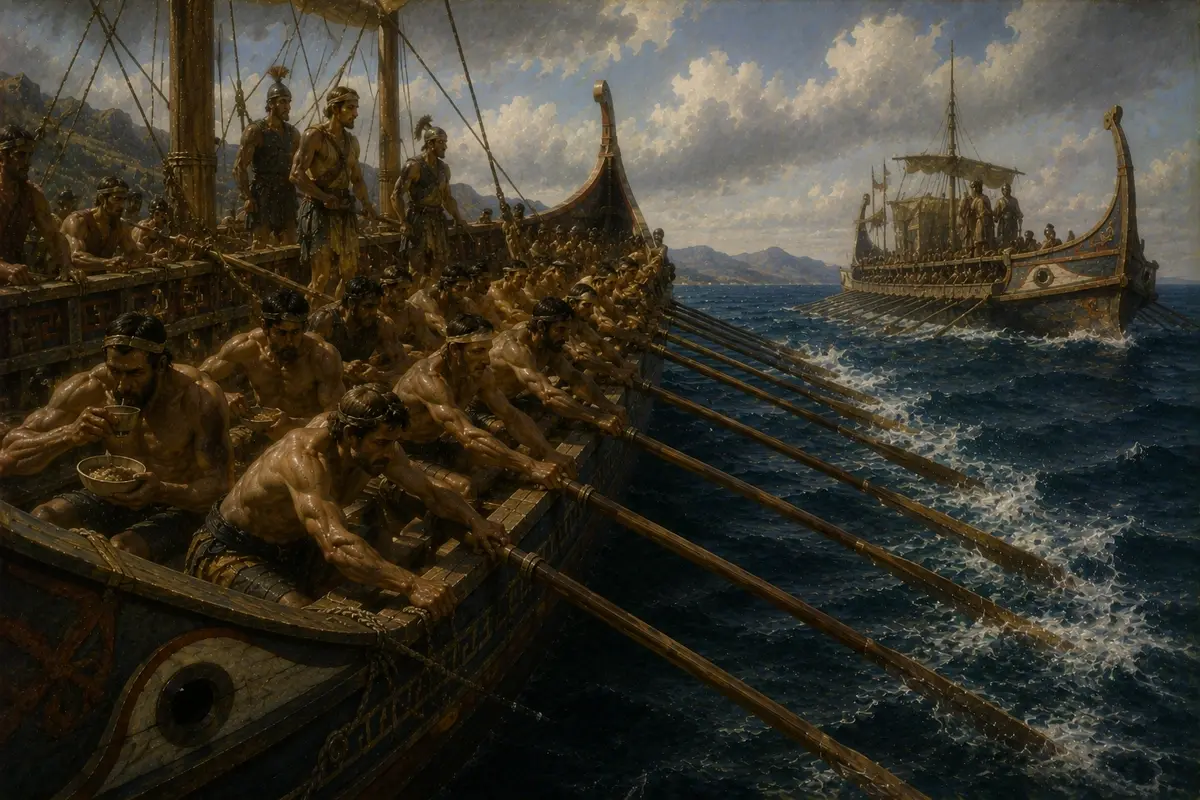
The crew ate barley and wine at the oar and rowed in shifts. The first ship had been in no hurry, its crew disliking their errand. The second arrived as the decree was being read out.
Plataea, 429–427 BCE
At the same time, a smaller and worse thing was happening a day's walk from Thebes. Plataea was the little city that had sent a thousand men to Marathon when nobody else came, and on whose territory the Persian invasion had been finally destroyed in 479 BCE. After that battle the Greeks had sworn that Plataea would be independent and inviolable forever. In 429 BCE the Spartans and Thebans besieged it. The defenders held out for two years behind a double wall of circumvallation. About half the garrison escaped in a single night — in a storm, on ladders they had built to a height calculated by counting the courses of brick in the enemy wall from a distance, having several men count independently to reduce error. That detail is worth pausing on. Under siege, at night, they solved a surveying problem with repeated measurement and averaging. When the rest surrendered, the Spartans held a "trial" consisting of a single question put to each man: had he done anything to help Sparta and her allies in the present war? They had not, being allies of Athens. Every one of them was executed and the city was levelled. The oath of 479 BCE was less than fifty years old.
Phase Two: The Peace of Nicias, 421–415 BCE
Cleon and the Spartan commander Brasidas — the two men most committed to fighting — were both killed at Amphipolis in 422 BCE, which promptly made peace possible. The Peace of Nicias was supposed to last fifty years. It lasted about six, and neither side implemented its terms. It was less a peace than a period in which the fighting was done through proxies.
Melos, 416 BCE
During this notional peace, Athens attacked Melos, a small neutral island with Spartan ancestry that had done nothing to anyone. Thucydides renders the negotiation as a dialogue — the only time he uses the form — and the Melian Dialogue is the most quoted passage in the book. The Athenian envoys refuse to argue about justice at all. They tell the Melians outright that they won't pretend they have a right to an empire or that Melos has done anything wrong, because both sides know that questions of justice only arise between equals in power, and that in reality the strong do what they can and the weak suffer what they must. The Melians make every argument available: that the gods will favour a just cause, that Sparta will come, that hope is not nothing. The Athenians answer each one coldly and accurately. The gods, they observe, appear to operate on the same principle. Sparta will not come, because Sparta acts only in its own interest. And hope is a luxury for people with reserves. Melos refused to submit. Athens took the island, killed every adult male and sold the women and children into slavery. No second trireme this time. No Diodotus. It is placed in the text immediately before the Sicilian Expedition, and Thucydides is not being subtle.
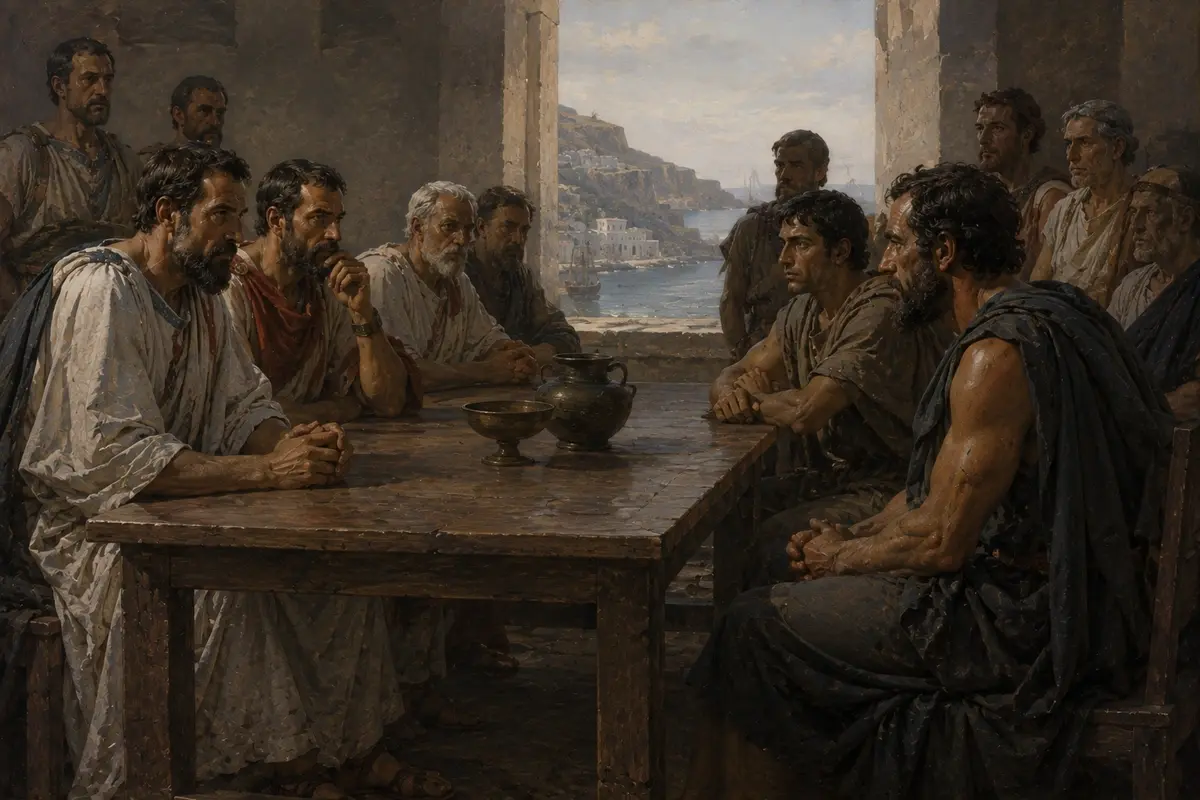
They refused to argue about justice at all. Questions of justice, they said, only arise between equals in power. The strong do what they can and the weak suffer what they must.
Phase Three: Sicily, 415–413 BCE
Then Athens, at war with Sparta, decided to invade Sicily. The scheme was Alcibiades' — conquer Syracuse, then the island, then use its resources against the Peloponnese. Nicias opposed it, and then tried to kill it by describing an impossibly large force, and the Assembly enthusiastically voted for the impossibly large force. It went wrong in every possible way. Alcibiades was recalled for trial over a religious scandal before achieving anything, defected to Sparta, and advised them how to beat Athens. Sparta sent a general, Gylippus, to Syracuse on Alcibiades' advice — the single most consequential decision of the war. And Nicias, left in command, was cautious, ill, and superstitious. When the situation became hopeless and the fleet was ready to withdraw, there was a lunar eclipse, and the seers advised waiting twenty-seven days. He waited. By then the harbour mouth had been closed. The fleet was destroyed inside it. The army marched inland and was hunted down; the survivors were put to work in the stone quarries of Syracuse in conditions Thucydides describes carefully and without adjectives. Athens lost around 200 ships and perhaps 40,000 men, including its best-trained crews. Thucydides calls it the greatest action of the war and the greatest in Greek history — the most glorious for the victors and the most disastrous for the defeated, who were destroyed utterly, and of whom few out of many came home.
Phase Four: The End, 413–404 BCE
Athens should have collapsed. It didn't, for nine more years, which is genuinely remarkable. But the strategic position was now hopeless in a specific way. On Alcibiades' advice, Sparta had fortified Decelea inside Attica and garrisoned it year-round. That meant permanent occupation rather than annual raids: no access to the silver mines at Laurium, no farming, and around 20,000 slaves deserted. And Persia entered the war — on Sparta's side. Persian gold paid for a Spartan fleet, which is the only way Sparta could ever have won. The irony is total: the war against Persia had made Athens; Persian money unmade it. At Aegospotami in 405 BCE, the Spartan admiral Lysander caught the Athenian fleet beached and unprepared on the Hellespont and destroyed almost all of it. Alcibiades, living nearby in exile, had ridden down to warn the Athenian commanders that their position was indefensible, and was told to go away. With the fleet gone, the grain route from the Black Sea was cut. Athens was besieged and starved.
In 404 BCE Athens surrendered. The terms were the empire dissolved, the fleet surrendered except for twelve ships, exiles recalled, and the Long Walls demolished. Xenophon records that they were pulled down to the music of flute girls, and that the allies believed this was the first day of freedom for Greece. Corinth and Thebes wanted Athens destroyed completely and the population enslaved — exactly what Athens had done to Melos. Sparta refused, on the grounds that a city that had done so much for Greece against Persia should not be wiped out. It is the single most creditable decision anyone makes in the entire war. Sparta then installed the Thirty Tyrants, who killed around 1,500 Athenians in eight months before being overthrown and the democracy restored in 403 BCE.
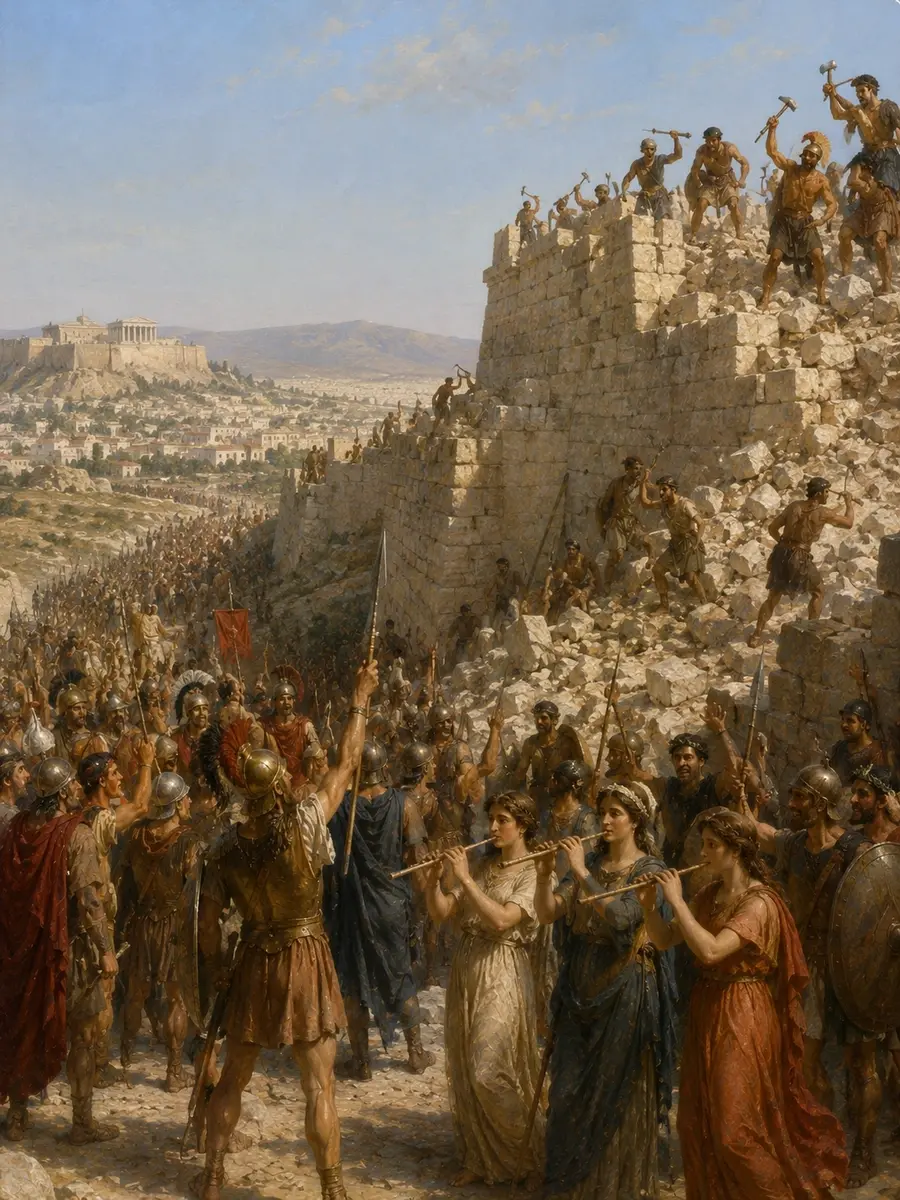
Xenophon records that they were pulled down to the music of flute girls, and that the allies believed this was the first day of freedom for Greece.
What It Cost
Athens lost its empire, its fleet, perhaps a third of its citizens, and its position permanently. It recovered as a city and never again as a power. Sparta won and immediately proved unable to run anything. Within thirty-three years it had been beaten at Leuctra and stripped of Messenia, and was finished. Greece as a whole lost the ability to resist an outside power. Persia ended up arbitrating Greek disputes by treaty in 386 BCE — the exact reverse of 479 BCE. And in 338 BCE, Philip of Macedon took the lot. Thucydides also records something harder to quantify, in his account of the civil war at Corcyra: that words changed their meaning. Reckless aggression came to be called loyal courage; prudent hesitation, cowardice; moderation, weakness; the ability to see every side of a question, an inability to act on any. Fanaticism became a mark of manliness. That passage gets quoted in every century, usually by people who have just watched it happen.
Why Athens Lost
Not one reason. Several, compounding. The plague removed a third of the population and the one leader with a coherent strategy, in year two. Sicily was a catastrophic unforced error — an offensive war of choice, launched mid-conflict, against a target that posed no threat. Persian money gave Sparta a fleet it could never have afforded, and Athenian sea power was the entire basis of Athenian strength. And democratic decision-making at war did not perform well. Thucydides is not neutral on this and it's worth reading him with that in mind — but the record is what it is. The Assembly voted to massacre Mytilene and reversed it a day later. It voted for Sicily on the strength of a speech. It recalled its best commander mid-campaign over a religious scandal, then re-elected him, then dismissed him again. After a naval victory at Arginusae in 406 BCE it put its own winning generals on trial en masse and executed six of them — illegally, over the objection of the one presiding officer who refused to allow the vote, who happened to be Socrates. Five years later, that decision-making body executed him too.