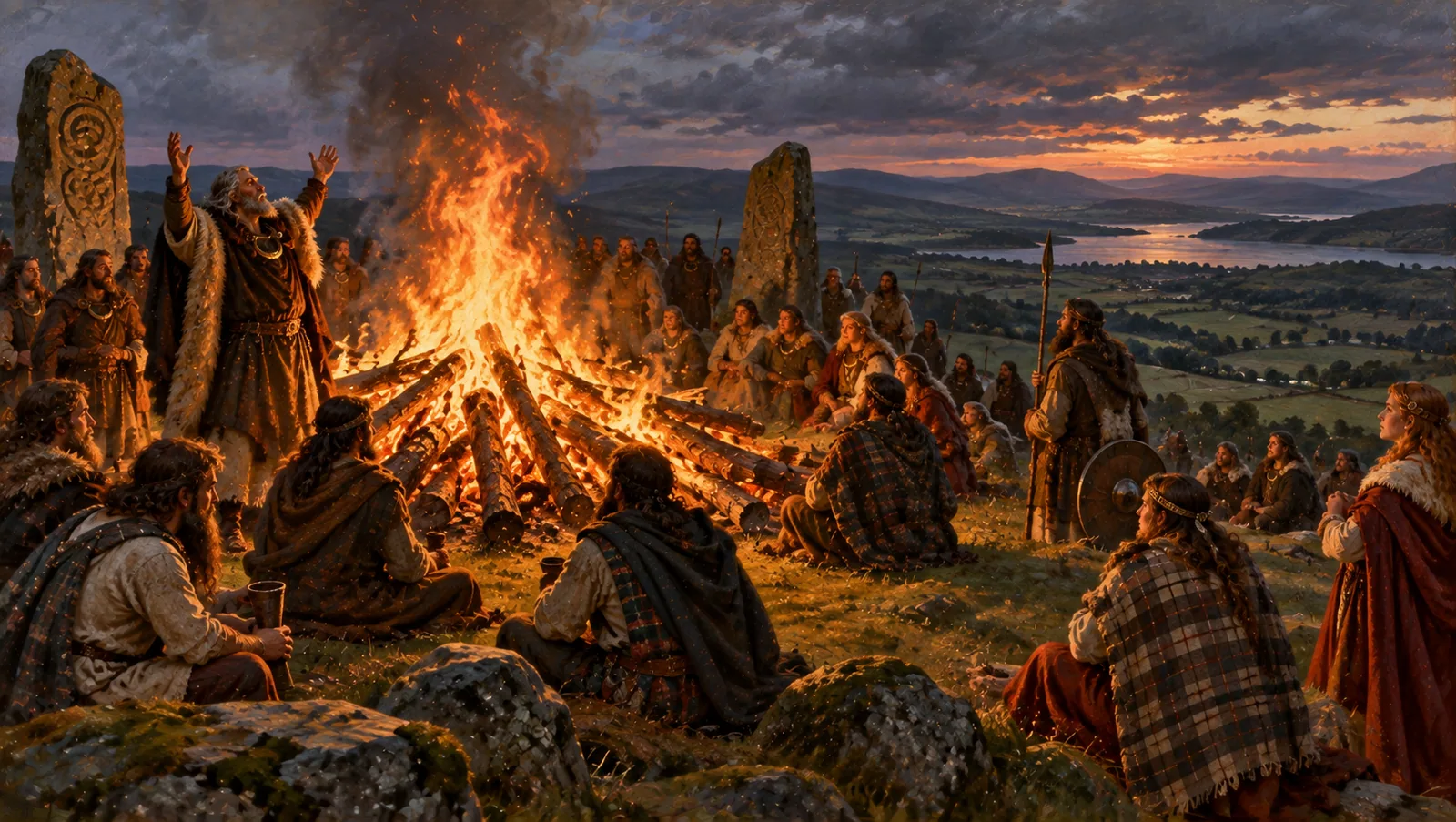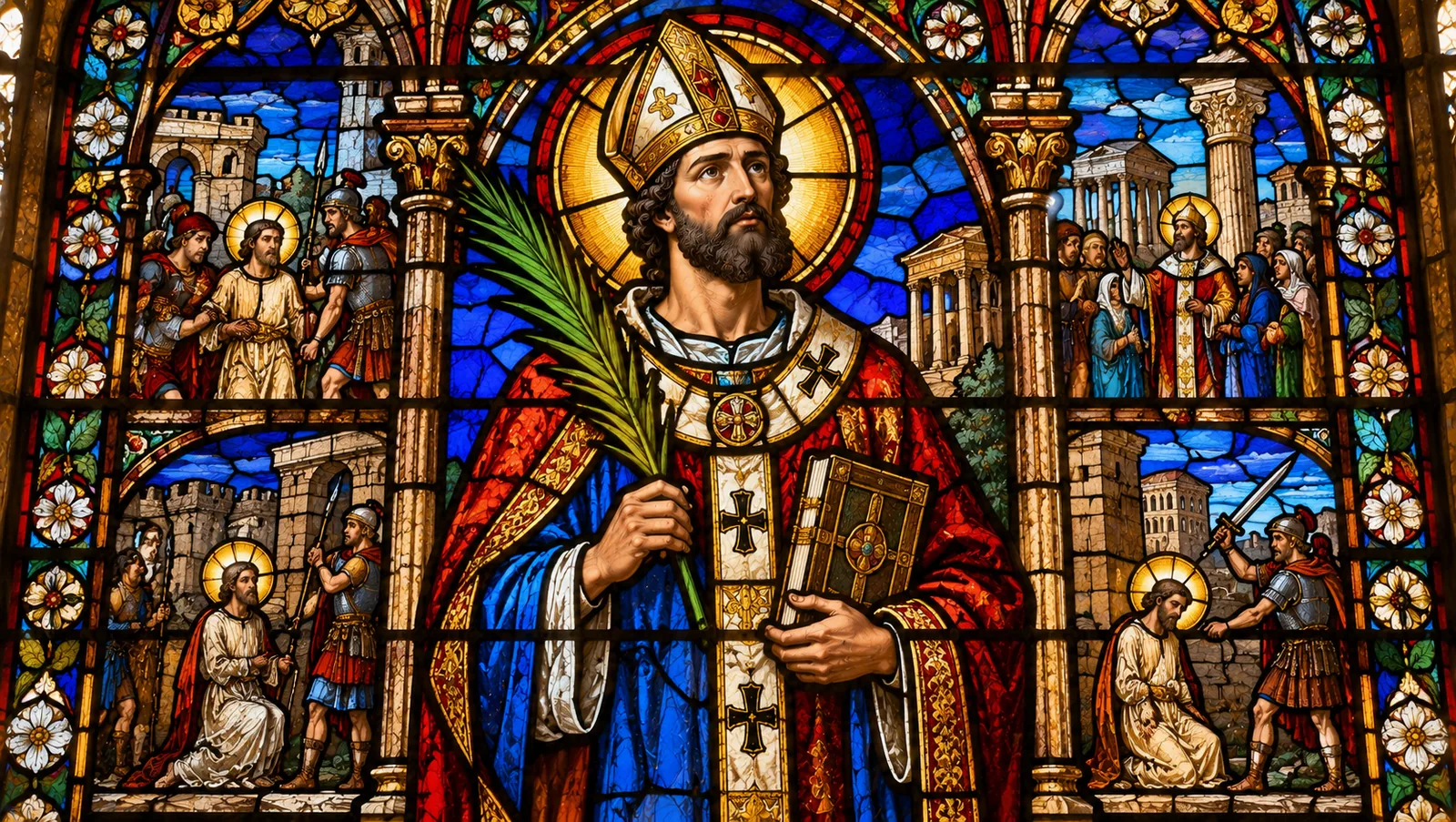
The Book of Enoch is the strangest book the New Testament quotes, and few have read it. Angels fly down from heaven and take wives. Their children are giants who devour everything growing from the hand of man and then turn on the men, then the birds, beasts, reptiles, fish and each other. A solar calendar to keep its users eternally out of step with the Temple in Jerusalem and a figure called the Son of Man on a throne of glory to judge the kings of the earth. The Epistle of Jude quotes it by name as prophecy from the seventh from Adam.
None of which secured it in most Bibles. It didn't make it into the Tanakh, the Septuagint or the deuterocanonical books. The complete text survives in exactly one language on earth, Ge'ez the old liturgical tongue of Ethiopia, because the Ethiopian and Eritrean Orthodox Tewahedo Churches and the Ethiopian Jewish community of Beta Israel never stopped copying it.
Which makes 1 Enoch one of the best windows we have into Jewish thought in the centuries before Christ and one of the most badly reported texts in circulation. Much of what gets written about it is based on loose nineteenth century translations, filtered through people who've never looked at the manuscripts behind them.
Here's what the book contains, where the scholarly arguments are, and how the book so widely read disappeared from almost everywhere at once.
Five books bound into one
Start with the thing that trips up most discussions of Enoch. It isn't a book. It's five, written by different people across a couple of centuries and only later stitched into one volume: the Watchers, the Parables, the Astronomical Book, the Dream Visions and the Epistle of Enoch, which closes things out at chapter one hundred and eight.
Scholars generally treat these as originally independent works with their own dates, each already reworked by editors before anyone bound them together. Ephraim Isaac, who translated the text for The Old Testament Pseudepigrapha, calls it plainly composite, spanning many periods and many writers, George Nickelsburg describes a collection of apocalyptic traditions from the last three centuries BC. The older layers go back roughly three hundred to two hundred years before Christ.
Aramaic was the original language, possibly Hebrew in parts, Isaac has suggested it may have worked like Daniel, partially one and partially the other. No Hebrew copy has ever turned up. And since people conflate them constantly, worth pointing out plainly: 2 Enoch and 3 Enoch are separate works, attached to the same patriarch but not part of this text.
As for the man, Genesis gives Enoch hardly anything. He's a few lines in a genealogy, father of Methuselah and great-grandfather of Noah. What sets him out is that his entry doesn't end the way the others do. He doesn't die. God takes him. For any writing about the machinery of heaven, this thin biography is ideal because it gives one who went up there and could report back.
Who were the Watchers

1 Enoch places the descent of the two hundred Watchers on the summit of Mount Hermon, the highest point in the region and a long-standing cultic site.
Two hundred angels look down on human women and decide they want them. Their leader Semyaza hesitates, and his reason is oddly bureaucratic. He's worried the others will lose their nerve and he'll be left carrying the penalty alone. So they do something deliberately: every one of them swears a binding oath, meaning nobody can back out and nobody carries more blame than any other.
They descend in the days of Jared, on the summit of Mount Hermon and the text turns the mountain's name into a pun on that oath. They bound themselves there, and the place kept the memory. Twenty are named as chiefs of tens, and the list reads like a roll call of Western demonology: Semyaza, Azazel, Baraqiel, Kokabiel, Armaros, Chazaqiel, Sariel, Shamsiel, Tamiel, Ramiel.
The real crime was knowledge
What gets missed when the Watchers get reduced to a story about angels and sex is that the text spends far more energy on what they taught than on what they did.
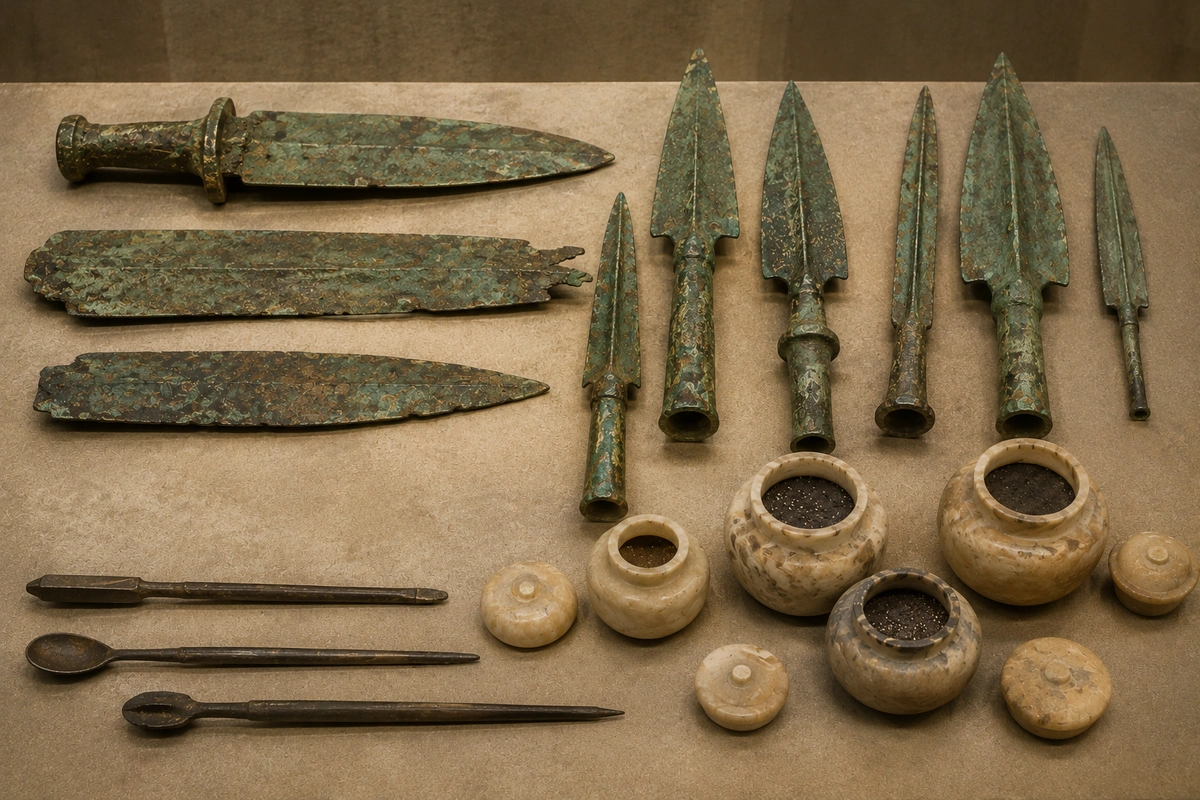
The crafts Azazel is accused of leaking, metalworking for weapons and antimony for painting the eyelids, were both well established across the ancient Near East long before 1 Enoch was written.
Azazel hands humanity metallurgy, the first products listed being swords, knives, shields and breastplates. He finishes with bracelets, the use of antimony and the painting of eyelids, costly stones and colouring dyes. Semyaza teaches enchantments and root-cutting, Armaros how to break enchantments, Baraqiel astrology, Kokabiel the constellations, Ezeqeel how to read clouds, Sariel the courses of the moon.
Weapons, cosmetics, divination and pharmacology, all arriving at once, from above, ahead of schedule. When God later tells Raphael about the punishment the text says every sin should be laid to Azazel's account. That's the theology in a line. Civilisation entered the world as contraband.
The manuscripts disagree about the giants
The offspring are giants, and this is where I'd be careful with anything you read online, because the manuscripts don't agree on how big they were.
The Ethiopic tradition R. H. Charles worked from gives their height as three thousand ells, an absurd figure running to thousands of feet. The Greek preserved by the chronicler George Syncellus reads three hundred cubits instead. The modern critical edition by Nickelsburg and VanderKam drops the measurement and puts a genealogy in its place: giants who fathered the Nephilim, who fathered a third generation called the Elioud.
So when a site states flatly that the Nephilim stood four hundred and fifty feet tall, it's picking one manuscript reading and hiding the two others. That matters because this text reached us through centuries of copying, a translation into Greek, another into Ge'ez, and no small amount of scribal confusion en route.
Size aside, the story remains consistent. The giants consume everything humans produce, turn on humanity when the food runs out, then on birds, beasts, reptiles, fish and one another, drinking blood. The earth itself lodges a complaint against them.
Four archangels and a sentence
Michael, Uriel, Raphael and Gabriel carry the case upward and ask God to judge the fallen angels and the state of the world below. Four specific assignments come back, and the first quietly reframes the whole flood story.
Uriel is sent to Noah with a warning and instructions: hide, prepare, preserve the line. In Genesis the flood arrives as judgment. For Enoch it arrives as the last stage of a containment operation with advance notice given to the one family worth saving. That's the moral logic this book exists to supply.
Raphael is told to bind Azazel hand and foot, throw him into an opening cut in the desert at a place called Dudael, pile jagged rocks on him, cover his face so he never sees light and leave him until the great judgment sends him into the fire. A second job comes along: heal the earth the Watchers ruined.
Gabriel gets the giants and the method is grim. He isn't told to kill them. He's told to set them against each other and let them finish the job themselves. Michael takes Semyaza and the rest, but only after they've watched their own sons destroy one another, and then binds them in the valleys of the earth for seventy generations.
Enoch's own role is worth a pause. The fallen angels, panicking, ask him to petition God on their behalf. He agrees, carries the appeal up, and comes back with a refusal. He's the intermediary who failed.
The Son of Man problem
The Book of Parables is where the scholarship gets genuinely contentious, and it comes down to one phrase.
Building on the Watchers material, the Parables move past the fate of the fallen angels to the fate of the wicked kings of the earth, centring the judgment on a figure called the Righteous One, the Chosen One, the Messiah and the Son of Man. He sits on the throne of glory. This is the first known use of Son of Man as a definite title in any Jewish writing.
Which presents a problem. If the Parables are pre-Christian, they're crucial background to how the Gospels use that title. If they're later, the influence may be the other way. In 1976 Józef Milik argued for late, dating the section to around AD 260 to 270 and proposing a Jewish Christian author borrowing Enoch's authority, Michael Knibb followed the same reasoning, resting heavily on absence. No fragment of chapters thirty-seven to seventy-one turned up at Qumran, and the section is missing from the Greek as well.
Most scholars have since rejected that date, David Suter notes a general tendency to place the Parables between 50 BC and AD 117, Charles between 94 and 64 BC. There's no firm consensus even now, but the late-Roman Christian theory is no longer where the argument lives.
A second dispute sits inside the section. Chapters seventy and seventy-one seem to identify Enoch himself as the Son of Man, contradicting earlier chapters where the two are clearly separate, and the narration switches person halfway. Most read those as a later addition; James Charlesworth flatly disagrees.
Milik had one more idea worth keeping. He proposed the Parables were a substitution, and the Book of Giants originally filled that slot. There's real evidence for it: a Book of Giants fragment from Qumran was copied by the same scribe who wrote out a portion of Enoch, and the two may be from a single manuscript.
A calendar built for schism
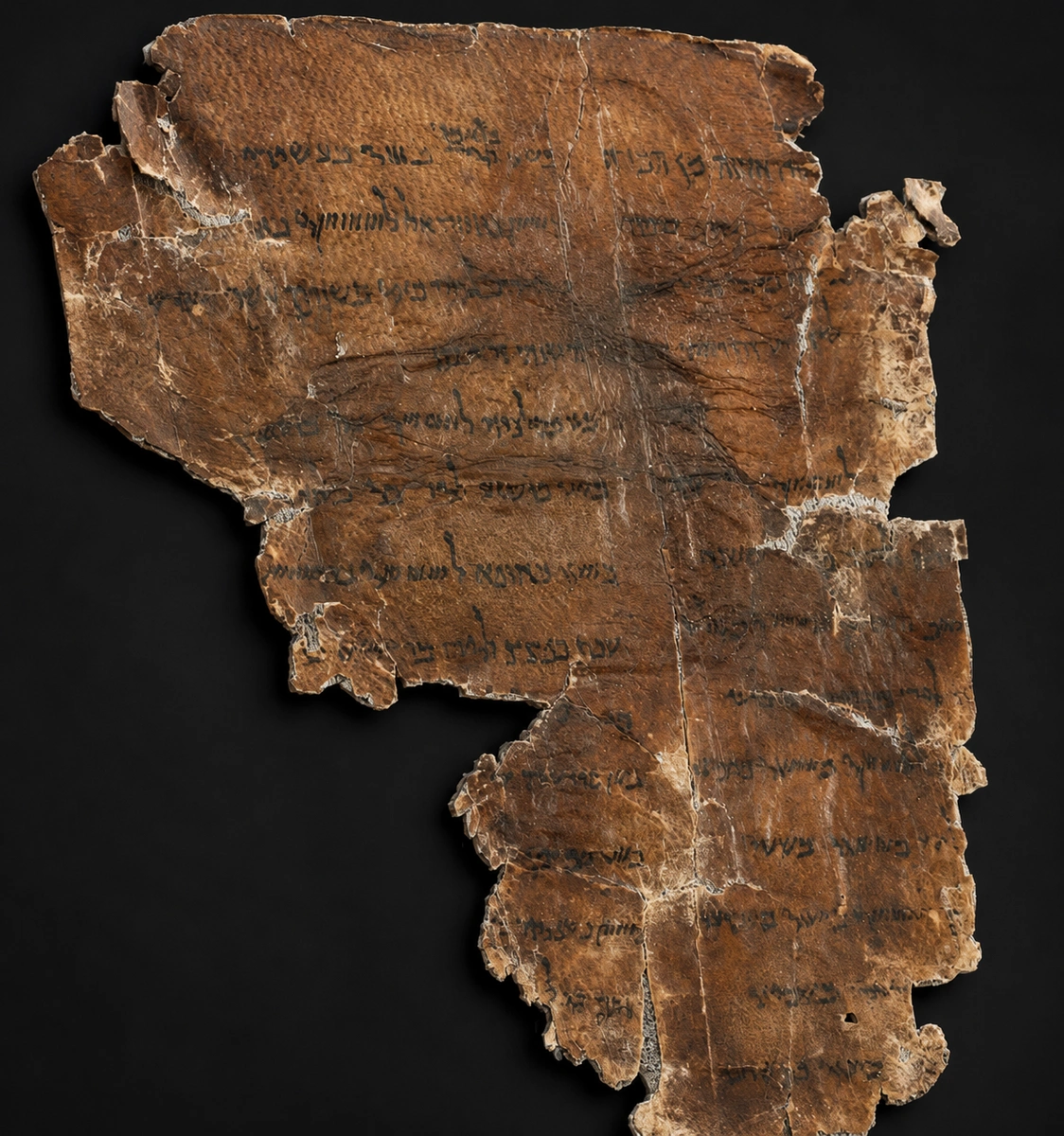
Calendrical scrolls recovered from Qumran work out the same 364-day scheme the Astronomical Book describes, in which every date falls on a fixed weekday.
The Astronomical Book is the section everyone skips, which is a shame, because it may be the one with the most real-world consequences.
Uriel walks Enoch through the movements of the heavens and from it a calendar comes. The year runs 364 days in four seasons of exactly 91. Each season holds three months of thirty days plus one extra day at the end. That produces 52 perfect weeks, so every date falls on the same weekday every year, forever, and the year always opens on a Wednesday, the fourth day of creation in Genesis, when the lights in the sky were made.
Nobody knows how its users handled the gap against the real solar year, at least seven proposals have been floated, and it isn't clear they felt any need to fix it.
The consequence is the point. The same calendar appears in the Book of Jubilees and was used by the Dead Sea sect, and keeping it made observing the festivals alongside the Jerusalem Temple impossible. That's not an astronomy chapter, it's a schism, written as a timetable. Four fragmentary copies turned up at Qumran, two dating to the start of the second century BC, pushing composition back into the third.
Israel's history, told with animals
The Book of Dream Visions holds one of the odder literary experiments to survive antiquity: the whole history of Israel retold with animals standing in for people and people standing in for angels.
Adam is a white bull, Eve a heifer, Abel a red calf and Cain a black one. Noah is a white bull, and his three sons come out white, red and black. The faithful are sheep, their leaders rams. Every hostile nation gets an animal, so the Philistines are dogs, Esau and Edom wild boars, the Assyrians and Babylonians lions and tigers, the Seleucids ravens, the Ptolemies kites. The giants and their descendants appear as elephants, camels and asses.
It tracks as real history. You can follow the exodus, the giving of the law, the temple, the kingdom splitting in two, Israel falling to Assyria and Judah to Babylon, and the rebuild that finished in 515 BC.
Then a great horn sprouts on a lamb, fights Seleucids, Ptolemies and Macedonians together and cannot be brought down. Most read that as Judas Maccabeus, Mattathias doesn't fit, since he dies a natural death in 1 Maccabees, the earlier line about a lamb seized and destroyed is usually matched to the murder of the high priest Onias III around 171 BC.
That reading hands over the date almost for free. The vision remains confident and specific right up to the mid-160s BC, then goes vague and cosmic, which is the signature of something written during the revolt by someone guessing at the ending. Most place it between 163 and 142 BC. It closes with a white bull born with great horns and every animal transformed into white bulls alongside him, humanity restored to what it was in the vision's opening lines.
Woes against the wealthy
The closing section switches register hard. It opens with the Apocalypse of Weeks, compressing history into ten periods, seven behind and three ahead, usually dated to the first half of the second century BC. Then come the woes, and they have teeth. Gabriele Boccaccini argues the epistle holds two layers, an earlier one closer to the deterministic theology at Qumran and a later one insisting on individual responsibility. In that later material the sinners are consistently the wealthy and the righteous consistently the oppressed, a theme the Parables share.
How a popular book vanishes
The early church knew Enoch well. The Epistle of Barnabas treats it as scripture outright, and Justin Martyr, Irenaeus, Clement of Alexandria, Origen, Cyprian and Tertullian all reference it, some approvingly and some not. Around AD 200 Tertullian offered his own explanation for its absence from the Jewish canon, claiming it had been rejected because it pointed to Christ.
By roughly the fifth century it had dropped out of Christian canons nearly everywhere. Rabbinic literature is close to silent about Enoch, and active polemic against Enochic traditions may be what pushed these books out of use. One strand of influence clearly survived: the description of God's throne in chapter fourteen became foundational for the later Merkabah tradition, and Gershom Scholem singled out the book as the best representative of that older esoteric literature.
After that, erosion. Two passages survive in Latin, one in Syriac inside a twelfth-century chronicle, part of the Apocalypse of Weeks in a damaged Coptic manuscript. Greek did better, with a sixth-century codex from Akhmim carrying chapters one to thirty-two and a fourth-century Chester Beatty papyrus most of the final section. Pieces of a book, none of them the book.
Ethiopia kept the whole thing
Meanwhile the complete text sat on Ethiopian shelves the entire time, in continuous use.
Europe was slow to believe it. When Nicolas-Claude Fabri de Peiresc bought a Ge'ez copy in the early seventeenth century, Hiob Ludolf, the leading Ethiopic scholar of the age, dismissed it as a forgery. The turning point came in 1773 when the Scottish traveller James Bruce returned from six years in Abyssinia carrying three copies, one of which went to the Bodleian.
They sat largely unread for decades. Richard Laurence published the first English translation in 1821, August Dillmann the first proper critical edition in 1851. Charles then dominated the field for a generation, building a 1906 edition on twenty-three Ge'ez manuscripts and following it with his English translation in 1912.
What the Dead Sea Scrolls settled
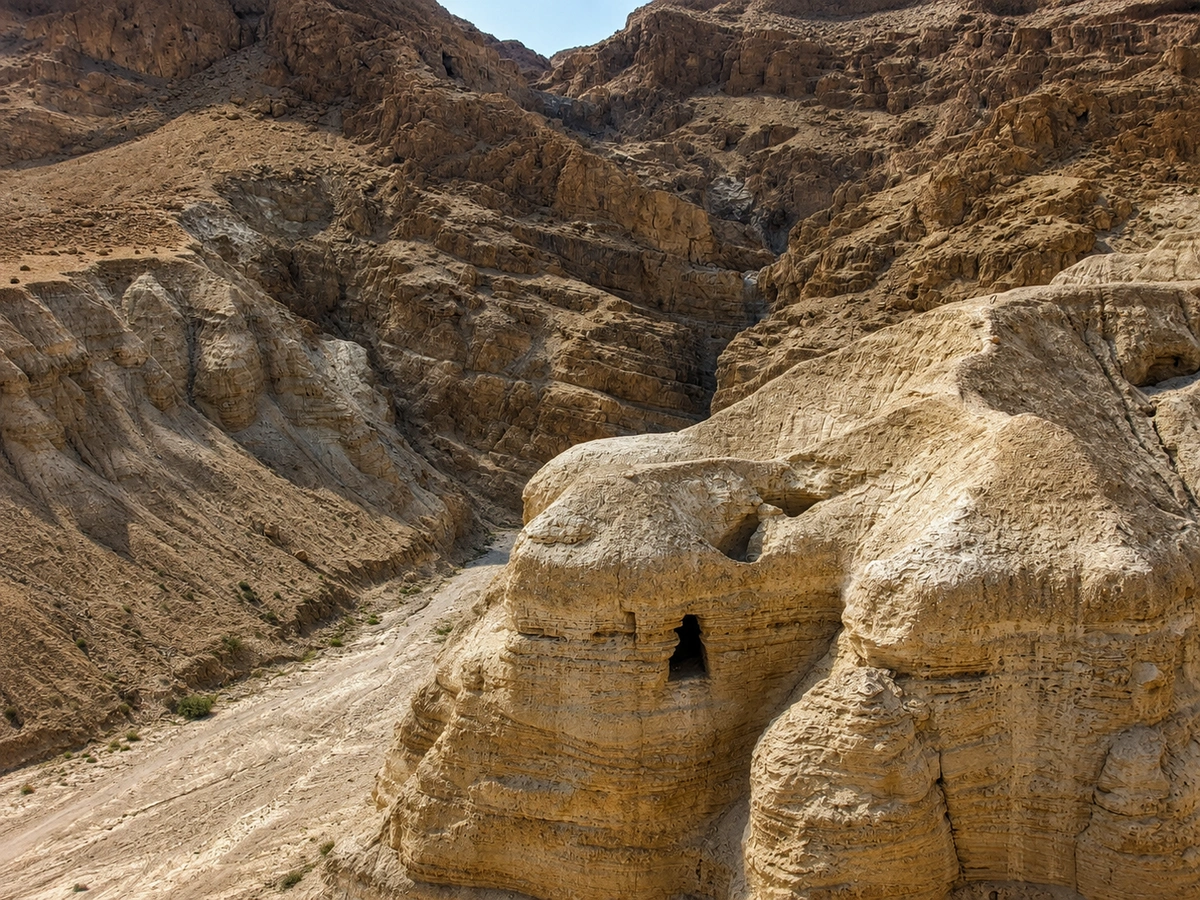
Cave 4 produced roughly ninety percent of all Qumran material, including the eleven Aramaic copies of Enoch that ended the forgery argument.
The forgery question died at Qumran. Cave 4 was opened in August 1952, and that September Milik identified the first Aramaic fragment of Enoch among a mass of tiny scraps, publishing the official edition in 1976. Eleven Aramaic copies eventually surfaced. You'll see 1948 given as the discovery date in some reference articles, Wikipedia's included, and that's simply wrong. Cave 4 hadn't been found yet.
Paleography dates the oldest Watchers fragments to between 200 and 150 BC. Since that section already shows several stages of composition behind it, the work was probably circulating in the third century BC. That killed a comfortable older theory that Enoch's core was written in response to Hellenization after the Maccabean revolt. The material predates the revolt.
What the fragments reveal is a version of Judaism that doesn't much resemble the tradition that eventually won. Evil doesn't enter through Adam here; it comes down through angels. The markers of the Mosaic covenant, Sabbath and circumcision, barely register. The Second Temple's offerings are described as polluted. Heaven is modelled on a royal court rather than the Jerusalem temple. David Jackson has gone as far as calling this Enochic Judaism, a tradition the Qumran writers descended from, and Margaret Barker argues its roots reach back to “the time of the First Temple”.
The book that outlived its canon
Which brings us back to where we started, Jude quoting 1 Enoch 1:9 almost verbatim with the words naming Enoch as the seventh from Adam deriving from Enoch itself rather than from Genesis. John Barton's warning applies here: demonstrating a text was quoted is not the same as demonstrating it was regarded as scripture, and the nature of the quotation still has to be established. Peter Davids puts it plainly. Jude clearly regarded it as authoritative, but we have no way of knowing whether he placed it on a level with Isaiah.
Other than Jude there are more echoes. Passages in 1 Peter and 2 Peter have been read as using Enochic material concerning imprisoned angels. Simon Gathercole has explored whether Luke's reference to the fall of Satan from heaven draws on Enoch's cosmology though ultimately he finds himself arguing against it. The Church of Jesus Christ of Latter-day Saints does not accept 1 Enoch as canonical but teaches that an original Book of Enoch was inspired, their Book of Moses presenting one section in the form of extracts from it.
And still it functions in theological discourse. Enoch is regarded as Old Testament scripture by the Ethiopian Orthodox Tewahedo Church and has been interpreted for centuries through the andemta commentary tradition. In 2015 scholars from Ethiopia and abroad met to discuss what the book had to say to contemporary theology, producing essays two years later on themes of justice, the environment, political theology, suffering and the identity of the Son of Man.
For a book that most of Christendom abandoned fifteen centuries ago, this is an impressive afterlife. The real issue is not so much whether Enoch belongs in anyone's canon. It's how much of what people think are biblical ideas, those of the fallen angels, the bound demons, the last judgment, the Son of Man on his throne, derived from a text that never made the cut.