Mention Mennonites and horse-drawn buggies probably come to mind, but that covers maybe a tenth of a five-century story. It includes Swiss radicals drowned for re-baptizing adults, a self-proclaimed king whose corpse still hangs in an iron cage in Germany, an invitation from Catherine the Great, and a record of Nazi-era collaboration that Mennonite historians only recently began to reckon with. Today the tradition's fastest growth is in Ethiopia, even as some of its Latin American colonies rank among the biggest drivers of Amazon deforestation.
Mennonites occupy a strange space in the popular imagination, next to the Amish. Hats, horses and a suspicion of electricity come to mind. That's not an accurate portrayal, not even close. That's perhaps one tenth the people they claim to represent, and entirely missing the fascinating history.
The real story spans five centuries and four continents, only a small portion of which is spent promoting pacifism. It involves a few Swiss radicals put to death for baptizing adults, mass burnings, a self-proclaimed Anabaptist king whose body hangs in an iron cage, an invitation from Catherine the Great, and a chapter of history involving Nazi-occupied Ukraine that Mennonite historians have only recently acknowledged. Along the way one of the first written protests against slavery in the American colonies was quietly put aside by those who received it.
And more recently it involves colonies of Mennonites in the Bolivian and Peruvian Amazon, satellite monitoring indicates, that are substantial drivers of deforestation. How did a group of pacifists get there?
What Mennonite Actually Means Today
Mennonites are Anabaptist Christians, a tradition going back earlier than the name, which comes from Menno Simons, a Dutch priest who joined the movement around a decade after its founding. (He didn't found it.)
The distinguishing characteristic is baptism on confession of faith rather than at birth, and all the rest follows from there - a voluntary church, separation of church and state, refusal of oaths, and most especially nonresistance, the refusal to take up arms under any circumstance. That last belief earned them a place among the historic peace churches.
What confuses outsiders is the variety on display. The Old Order Mennonites are visible in horse-and-buggy enclaves in Pennsylvania, speaking German. Other conservative Mennonites don't ride horses, but they do use cell phones. Progressive Mennonites in North America's cities are indistinguishable from any mainline Protestant congregation. All three groups call themselves Mennonite, and any two would have difficulty attending the same service. Each was unintentionally created, each is the product of a bitter argument that someone lost.
The Zurich Baptism of 1525
Zurich in January of 1525 was not a place where people expected much of a debate on the nature of faith. Huldrych Zwingli had sparked the Reformation there, and a group of his younger followers came to see themselves as correcting his course. On the twenty-first of the month, fifteen of them - including Conrad Grebel, Felix Manz, and a former priest named George Blaurock - gathered in the house of a private citizen and baptized each other. No bishop approved this, nor did the council.
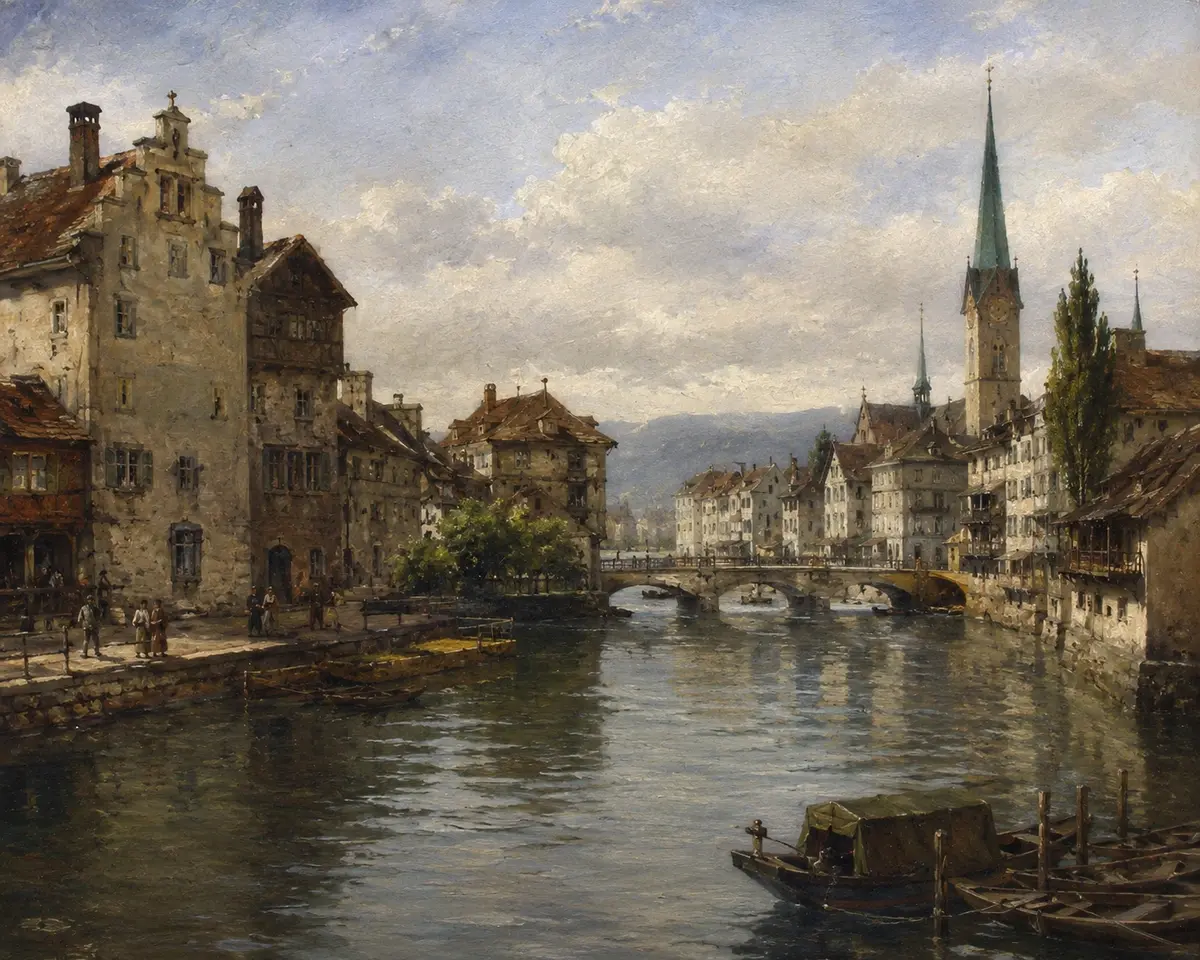
The first adult baptisms of the Radical Reformation took place in a private house near this river in January 1525; two years later, Felix Manz would be drowned in it for the same act.
It doesn't sound like much, but in 16th century Europe it was revolutionary. In that era nearly every infant was baptized into the Catholic faith, and that baptism had two functions. It marked a person as a Christian, and a subject. You joined the church and your territorial lord in one simultaneous event, without your consent or consideration.
To suggest that baptism should be an adult decision, made on the basis of scripture alone, was to suggest that church membership be voluntary, which in turn was to suggest that the church and state be entirely separate entities. All of this was considered a radical position in 1525, but more radically it was treason.
Why Rulers Wanted Them Dead
Their opponents called them Wiedertäufer. That is, re-baptizers - the modern term is Anabaptists. Catholic and Protestant authorities in the 1520s could disagree on little else, but they both considered Anabaptists a danger. Zurich was first among those dangers, which meant it was first among those who acted. In March of 1526 the council made re-baptizing a capital offense, punishable by drowning. Felix Manz was the first man put to death for the crime on the fifth of january, 1527, and also the first Anabaptist killed by Protestants. His murderers tied his hands under his armpits, ran a pole through, and dumped him off a fishing platform into the Limmat while his mother called from the shore telling him to hold firm. Onlookers had an appropriate joke waiting. They called this the third baptism.
Manz was far from the only casualty. Across the region banishment, torture, burning, live burials and beheadings followed, and by 1530 most of the founding generation was dead. The non-resistant wing was usually unwilling to fight back, which made them susceptible to being killed.
In 1660 a Dutch pastor named Thieleman van Braght collected many of these stories into a thousand page martyrdom, Martyrs Mirror. Estimates of how many Anabaptists actually died range from about 2,500 in careful scholarly work to 4,000 or 5,000 in older calculations, and the truth is unlikely to be known. The book's later popularity is secure. In many Amish and conservative Mennonite homes it is still kept near the Bible, and some families give it as a wedding gift.
Münster and the Militant Wing
Not all Anabaptists believed in pacifism, and that caused problems.
In February of 1534 a radical end-times faction captured the city of Münster and made it the New Jerusalem. They expelled anyone who refused rebaptism, burned all books but the Bible, and forbade private property. Jan Matthys, their first prophet, walked out the gates on Easter Sunday expecting the surrounding army to dissolve and was killed within minutes. His successor, a Dutch tailor named Jan van Leiden, took up the reigns, married sixteen women, and began executing dissidents in the marketplace square.
The siege of Münster lasted until June of 1535, when the bishop's forces entered and killed most of the defenders, and van Leiden himself was tortured to death that January. His body and that of two of his lieutenants were placed in iron cages and hoisted up on the tower of St Lambert's church as a warning. The cages can still be seen.
Münster served as a pretext for every European ruler to intensify the hunt. After 1535 few Anabaptists could be considered heretics - they were revolutionaries, and the punishment remained the same. The non-violent wing would spend the next two centuries providing cannon fodder.
Menno Simons and His Brother
Menno Simons was a Catholic priest in Friesland, ordained in 1524 and quietly troubled by nearly everything he was sworn to uphold. He came to doubt transubstantiation, then infant baptism, and kept the ideas private, which cost him nothing.
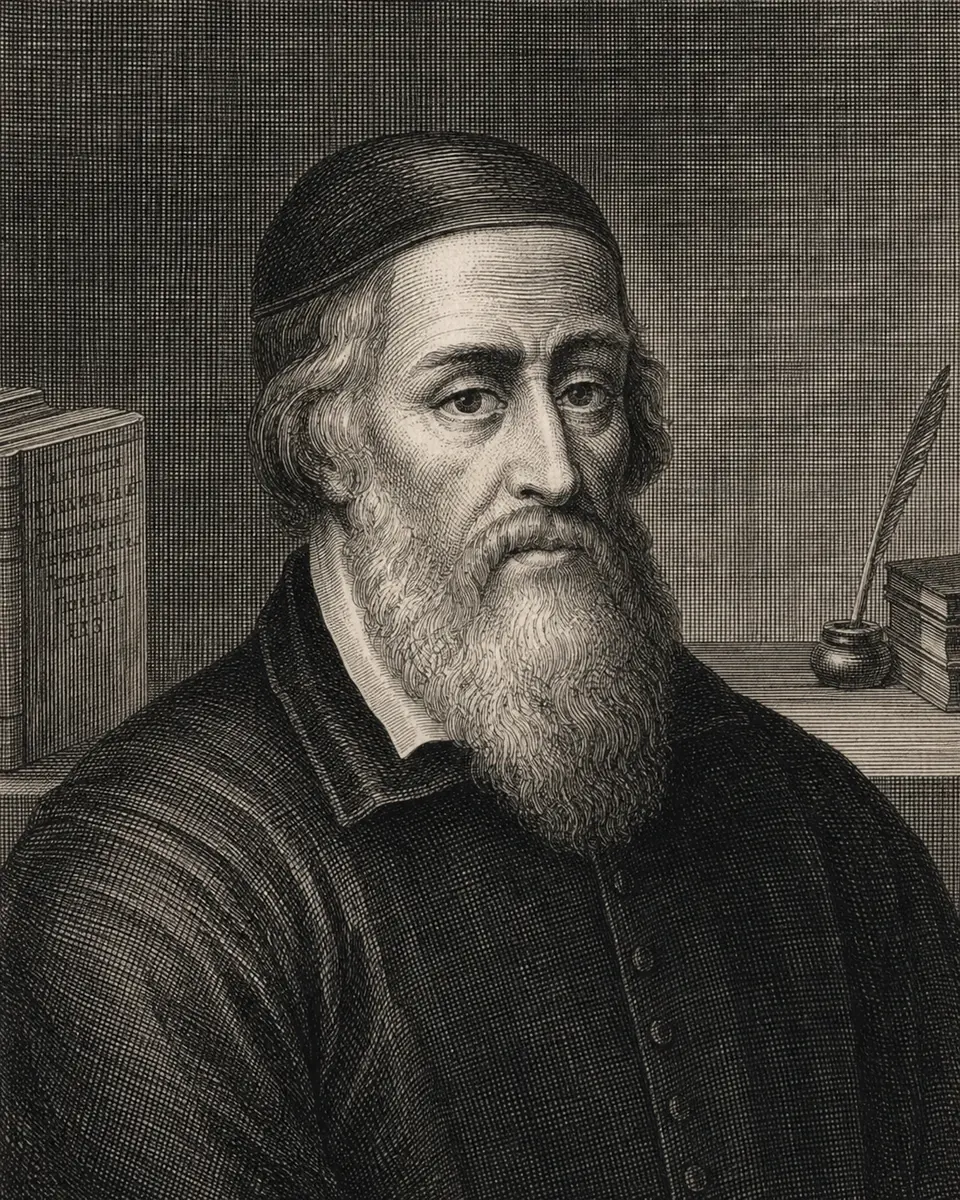
Menno Simons never founded the Anabaptist movement; he joined it a decade in, after a personal crisis, and became its most durable organizer.
Simons was prompted to leave the Church by events occurring in 1535. His brother Pieter had joined the militant wing, and a group of about three hundred Anabaptists captured a monastery near Bolsward led by an emissary from Münster. When the authorities re-took the place, Pieter was one of those killed.
The last detail is often overlooked or changed, even in reference works on Menno, presenting his brother as a pacifist who died resisting. That is not what happened. Pieter van Simons was part of a heavily armed occupation force, which is why what Menno did next is of interest.
In January of 1536 when Menno was forty years old, he walked away from the Church, and for the next twenty-five years would live as an agitator, hunted by nearly every territorial power in Europe. He wasn't the founder of the movement, nor its most gifted thinker. He was its chief organizer, a position that lasted just long enough to create a lasting impression.
What They Actually Believed
The theology was hammered out early. Seven articles adopted at Schleitheim in February of 1527 formed the foundation of the Mennonite worldview: baptism for believers only, communion, separation from the world, excommunication as the church's only punishment, ministers chosen by the congregation, renunciation of the sword, and of the oath as well. That last article is quietly logical - if the word is truth, then a ceremony affirming it admits that it is rarely the case.
The Dordrecht Confession of 1632 provided greater detail, and became the standard in Dutch Mennonitism, then Alsace in 1660, then North America by 1725. It also introduced footwashing as an act of service and made shunning of the excommunicated a formal church procedure, both of which would later prove problematic.
The emphasis on plain living was dictated by circumstance as much as philosophy. Losing one's belongings every generation or so tends to make a person value people over things. The Dutch Mennonites were tolerated but constrained - their churches had to face away from the street, and the ringing of a bell to signal a service was forbidden. This led to a certain austerity in their appearance, the same impulse that guided their rejection of music performed by more than one person. A theology of humility and the practical matter of avoiding seizure, resulting in something very much like the Amish.
A Tradition of Splitting Apart
A movement begun by people who believed strongly in separating from the unbaptized had one fatal flaw, which manifested at various points in Mennonite history.
The first great schism occurred in 1693, when Swiss elder Jakob Ammann pushed for stricter rules - twice-yearly communion instead of once, literal footwashing, and actual social shunning of the excommunicated instead of the symbolic kind practiced in Switzerland. He came into conflict with a more lenient leader, Hans Reist, and negotiations collapsed. Ammann excommunicated everyone who refused to agree with him, and his followers became the Amish. He later admitted he had acted rashly, which did him no good.
America provided schism material almost immediately. The first occurred in 1778, when bishop Christian Funk backed the Revolution and was excommunicated, along with a small group of his followers. Another split in Lancaster County occurred in 1845. The largest wave of separatism occurred from 1872 to 1901 in Ontario, Pennsylvania and the Midwest. This happened because conservative Mennonite congregations in America and Europe became uncomfortable with the revivalist practices of American Protestantism. The resulting groups of Old Order Mennonites remain to this day.
Some of the later divisions are almost whimsical. An Old Order branch permitted automobiles in 1927 on the condition they be plain and black, which they proceeded to do, painting the chrome bumpers to meet the requirement. Some congregations permit tractors but insist on steel wheels, to prevent anyone from driving one on the road.
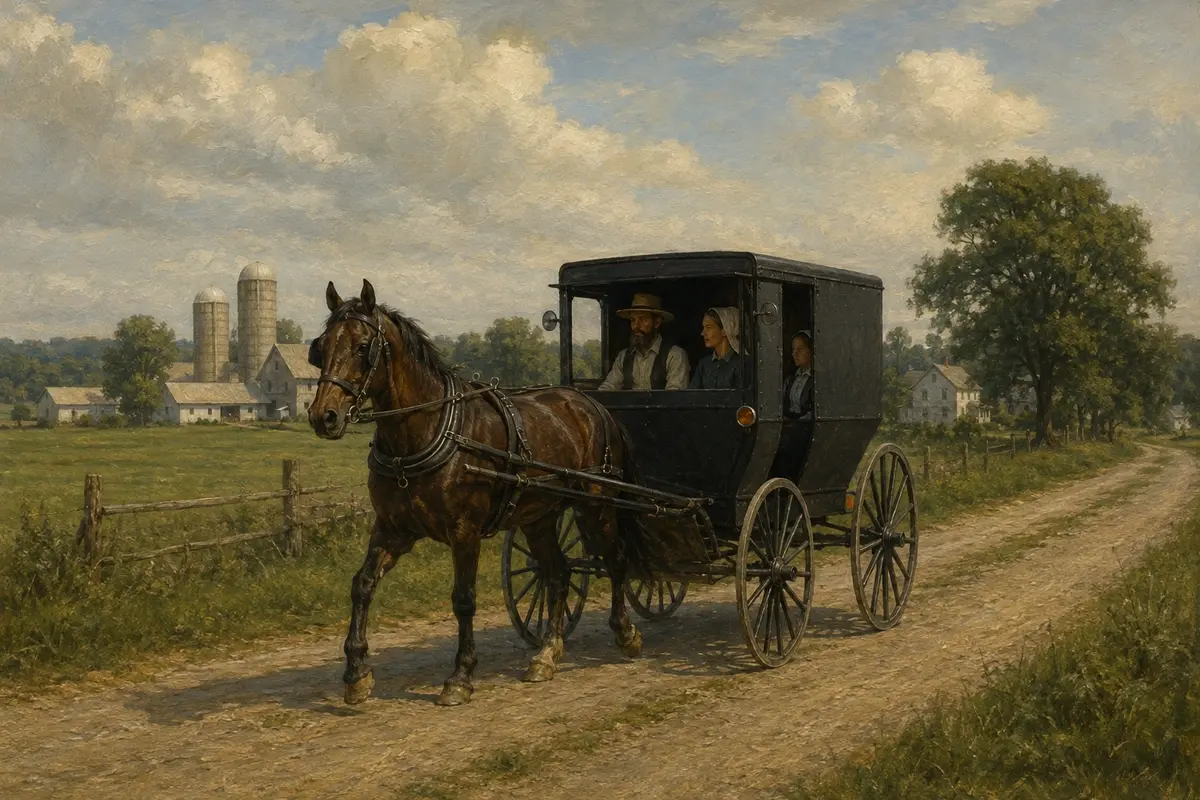
Every one of today's Mennonite subgroups, from horse-and-buggy Old Orders to car-driving 'Black Bumper' congregations, traces back to a schism someone eventually lost.
Germantown and an Ignored Petition
Thirteen families from Krefeld, Germany arrived in Pennsylvania in 1683 and founded the colony of Germantown, the first permanent Mennonite settlement in the colonies. The group included William Rittenhouse, a lay minister who built the first paper mill in North America.
Five years later, four men from this community - all former Mennonites who had joined the Quaker church - presented a petition arguing that slaveholding was incompatible with any Christian beliefs they held. They cited the golden rule, "we shall doe to all men like as we will be done ourselves," with no qualification of race or nationality, as absolute moral instruction. It is the first known protest against slavery in the American colonies, and a remarkable document in that context.
It accomplished nothing. The petition went to the monthly meeting, then the quarterly, then the yearly meeting in Burlington, which decided not to take a position either way. It was lost for a hundred years.
The larger wave of immigration occurred when Germans from the Palatinate began arriving in Pennsylvania, around 2,500 of them Mennonites. They settled on cheaper land near Lancaster, and were distinguished from other Germans by their refusal to serve in the Revolution, public schooling, and aversion to revivalist sermons.
From Prussia to the Ukrainian Steppe
Dutch Anabaptists had been trickling into Danzig and West Prussia since the 1530s, and they farmed there for about 250 years. When Catherine the Great acquired a large tract north of the Black Sea, she needed people to work the land.
Her government made the Prussian Mennonites an attractive offer - they could settle the steppe, and in return would receive official religious freedom and permanent exemption from military service. Colonies began to appear in 1789, with more on the Volga by the 1850s and in Orenburg by the 1890s. This was a prosperous community, made up first of large landowners, then factories and city shops by the end of the 19th century.
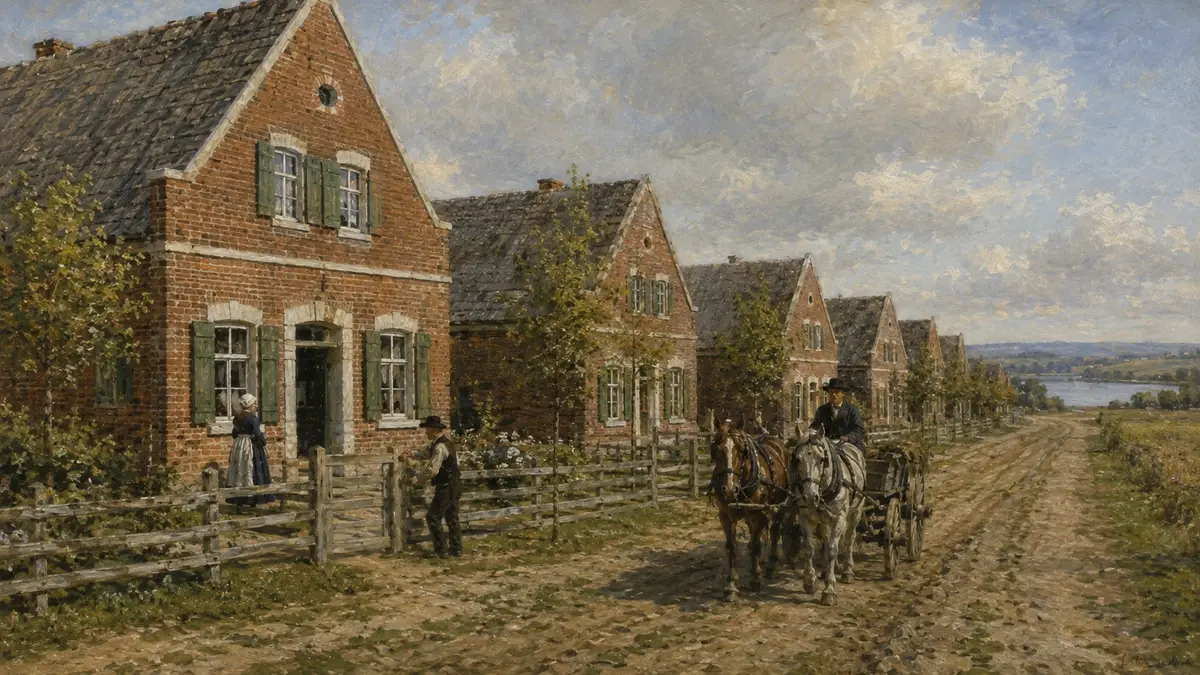
Villages like this one, built by settlers from West Prussia starting in 1789, grew into a prosperous farming and manufacturing community along the Dnieper River.
Then the Revolution happened, and prosperity became a liability. Estates were seized, owners called kulaks. During the Civil War, anti-Tsarist anarchist forces under Nestor Makhno regarded Mennonites as a privileged class, foreigners, and killed hundreds of Mennonite men, women and children. Open practice of the religion was a crime. Between 1874 and 1880, when military draft exemption was first threatened, about 16,000 of the approximately 45,000 Mennonites had left for America - 9,000 for Kansas and Nebraska, 7,000 for Manitoba. After 1917 the remaining ones either fled or waited.
Mennonites and the Holocaust
This is the subject Mennonite authorities were slow to confront, and where the most serious debate remains.
When the German army invaded the Soviet Union in 1941, about 35,000 Mennonites in Ukraine were caught inside Nazi Germany's territorial gains and welcomed the soldiers as liberators. This is understandable considering the circumstances, but not an excuse. The complication comes in the form of the Volksdeutsche, or ethnic Germans, who were classed with Jews as an undesirable element by the new authorities. Mennonite identity was considered a particularly good index of Aryan purity, and that had advantages. Many Mennonites were placed in administrative posts in the regions where they lived, and some joined auxiliary police units. Historians such as Doris Bergen of Toronto and the late Gerhard Rempel have described Mennonite involvement in atrocities committed against Jewish communities in the Black Sea area, ranging from collaboration to active perpetration. Others hid Jews and refused to cooperate, especially across the Netherlands. The latter is also true, and for about fifty years only the former was discussed.
The process of reckoning is ongoing. A conference in 2018 at Bethel College in Kansas, sponsored by the Mennonite Church USA, allowed twenty presenters to examine this fully. The complexity of the subject, rather than its evil simplicity, has always been its true interest. A large number of Mennonites were being deported, en masse, to Siberia and Kazakhstan at the same time, with accusations of collective guilt. Thousands of Mennonites had been shipped east before the war even began, unrelated to any of this.
Colonies, Soy, and the Amazon
Latin America is where the migration stream set its next bend, and where the controversy resides. In 1921 a Canadian delegation of Mennonites obtained a privilegium from the Mexican government, a formal assurance of non-interference, and about six thousand people moved from Manitoba and Saskatchewan into Durango and Chihuahua. From there the colonies spread to Paraguay, Bolivia, Belize, Brazil, Argentina and eventually Peru, still speaking the Low German dialect of Plautdietsch, carried out of the Vistula delta four centuries earlier.
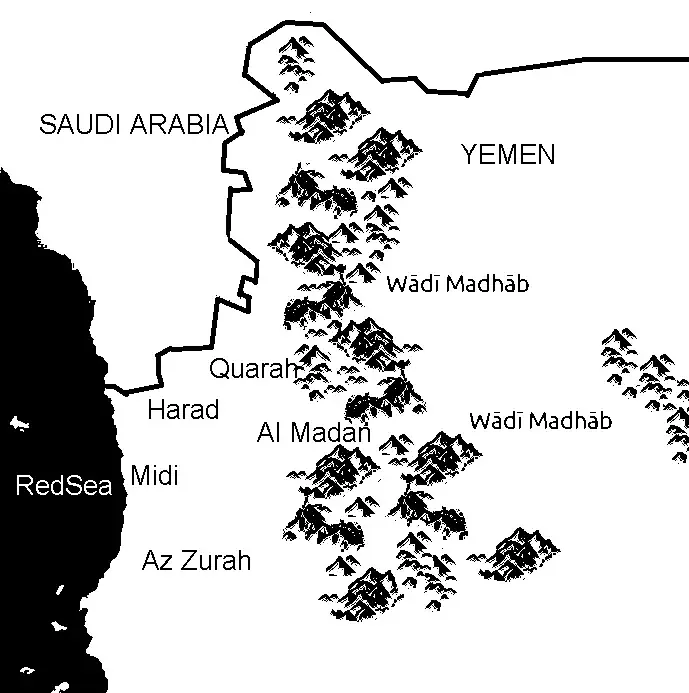
These colonies require land, and a great deal of it. The Amazon Conservation Association's monitoring program has identified Mennonite settlements as a substantial driver of forest loss in the Amazon basin. In the Peruvian Amazon, five colonies established since 2017 had logged more than 8,600 hectares by late 2024, with prosecutors looking into all of them. In Bolivia, Mennonite colonies were linked to about 211,000 hectares of soy-producing deforestation between 2001 and 2021 - about 23 percent of the total for those two decades, rising to a third in the last measured period. Mexican federal authorities have taken over properties and brought criminal charges regarding illegal logging throughout the Yucatán peninsula.
The irony is not lost on anybody. The Latin American governments were eager to attract these people, and they were chosen for their discipline. They farmed difficult land and produced surpluses. That is precisely what they did with the Amazon.
Where the Church Is Growing Now
The Mennonite World Conference, formed in Basel in 1925 on the four hundredth anniversary of that night in Zurich, currently has some 1.44 million baptized members in 61 countries. Zoom out to encompass the entire Anabaptist tradition and the number rises to about two million.
What is surprising about these figures is the breakdown. Roughly 84 percent of Mennonites today are African, Asian or Latin American. One of the largest national congregations in the history of the tradition is the Meserete Kristos Church in Ethiopia, made up almost entirely of converts. Meanwhile the Mennonite Church in the US has dropped from about 133,000 members in the late 1990s to 50,000 today.
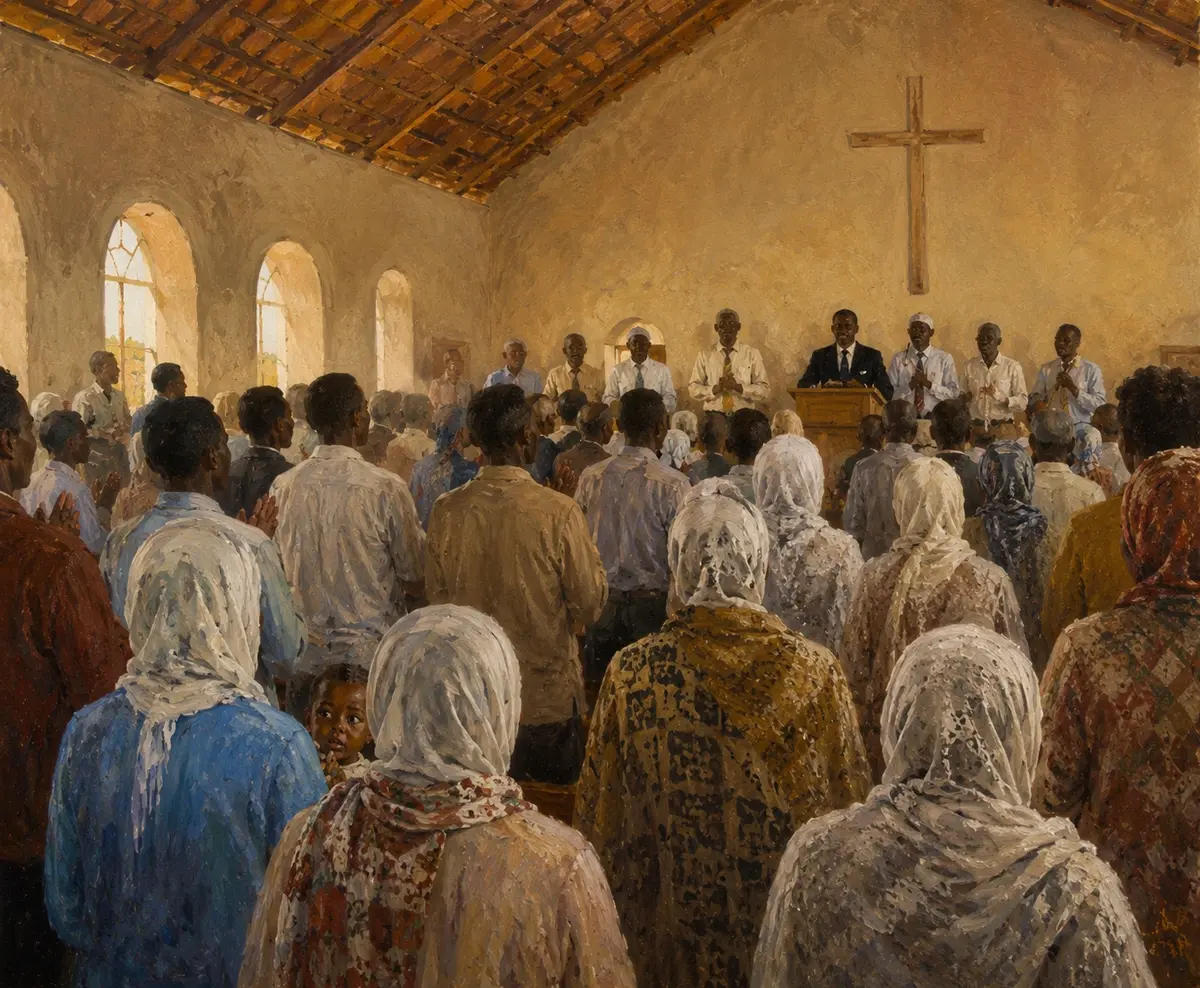
Now the largest single national body in the Mennonite World Conference, the Meserete Kristos Church grew out of persecution under Ethiopia's Marxist Derg regime rather than out of European heritage.
This leads neatly to the discussion that has always surrounded the Mennonites. There is an ongoing argument about whether "Mennonite" refers to a faith or an ethnicity, and it isn't just an academic argument. Families of Plautdietsch background in Manitoba or Chihuahua fit the latter description reasonably well, and an Ethiopian convert baptized last year fits the former. Historians and sociologists have classified the Mennonites as an ethno-religious group, and it has become increasingly difficult to do so.
Five centuries after fifteen men in Zurich poured water over each other's heads in a private home, the movement they began is strongest in countries these men would not have recognized, and weakest in the one where it began.