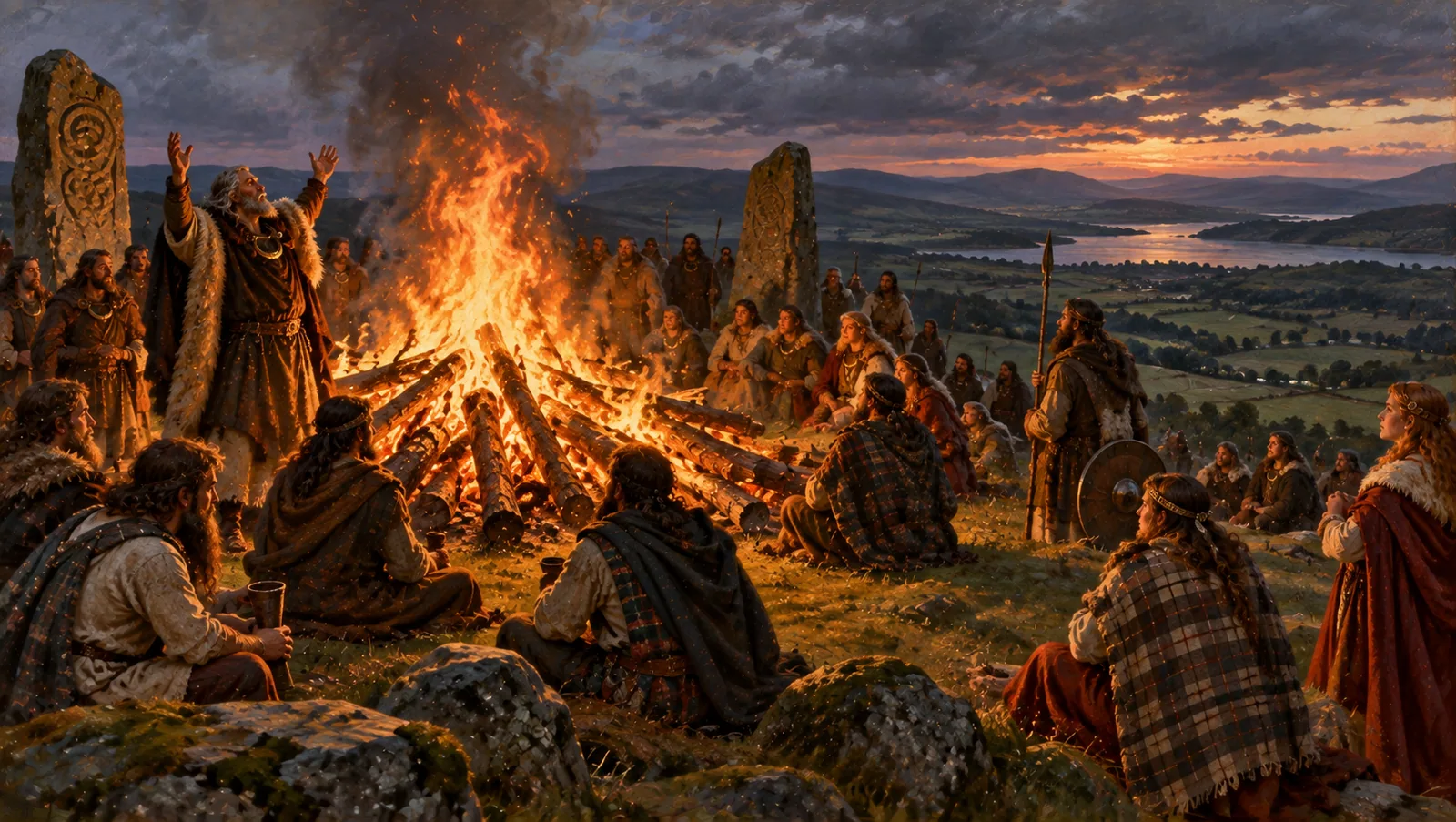
Hunter-gatherers ran the only economy our species ever operated for any length of time. Without fields, herds or harvested produce to speak of, diet was largely dictated by the surrounding environment and the nearest valley always had a call. It stretched from the appearance of the first recognisable stone implements to roughly 12,000 years ago, when agriculture began its spread.
Place that on the timeline and the proportions can be startling. The Palaeolithic takes up something like 99% of the history of our species' technology. All the cities, writing and agriculture we usually think of as civilisations, all that fits into the tail end.
The issues arise when people compress that, "hunter-gatherer" coming to be regarded as a specific way of life when it actually describes millions of years and a dozen or so human species. The people cracking open a bone with a sharp rock in Ethiopia and those painting a rhino on a cave wall in France are both hunter-gatherers but have about as much in common as a Roman legionary and a NASA engineer. The only fair way to approach it is chronologically, starting right at the beginning and noting what changes, and where the evidence gets thin.
What hunter-gatherer actually means
The definition is exactly what you'd think, these are cultures where people obtain the majority of their food by hunting, fishing, scavenging, or gathering wild plants, and anything else that might be edible. There are a few such communities left today but the ones that matter here are the prehistoric ones working this system long before someone thought to try growing plants.
They were small, a band of a few dozen people, usually including several families, working together and moving around as a single unit because the alternative was dying alone. All that depended on the food availability in the local region.
Beyond that generalisation, the variation sets in. The earliest hunter-gatherers were able to adapt to the conditions in a way that has almost nothing in common with cultures on the verge of agriculture, and the tools they used became increasingly specialised and effective at extracting calories from the landscape. It's the overall pattern of change that's important, following people through these transitions rather than looking for the one label everyone fits.
The Pleistocene and the Palaeolithic
Two labels cover roughly the same span, causing constant confusion. To geologists it's the Pleistocene, an epoch defined by the repeated glacial cycles we call the Ice Ages, extending from about 2.6 million years ago to 12,000 years ago. Archaeologists also use that same time period, but define it in terms of stone tool cultures rather than the weather.
That divides it into three: Lower or Early Palaeolithic from around 2.6 million to 250,000 years ago, when the oldest recognisable stone tools we've found appeared, Middle from 250,000 to 30,000, and Upper or Late from about 50,000 to 10,000, ending as the last Ice Age receded and agriculture developed. The breakpoints are approximate and the different cultures overlap, as different tool cultures persisted in some places while others moved on. Prehistory doesn't change over on a strict schedule.
Where the first hunter-gatherers lived
Our genus, Homo, evolved on the African continent, so it's no surprise this began there. Certain locations offered such good prospects that people kept coming back, long after any particular group had left. The Swartkrans Cave and Sterkfontein in southern Africa both show signs of multiple occupations.
The oldest tools we can confidently attribute to hunter-gatherers come from in or near Ethiopia, dating to around 2.6 million years ago. There's an earlier find at Lomekwi in Kenya, dated to 3.3 million years, which would predate our genus, but that's a disputed claim and the 700,000 year gap between it and anything else should make you cautious.
Lake Turkana in Kenya is another place where people kept turning up, long before us. Australopithecines lived there, the same broad category that includes Lucy, and they were followed by people for an extremely long period of time.
The Turkana basin has yielded hominin remains and stone tools spanning millions of years, making it one of the longest-running addresses in human prehistory.
Food supply set every other rule
The amount of food available, both plants and animals, dictated the numbers supported in any given area. Reliable sources meant people could settle down, develop techniques to store food, and defend their territory from anyone else who had the same idea. Unreliable sources meant the people had to move on, again and again. Neither was comfortable, terrain and weather were always hostile, and the local fauna had considerably better teeth and claws than any human was born with. That's why the band format persisted, several families working together and sharing the risks because on your own none of them could succeed.
How far early humans got
Distance is always the surprising element. Early bands of Homo erectus were likely among the first to leave Africa, about two million years ago, reaching as far as Eurasia and China and Indonesia by roughly 1.7 to 1.6 million years ago. Older finds in these same regions, tools made by species we can't positively identify, suggest early man's expansion was less orderly than a single wave of pioneers.
Europe was slower to accept people, the major mountain ranges remained impenetrable until around 700,000 years ago, usually credited to Homo heidelbergensis, and once through they made good progress. Neanderthals were to come out of this population, pushing into the Near East and part of Central Asia as far as the Altai region of Siberia, where the Denisovans also appear in the record. By the end of the Middle Palaeolithic almost all of the Old World was occupied, and then Insular Asia, Australia and the Americas followed during the final years of the Pleistocene.
Here's where it gets interesting. A non-genetic estimate places the total population during this period at around 500,000 individuals, which fits in well with more recent genetic results. Half a million people, spread across an entire planet. You could travel a very long way without encountering anyone.
Caves, hearths and the first real architecture
Most hunter-gatherers made use of naturally-occurring formations, overhanging rock faces to keep the wind and rain out. Caves were a particular favourite, as they allowed a living space to be created within, generally near the entrance to keep the daylight coming in. Open-air sites were used, but they were far less common.
Early settlements show no organisation, but throughout the Middle Palaeolithic this began to change, with areas set aside for specific tasks appearing. Hearths show up once fire was mastered, which we know from at least 400,000 years ago, and some of these sites include evidence for long-distance transport of materials, since certain types could only have come from 100 kilometres away. All the same, they remained reliant on natural shelters.
The Upper Palaeolithic is where things took a turn towards construction, with huts and tents being built on wooden supports, or frames of mammoth bones in some places, that were then lit by a hearth and divided into separate areas. Caves remained in use, both because they were good shelters and because they weren't available everywhere, and they were sought after by cave bears and cave lions, hence the names. And it's in the caves that the era's outstanding achievement is preserved, in the form of both Chauvet and Lascaux, located in what is now France. Art of this kind is an expression of symbolic thought and is part of the reason these later hunter-gatherers are considered to be fully modern humans.
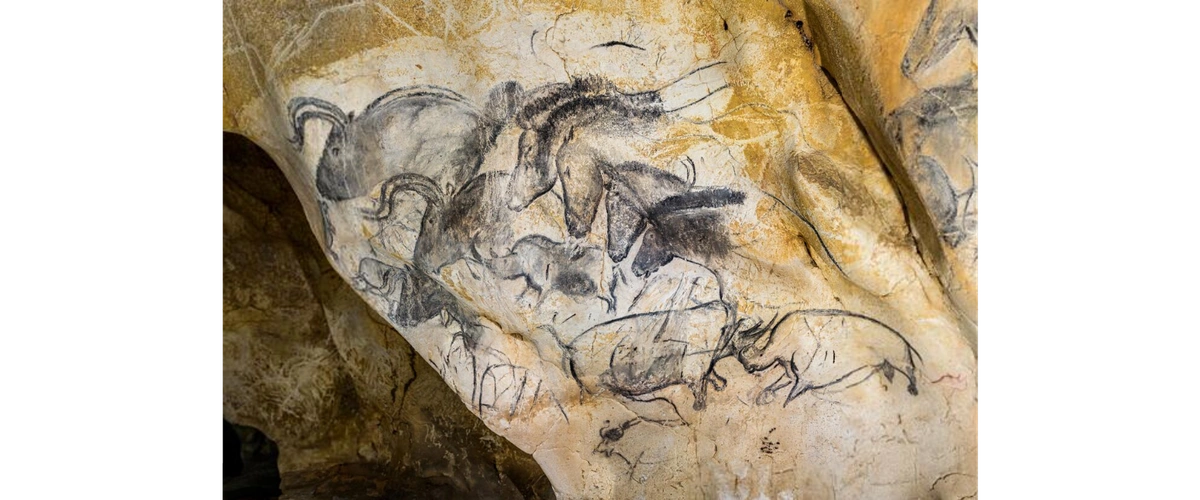
Chauvet's animal panels are among the oldest figurative art known, and the cave was sealed by a rockfall for roughly 21,000 years before its rediscovery in 1994.
What was on the menu
It's all about local conditions. Some groups specialised in hunting megafauna, the giant elk, the woolly mammoth, the woolly rhinoceros. Others focused on smaller prey or fished. And despite the name there's a very good chance, almost a certainty, that a decent amount of scavenging was involved.
The very earliest people in Africa wouldn't have been hunting anything as big as a mammoth. They lacked the tools to do so. They did eat meat, though, and that requires processing, which requires either strong teeth or strong tools, and human teeth were trending in the wrong direction. Molars had already become smaller in Homo rudolfensis than in their predecessors and the trend continued in Homo habilis and Homo erectus. Teeth reduced in size at the same time as the brain increased, which is what made possible the development of a truly omnivorous diet and the adaptability we see in people today.
Plants are harder to track, since plant matter rarely survives nearly as well as bone does, but a 2016 study of Gesher Benot Ya'aqov in Israel is unexpectedly helpful. About 780,000 years ago people there were eating 55 different types of food plant, representing seeds, nuts, fruits, vegetables and roots, which indicates a good understanding of the local ecology and its cycles. They ate meat and fish as well, and made use of fire in their preparation, which is unusually early given that cooking does not appear to have become widespread until around 500,000 to 400,000 years ago.
Later groups could get more densely packed, competition encouraged the hunters to expand their prey base, but the preferences remained the same, medium and large deer, horses and bovids like bison and gazelle. Larger animals of all sorts are always the most valuable, to feed a band of active adults, and the Late Pleistocene was the period to be in, from roughly 120,000 to 10,000 years ago, across Eurasia and into eastern Siberia. This area supported an amazing variety of large mammals, known collectively as the Mammoth complex, including mammoth, woolly rhinoceros, Lena horse, bison. Neanderthals made the best use of it, with a substantial portion of their diet made up of mammoth and rhino along with bison, wild cattle, reindeer, ibex and wild boar. But legumes, grasses, fruits, seeds and nuts also featured heavily, as they did for most hunter-gatherers. The old view of the Neanderthal as a near-exclusive carnivore has been dead for a while.
One find changes our understanding of the sophistication of late hunter-gatherers. At Shubayqa 1 in northeastern Jordan, archaeologists investigating a stone-lined hearth found fragments of an unleavened bread dating to around 14,400 years ago. Bread, created by hunter-gatherers, roughly 4,000 years before agriculture came to the region.
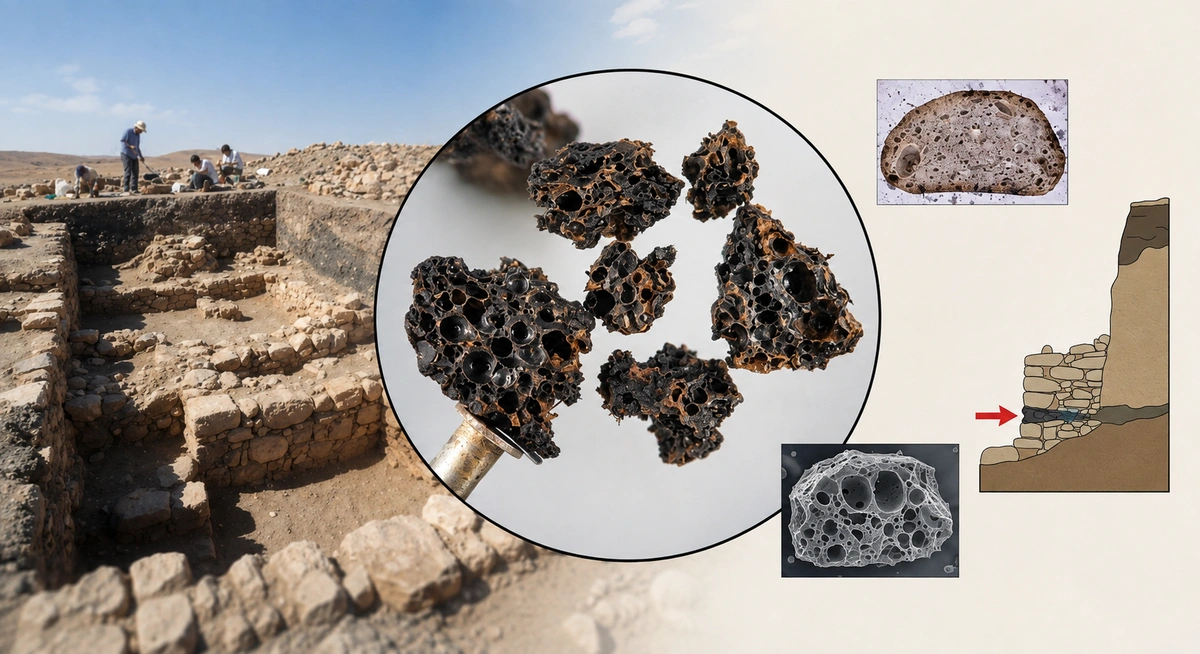
Charred crumbs from two fireplaces at Shubayqa 1 are the oldest direct evidence of bread anywhere, baked by Natufian foragers who had no farms.
Stone tools, and one German site that got rewritten
A caveat, the categories we use for ancient tools are broad groupings meant for our convenience. Tools had to work in their immediate environment and were made from what that environment provided, nobody was following trends.
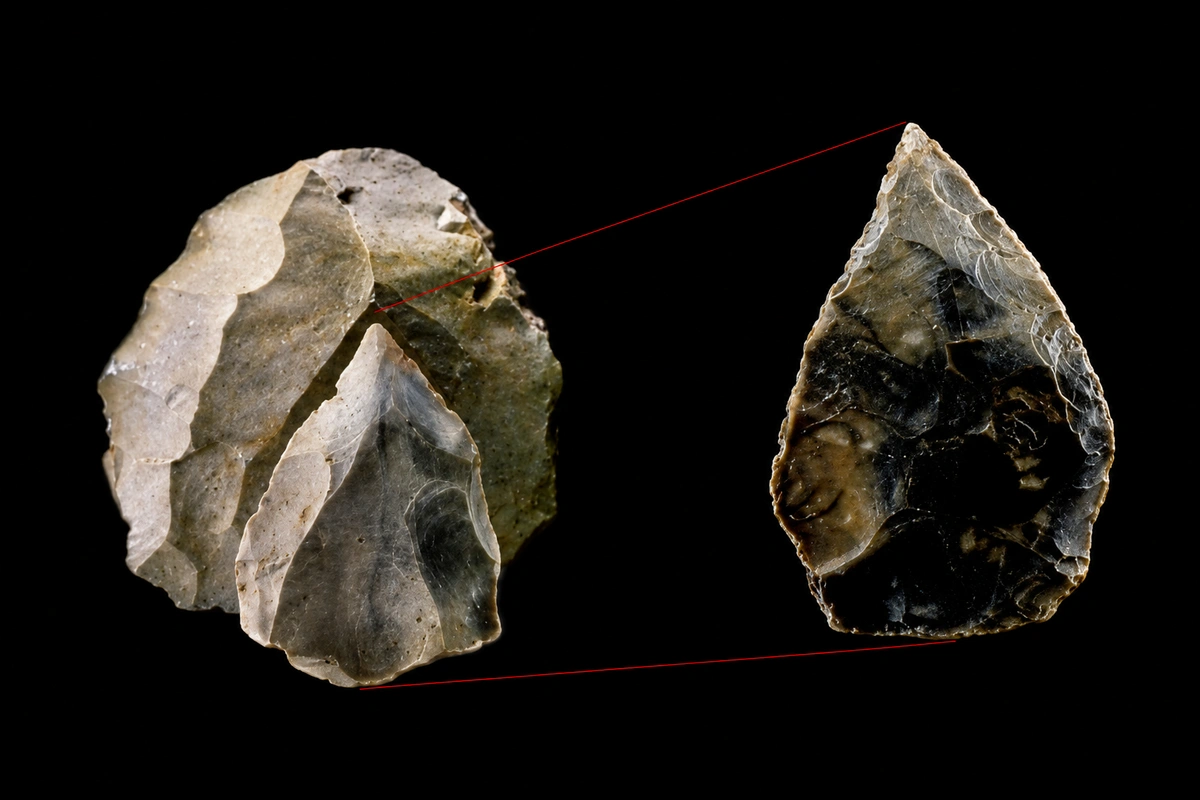
The progression begins with the Oldowan, dating from around 2.6 million years ago and continuing until roughly a million. Simple stone cores are used as choppers and hammerstones along with retouched flake scrapers, cutting meat from carcasses, opening bones to get at the marrow, and working on plants and seeds. This is the toolkit that Homo erectus carried with them when they left Africa and went to Asia. Meanwhile back home the Acheulean was developing, from about 1.7 million to 250,000 years ago, and with it large bifaces, hand axes, picks, and cleavers. Wood that old almost never survives but a northern European site suggests wooden tools were an important part of the equipment.

The Acheulean hand axe stayed in production for well over a million years, one of the longest-lived designs in the human record.
Homo heidelbergensis managed to get everywhere, appearing around 700,000 years ago in Africa and reaching as far as present-day England by roughly 500,000 years ago. Which brings us to Schöningen, in Germany, one of the most important sites in the record and one that recently changed underneath us. Excavators found carefully-crafted wooden spears alongside flint tools and chips, and the target was still with them, numerous horse bones bearing cut marks. For years the site has been dated to at least 300,000 years old and assigned to heidelbergensis. A 2025 study in Science Advances redated the spear layer directly, using amino acid geochronology on the snail shells in the deposits, and found roughly 200,000 years, assigning the find to Neanderthals instead.
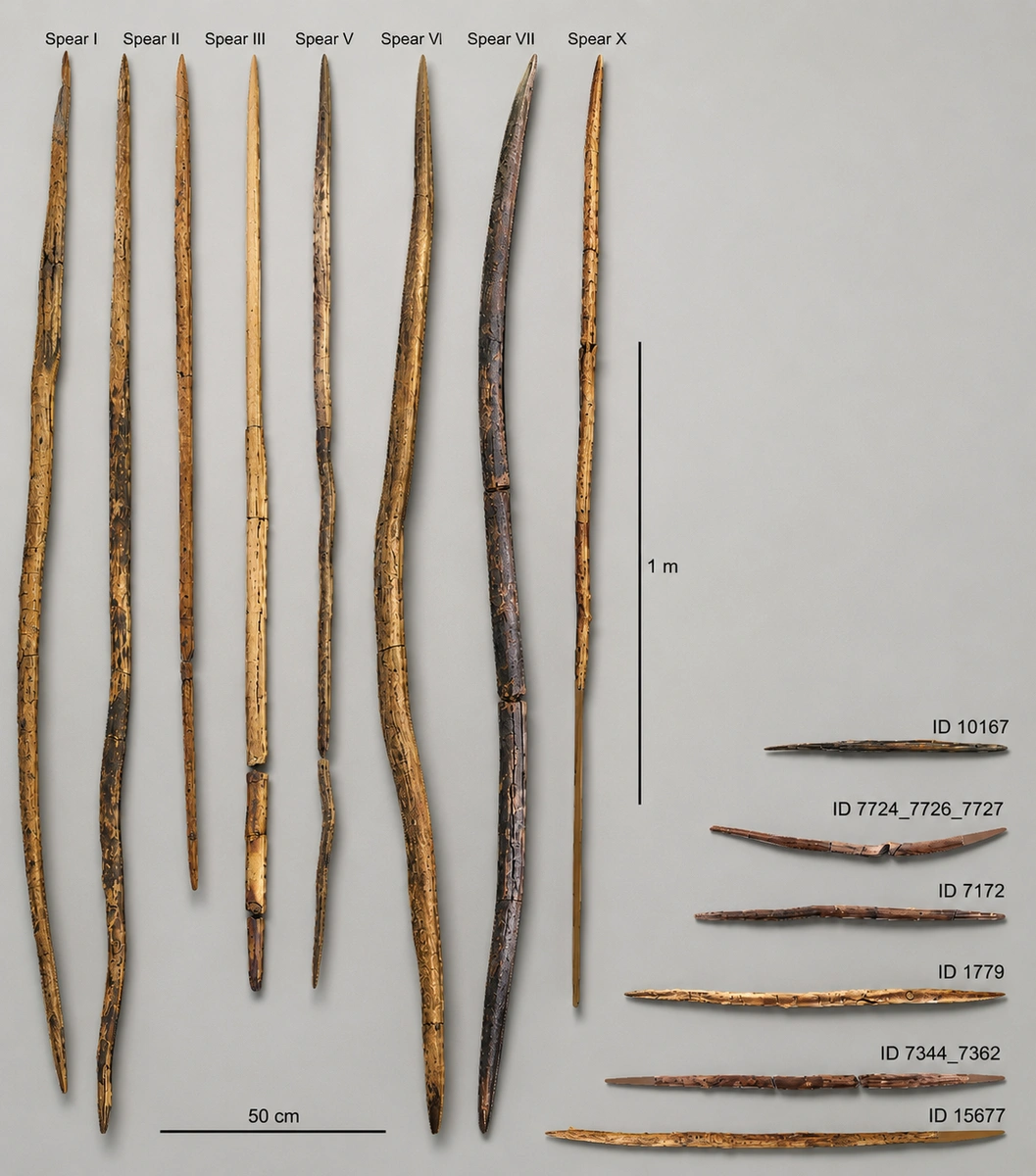
The Schöningen spears are the most complete Palaeolithic wooden hunting weapons ever recovered, preserved by waterlogged ground in a German lignite mine.
The date has changed, the importance hasn't. These are the earliest clear evidence of planned hunting, and systematically bringing down large animals is never something a group does by accident. Researchers have suggested the scene implies a high degree of cooperative behaviour, it's hard to argue otherwise.
The Middle Palaeolithic mostly elaborates on existing forms, scrapers, points and backed knives being created by Neanderthals and the earliest anatomically-modern humans, and then the Upper Palaeolithic opens up completely, with blade tools, worked bone, antler and ivory, and eventually spear throwers and bows and arrows. Stone industries become more varied at a regional level, an indication of increasing innovation and local cultures.
Fire did far more than keep people warm
Tools are important but fire is the element that changed everything. Warmth and protection are the obvious advantages, most wild animals have no interest in engaging with a fire. The longer-term change took more time to develop.
Our earliest evidence for hominin fire goes back more than a million years, around Lake Turkana there are signs from about 1.8 million years ago of reddened ground and heat-altered stones but no certain hearths, and these are rare on African open sites generally. That suggests people were taking advantage of natural fires, burning grasslands or the aftermath of a lightning strike, rather than making them themselves. It changes by at least 400,000 years ago, with unambiguous hearths appearing in Acheulean levels across Africa, the Middle East and Europe, and over the next 100,000 years habitual, deliberate use becomes apparent, including at open-air sites in southern France.
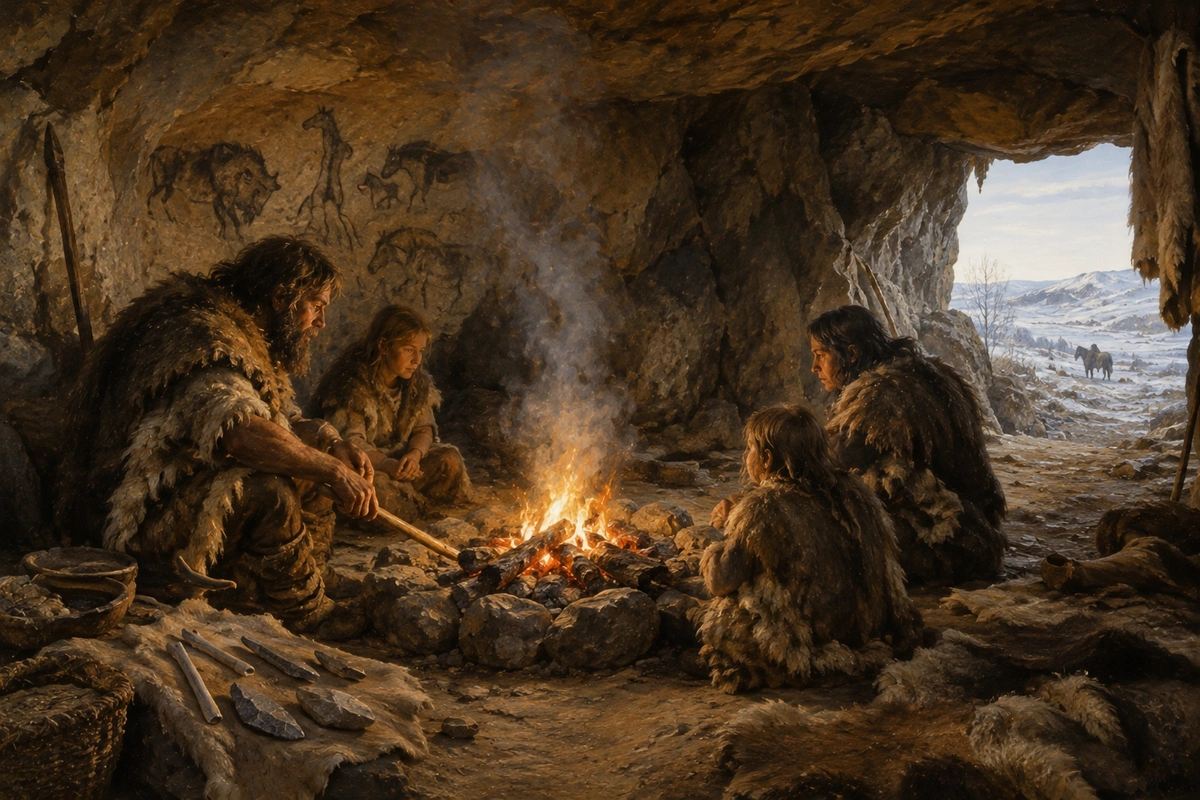
A maintained hearth is the clearest archaeological signature of controlled fire, and hearths become unambiguous in the record by around 400,000 years ago.
Cooking is the benefit, and remains rare until roughly 500,000 years ago. Cooking alters the texture and makes the food easier to digest, which allows for smaller teeth, a shorter digestive tract, and far less time spent on eating. The raw version is exceptionally taxing to get through, so the change was considerable even before the extra calories. Those calories represent another advantage to cooking as well, since they contribute to the resources needed for a growing brain. Large brains are always costly and require rich food, and bigger brains in turn produce better fire management and better hunting, which produce more food. The cycle feeds itself.
Fire alters the social rhythm as well, with light allowing the day to extend well past sunset. Larger groups are possible, as is the time to develop bonding behaviours that larger groups need. Modern humans stay awake nearly twice as long as many of our primate relatives.
Who hunted and who gathered
Older reference works will state it plainly, generally the men hunted and the women foraged. It's the default assumption and the evidence supporting it from the deep past is much thinner than it appears.
Recent work has challenged this considerably. A 2023 study in PLOS ONE by Abigail Anderson, Cara Wall-Scheffler and colleagues surveyed the ethnographic record and reported that women hunt intentionally in the large majority of foraging societies with clear descriptions of hunting practice. Sarah Lacy and Cara Ocobock have made similar arguments from the archaeological side, citing tools, diet, burials and anatomy that don't fit neatly into male and female.
The response has been equally forceful, with critics arguing that the 2023 survey contains methodological problems that bias the results, and that flexible but genuine gendered division of labour in foraging societies represents one of the better-documented findings in the field.
Both sides cannot be correct and the argument remains open. What is safe to say is that the neat division represented in most of our textbooks is not a settled finding, and anyone who presents it as such has ignored an ongoing debate.
Sharing, meeting places and the arrival of language
A group that shares a living space, organises it, and works at keeping everybody alive, is by definition engaging in social behaviour. Research suggests network structures appeared at an early date, beyond just the family unit and involving non-kin, and this encouraged cooperation to become more intense over time.
The Schöningen hunters are a good example, as are Boxgrove and Arago. If those groups ended up with large quantities of meat, which the evidence suggests they did, they had more than they could eat, presenting an opportunity to share or trade with neighbours, possibly at designated meeting places accessible to all.
Language is the final benchmark, and the one we can be least specific about. Across these societies communication evolved from whatever early hominins started with, through primitive language-like systems, to something that resembles what you're reading now. Its value is easiest to appreciate when you imagine the alternative, coordinating a hunt in detail, describing where a predator is standing, telling someone which slope had the berries on it, none of that is possible without it.
The exceptions are still out there
How many different species of Homo appear in the story is the best demonstration of just how varied hunter-gatherers really were. Different abilities, different drawbacks, different social structures, all spread across millions of years and most of the planet.
Nearly all of them eventually walked the same road to agriculture, but not every one. A few hunter-gatherer societies never turned that corner and are still around, a consideration to bear in mind the next time someone speaks of agriculture as an inevitability.