The Book of Jubilees, an almost forgotten writing of the end of the first millennium BCE, is a thoroughly exceptional find. Its very existence as a manuscript which almost none of the major early Christian and Jewish groups wanted to include in their canon, but which nonetheless kept surviving – and thriving – for hundreds of years from generation to generation adds to its mystery. This book of fifty chapters and over a thousand three hundred verses recounts Moses's receiving the instructions from angels on the mountain of Sinai to augment and explain the Torah, and was adopted as scripture by two small religious communities – the Ethiopian Orthodox Tewahedo Church and the Eritrean Orthodox Tewahedo Church, as well as by the Haymanot Judaism, and, for a brief period, was accepted elsewhere as well, despite the objections from the religious authorities. The Book of Jubilees was classically considered a pseudepigrapha which enjoyed wide popularity in its time, despite only several early Christian writers making specific mentions of it as scripture. The following paper will examine this piece of esoteric writing, discuss its contents, analyze the contradictions concerning its origins and the reasons why it was all but rejected, and speculate on its impact.
What the Book of Jubilees Claims to Be
The Book of Jubilees has a claim to be considered scripture, as it presents itself as revelations received from angels through Moses on the mountain of Sinai at the time of his receiving the Torah, intended as additions to the Torah so that it could better be observed by all pious Israelites. The source of its claims to being a second Torah seems to be the text itself, where it proclaims to record the entire division of days, weeks of years, and jubilees across all the years of the world, received from the angels during the time of Moses. Perhaps because of this claim, the later rabbinical authorities were opposed to it, despite some of them adopting its computations and its ideas, such as the chronology of history based on 7-day weeks and 7-year cycles, which are further expanded into 7 x 7 = 49-year jubilee cycles. Indeed, following this system of numeration, the text computes the total number of years from the creation of the world to the receipt of the Torah by Moses on the mountain of Sinai to be fifty jubilees less the forty years spent by the Israelites wandering the desert, equal to 2410 years.
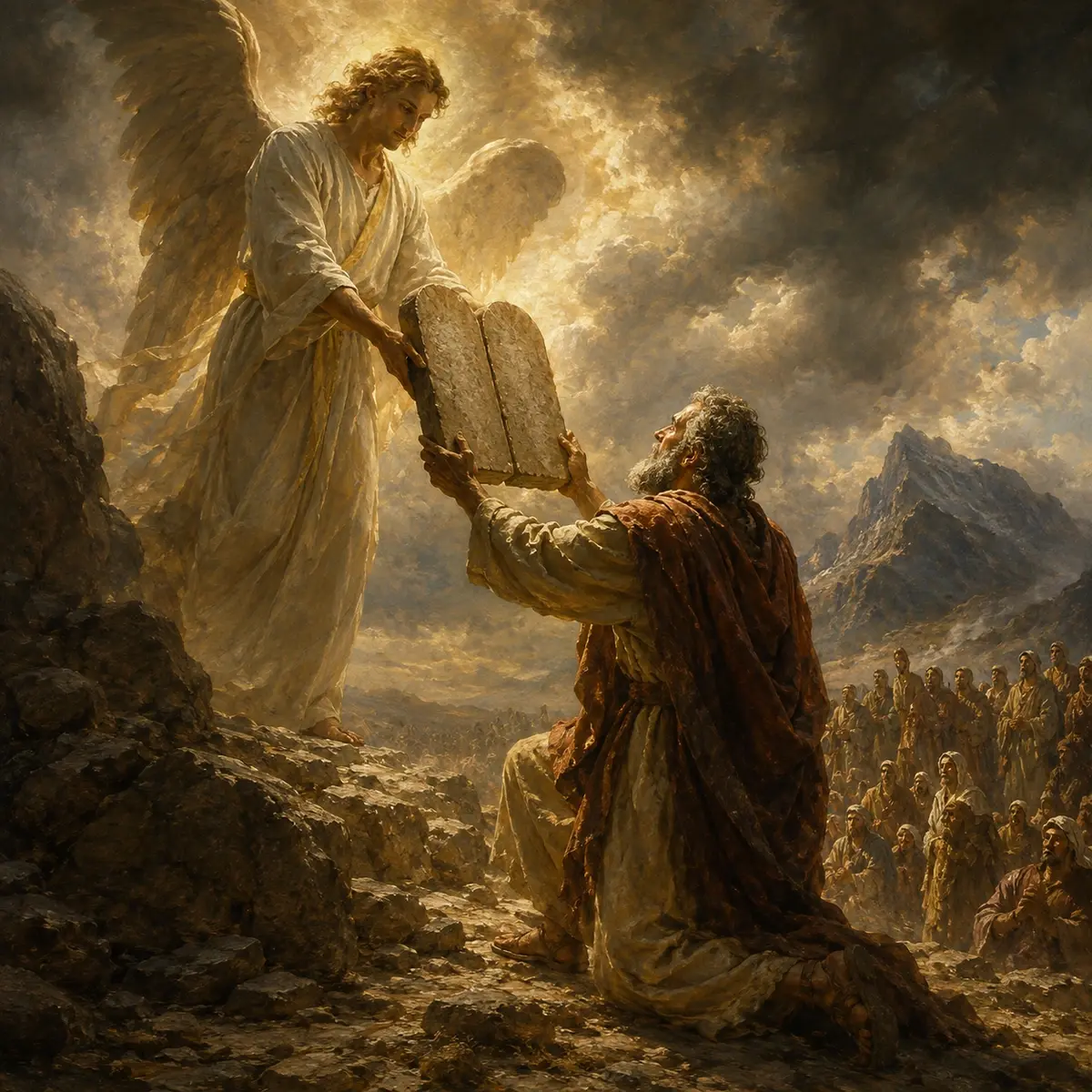
Jubilees presents itself as a second, angel-delivered revelation handed to Moses during this same forty-day stay on the mountain.
How the Book of Jubilees Survived
The text was almost entirely lost to early scholars, as prior to its discovery in the twentieth century in the Qumran caves there existed only a handful of manuscripts and isolated citations from it. The four Ge'ez manuscripts of the 15th and 16th centuries which survived until the modern time, as well as a handful of excerpts from its text by later authors, provide some insights into its content, as does the Latin fragment copied in the fifth century which contains approximately a quarter of the entire text. All this combined, however, is far from being enough to have allowed a full understanding of the work. Thus, the first impression of the book, which might have contributed to its slow acceptance or even rejection by various authorities, was not favorable.
The number of Ge'ez manuscripts has since been increased to twenty-seven, and the majority of them are used in the modern English translations of the Book of Jubilees. These manuscripts appear to be the primary source for the text of Jubilees, since neither the Masoretic nor the Septuagint tradition contains its chapters or verses. It is noteworthy that this state of affairs was noticed and commented upon by R. H. Charles, the scholar who was the first to analyze Jubilees in detail around the turn of the twentieth century, who concluded that the underlying Hebrew source text was otherwise unattested and not preserved anywhere else. Some later scholars went as far as postulating not one but three textual traditions of the Book of Jubilees, represented by the surviving fragments of the Babylonian, Palestinian, and proto-Masoretic texts, which were used by the authors of Jubilees as they compiled their text. This theory appears to explain the discrepancies between the manuscripts of Jubilees, the Masoretic Torah, and the Septuagint, as well as the presence of similar expressions in 1 Enoch, as the result of a free adaptation by the author.
The discovery of the scrolls in the Judaean desert provided additional support to this hypothesis. The 1947-1956 excavations yielded approximately fifteen Jubilees scrolls, which were found in five different caves, all of them written in Hebrew. This consistent use of Hebrew across every recovered copy is itself notable, since only the most dedicated students of the community that produced the scrolls would have been trained to read and copy it in that language. Only Psalms, Deuteronomy, Isaiah, Genesis, and Exodus possess more scrolls than Jubilees, representing this community's devotion to the Torah, as well as their interest in the Psalms and other ritual texts. The comparison of the Hebrew scrolls' fragmentary verses to their Ge'ez counterparts made by James VanderKam appears to confirm the accuracy of the Ethiopic version.
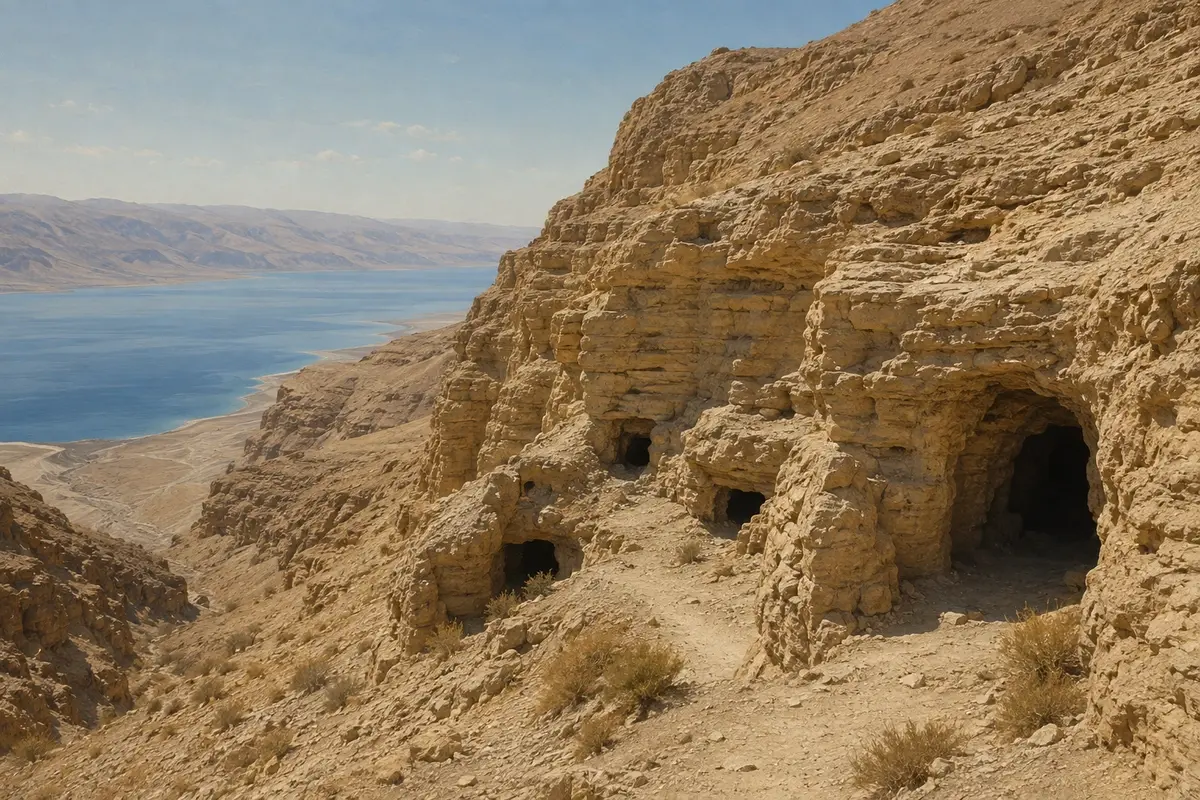
Roughly fifteen Hebrew copies of Jubilees, spread across five of these caves, made it one of the best-attested texts found at Qumran.
Who Really Wrote the Book of Jubilees
R. H. Charles was also the first scholar to attempt at determining the origins of the Book of Jubilees, and his conjectures concerning them, while partially supported by the following research, were eventually disproven. He suggested that it was a Pharisaic writing which drew inspiration from the Book of Chronicles and other books of the Hebrew Bible, utilizing the same kind of materials as the authors of these latter books had. However, the further archaeological discoveries, namely the finds in the Qumran caves, undermined his theory, as subsequent research pointed to the Essenes rather than the Pharisees as the group behind the scrolls. In twentieth century, the Book of Jubilees was largely rejected by the scholars as a Pharisaic writing, although the exact origins of the text still remained elusive. Later commentators attempted, with varying degrees of success, to associate Jubilees with either the Zadokian priests, the Qumran community, or the Pharisaic tradition, which became the general agreement among the scholars for a brief period of time.
The dating of the book is similarly complex, and was performed using both external, historical evidence and internal linguistic observations. According to the latter, the earliest copies of Jubilees could have been written in approximately 100 BCE, while the analysis of the language used in the text suggests that it might have been written earlier. The book describes visions seen by Enoch, of both the past and the future, and mentions that his wife was named Edna. Similar phrasing can be found in the chapter entitled Animal Apocalypse, which is traditionally believed to have been written around 167 BCE and which describes the events of the Maccabean revolt. The debate over the relationship between the two texts, which followed until 2008, was eventually resolved in favor of the theory which held that Jubilees drew upon the Animal Apocalypse rather than the other way around. Modern scholars, including those who have contributed to the Oxford Annotated Bible, date the writing to approximately 160-150 BCE, while J. Amanda Guire suggests that it was written between 170 and 150 BCE and provides evidence for her claims. She argues that the author was likely to have been a Palestinian priest familiar with the Canaanite landscape and versed in Jewish legal traditions. Such a person would have been capable of producing a writing similar to Jubilees, with its extensive details concerning the Jewish ritual practices and festivals.
Angels, Giants, and the Watchers
The Book of Jubilees contains numerous additions to the account given in Genesis, which describe the creation of not only the world but also the angels as beings who serve the Lord on Earth and in Heaven, the divisions among them, and the ways in which they interact with men. Four classes of angels are mentioned within the text, including the angels of presence, sanctification, and personal angels, as well as the angels of the seasons. Furthermore, the Book of Jubilees is the source of the legend of Enoch being the first ever scribe in Israel to have received the Lord's commandments and who subsequently taught them to other people, including his sons, concerning the stars and their meanings.
The Book of Jubilees provides the details which are absent in Genesis concerning the Watchers, angels who descended to Earth to take the wives of men, and their sons, the giants called Nephilim and the Elioud. These offspring are presented as a corrupting, violent presence on the earth rather than a positive one, which is precisely why the text has God wipe them out in the great flood. The later Ethiopian traditions speak of the “angels” depicted in Jubilees to be the descendants of Seth and of the daughters of Cain, and this interpretation was shared by several early Christian authors, including Augustine and John Chrysostom. According to the view held in Ethiopia, God drowned the Nephilim in the Deluge, while leaving ten percent of their spirits to continue corrupting mankind. This teaching, which was largely rejected by later Judaism and Christianity, serves as another example of Jubilees's deviation from the accepted beliefs.
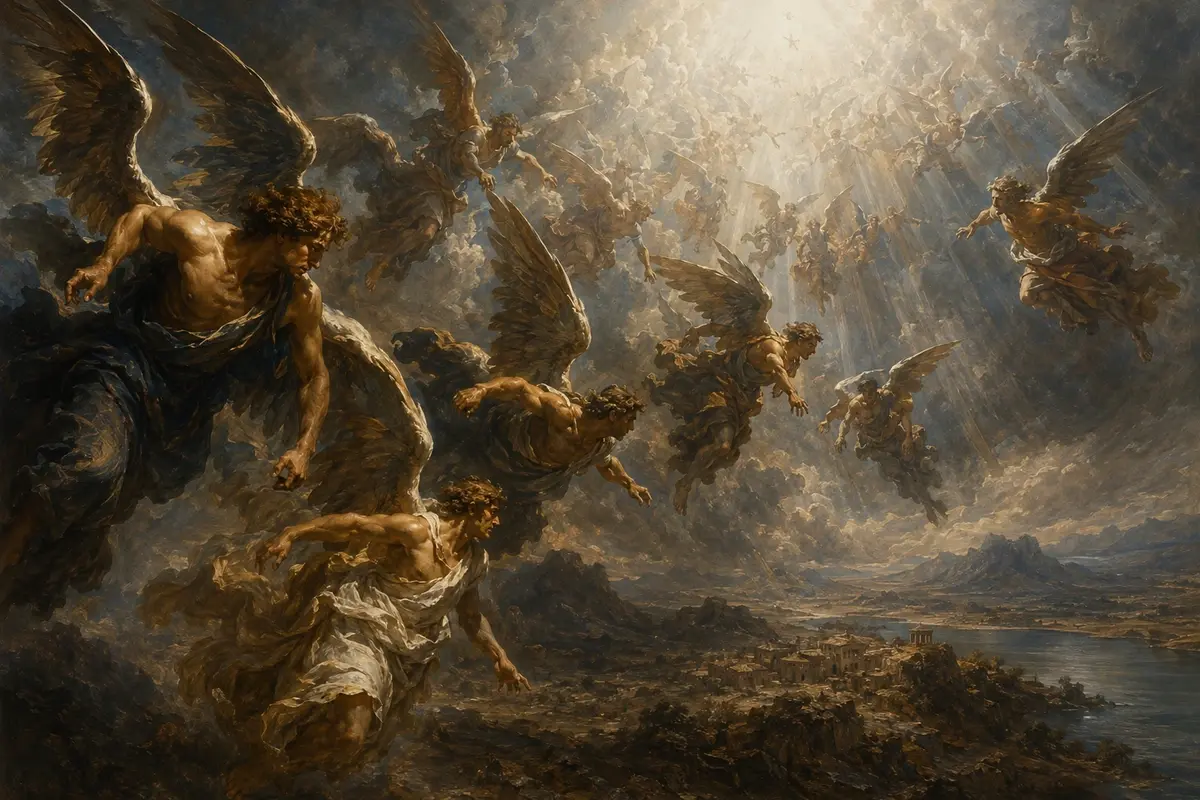
Jubilees expands Genesis with the story of the Watchers, whose union with human women produced the Nephilim later destroyed in the flood.
The 364-Day Calendar Jubilees Demanded
One of the themes which appears to have been of particular interest to the author of Jubilees was the Jewish solar calendar. He favored the 364-day year which consisted of four quarters of thirteen weeks each and strongly disapproved of the traditional lunar Jewish months, which were roughly ten days shorter. To reconcile the resulting gap, the author proposed counting two consecutive Sabbaths together as a single “double Sabbath” day, rather than dropping any Sabbaths from the count. The disagreements between the proponents of the solar and the lunar calendars were common in Second Temple Judaism, which is why this topic is known to have been of extreme religious importance. This might explain Jubilees's impact on later religious practices, as well as the interest in it displayed by priests who nonetheless chose not to adopt it. The Qumran community, which is known to have used a solar calendar, was among the few groups to have extensively utilized the Book of Jubilees, having both copied it and relied on its teachings.
Incest, Eden, and the Language of Heaven
Among Jubilees's other additions to the Biblical account of the early history of humanity are the descriptions of the events which are only hinted at in Genesis. They concern primarily the genealogies of Cain's and Seth's descendants, and particularly the marriages between siblings which were necessary for the survival of humanity. The Book of Jubilees explicitly states Cain to have married his sister Awan and Seth to have married his sister Azura. Additionally, the text says that Hebrew was the language spoken by Adam and all living creatures in Eden before the banishment, and that it was the angels who taught it to Abraham, who had forgotten it along with the rest of the ancient languages following the confusion at the Tower of Babel.
The Ten Trials of Abraham Explained
Another contribution of the Book of Jubilees to the Biblical traditions concerns the trials of Abraham, which are further developed in later Judaism and Islam. Jubilees itself states the number directly: in 19:8, it says Abraham endured ten trials and was found faithful in all of them, making this the earliest known reference to the tradition. The text does not spell out what all ten trials were, though, and later Jewish writings took up the task of filling in the list, starting with the Mishnah, which refers to Abraham's ten trials without specifying what they precisely consisted of, while the ninth-century Pirke De-Rabbi Eliezer attempts to provide a detailed list of all ten of them. Neither the ninth-century nor the earlier sources agree completely, and later medieval commentators, including Rashi in the eleventh century and Maimonides in the twelfth, were unable to settle on which ten events should be included in the list. This inconsistency further supports the view that Jubilees, despite being rejected, nonetheless contributed significantly to the development of the tradition surrounding Abraham's trials.
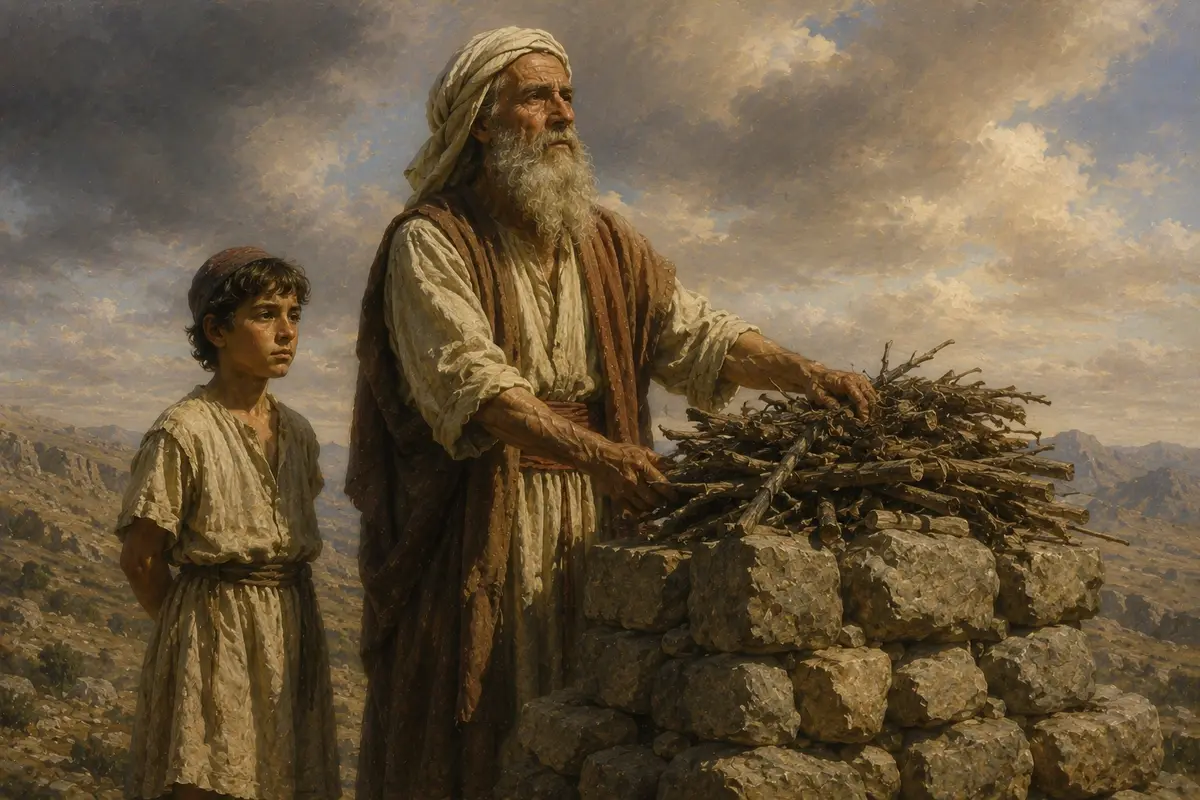
The Binding of Isaac is one of the few trials Jubilees does spell out, and it became one of the most reworked scenes in later Jewish commentary.
Jubilees' Hidden Influence on Jewish Texts
Despite claiming to be Moses's writing, the Book of Jubilees is absent from the early Jewish canon, and the later rabbinic writings make no mention of it or its author. There appear to be no direct references to Jubilees in the later Jewish writings, but the parallels which survive might point to a greater extent of influence than the historians used to believe. The scholar Zvi Ron has proposed to see in Jubilees an early form of the midrash which was later adapted by its interpreters to fit their needs. This hypothesis appears to have some grounds, as certain elements of Jubilees's narrative tradition survived in several later writings, including the Midrash Aggadah, where it is presented in a form similar to the episode with Enoch turning into Metatron.
Some of the most apparent similarities can be found in Midrash Tadshe, an eleventh-century writing which supposedly draws upon an earlier document attributed to the second-century rabbi Pinchas b. Jair. Related material appears in Bereshit Rabba, the fifth-century midrash on Genesis, as well as in the ninth-century Pirkei de-Rabbi Eliezer. The most remarkable of these parallels appears to be the tradition regarding the Binding of Isaac, which is also present in Bereshit Rabba. The scholar J. van Ruiten draws a connection between this story and the similar account in Jubilees 17:16, as well as in the 4Q225 scroll and the Biblical Antiquities by Philo. None of the later writers drew explicit connections between Jubilees and the stories which survived in the later traditions, but they were clearly influenced by it, either directly or through the writings that drew upon it.
How Christians and Muslims Received Jubilees
Early Christian writers were aware of the Book of Jubilees, and many of them cited it and treated it as an important, if non-canonical, source. It appears to have been the first source which gave early Christians the idea that the Torah was not written by God directly, but rather came to Moses via angels, an idea later echoed in Paul's Letter to the Galatians. The Ethiopic Christians translated the Book of Jubilees into the Ge'ez language, most likely before the sixth century, which explains both its presence there and the lack of it elsewhere. The Syriac Christians appear to have similarly embraced it, incorporating extracts from it into their writings. The tradition of writing about Jubilees continued among Syriac theologians for centuries afterward, beginning with the Cave of Treasures around the sixth or seventh century and continuing through the letters of Jacob of Edessa, the Catena Severi, and later still the writings of Michael the Syrian and Barhebraeus in the twelfth and thirteenth centuries.
The Book of Jubilees might also have influenced early Islamic traditions concerning Abraham's life and interactions with idols, which is suggested by Jan van Reeth. According to him, it appears to have served as one of the sources for later Islamic legends about Abraham, including the episode of his confronting his kinsmen regarding their polytheistic beliefs, which differs from what is suggested by the Book of Genesis. Etsuko Katsumata, comparing the two texts more closely, highlights real differences in how Abraham is portrayed: in the Quran he directly confronts idolatry among his own people without leaving his homeland, while in Jubilees he simply burns down a temple and departs, a distinction she connects to differing ideas about how each tradition expected converts to be won over.
Why This Rejected Book Still Matters
None of the early religious authorities canonized the Book of Jubilees, and the reasons for this are not difficult to guess, given the book's claims to be scripture and to amend the Torah. Nevertheless, the writer who compiled it was a serious person who sought to perform a great task: to mend the flaws in the Torah, to correct the mistakes in the books which Moses had written, to make these books more coherent, more comprehensible. The Book of Jubilees was not rejected but rather quietly laid aside by the early Christians and Jews who nonetheless found it useful. They translated it into other languages, commented upon it, expanded upon its teachings, and eventually forgot about it. The Book of Jubilees is an incredibly important document, one which served as the source of inspiration for later theological writings, but its true value lies in its being a testament to the devotion, faith, and the determination of the person who wrote it. As Donald Akenson notes in his discussion of the author, he or she was a pious person, one who had a great interest in scripture, was patient enough to compile this book, most likely on more than one occasion, and who, as Akenson puts it almost regretfully, sought to “correct the Books of Moses.”