Nok culture is the name of one of the mysterious findings in the history of West African anthropology. The culture is famous for its advanced level of artistic expression and mastery of blacksmithing that appeared in the region long before writing was invented there. It was previously believed that art and metallurgy developed in Africa as a result of foreign influence, but the Nok culture challenges this theory.
This culture is considered one of the most mysterious and unique ones in the history of humanity. Its fame is due to the fact that it is one of the few that feature both an extensive tradition of sculpture and iron metallurgy. West African Nok was the first to create sculptures made of terracotta and to develop the techniques of iron working in the region. These achievements distinguish it from other contemporary cultures. The culture thrived in modern Nigeria about the same period as the classical antiquity and the Warring States period in China.
What the Nok Culture Was
The culture's name derives from the Nigerian village of Nok, where the statues were first discovered. It is unknown exactly what this primitive culture called itself. Nok was widespread in the region of modern Nigeria between the 5th century BC and the 2nd century AD. It was located to the east of the Niger River and to the north of the Benue. The territory of Nok was relatively large and could have reached 78,000 km2. Many excavations in the 20th century revealed a wide variety of cultural-historical treasures. However, local conditions were quite diverse, so different areas of the culture had their own unique pottery, tools, and other artifacts.
Two significant discoveries are presented by the terracotta sculptures and artifacts made of iron. The local tradition of sculpture and metallurgy has long been the subject of scientific debate, but most scholars agree that these artifacts were local products. The combination of these two cultural elements distinguishes Nok from contemporary civilizations.
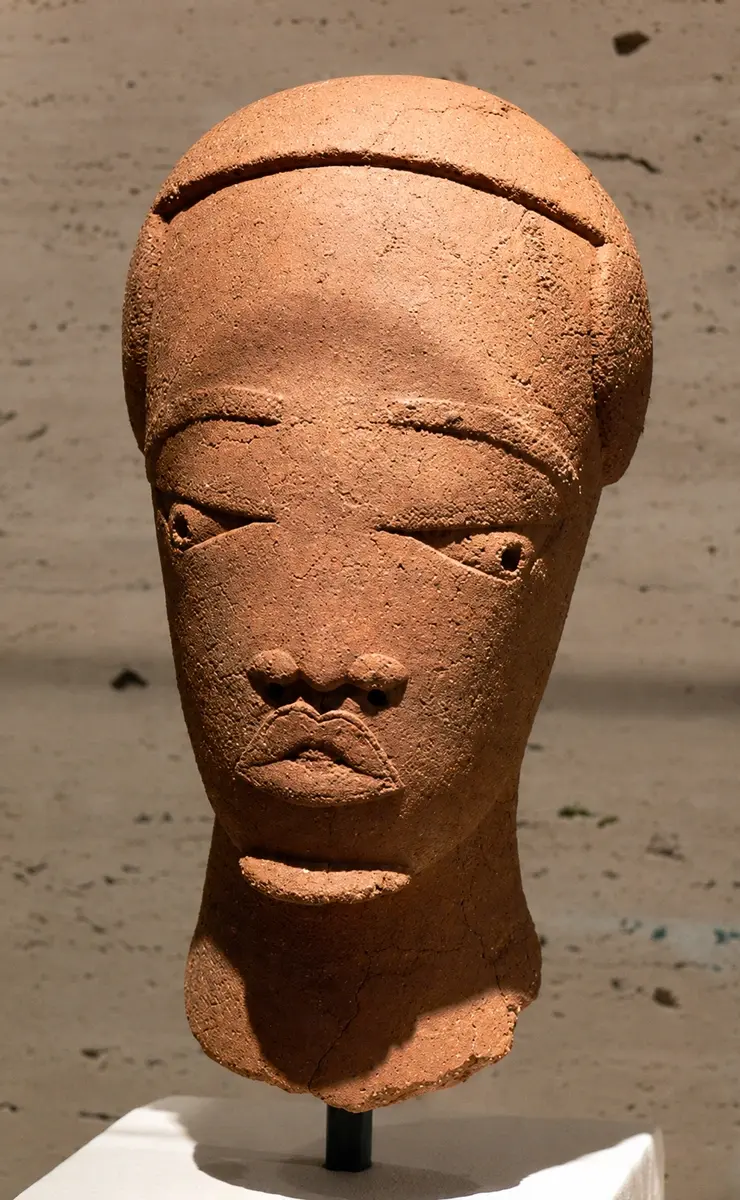
Nok sculptors gave their figures naturalistic vent holes at the eyes, nose, and mouth, letting trapped gases escape safely during firing.
Discovery History of the Nok Culture
The discovery of the culture was quite accidental. At the beginning of the 20th century, miners searching for tin deposits in central Nigeria began finding fragments of terracotta sculptures several meters below the surface. These finds were not sought after, as they were not considered valuable. Consequently, the integrity of the artifacts found was very low, and the location of the finds was poorly documented. It is challenging to determine their significance for the culture based on this scarce information.
More comprehensive excavations at the end of the twentieth century provided scientists with additional knowledge and artifacts from Nok. Fortunately, the finds were made in the settlements of the culture, so it was possible to study the way of life of its residents in detail. Nevertheless, most of the artifacts discovered in the mines were found fragmented. Excavations of settlement sites revealed the remains of huts, tools, and weapons, which helped scholars get a more complete picture of the culture.
Where Did the Nok Culture Get the Knowledge of Metallurgy?
The debate about the origin of metallurgy knowledge among the Nok residents has not been concluded yet. There are three main theories. According to the first hypothesis, the Nok people received the knowledge of working iron from Carthage across the Sahara. The second theory claims that the culture's ancestors brought the technology to the region from Nubia. This assumption seems more plausible because Nubia was within the capabilities of the Nok people at the time of the arrival of iron. The third version says that the residents of Nok invented the technology of iron working independently. Scholars have not been able to identify which of the proposed theories is true.
Most intriguing about the Nok culture is the fact that it is not known exactly what tools and technologies the residents used to work with iron. Researchers note that the local people managed to transfer from stone to iron, bypassing the bronze stage, which is unusual for the history of technology. Such assumptions allow scholars to make more interesting conclusions about this culture and its characteristics.
The Daily Life of the Nok People
The study of the daily life and material culture of the Nok people is based on the excavation of Taruga. This site is located 55 km to the southeast of Abuja. The radiocarbon dating of charcoal from pits found there indicates that this settlement was occupied between the 4th century BC and the 2nd century BC. Archaeologists have identified the remains of about 13 iron-smelting furnaces in Taruga. These findings indicate that iron working played a significant role in the local economy.
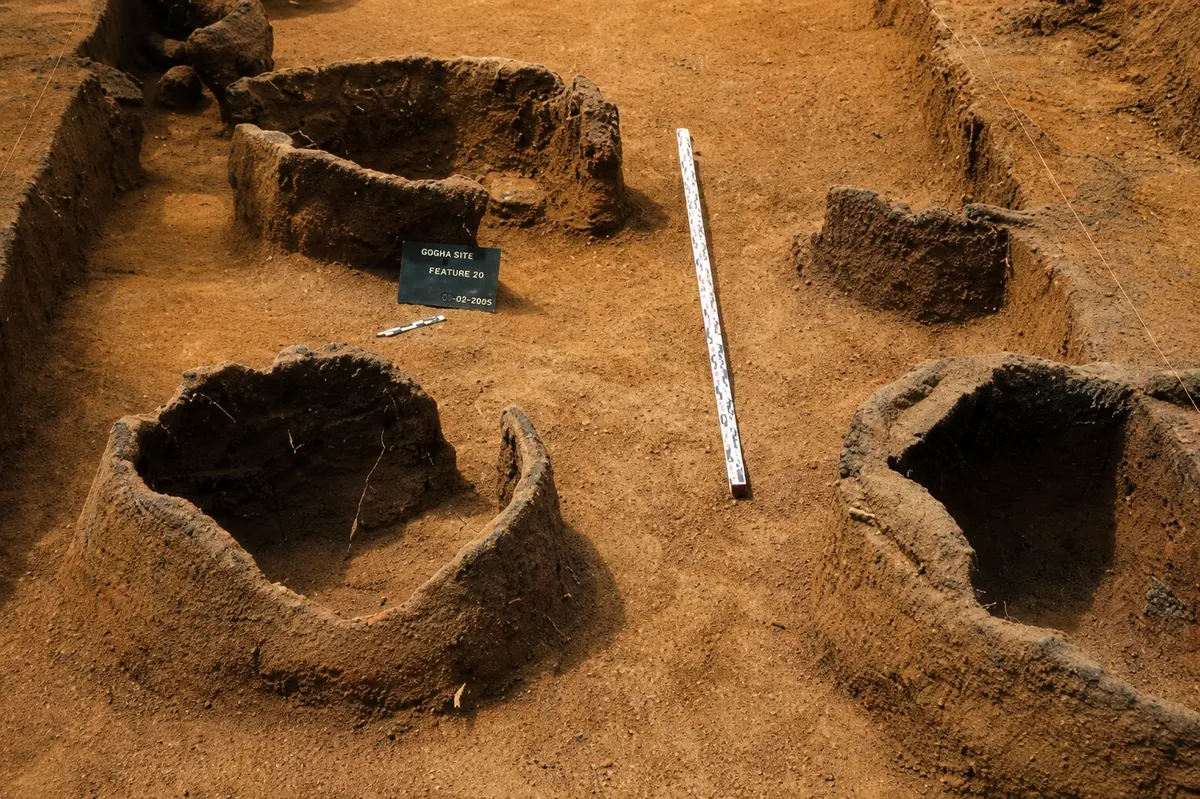
About 13 furnace remains have been identified at Taruga, the oldest known Nok settlement, showing how central iron production was to daily life there.
In addition to tools, the local people used various artifacts made of iron. Iron hoes, axes, and cleavers were essential to increase the productivity of individual farmers. They allowed the Nok people to grow more food and take care of their vegetable plots, where they grew pumpkins. The study of the settlement also found that the local people used stone tools. The use of this type of artifacts was seasonal, but it was quite significant for the Nok people. Stone continued to be used in the local settlement when it was more advantageous over iron, which indicates a shortage of the metal.
The local people built their houses using the wattle and daub technique, which is characteristic of the region. The preservation of wood is difficult in the local climate, which is why the finds of such houses are rare. However, the archaeologists were able to find the stone circles that were used as a base for the houses. In addition to the houses built on the stones, researchers note that the 21st-century excavations allowed determining another detail of the culture's history. New dating methods have allowed shifting the dating of the culture back by several centuries. Thus, there is a hypothesis that the Nok culture began earlier than previously thought and dates back to the late 10th century BC.
Warfare and Political Structure
The study of the Nok culture makes it possible to make quite surprising conclusions about the characteristics of the social structure of this culture. Excavations of the sites of this culture have yielded many artifacts made of stone and iron. Among the finds, archaeologists have identified a large number of different projectile points, among which are arrowheads and spearheads. The presence of these tools indicates that the Nok people were engaged in hostilities. Although the evidence does not point to an ancient centralized state, it allows speaking about the military opposition of the local communities.
Some scholars suggest that the culture's 78,000 km2 territory is too large to support one civilization. The differences in the pottery found in different parts of the culture suggest that there may have been several regional cultures. At the same time, however, the similarity of artifacts also indicates the common cultural traditions shared by all the local people. The debate about the unique character of the Nok culture continues to be unresolved.
The End of the Nok Culture
The reasons why the Nok culture declined and disappeared are unknown. The only assumption that archaeologists make is connected to the long period of local population growth. A reduction in the number of residents, triggered by such reasons, led to the localization of some cultural elements, such as specific types of pottery. This phenomenon can be used to predict the imminent end of the culture. Another reason for the decline of Nok might be the changed natural conditions. In fact, the desertification process could have been triggered by the prolonged dry season. In addition, the scholars have suggested that internal struggles might have significantly weakened the culture's development. Moreover, the appearance of strong neighboring states could have had an impact on the decline of Nok, as the Nok people might have been annexed by them. It is difficult to say exactly what caused the end of the Nok culture, since several different reasons could have been related. However, regardless of whether one or more of the proposed reasons apply, they were most probably the reason why the culture disappeared.
The Artistic Craftsmanship of the Terracotta Statues
The statues made by the Nok culture are among the most fascinating archaeological finds in the world. In fact, they are not only amazing ancient masterpieces but also present a great scientific interest. First of all, the process of baking the clay figures seems to have been complicated, as the air trapped inside the clay and the evaporated moisture could explode due to the high pressure. Thus, the fact that the Nok master managed to solve this problem indicates their skill and qualifications. Scholars suggest that they achieved the desired effect by equipping the figures with additional holes, the purpose of which was to expel the air from the inside. These holes imitated the shape of human eyes, nose, and mouth, thus, serving both a practical and aesthetic function. The small statues were made using a different method, as they could be baked without additional holes.
The detailed carving of the figures suggests that they were made using a special technique. It includes making various lines and patterns on the surface of the semi-hardened clay, as well as attaching jewelry to the figures. The archaeologists have found that most of the Nok statues were made using the method of baking on the pot. The base of the statue was made in the shape of an overturned pot. The researchers suppose that the Nok people might have used some kind of stand. The sitting figures always hold one knee above the other, with one hand resting on it. Interestingly, the famous French sculptor Auguste Rodin used a similar design for his sculpture The Thinker.
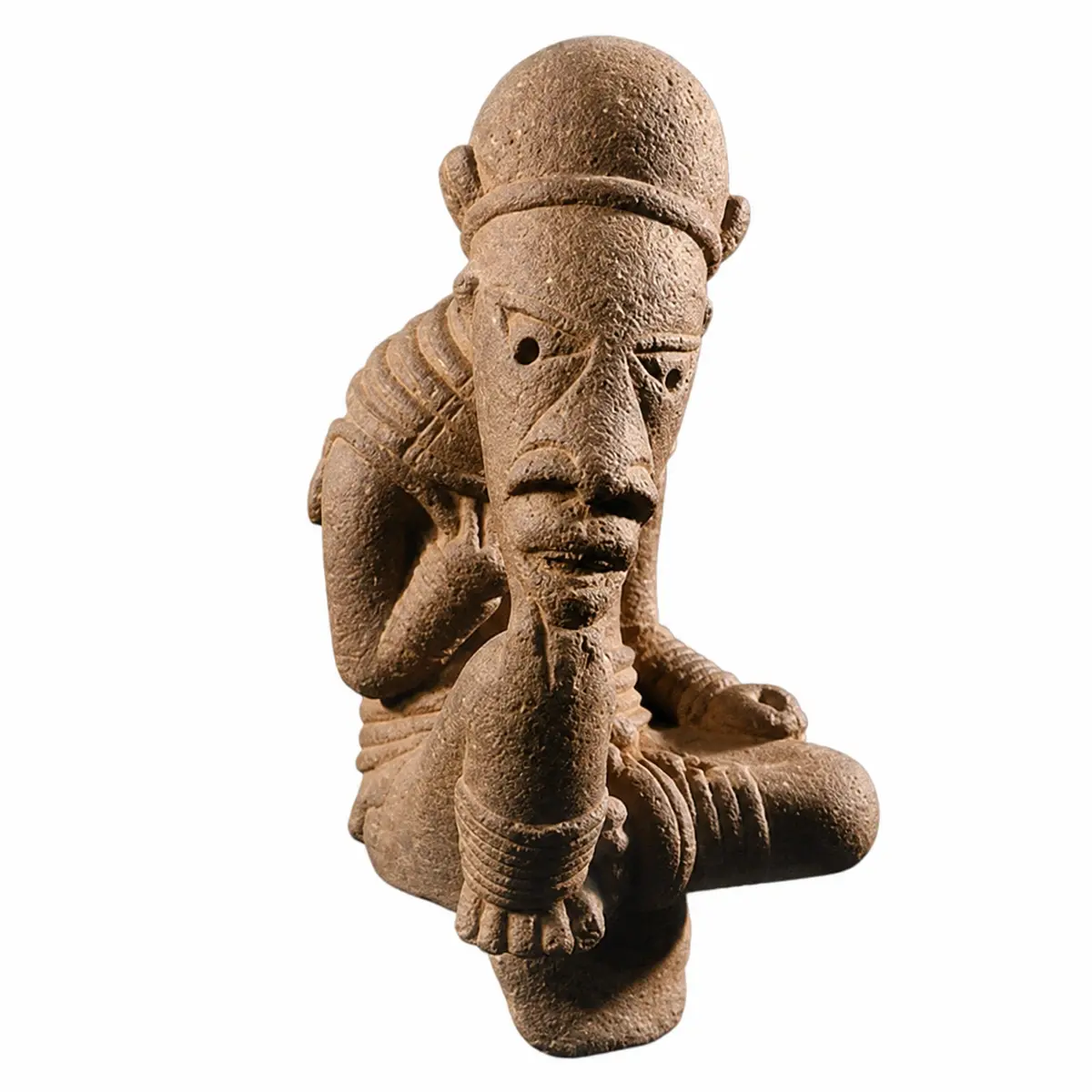
This seated pose, with one arm propped on a raised knee, recurs across Nok figures centuries before Auguste Rodin arrived at a similar composition for The Thinker.
The statuettes made in the Nok tradition mostly depict people involved in rituals. Some of the warriors carry weapons, but their weapons are not those used by soldiers. Most of the warriors wear unusual costumes with beads and pendants suggesting that the Nok warriors were dressed like ritual dancers. In addition, the male figures in the statues have a feature in common that can be seen in all of them – a short beard and a mustache that only grows on the corners of the mouth. These details indicate the presence of some kind of specific tradition in culture, which is a manifestation of the identity of the Nok people.
Among the finds of the Nok culture, there are also works of art that cannot be classified as human figures. Some of the statuettes were made in the style of anthropomorphic animals – either with birds' beaks, tails, and limbs or with an elephant's head, but with human eyes and foreheads. The meaning of such images is difficult to identify; thus, it is hard to say what the Nok people meant by creating them. However, their existence indicates that the Nok people developed a concept of anthropomorphic depictions long before similar artifacts appeared in other cultures.
Pottery Traditions and Possible Political Divisions
Local pottery is one of the most common artifacts found in the Nok culture. The vessels found are usually shallow bowls, which have a flat bottom and wavy edges, the inner surface of which is lined with grooves. The function of such pottery has not been finally clarified by scholars yet. However, there is a hypothesis suggesting that the groove served as a sieve when preparing various dishes. In addition to various sculptures and stone tools, the Nok people made numerous artifacts using the skills of local blacksmiths. Scholars have found that all clay artifacts found were made from a particular type of clay. Thus, these cultures had a unique tradition of pottery making that has not been identified by scientists yet. The fact that the use of this type of clay was not local suggests that it may have been used to manufacture artifacts for special purposes designated by local leaders.
The Cultural Legacy of the Nok Culture
The cultural-historical significance of the Nok culture is difficult to overestimate. Although written sources about this culture's history and social structure have not been discovered yet, scholars believe that there may have been a connection between different artistic traditions. In particular, art historians have suggested that the Nok tradition has influenced the later Igbo-Ukwu traditions. Igbo-Ukwu peaked in the 9th century AD and was followed by the Ife culture from the 11th to the 15th century AD. Thus, art historians assume that there is a unique artistic tradition dating back to the Nok period.
The Nok culture has also significantly contributed to the understanding of the history of sculpture. Prior to its discovery, it was believed that the traditions of portrait sculpture in West Africa began no earlier than the Ife culture. However, the discovery of the Nok culture significantly extended this tradition and demonstrated that it was known long before the Ife civilization. This assumption made it possible to revise some of the theories about the development of West African art and culture, which were based on partial data. In particular, the Nok findings provided scholars with new arguments refuting the claim that elements of sculpture in African societies were derived from foreign sources. However, the current state of research indicates that these assumptions are far from being definitive, as different scientists offer diverging theories at various times.
The study of the Nok culture is still ongoing, as new excavations continue to yield new artifacts that contribute to the understanding of this unique culture. The more such discoveries are made, the more questions arise about the nature and significance of this culture in history. Although it was once thought that the Nok culture had largely disappeared from the historical stage and was only found by chance in the early 20th century, new archaeological research continues to expand current knowledge of the Nok civilization.