Northern China fell to the Mongols between 1213 and 1215, and the sequence is worth following closely because it contains one of the clearest examples in history of a defensive decision destroying the thing it was meant to protect.
The state being invaded was the Jin empire, ruled by the Jurchen, which held the north; the Song held the south and were a separate country. In 1214 the Jin bought the Mongols off with a ransom and then, later the same year, moved their capital six hundred kilometres south to Kaifeng. The Mongols read the move as a breach of the agreement, came back, and took the abandoned capital in 1215.
What follows is grim in places and is not softened here. It also ends with an administrative question that matters more than any of the battles: what a conqueror actually does with a country once the fighting stops.
The Country Behind the Wall
The land the Mongols entered was populous, wealthy and unlike anything in their own experience. People lived by farming and practised manufacturing and mechanical crafts to a high standard. In place of open pasture the country was covered with cultivated fields, gardens, orchards and mulberry groves, with prosperous villages and busy towns across the whole of it.
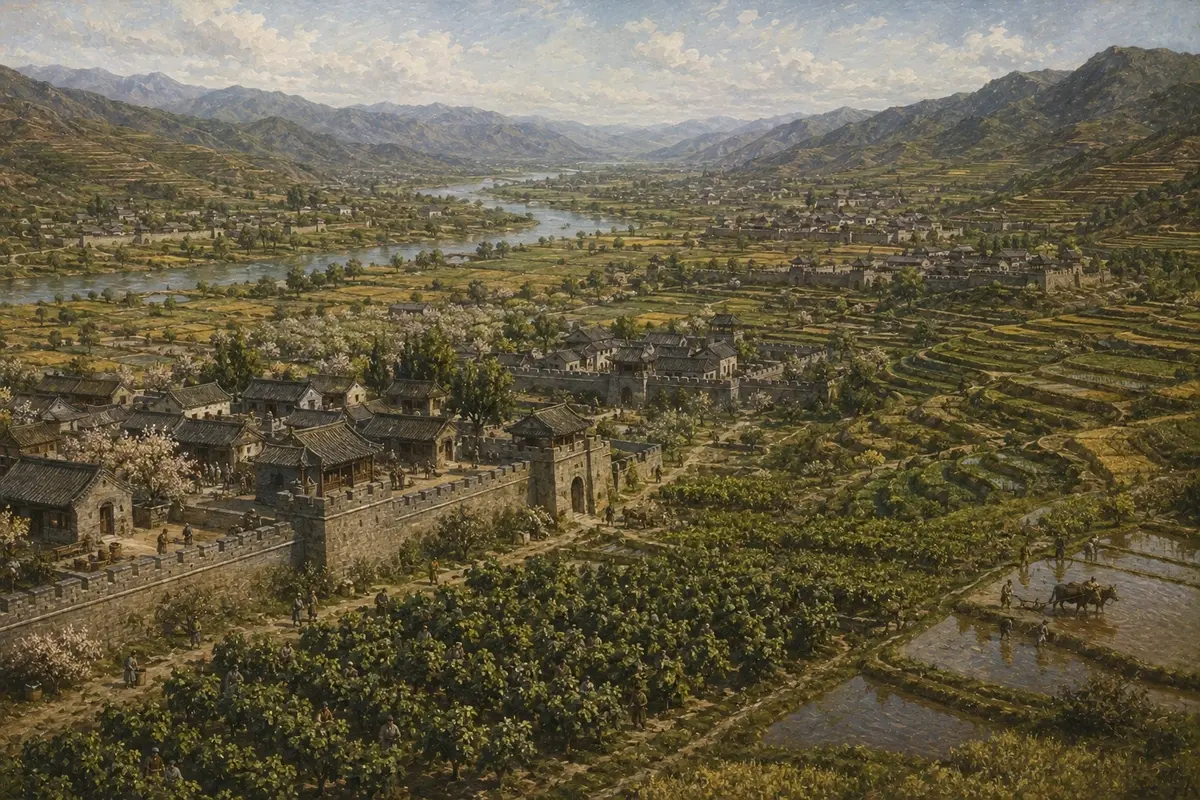
This was the country on the other side of the frontier: fields, workshops and walled towns, with almost no pasture in it.
The frontier defences existed to regulate that boundary, and for a long time they worked. What changed was not the wall but the other side of it. Nobody had previously combined the steppe confederations on a scale large enough to force the line, and by 1211 somebody had.
It is worth noting that the Jin were themselves a conquest dynasty of northern origin. They had destroyed the Khitan Liao empire in 1125 and were governing a Chinese population and a displaced Khitan one at the same time, which is why so much of the north changed sides so quickly once the Mongols were inside.
Through the Passes, 1213
The Mongols broke through the Juyong Pass and the Zijingkou gap by November 1213, and from then until the spring of 1214 they ranged across the entire north China plain in separate columns, each taking a different road and stripping a different district.
The Jin sent troops to hold the mountain passes and the river crossings and it made no difference. The invading army had been raised and equipped largely out of the plunder taken the year before, and the men had been promised a great deal more.
Something else had changed since the first invasion, and it mattered more than numbers. In 1211 the Mongols had been an army that could not take a walled city. By 1213 they had catapults and other siege equipment, and the engineers to work them, acquired from defectors and captured specialists. A steppe army that could only ride past fortified places had become one that could sit down in front of them.
The Order That Emptied the Villages
Then a defensive measure backfired completely. The emperor ordered every man capable of bearing arms in the villages and open country to report to the nearest city or fortress to be enrolled and equipped.
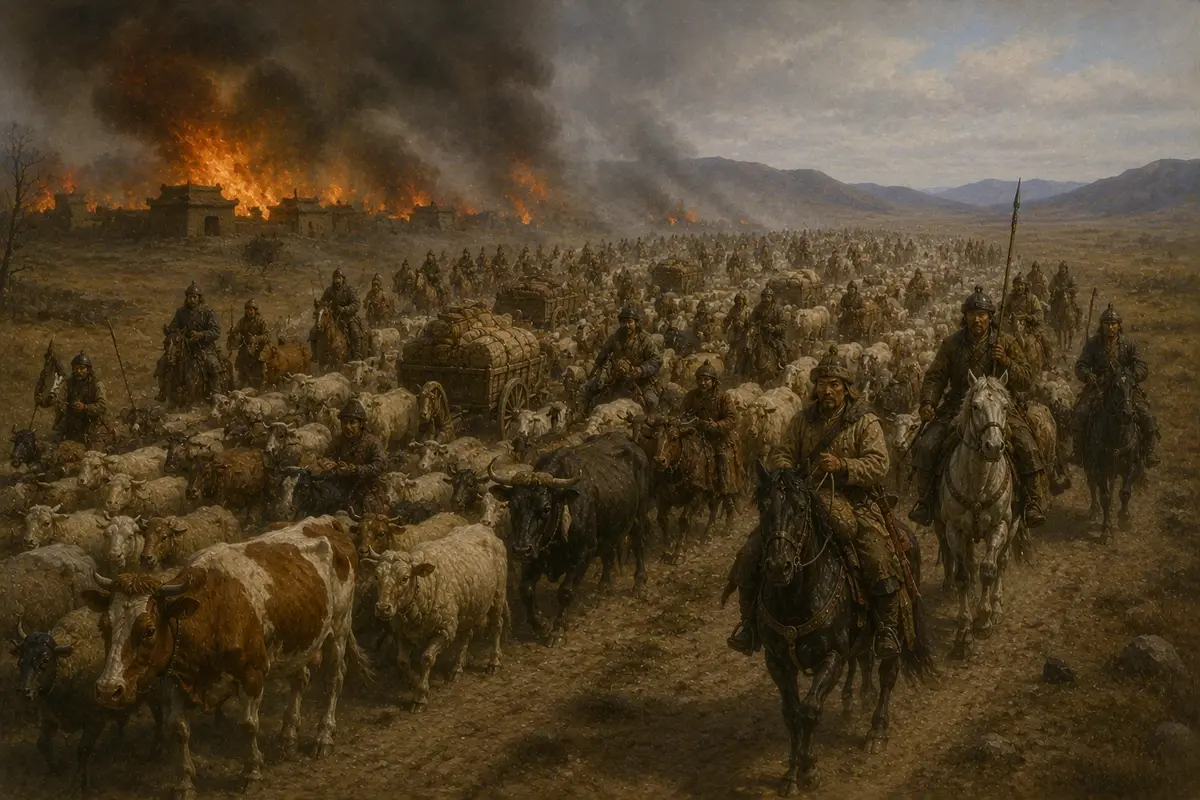
The order calling every able-bodied man into the fortresses left the countryside undefended and the herds unguarded.
The result was that the Mongols found the hamlets containing nobody but the elderly, the women and the children. They took those who could be sold, along with the gold, the silver, the silks and everything else portable. The haul in sheep and cattle was enormous and was driven north in immense herds. What could not be driven off was slaughtered to feed the army, and once a town had been stripped it was burned.
Captives Driven Ahead of the Assault
The use made of the prisoners should not be passed over quickly, because it was systematic rather than incidental.
Captives were driven ahead of the army to fill in moats, haul and work the siege equipment, and absorb arrows. At a fortified town they were placed in the front rank of the assault, positioned so that the men on the walls could not shoot at the attackers without killing their own families. In some accounts they were dressed as Mongol warriors so that defenders would spend their arrows on their own people before realising it.
Populations from the surrounding countryside were also driven into a besieged city deliberately, to exhaust its food faster.
None of this defeated a garrison's weapons. It defeated its willingness to use them, by making the correct military decision and the unbearable one the same decision. It sat inside a wider policy in which terror was an instrument: cities that resisted were destroyed and a few survivors were deliberately left alive to carry the news to the next town, which frequently then surrendered without a fight.
Why the North Changed Sides
The speed of the collapse is not explained by Mongol cavalry alone. The Jin were a Jurchen dynasty ruling a Khitan population they had conquered in 1125 and a Chinese one under that, and both had reasons of their own.
The Khitan went first. Suspecting they might side with the invaders, the Jin court had settled Jurchen colonist households among them so they would be outnumbered where they lived, and the policy produced exactly the revolt it was meant to prevent: their leader declared for Genghis Khan and proclaimed a revived Liao dynasty, taking Manchuria out of Jin control. Chinese and Khitan officers defected in numbers throughout the campaign, and several of them ended up commanding Mongol armies.
Rebellions broke out independently as well, including a rising in Shandong from 1214 whose men became known as the Red Coats. The Jin were fighting on several fronts at once, and most of the other fronts were internal.
The Ransom of 1214
In 1214 Genghis Khan encircled Zhongdu, the Jin central capital, on the site of modern Beijing. It was a massive and well-defended city, and although the Mongols twice broke into it they could not hold what they had taken. The siege dragged on for months until starvation inside the walls and disease on both sides brought everyone to the negotiating table.
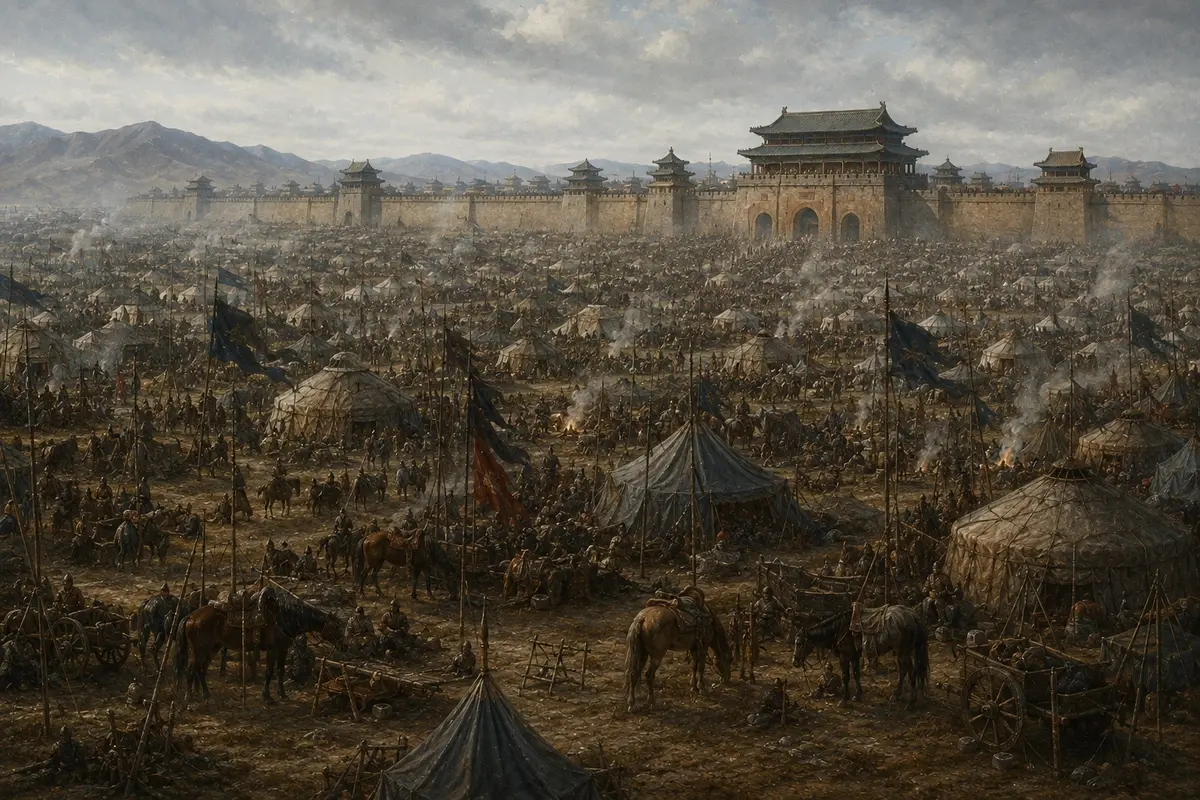
Rather than storm the walls, he offered to be bought off, and the court, having counted its options, paid.
So he offered to be bought off, and the court, after a hard argument in which some counsellors wanted the offer rejected outright, decided to pay. The case for paying was bleak and accurate: a failed defence meant total ruin, a successful one bought only a brief respite, and the garrison was made up largely of men brought in from the countryside who wanted nothing except to go and find out whether their families were alive.
The terms were a Jin princess, three thousand horses, five hundred slaves and large quantities of gold and silk. The princess was Qiguo, a daughter of Wanyan Yongji, the emperor who had been murdered by his own commander-in-chief the previous year. She went north as a concubine to the man her father had refused to submit to.
The negotiations on the Mongol side were handled by an envoy named Ja'far, who was rewarded afterwards with authority over the lands between the Yellow River and the Iron Gate. The Mongols withdrew in 1214.
The Court Moves to Kaifeng
The emperor did not feel safe, and his instinct was sound. A raiding enemy bought off with a ransom generally finds a reason to come back.
Later the same year he proposed moving the court south across the Yellow River to Kaifeng. His counsellors objected strongly, and the general Li Ying wanted to fight. If the emperor withdrew from the northern provinces, they argued, the north was lost beyond recovery.
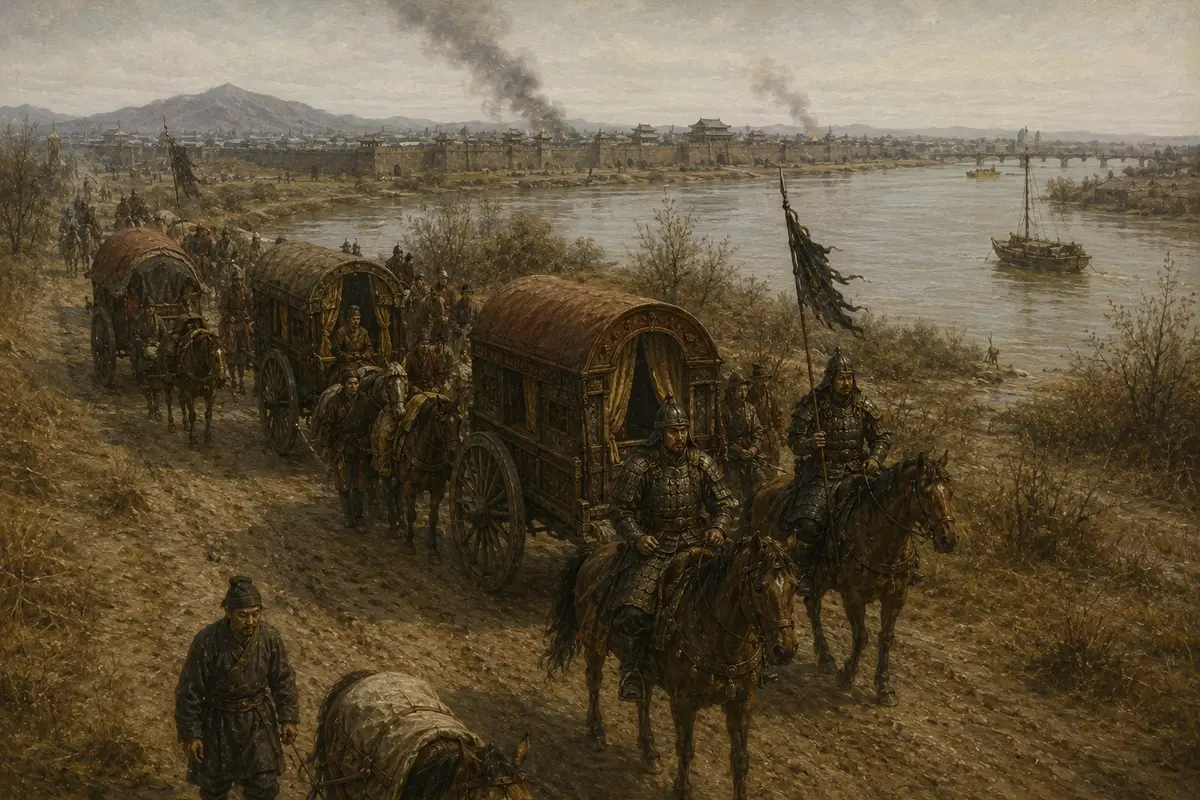
Six hundred kilometres south to Kaifeng, and the population read the move exactly as the Mongols did.
He went anyway, roughly six hundred kilometres, and the counsellors were proved right within a year. On the road one of his own armies defected to the Mongols and turned back to attack Zhongdu from the south, taking the Lugou Bridge. Genghis Khan treated the relocation as a breach of the terms just agreed, and the siege was renewed.
The Two Men Left to Hold the City
The court left the chancellor Wanyan Chenghui and the general Moran Jinzhong to garrison a capital its own emperor had abandoned, with no prospect of relief.
What the record preserves is a split between them, and it is the same split in every account. One of the two took his own life at his post rather than survive the surrender. The other got out, escaping to Kaifeng with his relatives and leaving the city to whatever came, and afterwards had to explain himself at a court that had done exactly the same thing on a larger scale.
The Fall, 31 May 1215
The second siege was a blockade rather than an assault, and it lasted close to a year. The city starved. Disease broke out among the besiegers too, and the Mongols suffered an epidemic of their own outside the walls.
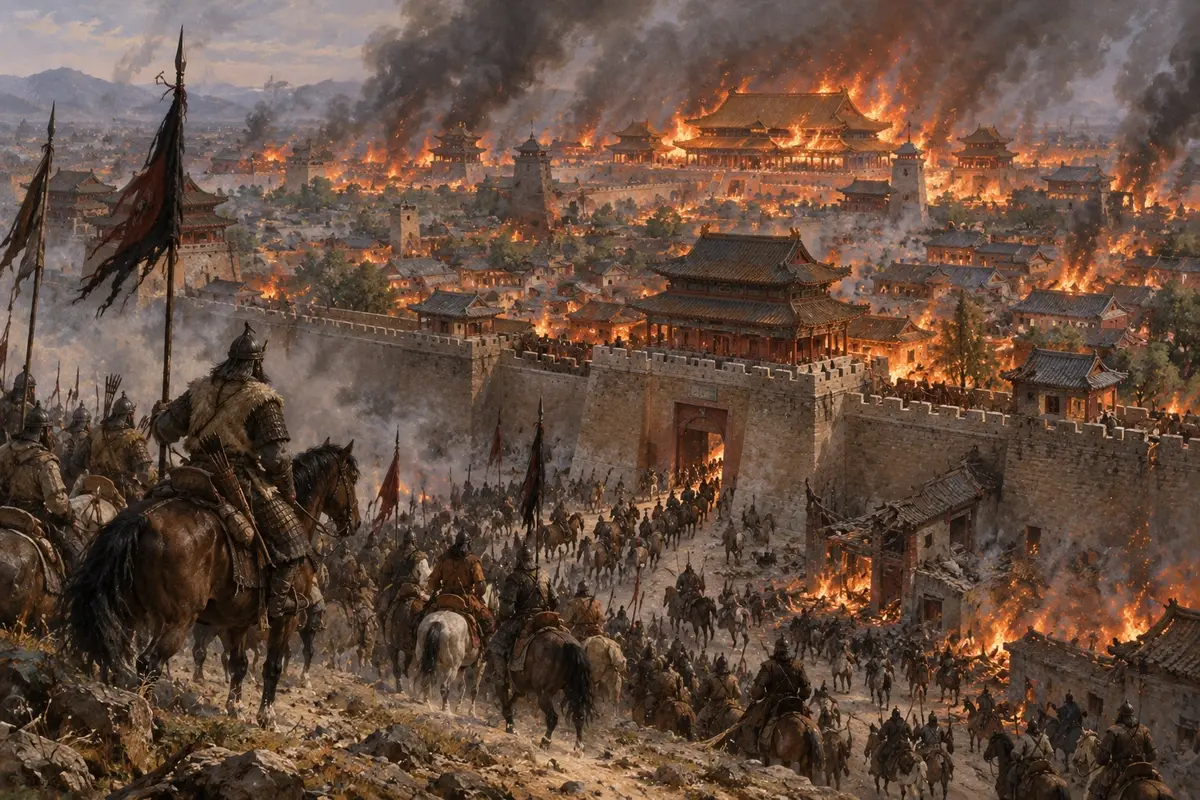
The defenders surrendered at the end of May 1215 after nearly a year without relief from a court that had moved south.
Receiving no relief from the relocated court, the remaining defenders surrendered and opened the gates on 31 May 1215. The city was plundered, thousands were massacred, and fires destroyed large parts of it. Some sources report women and girls throwing themselves from the walls rather than be taken. Travellers passing the site afterwards described a white hill made of the bones of the dead.
Ming'an, a Khitan officer who had defected from the Jin, distinguished himself in the storming and was given command of both Mongol and Han troops afterwards, which is a detail worth holding onto for the next section.
Two things are worth saying about the scale of it. The first is that the Mongols were not simply more savage than everyone else in the thirteenth century; sacking a city that had refused terms was normal practice across Eurasia, and what was different here was the size of the cities and the consistency of the policy. The second is that consistency was the point. A reputation like this one did more work than any siege engine, and it was maintained deliberately.
What a Conqueror Does Next
It is tempting to say that Genghis Khan then installed the defeated bureaucracy as his revenue service and turned a raid into a state. That is roughly what happened in the end, but not yet, and not by him.
He did take defectors like Ming'an into service and set them over territory, and that was the seed. But assessments of the early Mongol regime in northern China find it made little use of the existing state machinery, disregarded the old administrative divisions, and left conquered populations to Mongol commanders who relied heavily on non-Mongol tax-farmers. It was extraction, not government.
The systematic version came a reign later, under Ogedei, and the man who argued for it was Yelu Chucai, a statesman of Khitan descent taken into Mongol service, whose case was simply that northern China was worth more taxed than depopulated. It is one of the more consequential arguments anyone ever won.
By 1216 large stretches of Jin territory were under Mongol control. The dynasty itself survived, penned south of the Yellow River at Kaifeng, for nearly two more decades before the Mongols finished it in 1234.
Genghis Khan, meanwhile, turned west, toward a frontier where his empire now met the Muslim states of Central Asia. He was about to open a correspondence with the man on the other side of it, and for a couple of years it would look remarkably like peace.