The Jin war began in 1211 and it is the strangest campaign of Genghis Khan's career, because for long stretches he is barely the antagonist. The empire on the other side of the frontier did most of its own destruction. In the space of about two years it lost an emperor to a coup staged by its own commander-in-chief, lost that commander to a mutiny by an officer he had condemned to death, and lost Manchuria to a revolt it had provoked itself.
A clarification about names is needed at the outset, because it is usually described as a war against China and that flattens something important. The state Genghis Khan attacked was the Jin empire, ruled by the Jurchen, which held the north; the Song held the south and were a separate country under a separate government. The Jin were themselves a conquest dynasty. They had destroyed the Khitan Liao empire in 1125 and were governing both a Chinese population and a displaced Khitan one, and that fact drives the entire first phase of the war.
It also began, at least in its immediate form, with a personal insult delivered to an envoy, followed by a man spitting on the ground and riding away. The longer grievance behind it went back three generations.
Which Wall the Mongols Crossed
The stone-and-brick Great Wall of the photographs is Ming work, built more than two centuries after these events.
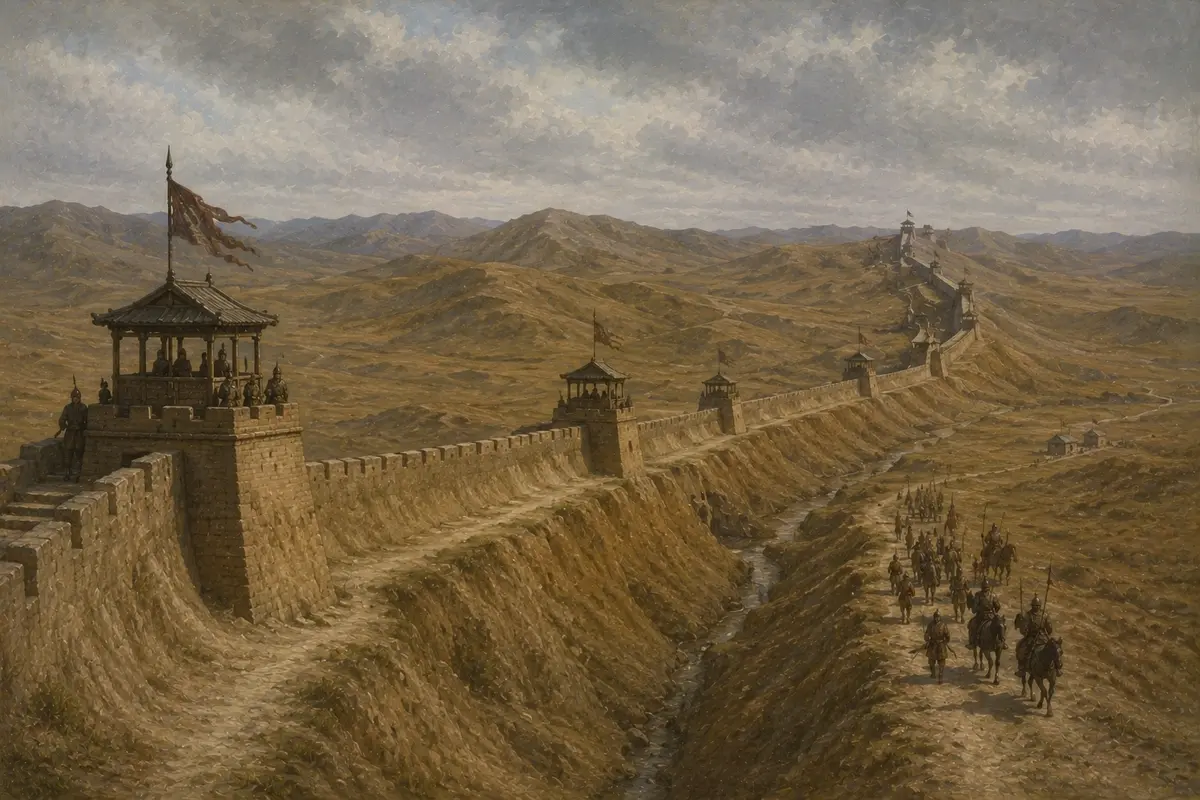
The line the Mongols crossed was rammed earth, ditches and garrison enclosures, not the stone wall of later centuries.
What existed in 1211 was a medieval wall system running roughly four thousand kilometres across northern China and Mongolia: rammed-earth walls, ditches and hundreds of associated structures, built in sections by different states between about 1000 and 1220. It was never one planned barrier.
Archaeologists surveying the northern line have made an argument that changes how the whole frontier should be read. The enclosures along it were not placed on high ground with good visibility, as military fortifications would be, but on flat lowland at points that favour natural pathways through the wall. The conclusion drawn from that is that most of these lines were built to control and regulate the movement of people and their herds, funnelling nomads through narrow gates where they could be counted and possibly taxed, rather than to stop an invading army.
The wall was not the border either. Jin territory extended a considerable distance beyond it, holding large towns and strong fortresses garrisoned by Jin troops. So the fighting started outside the wall, among populations whose loyalty was already in question.
The Khitan Grievance
The most dangerous of those populations were the Khitan. Until 1125 they had ruled the Liao empire across this whole region, and then the Jurchen had destroyed it and taken their place. They were a former ruling people living under the men who had displaced them, which is not a stable arrangement in any century.
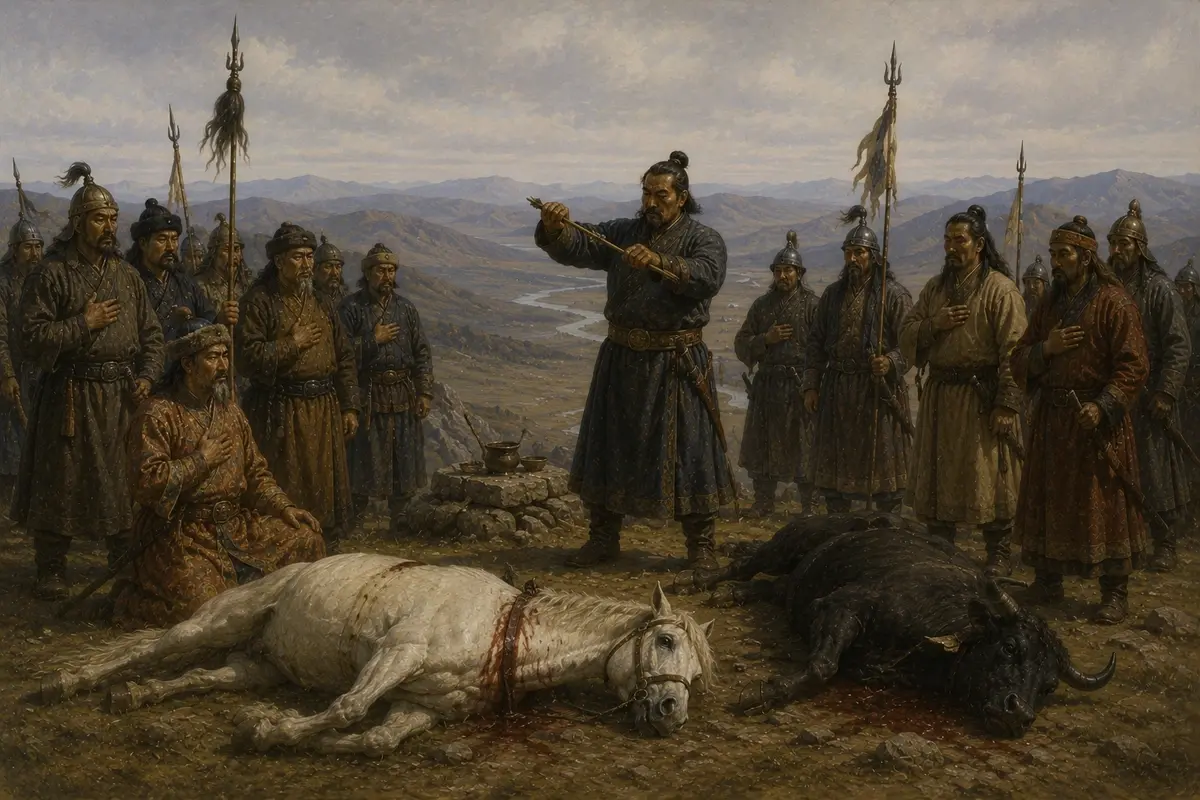
Alliances on this frontier were sealed by sacrifice before witnesses, and were meant to be reported back across it.
The Jin court knew it. Suspicious that the Khitan of Manchuria might align themselves with the Mongols, the emperor Wanyan Yongji ordered Jurchen colonist households settled among them, distributed so that the Khitan were permanently outnumbered where they lived.
It produced precisely the revolt it was designed to prevent. The Khitan leader Yelu Liuge rebelled, declared his allegiance to Genghis Khan, and went further than allegiance: he proclaimed a revived Liao dynasty with himself as its king. Within months Manchuria had effectively left Jin control, and the Mongols had a friendly power on the Jin flank that cost them nothing to maintain.
The Older Grievance
The Jin had spent a century managing the steppe by keeping it divided, backing one confederation against another, and periodically sending punitive expeditions north. It worked for a long time and it accumulated enemies.
The Mongols had a specific score. Their own khan Ambaghai, a predecessor and kinsman of Genghis Khan, had been seized by the Tatars, handed over to the Jin court and executed there, nailed to a wooden donkey, which was the prescribed end for a rebel of his rank. It was remembered. A confederation that had once been broken up on Jin instructions was now unified, and the man who had unified it had grown up inside that memory.
On top of that sat the tribute. The Mongols had long paid something to the Jin emperor, which is a fact worth holding onto, because in 1211 the invader was technically a tributary in revolt.
The Tribute Demand and the Insult
Wanyan Yongji had served on the steppe frontier before he took the Jin throne in 1209, and Genghis Khan had disliked him since then.
In 1210 a Jin envoy arrived to require submission and the annual tribute the Mongols had long paid. Genghis Khan asked who the new emperor was. Told the name, he declared publicly that the man was cowardly and unfit to rule, added that the emperor of such a country ought to be a man from the sky, spat on the ground, and rode away from the envoy.
It was a calculated humiliation and it worked as one. Yongji was enraged enough to have the Mongol ambassador executed, which removed any remaining ambiguity about what came next.
March 1211: Everything Mobilised
The scale of the commitment tells you how seriously Genghis Khan took this. In March 1211 he moved somewhere between ninety and a hundred and ten thousand cavalry south, leaving roughly two thousand men behind to hold Mongolia. Over ninety per cent of the army he had was in the field.
The Jin numbers as reported are enormous, three hundred and fifty thousand infantry and a hundred and fifty thousand cavalry, and modern estimates of what was actually present at the decisive battle run far lower, in the region of thirty to forty thousand. Either way the Jin had more men.
What they did with them was the problem. Wanyan Chengyu, newly in command, ordered his forces spread out along the length of the wall to block the Mongols everywhere rather than concentrating them anywhere. Against an army that could choose its crossing point and move faster than any message about it, that is the worst available disposition.
Yehuling and the Huihe River
The two armies met at Yehuling, Wild Fox Ridge, north-west of what is now Zhangjiakou in Hebei, between August and October 1211. The battle is also known as the Badger's Mouth.

The Jin were spread along the wall to block every crossing. The Mongols chose one and hit it with everything.
Genghis Khan sent Jebe and Subutai around to strike the Jin from the rear at the Wushao fortress while the main force engaged the ridge. He was also helped by a defection at exactly the wrong moment for the Jin: an officer named Shimo Ming'an, sent out to negotiate, went over to the Mongols and told them where the Jin positions were.
The Jin army broke. Chengyu managed to rally the survivors at the Huihe fortress, and the pursuing Mongols surrounded them there and fought them for three days. Genghis Khan personally led a charge of three thousand horsemen with the rest of the army coming up behind it, and what was left of the Jin field army was destroyed. Chengyu escaped with his life and very little else, and was replaced as chancellor.
It is worth being precise about what that meant. The Jin did not lose a battle at Yehuling. They lost the field army, the instrument with which a state fights a war in the open, and they never replaced it. Everything after 1211 is a war of sieges, defections and court politics, because the Jin no longer had the means to contest open country.
The Arrow at Datong
The Mongols rested their horses over the summer of 1212 and came back in the autumn, and this time it went badly.
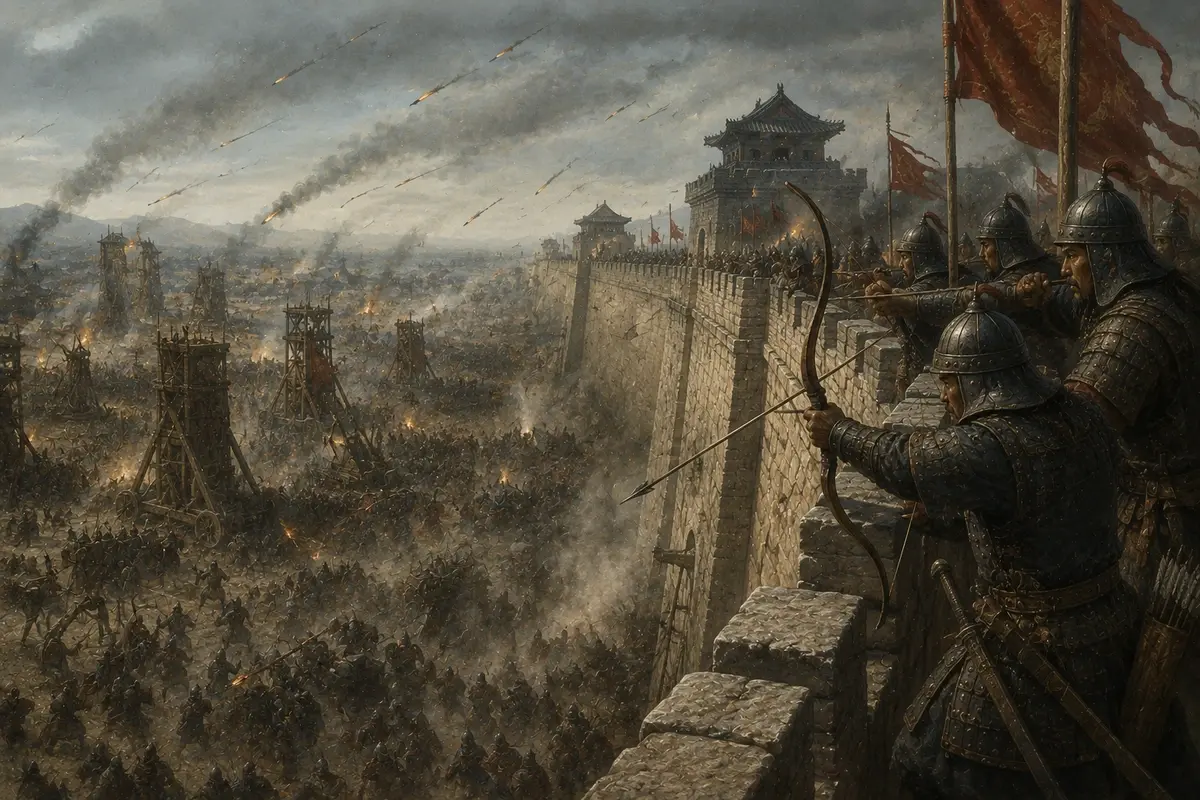
Xijing's sloping walls defeated the Mongol siege equipment, and then an arrow from the battlements ended the campaign.
Genghis Khan laid siege to Xijing, the Jin western capital, modern Datong. The city's sloping walls turned out to defeat the siege methods the Mongols had brought with them, and the assault stalled. Then he was hit in the leg by an arrow shot from the walls.
The wound was serious enough to stop the campaign. The siege was lifted and the army withdrew, and he did not return until he had healed, in the middle of 1213.
What the Arrow Actually Cost the Jin
A year's reprieve sounds like a gift. It was the opposite, and this is the most consequential thing in the whole account.
Genghis Khan's response to failing at Datong was not to avoid cities in future. It was to build a corps of siege engineers, recruiting some five hundred Jin specialists into it over the next two years. The empire that had just repelled him spent the following decade being taken apart by siege equipment built by its own engineers, and so did every walled city from there to the Caspian.
The Jin used their year differently. Famine broke out across several provinces. The Tangut, to the west, began raiding a frontier the Jin could no longer properly garrison. The Song, in the south, stopped paying the tribute they had been sending north for decades, having worked out which way things were going. And at court a quarrel was building that would prove more destructive than any of it.
Hushahu's Coup
The general at the centre of that quarrel was Hushahu, and his record against the Mongols was appalling. He had abandoned his own men in the field in 1211 and lost the battle at Huan'erzui, escaping with about a hundred men. He was dismissed from his command in disgrace, and he did not accept it.
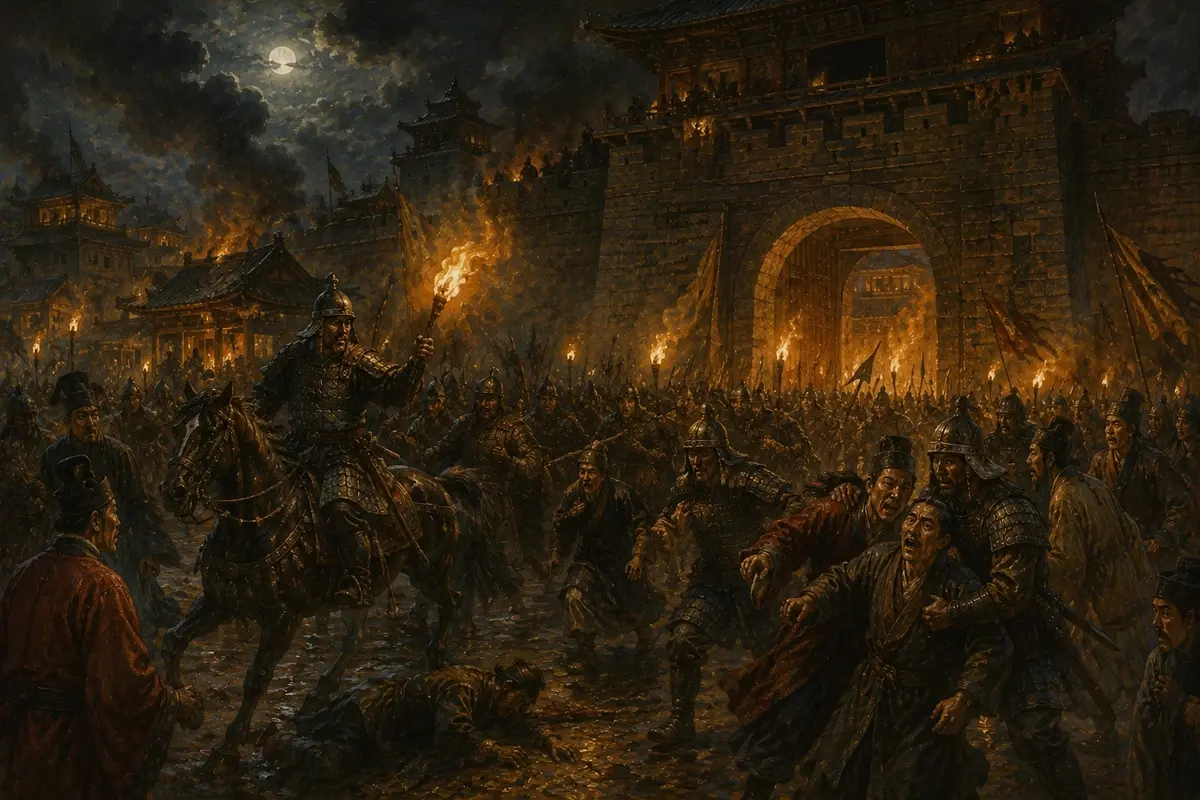
The commander charged with defending the western capital abandoned it, marched on his own capital instead, and killed his emperor.
In 1213, with the Mongols back in the field and Hushahu holding the command at Xijing, he left his post. He took his troops to Zhongdu, the Jin central capital on the site of modern Beijing, seized the city, and had the emperor Wanyan Yongji assassinated in the eighth month of that year.
He did not take the throne. Finding the opposition to his own accession too strong, he installed the dead emperor's nephew instead, who reigned as Xuanzong, and kept the office of commander-in-chief and the real power for himself.
So the man appointed to defend the empire's western capital abandoned it in the middle of an invasion in order to march on his own capital and murder his sovereign. The Mongols did not have to do anything at all while it happened.
Zhuhu Gaoqi and the End of Hushahu
Hushahu then tried to go on fighting the war, and sent a marshal named Zhuhu Gaoqi out against the Mongols. Gaoqi was defeated.
Hushahu's response was to order his execution. Gaoqi, facing certain death from his own commander and correctly guessing that his troops felt about Hushahu roughly what he did, turned them around instead.
They surrounded Hushahu's house on 28 November 1213 while he was trying to get away, and killed him. Gaoqi then presented himself to the emperor Hushahu had installed, expecting, one imagines, to answer for killing his superior officer. He was pardoned and promoted.
Inside four months the Jin had lost an emperor to their commander-in-chief and their commander-in-chief to a subordinate, and had rewarded the subordinate for it.
Jebe at the Juyong Pass
The Juyong Pass, the last defensible approach to Zhongdu, had been heavily reinforced while Genghis Khan was recovering from his wound. It did not hold.
A Mongol detachment under Jebe infiltrated the pass and surprised the elite troops holding it, opening the road to the capital. By November 1213 the Mongols were through both Juyongguan and the Zijingkou gap, and from then into the spring of 1214 they ranged across the whole north China plain.
Zhongdu itself was bought off rather than taken, at least at first. The ransom included three thousand horses, five hundred slaves, a Jin princess and large quantities of gold and silk, and the Mongols withdrew in May 1214.
The princess was Wanyan Yongji's own daughter, handed over to the man her father had provoked into the war and to whom he had refused to submit. She went north as a concubine. Her father had been dead for less than a year.
A Coda on Wanyan Yongji
The emperor whose contempt for a Mongol envoy started the war received an unusual posthumous punishment. He was never given a temple name, the honorific by which Chinese emperors are normally remembered, and in 1216 his successor formally demoted him to Prince Shao of Wei.
The Jin entered the decisive phase of the war having lost an emperor to a coup, a commander-in-chief to a mutiny, an entire faction of senior officials to a purge staged under a false alarm, Manchuria to a revolt they had provoked by their own settlement policy, and a year of campaigning to a court quarrel. None of it was Genghis Khan's doing.
He simply kept advancing while it happened, and used the one year they did buy him to learn how to take cities.