The Otrar massacre killed roughly four hundred and fifty merchants and envoys at a single stroke and started a war that erased one of the great powers of the Islamic world. It was ordered by a provincial governor, approved by a sultan who barely thought about it, and it may have come down in the end to nothing more than greed or wounded vanity.
What makes the episode unusual is that the two years before it are a story about trade rather than conquest. Genghis Khan opened the frontier deliberately, negotiated a commercial treaty, garrisoned the caravan roads and cleared them of bandits, and declined an invitation to invade on the grounds that he had signed something. It is the period in which he looks least like a conqueror.
Then one governor in a border town wrote one letter, and the arrangement collapsed into the most destructive campaign of his life.
Two Empires on One Frontier
By 1218 the Mongol empire ran from the seas off China almost to the Aral, and its western edge met the Khwarazmian empire of Ala ad-Din Muhammad II, which covered territory across what is now Iran, Uzbekistan and Turkmenistan. Muhammad had recently acquired the flattering title of Second Alexander and had reason to feel secure.
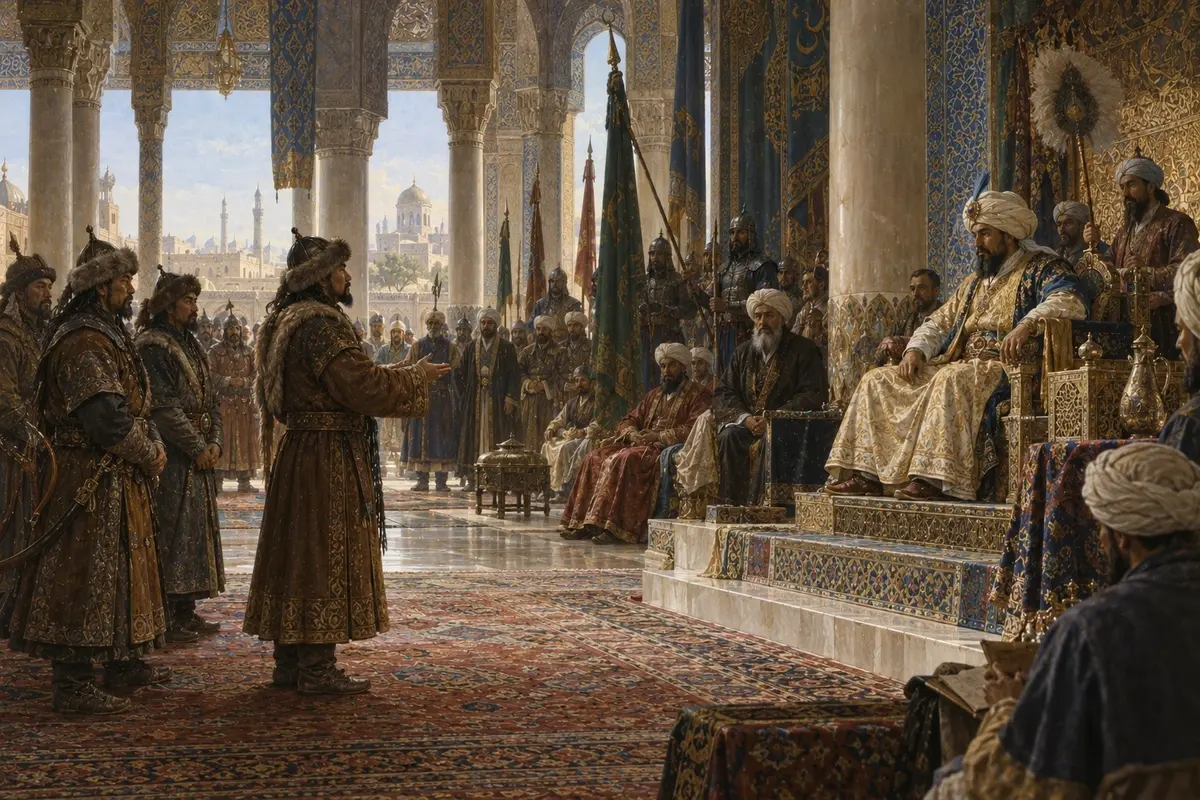
The offer was friendship and open trade; the phrase that caused the trouble was buried in the courtesies at the end.
It would have been reasonable to expect the Mongols, having run out of rivals in the east, to invent a pretext and take his territory too. Instead an embassy arrived proposing friendship and commerce.
There were good reasons for that on the Mongol side, and they were not sentimental. The war against the Jin in northern China was unfinished and consuming. The Kara Khitai state between the two empires had only just been dealt with. And the caravan routes running west were worth a very great deal to a ruler who had spent a decade discovering how useful settled economies were. Peace on that frontier was, for the moment, the profitable option.
At the audience the chief ambassador recited his master's recent victories, observed that the two rulers were now neighbours, and proposed a treaty that would obviously benefit both. Then came the phrase that caused the trouble: Genghis Khan wished the sultan to regard him as a father, and would look on the sultan as a son.
Under the ideas of the day that formula was not merely affectionate. It implied precedence on one side and dependence on the other, and the sultan heard it that way.
The Jewelled Scarf and a Blunt Answer
He said nothing until the public audience ended. Then he took the ambassador aside privately and gave him a rich jewelled scarf, to encourage candour, and asked whether the emperor had really made all those conquests and whether his power was genuinely what he claimed.
The ambassador said it was, and added that the sultan would find out for himself if he ever had difficulty with him. It was a serious misjudgement and the sultan's temper went immediately: on what basis did this man pretend to be the greater, expecting to be honoured as a father?
The ambassador recovered by retreating. He softened everything, complimented the sultan, said plainly that the sultan was the more powerful of the two, and asked not to be blamed for a message he had merely been given to deliver. The flattery worked. A treaty of peace and commerce was signed and he went home loaded with presents.
Guarded Roads and the Caravan Trade
A caravan of merchants travelled back with him to see what the new market would bear, using his escort to cross country full of tribes barely subject to any law.
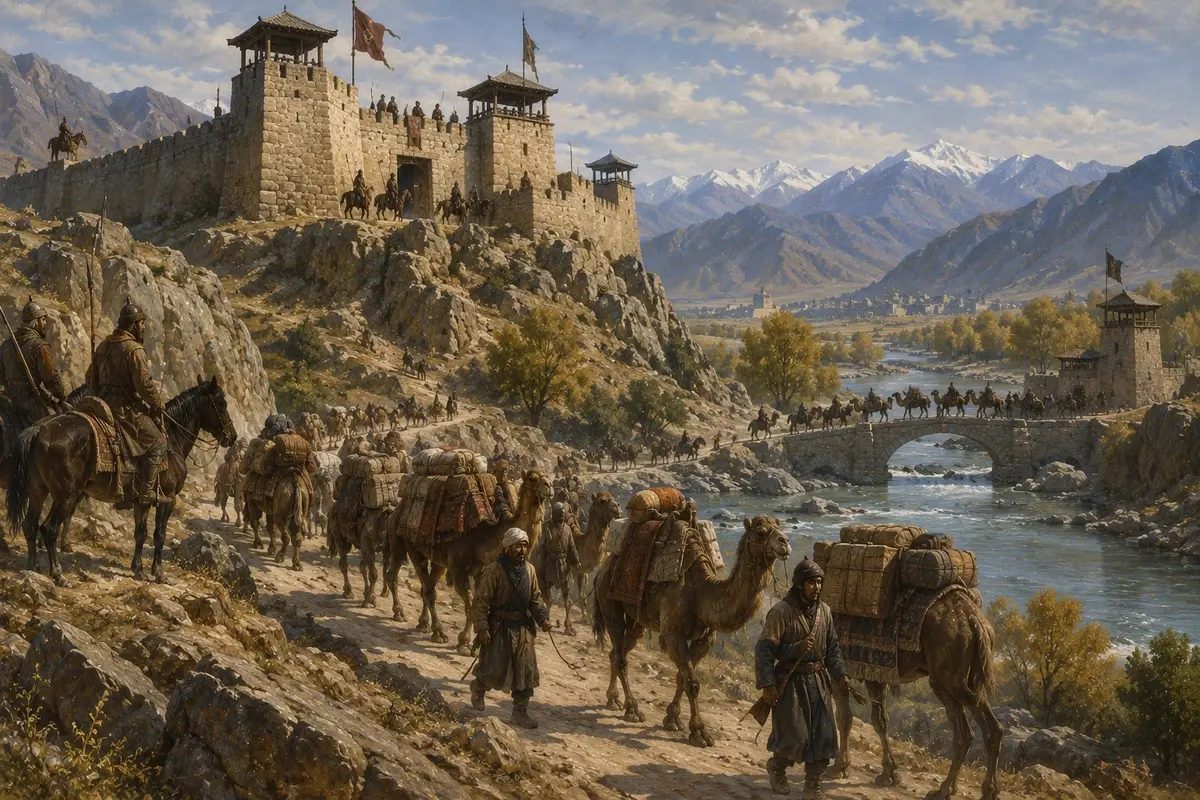
Posts at the fords and passes, with orders to sweep the country around them until the road was clear.
Then Genghis Khan did something more substantial. To make the route safe in both directions he established guards along the whole road between the two empires, quartered in fortresses built at river crossings and mountain passes. Their orders were to sweep the surrounding country continuously, and whenever a robber band formed they hunted it from one hiding place to the next until it was destroyed. Within a short time caravans could carry gold and silver openly.
This is worth sitting with. The same administration that had just spent four years dismantling northern China spent the following year building a policed trade corridor across Central Asia, because it wanted the commerce. The safety of long-distance travel under Mongol rule later became substantial enough to acquire its own name, the Pax Mongolica, and this is where it starts.
It is also worth noticing what the arrangement was not. This was not tolerance in any modern sense, and the men clearing the roads were the same men who had driven captives against the walls of Chinese cities the year before. It was a calculation about where the money was, made by someone perfectly capable of making the opposite calculation the moment the terms changed.
Two Lessons in Pricing Goods
Two anecdotes from the early trade say a good deal about the man's temper.
Merchants arriving soon after the treaty offered their goods to Genghis Khan first and asked prices high enough to astonish him. He observed that from what they were asking, they evidently thought he had never bought anything before.
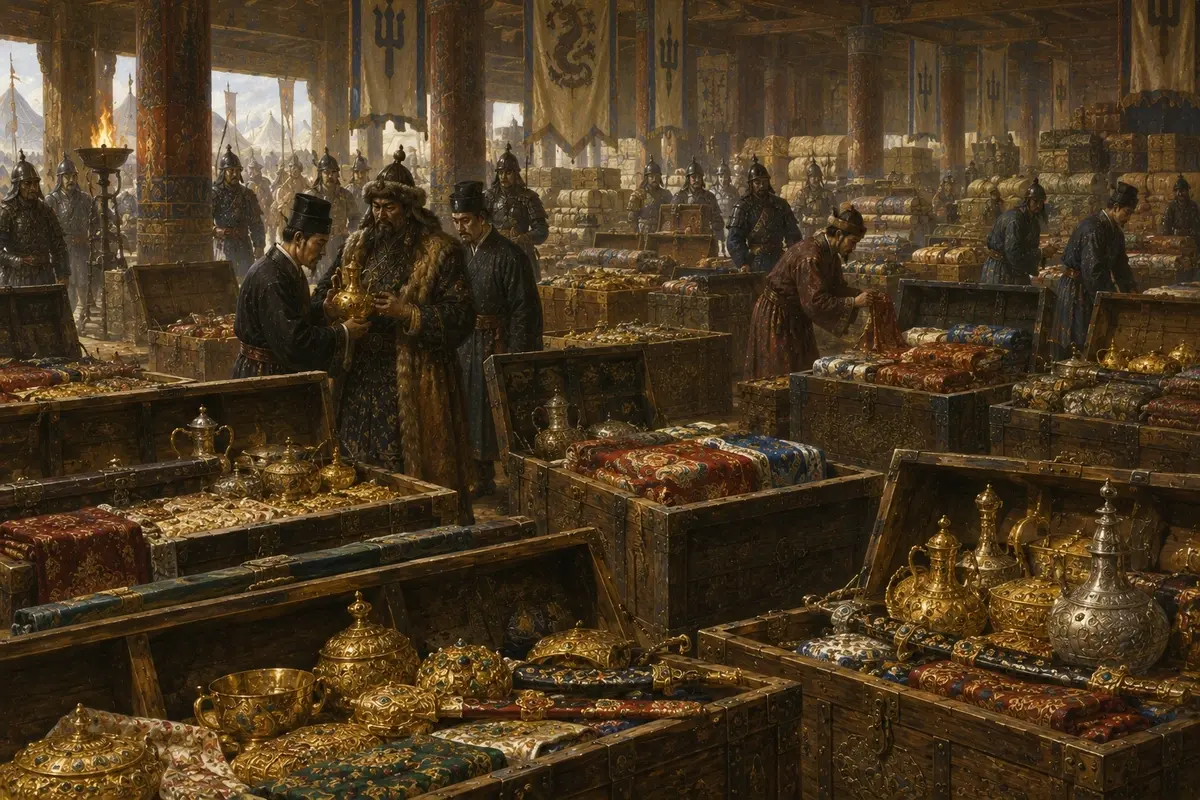
A thousand chests, opened for the visitors' benefit, to establish that they were not selling to a man who had never seen merchandise before.
He then took them to see over a thousand chests packed with gold and silver vessels, rich silks and jewelled weapons, explained that he therefore had some idea what such things were worth, and sent them home with everything they had brought, forbidden to sell anywhere in his territory at any price.
The next company had heard the story. Asked a price, they replied that his majesty was a better judge than they were and might set it himself, and that if he wanted the goods for nothing he was welcome to them. He paid them double for everything he took and gave them trading privileges besides.
A Caravan of Four Hundred and Fifty
The trade was not one-directional. Genghis Khan fitted out a company of his own merchants to go west with the products of his territory, loaded with gold, silver, sable furs and silk.
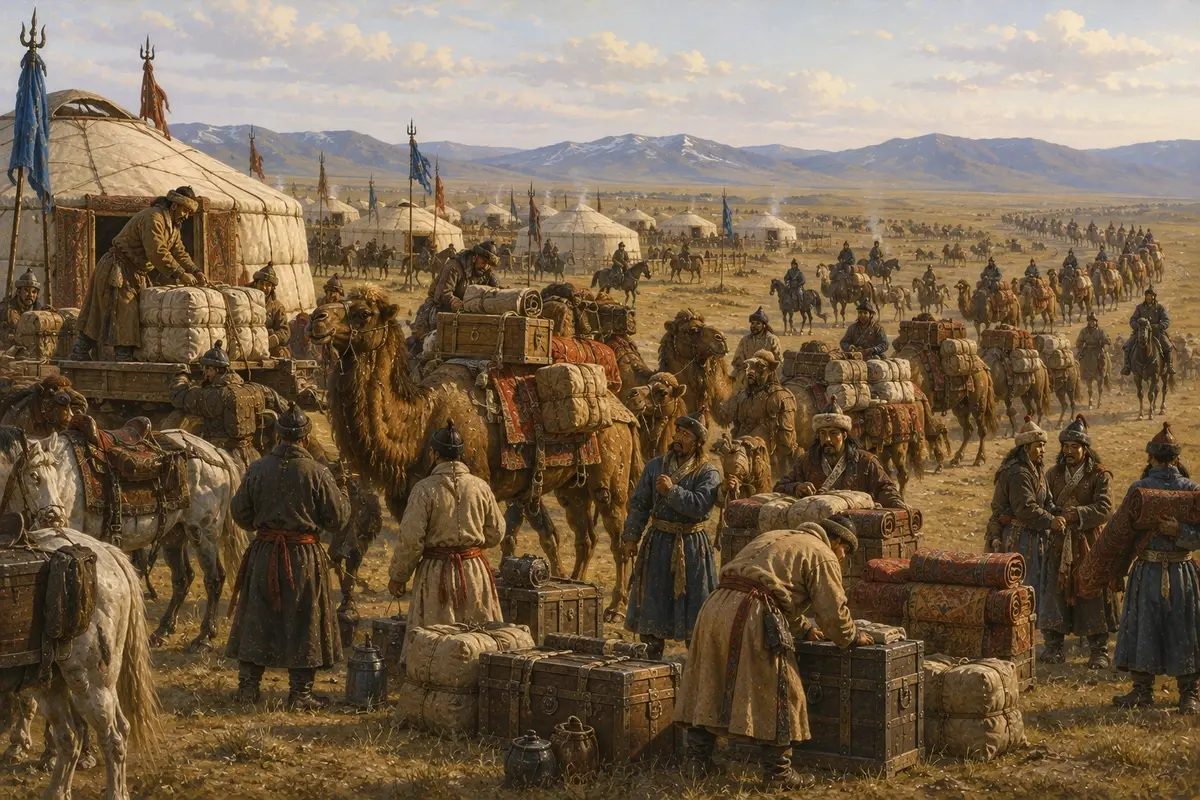
Four hundred and fifty people, with a servant sent along by every one of the khan's wives and great lords to buy on their behalf.
He sent three ambassadors with it, deliberately choosing Muslims from among the men of that faith serving at his court, on the reasoning that the sultan would rather receive a message through people of his own religion. He also gave each of his wives and each of the great lords of his court permission to send a servant along to buy on their behalf, and every one of them did.
The whole company came to around four hundred and fifty people. That last detail is what gives the massacre its weight. Many of the traders were agents of the Mongol elite, buying with their masters' money, so killing them was not an attack on foreign merchants but on the personal investments of every powerful family in the empire.
Muhammad's Quarrel With Baghdad
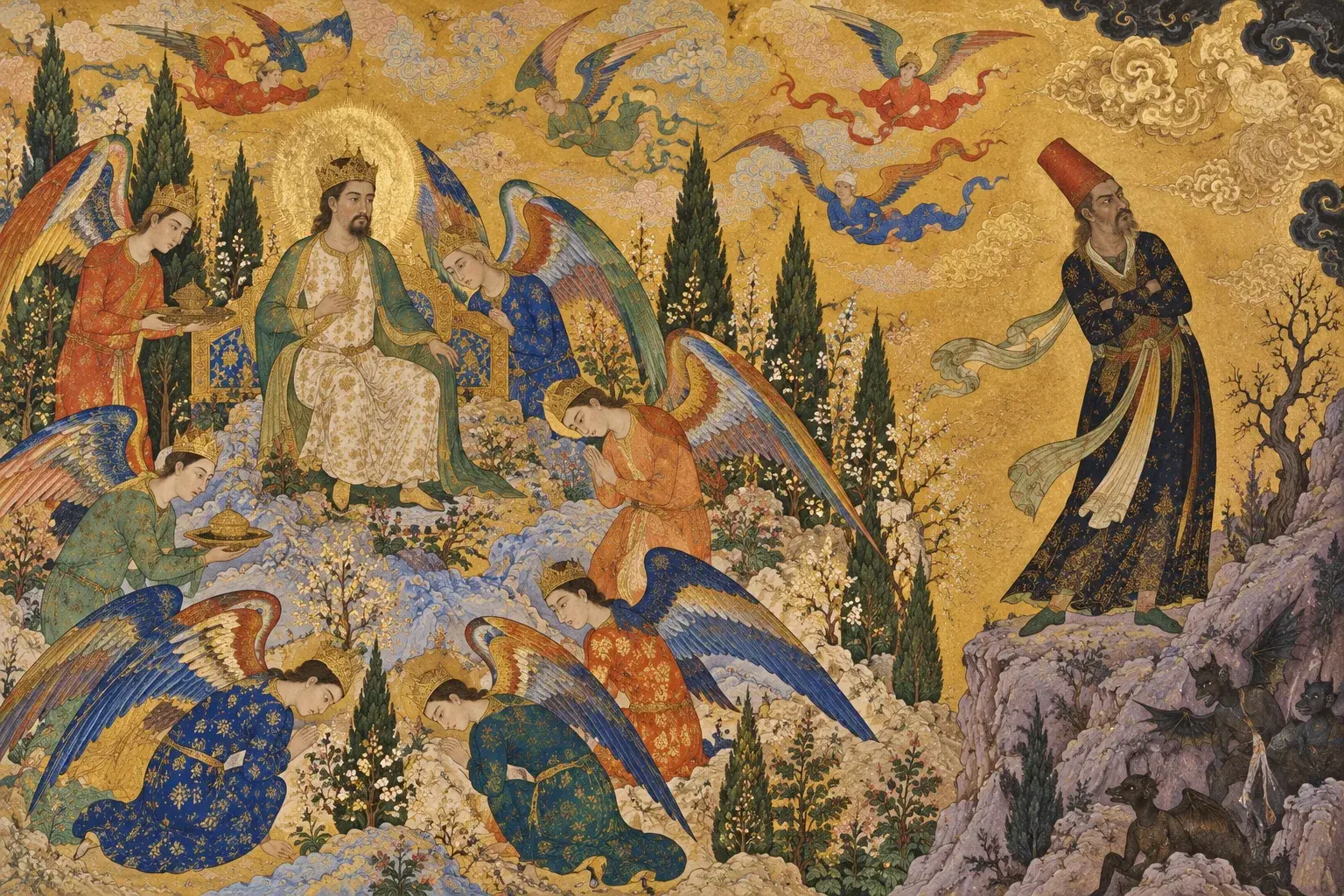
While this was happening the sultan had fallen out with the Caliph of Baghdad, al-Nasir, who ruled from 1180 to 1225 and is generally reckoned the last effective Abbasid caliph.
Muhammad had applied for formal privileges of a kind occasionally granted to sultans who had rendered great service to Islam, arguing that he had conquered more than a hundred princes and greatly enlarged Muslim power in the process. The caliph refused, courteously, sending an ambassador of his own to deliver the refusal politely.
Muhammad concealed his anger until the man had gone, then convened his generals and announced that he would march on Baghdad, depose the caliph and reign in his place.
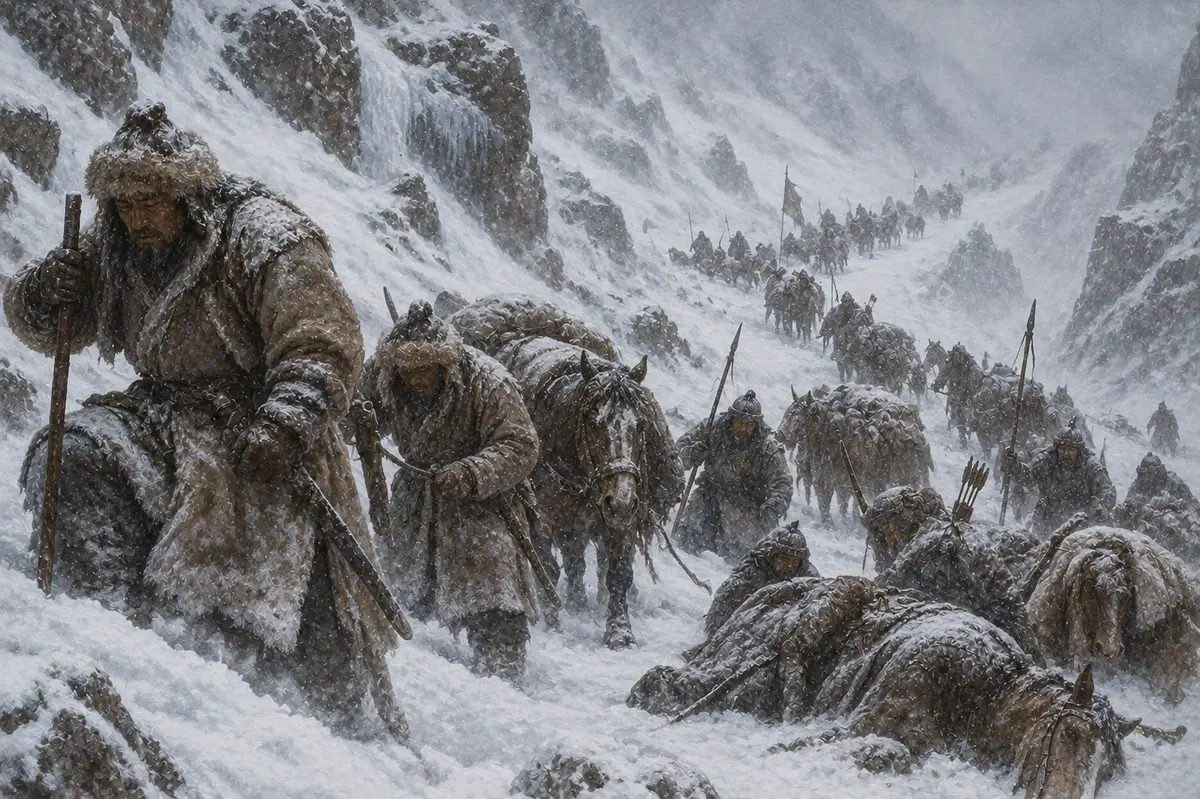
The march on Baghdad never reached the enemy; the Zagros mountains and the winter finished it first.
The expedition never reached the enemy. It started too late in the season and was caught by a blizzard crossing the Zagros mountains, where thousands died of cold. The sultan turned back, and the caliph now knew exactly what had been intended and had a year to prepare.
The Message Tattooed on a Scalp
There is a persistent tradition that al-Nasir then tried to bring the Mongols in from the east while he attacked from the west, and that his counsellors objected that inviting unbelievers to make war on fellow Muslims was impious, and that the caliph answered he would rather have an open unbeliever for an enemy than a Muslim traitor.
The story is contested and modern historians treat it with scepticism. So should the detail attached to it, which is the most repeated part of the whole episode: that because the route ran through the sultan's territory, the caliph had the message pricked into a messenger's scalp with a needle and indigo and let the hair grow over it, so that Genghis Khan simply shaved his head and read it.
Herodotus tells almost exactly the same story in Book 5 of the Histories. In 499 BC, Histiaeus shaved the head of his most trusted slave, tattooed a message on it telling Aristagoras to revolt against the Persians, waited for the hair to grow back and sent him off to be shaved at the other end. That is seventeen centuries earlier, and its reappearance here says more about how such histories were written than about what happened.
Inalchuq and the Banquet
What is not in doubt is what happened at Otrar in 1218.
The governor was Inalchuq, who held the title Ghayir Khan and was the sultan's maternal uncle. When the great caravan arrived he accused its members of being Mongol spies and had them arrested.
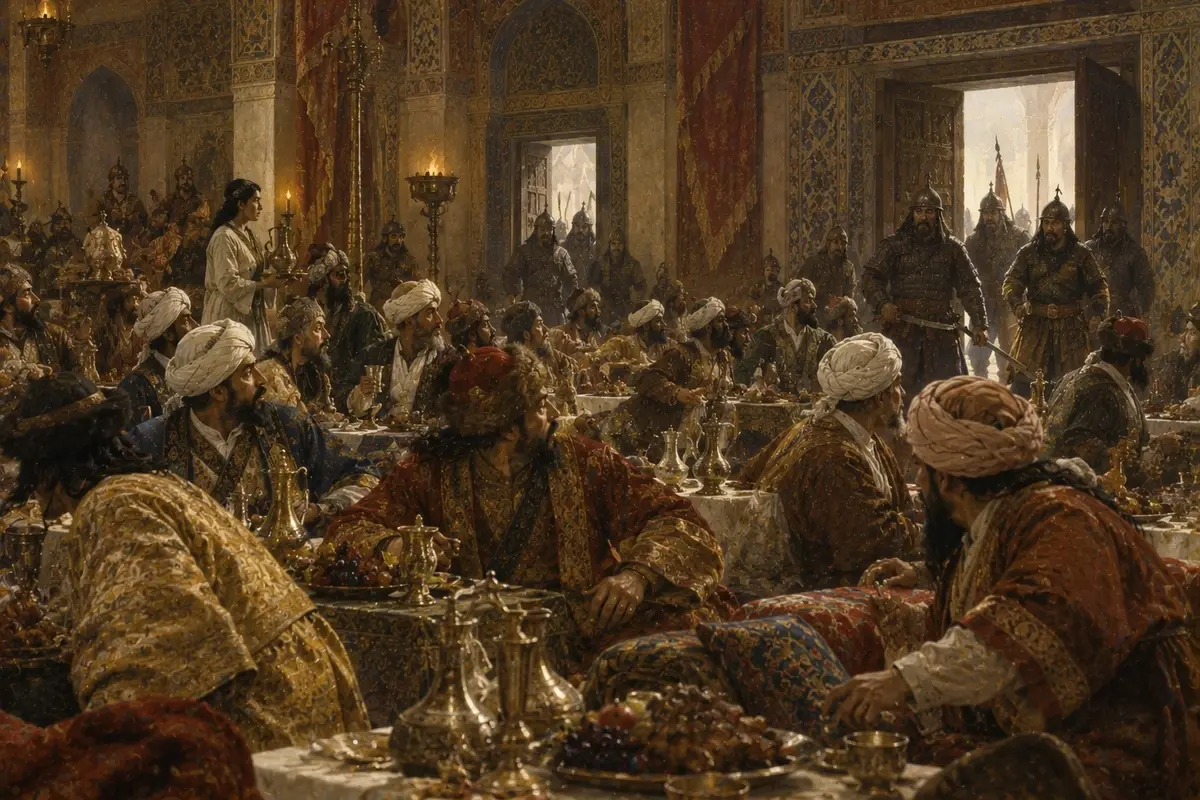
The hospitality was the method: the whole company was gathered into one place before the signal was given.
His motive is genuinely uncertain and two explanations survive. One is that he was offended at being addressed as Inalchuq, his personal name, rather than by his title, by a member of the caravan who had known him before his elevation. The other is that he simply wanted a pretext to seize a very large quantity of gold and silver. It should also be said that there may in fact have been spies among the merchants; the charge was not necessarily invented.
Either way he acted with the sultan's assent. The entire caravan was executed and the goods were sold in Bukhara. One camel driver escaped and got the news back east.
A war that killed hundreds of thousands of people may therefore have begun because a provincial official was either snubbed at a reception or wanted the cargo.
Three Envoys and a Declaration of War
Genghis Khan did not immediately reach for the army. He sent a delegation of three, one Muslim diplomat and two Mongols, demanding that Inalchuq be handed over for punishment and that restitution be made.
Refusing was not straightforward for the sultan, because Inalchuq was his mother's kinsman and Terken Khatun, who held enormous influence at his court, protected him. Muhammad refused, and did it in a way that closed every remaining door. He had the Muslim envoy beheaded, ordered the beards of the two Mongols shaved off, a profound humiliation, and sent them home with their colleague's head.
Envoys were inviolable in Mongol practice, treated as extensions of the ruler's own person, and Genghis Khan had enforced that principle rigorously in every direction, including against his own people. Killing one after massacring the caravan removed the last basis on which anything could be settled short of war. For three days, it is said, he neither ate nor slept.
Whether Muhammad understood what he had done is doubtful. He appears to have regarded the Mongols as barbarians not worth negotiating with seriously, and he had a large army, a wealthy empire and a recent habit of victory. What he did not have was any accurate picture of what was on the other side of his eastern border.
The invasion began in 1219. Otrar was besieged from late that autumn and fell early in 1220, and Inalchuq was taken alive on Genghis Khan's specific order and executed shortly afterwards. The tradition that he was killed by having molten silver poured into his eyes and ears is probably a later embellishment.
Genghis Khan had spent two years building a trade route and had turned down an invitation to invade because he had given his word. Whatever restraint that represented was gone, and the sultan had removed it himself, twice.