In 480 BCE the Persians took Athens and burned it. The temples on the Acropolis came down, the houses went, and the population was scattered across three islands watching the smoke from the sea. Fifty years later it was the most spectacular city in the Greek world, and it stayed that way long enough to produce a body of drama, philosophy, history and architecture that nothing since has matched for a comparable population. That's the story people know. Here's the part that usually gets left out: the money wasn't Athenian. The Parthenon was built with funds contributed by other Greek states for a different purpose entirely, and everyone at the time knew it.
Starting With Nothing
When the Athenians came back after Salamis, they found rubble. The first decision was the walls, and it caused an immediate diplomatic crisis. Sparta asked Athens not to rebuild them, on the stated grounds that a fortified city north of the Isthmus could be useful to a future invader. The real reason was obvious. Themistocles handled it with a con. He went to Sparta as an ambassador and then stalled — waiting for colleagues, unwell, unable to begin talks — while every man, woman and child in Athens worked day and night building the wall out of whatever was to hand. Old grave markers and broken column drums went into it, and you can still see them in the surviving stretches. By the time the Spartans worked out what was happening, the wall was high enough to defend. Themistocles then told them so to their faces and pointed out that Athens was now in a position to negotiate as an equal. He followed it by fortifying the port of Piraeus on a scale nobody had attempted, and then Athens built the Long Walls — two parallel fortifications running about six kilometres from the city down to the harbour, turning Athens and its port into a single walled unit that could not be starved out by land as long as the fleet held the sea. That's not decoration. It's the strategic doctrine of the next fifty years built in stone.
The League That Became an Empire
In 478 BCE the Greek states that wanted to keep fighting Persia formed an alliance, with Athens leading because Athens had the navy. The Delian League was set up properly. Members contributed either ships or money. The treasury was kept on the sacred island of Delos, neutral ground. Decisions were taken in a common assembly. It was a coalition of allies. Then it changed, in stages, and each stage was defensible on its own. States started paying cash instead of sending ships, because cash was easier and Athens was happy to build the ships. Which meant that within a decade or so, Athens had a colossal navy and most members had none. Members who tried to leave were prevented. Naxos tried around 470 BCE and was besieged and forced back in. Thasos tried in 465 BCE, was blockaded for two years, and lost its walls, its fleet and its gold mines. Thucydides is entirely clear-eyed about it: allies who revolted were reduced to subjection. And in 454 BCE the treasury was moved from Delos to Athens, on the stated grounds that Persian raiders made Delos unsafe. It never went back. From that point the League was an empire. Athens set the tribute assessments, tried allied legal cases in Athenian courts, installed garrisons and settlers, and in some cases imposed democratic constitutions on unwilling states. And one-sixtieth of the annual tribute was set aside for Athena, with the records of those payments carved on marble and put up publicly. Large fragments survive. You can read the accounts of the Athenian Empire.
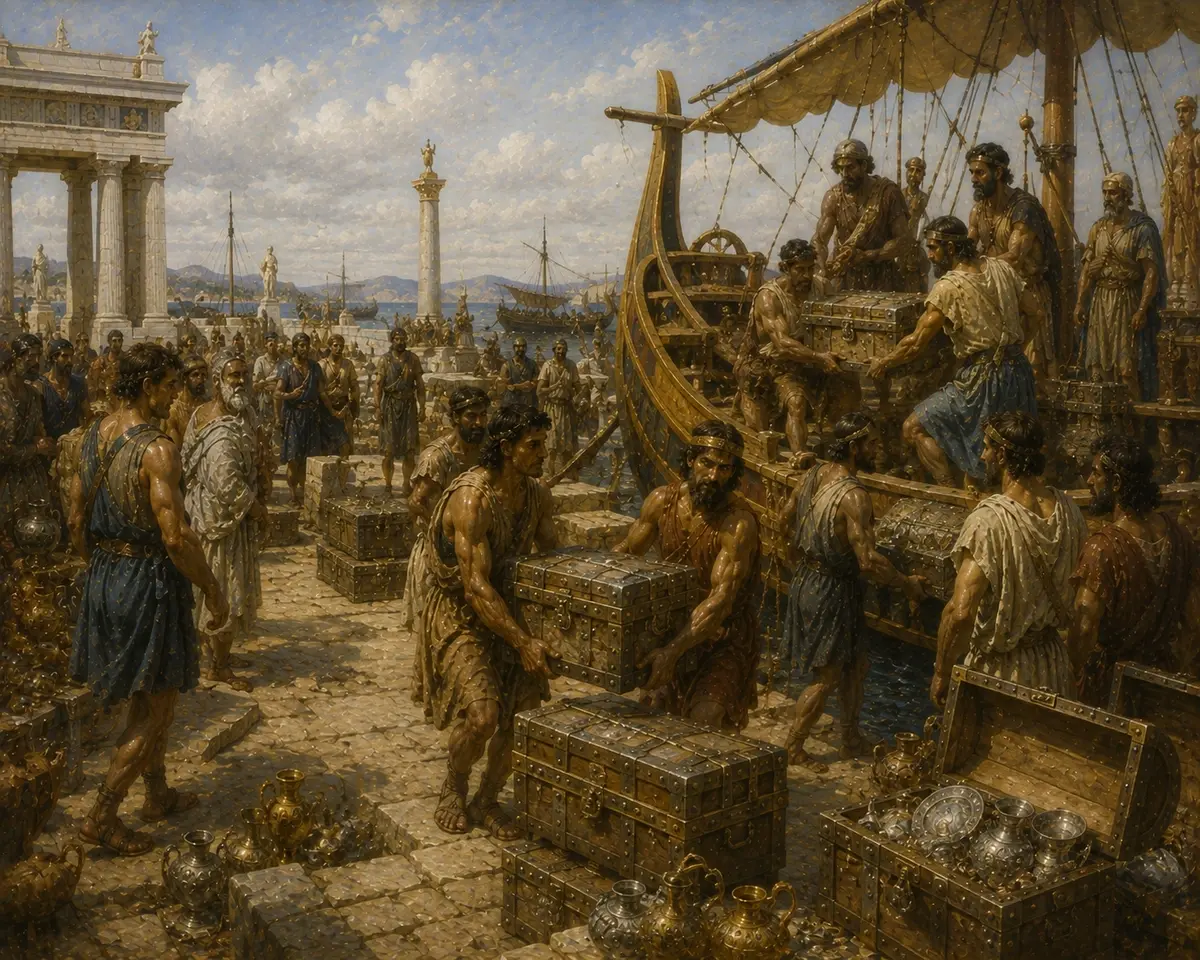
Moved in 454 BCE on the stated grounds that Delos was unsafe. It never went back. From that point the League was an empire.
Pericles
Pericles dominated Athens from around 461 BCE until his death in 429 BCE — not as a king or tyrant, but by being elected strategos, one of the ten generals, almost every year for three decades, and by consistently carrying the Assembly. Thucydides, who admired him and was not a democrat, gives the sharpest description of the arrangement: in name it was a democracy, and in fact it was rule by the first man. His domestic reforms pushed the democracy further than Cleisthenes had. He introduced pay for jury service, which sounds trivial and was transformative — it meant a poor man could afford to spend a day in court instead of working, and the juries stopped being dominated by those who could take the time off. Pay for other offices followed. He also, in 451 BCE, restricted citizenship to those with two Athenian parents rather than one, which narrowed the citizen body considerably and had the incidental effect of making his own children by the Milesian Aspasia illegitimate. He had to ask the Assembly for a special exemption after his legitimate sons died in the plague, and got it. Aspasia herself is one of the more interesting figures of the period — a foreign woman, intellectually formidable, whose house was a gathering point for the city's thinkers, and who was mocked relentlessly by the comic poets precisely because everyone knew she mattered.
The Building Programme
From 447 BCE, Pericles put the tribute money into construction. The Parthenon (447–432 BCE) had architects Ictinus and Callicrates, with Phidias as overall director of sculpture — a Doric temple of Pentelic marble housing a forty-foot statue of Athena in gold and ivory. The refinements are the famous part: there is almost no true straight line in the building. The columns swell slightly at the middle, lean inward, and are spaced unevenly; the floor curves upward towards the centre. Whether these corrections are optical or aesthetic is still debated, and either way they were cut by hand into marble. Alongside it came the Propylaea, the monumental gateway onto the Acropolis; the Erechtheion, with the Caryatid porch, built on the most sacred ground on the rock; the Temple of Hephaestus in the Agora, which is the best-preserved Greek temple anywhere and gets a fraction of the attention; and the Odeon, the Telesterion at Eleusis, and the temple at Sounion.
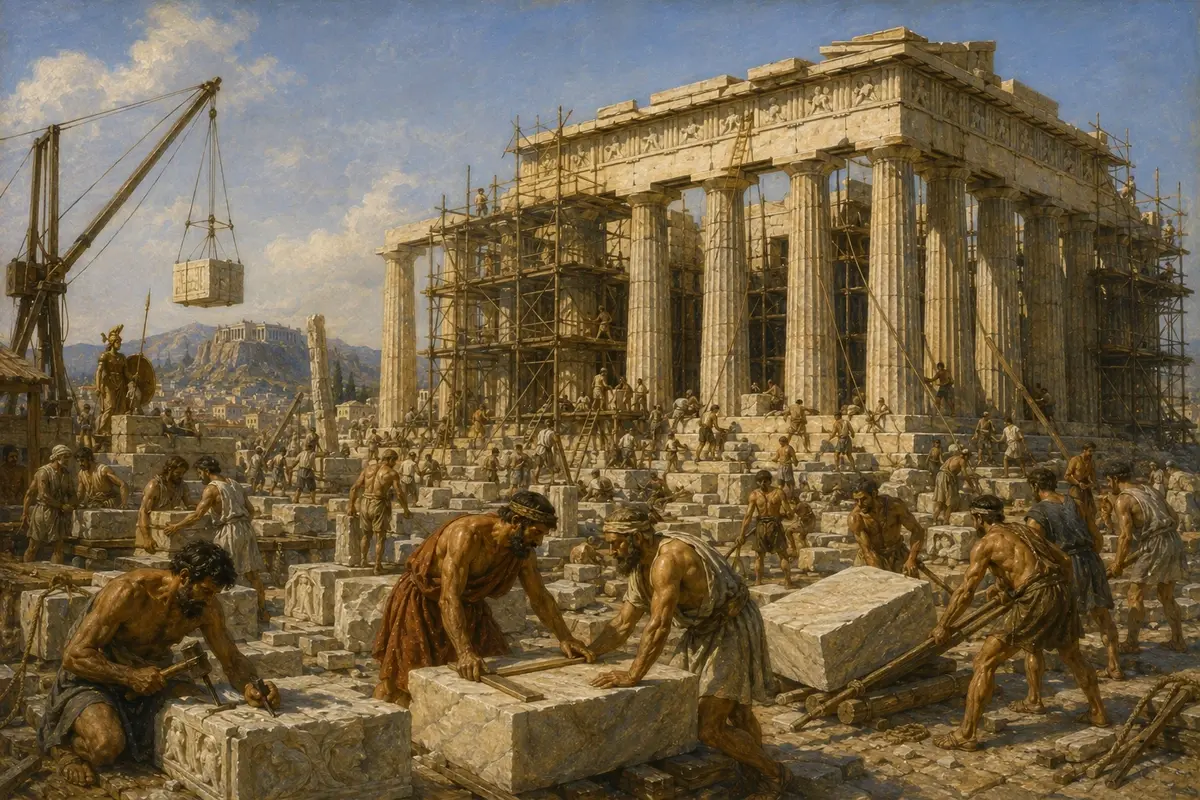
Almost no true straight line in the building. The columns swell at the middle, lean inward, and are spaced unevenly. All of it cut by hand into marble.
The Row About Paying For It
This was controversial at the time, and the criticism was blunt. Plutarch preserves the argument made by Pericles' opponents: that Greece was being treated with intolerable insolence, that money contributed by force for a war against Persia was being spent gilding and decorating Athens like a vain woman. Pericles' answer, as Plutarch gives it, is remarkable for how little it concedes. Athens, he argued, owed the allies no account of the money as long as it defended them and kept the Persians off — since the allies supplied no horses, ships or men, only money, and money belongs to the recipient once the service is delivered. He also made a straightforwardly economic case: the projects employed the whole city, put wages into every trade, and left something permanent. Both arguments are recognisably modern, and the first one is exactly what an imperial power says.
The Golden Age
What that money bought, alongside the buildings, is the most concentrated period of cultural production in the ancient world — all of it within roughly one lifetime, in a city of perhaps 250,000 including slaves and foreigners. Aeschylus, Sophocles and Euripides writing tragedy for the annual festival of Dionysus, competing for prizes in front of the whole city. Aristophanes writing comedy that abused Pericles, Socrates and the war by name, in public, at state-funded festivals. Herodotus in Athens reading his history aloud, and Thucydides inventing a different and much harder kind of history. Socrates in the Agora. Phidias, Polyclitus and the sculptors who established what Western art would look like for two thousand years. Hippocrates and the beginnings of medicine as an evidence-based discipline. And Anaxagoras, Protagoras and the sophists, teaching argument for money and being resented for it. And it should be said clearly that this rested on slavery and on the tribute of subject states, and that the Athenians did not think either fact required an apology.
The Funeral Oration
In the winter of 431/430 BCE, at the state funeral for the first war dead of the Peloponnesian War, Pericles gave the speech Thucydides records in Book 2 — and it's the closest thing the ancient world produced to a statement of democratic principle. The claims he makes are these. Athens is governed in the interest of the many rather than the few. Advancement depends on merit rather than class, and poverty is no bar to serving the city. Athenians extend to private life the same tolerance they show in public and do not resent a neighbour for doing as he likes. They obey the law and particularly the unwritten laws whose breach brings shame. They love beauty without extravagance and thought without softness. And the city is an education to Greece. He then says the thing that gives it its edge: that a man who takes no interest in public affairs isn't minding his own business, he is useless. Whether Pericles said any of it is unknowable — Thucydides admits he reconstructed speeches. Whether Athens lived up to it is very doubtful, and Thucydides places the speech immediately before the plague specifically so that you read the two together. But as a statement of what a citizen state might be for, nothing better was written for two thousand years.
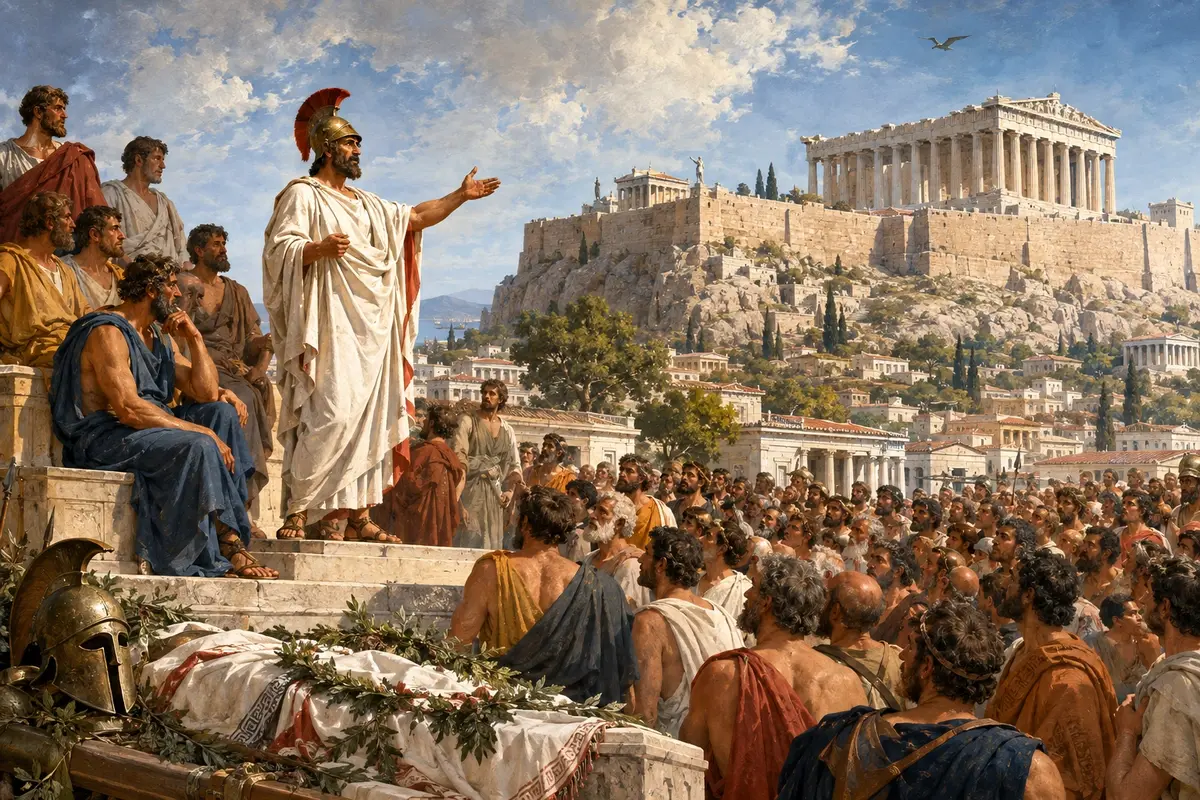
A man who takes no interest in public affairs isn't minding his own business — he is useless. Thucydides places this speech immediately before the plague, deliberately.
And Then
The Peloponnesian War started in 431 BCE. Pericles' strategy was to abandon the Attic countryside, bring everyone inside the Long Walls, refuse land battles and use the fleet. It was militarily sound. It also packed the entire population of Attica into a fortified city in summer with inadequate sanitation, and in 430 BCE the plague arrived. It killed perhaps a quarter to a third of the population. It killed both of Pericles' legitimate sons. In 429 BCE it killed Pericles. Athens fought on for another twenty-five years, lost, and had the Long Walls pulled down to the sound of flute girls while the victors celebrated. The Parthenon was still standing. It stood, essentially intact, for over two thousand years — through the Roman Empire, through conversion to a church and then a mosque — until 1687, when a Venetian shell hit the Ottoman gunpowder store inside it and blew the middle out.