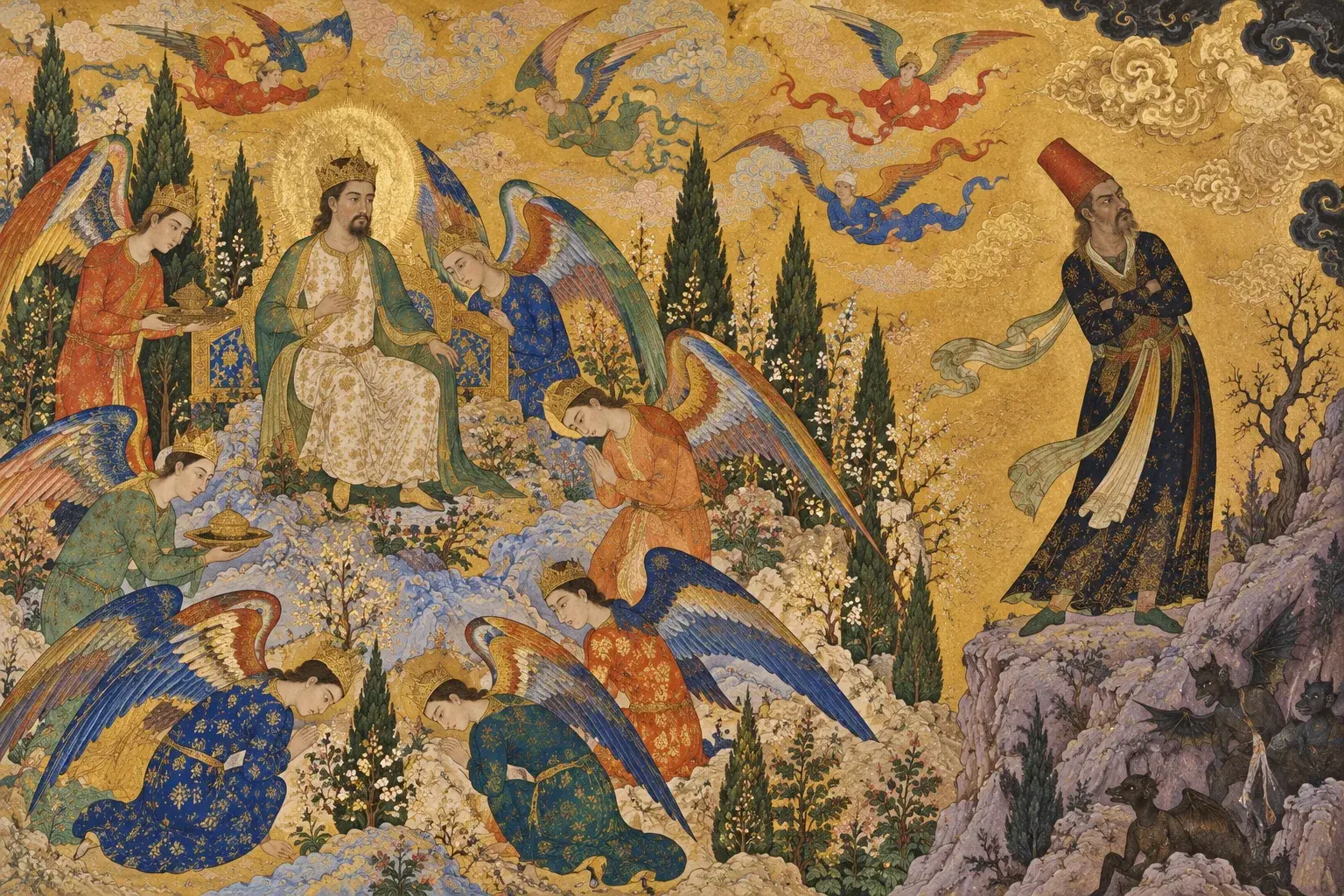
Sultan Muhammad II ruled one of the biggest empires in the world. It stretched across what is now Iran, Uzbekistan, Turkmenistan and Afghanistan. In December 1220 he died in a tent on a tiny island in the Caspian Sea. His men buried him in part of the clothes he had been wearing, because they had nothing else to wrap him in.
His mother, Terken Khatun, was in some ways even more powerful than he was. She had run large parts of the government for twenty years. She ended her life as a prisoner, eating food thrown to her from another man's table.
This is the story of how both of them fell, and of the argument inside their own family that helped bring the empire down.
Who These Two People Were
The Khwarazmian empire was young, rich and enormous. Muhammad II had come to the throne in 1200 and spent twenty years making it bigger, until it covered more than four hundred thousand square miles.
Terken Khatun was his mother. She was the daughter of a Kipchak khan, from a Turkic people of the steppe, and she had married the previous shah. After his death she did not step back. She became her son's co-ruler in everything but name.
Her power was real and organised. She had her own government office, her own seal for stamping official documents, and her own lands and income. When her son or her husband conquered a region, one of her trusted relatives was usually put in charge of it. Historians who study the period say her orders often outranked her son's.
That is not a compliment to the way the empire worked. Two governments were giving orders at once, and when the Mongols arrived, the empire could not agree with itself about anything.
There was a second weakness underneath that one. A great deal of the army was made up of Qipchaq horsemen, a Turkic people from the steppe, and their loyalty ran to Terken Khatun and her relatives rather than to the sultan. So the empire was not really one country with one army. It was a loose collection of regions, held together by a family that had stopped trusting itself.
Samarkand and Its Twenty Elephants
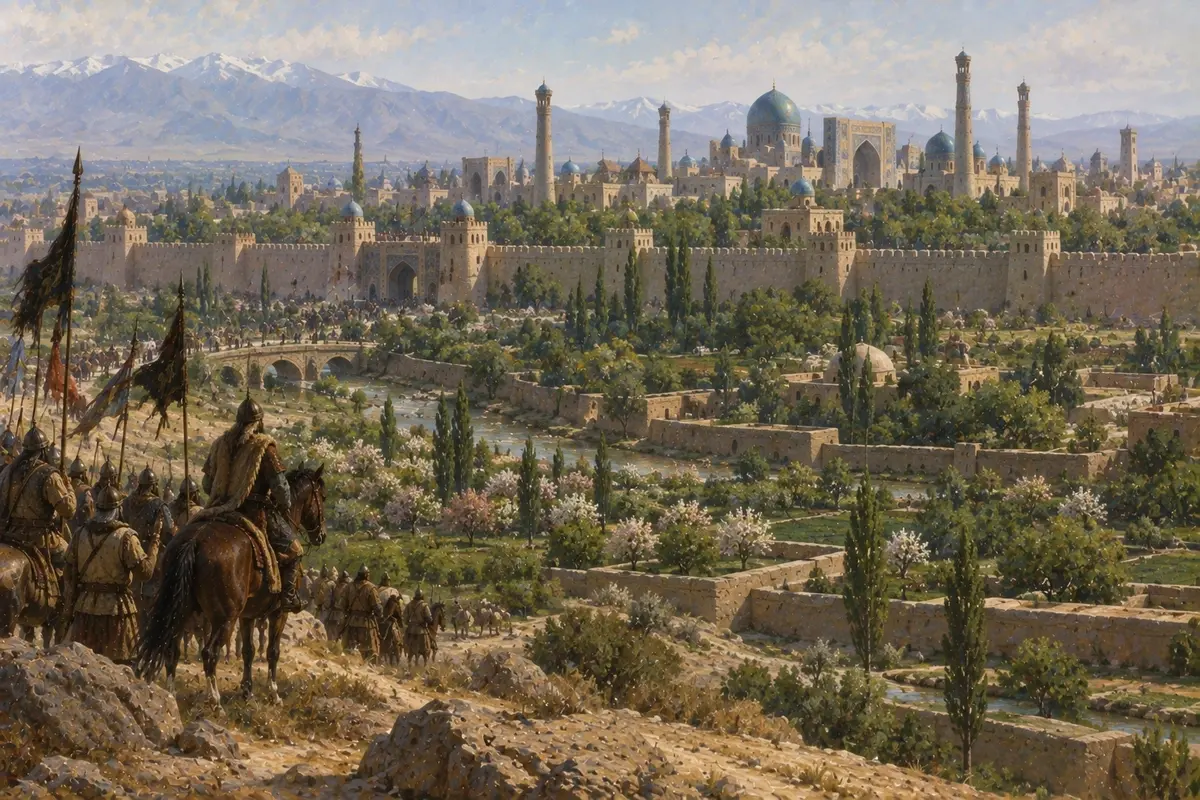
From a distance the city was mostly trees. The walls, the iron gates and the forts along them were what an army saw first.
Samarkand was the empire's greatest city. It had double walls, iron gates, forts spaced along the outside, and a deep ditch. Water arrived through lead pipes from a stream in the mountains, so that almost every house had a fountain in its courtyard. Orchards and gardens grew so thickly around it that from a little way off you could only see the minarets above the treetops.
The sultan put more than a hundred thousand soldiers inside. He also sent twenty war elephants.
Genghis Khan arrived in March 1220. What happened next was not really a battle. The city's wealthy merchants and its religious leaders decided the place would fall sooner or later, and that surrendering early was safer than surrendering late. The professional soldiers wanted to fight on.
The citizens won that argument. They opened the gates.
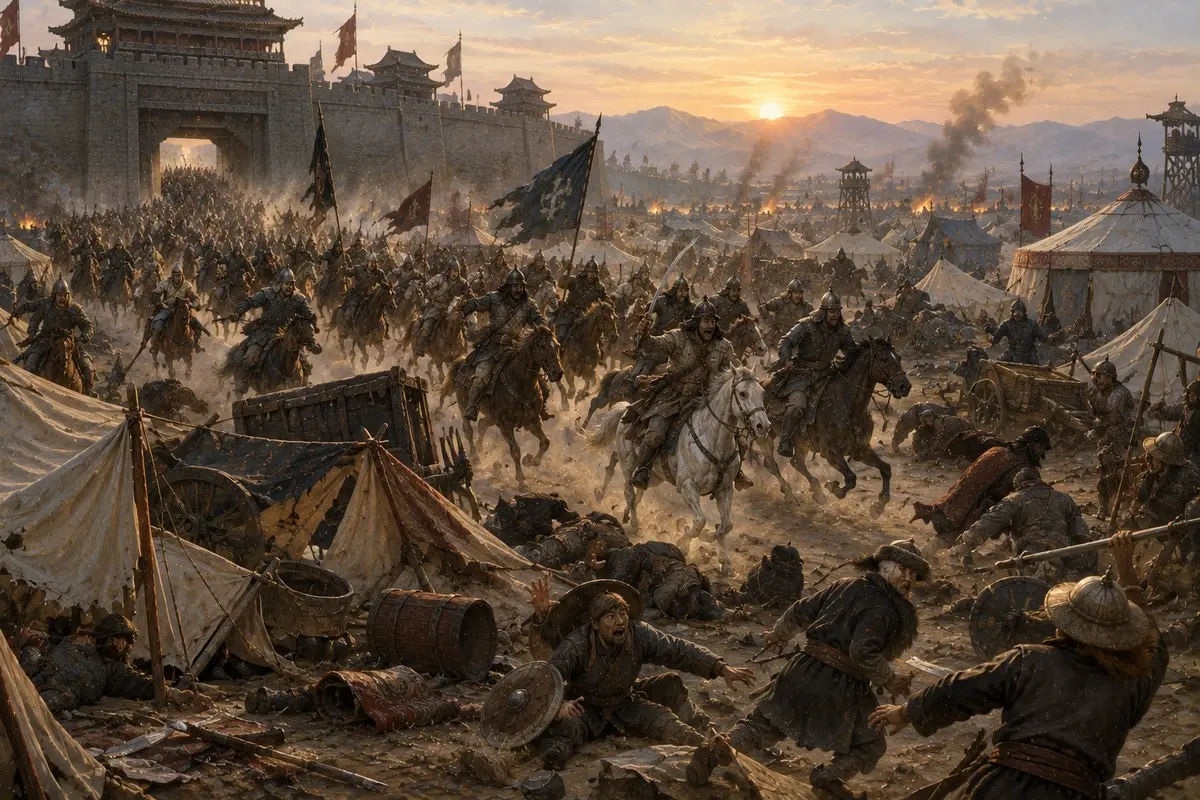
About a thousand riders cut their way out through the middle of the besiegers. Almost everyone who stayed was killed.
Genghis Khan kept the deal exactly as he had made it. The ordinary people of Samarkand were spared. The soldiers were not. Around three thousand men who surrendered were executed. About a thousand more made a final charge, cut straight through the Mongol camp and escaped into open country.
It is worth understanding why he did it that way rather than simply killing everyone. Keeping a promise exactly, in public, was useful to him. Word travelled. The next city along would hear that the people who opened their gates lived and the people who fought did not, and would make its decision accordingly. Mercy and terror were being used as two halves of the same tool.
The elephants, by the way, were no help at all. War elephants panic under heavy noise and arrows, and at Samarkand they turned and trampled through their own side before running off across the open plain.
The Fight Over Who Came Next
Muhammad had several sons. The eldest was Jalal al-Din, and by any normal rule he was the heir.
His grandmother did not want him. Jalal al-Din's mother had been a concubine rather than a royal wife, and she came from outside Terken Khatun's own family group. A younger brother's mother did not. So Terken Khatun pushed her son to name that younger boy as heir instead.
This mattered far more than a family squabble should have. The empire was about to be invaded, and its royal family could not agree who would lead it. Jalal al-Din turned out to be the only member of the family who could fight the Mongols at all.
Chased Across an Empire
Once the great cities began falling, Muhammad stopped trying to hold anything and simply ran.
Genghis Khan sent two of his best generals, Jebe and Subutai, after him with about twenty thousand men. Their only job was to keep chasing. They followed him across Khorasan, from province to province, while the men still with him drifted away.
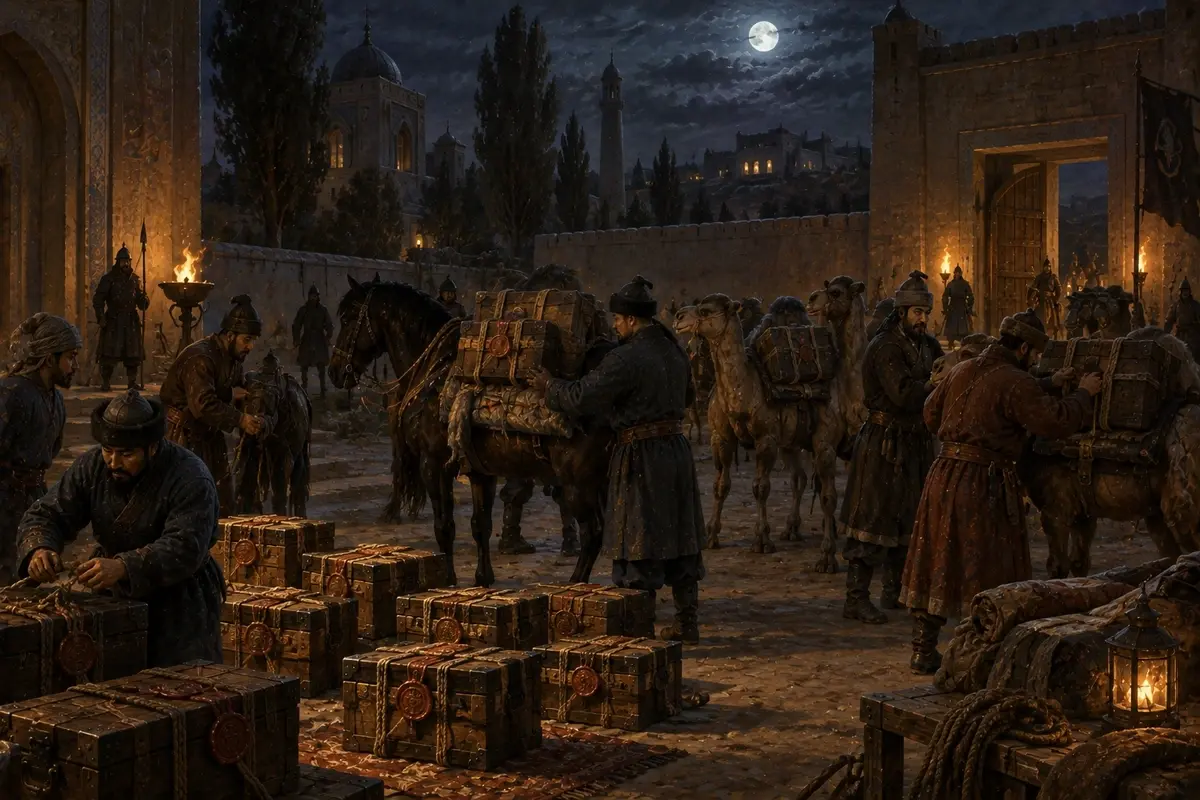
The royal treasure was sent off into the dark with a household officer, to a fortress nobody was supposed to know about.
Somewhere along the way he sent the royal jewels off in sealed chests with a trusted household officer, to be hidden in a distant fortress. He was already behaving like a man who did not expect to need them.
This is the part of the story people find hardest to believe. He was not a weak or foolish man. He had spent twenty years expanding one of the largest empires on earth and had beaten the Ghurids and the Qara Khitai to do it. But he had never faced an enemy who simply would not stop coming, and once he decided he could not win a battle, he stopped trying to fight one at all. Shutting his soldiers into separate fortresses meant none of them ever had to face the Mongols together.
The Boat and the Island
He reached a small town near the Caspian coast and tried to hide there. By this point he was worn out and badly frightened. He spent his days in the mosque praying to be saved.
A local man told the Mongols where he was.
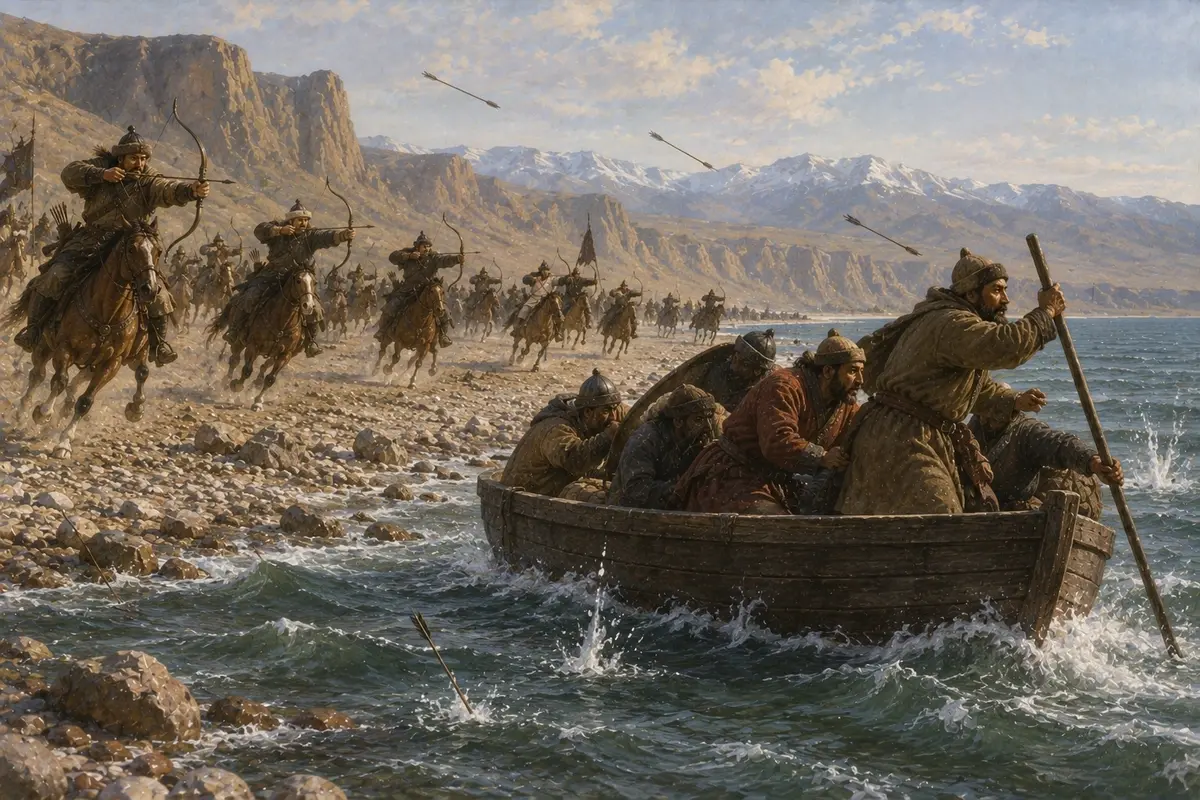
They reached the water a few moments too late, and had nothing that floated.
Word came while he was praying. He ran for the shore and got into a boat. The Mongol riders arrived on the beach just as it pushed off. They shot at him and missed, and they had no boat of their own, so they could only stand and watch him go.
He was already ill. On the water a sharp pain started in his chest, and his men steered for a small island near the south-eastern corner of the sea. Some sources call it Abiskun and others Ashur-Ada. They put up a tent and sent secretly to the mainland for a doctor, who arrived too late to help.
Jalal al-Din heard where his father was and crossed to the island with two of his brothers, keeping the whole visit hidden from the Mongols. On his deathbed Muhammad cancelled the order that had pushed Jalal al-Din aside. He named him his successor, told the other princes to obey him, and handed him his sword.
He died in December 1220. His men washed his body, dressed it again in his own clothes because there was no burial cloth to be had, and buried him on the island in secret.
Twelve Children
Terken Khatun was at Gurganj, the old capital, when she heard that her grandson had been made heir after all. She was furious, and began trying to persuade the officers around her to ignore the dying sultan's wishes.
Then word came that the Mongols were approaching.
She had twelve children in her custody. They were the sons of local princes, held at court as hostages. Keeping royal children as hostages was normal in that world: it was how a ruler made sure their fathers stayed loyal. The children lived at court, but they were prisoners.
She could not take them with her when she fled. So she had all twelve of them killed. Her reason was simply that the Mongols might otherwise set them free.
Nothing in this article excuses what was done to her later. That should be said plainly. It should also be said plainly that this is what she did.
Four Months in a Mountain Castle
She fled south to Mazandaran, a mountainous region on the Caspian coast, and shut herself in a fortress with her jewels and her household.
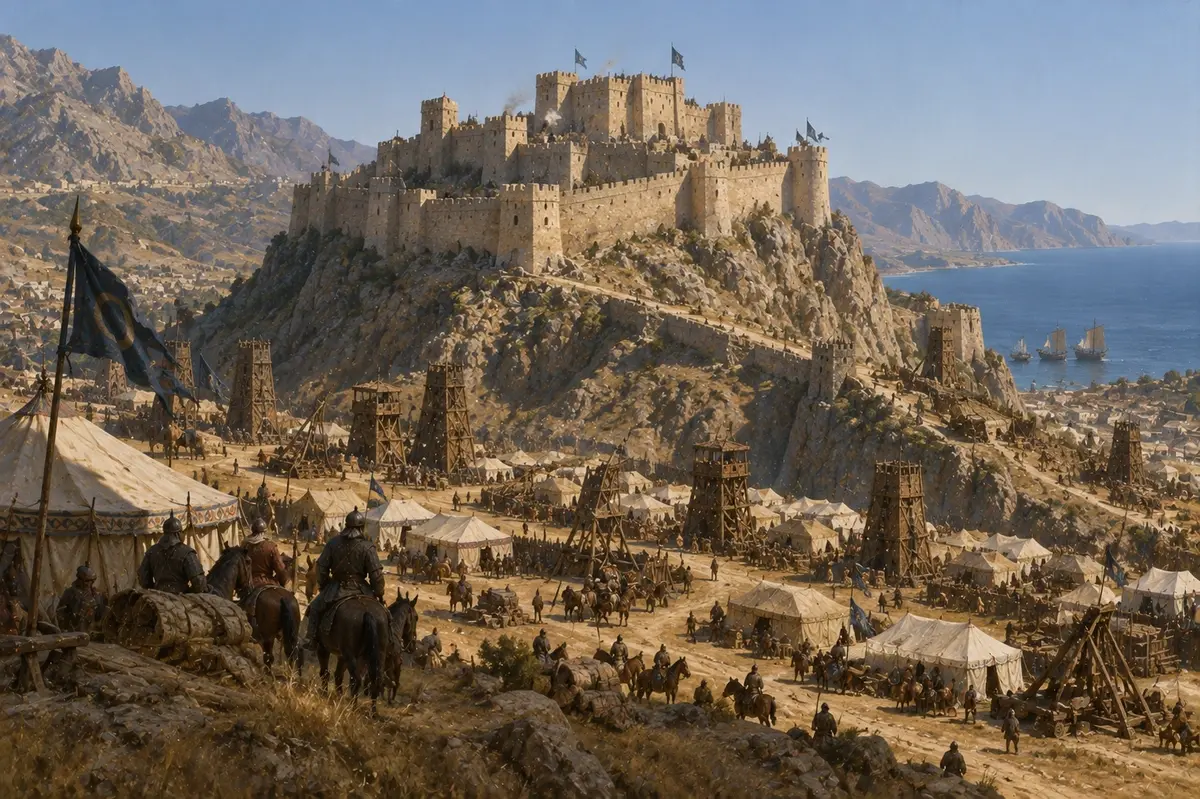
The walls held for four months. Local stories said what finally emptied the castle was a drought in a place that had never needed wells.
The lords with her offered to take her to Jalal al-Din, who would have protected her. She refused. She said she would rather be treated badly by the Mongols than well by her own grandson. That is how deep the family quarrel ran.
The Mongols besieged the fortress in 1221 and it held out for about four months before she surrendered. Her household was killed.
There is a story attached to the siege that people in the region repeated for a long time afterwards. It says the castle fell because the rain stopped. That part of the country got so much rain that nobody there had ever bothered digging a well, and when three weeks passed without a shower the defenders had nothing to drink. People took it as a punishment from heaven for the twelve murdered children. It may or may not be what happened, but it tells you what her neighbours thought of her.
Scraps From the Table
Terken Khatun was not killed. She was taken east to Karakorum, in Mongolia, and kept there as a living trophy.
Genghis Khan had her brought into his tent at the end of dinner so he could mock her, and threw her leftover food as though she were a dog. That detail is not an exaggeration invented later; it is in the record.
She lived like that for more than ten years. She died around 1233, roughly twelve years after her capture, thousands of miles from the empire she had helped govern.
What to Make of It
It would be easy to turn this into a simple moral: she was cruel, and cruelty came back to her. That is too tidy.
She had twelve children killed because moving them was inconvenient. Nothing she suffered afterwards changes that, and she is not a figure anyone needs to feel warmly about.
But the man who kept her alive for a decade so he could humiliate her at dinner was not delivering justice. He was enjoying himself. Both things are true, and the story is better when you hold on to both of them.