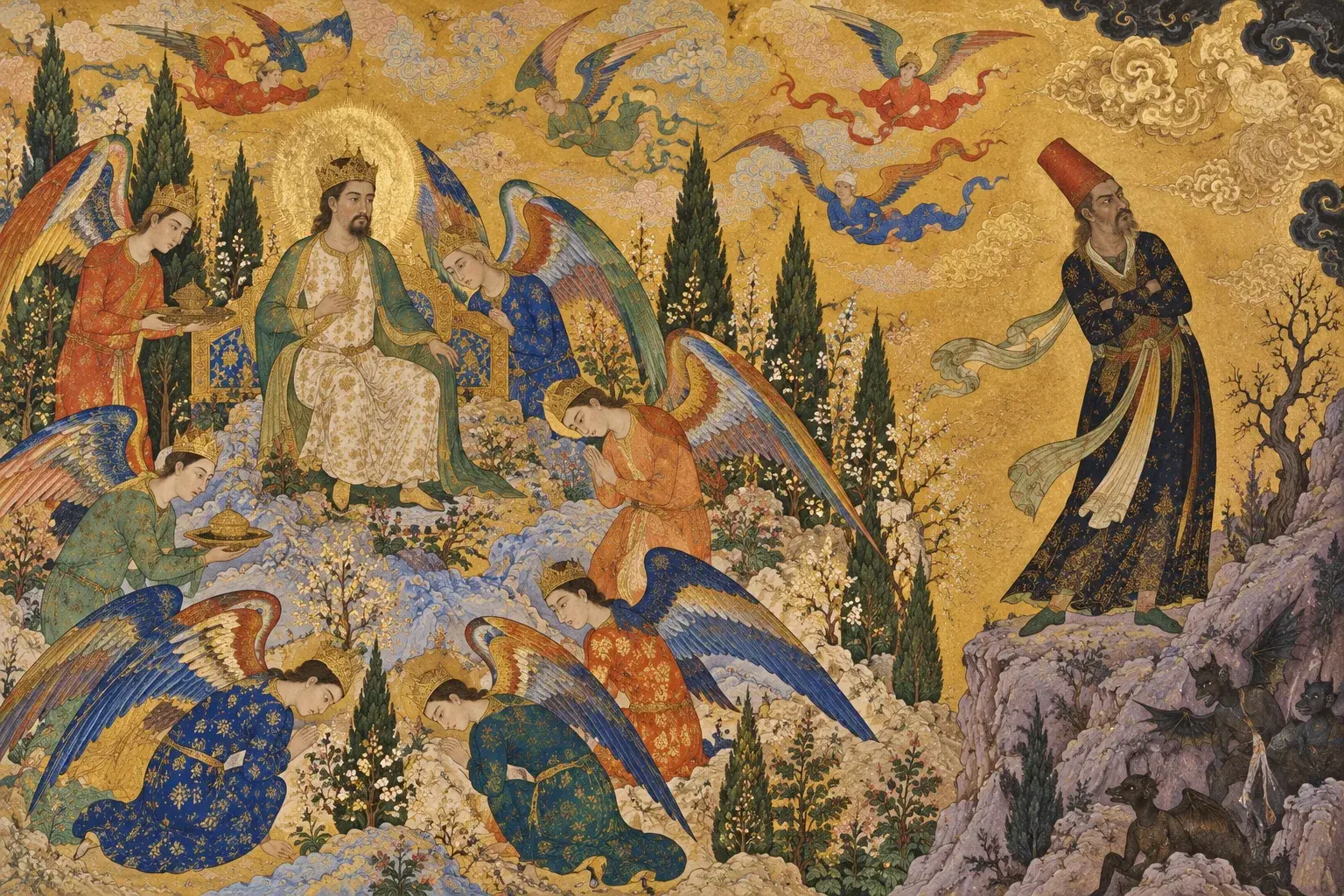
The Mongol invasion of Khwarazm began in 1219 with a mobilisation order sent to every khan, governor and chieftain in the empire, and it destroyed one of the great powers of the Islamic world in about two years.
The numbers reported by the chroniclers are enormous and should not be taken literally. Modern estimates of the force Genghis Khan took into Khwarazmia run from roughly seventy-five thousand to two hundred thousand, very large for the period but a fraction of the figures in the older accounts. The sultan's reported four hundred thousand is inflated on the same scale.
What is genuinely remarkable is not the size of the army but its equipment, its discipline and one piece of navigation. Every soldier's kit was specified. The rules of engagement were written down. And the campaign was decided by a march across a desert nobody believed an army could cross.
The cause was a massacre. In 1218 a Mongol trade caravan of around four hundred and fifty people was arrested at Otrar on the Khwarazmian frontier, accused of espionage and killed, and when Genghis Khan sent envoys demanding the governor be handed over, the sultan had one of them beheaded and the other two humiliated and sent home. That closed every remaining door.
Arms, Armour and the Rope Every Soldier Carried
Messengers went out in every direction with letters explaining the cause of the war and ordering every prince, khan and governor to bring all the troops he could raise to a rendezvous.
The equipment was specified precisely. Each man was to carry a sabre, a bow with a full quiver, and a battle-axe. Each was also to carry a rope, which is the detail that gives the order away as the work of someone thinking practically: rope and cordage were in constant demand among people who lived on horseback and in tents.
Officers were to be armoured as well as armed. Those who could afford it provided a complete coat of mail and the rest had helmets and breastplates at minimum. Horses were protected too, with breastplates of iron or of leather thick enough to stop an arrow.
The Articles of War and a Succession Plan
The army was then issued rules that functioned as articles of war.
No body of troops was ever to retreat without having first fought, whatever the danger. The enforcement mechanism is brutal and explains a great deal about Mongol battlefield behaviour: if any subordinate unit broke ranks and ran before a retreat had been properly ordered, the rest were to stop fighting the enemy, turn on the men who were running, and kill every one of them.
That rule makes your own line the most dangerous thing behind you. It is also a solution to the specific problem that had destroyed every steppe confederation before this one, which is that armies built from allied contingents dissolve the moment one contingent decides it has had enough.
There was also formal provision for the emperor dying on campaign. A grand assembly of khans and chieftains was to be convened, the constitution and laws read aloud in the presence of those khans and of his sons, and a new khan elected according to the forms laid down.
The Irghiz River and the Campfires
Before the invasion proper there had been an accidental meeting between the two powers, and its effect on the sultan may have shaped the entire war.
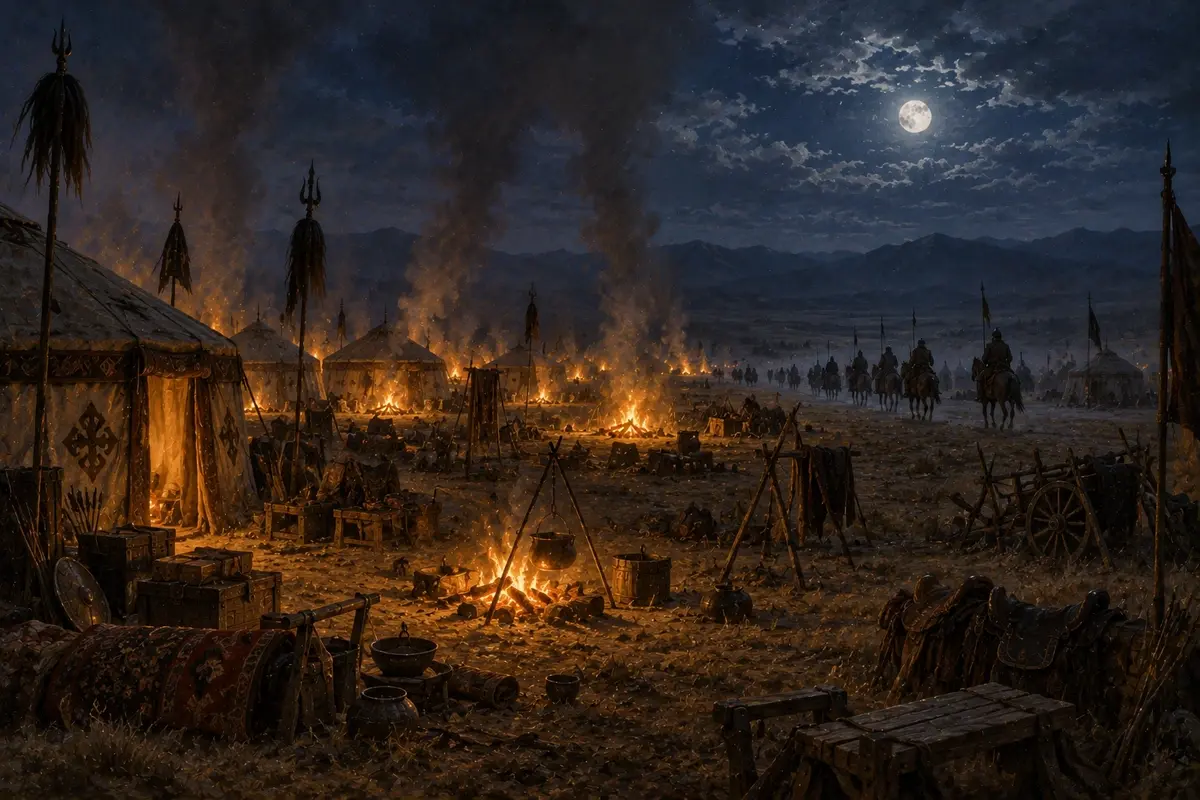
Fresh fuel on the fires bought a night's head start, and the enemy formed up the next morning against nobody.
A Mongol column ran into the sultan's army on the Irghiz river and fought an indecisive engagement that lasted the whole day. At nightfall the Mongols withdrew, having first kindled fires and torches across the camp so that it appeared still occupied, and by morning they were beyond reach. The command is usually credited to Subutai, with Jochi present, and the date is disputed between 1209 and 1219.
The chronicler al-Nasawi attributes something important to that encounter: the speed and mobility of the Mongol troops frightened Muhammad badly enough to shape his later strategy. Rather than meet them in the field again he broke his army up and shut the pieces into fortresses, which meant that when the invasion came, every garrison in his empire faced it alone.
Crossing the Kyzylkum
The invasion opened at Otrar, on the frontier, and the city held out for longer than expected. Genghis Khan used the time to learn how strong Samarkand's defences were, and then made the decision that won the campaign.
He split his forces and took a column of somewhere between thirty and fifty thousand men across the Kyzylkum, roughly four hundred and fifty kilometres of freezing sand and tussock that was considered impassable for a large army. Local guides took them through.
The point was not endurance. It was arrival. Muhammad had concentrated his defence around Samarkand and was watching the roads an army was expected to use. In February 1220 a Mongol army appeared in front of Bukhara, several hundred kilometres behind where anyone was looking for it.
This is the manoeuvre that decided the war, and it is worth being clear about why. Bukhara sat behind Samarkand. Taking it did not merely add a city; it cut the sultan's capital off from the western half of his own empire and put a Mongol army on the wrong side of his defensive line. Everything after this is a man trying to hold a position that has already been turned.
Zarnuk, Nur and the Value of Surrender
Two towns on the road show the policy working exactly as designed.
At Zarnuk a body of Mongol horsemen rode up shouting and the gates were shut in terror. Genghis Khan sent an officer to say resistance was pointless, that the citadel should be demolished and the young men sent out to him, and that presents would help. The town did all of it. The young men were enrolled in his army, the elders were sent home, and Zarnuk survived intact minus its fighting-age population.
Nur was reached by a shortcut pointed out by a man from Zarnuk. It hesitated before opening its gates, and the punishment for having thought about resisting was calibrated: enough cattle and provisions were set aside to keep the inhabitants from starving, and everything else in the town went to the soldiers.
Surrender at once and you keep your property. Hesitate and you keep only your life. The reputation travelled ahead of the army and did most of its work for it.
Bukhara, February 1220
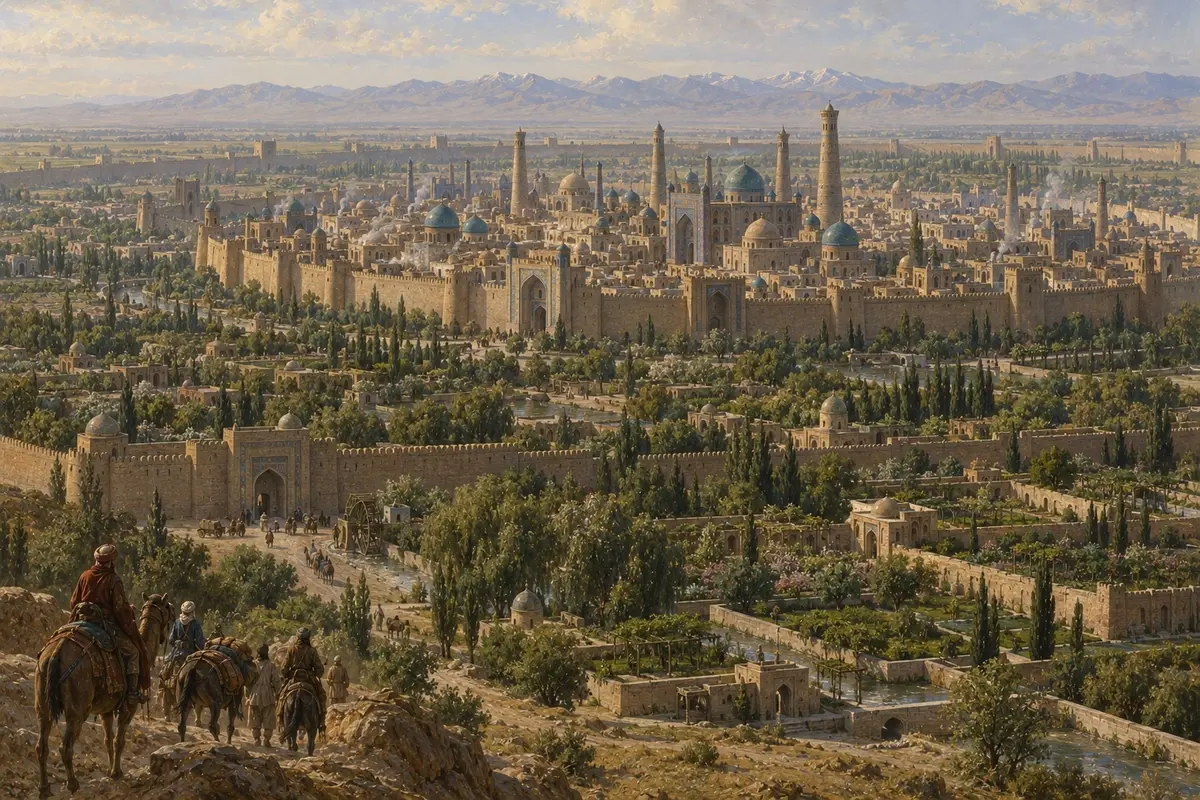
Inside the inner wall stood one of the great centres of Muslim learning; beyond it lay miles of gardens and country houses.
Bukhara was a city of perhaps three hundred thousand people with a history running back five centuries, a centre of Islamic scholarship that nearly rivalled Baghdad, standing in fertile country and well placed for trade. Its garrison is variously estimated at anywhere from two thousand to twenty thousand men.
Its defenders were caught completely by surprise, and the siege was nothing like the long grinding affair it is sometimes described as. After three days the garrison attempted a sortie to break out.
The Sortie and the Amu Darya
They got clear of the city and were caught in the open. A few fought their way through to the Amu Darya, the great river also known as the Oxus, and reached safety. The majority, put by one account at twenty thousand men, were annihilated on the riverbank by Mongol patrols.
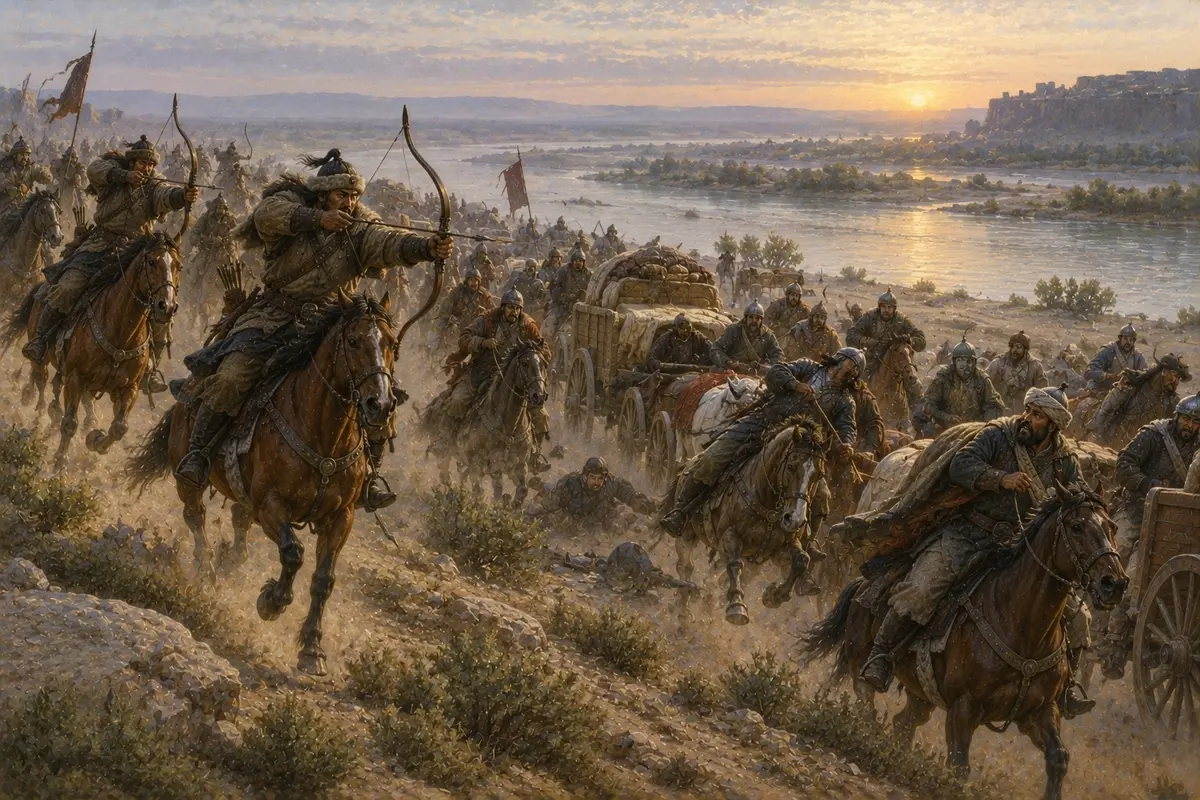
The garrison broke out of the city cleanly and was ridden down in the open on the banks of the Amu Darya.
The citizens, abandoned by the men supposed to defend them, opened the gates. The outer city surrendered on 10 February 1220, three days after the Mongols had arrived in front of it.
The Mosque and the Punishment of God
What Genghis Khan did next is among the most quoted episodes in medieval history, and it needs handling carefully because the sources disagree about it.
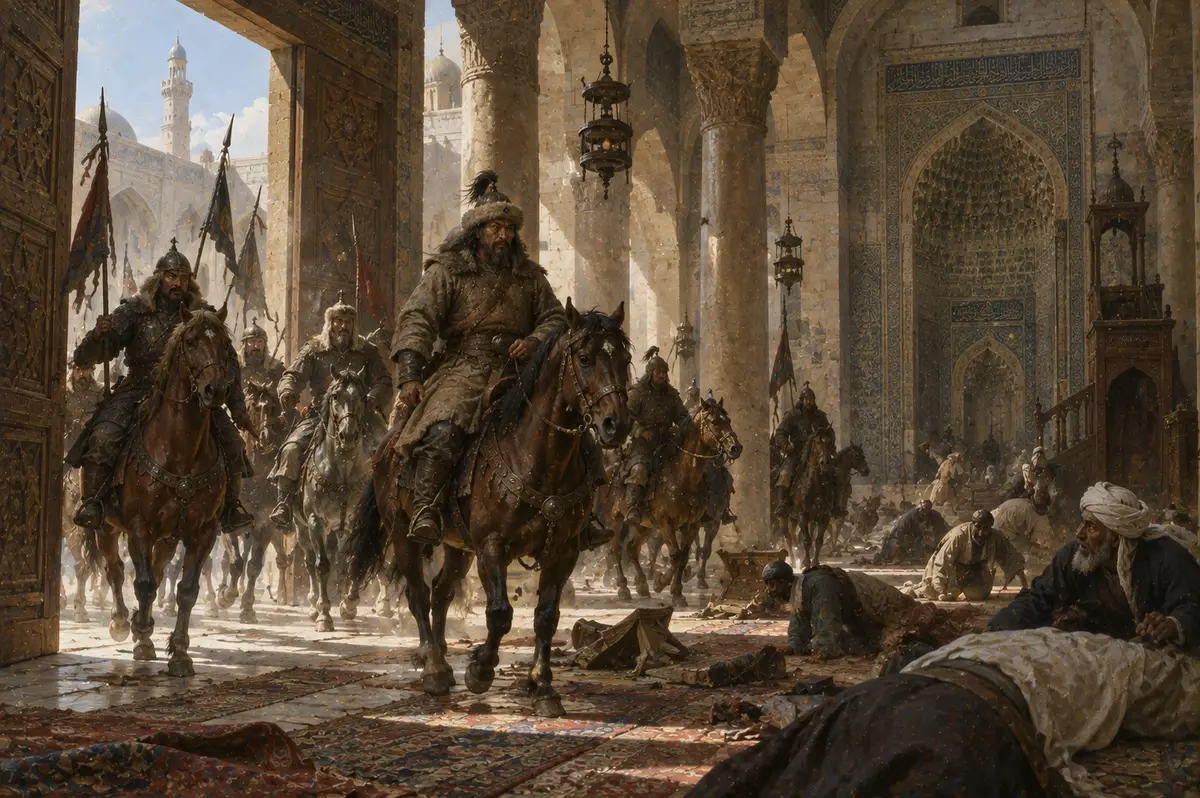
He asked whether it was the sultan's palace, was told it was the house of God, and went on with what he was doing.
In the version given by the Persian historian Juvayni, he rode into the Friday mosque, asked whether this was the sultan's palace, was told it was the house of God, and then had the cases holding the Qur'an emptied and filled with grain for his horses. He addressed the leading citizens from the pulpit and told them that they had committed great sins, that the great ones among them had committed these sins, and that he was the punishment of God: if they had not sinned, God would not have sent a punishment like him upon them.
The point of the speech was practical. It was the preamble to a demand that they produce every piece of money and treasure they possessed, on pain of torture.
The caution is that Ibn al-Athir, writing in Mosul in the 1220s and receiving reports as the Mongols overran Khwarazm, gives an account that corroborates most of Juvayni's but makes no mention of the punishment-of-God speech at all. In his version a shorter speech comes after the citadel fell, and the treasure demanded is specifically the wealth taken from the massacred caravan at Otrar.
The Citadel and the Fire
The outer city had surrendered. The citadel had not. Loyalist troops held it for less than a fortnight against everything the Mongols could bring up.

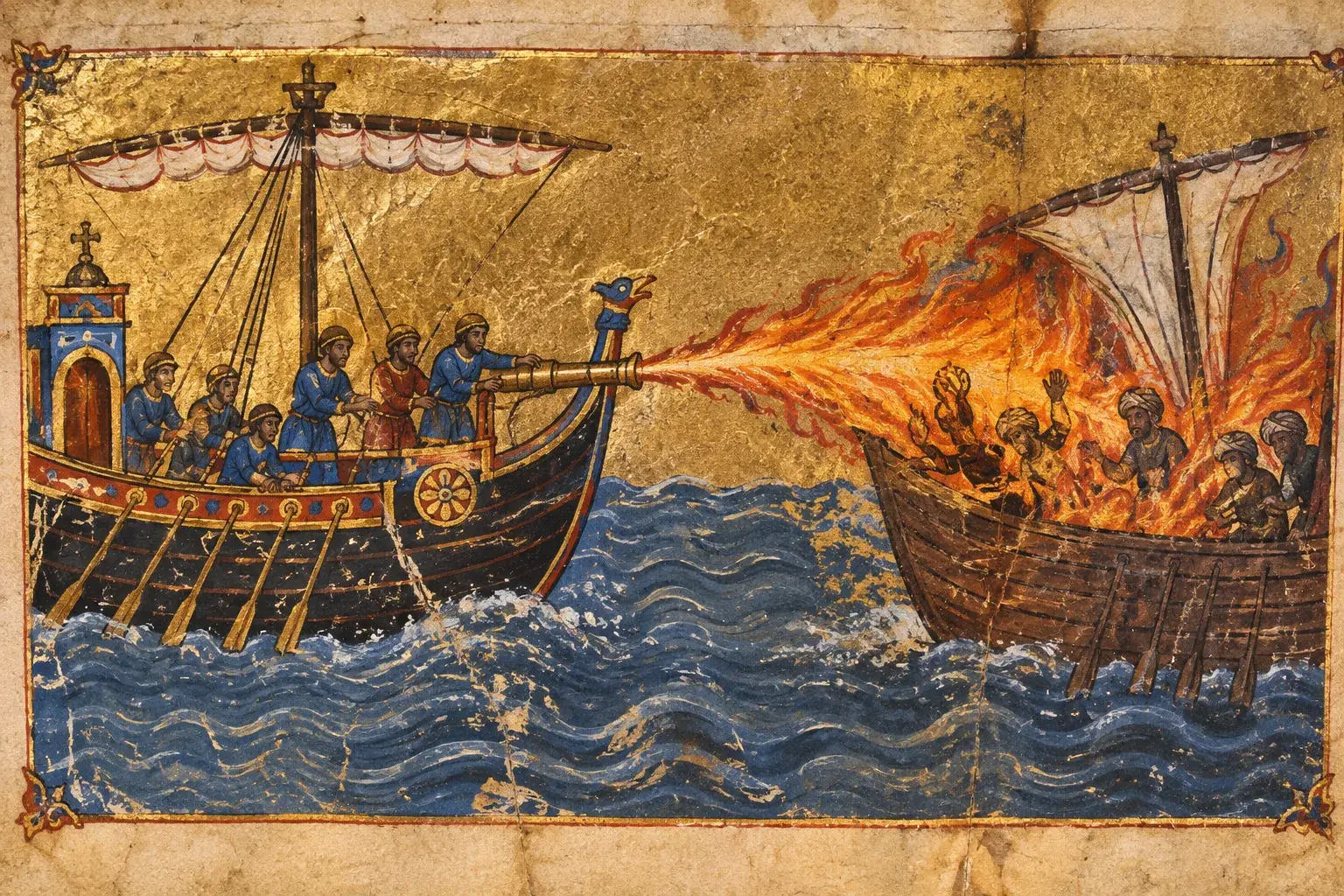
Townspeople were driven against the citadel walls, and the defenders had to pour burning naphtha down on their own neighbours.
The Mongols brought forward mangonels, catapults and heavy siege bows, and drove a large contingent of the townspeople toward the walls ahead of the assault. The defenders were left with the choice of doing nothing or pouring burning naphtha down onto their own neighbours, and the moat filled with bodies. After about twelve days the citadel was breached and everyone inside was killed.
This is the point at which one common retelling has to be corrected. The garrison of the citadel was not spared. It was massacred to the last man.
The fire that destroyed most of Bukhara belongs to the same fortnight, and here too the sources part company. Juvayni has it started inadvertently during the fighting for the citadel; Ibn al-Athir has the Mongols set it deliberately once the looting was finished. The city was largely built of timber and it burned, taking its library with it.
Most of the population was enslaved. Skilled craftsmen and artisans were appropriated and sent east, and other inhabitants were conscripted into the army, which was standard practice and which is also why modern assessments regard the destruction of Bukhara as milder than what the Mongols did to cities later in the campaign. It was a working city they wanted the use of, not merely a place to erase.
The craftsmen matter for a reason beyond their own survival. Skilled workers taken in Khwarazmia were moved east in large numbers, and the transfer of artisans, engineers and administrators across the empire became one of the defining features of Mongol rule. Some of the men who built siege engines for later campaigns were taken in cities like this one.
In March 1220 Genghis Khan moved on Samarkand, having isolated the sultan's capital by taking the city behind it. Muhammad was still watching the roads. Within months he would be a fugitive, and within a year he would die on an island in the Caspian with no shroud to be buried in.