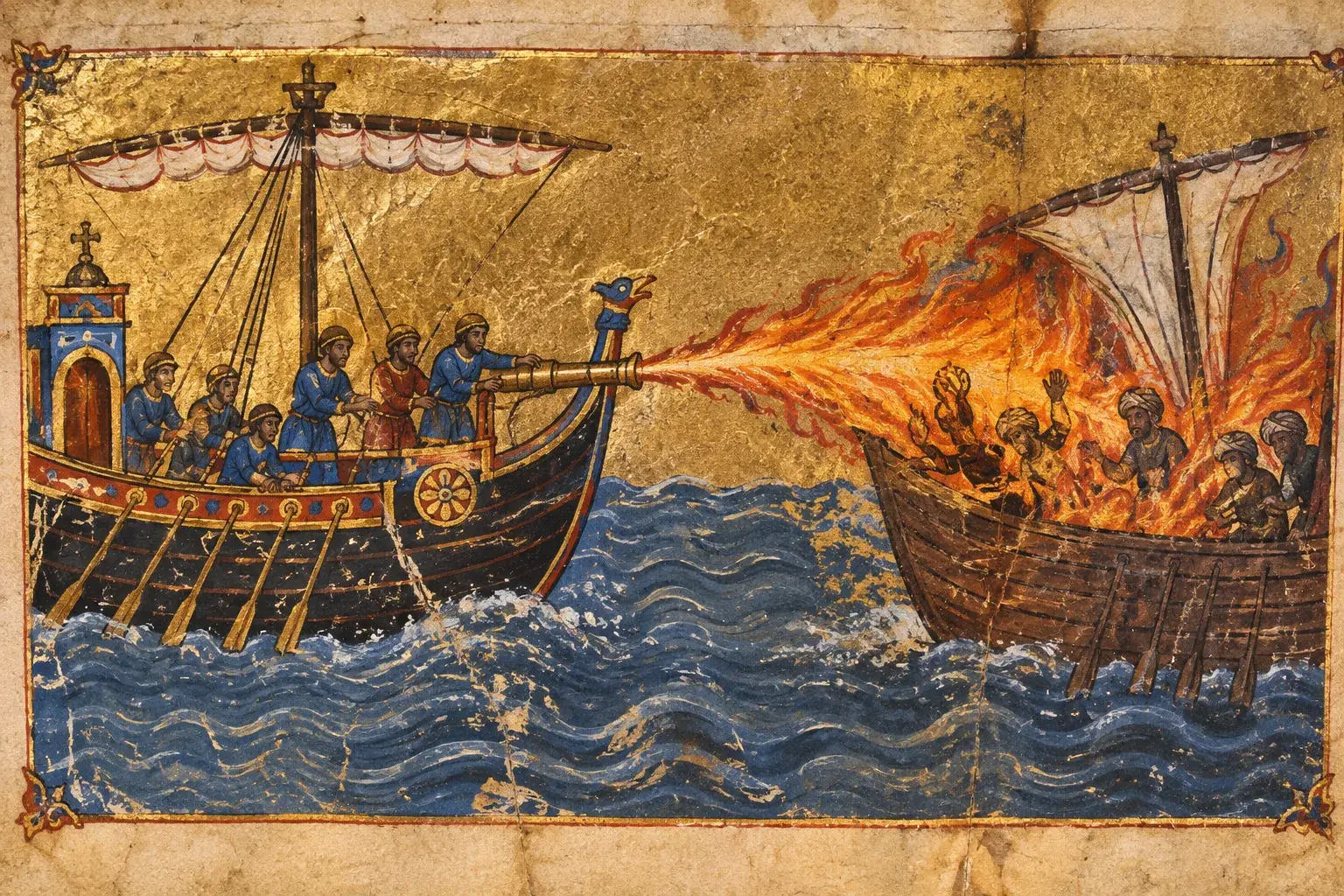
A philippic is a speech attacking someone with sustained, unrelenting hostility. The word is 2,300 years old and it comes from one man's twenty-year campaign to get Athens to take a threat seriously. He was right about the threat. He was right about the timetable. He was right about what would happen if nothing was done. Athens listened, admired the speeches, and did roughly nothing until it was too late. Then it lost a battle, lost its independence, and Demosthenes ended up taking poison in a temple to avoid arrest by the man who'd finished the job. And Athens gave him a statue, which is a very Athenian sequence of events.
The Pebbles
Demosthenes was born around 384 BCE, and everything about his early life pointed away from public speaking. His father, a wealthy manufacturer of swords and furniture, died when he was seven. His guardians spent most of the estate. When he came of age he sued them — and, crucially, wrote and argued the cases himself, learning rhetoric because he needed it rather than because he wanted a career in it. He won, and recovered very little, and had discovered what he was for. His first appearance before the Assembly was a disaster. He was laughed off the platform. Plutarch says his delivery was weak, his argument over-elaborate, his breath control poor, and he had a speech impediment — some kind of stammer or an inability to pronounce the r sound, which in Greek is unfortunate for a man whose profession is named rhētorikē.
What he did about it is the most famous training regime in history, and every element of it appears in Plutarch. He built an underground study and worked there for months at a time, shaving half his head so that he'd be too embarrassed to go out even if he wanted to. He spoke with pebbles in his mouth to force clearer articulation. He recited verse while running uphill to build breath control. He declaimed at the sea to learn to project over a crowd's noise. He hung a sword from the ceiling pointed at the shoulder he twitched, to break the habit. And he copied out Thucydides' History eight times by hand to absorb the prose. How much of this is true is anyone's guess. Plutarch was writing four hundred years later and these are exactly the anecdotes a tradition invents about someone who got very good at something. What isn't in doubt is the result. Demosthenes became the finest speaker in the Greek world by a margin nobody disputed, and his surviving speeches — around sixty of them — were studied as the model of Greek prose for the next two thousand years. Cicero learned from him. So did every European orator who came after Cicero.
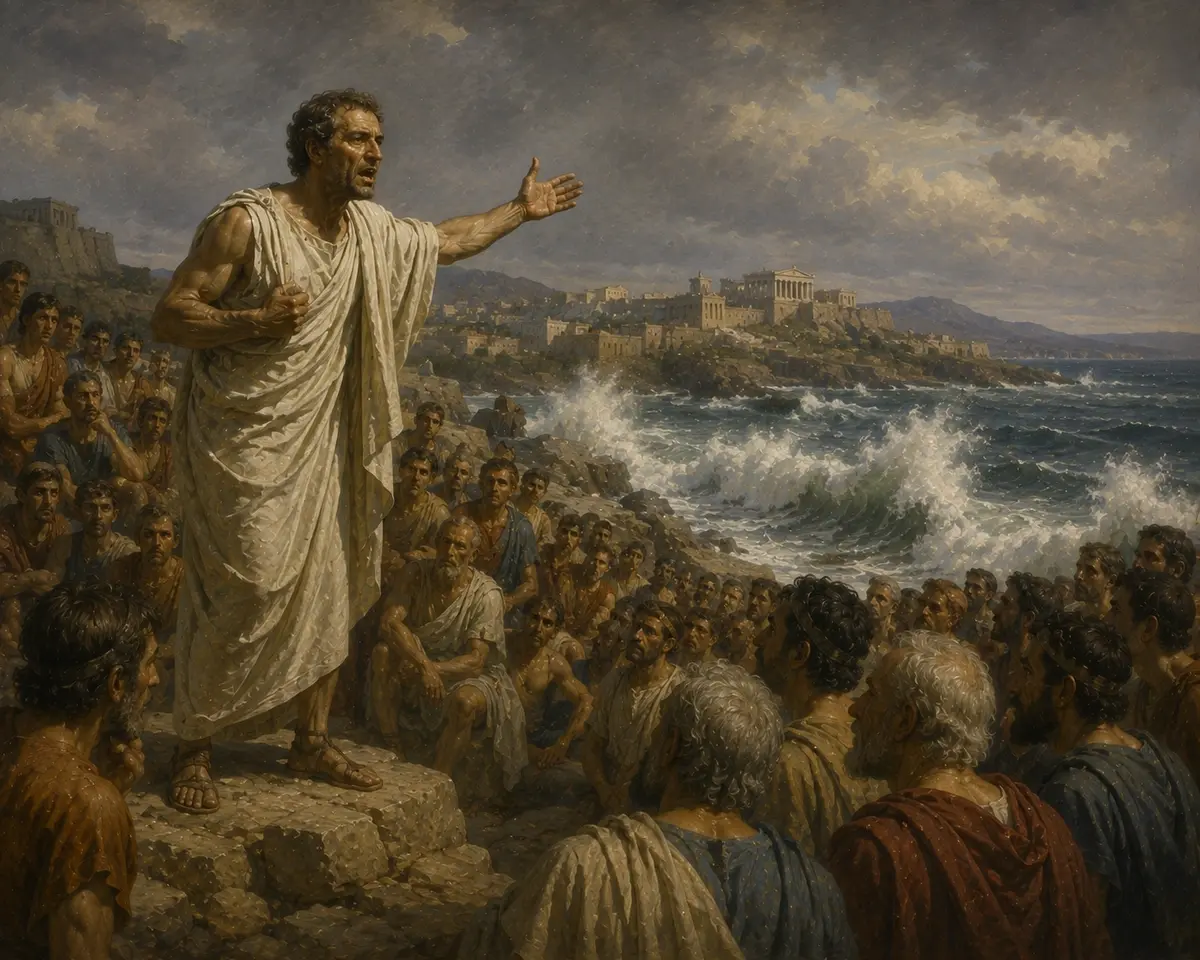
Pebbles in the mouth, verse recited running uphill, declaiming at the sea. All of it is in Plutarch, writing four hundred years later. The resulting speeches are not in doubt.
The Threat
Philip II of Macedon took a marginal, semi-Greek northern kingdom in 359 BCE and turned it into the dominant military power in the Aegean world within twenty years. He did it with a rebuilt army — the sarissa phalanx, professional and drilled year-round — and with an even better grasp of politics. Philip preferred to buy a city than besiege it, and said so: he claimed no wall was too high if a donkey loaded with gold could get over it. He took the gold mines of Mount Pangaeum, which financed everything. He picked off Athenian possessions in the north one at a time. He intervened in a religious war in central Greece and came out of it with a seat on the council that ran Delphi. He signed treaties and kept them exactly as long as they were useful. And at every stage he was, individually, deniable. One city. A border dispute. A dynastic marriage. Nothing that on its own justified a war. That was Demosthenes' whole problem.
The Philippics
From 351 BCE, Demosthenes gave a series of speeches — the three Philippics and the three Olynthiacs — arguing one case over and over, from different angles, for fifteen years. This is not a series of unrelated incidents. Philip is executing a plan and Athens keeps reacting to individual moves as though they were accidents. Delay is the enemy. Athens votes resolutions, sends embassies, and waits. Philip acts in winter, when Greek armies traditionally don't campaign, and by the time the Assembly has debated it he owns the thing they were debating. Athenians are fighting the war like barbarians box — a phrase from the First Philippic that has never been bettered. A barbarian boxer, he says, always puts his hands where he was last hit; he doesn't look at his opponent and never guards in advance. That's exactly how Athens conducts its foreign policy. And citizens have to serve. This was the unpopular part and he kept saying it. Athens had got used to hiring mercenaries and letting its own men stay home, and Demosthenes told the Assembly repeatedly that a citizen army was the only thing that would work, and that they should divert the theoric fund — public money distributed to citizens for festival attendance — into military spending. Telling voters to give up a cash handout and go on campaign themselves is not a way to win applause. He said it anyway, for years. He also — and this is where the modern reader should be careful — took Persian money. Persia had every reason to fund Greek resistance to Macedon, and Demosthenes was one of several Athenian politicians receiving it. He'd have said the interests aligned. His enemies said something else, and it isn't a charge he ever really disposed of.
Chaeronea
Athens finally acted, and finally built an alliance with Thebes — a real diplomatic achievement, since Athens and Thebes had loathed each other for a century, and Demosthenes personally negotiated it. The allied army met Philip at Chaeronea in 338 BCE. Philip commanded the Macedonian right. His eighteen-year-old son Alexander commanded the left, and broke the Theban line — including the Sacred Band, the elite corps of 150 pairs of lovers that had never been beaten. They died where they stood. Philip is said to have wept when he was shown the bodies. A stone lion still marks the spot, and excavation there in the 19th century found 254 skeletons laid in rows. The Greek alliance was destroyed and Greek independence effectively ended. Demosthenes fought in the battle as an ordinary hoplite. He also, according to his political enemies who never let anyone forget it, ran away. Philip treated Athens leniently — he wanted its navy and its prestige, not its ruins — and imposed a settlement that left the city intact under Macedonian supremacy. And Athens, which had just been catastrophically defeated following Demosthenes' advice, chose him to give the funeral oration for the dead. That decision tells you something important. The Athenians didn't think he'd been wrong. They thought he'd been right too late, and that the fault was theirs.
On the Crown
The best speech he ever gave came eight years afterwards, and it was in a lawsuit. A supporter had proposed that Demosthenes be awarded a golden crown for services to the city. Aeschines — a rival orator, long-standing enemy and consistent advocate of accommodation with Macedon — prosecuted on a technicality, and the real subject of the trial was whether Demosthenes' entire career had been a catastrophe. Aeschines' case was straightforward and had the advantage of being obviously true: this man's policy led to Chaeronea, Athens was defeated, and you cannot crown a man for that. Demosthenes' answer in On the Crown (330 BCE) is generally regarded as the greatest speech to survive from the ancient world, and his central move is remarkable. He doesn't argue that the policy succeeded. He argues that the outcome does not determine whether the choice was right. Athens, he says, had a choice between resisting and surrendering, and given who Athens was and what it had always claimed to stand for, there was only one choice it could have made. He invokes the men who fought at Marathon and Salamis — and swears by them, in the most famous oath in Greek oratory — and argues that the city acted as those men would have expected, and that no one can be blamed for an outcome the gods decided. It's an argument that shouldn't work and does. Aeschines failed to get even a fifth of the jury's votes, which under Athenian law meant a heavy fine and loss of the right to prosecute. He left Athens and set up as a teacher of rhetoric on Rhodes. There's a story, probably invented, that Aeschines used to read Demosthenes' speech aloud to his students, and when they exclaimed, told them they should have heard the man himself deliver it.
The End
Philip was assassinated in 336 BCE. Alexander destroyed Thebes in 335 BCE and demanded that Athens hand over its anti-Macedonian politicians, including Demosthenes. Athens negotiated its way out of it. In 324 BCE Demosthenes was convicted in a corruption scandal involving money brought to Athens by Harpalus, a fugitive treasurer of Alexander's. He was fined, imprisoned, and escaped into exile. Whether he was guilty is still argued. Alexander died in 323 BCE, Athens revolted, and Demosthenes was recalled to a hero's welcome — the city paid his fine by voting him a commission and setting the fee at exactly the amount owed, which is an elegantly Athenian solution. The revolt failed within a year. Antipater, Alexander's regent in Macedon, demanded the anti-Macedonian leaders and this time Athens complied. Demosthenes fled to the temple of Poseidon on the island of Calauria and took poison there in 322 BCE, before the soldiers sent for him could take him out of sanctuary. Plutarch says he had been carrying it in a reed pen. Athens put up a bronze statue of him with an inscription saying that if his strength had matched his judgement, Greece would never have fallen to Macedon.
Was He Right?
The case against him is real and worth stating. Macedon was going to win. Philip's army was better than anything the city-states could field, and the city-state system was already exhausted by a century of mutual destruction. Demosthenes' policy got Athenians killed at Chaeronea in the service of a resistance that could not have succeeded. Aeschines' position — accommodate, preserve the city, live — was not cowardice. It was arguably realism. The case for him is the one he made himself, and it's harder to dismiss than it looks. A state that has spent two centuries claiming to stand for something and then declines to defend it when tested has already stopped being that state, whatever survives of the buildings. Which of those you find persuasive probably depends less on your reading of the 4th century BCE than on other things entirely. That's why On the Crown is still on reading lists.