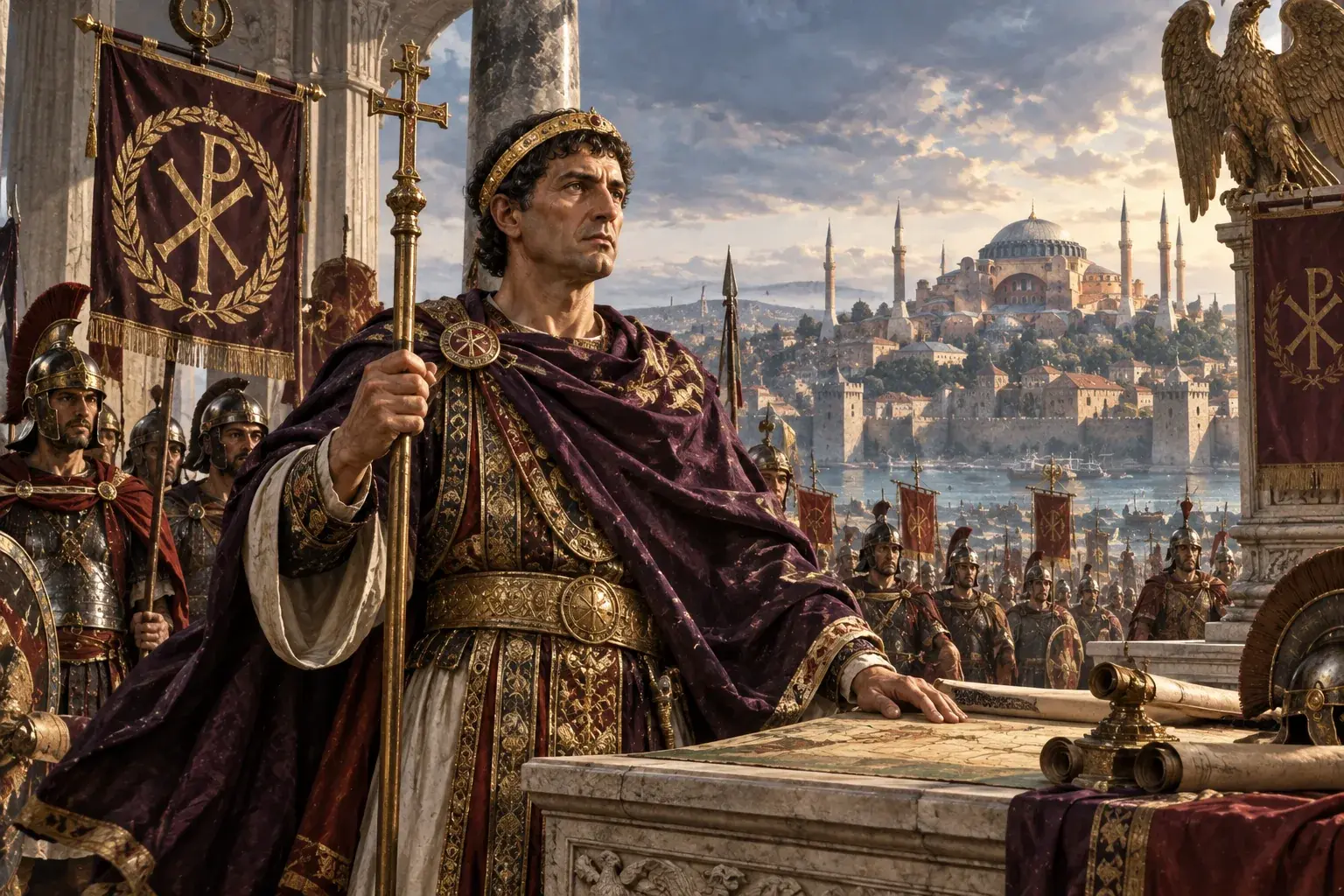
William the Conqueror ordered a survey so thorough it counted every ox, pig, and plough in his new kingdom, and cross-checked the results twice. Domesday Book still has no equal in medieval Europe. Nine centuries later, historians still can't agree on what it was actually for.
Domesday Book is the eleventh century's closest approach to a national database. Compiled over 1086 and 1087 on the orders of William the Conqueror, it recorded who held every piece of land in Norman England, who worked that land, what livestock stood on it and roughly what its yield was in a year.
Nothing else of its kind survives from medieval Europe. Kingdoms kept the charters and tax rolls, but no other ruler on the continent ever managed to take stock of their whole country in one go and write the results into a book that still survives. England would not have the confidence to attempt anything so grand for another seven hundred years.
What makes the survey more than an administrative novelty is the granularity of it. It counts ploughs, mills, fisheries, and pigs. It records how many peasants worked a specific manor before the Norman conquest and how many remained twenty years on, information that rarely survives at all from this period.
Here's what the survey really contains, how a medieval kingdom managed to collect all of it in under a year, and why historians still disagree on what William was aiming to find out.
What Domesday Book Actually Recorded
At its heart, Domesday Book is a survey of property and the people who belong to it. Landowners, tenants, serfs, moveable goods, and the annual income of each estate, gathered from all over the land controlled by the Normans and compiled into two volumes now in the National Archives in London.
The one little convention that trips people up most often is the lack of an article. Historians write Domesday Book, rather than the Domesday Book, which sounds odd, then ceases to register.
The stated aim was a description of all England, and it's a snapshot of a kingdom of up to two million people at a very specific point in time. The exact purpose is a matter still very much up for debate, but it is reasonable to presume it has two parts. To establish who legally owned what land, to settle the disputes that ownership always produces, and to measure income with sufficient accuracy that a tax could be levied on it later.
England After the Norman Conquest
To understand the need for such a record, you need to understand what had happened to English landownership in the country's twenty years leading up to the survey.
William won at Hastings in 1066 and was crowned king of England on Christmas Day of the same year. He took roughly a fifth of his new kingdom as his own, and the rest went to tenants-in-chief, the tenentes in capite, a group of about 1,100 new landowners who between them displaced an entire aristocracy. Any Anglo-Saxon noble who had not died at Hastings, and there weren't a huge number of them, were pushed aside. This group of 1,100 contained 200 great barons and 300 senior figures in the church.
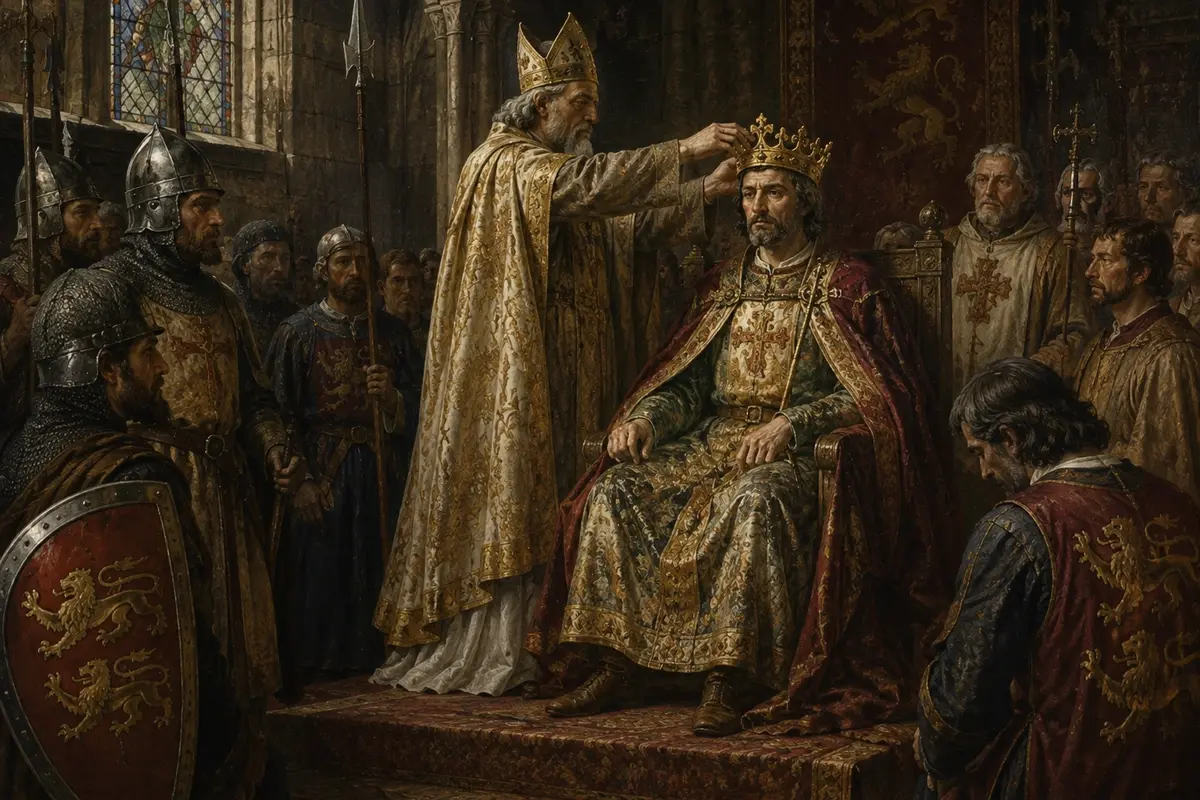
William took the throne after Hastings and spent the next twenty years redistributing nearly all of England's land to a new Norman aristocracy.
The sums are instructive. England's land, and therefore its wealth, was owned by far fewer individuals than before the conquest. Each of these men received an estate, the standard unit being a manor, worked by the serf peasants known as villeins. A great baron might own a cluster of different manors, which he could parcel out individually to his subtenants, who were selected from the lower ranks of the aristocracy, the majority of whom were also Norman.
The administrative machinery was all new, too. The Normans divided the country up into shires, what we'd now call counties, and put a sheriff in charge of each, responsible for judicial, financial, and military business in their jurisdiction. Sheriffs were another Norman monopoly, if not an inherited post then certainly one fixed by decree, and not one that would become hereditary again.
Why the Name Domesday Book Stuck
The title we know it by didn't come into use until the twelfth century, and its provenance is uncertain.
It derives either from doom, the Anglo-Saxon word for customary law, or from the Day of Judgement described in Revelation, on the grounds that what was recorded in the book was incontrovertible. You could not dispute it. Once a manor's entry had been written down, the question of who held it was settled, and a name borrowed from the final judgement carries that weight with it.
The eleventh-century names are far less romantic. Contemporaries appear to have referred to it as the book of the Exchequer, or the great book of Winchester, signifiers of a more mundane document. The grander name was not adopted until later, by people who knew what the book had been capable of.
Scholars Still Debate Domesday's Purpose
This is where the subject becomes most interesting, because after nine centuries studying it, historians cannot agree on the reason for its creation.
The most popular theory is defensive taxation. An invasion from Denmark appeared likely, defending the country would be expensive, and expense requires knowledge of what can be taxed. It does not fit as neatly with the contents, though, and the reason is organisational. Domesday Book is ordered by landowner rather than by parcel of revenue-producing land, which makes it a slow and awkward process if your only goal is to calculate one man's tax liability, a strange choice for a document that exists solely for the Exchequer.
The second theory speaks to legitimacy. The conquest had left English landownership in disarray. Saxon lords had been killed in battle, estates confiscated, William had awarded land to Norman allies, and other Normans had simply taken what they wanted. Twenty years on, nobody could say with any certainty who lawfully held what, and a survey settles that.
The third possibility is the most basic and perhaps the most compelling. William may have simply wanted to know who owned what in his kingdom, period. The historian M. Morris reads the result as a political tool: with the book completed, the king could crush a single rebellious baron on the spot, because he could order the confiscation of every estate that baron held, all of which had been listed.
How the 1086 Survey Was Conducted
The logistics are the most surprising thing about the survey.
Inspectors were sent out across circuits of counties, probably under the overall supervision of William of St Calais, the bishop of Durham. Their remit was to record every single landowner, tenant, peasant, and piece of moveable property, along with the annual income of every manor. A total of around 30,000 manors would appear in the finished document, each one either having been put through a list of questions in person or submitting a self-assessment that the inspectors had then examined.
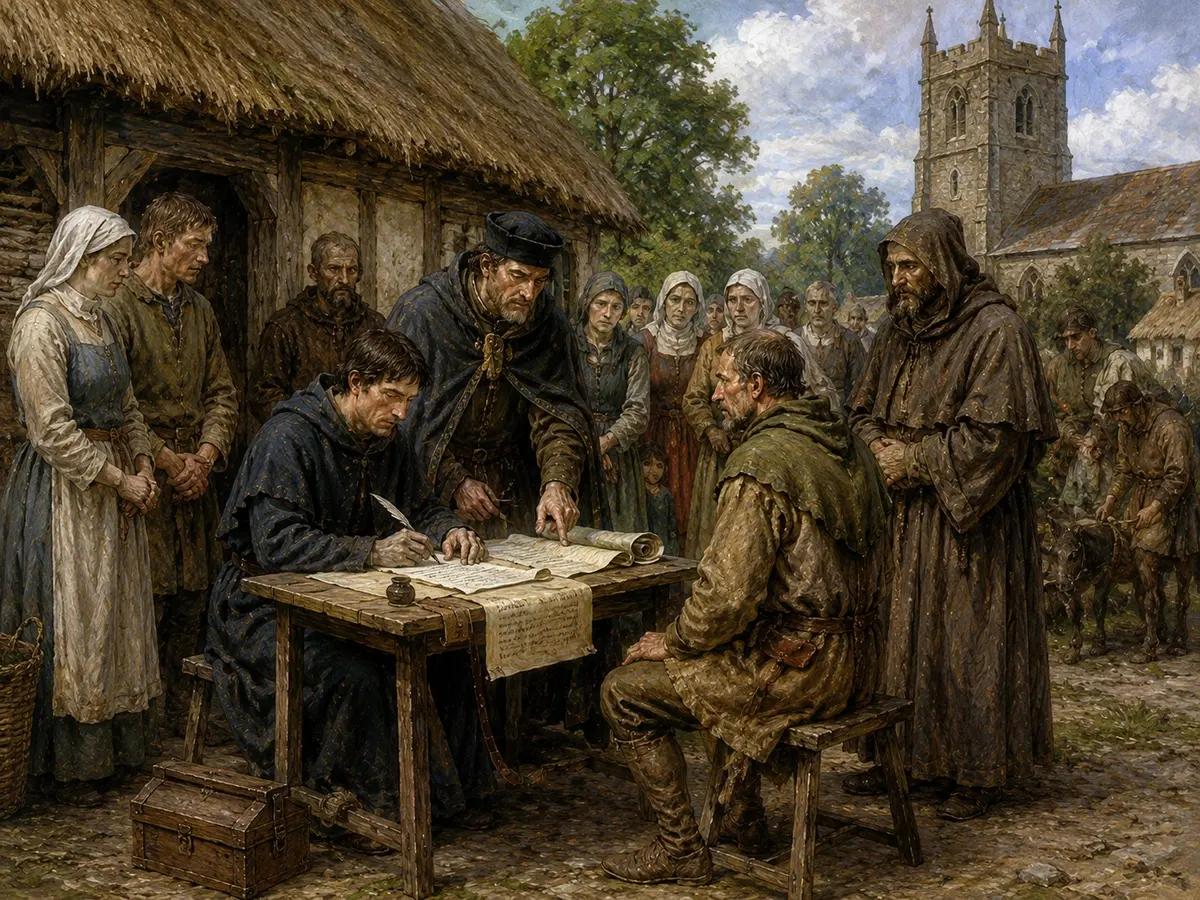
Inspectors worked circuits of counties, asking a fixed set of questions about every manor and cross-checking the answers against witnesses and existing records.
Verification was the real work of the survey. Witnesses were brought before public sessions, existing documents were brought out and cross-referenced, sometimes two or three times over. Local sheriffs and juries were also involved, and the latter were specifically instructed to be split half and half between Englishmen and Normans, an expedient designed to prevent injustice in cases of dispute or uncertainty on either side. There were thousands of such claims.
Then there is the detail that reflects William's true interests. A second round of inspections was sent out to confirm that the first set of inspectors had not been corrupt. Nobody would go to such lengths to verify a simple tax census. The sheer scale of cross-checking is one of the best pieces of evidence that the survey was about much more than raising money.
Winchester and the Royal Scriptorium
When the circuits were complete, the officials returned to Winchester and the findings were compiled in the royal writing office, the scriptorium there.
Within a year of the survey beginning, William had a reasonably accurate, up-to-date account of his kingdom's assets. A list of who owned what, and where, in a country he had more or less entirely redistributed in his lifetime. That achievement alone makes Domesday Book the oldest surviving national census in Europe, with one significant qualification. The lower classes are included here as numbers rather than names. You can learn how many villeins worked a particular manor in 1086, but not what a single one of them was called.
Great Domesday and Little Domesday
The survey survives as two volumes, and the division between them is an accident of history.
Great Domesday, the larger of the two, covers the counties south of the River Tees and the fells of Westmorland. Three counties are omitted from it, and those, Norfolk, Suffolk, and Essex, form the slimmer second volume known as Little Domesday. The curiosity is that Little Domesday is the more detailed of the two. The intention appears to have been to condense its contents and integrate it into the first, a process that was never completed, because William died unexpectedly in September 1087.
Physically, the document extends to 832 pages, or folios, written on both sides in a close, plain hand. The ink is black throughout, with red used in places to denote clusters of holdings or to mark something of particular interest. There is very little in the way of decoration, it is a working document, and it looks like one.
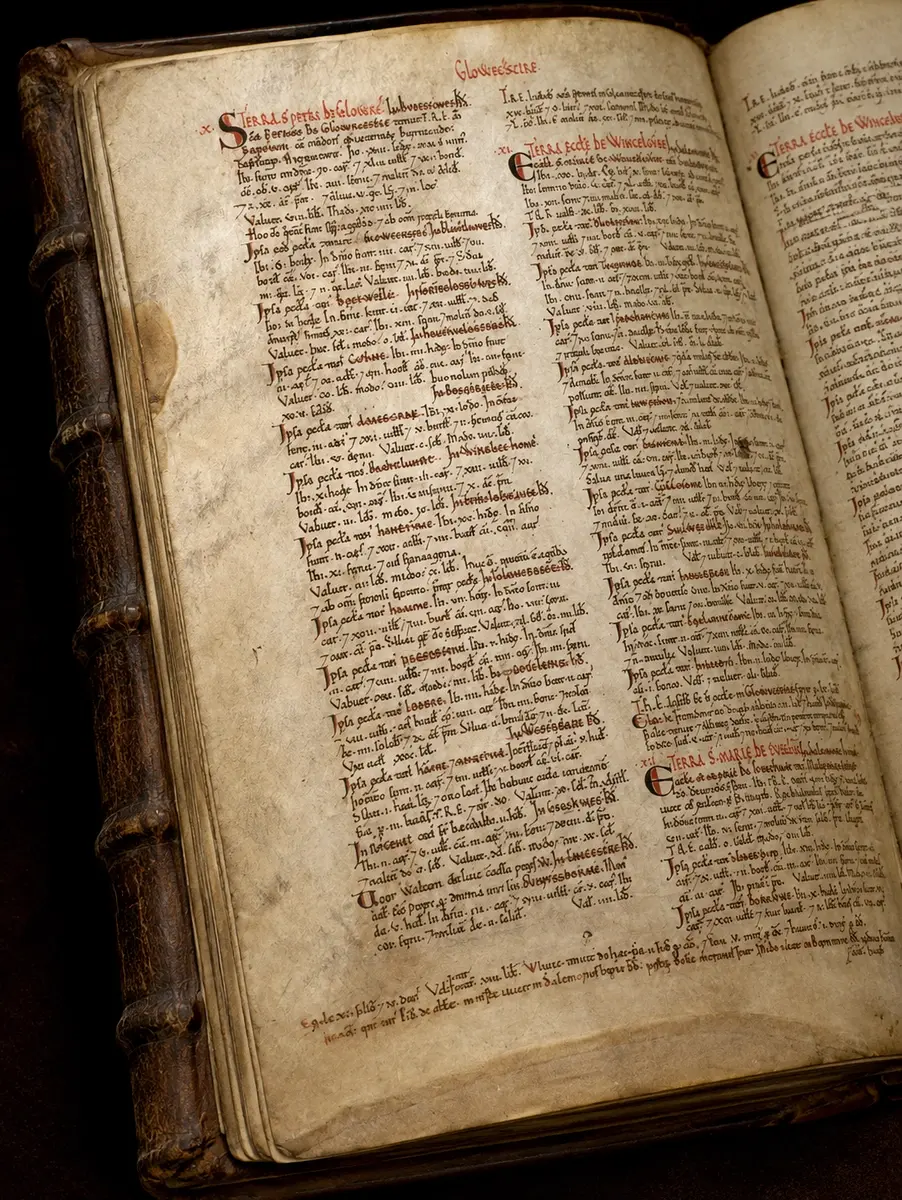
Great Domesday runs to more than 800 pages of close Latin script, with red ink reserved for marking important entries.
Shires, Hundreds and Manor Entries
The organisation reflects the administrative geography of the Normans, with entries catalogued by shire and then by the subdivisions known as hundreds, describing the royal estates in each, detailing every landowner and sub-tenant, and noting who held a position on the local borough and town councils.
Looking at Suffolk is a good way to get a sense of the detail. Its land is divided among 76 different landowners, every one of them named, ranging from King William himself down to ordinary free men. The list includes counts, a countess, bishops, abbots, priests, a long tail of aristocrats whose names have not survived, and crossbowmen, who had presumably earned the king's gratitude on a battlefield somewhere.
The things that are not included are as interesting as the things that are. Castles and churches appear only incidentally, because the survey is about agricultural wealth: what a manor produces, how it is produced, and who owns the proceeds. A castle is a liability rather than a source of income, with very few exceptions, and church lands were largely exempt from state taxation anyway. So the great stone landmarks of the Norman period get barely a mention, and the ploughs are counted individually.
Each manor is treated separately, with a recitation of its means of production, the number of peasants both free and unfree, the livestock, the equipment down to ploughs and mills, and an estimate of what it all brings in during the year.
A Suffolk Manor Before and After 1066
One entry, from the second volume, is particularly illuminating. It details the holdings of a Norman named Robert Malet at Eye in Suffolk, measuring everything against what the previous owner, Edric of Laxfield, had possessed under the reign of Edward the Confessor, who ruled from 1042 to 1066.
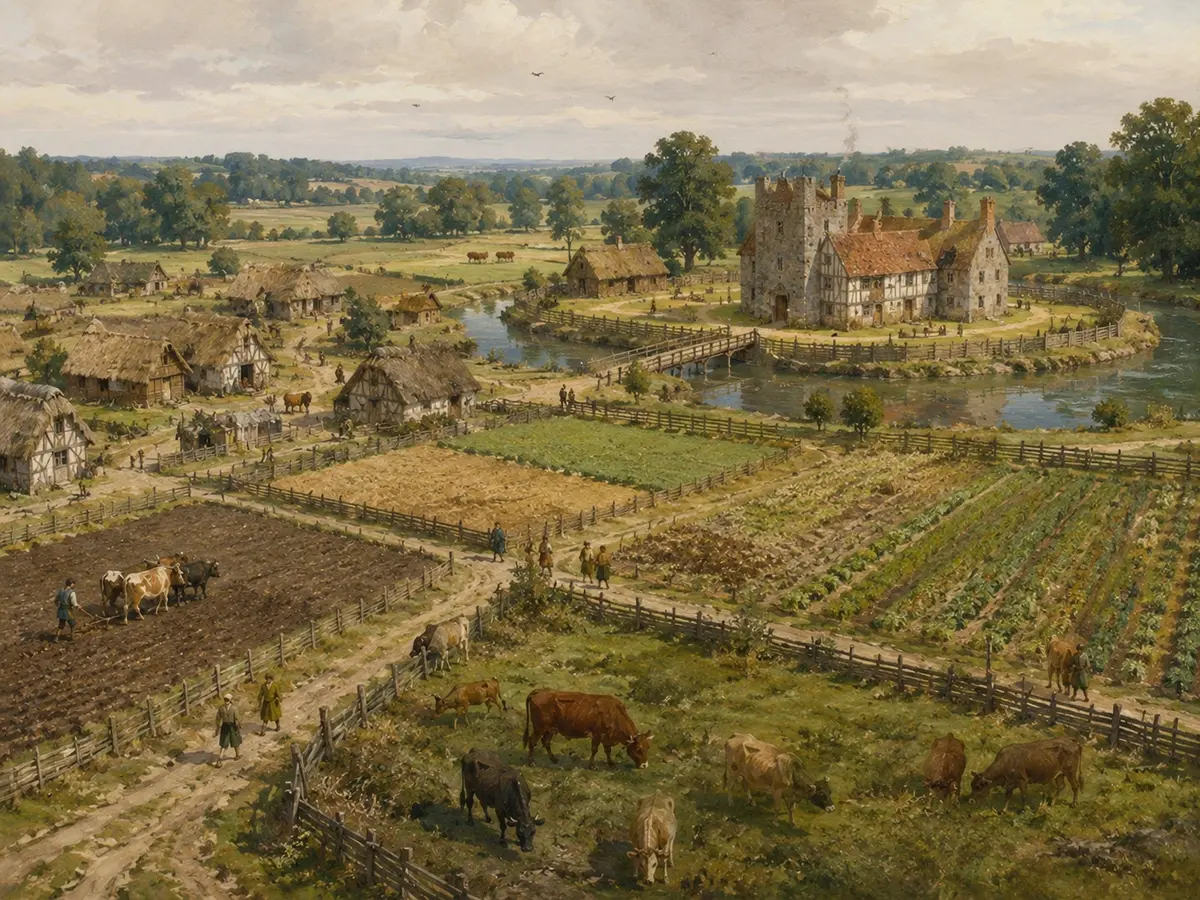
The Eye entry in Little Domesday tracked one Suffolk manor's ploughs, livestock, and tenants against what it had held twenty years earlier under Edric of Laxfield.
The comparisons are stark and they run in only one direction. Where there had been 39 villeins, there are now 20. Where there had been 12 serfs, there are none at all. Eight ploughs on the demesne have been reduced to five, the fifteen that belonged to the men have been cut to six, with a note to the effect that the missing ploughs could be rebuilt. Woodland that had previously supported 120 swine now supports 60. Twenty-four beasts have become none, seven horses have become one, fifty swine have become seventeen.
There is no expansion in everything that is counted. The sheep have gone from 80 to 90, the mill and the fishery are still running, and the manor has acquired a market and a park, but the overall effect is of a working estate that has lost a large share of its people and animals within twenty years of the conquest, noted down without comment by a clerk who was only there to count.
Feudal Military Service in the Records
Scattered throughout the entries on land and its owners, Domesday occasionally records local custom, and some of those passages are the best extant description of how feudal obligation really works.
One specifies the penalty for ignoring a military summons. A man called to an expedition who fails to appear will forfeit all of his land to the king, which is as clear a statement of consequence as it is possible to make. There was also a clause covering legitimate absence, though. If a man had a bona fide reason to stay behind and promised to send a substitute in his place, and the substitute then fails to appear, his lord can deal with the issue by paying a sum of 50 shillings.
That single entry tells you everything you need to know about the period. Military service was the price of holding land, failure to perform could ruin a family, and yet a cash value had been set that would allow a lord to buy his way out.
Villages, Serfs and Castles in 1086
Because the survey was so comprehensive, historians have been able to draw conclusions from it that no other contemporary source allows.
It names around 13,000 villages, it indicates that 90 per cent of the population lived in the countryside, and that roughly 75 per cent of the population were serfs, facts that have no bearing on any romantic view of medieval England you might have. It marks the site of 50 castles, records how many existing properties were demolished to make room for them, and connects them to the markets that grew up alongside.
It also contains a detail that speaks to the conquest in an uncomfortable way. Many English lords had to buy their own lands back from William after 1066. And by adding up the obligations across the kingdom, historians have calculated that the king could raise an army of roughly 16,000 fully armed warriors if he needed to, and that was very possibly the number he most wanted to know.
The Lasting Authority of Domesday Book
The historian Maurice Keen assessed it as a matter of Norman direction within existing Anglo-Saxon tradition of local administration, and pronounced the result the most complete survey of a medieval kingdom's men and wealth ever recorded. A contemporary assessment was even blunter. The Anglo-Saxon Chronicle recorded in 1085 that not a yard of land, and not a single ox, cow, or pig escaped being written into William's record.
England did not manage anything comparable until the nineteenth century. Domesday Book was in the Royal Treasury at Winchester until the thirteenth century, when it was moved to London, and through the medieval period and long afterwards the entries were consulted and cited in legal disputes. That is how the name acquired its weight. Over centuries of being taken as the final word on a question of ownership, Domesday Book came to mean the idea of an unarguable record.
Domesday Book at the National Archives
The manuscript has enjoyed a long physical life since then. It was first bound in the seventeenth century and has been rebound several times since, and in 1859 it came to its current home at the National Archives in Kew, in London, where a version is currently available online for anyone to peruse.
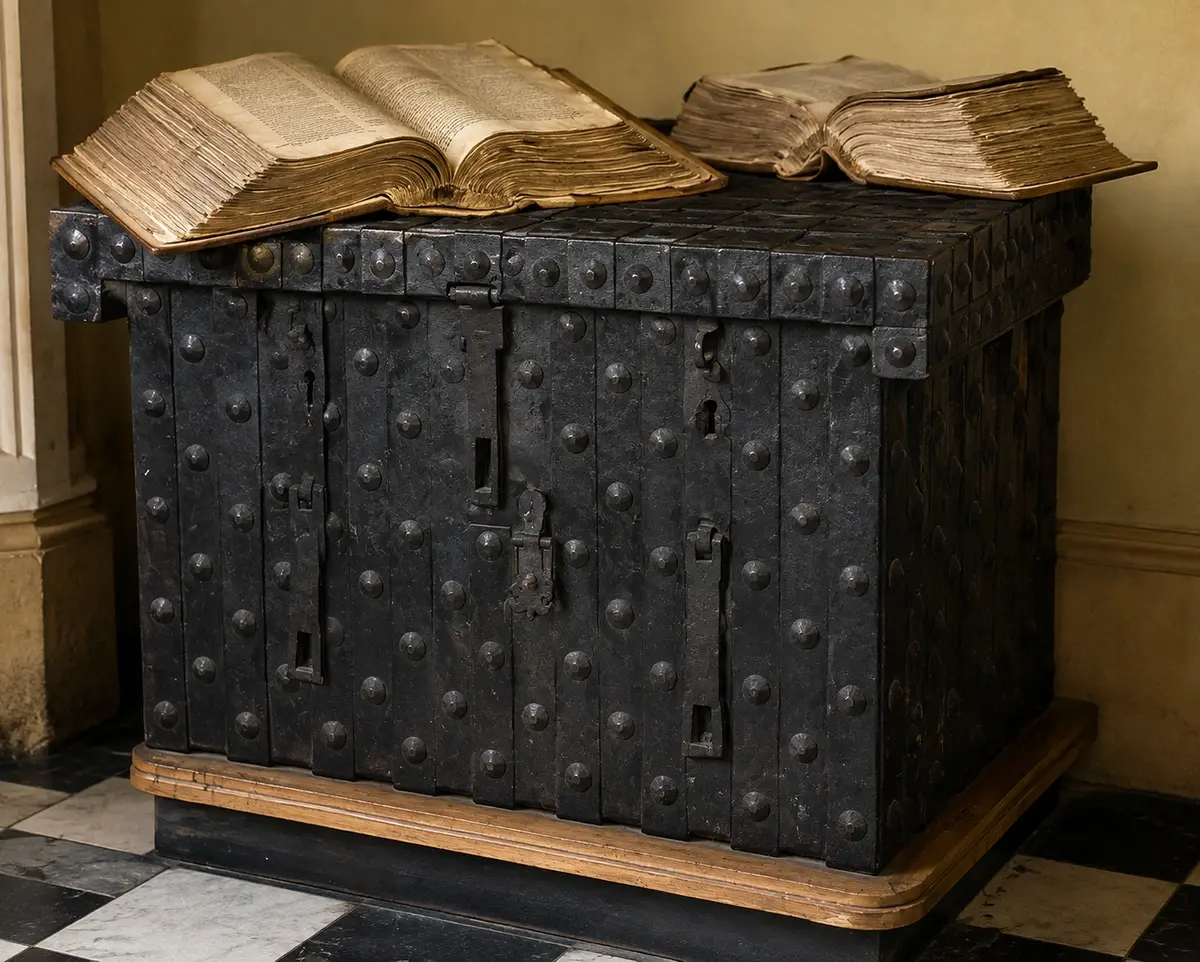
Domesday Book has been housed at The National Archives in Kew since 1859, where a digitized version is also available online.
Some of its technical vocabulary has never been decoded, and there are terms in those 832 folios that have no known meaning, a strange thing to say of a document this well studied. As a snapshot of a medieval population it has no equal, and the reason is simply that nobody else tried.
What remains is the original question, because nine centuries on, we can read almost every single entry in the book and not know for certain what it was intended to do, whether William wanted a tax base or a legal settlement, or just the certainty of knowing what he had taken. The survey answered every question except the one about itself.