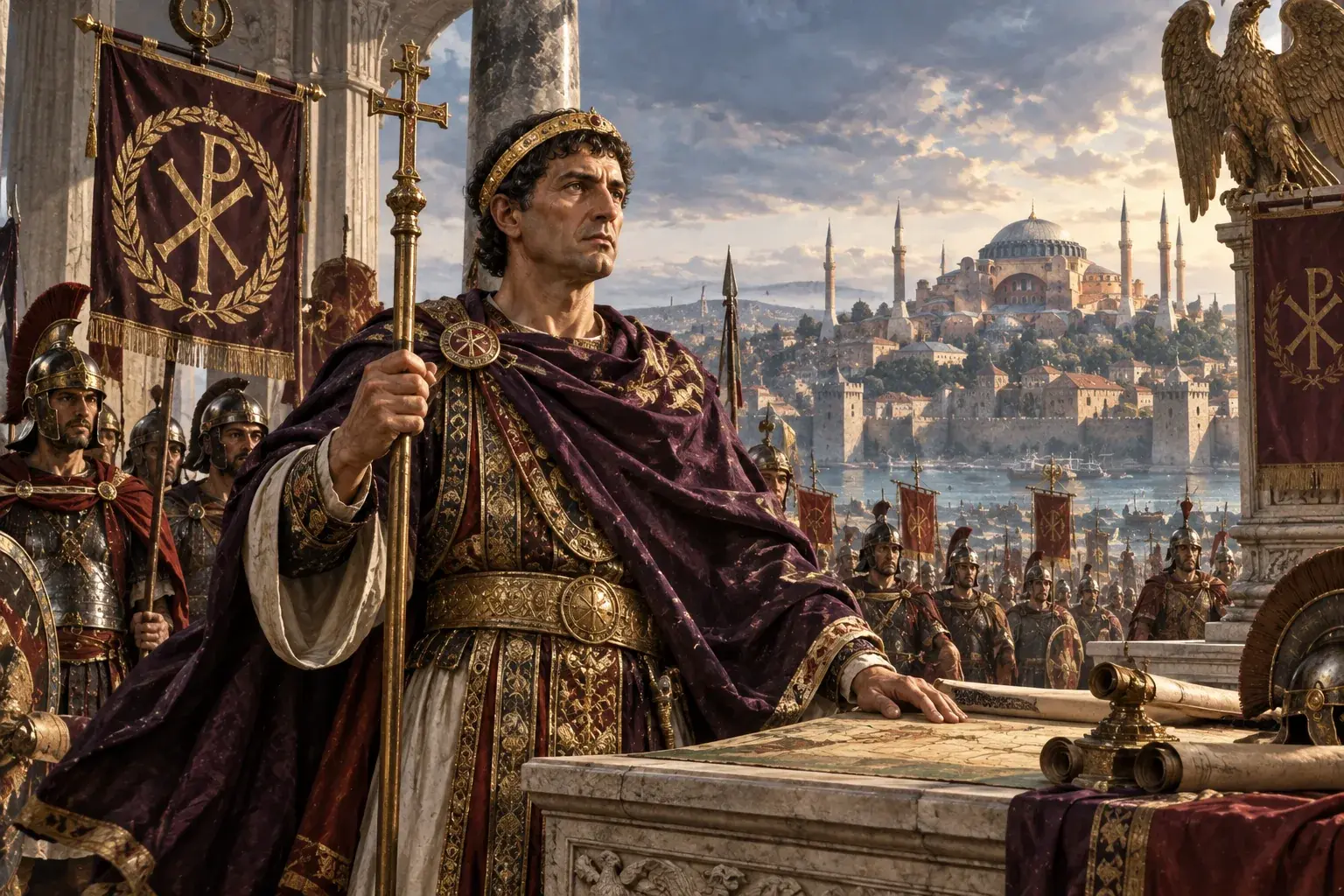
Three out of every four people in medieval Europe were serfs: unfree, tied to the land, and legally barred from leaving. But unfree didn't mean powerless, serfs could marry, inherit, and sue their own lords in court. Then the Black Death emptied half of Europe's fields, and for the first time serfs had leverage. Here's what a serf actually owed, owned, and endured, and how an arrangement embedded in European life for centuries came apart within a single one.
Medieval serfs comprised roughly 75% of the population of medieval Europe, which is the statistic upon which to build every other aspect of the era. The knights, the castles and the courtly poetry are all underpinned by a population of unfree agricultural labourers who are, as a rule, legally barred from leaving the estate they work.
A serf, also called a villein, works land belonging to a lord or to that lord's tenant. In return he receives two things: protection, and the right to farm a separate plot for his own family's needs. The distinction between a serf and a slave is important because they were not the same thing. A landowner could sell a serf, but what changed hands was the labour, and serfs had legal standing so they could appear in court, inherit, marry and occasionally to sue their own lords and win.
What they didn't have was the right to leave. Here's what the arrangement actually involved, and how something so deeply embedded in European life came undone within a single century.
What Made a Serf Unfree
The constraints on a serf were real but specific, and they varied enormously by local custom. Two estates fifty miles apart could run on noticeably different rules about what was owed and what was forbidden.
The common threads were restricted movement and a long list of obligatory payments. Being unable to leave sounds purely punitive until you flip it around, as the same rule gave a serf the right to live there, which meant shelter, food, and someone with armed men obligated to protect him. In an era of raids, banditry and famine, that wasn't a small thing.
Everything revolved around the manor or castle, the estate owner's residence and the place where the community gathered for administrative and legal business. Historians call the relationship between the peasantry and these estates manorialism, and it's worth keeping distinct from feudalism which describes the relationship between lords and vassals higher up.
Where Medieval Serfdom Came From
The basic model is older than the Middle Ages. Roman country villas already operated on the principle of people of different social ranks living together on a single estate for mutual benefit, producing food from the surrounding land.
As the Roman Empire waned and foreign raids grew more frequent, the logic of clustering behind someone else's protection grew more compelling. An estate owner could offer the right to live and work on his land, and the peasantry paid for it with labour service. Serfdom grew partly out of the old Roman slavery system and partly through that exchange; owning almost nothing, trading freedom of movement for the security of a working estate was not an obviously bad bargain.
Plenty of people were born into it. But a striking number fell into it, and that's the part usually left out. Free labourers with a small plot of their own often found it barely sufficient, and a prolonged illness or a single bad harvest could be enough to finish their independence. Rather than starve they accepted serfdom. Domesday Book, the great survey of landowners and labourers in Norman England compiled in 1087, records this downgrading happening again and again.
The Manor, the Demesne and the Mansus
A manor was the smallest unit of land in the system, and some estates ran to only a few hundred acres, which was about enough to support the people living on them. Manors could belong to the monarch, to aristocrats or to the church, and the wealthiest owners held several hundred of them, a collection known as an honour.
Most manors functioned as small villages, essentially self-contained and independent. Alongside the manor house or castle there were simple dwellings for the labourers, and often a stream running through the property, a church, a mill, barns, and a stretch of woodland.
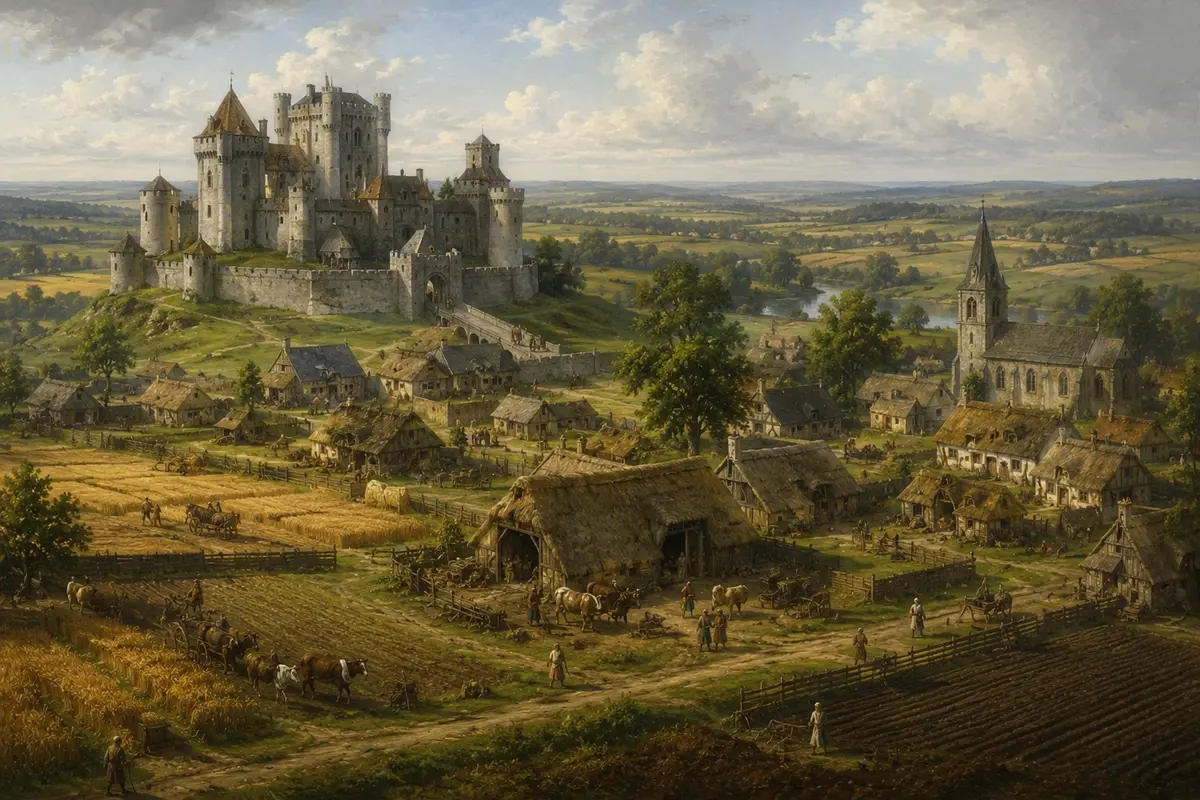
A manor functioned as a self-contained village, with its land split between the demesne, reserved for the lord, and the mansus, worked by serfs for their own needs.
The land was split in two, which is the thing to understand if nothing else sticks. The demesne, typically 35 to 40% of the estate, was devoted entirely to the landowner. The mansus was the land the labourers lived on and farmed for their own needs, running to about 12 acres, or five hectares, per family. Serfs worked both. Their own plot fed their family, and the demesne fed the lord.
Labour Service on the Demesne
The single most important obligation was demesne work, and it consumed two or three days of every week, rising sharply during busy periods like harvest. Every scrap of food produced on that land went to the lord.
There was some flexibility built in. A serf could sometimes send a family member to do the demesne work in his place, provided they were physically capable of it, which mattered for a household balancing its own sowing and reaping against the lord's schedule.
On the remaining days he worked his own land. That's the rhythm to hold on to: a week permanently split between someone else's field and your own, with the timing of both dictated by the same weather.
Inheritance, Tithes and Customary Fees
Status passed down through families. A serf's children were serfs. Where a marriage crossed between free and unfree, a legitimate child usually took the father's status and an illegitimate one took the mother's.
Land inheritance varied by region in ways that reveal a lot about local custom. In England and Normandy the eldest son inherited the land his serf father had worked, and daughters inherited only when there were no brothers, with widows typically receiving around a third of their late husband's holding. Across central and southern France, Germany and Scandinavia the arrangement was markedly different: sons and daughters inherited equally.
Then came the costs. Beyond handing the lord a regular share of the produce from his own plot, a serf owed a tithe to the parish church, generally a tenth of his harvest, which funded the priest, maintained the building, and provided a small welfare fund for the poor. On top of those two charges sat a list of fines and customary fees, due when the lord's eldest daughter married and again when a serf died, in the form of an inheritance tax paid by his heir. For most of the medieval period these were settled in kind rather than coin, often with the best animal the family owned, which meant a death in the household could cost it the cow.
One custom shows the underlying logic with unusual clarity. If a serf's daughter married someone from outside the estate, a fine was payable, because she and her future children represented labour the landowner was losing.
Serfs Without Land of Their Own
Large families created a problem the system never really solved. There wasn't always enough land to go round, and a serf who inherited none had only a narrow set of options.
He could stay in his parents' house, or marry another serf who did have land. He could move into another peasant's household and hand over his labour as rent, which is serfdom with an extra layer. Alternatively he could negotiate a new parcel out of the lord, take work with a local clergyman, or leave for a town and look for unskilled work with a tradesman, a miller or a blacksmith.
Because customs varied from estate to estate and shifted over time, some labourers occupied a genuine grey area between free and unfree. The clearest example is the ministerial serf, found in parts of France, Germany and the Low Countries. Legally still unfree, these people in practice moved around freely and could own property and land, because they were the children of serfs who had served a lord as administrators or in some military role. Service to the right man was worth more than legal status.
A Serf's Working Year in 1298
The customs recorded for the Richard East estate in England in 1298 set out what was expected of a serf in unusually plain terms.
He was to plough and harrow a quarter of an acre at his own expense. Across the whole year he worked every second day doing whatever the lord or the bailiff told him to do, whether that meant carting, mowing, reaping or something else entirely, with Saturdays and major church holidays excepted. During harvest the demands escalated: he had to supply two men to reap for two days, again at his own cost, and at the end of harvest he reaped for a full day himself with one other man, also paid for out of his own pocket.
The lord's side of the ledger was thinner but not empty. When the mowing finished, the villeins each received sixpence for beer and a loaf of bread, with the lord providing three bushels of wheat for the baking. Each mower also received a small bundle of hay every evening, as much as he could cut with his own scythe.
Women's Work on the Manor
The heavy agricultural labour described in those customs was men's work. Women did lighter farm tasks and joined the effort at harvest time, when every available pair of hands went into the fields.
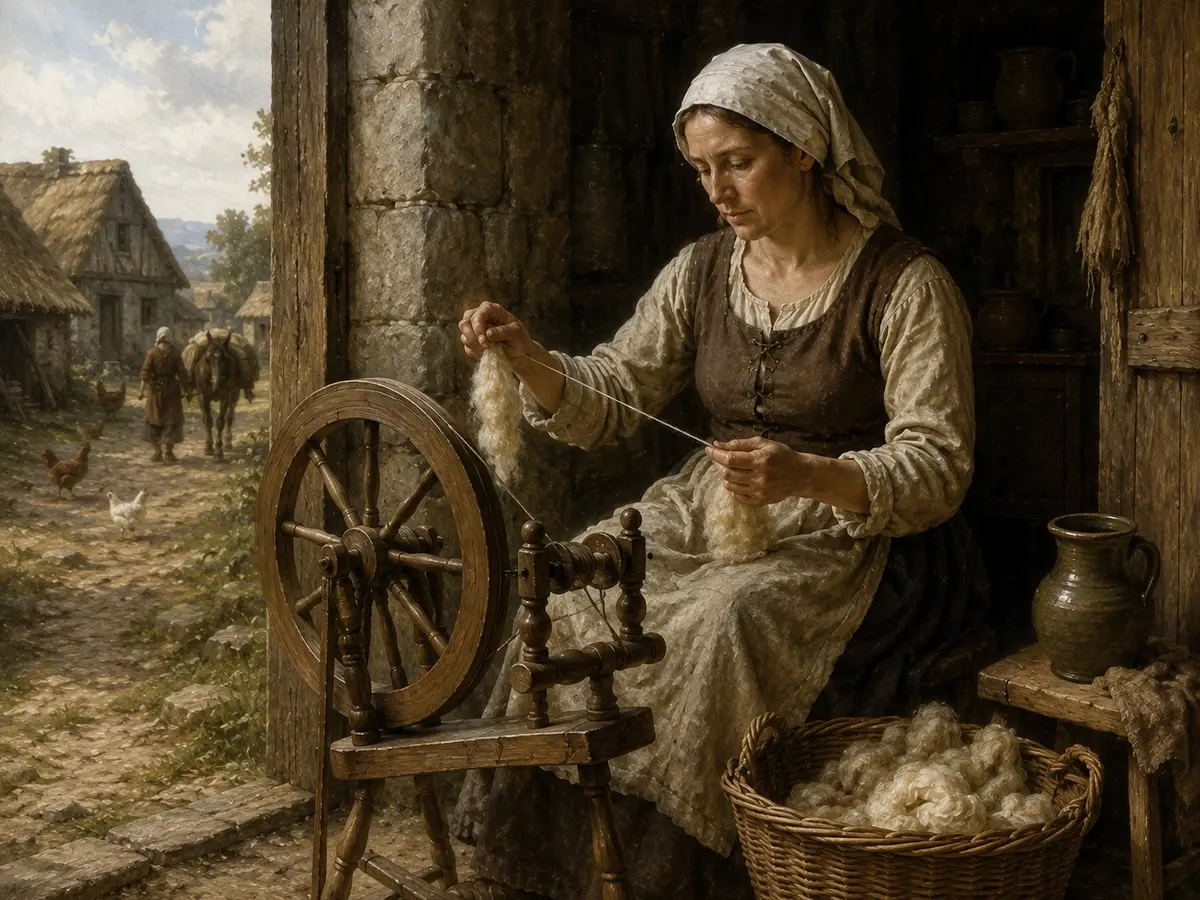
Beyond the harvest, women's labour, including milking, brewing, spinning and weaving, kept a serf household fed and clothed year-round.
The rest of the year they carried a workload that rarely makes its way into descriptions of manorial life, and it was relentless. Milking. Making butter and cheese. Brewing ale from malted grains, which was a genuine skill and the source of the household's main drink. Baking the bread. Tending fruit trees, cooking, keeping poultry, cleaning the house, and almost certainly raising the children.
They also produced the family's cloth from scratch, making wool and then working it into woollen and linen fabric. A serf household bought very little, which meant somebody had to make nearly everything in it, and that somebody was usually a woman.
What a Serf Owned in 1304
A tax assessment compiled in 1304 for a man named Richard Bovechurch of Cuxham gives an unusually concrete picture of what an averagely well-off serf owned. There were twelve pence to a shilling, which matters for reading the figures.
His cow was assessed at four shillings and his horse at two, so the cow was worth twice the horse. He had a piglet valued at sixpence, three hens at threepence, and a bushel of beans at another threepence. Two acres sown with grain came to four shillings, matching the cow, and two acres sown with vetch to two shillings. His cottage was assessed at eighteen pence. His brass pot came to twelve.
Read that last pair again, as it's the detail that makes it land. A single brass cooking pot was assessed at two thirds the value of the house it sat in. Add the pan at threepence and the cart at eightpence and the whole estate of a reasonably comfortable serf comes to a little over sixteen shillings, cow, crops, cottage, cookware and all.
Inside a Medieval Peasant Cottage
The house itself was modest by any standard: a single storey built from cheap and locally available materials, mud and timber for the walls and thatch for the roof. A small family unit lived inside, while retired parents usually had a cottage of their own nearby.
A dog and a cat generally earned their keep, the dog for herding and the cat for holding down the rat population in the granary. A hearth fire in the middle of the room supplied warmth and light along with a great deal of smoke, supplemented by candles. The windows held no glass and were shut with wooden shutters after dark. Bedding was straw and woollen blankets.
Farm animals lived in a separate or attached building, and a more prosperous household might run to a further structure for brewing and baking. The toilet was a hole over a cesspit, occasionally inside a small shed for privacy and frequently not. These buildings were typically grouped around a courtyard, which gave some shelter from the wind.
Bread, Weak Ale and Peasant Leisure
Peasant food was based on grain. Coarse bread came from wheat and rye or barley and rye, porridge from barley or rye, and the thick soup that filled most meals could contain cereals, peas, cabbage, leeks, spinach, onions, beans, parsley and garlic depending on the season and the household.
Better-off peasants had milk, cheese and eggs. Meat was a rare luxury for a purely economic reason: a live farm animal was worth far more than a dead one. When meat did appear it was usually salted pork or bacon, and dried or salted fish and eels could be bought at a price. Fruit meant apples, pears and cherries, generally cooked, along with whatever wild berries and nuts could be gathered. The drinks were weak ale, or water with honey stirred into it. Almost nobody had access to that whole list, and most diets ran short on fats, proteins, calcium and vitamins A, C and D.
Time off came on Sundays and church holidays, and it went on beer, singing, and group dancing to pipes, flutes and drums. There were dice and board games, and sport in the form of hockey and a version of football whose only real object was getting the ball to an agreed destination, with few rules if any. Once a year by tradition serfs were invited up to the manor for a Christmas meal. They brought their own plates and firewood, and every item of food on the table had been grown by them in the first place, but the beer was free and it was a rare look at how the other half lived.
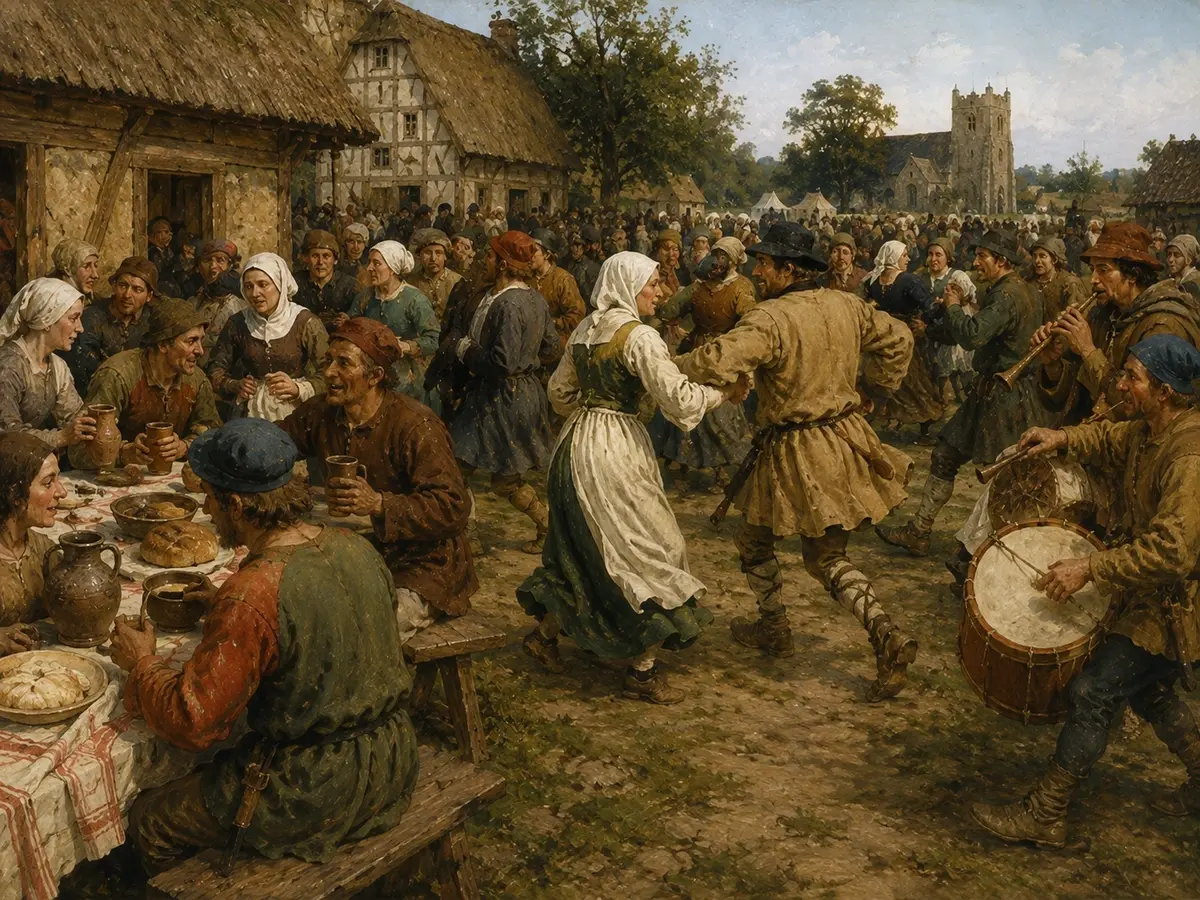
Sundays and church holidays brought music, dice and games, along with the one Christmas meal a year the lord supplied beer for.
The Hallmote and Manor Court Justice
Each manor ran its own court a few times a year, presided over by the lord or his steward. In England this was the hallmote, sometimes written halimote , and it convened in the great hall of the castle or manor house.
Its business covered disputes between people on the estate, arguments over the right to use woodland or peat land being typical, along with fines imposed on estate workers and criminal matters. Two things fell outside its reach. Disputes between the lord and an individual peasant weren't heard there, and serious crimes such as murder, rape and arson went up to the courts of the Crown.
The obvious objection is that a court run by the landowner would rule for the landowner, and in practice it was more complicated than that. He was generally bound by the customs his predecessors had established, and the final decision rested with a jury of locals who were usually fellow estate workers. That panel typically ran to twelve men and had grown out of the earlier medieval jury, which originally meant the men a defendant called to vouch for his character. Higher courts existed for appeals, and the records show peasants acting collectively to bring cases against a landowner, which is not the behaviour of people with no legal standing at all.
The Black Death and Rising Wages
Serfdom didn't end by decree. It was undermined, and the first blow was demographic. Wars and plagues hit the population repeatedly, and the Black Death, peaking between 1347 and 1352, did the most damage. Labour became scarce, and scarce labour is expensive labour.
Free labourers were also drifting off the land towards the growing towns to look for something better, and runaway serfs could attempt the same escape, helped by a custom that granted freedom to anyone who managed to live in a town for a year and a day without being reclaimed.
The result was estates standing abandoned for want of anyone to work them, and that handed the remaining serfs something they'd never had before. Leverage. A lord facing empty fields was in no position to refuse a negotiation, and for the first time serfs could push for better terms and even for payment.
Coinage, Revolts and the End of Serfdom
Money made that leverage usable. As coinage spread through medieval society, a serf could accumulate savings and then spend them on his own position, paying his lord instead of working for him, or buying release from particular labour obligations, or in some cases outright purchase his freedom.
Political weight followed economic weight. Serfs organised collectively through village communities, which began holding courts of their own and acted as a genuine counterweight to the courts of the landed gentry.
And sometimes it turned violent. Peasant armies took the field in the northern Low Countries in 1227, on the lower Weser in northern Germany in 1230, and in the Swiss Alps in 1315, and in each case they got the better of forces that included aristocratic knights. England's Peasants' Revolt of 1381, which explicitly demanded an end to serfdom, was the largest of these risings and it failed. The trend it belonged to did not. By the close of the 14th century, more agricultural work across Europe was done by paid labourers than by unfree serfs.
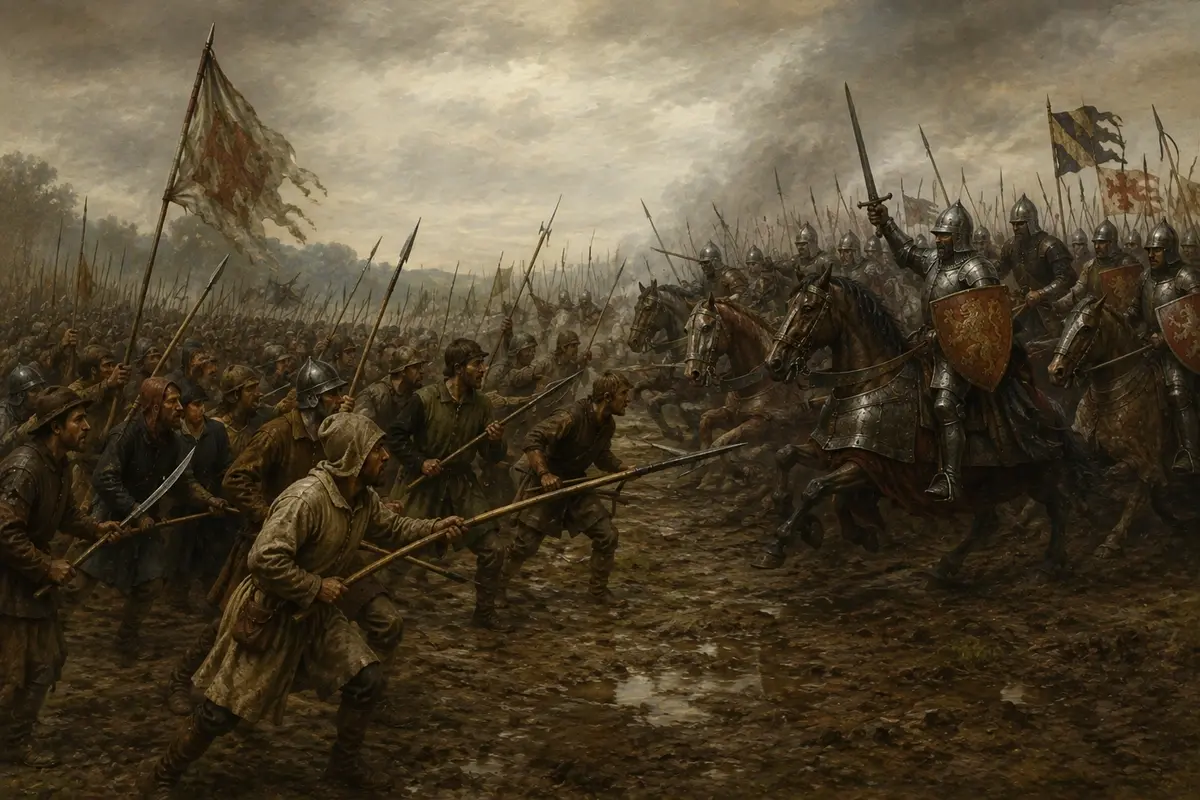
Peasant armies defeated forces that included aristocratic knights in the Low Countries, Germany and the Swiss Alps in the century before serfdom's decline.
How We Know About Medieval Serfs
Nearly everything in this piece comes from documents written by or for the people at the top. Domesday Book was compiled for a king. The 1298 customs of the Richard East estate exist because an estate needed its obligations recorded. The inventory of Richard Bovechurch's cow and brass pot survives because somebody was assessing him for tax.
That's the strange thing about the majority of medieval Europe. Serfs made up three quarters of the population and left almost no account of themselves, so we know them through the paperwork of the men who owned their labour. We can say what a serf owed, what his pot was worth, and how many days a week he spent in another man's field. What he thought about any of it is mostly missing from the record.