The early life of Genghis Khan is usually told as a rise. It reads better as a collapse followed by a very slow recovery. He was born Temujin, son of a chieftain with real standing on the Mongolian plateau, and by the age of ten he had lost the father, the followers, the herds and the standing, and was living on roots and marmots beside a river with his mother and four younger children.
What survived was a name and a betrothal, and it took most of twenty years to turn those into anything. The decades between his father's death and his proclamation as Genghis Khan in 1206 contain a murdered half-brother, a spell in a wooden collar as a rival clan's prisoner, a wife carried off by raiders, a son whose paternity was questioned for the rest of his life, and a crushing defeat at the hands of his own sworn brother.
Nearly all of it comes from one document. The Secret History of the Mongols was composed in Mongolian not long after his death, probably in the 1240s, and it is the only substantial account of these years written from inside the culture. It is also partly a work of literature, thick with omens and set-piece speeches, and it was written to justify a dynasty. Persian and Chinese sources fill some gaps and contradict it in others. Where the dates are disputed, and several of them are, this article says so.
Yesugei Baghatur and the Khamag Mongol
Yesugei was born around 1134 into the Borjigin, the ruling family of the Kiyad Mongols. Baghatur was a title rather than part of his name, meaning something close to hero or champion, and it was earned. His grandfather Khabul had been recognised as khan by the Jin dynasty of northern China and had led the confederation remembered as Khamag Mongol, All the Mongols.
That confederation was in trouble by Yesugei's time. An earlier khan, Ambaghai, had been handed over to the Jin and executed, and the Tatars to the east were the standing enemy. Yesugei never took the title of khan himself, but from roughly 1160 he was the leading man among the Mongols in practice, raiding, campaigning against the Tatars and holding a following together.
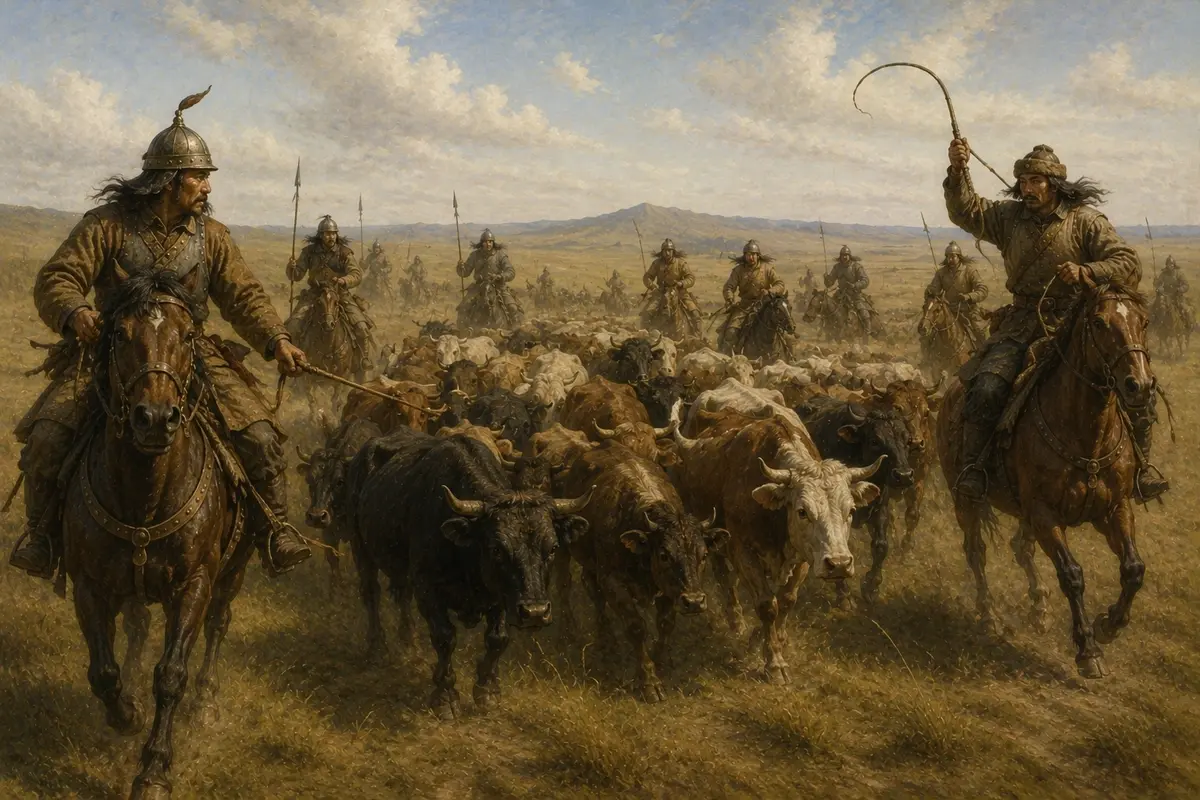
Herds were the point of most steppe campaigns, and a chieftain's following lasted only as long as he could keep delivering them.
The word for that following was orda, and it is worth a moment because it entered English. In Turkic, ordu or orda meant a khan's residence or camp, and from the camp the sense widened to the people attached to it. It passed through Old Russian, then Ukrainian and Polish, arriving in English by 1555 as horde, at first meaning precisely a political subdivision of Central Asian nomads. Only later did it broaden into the general sense of an unruly crowd.
The important thing about an orda is that it was personal. Nothing about it was institutional or territorial. Men followed a particular chieftain because he protected them and because his raids paid, and when he died the arrangement was simply over. Yesugei's following held together while he lived. It did not survive him by a season.
The Abduction of Hoelun
Hoelun came from the Olkhonud, a lineage of the Onggirat, a tribe known for supplying brides to Mongol nobility. She was newly married to Chiledu, a Merkit aristocrat, and travelling with him when Yesugei and his brothers ran the couple down and took her. Chiledu escaped alone. Hoelun became Yesugei's principal wife, senior to his existing wife Sochigel, who had already borne him two sons.
It was a common enough way to acquire a wife on the twelfth-century steppe, and it looks unremarkable in the narrative until the consequences arrive. The Merkits did not forget. Roughly two decades later they collected on the debt, and the person who paid was Hoelun's daughter-in-law.
The Birth of Temujin on the Onon
Hoelun gave birth to her first son at a place the Secret History calls Deliun Boldog, on the Onon river in what is now northern Mongolia. The site has been identified with Dadal in Khentii province and, alternatively, with a location just over the Russian border in southern Agin-Buryat Okrug. It lies near the mountain Burkhan Khaldun, which recurs throughout his life as a refuge and a place of prayer.
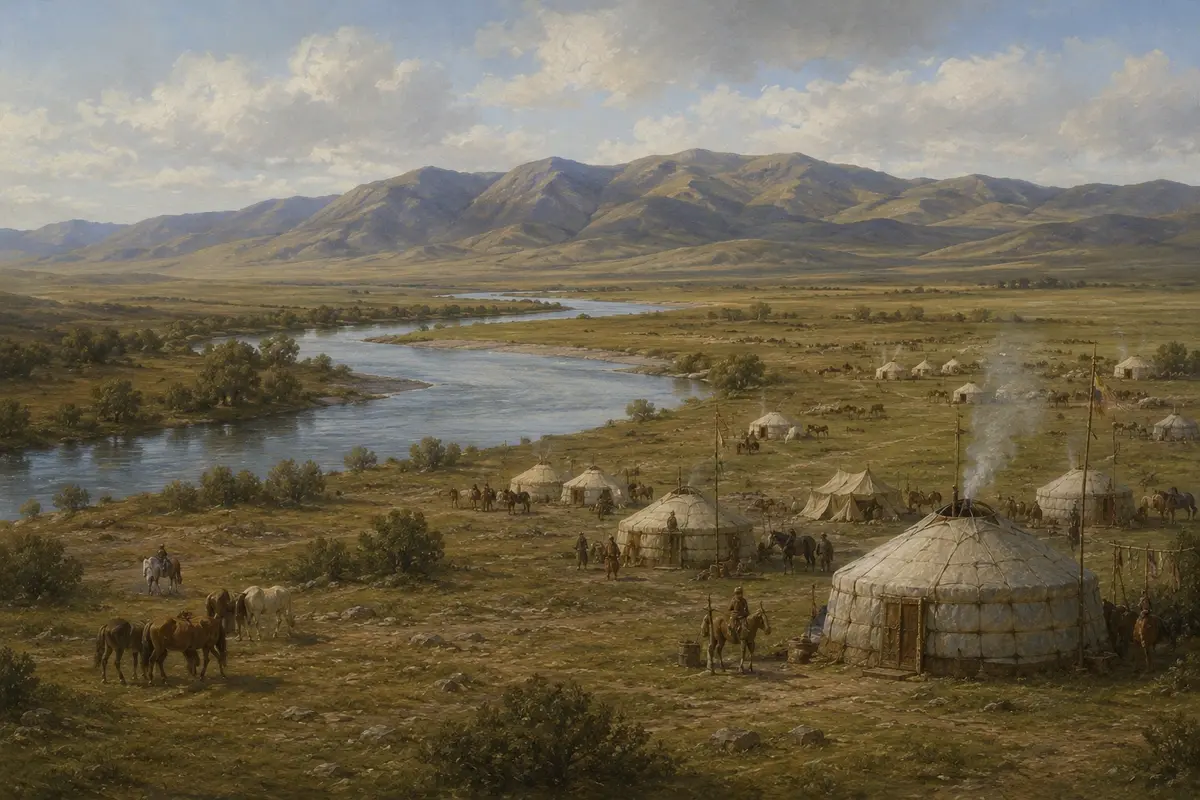
The Onon valley, where the Secret History places the birth at Deliun Boldog, near the sacred mountain Burkhan Khaldun.
The date is genuinely disputed. The Persian historian Rashid al-Din gave 1155. Ming-era Chinese scholars gave 1162, which is the figure most often cited now. Arguments have also been made for 1165 and 1167. None of the four is decisive, and any account that states a birth year without qualification is overselling the evidence.
The name came from a prisoner. Yesugei had just captured a Tatar called Temujin-uge, and named the child after him, which was a straightforward piece of steppe commemoration rather than anything mystical. The Secret History adds that the infant was born gripping a clot of blood the size of a knucklebone in his right fist. That is the kind of omen a founder's biography acquires afterwards rather than a report from the tent, and it should be read as literature.
Four more children followed: Qasar, Hachiun, Temuge and a daughter, Temulun. Sochigel's sons, Begter and Belgutei, grew up in the same camp as half-brothers, and one of them does not survive this article.
Betrothed at Nine to Borte
When Temujin was around nine, Yesugei took him to find a wife among his mother's people. On the way they met Dei Sechen of the Onggirat near the Ulz river, and the two men liked what they saw in each other's children. Dei Sechen told Yesugei he had dreamt the night before of a white falcon carrying the sun and the moon in its claws, and had taken it as a sign that a nobleman would arrive at his camp.
The girl was Borte, about a year older than Temujin. The match was agreed, and custom required the boy to stay with his future in-laws rather than take the bride home. Yesugei left him there and rode back alone. The Secret History records the practical request he made on the way out: look after my son, and be careful, because he is frightened of dogs.
Poison on the Road Home
Riding home by himself, Yesugei came across a band of Tatars feasting. Steppe custom obliged them to feed a stranger who asked, and he was tired and thirsty enough to dismount and join them. They recognised him. They remembered the campaigns he had fought against them, and they put poison in his food.
He got home and knew what had happened. Dying, he sent an old retainer named Munglig to fetch Temujin back from the Onggirat, asked him to look after the children, and died before his son reached the camp. The year is usually given as around 1171.
Abandoned on the Steppe
Temujin was about ten. Begter, the eldest boy in the camp, was perhaps twelve. Neither was old enough to command anything, and Yesugei's following understood that immediately.
The break was formalised the following spring, when the widows of the old khan Ambaghai excluded Hoelun from the ancestral sacrifice, a public statement that she and her children no longer counted. Then the Tayichiud, under a chieftain called Targutai Kiriltukh, moved camp and left the family behind, taking the herds and the followers with them.
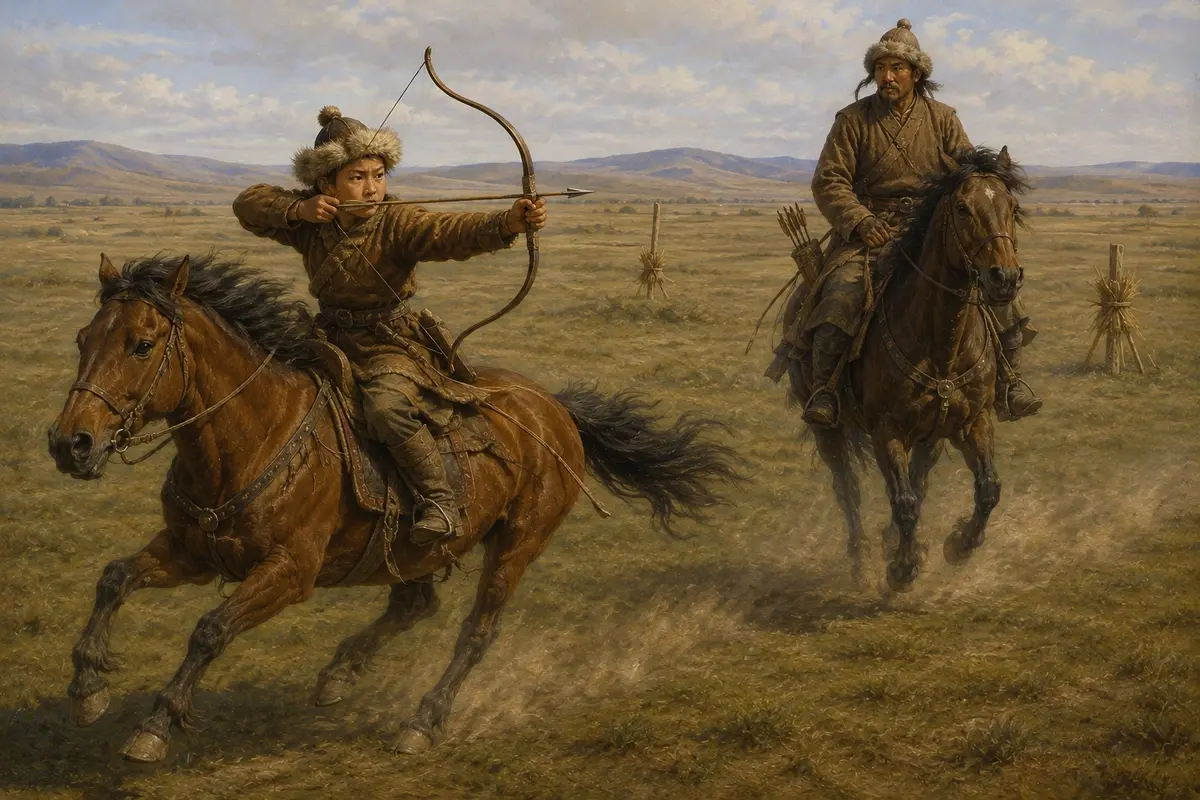
Steppe children learned to ride and shoot from infancy; for Temujin and his brothers it stopped being training and became how the family ate.
Hoelun kept them alive, and the detail of how is one of the least glamorous passages in any founder's biography. They dug wild roots and gathered fruit. They caught fish in the Onon on lines twisted from horsehair. They hunted marmots and whatever small game the boys could bring down. This went on for years, in a society where a family without a herd or a protector was ordinarily finished.
It is difficult to overstate how much of the later empire reads as an answer to this period. The system Genghis Khan built in 1206 dismantled clan contingents, promoted men on loyalty and ability rather than birth, and made desertion of a commander a capital matter. All of that was designed by someone who had watched an aristocratic clan structure decide that a widow and five small children were not worth the trouble.
The Killing of Begter
As the eldest male in the camp, Begter began to assert the rights that came with it, which in Mongol custom would eventually have included claiming Hoelun, who was not his mother, as a wife. He and Belgutei also took food from the younger boys, and the Secret History fixes the quarrel on two petty thefts: a fish and a lark.
Hoelun told them furiously to stop, pointing out that they had no allies in the world but each other. Temujin and Qasar ignored her. They stalked Begter as he sat on a hill watching horses, came at him from the front and behind, and shot him with arrows.
Their mother's reaction, as the Secret History records it, was not grief so much as horror at what she had raised, comparing them to animals that devour their own. The episode is worth noticing precisely because the document keeps it. A text written to glorify a dynasty had no obligation to record that its founder murdered his half-brother over a fish, and the fact that it does is one reason to take the rest of it seriously.
The Cangue and the Wool Cart
Around 1177 the Tayichiud came back for him. A surviving heir of Yesugei's line was a problem that would only grow, and Targutai seized him. Some Persian accounts attribute the raid to a different rival, which is one of several places where the sources diverge.
He was fitted with a cangue, a heavy wooden collar locked around the neck and wrists that made it impossible to feed himself or lie down properly, and was passed between households in rotation to be guarded. He was reportedly paraded at feasts as an object lesson.
He escaped during one of those feasts, knocked his guard down with the cangue itself and hid in the Onon with only his face above the water. A man called Sorkan-Shira, of the Suldus, spotted him lying there and said nothing to the search parties. Later, when Temujin came to his tent, Sorkan-Shira's sons Chimbai and Chilaun cut the cangue off and burned it, his daughter Qada'an looked after the fugitive, and the family hid him in a cart of wool while the Tayichiud searched the camp.
The payoff came more than twenty years later. When Temujin destroyed the Tayichiud around 1201, Sorkan-Shira and his sons came over to him and were made commanders, and Chilaun became one of his closest companions. Remembering exactly who had helped him and who had not turns out to be the single most consistent trait in his career.
The Sable Coat and the Kereit Alliance
Around 1178, aged roughly sixteen, he went back to the Onggirat to claim the betrothal his father had arranged nearly a decade earlier. Dei Sechen honoured it, and Borte's mother sent her away with a dowry gift of a black sable coat.
What Temujin did with the coat is the first genuinely shrewd political act recorded of him. He had no herds, no following and no leverage. So he took the most valuable object he owned and gave it away, presenting it to Toghrul, khan of the Kereit and his father's sworn brother, and asking for his protection in return. Toghrul accepted, and Temujin acquired a patron with an army.
Toghrul is better known by the title Wang Khan, which the Jin court granted him in 1197. Around the same period Temujin picked up his first personal follower outside the family, a young man named Bo'orchu who helped him chase down stolen horses and simply stayed.
The Merkit Raid and the Birth of Jochi
Not long after the wedding, a Merkit war party rode into the camp before dawn. This was the reckoning for Hoelun, taken from a Merkit husband a generation earlier, and the Merkits knew exactly what they were doing.
Temujin, his brothers and his mother fled to Burkhan Khaldun. Borte was captured and handed to a Merkit man as a wife, which was the same treatment Hoelun had received from Yesugei and was understood on both sides as symmetry.
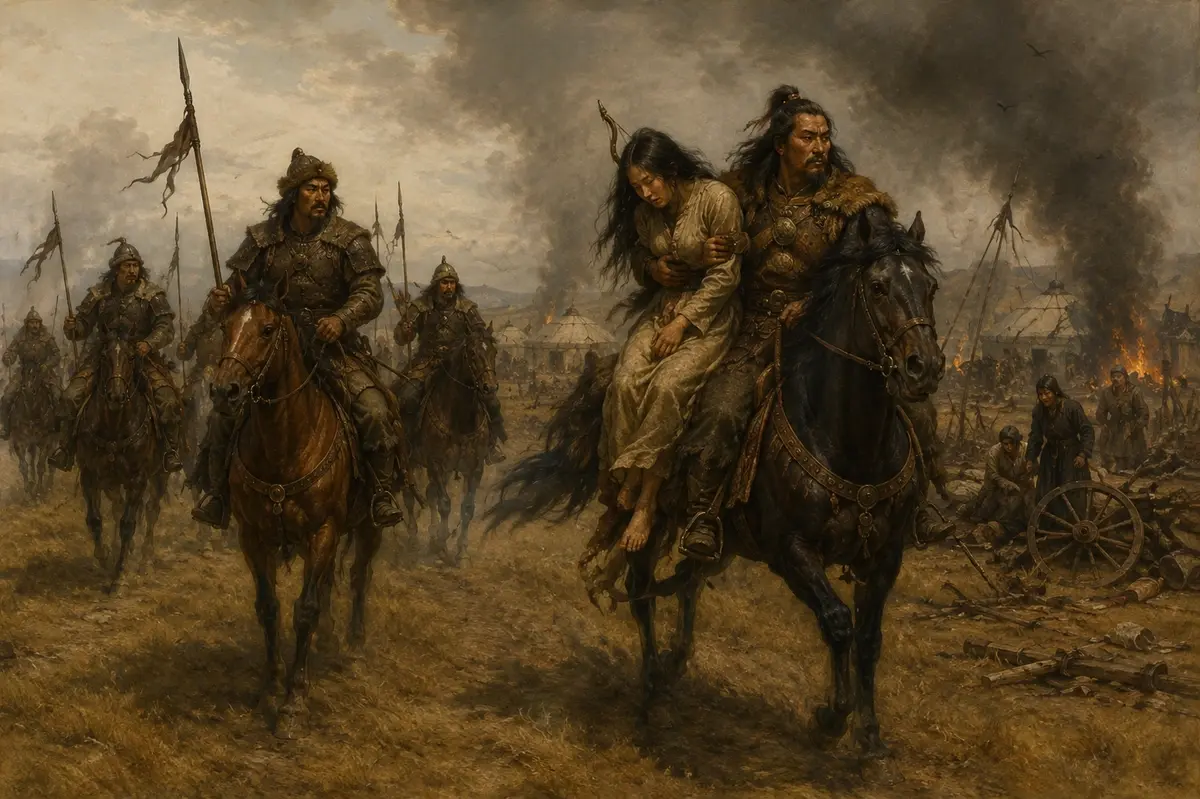
The Merkit raid on Temujin's camp was revenge for Yesugei's abduction of Hoelun two decades earlier.
He went to Toghrul, who owed his throne partly to Yesugei and honoured the debt, offering twenty thousand Kereit horsemen and suggesting Temujin bring in Jamukha of the Jadaran, his childhood sworn brother, who was now a war leader in his own right. The combined force fell on the Merkits and scattered them. The Secret History describes Temujin riding through the fleeing crowd calling Borte's name until she heard him, got down from a cart and ran to him.
She was pregnant, or gave birth very soon after the rescue. The boy was Jochi. Whether he was Temujin's son was questioned for the rest of his life, and Chagatai eventually threw the accusation at him in front of their father. Temujin acknowledged Jochi as his son publicly and consistently, and the doubt never quite went away.
Jamukha and the Defeat at Dalan Balzhut
Temujin and Jamukha had sworn the anda bond in boyhood, and after the Merkit campaign they camped together for a period. Then, somewhere around 1181, they separated. The Secret History puts the break on a cryptic remark about grazing grounds and on Borte's advice that they should keep riding rather than make camp.
The real division was about what a following should be. Jamukha stood for the rights of the aristocracy he belonged to. Temujin gave command to the men who had proved loyal and capable, regardless of who their fathers were, which was attractive to exactly the people the old system had least use for.
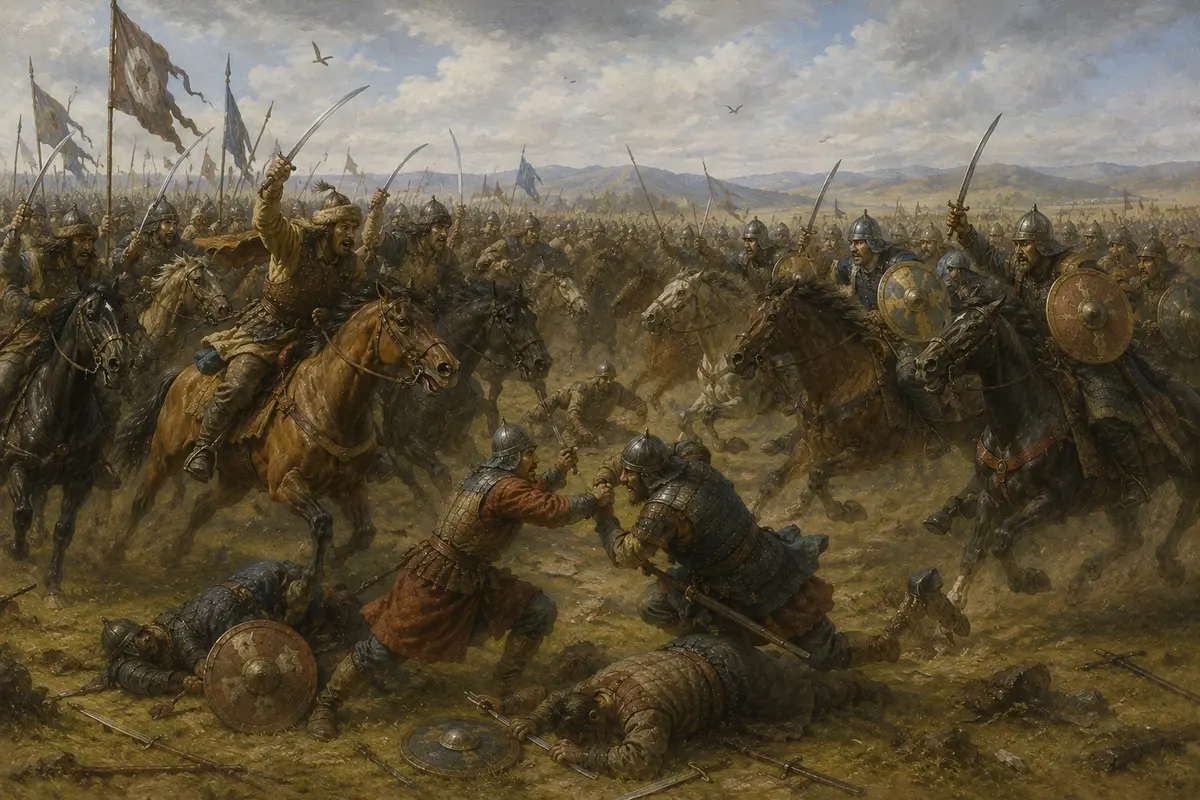
At Dalan Balzhut in 1187, Jamukha's reported thirty thousand men beat Temujin decisively; the recovery took the better part of a decade.
Around 1186 Temujin's own followers elected him khan. Jamukha treated that as a declaration and attacked the next year with a reported thirty thousand men. At the Battle of Dalan Balzhut in 1187 Temujin was beaten decisively.
What saved him was his opponent's conduct after the victory. Jamukha is said to have had captives boiled alive in cauldrons, an atrocity that appalled the very aristocracy he claimed to represent and pushed a number of clans toward the man he had just defeated. It is worth flagging that the story reaches us through a text written for the winners, so the detail may have grown in the telling.
The decade that follows is close to blank. The sources go quiet after 1187, and historians have argued that Temujin spent part of that time in Jin territory, possibly as a captive or a servant, though the evidence is thin either way. When he re-emerges in the mid-1190s he is a serious power, and within ten years he has destroyed the Tatars who poisoned his father, broken the Tayichiud who abandoned his family, and outlasted both Toghrul and Jamukha.
He was proclaimed Genghis Khan in 1206, at a great assembly on the Onon, roughly a day's ride from where he had been born and about thirty-five years after his own clan rode away and left him to starve.