Before 1206 the Mongols were herders whose whole world followed the grass: felt tents, houses dragged across the plain on ox-carts, and cavalry that shot backwards at anyone chasing it. Almost everything that later made Mongol armies unstoppable was already ordinary practice. Here is that society as the earliest outside observers recorded it, and an honest look at how far those records can be trusted.
Mongol life before Genghis Khan ran on grass. Where families slept, how they fought, whom they obeyed and how fast a tribe could assemble or fall apart all followed from that single fact.
The empire that appeared after 1206 usually gets told as the story of one man. It is worth starting a step earlier. Temujin, the chieftain's son who was proclaimed Genghis Khan in 1206, was born in the 1160s into a world that had already worked out almost everything that would later make Mongol armies so difficult to stop: the mobility, the mounted archery, the habit of shooting backwards at a pursuer, and above all a political structure that could dissolve on the death of one chieftain and re-form within a season around another.
Reconstructing that world is harder than it sounds, because the Mongols left almost no written record of themselves before the empire existed. Nearly everything comes from outsiders — Persian and Arabic geographers, Chinese officials, and European friars who reached the Mongol court a generation after Genghis Khan died. Their descriptions of tents, carts and weapons are specific and consistent enough to be useful. Their explanations of who these people were and where they came from are a different matter, and the last section of this article shows exactly why.
Pastoral Herding and the Making of Steppe Tribes
Human communities feed themselves in one of a few ways: by hunting wild animals, by herding tame ones, by gathering wild plants, or by farming. Central Asia had taken exactly one step out of the first category and stopped there. Its people did not hunt for a living and they did not till the soil. They reared animals and followed them.
That choice shapes the landscape as much as the landscape shapes the choice. Grazing animals need open ground, and open ground is what centuries of grazing produce. Forests never got the chance to regenerate, so the interior of the continent settled into enormous grassy plains and smooth green river valleys with almost no timber anywhere on them.
Political structure grew directly out of the household. The head of a herding family functioned as its lawgiver and commander. Sons stayed, brought wives into the same encampment, and worked the same herds, so a single patriarch might eventually command several hundred armed men drawn entirely from his own relatives and servants. On the march such a group looked like a caravan. Camped, it looked like a small town.
When the head died, the group did not scatter. It closed ranks behind his eldest son, because splintering meant defencelessness against every other roaming group in the same country. From there the arithmetic is easy to follow. A capable chieftain attracted weaker parties who wanted protection, or manufactured a quarrel and absorbed them by force. Small nations formed this way, held together for as long as the leadership held, and then broke back down into their parts and recombined in some new arrangement.
That cycle is the single most useful thing to understand about the steppe before 1206. Nothing was permanent. Confederations were personal rather than territorial, and they lasted exactly as long as the man at the top.
Mongol Clans, Tribes and Confederations
The Mongols were one people among many on that plateau, sharing it with the Kereit, the Naiman, the Merkit, the Tatars and others. Their name attached to a confederation later remembered as Khamag Mongol, meaning something close to All the Mongols, which had been led in its time by members of Temujin's own family and which fragmented after his father's death.
Below that level, society was built on descent. The basic unit was the obog, a cluster of households tracing themselves to a common male ancestor, whose members were forbidden to marry one another. Related obog gathered into larger bodies the sources call irgen, roughly a people. Above those sat the ulus, a confederation of several such groups bound to a khan. An ulus meant authority over people rather than over mapped ground, which is why steppe power could double or evaporate without a single border moving.
Why kinship organised everything comes down to economics. In a society with many different occupations, young people leave. A farmer's son goes off to trade, someone else's son arrives to work the farm, and within two generations one family's descendants are scattered across a continent. On a purely pastoral steppe there was nowhere to go and nothing else to do. Young men stayed with their parents, shared the care of the animals, and had the same interests as everyone around them. The great kin-blocs that made up Mongol political life were the natural result.
Felt Tents and the Mongol Household
The standard dwelling was a round tent, framed by poles set in a circle and drawn together near the top, in the general manner of a wigwam. A hoop held near the apex kept a round opening clear for smoke. Over the frame went sheets of thick felt, arranged to leave the smoke hole free and fastened carefully at the edges, especially in winter. One corner of one sheet could be lifted and dropped again, and that served as the door.
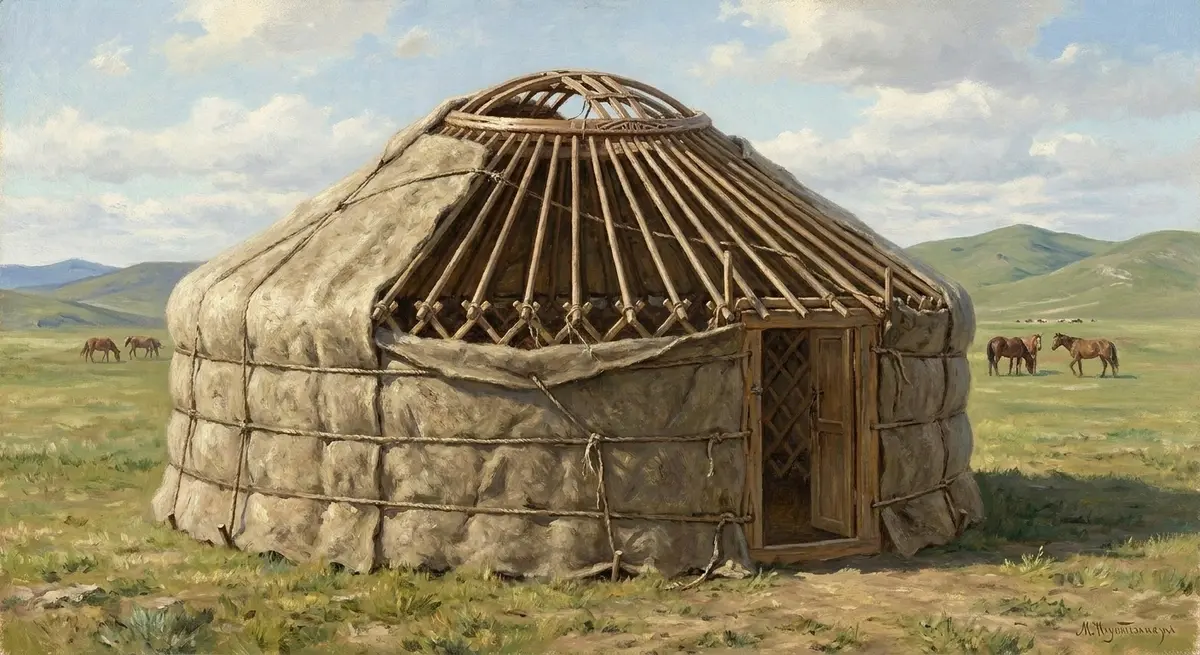
The roof hoop at the apex is the one fixed piece of engineering in the whole dwelling: it holds the poles together and keeps the smoke hole clear.
The fire burned on bare ground in the middle. Since the country grew almost no wood, fuel meant sticks, leaves, grass and dried dung gathered off the plain, which smouldered rather than burned clean. Between the smoke that never fully escaped through the hoop and the cold air that never stopped coming in through the seams, these were not comfortable homes. Families also brought young or weak animals inside to live alongside them, which did nothing for the atmosphere.
Permanent houses in the towns were built to the same idea. One room, no subdivisions, round in plan with a domed roof instead of a peak, no floor above bare earth and no windows. When your entire architectural vocabulary comes from the tent, the buildings that stand still end up looking like tents that happen not to move.
Mongol Houses Built on Wheels
As wealth accumulated, some chieftains built dwellings too large and too finely made to be taken down and re-erected every time the grass ran out. The solution was to put the whole structure on trucks at its four corners and drag it across the plain the way a table gets pushed across a floor on castors.
These were still tents in every material sense, framed in light poles fitted into permanent joints and covered in felt. The felt was often whitened with chalk, white clay or powdered bone so the house showed up brightly across the plain, and the panels were decorated with embroidered designs: vines and trees, birds and beasts.
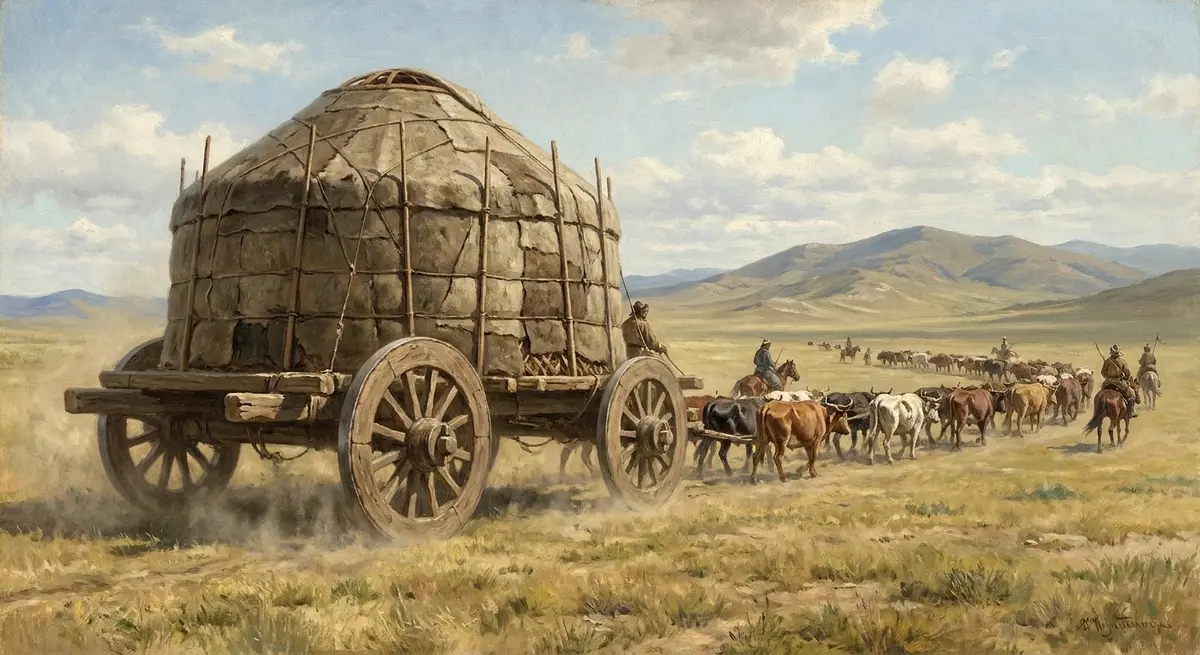
William of Rubruck measured one of these in the 1250s: about thirty feet across, overhanging its wheels by five feet a side, drawn by twenty-two oxen.
The most detailed description comes from William of Rubruck, a Flemish Franciscan sent east by Louis IX of France, who reached the Mongol court in 1253 and wrote up what he had seen for the king. He measured twenty feet between the wheel-tracks of one cart, with the house overhanging by at least five feet on each side, giving a dwelling around thirty feet across. He counted twenty-two oxen pulling it, eleven abreast and eleven more ahead of them, on an axle he compared to a ship's mast, with one man standing in the doorway of the house driving the whole team. He was writing a generation after Genghis Khan's death, but the practice long predated the empire and lasted for centuries after it.
Everything a household owned travelled separately, because a tent cannot be partitioned into rooms and cannot hold much. Goods went into chests woven from light twigs with a curved lid of the same material and a small door at one end, covered in black felt greased with tallow or ewe's milk so the rain ran straight off, and finished with embroidery. These chests were never unpacked at the far end. They stayed on their carts as permanent storerooms, parked in rows beside the tent. Rubruck counted around two hundred carts attached to a single great dwelling, and wrote that the camp of a rich Mongol looked like a large town with remarkably few men in it.
Herds, Horses and Mongol Wealth
The animals that mattered were camels, oxen and cows, sheep, goats and horses. Daily work meant watching the herds at pasture, penning them at night, rearing the young, making butter and cheese, and turning skins into clothing.
It also meant raiding, and the sources list war on neighbouring tribes in the same breath as making cheese. Disputes over pasture were settled by fighting, and stocks of sheep and oxen were replenished by driving off someone else's. This was not a breakdown of the system. It was part of how the system distributed resources, and it is the background against which the confederations of the late twelfth century kept forming and shattering.
Towns existed but mattered little. Some were the residences of khans and tribal heads, others were manufacturing or trading centres, and many had earth embankments or stone walls. What they did not have was economic dominance, because commerce and manufacture were marginal to a people whose entire idea of wealth involved animals and mobility.
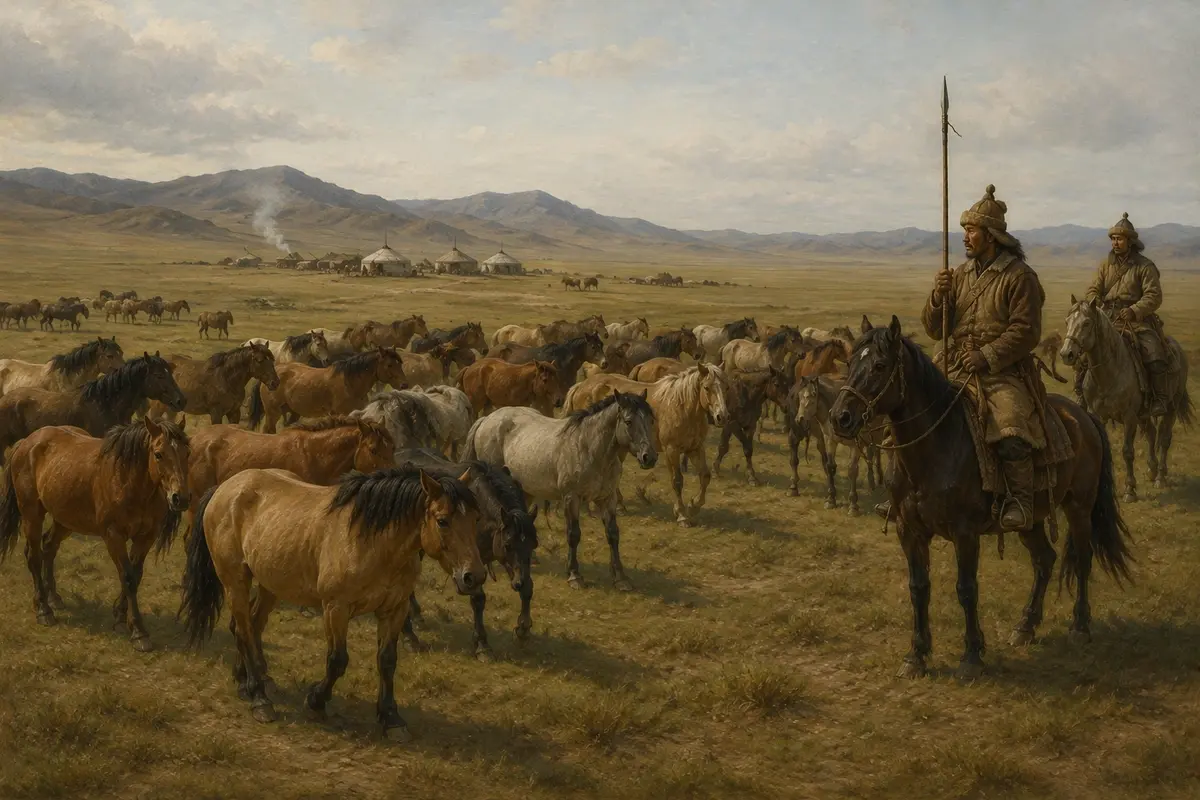
Horses were the one possession a Mongol household measured itself by, and the only weapon that never had to be imported.
The horses were a point of real pride, and the Mongols rode them with obvious relish. Weapons were bows and arrows, pikes or spears, and a sabre. Notably, the sabres were not made locally. They were manufactured in towns to the west and reached the steppe through the great trading caravans, which tells you something about how a pastoral economy plugged into the wider world.
Mongol Mounted Archery and Cavalry Tactics
In a general war, each tribe supplied a quota of armed men in proportion to its strength, and all of them went mounted. Squadrons galloping across open plains made an impressive spectacle, and the shock when they made contact was severe.
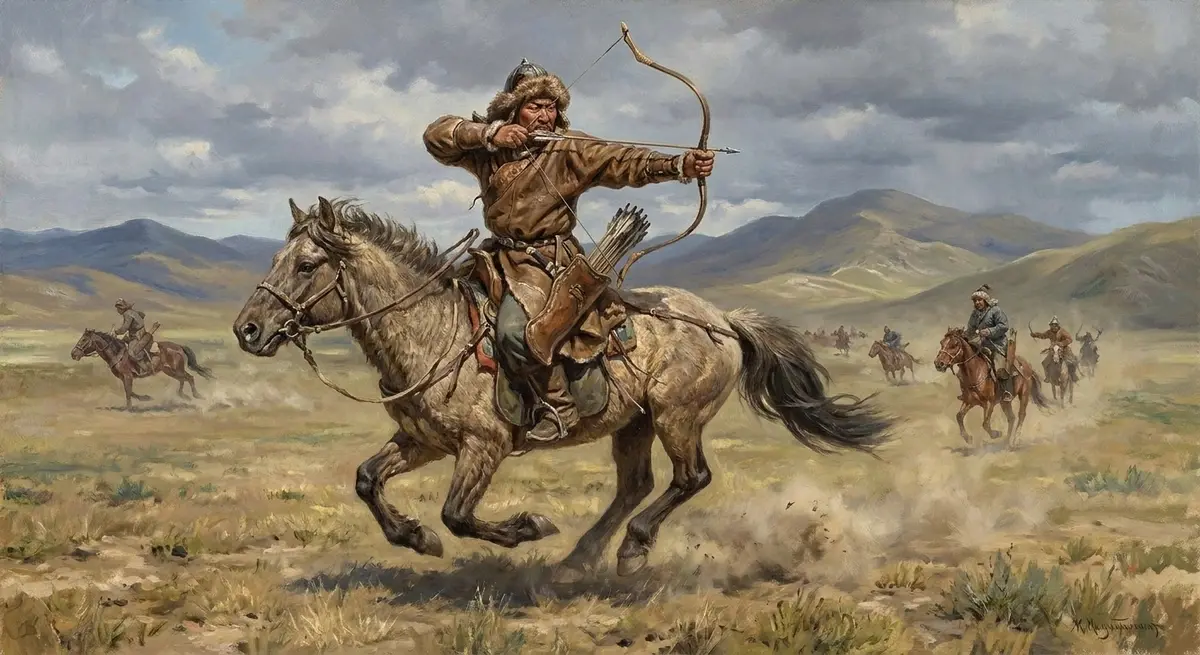
The tactic was straightforward and it worked. Riders closed at full speed and released a mass of arrows while still advancing. Then they dropped their bows to their sides, drew sabres, and cut down whatever the horses carried them into.
The more distinctive skill was the one they used going backwards. Forced into retreat, Mongol troopers galloped across the plain twisted around in the saddle, shooting at their pursuers with something close to the accuracy they would have managed standing still. They controlled the horse by voice and by pressure of the heels, which left both arms free for the bow. An enemy chasing them was therefore under fire the entire time, which turns a retreat into something much less attractive to pursue. The manoeuvre is often called the Parthian shot, and it paired naturally with the feigned retreat, in which a small unit ran deliberately in order to draw a pursuer onto a larger force waiting out of sight.
One traveller claimed these arrows could be shot with enough force to pass entirely through a man's body. The claim deserves a moment of scepticism, because a bow only returns the energy the archer put into bending it, so the real ceiling is the strength of the man drawing it. A composite bow built up from wood, horn and sinew wastes far less of that strength than a plain wooden one, and that efficiency is a large part of why Mongol range was exceptional. But no bow adds power the archer did not supply.
What Travellers' Reports Actually Tell Us
Everything above rests on accounts written by outsiders, and it is worth seeing what those outsiders were prepared to believe.
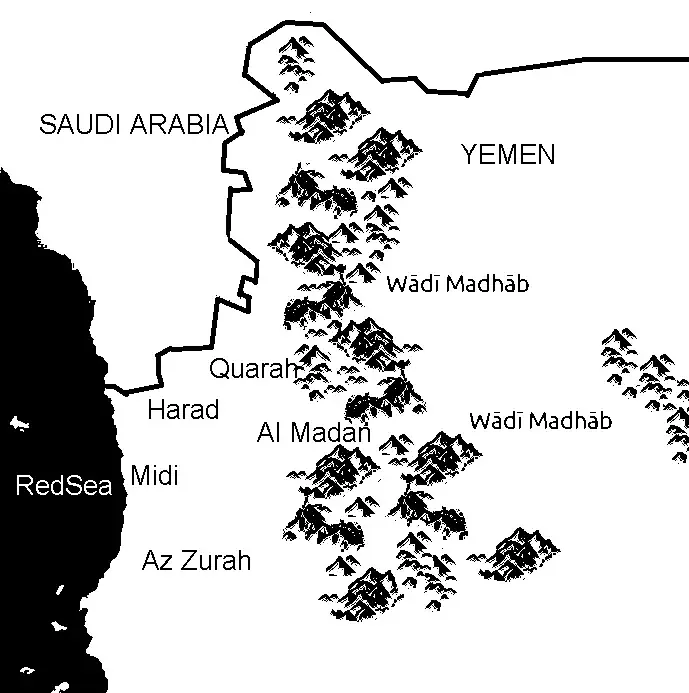
The clearest example is a mission sent east in 842 by the Abbasid caliph al-Wathiq. He had dreamt that the wall said to imprison the nations of Gog and Magog had been breached, and he dispatched a multilingual official remembered as Sallam the Interpreter to establish whether it still stood. Arabic writers of the period described Gog and Magog as two peoples, one of ordinary stature and one very small, who had destroyed many cities before being overpowered and shut away.
Sallam travelled with a large escort and a year's provisions loaded on camels. He went by way of the Caucasus and then east for months, including a stretch of blackened, foul-smelling land the party crossed while burning perfumes the whole way. Eventually he reached a country of strong fortresses and a city with temples and academies, and from there made a short excursion to see where Gog and Magog were confined.
Sallam described the barrier as an iron gate seventy-five feet high, struck with a hammer every Friday to hear what answered from inside.
He described a mountain cut through by an opening two or three hundred feet wide, flanked by iron buttresses carrying iron towers up to the summit, closed by an iron double gate seventy-five feet high with bolt, lock and key at matching scale. Every Friday, he was told, the governor of the nearby castles rode out with ten men and struck the great bolt three times with a five-pound hammer, after which a murmuring came from inside. Those were the groans of the prisoners. He was also told that three of the smaller ones had once been blown off the battlements in a high wind and measured three spans, a little over two feet, on the ground.
He went home and reported that the wall was intact, bringing back iron scrapings taken from a hairline crack as proof that the world was not about to end.
The report was dictated on his return to the geographer Ibn Khurradadhbih and preserved in his Book of Routes and Kingdoms, and scholars have argued over it ever since. Some have treated it as invention; others conclude that Sallam really did travel east and saw some pass or wall he took for the barrier. Either way, this is the calibre of material sitting underneath the earliest outside descriptions of inner Asia. The physical details of the felt tents and the wheeled houses are specific and consistent enough to trust in outline. The rest needs reading with one eye on who was doing the telling and what they had set out expecting to find.
Which makes what happened next genuinely strange. A society this thinly documented, organised entirely around animals and descent, with no cities worth the name and no political structure that outlived a single strong man, was two generations away from producing the largest contiguous land empire in history. The tools were already there. What arrived in the 1160s was someone who could use them.