Kuchlug escaped the battle that destroyed his father's kingdom in 1204, and the Mongols spent the next fourteen years chasing him. He was the son of Tayang Khan of the Naiman, and when the Naiman were broken at Chakirmaut he was holding a rear camp and got away with a handful of men.
What followed is one of the strangest careers of the period. Three rulers sheltered him and all three were destroyed. The last of them he destroyed himself, seizing an entire Central Asian empire from the father-in-law who had taken him in. He was finally caught by hunters in the mountains of what is now Afghanistan in 1218 and beheaded.
The chase matters for more than its own sake. Hunting one fugitive took Mongol armies steadily west, across the Irtysh, into the Uyghur lands and then into the Kara Khitai empire, until they were standing on the frontier of Khwarazm. Within a year of Kuchlug's death, that frontier caught fire.
Kuchlug and the Merkit After Chakirmaut
The battle he escaped was fought in May 1204 at the foot of Mount Naqu in the Altai foothills. The Naiman were the last great confederation on the Mongolian plateau still independent of Temujin, and they had gathered everyone who feared him: Jamukha, the Merkit, and the survivors of the Kereit destroyed the previous autumn. Tayang Khan was killed, his wife was taken, and the confederation ceased to exist in an afternoon.
Kuchlug's first refuge was family. He fled to his uncle Buyruq Khan, who ruled the southern Naiman near the Altai; the confederation had been split between the two brothers when their father Inanch Bilge died in 1198.
He also fell in with the Merkit under Toqto'a Beki, and that alliance carried a long history. The Merkit were the tribe whose feud with Temujin's family ran back two generations, to the day Yesugei carried off a Merkit man's new wife, Hoelun, and to the raid in which they took Temujin's own wife Borte in revenge. There was never going to be a settlement between them, and both sides knew it.
The Merkit were beaten again in 1205, at Qaradal Huja'ar, and the survivors of both peoples began drifting north-west into western Siberia, out of reach for the moment.
Buyruq Khan, Killed While Hunting
Buyruq did not last long as a protector. In 1206 Mongol forces ambushed and killed him while he was out hunting, which is a quieter end than a pitched battle and a considerably more humiliating one for a khan.
With his uncle dead, Kuchlug took over what remained of Naiman leadership himself. He was now the head of a defeated people with no territory, moving with the remnants of another defeated people, and being hunted by the largest army on the steppe.
The Battle of the Irtysh
The Merkit and Naiman survivors gathered at the Irtysh, a river rising near the centre of the continent and running north to the Arctic, well beyond the north-western edge of Mongol territory. They were far enough away to feel safe and they were not.
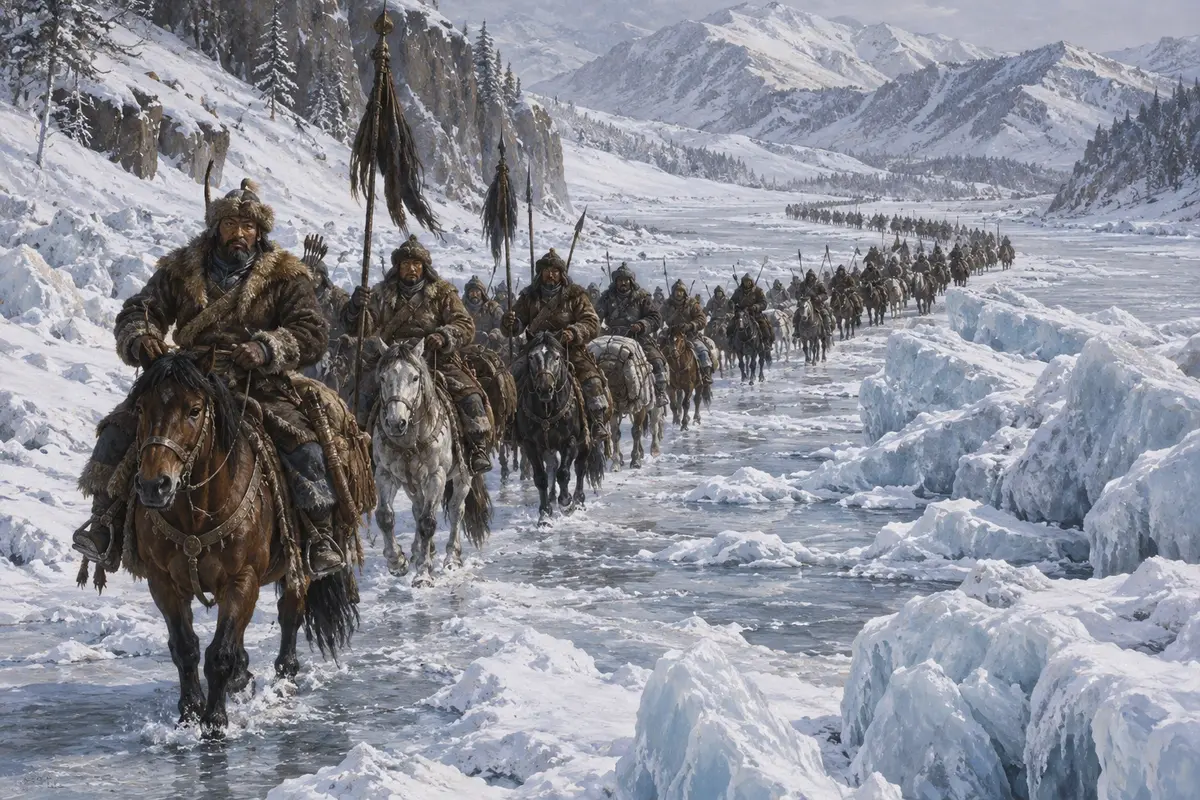
The Mongols came in winter, across country nobody expected an army to cross, to a river junction the fugitives had thought was far enough away.
The Mongol force reached them in late 1208 or very early 1209, at the point where the Bukhtarma joins the Irtysh. It was commanded by Jochi, Genghis Khan's eldest son, rather than by the emperor in person.
The battle was short. Toqto'a Beki was killed by an arrow and large numbers of his men drowned trying to get across the river. It ended the Merkit as an independent power, two generations after their quarrel with Temujin's family began.
Kuchlug escaped south. It was the third time he had walked away from the destruction of a host, and by now the pattern was established well enough to be a liability to anyone who took him in.
The Gyrfalcon as a Token of Submission
Along the way, the tribes of that country submitted, and submission on the northern steppe had a particular form.
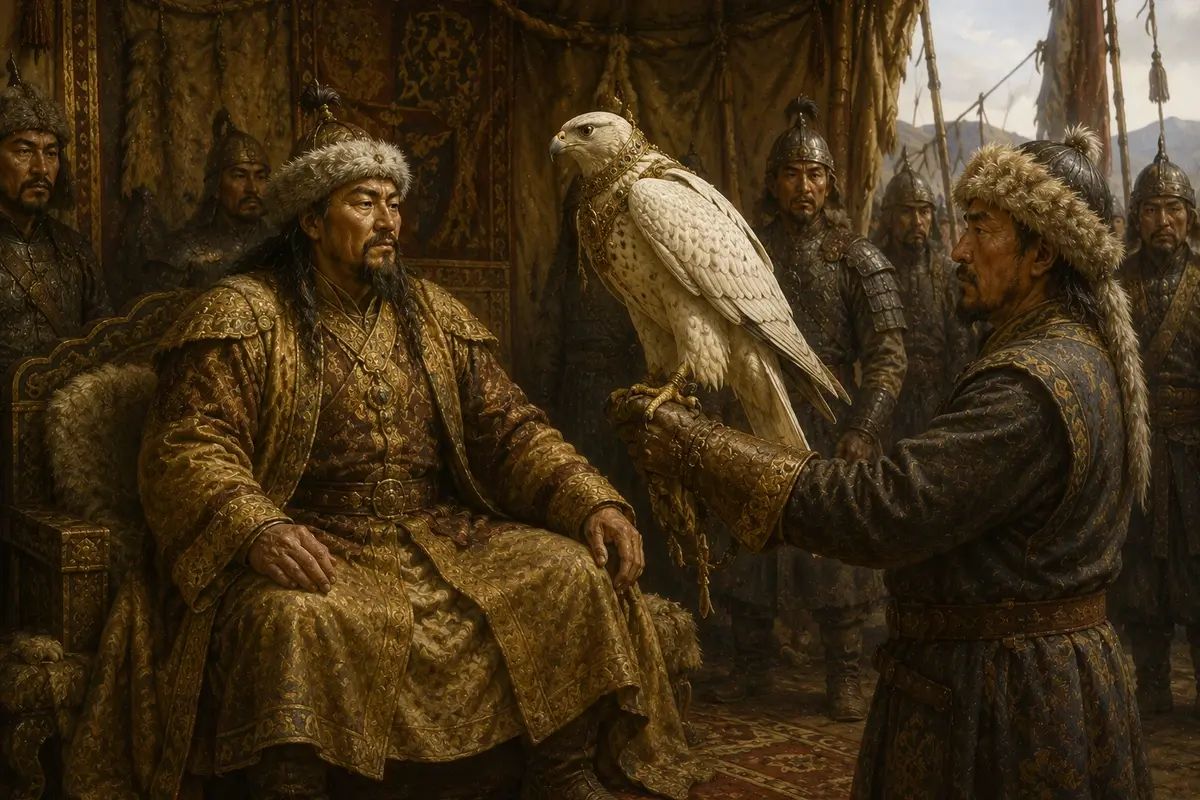
A white gyrfalcon was the most valuable object a northern people could hand over, and handing one over said in public what a treaty said on paper.
The bird was the shonkhor, the gyrfalcon, the largest of all the falcons. It appears in Mongolia only very rarely in the wild, and that scarcity is exactly what made it a prestige object. Khitan rulers are recorded demanding white gyrfalcons as tribute from the peoples they had subjugated in the far north, and using them to hunt swans in an annual spring ritual.
The archaeology backs the texts up. Excavators working in the citadel at Karabalgasun, the old Uyghur capital in the Orkhon valley, recovered the partial skeleton of a female gyrfalcon from near the top of a well, radiocarbon dated to the eleventh or twelfth century. Several of its rib bones show healed fractures, injuries that would have killed it in the wild, which means somebody had kept it and nursed it through them.
Shaukam and the Uyghur Defection
The next turn in the story came from a tax dispute several hundred miles away.
The Uyghur kingdom of Qocho, in the Turfan basin, was a vassal of the Kara Khitai empire, and the Kara Khitai kept a resident officer among the Uyghurs to collect and remit the tribute. His name was Shaukam.
Revenue collection in that world was widely farmed out: a government sold the entire revenue of a district in one lot for a fixed sum, less than it expected the taxes to yield, and the buyer recouped his outlay by squeezing it out of the population in detail. Everything above what he had paid was profit, and complaints went nowhere, because punishing a collector meant worse terms at the next sale.
Whether Shaukam was farming the revenue or simply extracting hard in his master's name, the Uyghur ruler had him killed in 1209. That was open rebellion against the Kara Khitai, and it left the Uyghurs needing a new protector immediately.
Barchuq Art Tegin Becomes a Fifth Son
The ruler in question is often called the Idikut, but that is a title rather than a name. Idiqut means roughly lord of fortune, and the man holding it was Barchuq Art Tegin.
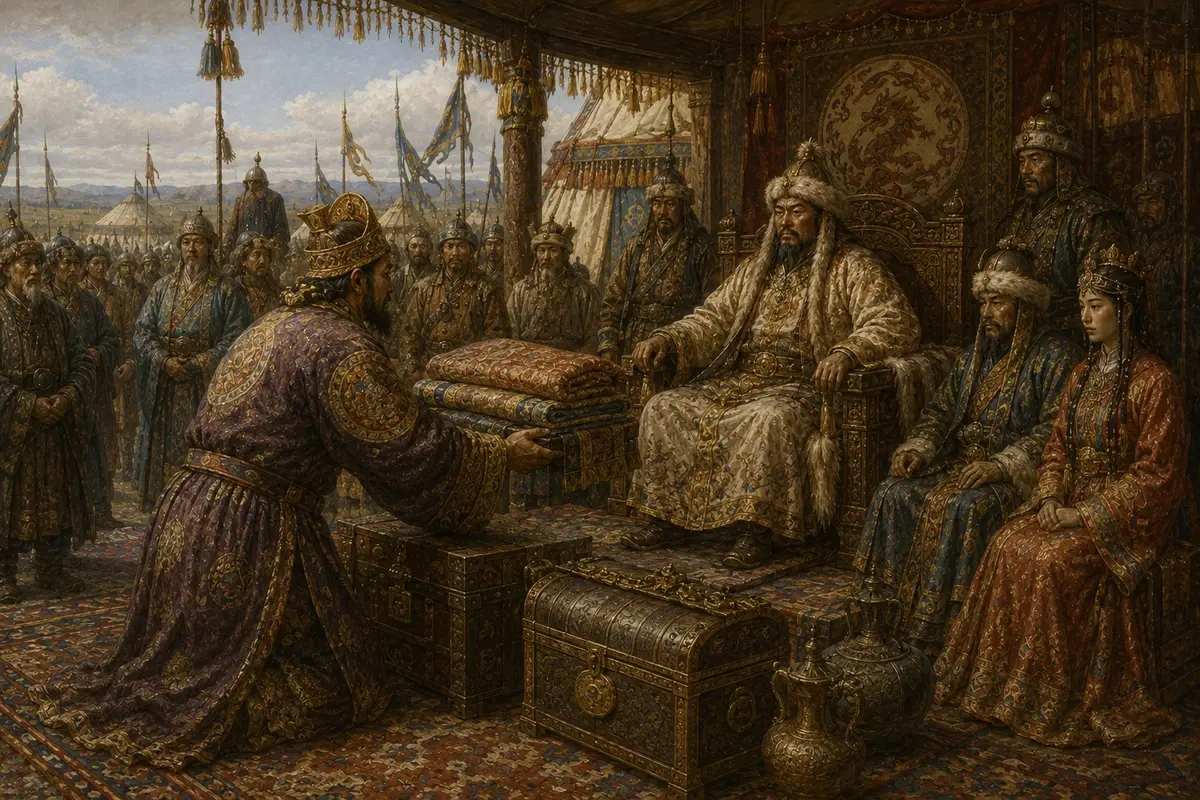
The Uyghurs came over with silks, a marriage and a standing in the new empire that no conquered people ever received.
He declared his allegiance to Genghis Khan around 1209 and came in person to Mongolia in 1211 to make it formal. What he received in return went far beyond ordinary vassalage. He married Genghis Khan's daughter Al-Altun, and he was formally declared a fifth son, ranking immediately after Jochi, Chagatai, Ogedei and Tolui, with Uyghuria treated as a fifth division of the empire.
The Mongols got more than a province out of it. The Uyghurs were literate, administratively experienced and long settled, and the Uyghur alphabet was adopted for writing Mongolian, which is the script the empire's records were kept in. A defection triggered by an extortionate tax collector gave the Mongols their bureaucracy.
The Kara Khitai reaction is the revealing part. Their first response was fury and a promise to put Uyghur territory to fire and sword, and then they learned that the Idiqut had married into the Mongol ruling family, and decided their vengeance could wait.
What the Kara Khitai Were
The state Kuchlug fled into in 1208 needs introducing, because it was unlike anything else in the region.
The Kara Khitai had been founded by Yelu Dashi, a member of the Khitan royal house who led a remnant west after the Liao dynasty of northern China collapsed in the 1120s. In 1141 he destroyed a Seljuq army at Qatwan, north of Samarkand, an event so startling that garbled reports of it reaching Europe helped seed the legend of Prester John. His successors ruled from Balasagun, in what is now Kyrgyzstan, over a patchwork of highly autonomous vassal states that at various points included Khwarazm, the Karluks, the Kara-Khanids and the Uyghur kingdom of Qocho.
Its rulers were Buddhists governing a largely Muslim population, and they governed it by leaving it alone. Chinese and Muslim historians alike treated the Kara Khitai as a legitimate Chinese dynasty; it kept the dynastic name Great Liao. For most of a century religious tolerance was simply how the state worked, and that fact becomes important shortly.
Kuchlug Takes an Empire
Kuchlug reached the Kara Khitai in 1208 and was welcomed by its ruler, the Gur-khan Yelu Zhilugu, who allowed him to marry his daughter.
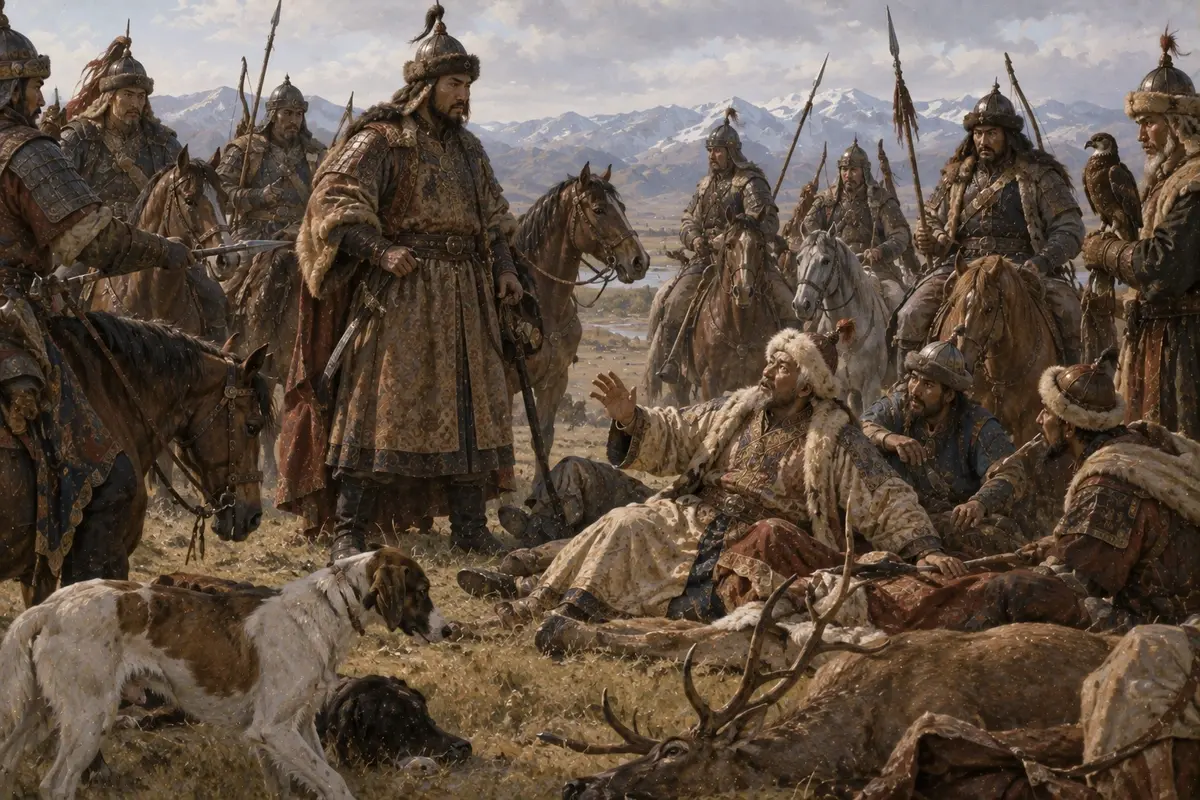
Kuchlug took the Kara Khitai throne in 1211 by ambushing his father-in-law during a hunt, five years after his own uncle died the same way.
In 1211 he repaid it. He ambushed and deposed the Gur-khan during a hunt, which is precisely how his uncle Buyruq had been killed five years earlier, and took the empire. Zhilugu was left as nominal ruler and died two years later. Most historians treat the usurpation as the end of the Kara Khitai dynasty, though the state itself survived under Kuchlug until 1218.
He had not done it alone. Muhammad II of Khwarazm, the Kara Khitai's most powerful vassal, had backed the coup, and the two men appear to have agreed to divide the empire between them. The arrangement collapsed almost immediately. Muhammad demanded that the deposed Gur-khan be handed over along with a Kara Khitai princess as payment for his help; Kuchlug stalled, and when Muhammad pressed, offered to settle it in single combat. Muhammad withdrew from the upper Syr Darya rather than take him up on it.
That is the third ruler to shelter Kuchlug and the third to be ruined by it, and the only one ruined by Kuchlug personally.
The Persecution That Undid Him
What he did with the empire destroyed him faster than any army could have.
Kuchlug had been raised a Nestorian Christian, as most of the Naiman were, and among the Khitai he converted to Buddhism. He then began persecuting his Muslim subjects, who were the majority, forcing them to convert to Buddhism or Christianity and destroying mosques.
The Kara Khitai state had been notable for exactly the opposite. It had governed a religiously mixed population for most of a century by leaving people alone, and reversing that policy alienated nearly everyone he ruled. When the Mongols arrived, the population had no reason at all to defend him.
Jebe's Pursuit to Badakhshan
The trigger was a siege. Kuchlug attacked Almaliq, a city belonging to the Karluks, and killed their ruler Ozar, who happened to be a grandson-in-law of Genghis Khan. The Karluks appealed to the Mongols for help.
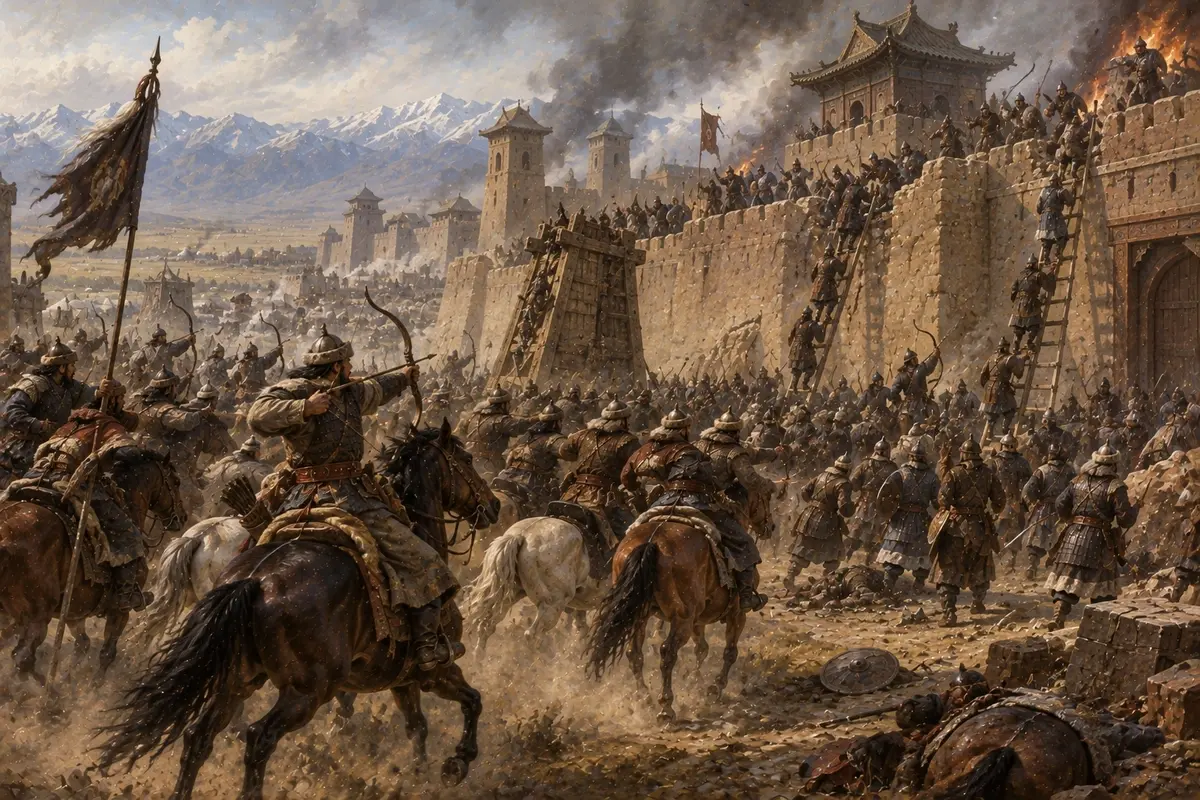
Jebe broke a force of thirty thousand at Balasagun, the Khitan capital, and then did something more effective than any siege.
In 1216 Genghis Khan sent the general Jebe west after him, with the Uyghur ruler Barchuq riding in the same force. Jebe defeated Kuchlug's army of more than thirty thousand at Balasagun, the Khitan capital.
Then he did the thing that actually finished it. He proclaimed religious freedom restored, which turned Kuchlug's own subjects against him and left him with nowhere in his empire to stand. Rebellions broke out behind him and he ran.
He fled across the Pamirs into Badakhshan, in the mountains of what is now Afghanistan, where local hunters caught him in 1218 and handed him to the Mongols. They cut off his head.
Fourteen years, four rulers and three states, to catch one man. Whatever else the pursuit demonstrates, it is not the behaviour of a state that lets things go.
It also did something nobody had planned. Chasing a fugitive had drawn Mongol armies a thousand miles west of the plateau, absorbed the Uyghurs and their alphabet along the way, and delivered an entire Central Asian empire into Mongol hands almost as a by-product. When Jebe finished at Badakhshan, the Mongols and the Khwarazmian empire of Muhammad II shared a border for the first time, with no buffer state left between them.
The following year a Mongol trade caravan of four hundred and fifty people was massacred at Otrar, on that new frontier, and the road Kuchlug had opened carried an army west along it.