Zeus was the king of ancient Greek gods and the ruler of Mount Olympus. He was the god of the sky and the weather, and the giver of life who could deliver death as well. He had a righteous character, creating rules, inviting guests, punishing offenders, promising rewards, and presiding over feasts. People prayed to him in their homes and at big temples and especially at the first Olympic Games.
Zeus’ life was surprisingly dramatic. It includes the attempt of his father to kill him, two wars with his relatives, many illegitimate children, and the most notable punishment for those who crossed him.
Who Was Zeus in Greek Mythology?
According to ancient mythology, Zeus was the mightiest of the twelve Olympian gods and goddesses. Olympian gods were the gods of the second generation, and they all lived on Mount Olympus. The gods were the daughter and son of Uranus, the personification of the sky, and Gaia, the earth. All gods and goddesses had to obey Zeus’ orders.
Zeus was primarily the sky god. The rain, storm, and lightning were all under his control. But the main feature that characterized Zeus was his role as the chief justice. He was the maintainer of laws, equality, and order. Zeus was a just god, although he had his weaknesses and sometimes acted violently.
The primary function of Zeus was to create perfect balance in the universe. Apart from that, according to some myths, he could predict the future and influence it by controlling the elements and sending some animal signs.
Cronus, Rhea and the Birth of Zeus
The story of the birth of Zeus runs about his father Cronus and mother Rhea. Cronus was the son of Uranus and Gaia and had several siblings, including Hestia, Demeter, Hera, Hades, and Poseidon. Cronus had a cruel and selfish character. He had to free himself from his father Uranus, who locked him and his brothers in the pits of Tartarus.
When he became the ruler, he did the same to his children, but Rhea saved the youngest son, Zeus. Cronus had swallowed all the other children when they were born. According to mythology, he did it to prevent them from stealing his power and throne. To save Zeus, Rhea deceived Cronus and said that the baby was a stone wrapped in a baby’s skin. Cronus ate the stone, thinking it was Zeus, and the baby survived.
Zeus Growing Up on Crete
After Rhea saved Zeus, she sent him to live in Crete, where Zeus grew up. Different myths tell about Zeus’ childhood during which he had a number of exciting adventures. According to one myth, Zeus spent his first five or six years in a cave at the mountain Dikte. The god Gaia, the earth goddess, protected and cared for Zeus. Others say that nymphs brought up the young god. Amaltheia was the nurse who gave baby Zeus milk to drink. Sometimes she is described as a real goat and sometimes as a nymph. In some myths, young people danced and sang around the cave to distract Cronus from the sound of baby Zeus.
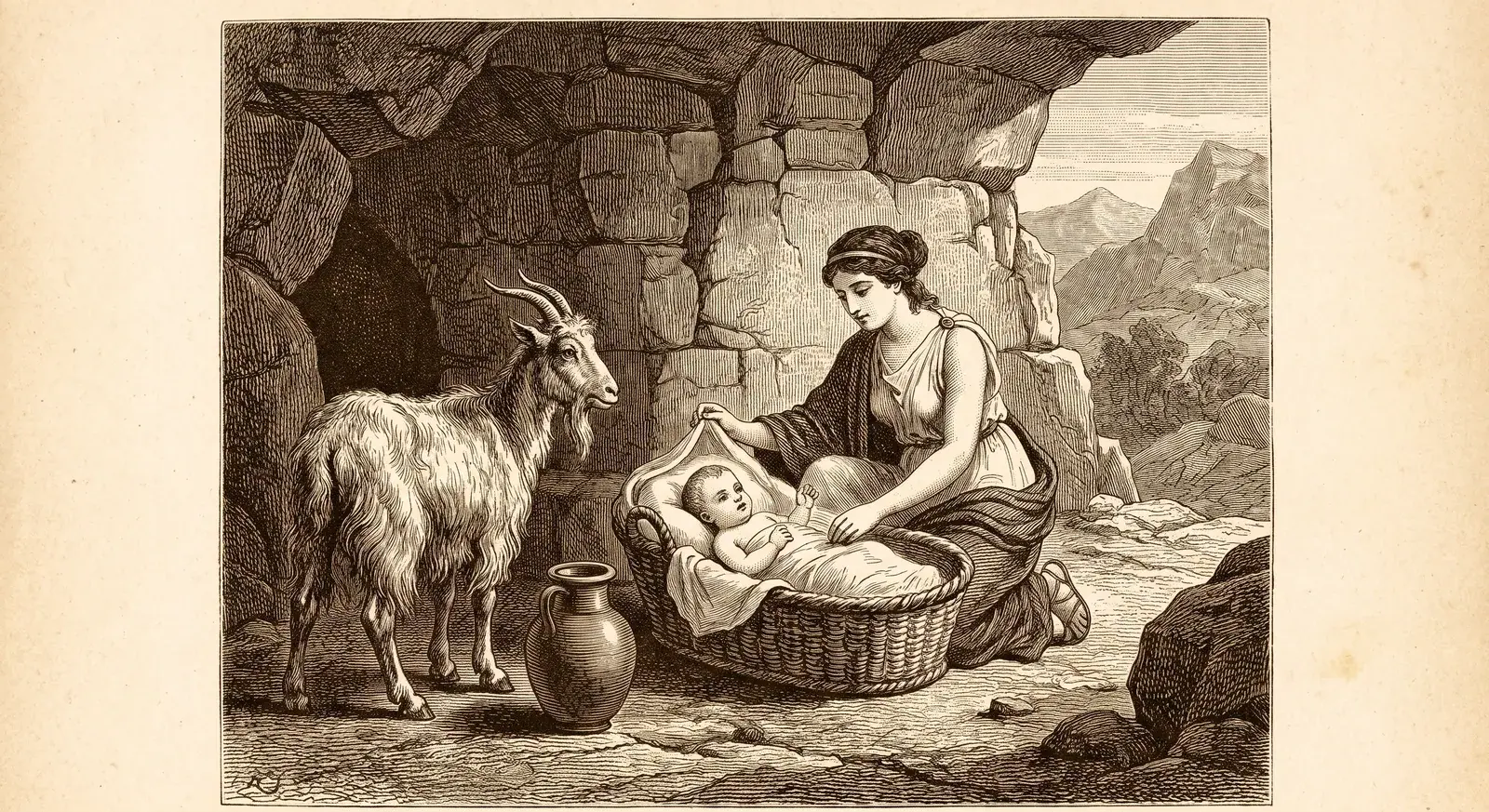
Hidden away from his father Cronus, the baby Zeus was said to have been raised in a Cretan cave and nursed by Amaltheia, sometimes described as a goat and sometimes as a nymph.
The Titanomachy: Zeus Versus the Titans
As an adult, Zeus returned to Crete and managed to make Cronus throw up all his sons and daughters. To do it, Zeus brought a drug made of millet and honey that caused pain to Cronus’ belly. When Hestia, Demeter, Hera, Hades, and Poseidon were born, Zeus gave them all the power of the air. After that, Zeus married Hera, who is considered the queen of Olympus.
But the Titans, led by Cronus, did not let Zeus inherit the throne of the sky. The battle between the Titans and Zeus, known as the Titanomachy, lasted for ten years. Zeus could not do it alone and gathered an army of the Cyclopes and the Hecatoncheires, powerful giants with a hundred hands and fifty heads each. They became Zeus’ allies and helped him defeat the Titans in the war. The Cyclopes gave Zeus his most prominent weapon, the thunderbolt.
After Zeus’ army defeated the Titans, they pushed them into Tartarus, the deepest part of Hades, where they were imprisoned for eternity. Atlas, one of the Titans, was sentenced to eternal banishment. He had to hold the sky on his shoulders so that it would never touch the earth.
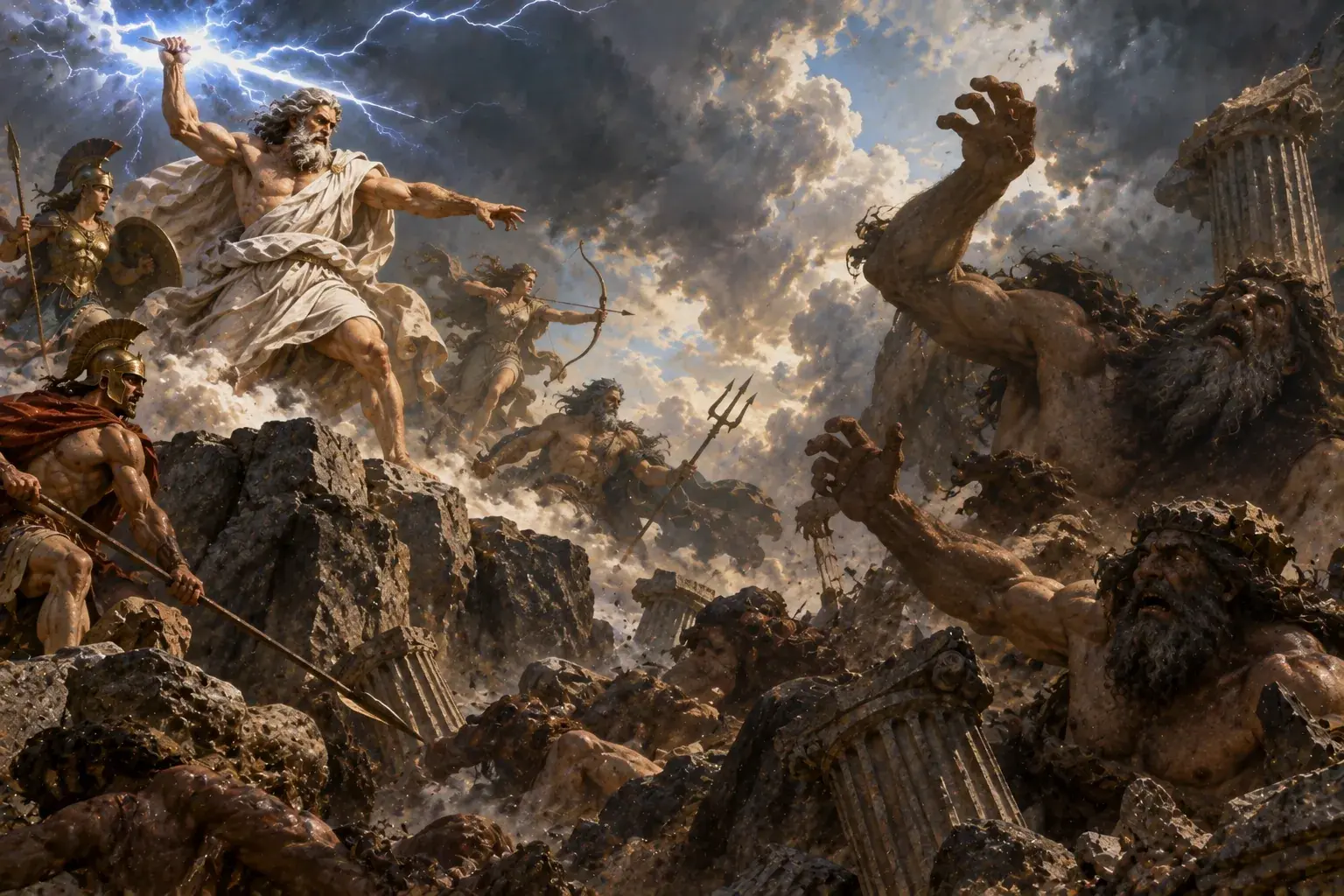
The Titanomachy raged for ten years before Zeus, backed by the Cyclopes and the hundred-handed Hecatoncheires, finally overthrew the Titans and cast them into Tartarus.
Zeus, Poseidon and Hades Divide the World
The three sons of Cronus – Hades, Poseidon, and Zeus – divided the world between themselves. Zeus took the sky and became the supreme god, while Hades and Poseidon received the underworld and the sea. Some say that the gods divided the world with a lottery, while others believe that Zeus assigned the sea to Poseidon, the underworld to Hades, and the sky to himself. The lands and Olympus belonged to them all, but it was Zeus who remained the supreme ruler.
The Gigantomachy and the Magic Herb
Gaia, the mother of the Titans, was not pleased with the fact that her children were imprisoned in Tartarus and she decided to avenge them. She conceived the Giants, a race of violent and aggressive people. She gave them incredible strength and persuaded them to fight against Zeus. The battle between the Giants and Zeus’ army was called the Gigantomachy.
Gaia also tried to find a magic herb that would make her sons invulnerable. Zeus found out about it and ordered the sun, the moon, and the dawn not to shine so that Gaia would not see the herb. After that, he picked it himself before Gaia could do the same. The Giants threw mountains, islands, and rocks, and the destruction was enormous. Fortunately, the gods had a clever trick to defeat the Giants. Heracles, the best warrior and hero in the world, came to the aid of the gods. Zeus and the gods together with Heracles defeated the Giants and once again became the owners of the world.
Hera, Athena and Poseidon’s Rebellion Against Zeus
After Zeus defeated the Giants and the Titans, he felt that his power was uncontrollable. He was not afraid of his enemies, but he was angry with his family for rebelling against him, especially Hera, the queen of Olympus. In one myth, it is said that Hera, Athena, and Poseidon conspired against Zeus. They captured him while he was asleep and tied him up so that he could not call for help. But soon, the rebellious gods were defeated, and Zeus was freed. The reason for this rebellion was not specified, but, according to one version, the reason was excessive pride.
The gods tried to rebel against Zeus again and again, but they were always defeated, and Zeus was angry with them and severely punished the rebels. Prometheus, a Titan who had stolen fire from Zeus to give to humanity, was chained to a rock, and an eagle came every day to eat his liver. However, as Prometheus was immortal, his liver grew back every night. He was eventually freed by the hero Heracles, who killed the eagle with his arrows and won Zeus’ consent to release him.
Zeus’s Wives: Metis, Themis and Hera
As Zeus grew up, he fell in love with many beautiful women and had numerous children with them. He loved Hera, the goddess of marriage, but he also fell in love with Metis, Themis, and the beautiful and clever Europa. According to the myth, Metis was a daughter of the Titans and she had unusual skills: she could speak with the minds of animals and understand their thoughts. Zeus decided to marry Metis, but he knew that the prophecy that foretold that Metis would have a son who would kill Zeus would come true. So Zeus, just as his father Cronus, ate Metis. But Metis was already pregnant and, later, Zeus suffered from terrible headaches. Finally, his head split open and out came Athena, the goddess of wisdom, war, and creativity. This was the greatest triumph and beloved daughter of Zeus.
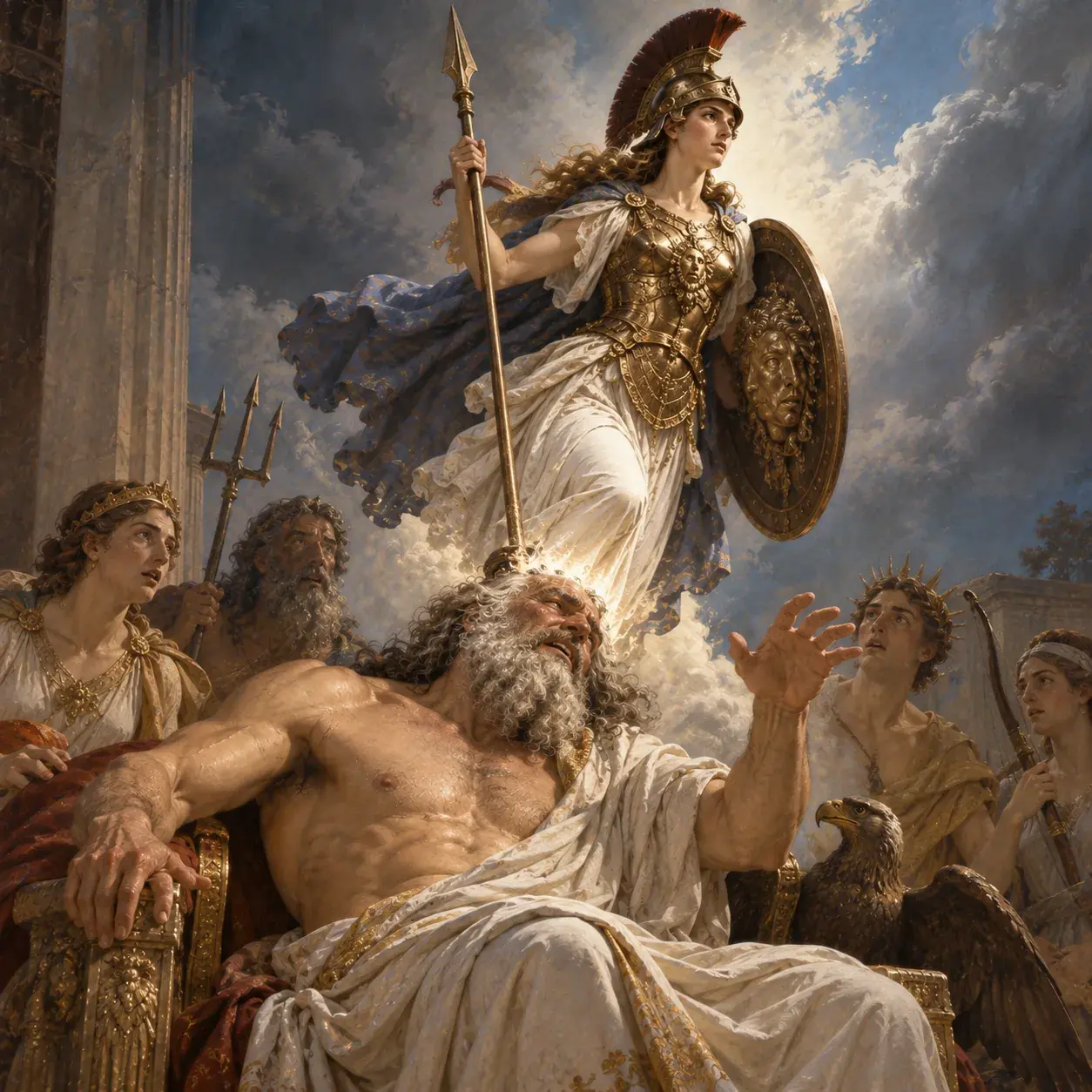
After Zeus swallowed the pregnant Metis to avoid a prophesied overthrow, Athena was born by splitting his head open — a favorite scene on Greek vases.
Zeus also had a son with the goddess Themis. She was the goddess of divine law, and her daughters – the Horae, the goddesses of seasons, brought order, justice, and peace to the world. Some say that the Fates, the goddesses who controlled every person’s destiny, were also Themis’ daughters.
Zeus and Hera had many children as well, including Ares, the god of war, Hebe, the goddess of youth, Eileithyia, the goddess of childbirth, and the blacksmith god Hephaestus.
Zeus’s Many Children and Disguises
Zeus was said to be the favorite father among gods because he gave life to many children and grandchildren. He was not conforming to the norms of the gods’ relationships and often fell in love with some women, beautiful nymphs, goddesses, and even human maidens. To avoid detection by Hera, Zeus appeared before his lovers in the forms of animals or birds, sometimes in the form of a handsome young man.
He appeared before Europa in the form of a white bull and took her to Crete, where Europa’s son Minos became the king of Crete and later imprisoned the Minotaur. He took the shape of a swan and seduced the Spartan queen Leda. She gave birth to Helen, later called Helen of Troy, and the twin brothers Castor and Polydeuces. He also came to Danae in the form of a stream of gold raindrops and created Perseus, the ancestor of Heracles and other great heroes. In other words, the most prominent gods and goddesses, as well as ancient heroes, were all Zeus’ children.
Zeus’ popularity among people was related to the fact that he often appeared in the human world. With the goddess Leto, he had two children, the god Apollo and the goddess Artemis. He also had a son Hermes with the nymph Maia. Hermes became his favorite messenger because of his agility and cleverness. One of Zeus’ most famous children was Persephone, who was born from the union of Zeus and the goddess Demeter.
Dionysus, the god of wine, was born from the union of Zeus and the human Semele. Semele, tricked by Hera, asked Zeus to show his god form to her. This happened, but Semele was mortally injured by the power of Zeus’ rays. Zeus saved the unborn Dionysus by taking the fetus and sewing it into his own thigh until it was ready to be born. Later, Dionysus grew up and became a god.
Heracles was also one of Zeus’ strongest sons. He was born from the union of Zeus and the mortal woman Alcmene.
However, Hera did not give up hope of Dionysus and Heracles dying, and she tried her best to kill them. When Heracles died, his soul flew to Mount Olympus and entered the company of the gods. Zeus was also the ancestor of many people, including the Macedonians and the Magnesians. He created the people of Myrmidons from ants and sent them to the aid of his son Aeacus. This son had two sons, Peleus and Telamon, whose own sons – Achilles and Ajax – became two of the greatest Greek heroes of the Trojan War.
Zeus and the Trojan War
The Trojan War began as a result of the dispute between Zeus and Aphrodite. The war was also caused by the desire of Zeus to reduce the number of people on earth because, according to him, the world was too crowded. However, there is a more fantastic version of the beginning of the Trojan War. According to this version, the Trojan prince Paris was chosen by Zeus to judge which of the three goddesses – Hera, Athene, and Aphrodite – was the most beautiful.
Paris chose Aphrodite, who promised him the most beautiful woman on earth, Helen of Sparta, as a prize. Helen was not willing to go with Paris, but she did leave her husband and go with Paris to Troy. Later, the Greeks sailed to Troy and spent ten years laying siege to the city. The reason for the fight between the Trojans and the Greeks was also the wall around Troy. The myth says that this wall was built by Apollo and Poseidon, who were ordered by Zeus to complete this task as a punishment for defying him.
Zeus was often compared to other gods, but he always proved to be stronger. He was also stronger in the fight against the giants, centaurs, and monsters.
Prometheus, Pandora and Zeus’s Punishments
Zeus was also infamous for the punishments he brought upon those who had crossed his path. Prometheus stole fire from the gods and gave it to people, and for this, Zeus ordered him to be put in chains on a rock, where an eagle ate his liver. In addition, people were subjected to the punishment prescribed by the gods. Zeus ordered the gods to make the first woman, Pandora, and gave her a jar in which he put all the evils and grief that could only be overcome by hope. Pandora opened the cover of the jar, and all the evils and grief flew out of it.
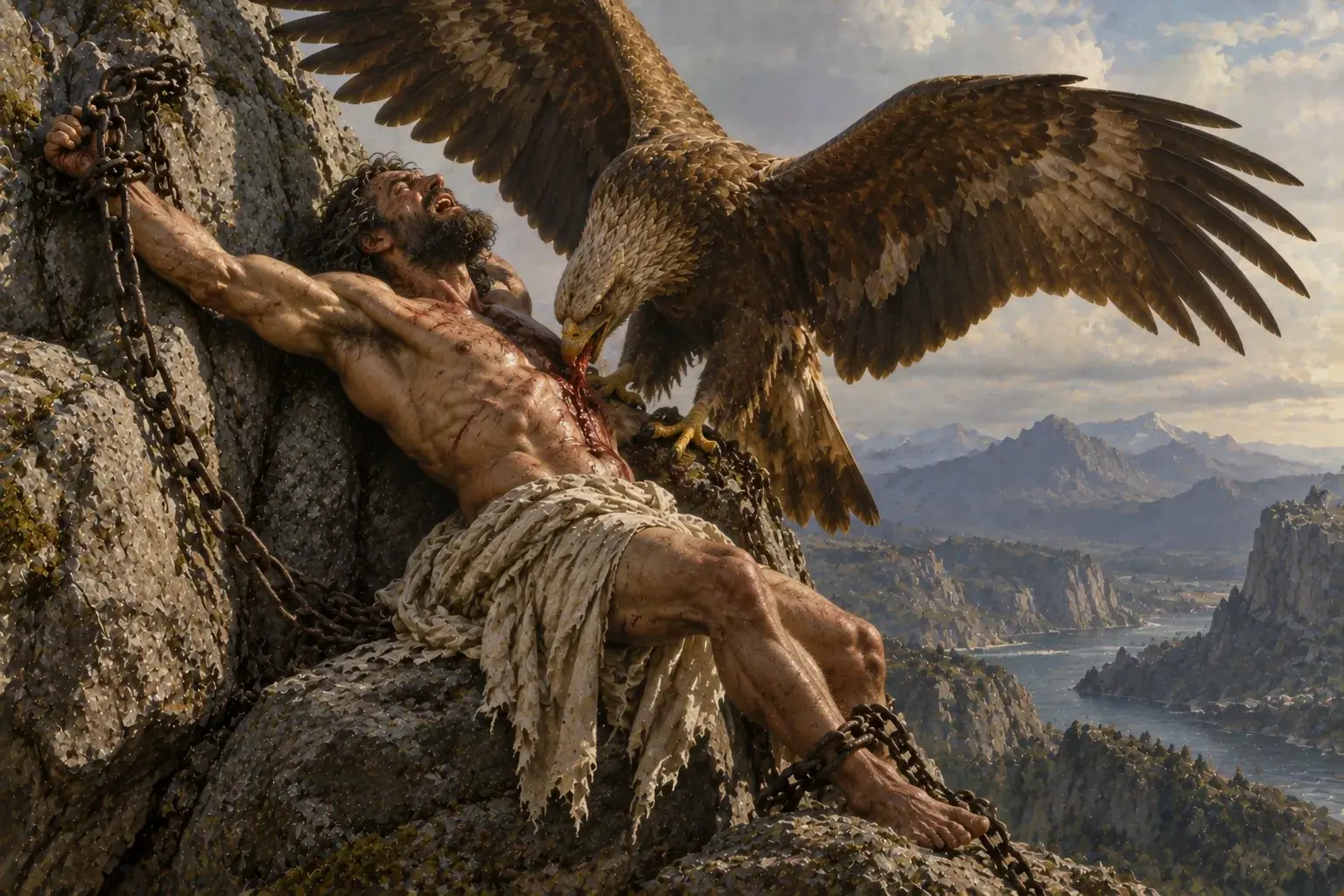
Prometheus was punished for giving fire to humanity; his liver regrew every night only to be eaten again the next day, until Heracles finally killed the eagle and freed him.
The most severe punishment was a premature death, which the rebellious Sisyphus received for refusing to return a cup to the temple. Sisyphus was also given the punishment of rolling a stone up a slope, only to watch it fall back down on him again. Ixion was imprisoned on a wheel for trying to kidnap Hera, king Lycaon was turned into a wolf for trying to make a meal of Zeus, and Salmoneus was struck by lightning for claiming to be Zeus himself and copying the movements of thunder and lightning.
Even good people were subjected to evil tricks of Zeus. He killed Asclepius, the son of Apollo, with a thunderbolt for bringing people back from the dead. Phineus was blinded and thrown out of his home, and Harpies, monstrous birds, tormented him by stealing food from him. The goal of all these punishments was to teach people to be humble and not to challenge the authority of Zeus.
Zeus often acted as a judge and was also the bringer of peace, especially between gods. He prevented discord between his children, especially Hermes and Apollo. Once Hermes stole some cattle from Apollo and brought them to Olympos. When Apollo demanded that Hermes be handed over, Zeus brought the two together. Hermes gave Apollo a musical instrument called a lyre and they became best friends. Zeus also brought peace between Heracles and the god Apollo, who competed with Heracles for the right to possess the tripod at Delphi. The quarrel subsided after Zeus threw a thunderbolt at both of them.
The biggest dispute was about Persephone, who had been kidnapped by Hades and taken to the underworld. When Demeter, the mother of Persephone, was told about this, she stopped all plant growth and food production. The whole country was devastated, famine and drought spread and people began to die of hunger. Zeus promised Demeter that Persephone would spend only half of the year with Hades. The ancient Greeks believed that the change of seasons was caused precisely by the fact that Persephone spent half of the year with her father Hades in the underworld.
The ancient Greeks believed that Zeus was just in his decisions and distributed punishment for people’s actions fairly. The poet Homer wrote that both good and bad things were prepared in Zeus’ house and, in accordance with these things, he granted people various fates. Zeus also used a pair of scales to decide what each person deserved. It is said that he also decided how much time a person was to live.
Dodona and Olympia: Sacred Sites of Zeus
The ancient Greeks prayed to Zeus everywhere and offered him sacrifices. There are some sanctuaries and altars mentioned in the myths. Herodotus, the ancient Greek historian, considers the oracle at Dodona in northern Greece to be the most ancient one. The word oracle means a place where predictions come from, and there were various rituals to obtain a prophecy.
Zeus played an important role in ancient Greece. He was prayed to, especially in matters of marriage and family. He had many temples and altars, but the most famous were the temple in Olympia and the altar in Delphi. The games called the Olympic Games were held every four years in the theater that was built in his honor in Olympia. Some say that the Olympic Games were originally held in honor of Zeus. One hundred oxen were sacrificed to Zeus during these games. The theater in Olympia also housed a temple of Zeus, which was built in the 5th century BC. This temple contained one of the seven wonders of the ancient world – a huge statue of Zeus made of gold and ivory. Unfortunately, the statue is no longer in existence.
Zeus’ most ancient home was on Mount Lykaion in Arcadia. There are still remains of the temple and the altar in it. The gods’ most beloved sanctuary was in Athens. It was the temple of the Olympian Zeus. These are the remnants of this temple, which are preserved to this day.
Zeus in Everyday Greek Worship
Despite the fact that Zeus was the most powerful and feared among the gods, he had few major festivals. It seems that the reason for this lies in his very nature as a god of a higher power who is unbound by any laws and rules. Nevertheless, the ancient Greeks paid much attention to his cult.
Ancient people attributed different names to Zeus, praying to him as Zeus Herkeios, the protector of the home and the family; as Zeus Xenios, the protector of the guests and the one who brought hospitality; as Zeus Polieus, the protector of the city; as Zeus Horkios, the protector of oaths and vows; and as Zeus Soter, the protector and savior of all.
People were especially happy to pray to Zeus for help and protection on voyages and trading. They believed that he could predict the weather and sea conditions and help avoid accidents. Many homes had a small altar to Zeus in their courtyards.
How Zeus Was Depicted in Greek Art
There is no doubt that Zeus is recognizable and easily identified in Greek art. He is depicted as a strong and bearded man, usually holding a thunderbolt in one hand and a scepter – a royal symbol in his other hand. His sacred animals include the eagle, the bull, and the oak tree. An eagle may also appear above his head when Zeus is not holding his thunderbolt.
The god appears in the center of the Parthenon’s eastern pediment in Athens, a place on the front of the Parthenon’s building, which means the birthplace of Athena. Greek vases contain numerous images of Zeus, which means that many hand-made objects were decorated with scenes of the king of gods and his animal transformations. The face of Zeus was also depicted on the coins in Elis, a region that included the famous Olympia.
The Artemision Bronze: Zeus or Poseidon?
It is hard to tell whether the great statue of Zeus or Poseidon was created. This roughly 2,500-year-old masterpiece was found in the Aegean Sea near Cape Artemision, and it is a fantastic example of ancient sculpturing techniques. It portrays a bearded god, who stands with his legs wide apart and one hand in the air, making a throw.
Since the statue’s hands are missing, it is not possible to know for sure whether Zeus was holding the thunderbolt or a trident, typical for Poseidon – the god of the seas and earthquakes. It is possible to state that the great statue of Zeus may also depict Poseidon, the most powerful god of water, which is also supported by the position of his arms, but some scholars argue that few pieces of evidence cannot be enough to prove something so extraordinary.
According to the art historian John Boardman, the statue depicts Zeus because Greek sculptors of that time were masters at creating mythical figures. He also pointed out that if it were Poseidon, a long trident would have been placed across the figure, blocking his face, which is not unusual in ancient sculptures.
Zeus’s Legacy Today
Although the ancient Greeks stopped worshipping Zeus, the god still lives today.
The Roman’s took over the gods of the ancient Greeks and changed their names – Zeus became Jupiter – the Roman equivalent of Zeus, and the planet Jupiter was also given this name, and several of its moons were named after Zeus’s lovers and children, Europa, Io, and Callisto, among others.
Modern Olympic Games, which were originally held to honor Zeus at Olympia, Greece, are the biggest sports events in the world today. Besides, Zeus appears in various movies, books, and video games as a powerful and wise god, whose main attribute is a lightning bolt. But the legacy of Zeus is mainly connected with the fact that this character represents a man in all his magnitude – including the good and bad parts.