Greek independence didn't end at one battle. It ended over about two hundred years, in stages, and at almost every stage the Greeks did it to themselves and then invited someone in to settle the argument.
The pattern repeats so exactly it becomes uncomfortable. A dispute between Greek states. One side calls in an outside power. The outside power arrives, settles it, and stays a little longer each time.
Macedon first. Then Rome. And in 146 BCE, a Roman consul burned Corinth to the ground and sold its population, and that was the end of it.
The War That Let Philip In
In 356 BCE, the Phocians — a small people in central Greece — were fined an impossible sum by the Amphictyonic League, the religious council that administered the sanctuary at Delphi, for cultivating sacred land.
Rather than pay, they seized Delphi itself.
And then they did the thing nobody had ever done: they melted down the treasures to pay for mercenaries. Centuries of dedications from every state in Greece — including, as it happens, the gold tripod from the Plataea victory monument — turned into coin and used to hire soldiers.
It was sacrilege on a scale that made the war unwinnable by negotiation, and the Third Sacred War dragged on for ten years, drawing in Thebes, Thessaly, Athens and Sparta on various sides.
Thessaly, losing, asked Philip II of Macedon for help.
That invitation is the hinge of Greek history.
Philip came, framed himself as the avenger of Apollo, had his troops wear laurel wreaths, and won. And when it ended in 346 BCE, he was rewarded with the Phocians' two seats on the Amphictyonic Council and the right to preside at the Pythian Games.
A Macedonian king now had a formal, permanent, religiously sanctioned role in the internal affairs of Greece — obtained not by conquest but by being asked.
Demosthenes spent the next eight years shouting about what this meant, and was proved right at Chaeronea in 338 BCE.
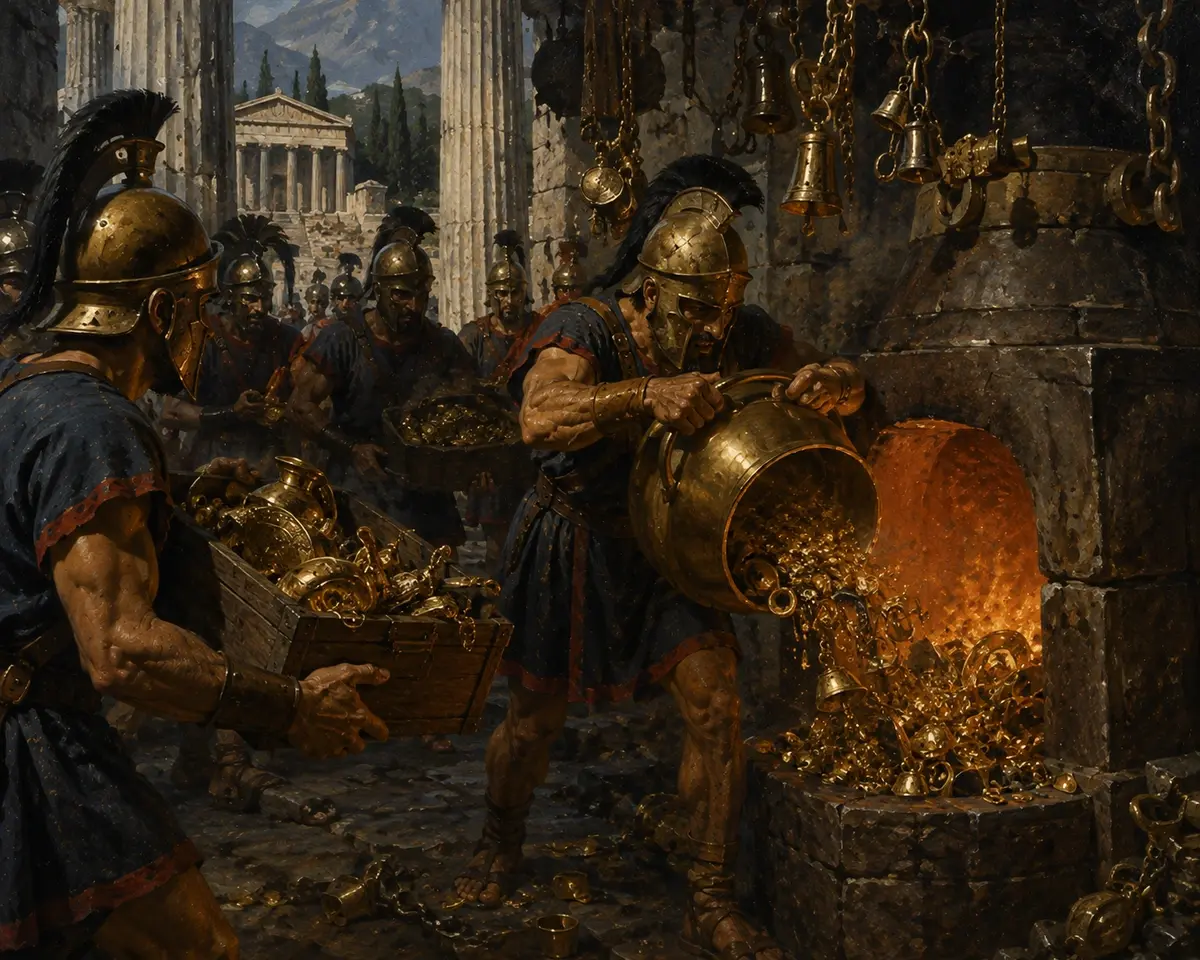
Centuries of dedications from every state in Greece, turned into coin. It was sacrilege on a scale that made the war unwinnable by negotiation — and Thessaly then invited Philip in.
The One That Went Well: Timoleon
While the mainland was doing this, something genuinely good was happening in Sicily, and it deserves recording because it's so rare.
Syracuse had spent decades under the tyranny of Dionysius I and then his son Dionysius II, and by the 340s BCE it was in ruins — depopulated, fought over by rival warlords, with Carthage taking the western half of the island. Grass was reportedly growing in the main square and cattle grazing in it.
The Syracusans appealed to Corinth, their mother city, for help.
Corinth sent Timoleon, a man with a very strange past. Years earlier his own brother Timophanes had seized power in Corinth as a tyrant. Timoleon pleaded with him to step down, failed, and then stood aside weeping while two companions killed him.
Corinth was divided on whether this made him a patriot or a fratricide. He withdrew from public life for twenty years and, according to Plutarch, considered starving himself to death.
Then Syracuse asked, and Corinth sent him with about 700 mercenaries and no real backing — partly, one suspects, because nobody else wanted the job.
What he achieved with almost nothing is remarkable. He deposed Dionysius II and shipped him to Corinth, where he ended his days as a private citizen and, allegedly, a schoolteacher. He beat a Carthaginian army many times his size at the river Crimissus in 341 BCE, in a thunderstorm that blew into the Carthaginians' faces. He cleared out the tyrants across Greek Sicily one after another. He repopulated Syracuse, inviting settlers from all over the Greek world — tens of thousands came. And he restored a democratic constitution, and had the tyrants' fortress on Ortygia demolished and law courts built on the site.
And then, with the island secure and his personal authority total, he retired. Voluntarily. He stayed in Syracuse as a private citizen, went blind in old age, and was consulted on public business by a grateful city that carried him into the assembly in a cart to hear his opinion, and applauded him in.
Plutarch clearly regarded him as the most fortunate man he ever wrote about — someone who did difficult things and had them come out right, which is not the usual shape of these stories.
It didn't last. Within a generation Syracuse had another tyrant, and Sicily eventually became the first Roman province. But for about twenty years, one man fixed something.
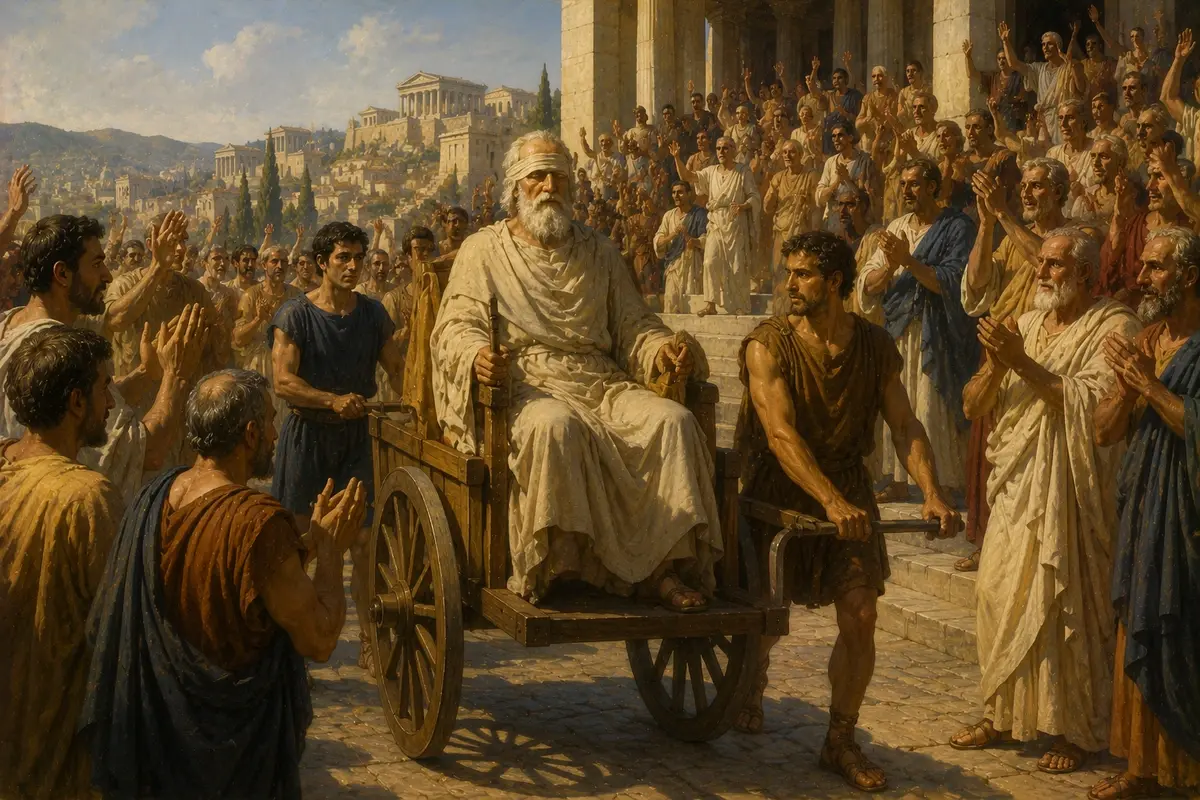
With the island secure and his authority total, he retired voluntarily. The city carried him in to hear his opinion, and applauded him in. Plutarch thought him the most fortunate man he ever wrote about.
The Hellenistic Interval
After Alexander died in 323 BCE, his generals carved the empire into kingdoms — the Antigonids in Macedon, the Seleucids in Asia, the Ptolemies in Egypt.
Mainland Greece became a secondary theatre in their wars. The old city-states were too small to matter individually, so they did the only sensible thing and combined into federal leagues: the Achaean League in the northern Peloponnese, and the Aetolian League in central Greece.
These are genuinely interesting and almost entirely forgotten. They had federal citizenship, a common assembly, elected generals, shared coinage and proportional representation of member cities. They are the closest thing the ancient world produced to a federal republic, and the American founders knew about them — the Achaean League gets discussed by name in the Federalist Papers as a precedent, mostly as a warning.
And then they made the same mistake as everyone before them. In 211 BCE the Aetolian League, at war with Macedon, allied itself with a rising western power that had just started paying attention to the east.
Rome had been invited in.
Philopoemen, the Last of the Greeks
Philopoemen (around 253–183 BCE) was elected general of the Achaean League eight times, and a Roman later called him the last of the Greeks — a phrase that has stuck to him ever since.
He deserved it in the sense that he was the last man to seriously try to make Greek states militarily independent rather than a client of somebody.
He reformed the League's army completely, replacing light skirmishing equipment with heavy Macedonian-style arms and drill, and he spent his own money doing it. Plutarch says he was contemptuous of luxury and used to tell young men who spent money on their appearance to spend it on their armour instead.
He beat Sparta twice, and at Mantinea in 207 BCE killed the Spartan tyrant Machanidas in single combat during the battle — a scene depicted on a bronze relief the Achaeans dedicated at Delphi.
In 188 BCE he did something that closed a circle. Sparta had joined the League and then tried to leave. Philopoemen took the city and — this is the significant part — abolished the laws of Lycurgus and the agoge, tore down the walls, and imposed Achaean law.
Five hundred years of the Spartan system, ended by a decree.
He was captured in 183 BCE putting down a revolt in Messenia — the country Epaminondas had freed — thrown into an underground cell, and given poison. Plutarch records him asking whether his cavalry had got away safely, being told they had, saying that was good news, and drinking it.
The Achaeans took Messene, and Polybius, then a young man, carried his ashes in the funeral procession.
Rome Takes Over
The last act runs quickly, and the tone of it is worth noticing.
In 197 BCE at Cynoscephalae, the Roman general Flamininus destroyed Philip V of Macedon's phalanx in Thessaly. The battle was a demonstration that the legion beats the phalanx on broken ground.
In 196 BCE came the "freedom of the Greeks." At the Isthmian Games at Corinth, Flamininus had a herald proclaim that Rome granted the Greek cities their freedom, without garrisons or tribute.
Polybius says the crowd's reaction was so loud that birds fell out of the sky, and that afterwards people crowded round Flamininus so enthusiastically he was nearly crushed. It was a genuine and extraordinary gesture, and the Greeks took it at face value.
What it actually meant was freedom under Roman supervision, which Rome would define.
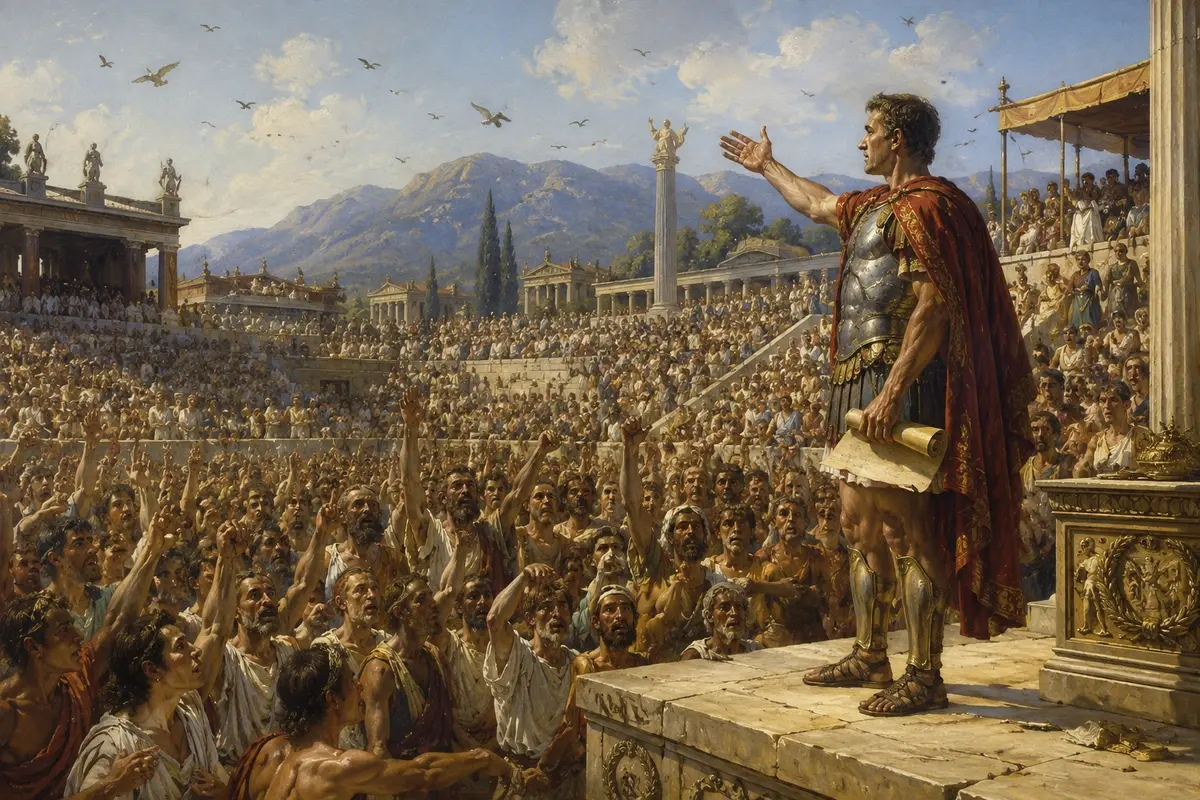
Polybius says the noise was so loud that birds fell out of the sky. It was a genuine gesture, and the Greeks took it at face value. What it meant was freedom under Roman supervision.
In 168 BCE at Pydna, Perseus of Macedon was defeated and the Macedonian kingdom abolished. Rome took 1,000 Achaean hostages to Italy as a security measure, including a young officer named Polybius, who spent seventeen years there, became attached to the household of Scipio Aemilianus, and wrote the history of how Rome conquered the Mediterranean — from the inside.
And in 146 BCE, the Achaean League, provoked and outmanoeuvred, declared war on Sparta in defiance of a Roman ruling, and effectively on Rome.
It was hopeless and everyone knew it. The consul Lucius Mummius defeated the League army outside Corinth, entered the city, and destroyed it. The men were killed, the women and children sold, the art shipped to Italy, and the city burned and left uninhabited for a century.
Polybius, who was there, describes Roman soldiers using priceless paintings as boards to play dice on.
The same year, Rome destroyed Carthage. Two cities, at opposite ends of the Mediterranean, erased in one summer. It was not a coincidence; it was a policy.
Greece became a Roman protectorate administered from Macedonia, and in 27 BCE the province of Achaea.
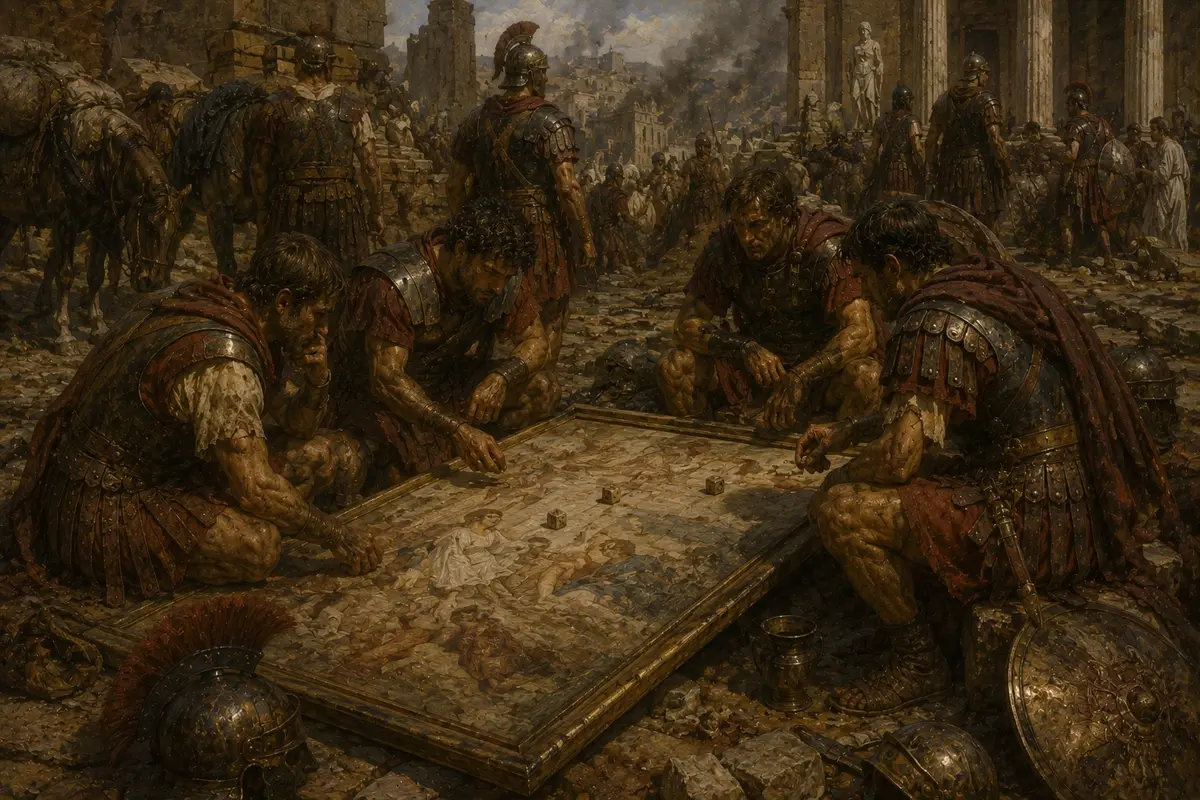
Polybius was there and describes it. The men were killed, the women and children sold, the art shipped to Italy, and the city burned and left uninhabited for a century.
What Actually Killed It
Nobody could stop calling in outsiders. Thessaly called Philip into the Sacred War. Syracuse called Corinth. The Aetolians called Rome. Each invitation was rational for the state issuing it and fatal collectively.
The scale had changed. A city of 30,000 citizens could dominate the Aegean in 450 BCE. By 200 BCE it was competing with territorial kingdoms of millions. The leagues were an intelligent response and arrived roughly a century late.
And the wars never stopped. Between 431 BCE and 146 BCE, Greek states were at war with each other more or less continuously. Athens broke Sparta's dominance, Thebes broke Athens', Macedon broke Thebes'. By the time Rome turned up, the region had been at war with itself for three hundred years.
The Consolation Prize
And then something unexpected happened.
Roman aristocrats began sending their sons to Athens to study. Greek became the second language of the Roman elite and, in some households, the first. Greek doctors, tutors, architects, sculptors and philosophers went to Italy in enormous numbers, some as slaves and some as very well-paid professionals. Roman literature was built directly on Greek models. Roman gods were assimilated to Greek ones. The Romans copied Greek statues by the thousand — and most Greek sculpture we have today survives only as Roman copies.
Horace put it in one line that has never been improved on: captive Greece took her savage conqueror captive, and brought the arts into rustic Latium.
He was right, and it isn't only a consolation. Greek culture reached far more of the world under Roman administration than it ever had under Greek independence, and it is largely why we can read any of this at all.
The cities lost. What they made didn't.