Herodotus has been called the father of history and, since antiquity, the father of lies. Both are fair. He is the first person we know of who set out to investigate what happened, ask people, compare versions and write the results down. He is also a man who will interrupt an account of an imperial war to tell you about a fish, and who reports things he clearly doesn't believe with a note saying so. That combination is why he's still readable 2,450 years later, and why his book is full of episodes that have nothing to do with the Persian Wars and everything to do with the fact that he found them interesting. Here are seven of the best.
1. The Man Who Danced Away His Marriage
Cleisthenes, tyrant of Sicyon, had a daughter called Agariste and decided she should marry the finest man in Greece. So he ran a competition. He announced it at the Olympic Games, having just won the chariot race. Any Greek who thought himself worthy to be Cleisthenes' son-in-law should present himself at Sicyon within sixty days. He would make his decision within a year. Thirteen came, from all over the Greek world, and he kept the lot of them for twelve months, testing them. He built a running track and a wrestling ground. He asked about their families and their politics. He watched them in the council chamber. And most of all — Herodotus is emphatic about this — he watched them at dinner. How a man behaves over a year of banquets tells you more than how he throws a discus. The clear favourite was Hippocleides of Athens, the richest and best-looking of them, and by the final night everybody knew it.
At that last banquet, with the decision effectively made, Hippocleides had a good deal of wine and called for a flute-player. He danced. Then he had a table brought in and danced on the table. Then, warming up, he stood on his head on the table and beat time in the air with his legs. Cleisthenes had been watching with growing horror. At the leg-waving he could not contain himself, and told him he had danced away his marriage. And Hippocleides, upside down, replied: Hippocleides doesn't care. It became a Greek proverb — ou phrontis Hippokleidēi — for magnificent indifference to consequences. The prize went to Megacles of Athens instead. His son by Agariste was Cleisthenes of Athens, who invented democracy. Which means the political system of the Western world exists partly because a man did a headstand at a dinner party. Herodotus, incidentally, tells the whole story without once mentioning what Agariste thought about any of it.
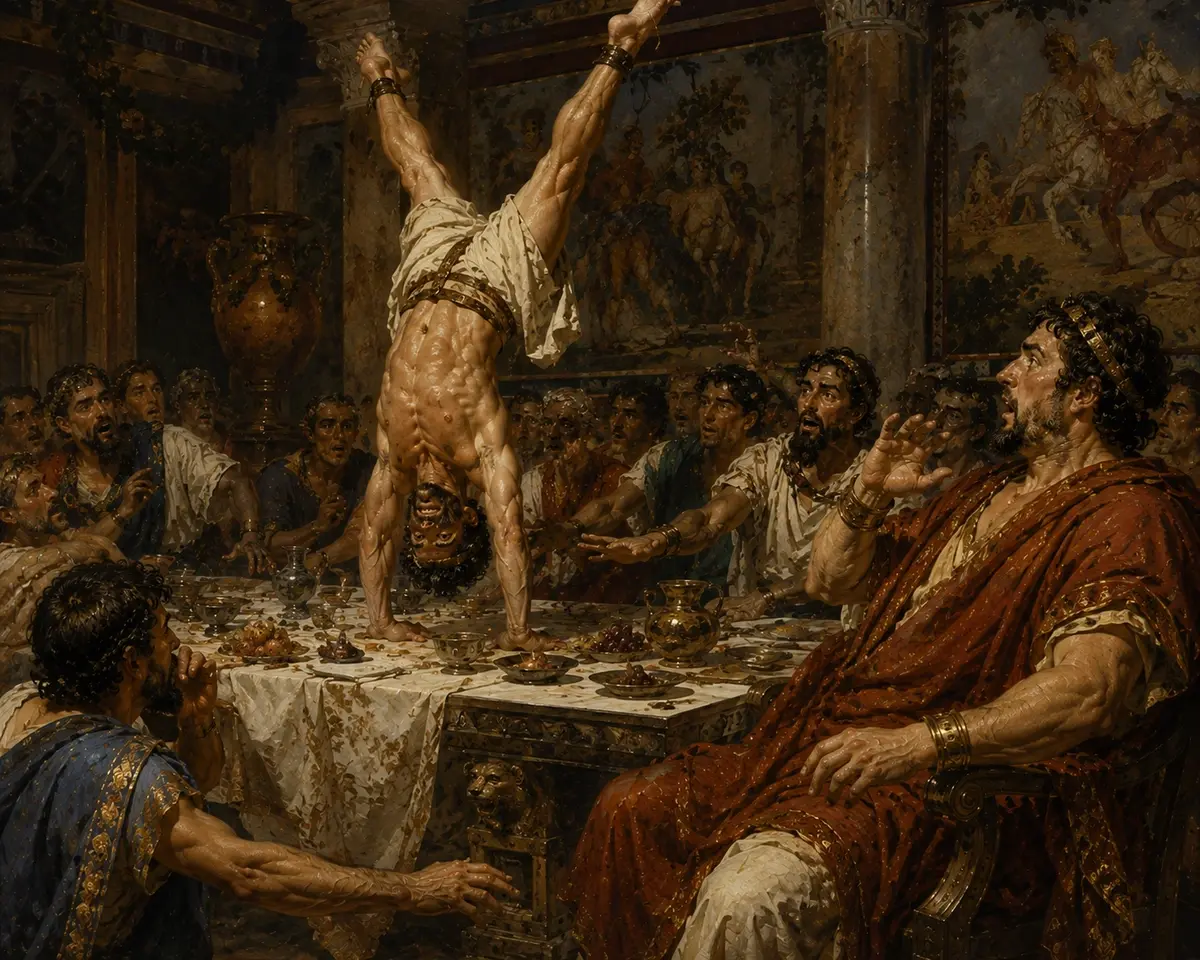
Told he had danced away his marriage, he replied — still upside down — that Hippocleides doesn't care. It became a Greek proverb for magnificent indifference to consequences.
2. The Baby in the Corn Bin
Corinth was ruled by the Bacchiadae, a closed aristocratic clan who only married each other. One of them, Amphion, had a daughter called Labda who was born lame, and no Bacchiad would marry her. So she married outside the family, to a man named Aëtion. They had no children, and Aëtion went to Delphi. The oracle told him a son would be born who would fall on the ruling family like a rock and set Corinth right. The Bacchiadae heard about it, waited for the child to be born, and sent ten men to the house to kill it. They had agreed on the way that whoever was first to take the baby would dash it to the ground. Labda, suspecting nothing, handed the child over — and it smiled at the man holding it, and he couldn't do it, and passed it to the next, who also couldn't, and so on down all ten. They handed it back and went outside, and there had a furious argument in the doorway, each blaming the others, and finally agreed they would all go back in together and share the deed. But they had argued loudly, and Labda had been listening at the door. She grabbed the baby and looked for somewhere to hide it, and chose the most unlikely container in the house: a kypselē, a corn bin. The ten came back, searched everywhere, found nothing, and left. Rather than admit failure they reported that the job was done. The child grew up and was named Cypselus, after the bin. He took Corinth around 657 BCE, expelled the Bacchiadae, and ruled for thirty years.
3. Periander, Who Was Worse
Cypselus's son Periander ruled Corinth for forty years and was counted among the Seven Sages of Greece, which tells you something about the standards for that list. Early on, wanting advice, he sent a messenger to Thrasybulus, tyrant of Miletus, asking how best to hold power safely. Thrasybulus took the messenger for a walk through a cornfield. As they went, he kept asking why the man had come from Corinth — and while asking, kept cutting off any ear of corn that stood taller than the rest, and throwing it away. They walked the whole field. He ruined a great deal of corn. Then he sent the man back without an answer. The messenger reported to Periander that Thrasybulus was mad and had destroyed his own crop. Periander understood perfectly. He began killing and exiling the most prominent men in Corinth. The image has never gone away. Tall poppy syndrome is the modern English version of exactly this parable.
Periander also killed his wife Melissa, and Herodotus does not explain why. Some time later he needed to consult her ghost about a lost deposit of money, and the oracle of the dead reported that she refused to speak — she was cold and naked, because the clothes buried with her had never been burned and so were no use to her. So Periander ordered every woman in Corinth to come to the temple of Hera in her best clothes, as if for a festival. He had them all stripped, and burned the clothing in a pit for Melissa. Then she talked.
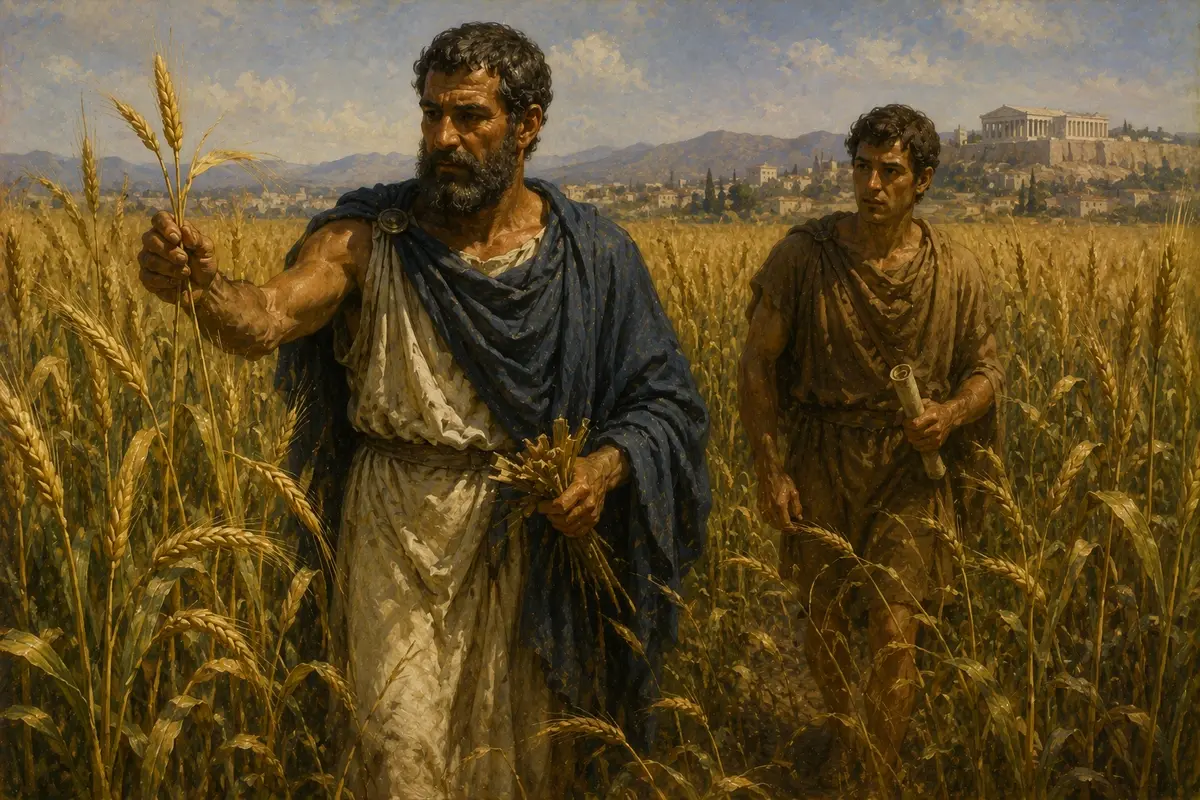
He ruined a great deal of corn and sent the man back without an answer. Periander understood perfectly. Tall poppy syndrome is the modern English version of exactly this parable.
4. Arion and the Dolphin
Also Corinthian, and a complete change of register. Arion was the greatest singer and lyre-player of his day, and lived at Periander's court. He went on a long tour of Italy and Sicily, made a great deal of money, and hired a Corinthian ship to bring him home — reasoning that he could trust Corinthians more than anyone else. Out at sea, the crew decided to take the money and throw him overboard. Arion offered them everything he had. They refused — they wanted him dead so there'd be no complaint. He asked to be allowed to stand on the deck in his full performing costume and sing one last song, and promised to kill himself afterwards. The sailors, rather pleased at the prospect of hearing the best singer alive for free, agreed and went to the stern. Arion put on his full robes, took up the lyre, stood on the rowing benches and performed. And at the end of it, in his costume, holding the lyre, he jumped. The ship sailed on to Corinth. A dolphin carried Arion to shore at Taenarum, and he made his way to Corinth and told Periander, who did not believe a word of it and kept him under guard. When the ship arrived, Periander sent for the crew and asked politely whether they had any news of Arion. They said he was alive and well and doing very nicely in Italy when they left him. At which point Arion walked in, still in the costume. Herodotus notes that a small bronze statue of a man riding a dolphin stood at Taenarum, dedicated by Arion. He clearly knew people thought the story was nonsense, and mentions the statue anyway.
5. The Doctor Who Conned His Way Home
Democedes of Croton was the best physician in the Greek world and got captured by the Persians almost by accident, ending up a slave in chains at Susa. Then King Darius dismounted badly from a horse and twisted his ankle so severely that the Egyptian doctors — then the most highly regarded anywhere — made it worse over seven days and nights of pain. Someone remembered the Greek in the slave quarters. Democedes was dragged in as he was, in rags and chains, and initially denied being a doctor at all, because he could see that admitting it meant never going home. Darius saw through him. He treated the ankle with Greek methods, gradually, and got the king sleeping again within days. His reward was enormous wealth, a fine house, dinner at the royal table — and absolutely no permission to leave.
Then Darius's wife Atossa developed a growth on her breast. She hid it out of embarrassment until it worsened. Democedes agreed to treat her on one condition: that she swear to grant him whatever he asked afterwards, and he assured her it would be nothing shameful. He cured her. Then he told her what he wanted. She went to Darius and — as though it were her own idea — argued that a great king with a young empire ought to be adding to it, and suggested he attack Greece. And she said she'd heard the best way to start would be to send Persian spies ahead to survey it, with Democedes as their guide, since he knew the country. Darius thought this was excellent. He appointed fifteen noble Persians to go with Democedes, told them to see everything and bring him back, and gave Democedes lavish gifts to take with him. They toured the Greek coast, mapping harbours and taking notes. And at Croton, Democedes' home city, he simply walked off the ship and stayed. The Crotoniates seized the Persians and refused to hand him over. He kept the gifts, married the daughter of the famous wrestler Milo, and lived out his life at home. He also, before parting, told the Persians to inform Darius that he was engaged to Milo's daughter — because the king knew Milo's name, and Democedes wanted him to know that the escape had been planned all along.
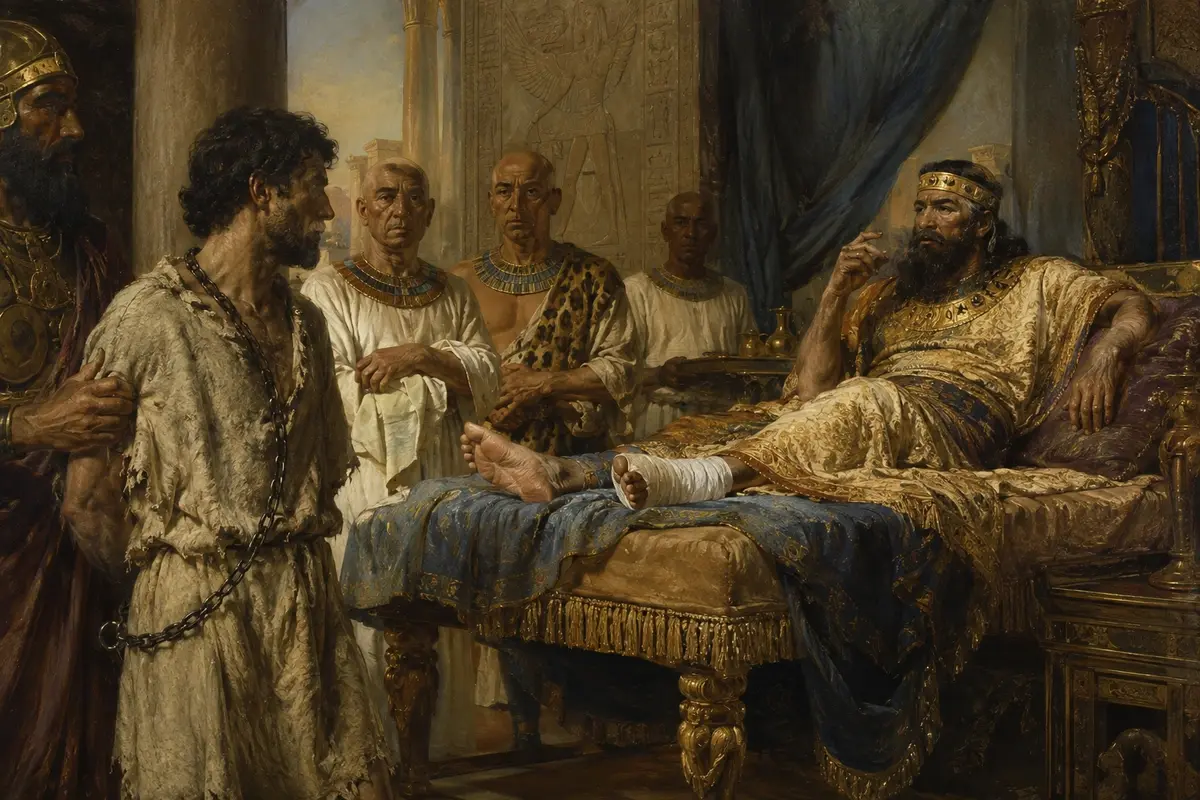
He denied being a doctor at all, because he could see that admitting it meant never going home. Darius saw through him. It took years and a second patient to engineer the escape.
6. The Gift That Was a Threat
In about 513 BCE, Darius invaded Scythia, north of the Black Sea, with an enormous army. The Scythians were nomads. They had no cities to defend, no crops to burn, and no reason at all to fight a pitched battle. So they simply withdrew, filling in the wells and destroying the pasture as they went, and let the Persian army chase them across the steppe until it was exhausted and starving. Darius eventually sent a messenger demanding they either fight or submit. The Scythian king replied that they were doing what they always did, that they had no cities or farmland to be anxious about, and that if he insisted on a fight he could try finding and disturbing their ancestors' graves and see what happened. Then the Scythians sent a gift: a bird, a mouse, a frog and five arrows. The messenger who delivered them refused to explain and left. Darius was delighted. He read it as surrender — earth (the mouse), water (the frog), horses (the bird, roughly) and their weapons, all handed over. His advisor Gobryas disagreed, and read it the other way: unless you become birds and fly into the sky, or mice and burrow into the earth, or frogs and jump into the marshes, you will never get home — you will be shot down by these arrows. Gobryas was right. Darius left his campfires burning and his weakest troops in camp to make it look occupied, and pulled out overnight. It is one of the earliest recorded cases of an empire being defeated by an enemy who simply declined to be found.
7. The Boiling Tortoise
And a short one that shows Herodotus's method better than anything. Croesus, before going to war with Persia, wanted to know which oracle was worth consulting. So he ran a controlled test. He sent messengers to seven oracles with identical instructions: on the hundredth day after leaving Sardis, ask the god what the king of Lydia is doing at this moment. Then he made sure to be doing something no one could guess. He chopped up a tortoise and a lamb and boiled them together in a bronze pot with a bronze lid. Only Delphi got it. The reply came back in verse, describing the smell of tortoise boiling in bronze with lamb. Herodotus reports this deadpan. What's remarkable isn't the answer — it's that a 6th-century BCE king designed a blind test with a control, and that a 5th-century BCE writer thought the methodology was the interesting part.
Why He Wrote Like This
Herodotus is often treated as an unreliable warm-up act before Thucydides got serious. That's unfair on both counts. He states his method at the start: he is setting down the results of his inquiry — historiē, which is where our word history comes from and which then meant something closer to investigation — so that human achievements are not forgotten and the reasons for the conflict are preserved. He names sources. He gives competing versions and tells you which he prefers. He repeatedly says he is obliged to report what he was told but not to believe it — a sentence that ought to be over the door of every newsroom. And he includes the tortoise and the dolphin and the headstand because he thought a history of a war should also be a description of the world the war happened in: what people ate, how they buried their dead, what they found funny. Thucydides took the other road and produced something harder and colder and arguably greater. But nobody has ever read Thucydides for pleasure on a train.