The Yapese people are the indigenous people of Yap, the main island group in one of the four states of the Federated States of Micronesia. Their culture is guided by two very important concepts, which are emphasized through family life, politics, meals and dances: respect and responsibility.
Yap is famous for the huge stone money the Yapese sailors brought from Palau as a cargo. Stone money is only one part of a very complex traditional society, which had strict rules about inheriting land, eating habits, food preparation and division of labor, and the division of the house.
The most notable aspect of Yap culture is that a large portion of it has survived colonization, wartime destruction, depopulation and the introduction of imported food. Traditional culture is actively taught in Yap schools, and most people surveyed want to see it passed on.
Who The Yapese Are
The Yapese are the indigenous people of Yap, a part of Micronesia. They constitute about the half of the population of Yap State. According to the 1994 census, 48.1 percent of the population on Yap was of ethnic Yapese, and 49.1 percent in 2000. In the Federated States of Micronesia, as a whole, Yapese made up 5.7 percent of the population in 2010.
There is also a small diaspora of the Yapese living outside Micronesia. It was reported in 2012 that there are 258 Yapese residents in the Northern Mariana Islands, 412 – on Guam, 72 – in Hawaii and 865 – in the continental U.S.
Yapese Voyaging & Contact With Neighboring Islands
Yapese people are experienced navigators; before the arrival of Europeans they knew the surrounding island groups well. Yapese sailors visited Palau to quarry the stone used to make Yap’s currency. Other islanders also visited Yap, including the Carolinian people from the outer atolls, who came to Yap in times of crisis.
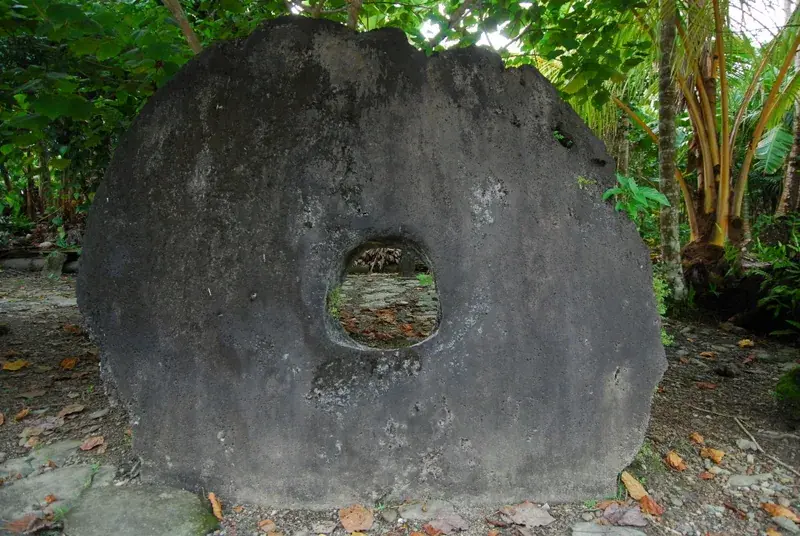
Yap's rai stones were quarried in Palau and carried hundreds of kilometers across open ocean.
Image Credits: By Bartek.cieslak at Polish Wikipedia, CC BY-SA 3.0, https://commons.wikimedia.org/w/index.php?curid=7785905
Colonial Rule on Yap: Spain, Germany, Japan and the United States
Yap's colonial period began in 1885, when Spain and Germany both laid claims to the island and missionaries started to arrive to proselytize. Pope Leo XIII's arbitration confirmed Spanish sovereignty that same year, but Spain sold the islands to Germany in 1899. However, in 1914, when World War I broke out, Yap was occupied by the Japanese navy and was to remain under their control until the end of World War II.
In the post-war period, Yap became part of the United States Trust Territory of the Pacific Islands. In the late 70s, Yap became a state of the Federated States of Micronesia, which it remains to this day.
Depopulation and Recovery on Yap
The period before World War II was very difficult for the residents of Yap. The population decreased rapidly due to sexually transmitted diseases brought by foreign workers and lower birth rates. The population reached its lowest point right before WWII.
The post-war period saw the introduction of antibiotics, which decreased the death rates, and the population recovered rapidly. This probably contributed to the preservation of the traditional culture.
The Tabinaw: Yapese Households and House Design
For the Yapese people, the basic social unit is the tabinaw, which roughly translates to a household. More specifically, a household consists of a nuclear family, which usually has its own house and land.
The interior of a traditional Yapese house is divided by a long log lying across the floor, dividing the house into two parts. The back part, called tabgul, belongs to the father of the household. The front part, the to’or, is a common space for the whole family to eat and sleep. Some families also had separate cookhouses, where different members of the household could prepare food. The domestic division of labor in traditional societies was quite strict, while today Yapese households tend to have one kitchen. Modern houses are built using metal and concrete instead of traditional materials.
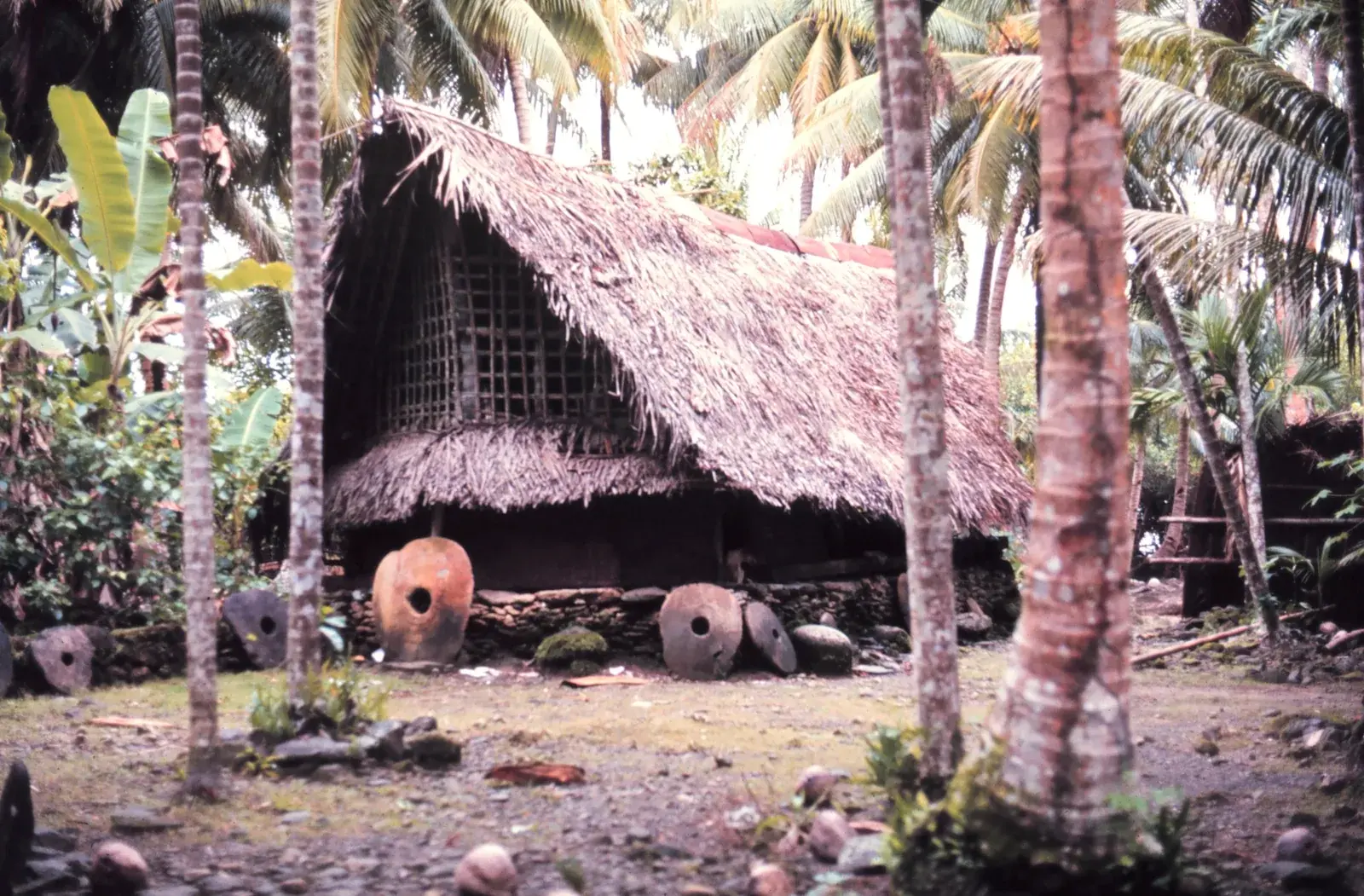
Traditional Yapese houses stand on stone platforms, with interiors divided between the father's section and the family's shared space.
Image Credits: Dr. James P. McVey, NOAA Sea Grant Program, via Wikimedia Commons (Public domain)
Estates, Land Inheritance and Social Rank
Several households can form an estate, sharing the land and the resources of a single house site. A man gains membership in an estate by having his name chosen from a pool of ancestral names in his father's line, and women can belong to the estate where they were born or join the estate of their husbands.
Traditionally, estates were passed on from the father to his sons or his brothers. If a man has no sons, his eldest daughter could inherit the estate. The land was also the basis for the social hierarchy. The Yap society had several classes, and those who had to rely on land owned by others belonged to a serf caste. Depending on the class, families had various rights and obligations.
Yapese Clans, Chiefs and Village Government
The Yapese kinship system is based on two kin groups, the patriclan and the patrilineage. The former is a political and economic unit, the latter is a social one.
Yapese clans are also called genung. Clans are based on common totem, which is either an animal or a plant. Clan members have to abstain from eating the totem animal and are forbidden to marry within the clan. All Yapese clans can trace their ancestry to a mythical figure and a mythical location, and consider themselves descendants of that ancestor.
Each clan has a chief, and each village has a head chief who acts on behalf of his clanmates. The chief is more of a mediator than a leader, as he merely expresses the opinion of the village. Traditional villages also had a council of elders, which was the judicial authority in the village. The chief would represent the village’s opinion in the council.
Yapese Beliefs About Conception & the Anthropology Debate
Yap has been the subject of considerable debate among anthropologists regarding the Yapese perceptions of conception and of the roles of women and men. The anthropologist David M. Schneider argued that the Yapese did not link sex to conception, and that the child was not considered the property of the parents.
According to Schneider, the Yapese believed conception to be a gift from the ancestors, who bestowed it upon those who had earned their favor. Schneider’s arguments were based on the fact that women who engaged in promiscuity did not conceive often.
Other anthropologists have contested his views, notably Thomas Helmig, who analyzed Yapese social structure using the field notes of Wilhelm Müller-Wismar. Helmig stated that Schneider’s interpretation did not allow for the complexities of the Yapese beliefs and overstressed the role of women. Helmig argued that the Yapese concept of paternity was similar to that of maternity – both began before birth, which is similar to the European perception of the role of parents in conception. Schneider’s interpretation shows the degree to which different anthropologists could interpret the same cultural heritage.
Sexual relationships and incest are serious issues in Yapese society. Incest is considered the worst crime a person can commit, and those who committed it were subject to the severest punishment. The taboos surrounding sexual intercourse are so strong, that the Yapese would compare an incestuous person to an animal or a cannibal.
Taro, Fish & the Thumag and Ggaan Food System
The food and the system of eating on Yap are highly ritualized. Different foods are produced by different members of the society. Yapese eat a variety of local crops, including taro, yams, breadfruit, bananas and seafood. Local farming methods include horticulture, shifting cultivation, taro patches and animal husbandry.
Men are traditionally responsible for fishing, which makes them the providers of thumag, or the protein in the food. The women tend to the taro patches, cultivating them with great care. The resulting product, the ggaan, or the starch in the food, is the duty of the women. The Yapese consider a meal to be incomplete without both of these ingredients.
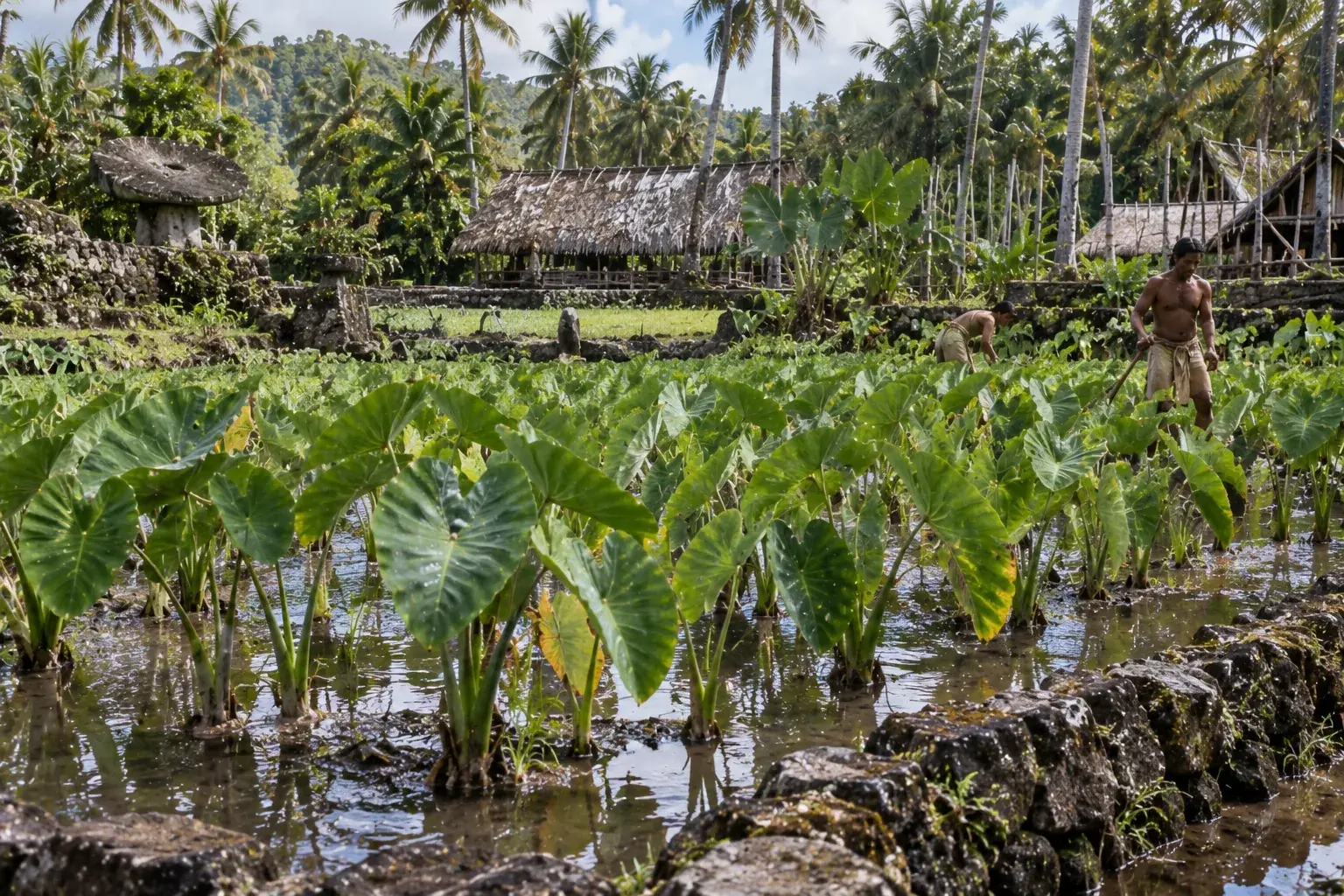
Taro patches tended by women produce ggaan, the starchy half of every proper Yapese meal.
This division of labor among men and women is quite flexible, however, as the Yapese are quite comfortable categorizing new foods according to the system. Processed meats are considered to be thumag, while white rice is classified as ggaan.
Eating Classes and Food Taboos on Yap
The divisions of labor based on sex and class are reflected in the eating habits of the Yapese. Groups of people with similar status and privileges eat together, and the food is prepared separately for each group. There are eating classes, the members of which are men of a non-serf class. To enter an eating class, a man has to participate in the initiation rite called dowach.
Men eat separately from women and children in the main house. Boys who are over ten years old live and eat in the young men’s house. Girls who are menstruating eat in a separate house. These are the broad rules, which are often subject to local interpretation.
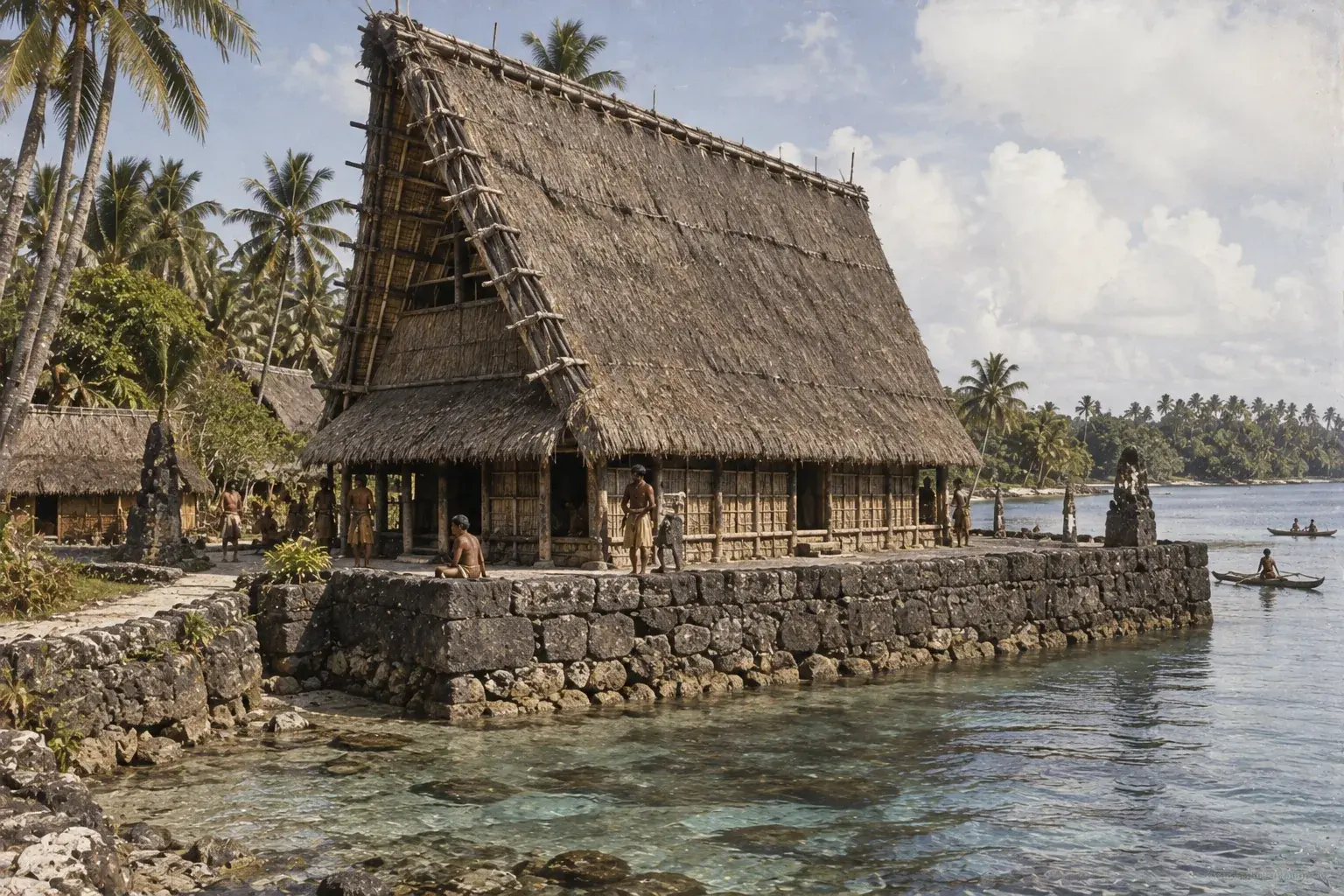
Village men's houses like this faluw were central to the separation of eating and living spaces by age and gender.
American Subsidies and the Shift to Imported Food
Since World War II, large numbers of American subsidies to the Federated States of Micronesia have affected local food production. Subsistence farming became less and less important to the Yapese, who substituted imported white rice for it. Canned meats also became a staple food. Socially, the Yapese have accepted chewing betel nut and drinking palm wine as a part of the social life, alongside alcoholic drinks.
Traditional Yapese Dance and Chant
Traditional Yapese musical expression does not involve any instruments. Instead, the Yapese engage in a highly ritualistic dance, which is accompanied by chant. The dance is considered the “writing” of the Yapese culture, as it serves to record cultural knowledge and pass it on from one generation to the next.
Dance is a traditional performance on special occasions, such as Yap Day and guyuwol, a ritual exchange between villages. Traditional dance is usually performed by a group of dancers, who move in unison and chant in rhythm, often telling a story. Dancers usually wear traditional costumes for the performance. The traditional dance is called churu’.
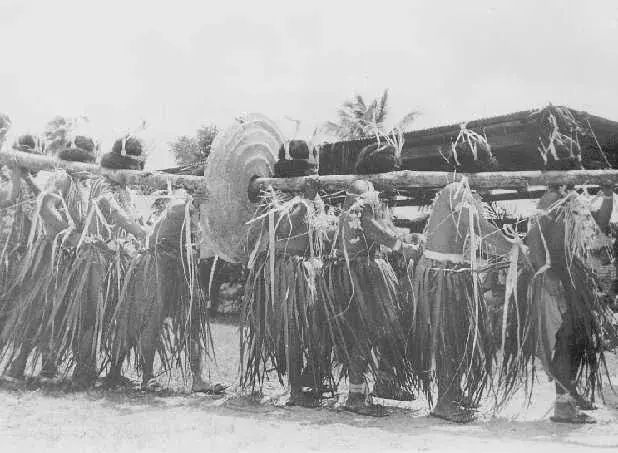
Traditional churu' dances, performed without instruments, are a highlight of Yap Day celebrations.
Image Credits: TTPI(Trust Territory of the Pacific Islands) Headquarters, via Wikimedia Commons (Public domain)
Traditional Yapese Clothing
The traditional men’s clothing in Yap includes loincloths, and the traditional women’s clothing is the grass skirt. These costumes are now mostly worn in remote villages and on special occasions, as contemporary Western-style clothing has replaced them in everyday life.
Keeping Yapese Culture Alive
When viewed as a whole, Yapese culture is one of structure and organization. Houses are divided by logs, meals are divided into ggaan and thumag, villages have chiefs and dances are performed in rhythm. Every element of culture reinforces the necessity of respect and responsibility.
These elements have persisted despite a century of colonization, wartime destruction, a drastic decrease in population and the introduction of new foods. At the moment, the culture is actively taught in schools, where it is assigned as a subject called Practical Art/Culture. In addition, a majority of the population expressed interest in preserving and passing on the culture in a 2010 survey. Perhaps, this dedication to traditional culture is the best legacy the Yapese people can pass on, being one of the few cultures in the world that has lasted for so long.