The Indo people are the Eurasian descendants of Europeans and Indonesians who lived in the old Dutch East Indies and for several centuries were the silent glue binding that colony together. In its narrowest sense the word refers to people of mixed Dutch and Indonesian descent who held European legal status under colonial rule, along with their descendants today. In its widest sense, anyone of mixed European and Indonesian ancestry can be referred to as Indo.
Their history cannot be seen solely in a national context. In the Indies they were legally European but culturally something else entirely, a community which spoke Dutch at school and Malay at home and ate rice with almost every meal. With Indonesia's independence, this in-between position became dangerous. Within two decades almost the entire community had left for the Netherlands, the country many of them had never seen.
Today, estimates as to how many people in the Netherlands hold Indo ancestry range anywhere from 800,000 to two million, which would make them the country's largest minority. And yet many younger Dutch people with Indo roots know surprisingly little about where their families came from.
What "Indo" Means
The word Indo first appears around 1898 as a short form of the Dutch term Indo-Europeaan. Over the years the same people have been described as Eurasians, Indo-Europeans, Indo-Dutch, Dutch Indonesians and Dutch-Indos. In Indonesian common terms include Indo-Belanda, Belanda-Indo and Sinjo for boys and men.
A related Dutch word causes confusion. Indische Nederlander covers every Dutch national who lived in the East Indies, whatever their ancestry. To distinguish the two groups, people of mixed descent were called Indo while Dutch people born in Europe were called Totok. Earlier centuries saw other terms including the Portuguese-derived mestiço and the Dutch kleurling, meaning "coloured", and a string of openly insulting names.
The European side of Indo ancestry was primarily Dutch but not only Dutch. Portuguese, German, British, French and Belgian ancestors are all seen in Indo family trees. Historically the community was Christian and spoke some mix of Dutch, Portuguese, English and Indonesian, forming a distinct society wedged between newly arrived Europeans and the Indigenous population.
Portuguese Traders and the First Eurasian Families
The oldest roots of the Indo community date back before the arrival of the Dutch. In the early 16th century Portuguese traders established posts throughout Southeast Asia, with a strong presence in the Maluku Islands, the Spice Islands, as it was known. The Spanish, meanwhile established themselves in the farther north Philippines.
These early contacts resulted in the first Eurasian families in the region. Some of the oldest Indo families possess Portuguese surnames such as Simao, De Fretes, Pereira and Henriques. The writer Tjalie Robinson used this evidence to argue that Indo culture did not merely appear painted on a Dutch foundation. In his view it grew from a much older mestizo culture that began with the first Europeans in Asia.
The Dutch East India Company and Early Batavia
When the Dutch East India Company, or VOC, built its headquarters at Batavia, now Jakarta, it faced a basic problem. The Netherlands was a small country and couldn't supply enough men for an empire in Asia. The company recruited extensively across the poorer corners of northwestern Europe. Germans, French, Scots, English, Danes, Flemings and Walloons all served, along with Norwegians, Italians, Poles, Irish and thousands of Swedes.
Company leaders were unsure what to do about families. In the 1620s Governor-General Jan Pieterszoon Coen took action when he felt that Dutch women and orphans should be shipped east and the establishment of an orphanage in Batavia raised Dutch girls to become colonial brides. Around 1650, mixed marriages dropped sharply as more European women arrived. This was short lived as later in the 17th century, the flow of passengers to Asia dropped dramatically and many men who had come without wives married local women.
The VOC and later the colonial government often encouraged these unions as they helped consolidate Dutch control. The existing Portuguese-descended mestizo population was welcome into the mix. Some company officers took great care of their Eurasian children, sending sons to be educated in the Netherlands, though some of those boys never returned.
A snapshot of Batavia in 1720 shows how small the European world was. The city housed about 2,000 Europeans and 1,100 Eurasians, as well as 11,700 Chinese, 27,600 Javanese and Balinese, and 29,000 enslaved people of many origins, including Africans.
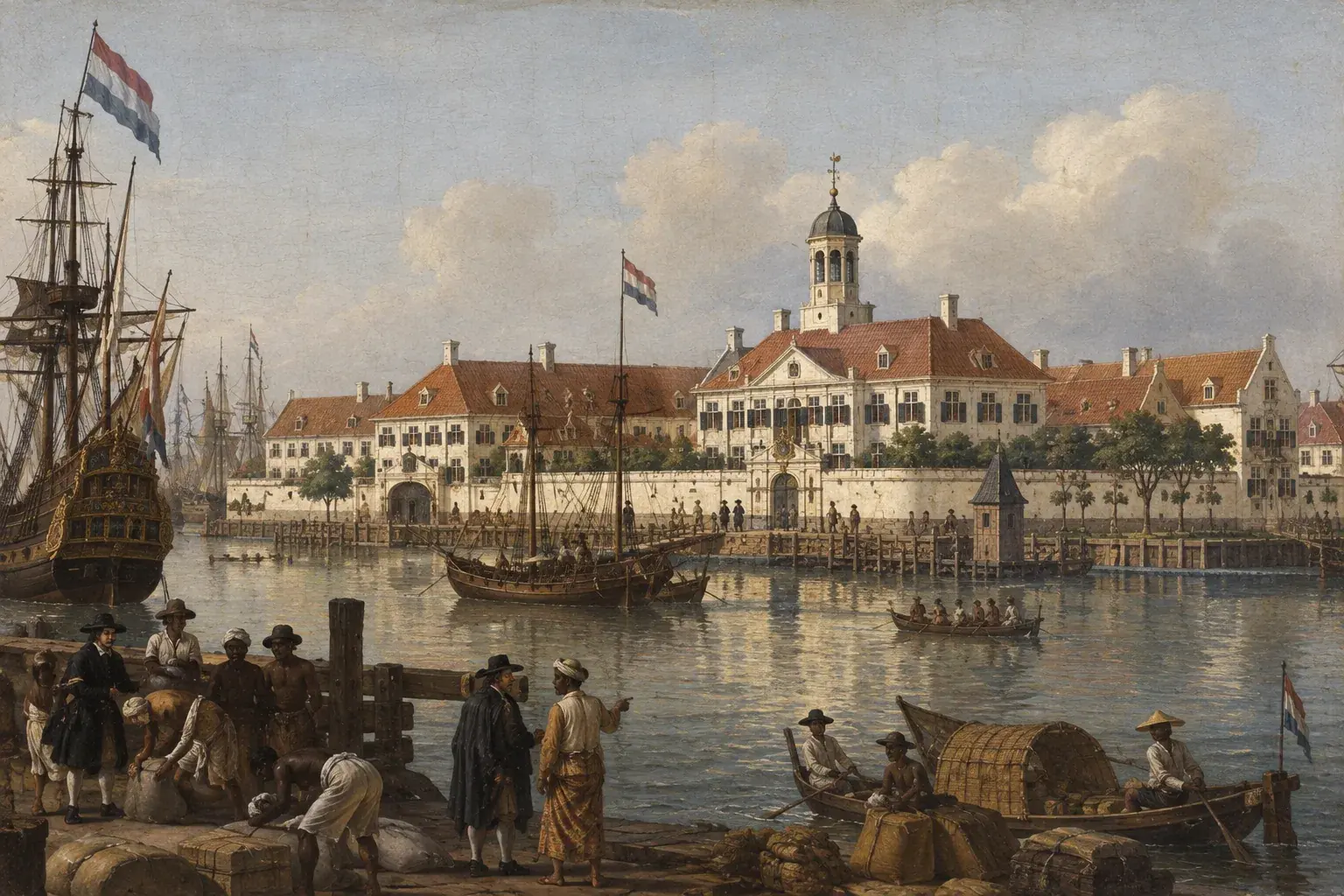
Andries Beeckman's view of Batavia, painted around 1656, shows the VOC headquarters where many early Eurasian families formed.
Indo Culture Shaped Colonial Society
For much of the colonial period "European" society in the Indies was really Indo society. Most of its members became Dutch citizens, but culture was bivalent, looking east and west. New European arrivals generally adopted Indo customs, language habits and dress rather than the other way around.
Eurasian men were particularly useful to the colonial state. Their fluency in two languages made them natural go-betweens in the civil service and the military, and mixed ancestry was no barrier to reaching the top ranks of colonial society.
The numbers speak in their own right. In 1854, over half of the 18,000 Europeans who resided on Java were Eurasians. By 1930, over 240,000 people in the colony held European legal status, and nearly three-quarters of them were Indo-Europeans. However for all that, the entire European class made up less than half of one percent of the colony's population. By 1940, Indos were estimated at around 80 percent of it.
Westernization in the 19th and Early 20th Centuries
That relaxed culture came under pressure as the Dutch state took formal control of the colony. The opening of the Suez Canal in 1869 meant the journey from Europe was much shorter, and more white Dutch families began arriving, particularly in the years around World War I. Indo influence over colonial society slowly waned as a more rigidly Western, more racially conscious European community took form.
Intermarriage never ceased, though. In 1925, 27.5 percent of Europeans in the Indies who married chose Indigenous or mixed-descent spouses and the figure was still around 20 percent in 1940.
Indo Politics and the Independence Question
Indos developed their own political organisations in the early 20th century. The Indische Partij was founded in 1912, Insulinde in 1913, and the Indo Europeesch Verbond, or Indo European Alliance, in 1919. The alliance floated the idea of independence from the Netherlands.
However, most Indos did not throw in their lot with Indonesian nationalism. Only a small minority, led by figures such as Ernest Douwes Dekker and P.F. Dahler, followed the Indigenous independence movement. This choice would have enormous implications for them after 1945.
The nationalist leader Sutan Sjahrir, writing in 1937, saw the shift as inevitable. He argued that the Indos' privileged position rested on being better educated than most Indonesians. As more Indonesians gained education, he predicted, that advantage would vanish, and with it the Indos' special status, whatever the law still said.
The Japanese Occupation of the Dutch East Indies (1942–1945)
Japan invaded the Dutch East Indies during World War II and set out to erase every trace of European rule. Europeans without Indonesian ancestry were sent to internment camps. First went prisoners of war, then adult men, and finally women with their children. Boys as young as ten were taken from their mothers and placed in camps with older men.
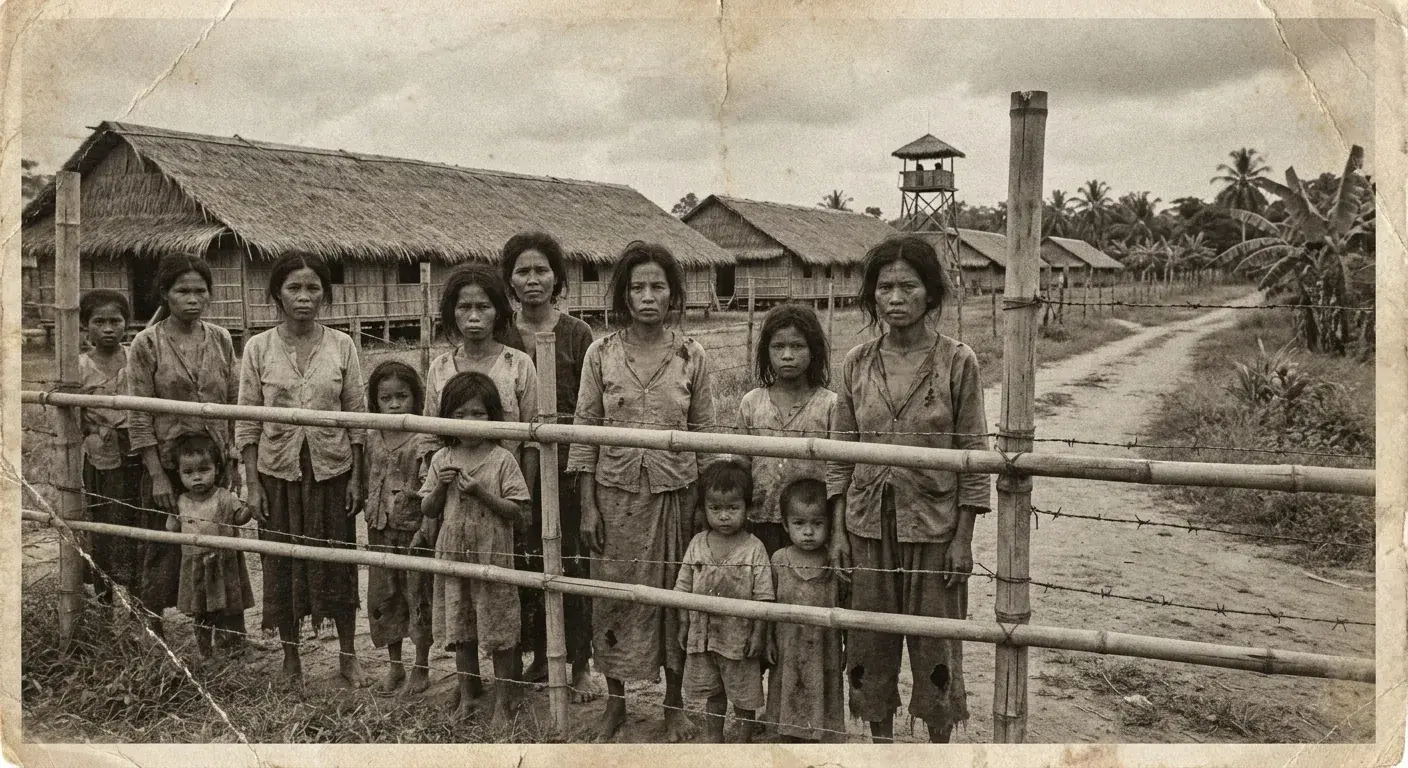
Europeans without proven Indonesian ancestry, including women and children, were interned in Japanese camps across Java.
Indos faced a strange sorting. Those who could prove close Indonesian ancestry were typically kept out of the camps and placed under curfew instead, becoming known as buitenkampers, or 'outside campers'. Around 160,000 Eurasians managed to avoid internment this way. However this did not mean much in the way of safety as Japan tried and failed to win the Indo community over, and Indos were subjected to the same harsh measures as everyone else.
A 1944 US Army guide written for American soldiers described the Indo-Europeans as the backbone of the colonial civil service, loyal to the Netherlands, Christian and Dutch in their customs. It also noted that this group had suffered more than any other under Japanese occupation. The death toll is testimony to this. An estimated 8,200 European prisoners of war and 16,800 Indo and European civilians died in the camps, and no one knows how many Indos died outside them.
The Bersiap Period and Indonesian Independence
Two days after Japan surrendered in August 1945, Indonesian nationalist leaders declared independence. Many Indo men were still prisoners or in hiding and barely knew it had happened.
What followed was the Bersiap period, one of the darkest episodes in the entire story. In the last months of 1945, armed nationalist youth groups attacked Dutch, Indo and Ambonese civilians. Estimates as to the number of Indo and European civilians killed vary enormously from about 5,500 to 20,000 with another 2,500 or so missing. The wide range reflects the chaos and poor documentation around events and historians still argue over the numbers.
Taken together, the losses were staggering. Of roughly 290,000 Indos and Europeans in the colony, it is estimated that more than 50,000 died between the beginning of the Japanese occupation and the end of Bersiap.
The Indo Exodus to the Netherlands (1945–1967)
The Netherlands formally transferred sovereignty to Indonesia in 1949. A little over 10 percent of the Indo-Europeans chose Indonesian citizenship. Most retained their Dutch passports, and over the next two decades, virtually the entire community left.
The departure came in waves. Around 100,000 people left in the first years after the war, many of them camp survivors who had lived through Bersiap. After 1950, civil servants, police and soldiers followed as the colonial army was disbanded, along with thousands of South Moluccan soldiers and their families. The dispute over Dutch-controlled New Guinea in 1957 and 1958 led Indonesia to declare Dutch citizens undesirable, pushing another 20,000 out. When New Guinea itself passed to Indonesia in the early 1960s, the last remaining Dutch citizens left too.
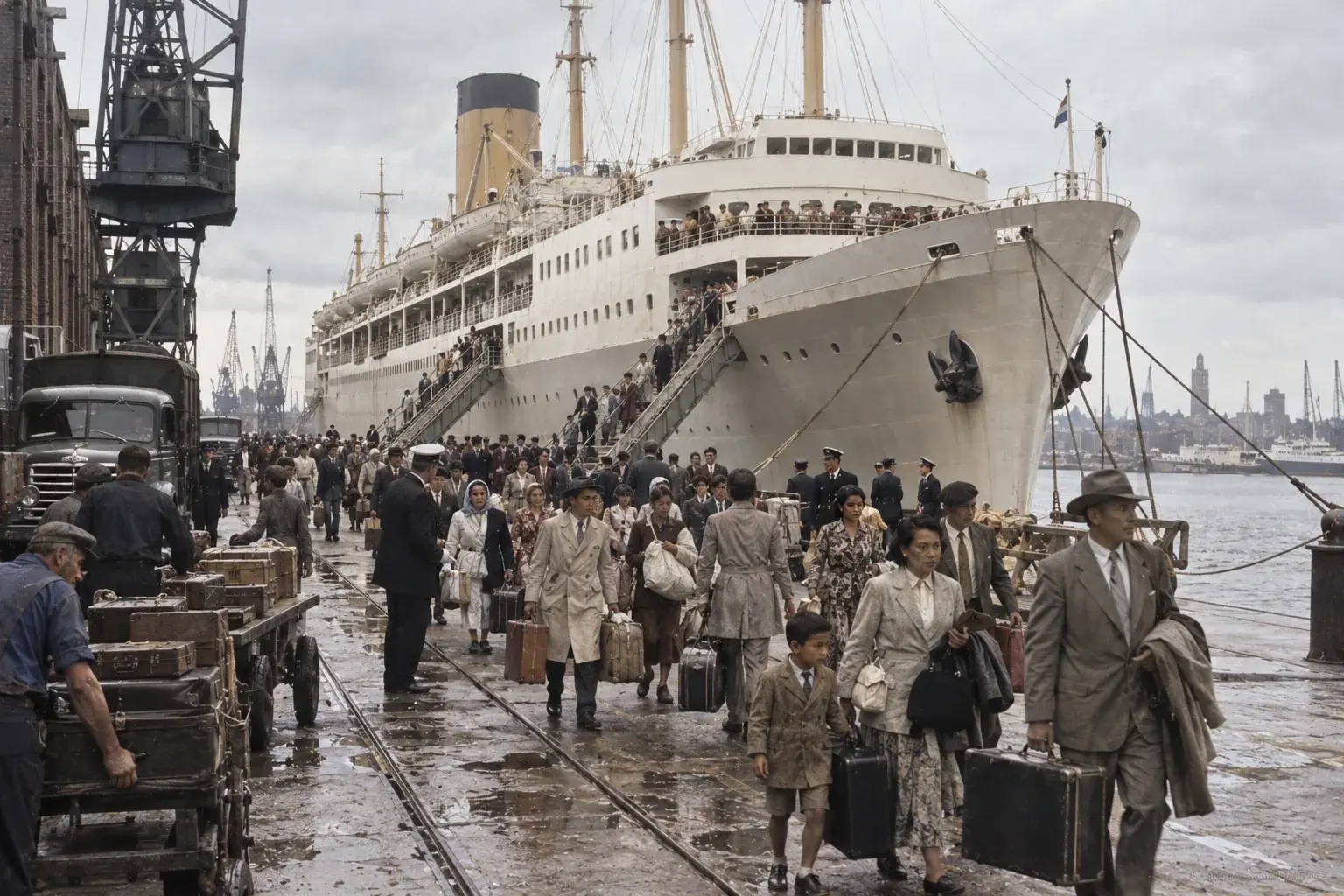
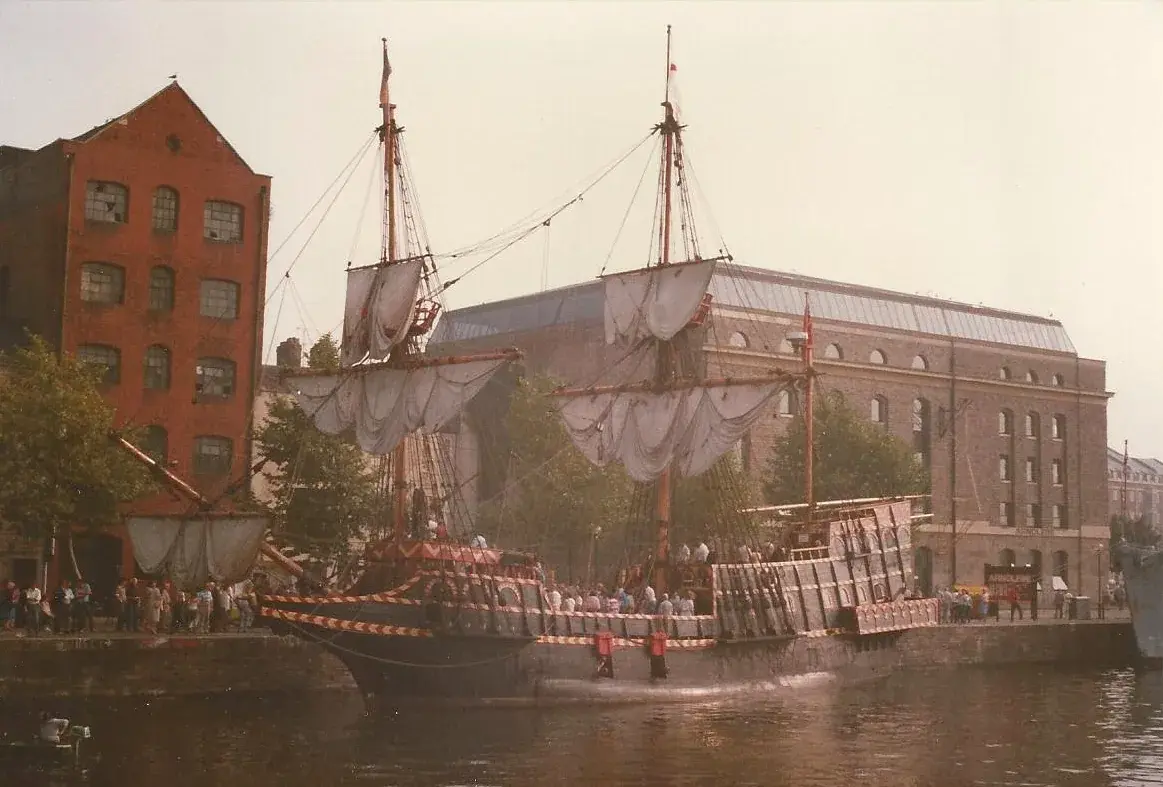
Ships such as the Castel Felice carried tens of thousands of Indo repatriates to Rotterdam during the late 1950s.
One group had a particularly painful path. The spijtoptanten, roughly "those who regretted their choice", had originally chosen Indonesian citizenship but found they couldn't make a life in the new republic. Of about 31,000 people who chose Indonesian citizenship, some 25,000 eventually reversed that decision. The Dutch government closed the option in 1967.
The Dutch government never actually wanted the migration to occur. Its official policy was to discourage Indos from coming to the Netherlands and nudge them towards Indonesian citizenship instead. Indonesia, meanwhile, was steadily closing Dutch schools, businesses and institutions, and Indos faced discrimination in the job market. In the end about 98 percent of the community moved to Europe.
Indo Integration and Assimilation Pressure in the Netherlands
Arriving in the Netherlands was its own ordeal. First-generation Indos adapted quickly, at least on the surface, because blending in with Dutch culture had always been the route to getting ahead, even in the colony. What was new was how much pressure was applied into their private lives.
Indos housed in guest houses were regularly checked by social workers for so-called oriental practices. Speaking any language other than Dutch at home counted as such, as did cooking Indonesian food, wearing clothing from the Indies, using water instead of paper in the toilet and even taking a bath every day.
The community integrated remarkably well by most measures. Dutch statistics describe Indos as the country's best-integrated minority with some of its lowest crime rates. A 1999 study found them to be the only foreign-born group whose average income matched that of people born in the Netherlands. A 2005 study found that they owned more independent businesses on average than any comparable group, and by 2007 over half of the first-generation Indos and around 80 percent of the second generation had married native-born Dutch partners. Researchers usually attribute to two advantages that Indos brought with them, namely Dutch citizenship and a head start in Dutch schooling, language and culture.
How Many Indos Live in the Netherlands Today
Counting Indos turns out to be tricky. In 1990 Dutch statisticians put the first generation at about 180,000. Including the second generation raised that to around half a million by 2001, and adding the third generation pushes estimates to at least 800,000.
Historian Peter Post of the NIOD Institute for War, Holocaust and Genocide Studies goes further and estimates that 1.5 to 2 million people in the Netherlands have some Indo ancestry. Either way, they rank as one of the largest minority communities in the country, albeit officially classed in the "Western" rather than the "non-Western" background category.
Indos in the United States and Australia
Not everyone stopped in the Netherlands. Many Indos moved on to warmer places, particularly California and Florida. Getting into the United States was not easy, though. Early postwar refugee laws still featured a color bar, and in the early 1950s the annual immigration quota for Indonesia was just 100 visas.
The door slowly opened. After the catastrophic 1953 North Sea flood, the Refugee Relief Act included slots for ethnic Dutch applicants, and in 1958 the Pastore-Walter Act allowed a one-time admission of 10,000 Dutch people from Indonesia. American officials had privately hoped for few of them to be of mixed race and grumbled when many were. An estimated 60,000 Indos arrived in the US during the 1950s and 1960s, with a large share settling in southern California. Well-known Americans with Dutch East Indies family roots include Eddie and Alex Van Halen, Michelle Branch, Mark-Paul Gosselaar and the video game designer Henk Rogers.
Australia was even harder. Under the White Australia policy, officials based in the Netherlands screened Indo applicants on skin color and how Western they appeared, and rejections gave no explanation. Rejection letters carried a standard line: "It is not the policy of the department to give reasons." By the early 1960s applicants had to show a family tree showing 75 percent European descent, and in 1956 an Australian security official even warned publicly that Dutch Eurasians could become an Asian fifth column. Despite this, around 10,000 Indos made it to Australia and discrimination eased only after the policy began to change in the 1970s.
Indo Food and Culture in Dutch Life
If the Indo community left one obvious mark on the Netherlands, it's on the dinner table. There's arguably nowhere else outside Indonesia with as much Indonesian food on offer. Indos were central to making dishes like nasi goreng, bami, satay with peanut sauce, lumpia and sambal part of everyday Dutch eating, to the point at which many people consider them Dutch national dishes. Most Dutch towns have an Indies restaurant or toko, and plenty of Chinese restaurants now describe themselves as Chinese-Indies restaurants.
Public displays of Indo culture were otherwise fairly rare, with one big exception. The Pasar Malam Besar, or Great Night Market, in The Hague grew into an annual festival, later renamed the Tong Tong Fair, which ran until its organizers went bankrupt in 2024. The city of The Hague has since backed a planned successor event called Jalan Jalan. It was co-founded by Tjalie Robinson, the writer who did more than anyone to champion Indo identity. Literature carries the story with works ranging from Louis Couperus's 1906 novel about the old Indies to the nostalgic work of Maria Dermoût and the identity-focused writing of Marion Bloem.
Indo Communities Remaining in Indonesia
Not every Indo left Indonesia. During colonial times many people of mixed descent were never registered as European at all and simply became part of their local Indonesian communities, so their numbers are unknown.
Small communities still exist. In Malang, some Indo families still attend Dutch-language Sunday services at the Sion Church, and some services at Jakarta's Immanuel Church are also held in Dutch. Depok on Java has a relatively large Dutch-speaking Indo community and Kampung Tugu in Jakarta is home to a smaller one. Semarang, Surabaya, Magelang and Sukabumi still have noticeable populations, and in Bandung more than 2,000 poor Indos receive support from overseas charities.
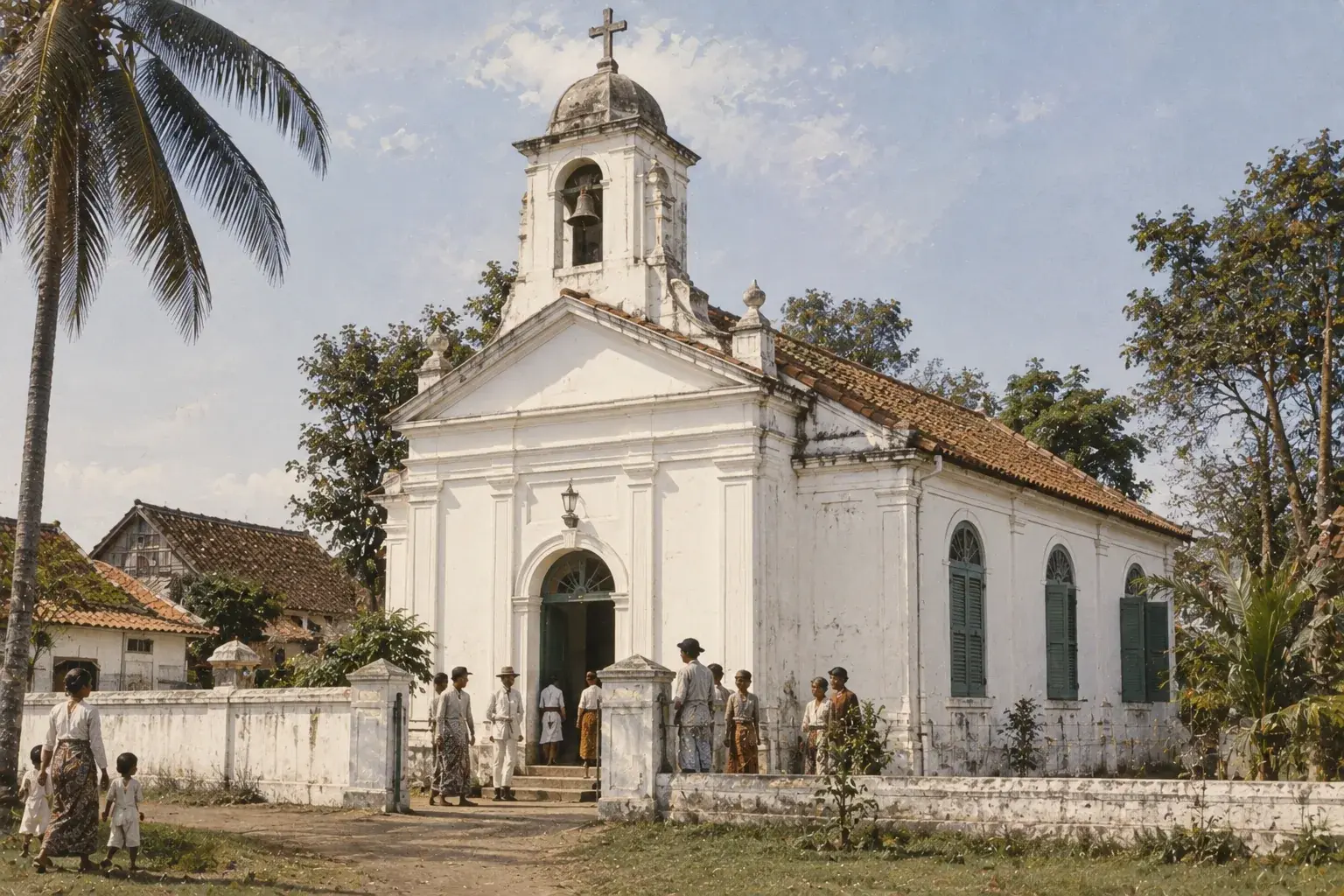
Kampung Tugu in North Jakarta is home to one of the small Eurasian communities that remained in Indonesia.
One of the more surprising discoveries came after the 2004 tsunami, which allowed Aceh to open up to outsiders. Journalists found a closed community of devout Muslim Eurasians in the Lamno area, mostly of Portuguese descent. During the Suharto years many Indos, as many Chinese Indonesians, changed their family names and some converted to Islam to avoid discrimination. More recently some have started changing their names back.
Indo Identity for the Third and Fourth Generations
Here's the irony at the heart of the Indo story. The same smooth assimilation that made Indos a model minority also left many of their grandchildren with little sense of where they came from. Some younger Dutch people with Indo roots struggle to identify their own cultural traits, and some lean towards ignoring their Indonesian side entirely, while others describe themselves as simply Indonesian.
Researchers have taken notice. Dutch scholar Nora Iburg argued in 2010 that for third-generation Indos there is no fixed essence to Indo identity beyond its hybrid nature, and no need to invent one. In the United States where the community was always small and dispersed, some expect it to fade into American multicultural life within a few generations. At the same time the loss of elders has prompted many American Indos to start reclaiming their heritage, helped by the internet's ability to connect a dispersed community.
This tension is familiar beyond the Netherlands. The Indo experience is a reminder that mixed communities created by empire rarely get a tidy national home once the empire ends. They survive in recipes, surnames, church services and night markets, and the questions their great-grandchildren eventually start asking.