The Minotaur is the monster everyone can picture. Bull's head, man's body, waiting somewhere in the dark at the centre of a maze. But strip the story back and the monster is the least interesting thing in it. What's actually going on is a young man volunteering for a death sentence to make a political point, a princess betraying her own family in an afternoon, and a hero who wins completely and then destroys his father through pure carelessness on the last morning of the voyage home. Also, one of the more famous images in philosophy comes out of the boat he sailed home in.
Two Sandals and a Rock
Theseus grew up in Troezen, across the water from Athens, not knowing who his father was. His mother Aethra had been visited on the same night by Aegeus, king of Athens, and — in some versions — by Poseidon, which conveniently gives him both a royal and a divine father. Before Aegeus went home, he put his sword and his sandals under an enormous boulder and told Aethra that if the boy could ever move it, he should bring what was underneath to Athens. At sixteen, Theseus lifted the rock. Then he made his first decision, and it establishes the character. The safe way to Athens was by sea. The land route round the Saronic Gulf was infested with bandits and monsters and nobody sane used it. He went by land, on purpose, because he wanted a reputation before he arrived.
The Six Labours on the Road
What he does on the road is a deliberate mirror of Heracles, and every one of them is the same joke: he kills each man by his own method. Periphetes, who clubbed travellers to death, was killed with his own club, which Theseus kept. Sinis, the pine-bender, who tied victims between two bent trees and released them, was bent between two trees. The Crommyonian Sow was the exception. Sciron, who made travellers wash his feet and kicked them off a cliff, was kicked off the cliff. Cercyon, who forced passers-by to wrestle him to the death, was out-wrestled — Theseus is credited with inventing technical wrestling on the spot. Procrustes, who had a bed and made every guest fit it by stretching them or cutting off the overhang, was put on his own bed and trimmed. Procrustean is still a perfectly good English word for forcing something to fit a template regardless of what it does to the thing. He arrived in Athens as a celebrity — and immediately nearly died, because Medea was living there as Aegeus's wife, recognised him before his father did, and persuaded the king that the young stranger should be poisoned at dinner. Theseus drew his sword to carve the meat. Aegeus saw the sword, recognised it, and knocked the cup out of his hand.
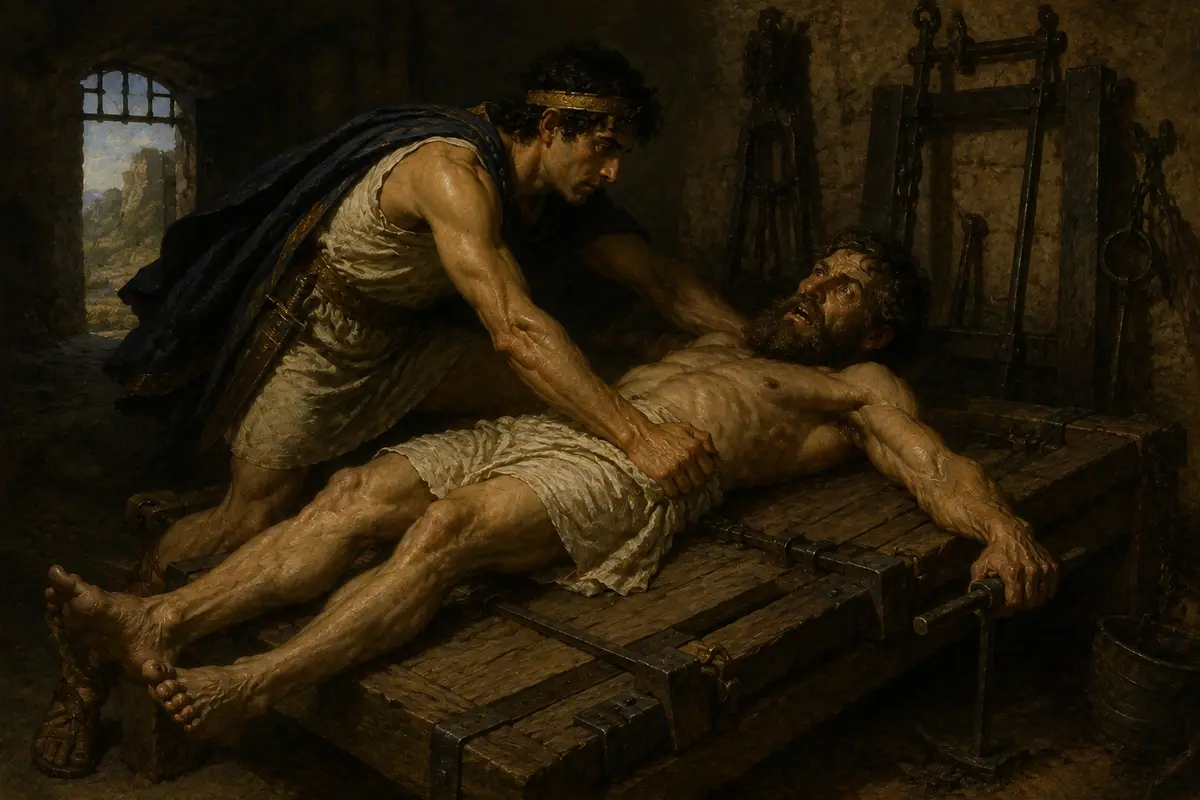
Each man on the road was killed by his own method. Procrustes made guests fit his bed. Theseus put him on it. Procrustean is still a usable word.
The Tribute
Years earlier, Androgeos, a son of King Minos of Crete, had been killed in Attica. Minos, who ran the strongest navy in the Aegean, went to war, won, and imposed terms: every nine years Athens had to send seven young men and seven young women to Crete, to be put into the Labyrinth and killed by the Minotaur. That's the political situation Theseus walks into. Not a monster problem. A tribute problem. Athens is a subject state paying its overlord in children. He volunteered for the third tribute. Some accounts have him drawn by lot; the better ones have him insist, over his father's objection, on the grounds that the son of the king cannot let other people's children go while he stays home. It's the most genuinely admirable thing he ever does.
Where the Minotaur Came From
Minos had asked Poseidon for a sign confirming his right to the throne, and a magnificent white bull came out of the sea, with the understanding that it would be sacrificed. Minos kept it and sacrificed a lesser animal instead. Poseidon's revenge was to make Minos's wife Pasiphaë fall in love with the bull. She had Daedalus build her a hollow wooden cow to get inside, and the child of that union was the Minotaur — Asterion, the bull of Minos. So the monster in the maze is Minos's own son, produced by his own greed, hidden in a building he commissioned to conceal the evidence. And he feeds it Athenian teenagers. The Labyrinth itself was Daedalus's work: a structure so intricately folded that anyone who entered it could not find the way out.
Ariadne
The ships arrived and Ariadne, daughter of Minos, saw Theseus in the group being led up from the harbour and decided within the day to betray her father, her brother and her country. She went to Daedalus — who had built the thing and knew its weakness — and got the answer, and gave Theseus two items. A sword, because the victims went in unarmed. And a ball of thread. Tie one end at the entrance, unwind it as you go, follow it back out. In older English it's a clew, and that word is the direct ancestor of our clue — a clue is originally the thread that gets you out of a maze, which is a very good thing to know about the word. Her price was that he take her with him and marry her. He went in, followed the turns down to the centre, killed the Minotaur — bare-handed in the oldest versions, with the sword in most — wound the thread back up, collected the other thirteen, and got to the ships.
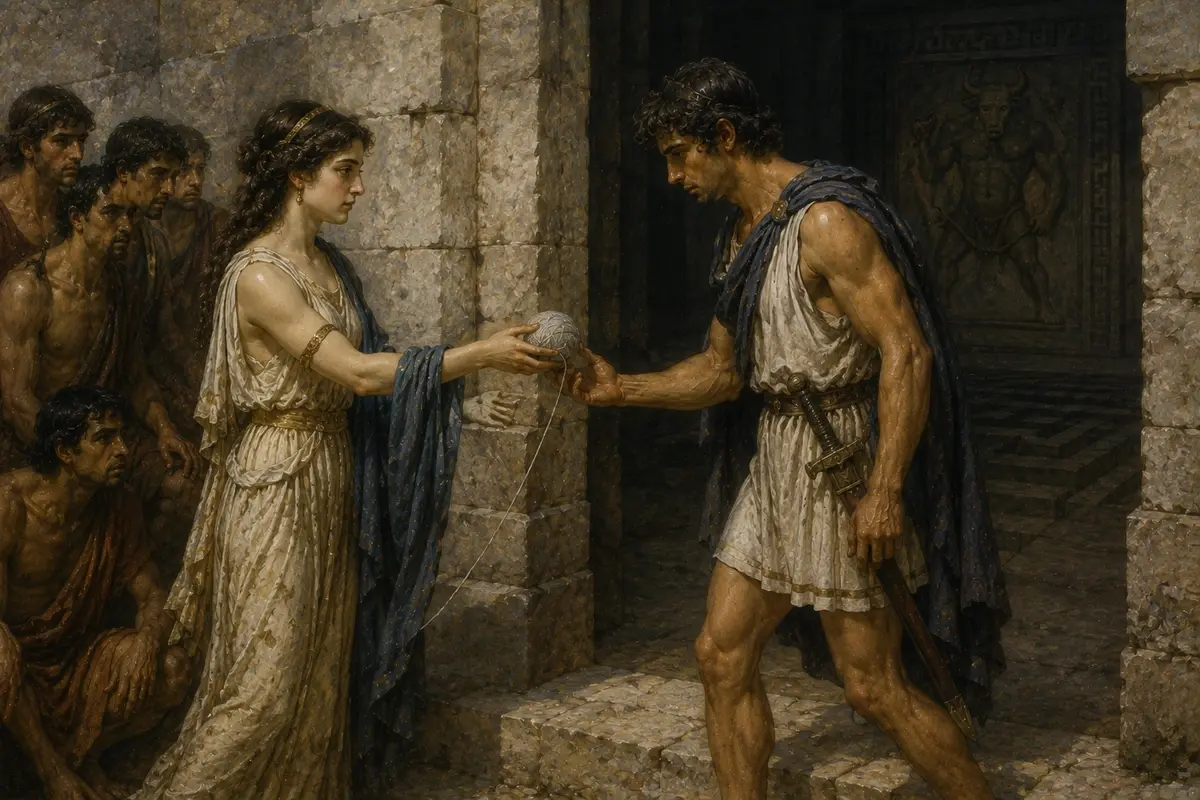
A clew, in old English, is a ball of thread. Clue comes from clew — from this exact image. A clue is the thread that gets you out of a maze.
Naxos
They stopped at the island of Naxos on the way home. And Theseus left without her. The sources are visibly uncomfortable about this and offer a menu of explanations: he forgot; a storm separated them; Dionysus appeared and told him to leave because the god wanted her himself; Athena ordered it; he simply didn't want her any more. Plutarch, characteristically honest, lists several versions and declines to pick. What every version agrees on is the ending: Ariadne wakes on a beach and the sail is already on the horizon. It's one of the images ancient art returned to over and over — the woman on the shore, watching the ship leave. Then Dionysus finds her, marries her, and sets her bridal crown in the sky as the constellation Corona Borealis, which is genuinely there and visible on summer nights. So she gets a god and immortality, and the man she gave up everything for gets nothing but the credit.
The Black Sail
Aegeus had made his son one request before the fleet sailed. The ships carried black sails for a voyage expected to end in fourteen deaths. If Theseus came home alive, he was to change them to white so his father would know from the cliff before the ship came in. Theseus forgot. Aegeus was watching from the headland at Sounion, saw the black sail, and threw himself into the sea. Which is why it is called the Aegean. There's no way to read that as anything but a failure. The hero completes the mission perfectly and kills his father through carelessness on the last morning, arriving home to a funeral he caused. Some later moralising versions try to make it fate or divine punishment for abandoning Ariadne. The plainer reading — he had a lot on his mind and he forgot — is worse and better.
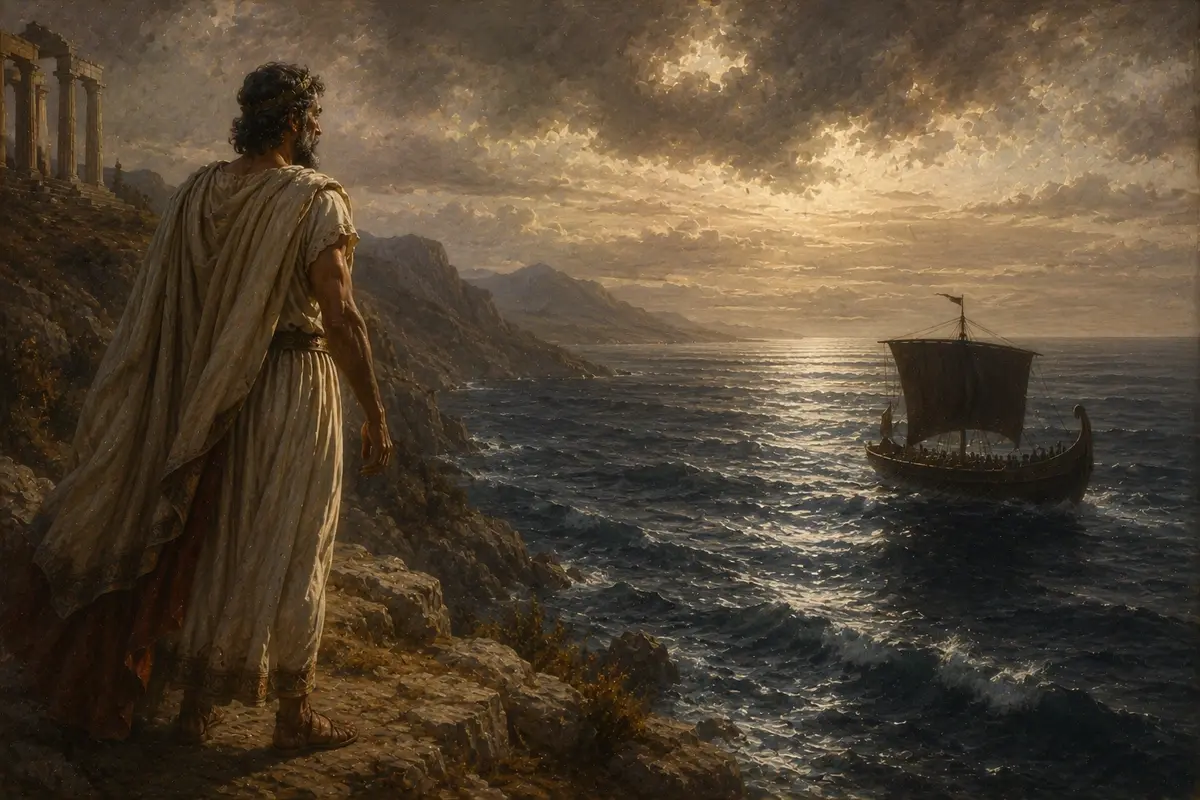
Which is why it is called the Aegean. The hero completed the mission perfectly and killed his father through carelessness on the last morning.
The Ship of Theseus
The Athenians preserved the ship he came home in and sailed it in an annual procession to Delos for centuries. As planks rotted they replaced them, one by one, with new timber. Eventually not a single original piece remained. Plutarch records that this became a standing philosophical example: was it still the same ship? That question has never gone away. Hobbes sharpened it by asking what happens if you collect all the discarded original planks and reassemble them — now which one is the ship? It runs straight into modern debates about personal identity, restored buildings, rebuilt classic cars and gradually rewritten software. The whole thing comes out of a boat that fourteen Athenian teenagers sailed home in.
Was Any of It Real?
In 1900 Arthur Evans began excavating at Knossos on Crete and found an enormous Bronze Age palace complex — over a thousand interconnecting rooms on multiple levels, corridors doubling back, storage magazines running off in all directions. Anyone wandering in without a guide would struggle to get out. He also found the labrys, the double-headed axe, used as a symbol throughout the site. One long-standing suggestion is that labyrinth means house of the double axe, though the etymology is disputed. And he found frescoes of bull-leaping — young men and women vaulting over the horns of charging bulls — plus bull-horn architectural motifs everywhere. So: a maze-like palace, a bull cult involving young people risking their lives, and a Cretan naval power that dominated the Aegean centuries before Athens amounted to anything. Be careful with the leap, though. Evans named the civilisation Minoan after the myth, then interpreted what he dug up through the myth, and some of his reconstructions at Knossos are more imaginative than the evidence supports. What's fair to say is this: the Athenians remembered being subordinate to a Cretan sea power that demanded something from them, and that this ended. The archaeology says Minoan Crete really was dominant and really did collapse. The Minotaur is what a memory like that turns into after eight hundred years of retelling.