Sparta is the most misunderstood state in ancient history, and the misunderstanding runs in both directions. It was neither the noble warrior republic of the films nor a straightforward totalitarian nightmare. What it was, precisely, is a society engineered around a single problem — and once you know what that problem was, every strange law and every famous story falls into place. The problem was this. Sparta had conquered its neighbours and enslaved them, and the enslaved outnumbered the Spartans by something like seven to one. Everything else follows.
Did Lycurgus Exist?
Probably not, or at least not as described. Lycurgus is the lawgiver credited with designing the entire Spartan system in one go. Ancient sources place him anywhere between the 9th and the 7th century BCE and cannot agree on his parentage, his dates or how he died. Plutarch — our main source — opens his own biography by admitting that nothing can be said about the man that isn't disputed. What almost certainly happened is what happens everywhere: a set of institutions evolved over generations, then got attributed retrospectively to a single founder to give them authority. Sparta had a particular reason to want that authority. The system was said to have been endorsed by the oracle at Delphi in a document called the Great Rhetra, which made it not merely law but religiously untouchable. That's a useful thing to have when you're asking citizens to live the way Spartans lived.
The Thing Sparta Was Built Around
In the 8th and 7th centuries BCE, Sparta invaded Messenia next door, took it, and enslaved the entire population. The Messenians became helots — not chattel slaves owned by individuals, but a subject people bound to the land, farming estates for Spartan masters and handing over a fixed share of the produce. This solved Sparta's land problem permanently and created a much worse one. Every Spartan citizen was now a landowner living off forced labour, surrounded by a large, homogeneous, resentful population that remembered being free and revolted whenever the opportunity arose. A major rising after an earthquake around 464 BCE nearly finished the state. So Sparta needed a permanent standing army of its own citizens, ready at all times, at home rather than abroad. That is what the Spartan system is. Not a philosophy of virtue. A garrison. And the ugliest institution makes the point plainly. The krypteia sent selected young Spartans out into the countryside at night, armed, to kill helots — and Aristotle records that the ephors formally declared war on the helots every year on taking office, so that killing one carried no religious pollution. You do not need an annual declaration of war against your own agricultural workforce unless you are running an occupation.
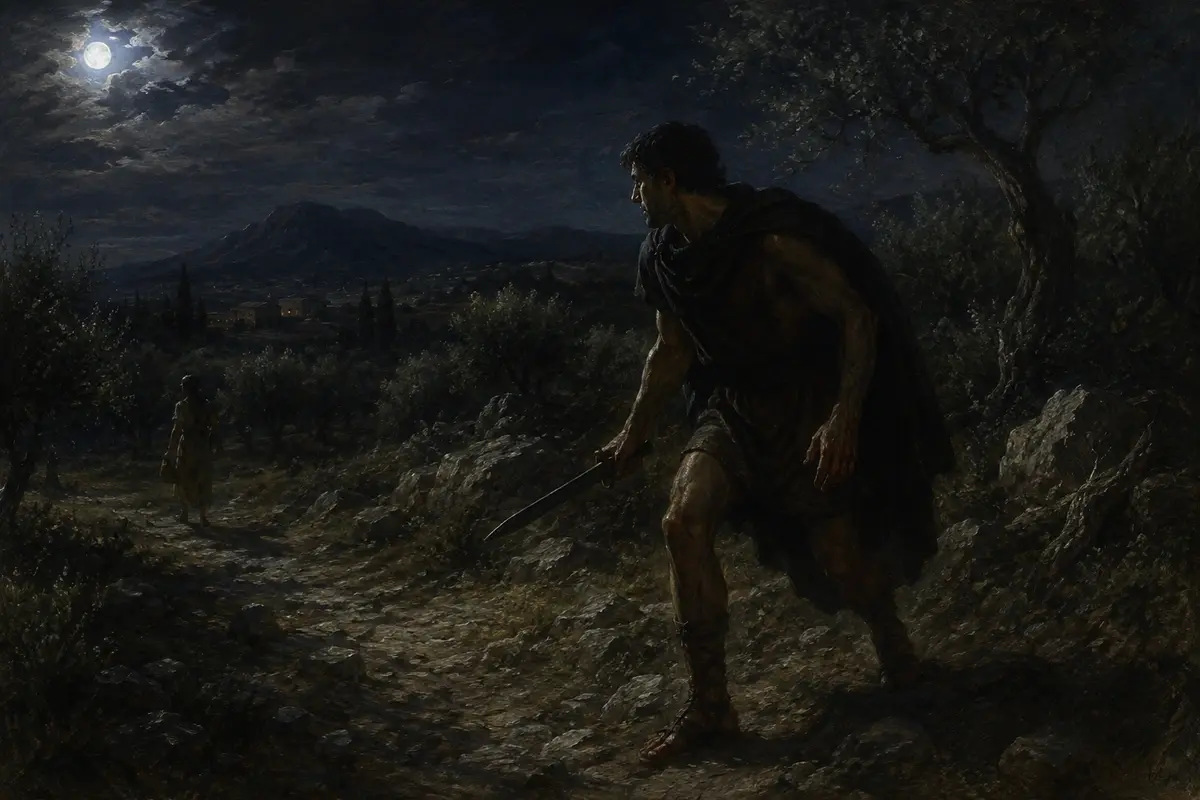
The ephors declared war on the helots every year on taking office, so that killing one carried no religious pollution. You do not need an annual declaration of war against your own farmers unless you are running an occupation.
The Agoge
The agoge — the rearing — was the state education system, compulsory for every Spartan boy except the heirs to the two thrones. Newborns were reportedly inspected by the elders and, if judged unfit, exposed at a chasm on Mount Taygetus. There's real scholarly doubt about how systematic this was; excavations at the supposed site have not produced infant remains, and it may be later exaggeration. Infant exposure was practised across the Greek world; what's claimed as distinctive here is that the decision was the state's rather than the father's. At seven, boys left home and entered the system in age-cohorts. They were kept barefoot to toughen their feet, given one cloak a year, and deliberately underfed — expected to make up the shortfall by stealing food. Getting caught brought a beating explicitly for being caught rather than for the theft. They slept on reed beds they cut themselves from the riverbank. They were taught to read and write, but minimally. What they were really taught was to endure, to obey, and to fight in formation. They were also trained to speak in a particular way: short, dry, and pointed. Laconia is the region; laconic is the word we got from it. When Philip II sent a message threatening that if he entered Laconia he would raze Sparta to the ground, the reply was reportedly one word — if. At around twenty a man became a soldier. At thirty he became a full citizen with a vote.
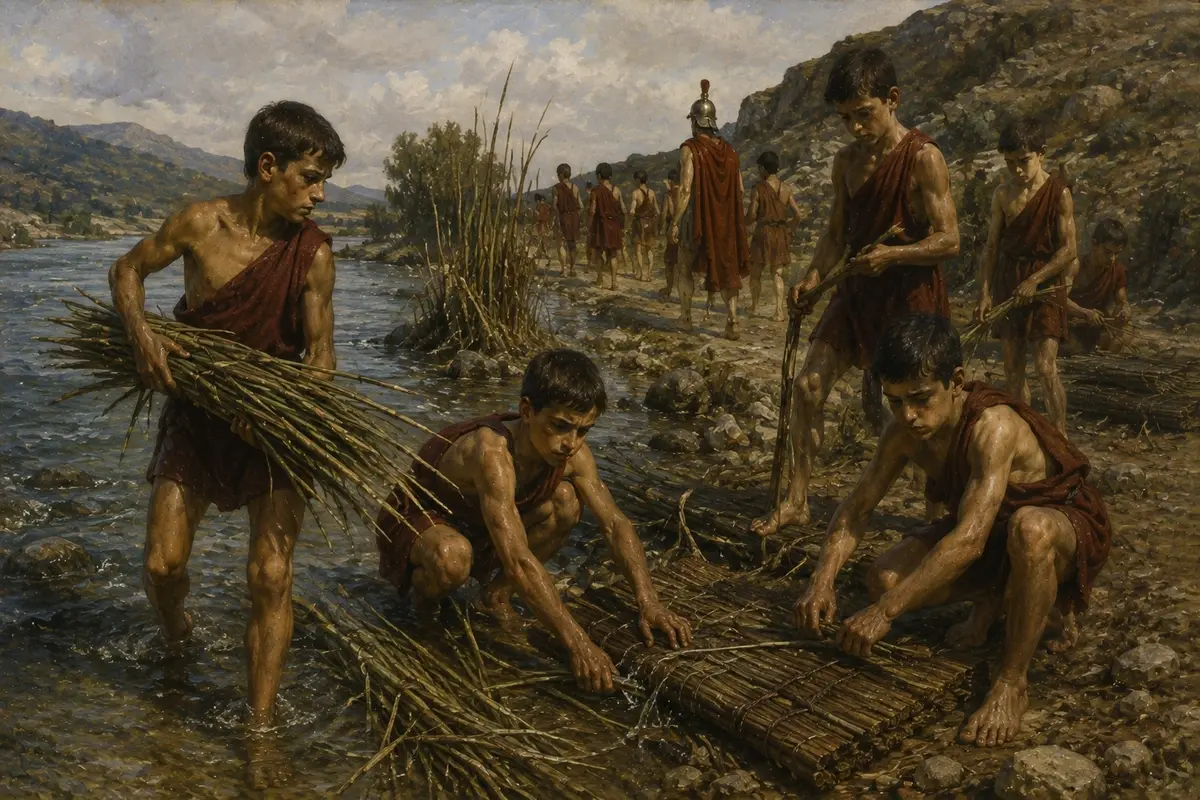
One cloak a year. Deliberately underfed, expected to steal food and punished only for being caught. What they were really taught was to endure, to obey, and to fight in formation.
The Common Messes
Full citizens ate together in syssitia — dining clubs of about fifteen men, for life. Membership required a monthly contribution of food and wine from a man's own estate. Fail to contribute and you lost your place in the mess, and losing your place in the mess meant losing citizenship. This is the load-bearing institution of the whole system. The mess bound men to their unit socially rather than to their families. Admission required a unanimous vote. And the property qualification meant that any Spartan who fell into poverty dropped out of the citizen body permanently. The food was notoriously terrible. The famous black broth — pork boiled in blood, vinegar and salt — prompted a visitor to remark that he now understood why Spartans didn't fear death.
Iron Money and Closed Borders
To suppress the accumulation of wealth, Sparta refused to coin silver or gold and used iron bars as currency — deliberately heavy, low in value, and reportedly quenched in vinegar to make the metal brittle and useless for anything else. Foreign traders had no reason to come, and luxury goods effectively couldn't be bought. Spartans were also barred from travelling abroad without permission, and foreigners were periodically expelled. The state was sealed on purpose, because ideas from outside were understood to be corrosive to a system this artificial.
How Sparta Was Governed
The constitution is genuinely odd and was much admired by outsiders precisely because it was a mixture rather than a pure type. Two kings from two separate hereditary houses ruled simultaneously, permanently checking each other — leading the army and handling state religion. The Gerousia was a council of 28 elders over sixty, elected for life, plus the two kings, preparing legislation and acting as the supreme court. The Apella was the assembly of all full citizens over thirty, which voted on what the Gerousia put in front of it by shouting, with the result judged by whichever shout sounded louder. And the Ephors — five officials elected annually — held most of the real power by the classical period. They could arrest a king, prosecute one, and supervise everything. Aristotle admired the balance and thought the shouting was childish. He was right on both counts.
Spartan Women
This is where Sparta genuinely was different, and it's usually the part that surprises people. Spartan women exercised in public, ran, wrestled and threw the discus, on the stated grounds that strong women bear strong children. Other Greeks found this shocking and made jokes about it that have not aged well. They married later than other Greek women — around eighteen rather than fourteen — which meant better health outcomes. They owned and inherited property. Aristotle, writing in the 4th century BCE and thoroughly disapproving, calculated that women owned around two-fifths of all land in Sparta. In Athens a woman could not legally control property at all. They ran the estates, because the men were in the messes and the barracks. And they were expected to be publicly, brutally patriotic. The line about coming home with your shield or on it — a mother's parting instruction — comes from Plutarch's collection of Spartan sayings. A caution: all of this comes to us filtered through Athenian and Roman writers who were fascinated, appalled, or both. How much reflects Spartan reality and how much reflects what outsiders needed Sparta to be is one of the live arguments in the field.
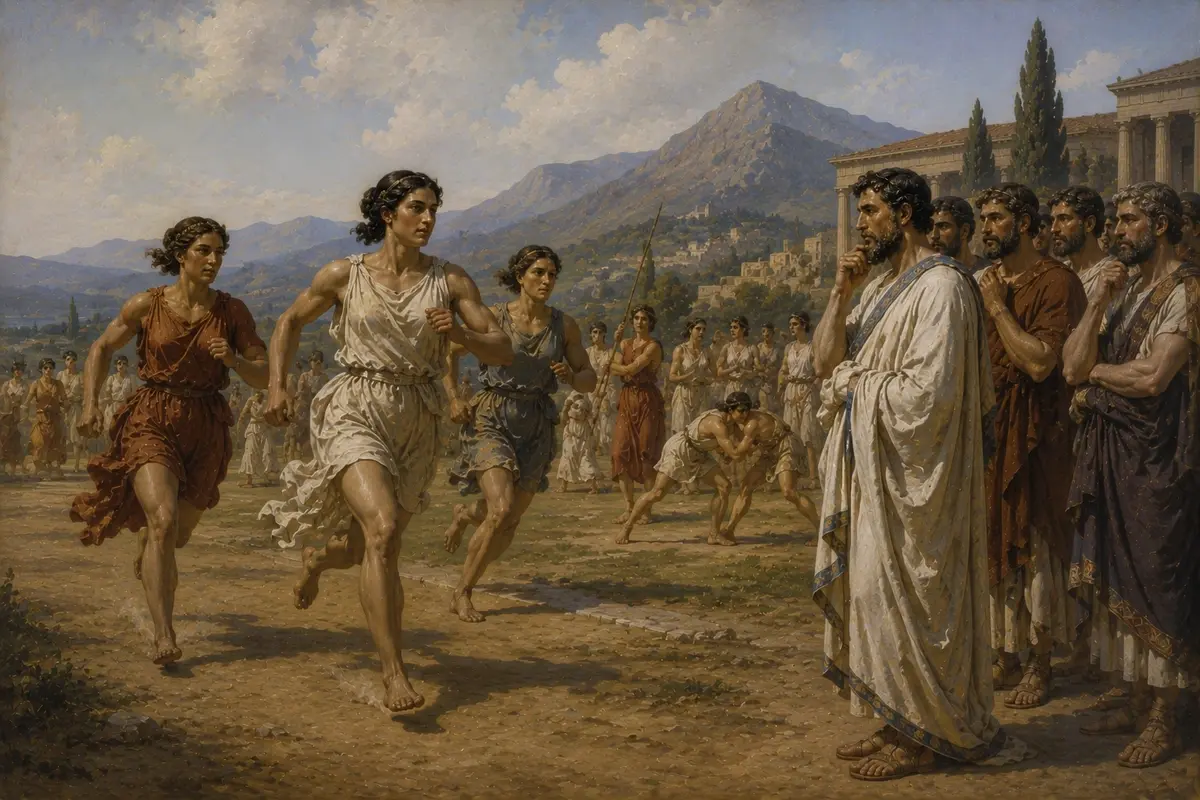
Spartan women exercised in public, owned property, and married later. Aristotle calculated they owned two-fifths of all Spartan land. Other Greeks found this scandalous — which was, in part, why the Spartans kept doing it.
The Spartan Mirage
Scholars call it the mirage spartiate — the Spartan mirage. Almost nothing written by a Spartan survives. Sparta produced no historians, no philosophers, no dramatists and very little art after the 6th century. Everything we know was written by outsiders with agendas. Athenian aristocrats who despised their own democracy idealised Sparta as the ordered alternative. Xenophon lived there and sent his sons through the agoge. Plato's ideal state in the Republic borrows heavily from it. Plutarch, our fullest source, was writing around 700 years after Lycurgus supposedly lived, at a time when Sparta had reinvented itself as a tourist attraction performing an exaggerated version of its own traditions for visiting Romans. So the Sparta in our heads is partly a real state and partly a thought experiment that generations of anti-democratic writers found useful.
Why It Failed
Sparta beat Athens in 404 BCE and was the leading power in Greece. Within thirty-three years it was finished as a serious state, and the reason was arithmetic. The citizen body shrank continuously. Herodotus implies around 8,000 Spartiates at the time of the Persian Wars. By the battle of Leuctra in 371 BCE there may have been fewer than 1,500. War losses among a closed hereditary caste couldn't be replaced. Estates divided among heirs until holdings fell below the mess contribution threshold, and men dropped out of citizenship. The system had no mechanism for admitting new citizens. At Leuctra, the Theban general Epaminondas stacked his left wing fifty ranks deep against the Spartan right, broke it, and killed a Spartan king. It was the first time a Spartan army had lost a full pitched battle to a Greek enemy. Then Epaminondas marched into the Peloponnese and liberated Messenia, refounding it as an independent state. That was the end. The helots were the economic base of the entire system, and the entire system existed to hold them down. Take them away and there is no Sparta — just a small, impoverished town with an unusually large collection of stories about itself. It survived as a curiosity for centuries, charging Roman visitors to watch boys being flogged at the altar of Artemis Orthia. That was what remained of the agoge.