In 399 BCE, Athens tried a seventy-year-old man for impiety and corrupting the young, found him guilty by a narrow margin, and made him drink hemlock. The standard version has Socrates as a martyr to free thought killed by a mob that couldn't handle awkward questions. That's not wrong exactly, but it leaves out the thing everyone in that courtroom was thinking about and nobody was legally allowed to say. Athens had just lost a twenty-seven-year war, been occupied, had its walls pulled down, and endured a murderous eight-month junta. And two of the men most responsible had been Socrates' students. You cannot understand the trial without understanding Alcibiades.
The Most Talented Man in Athens
Alcibiades was born around 450 BCE into the Alcmaeonid family — old money, enormous political weight — and was orphaned young. His guardian was his relative Pericles, who was running Athens at the height of its power. He was startlingly handsome, and everybody said so for his entire life. He was also brilliant, athletic, spectacularly rich, and entirely without restraint. He cut off the tail of a beautiful and expensive dog so that Athens would gossip about that rather than something worse. He entered seven chariots at one Olympics — a display of wealth nobody had matched — and took first, second and either third or fourth. Thucydides, who was not given to psychological speculation, thought Alcibiades' personal extravagance frightened Athenians into distrusting him, and that this distrust cost the city the war.
Socrates
Socrates was about twenty years older, the son of a stonemason and a midwife, physically unimpressive to the point that people commented on it, and by choice poor. He wrote nothing. He walked around Athens asking people to define things they were sure they understood — courage, justice, piety — and demonstrating, politely and inescapably, that they couldn't. He did this in public, for free, for decades, in a city where the ability to speak confidently in front of a crowd was the route to power. He served as a hoplite in three campaigns, and by all accounts was extremely good at it.
What Was Between Them
At Potidaea in 432 BCE, Alcibiades was wounded and Socrates stood over him and drove off the men trying to kill him. Eight years later, at the disastrous retreat from Delium, Alcibiades, mounted, covered Socrates as he walked off the field — and Plato has him describe Socrates retreating on foot, calm, looking around him steadily, so obviously unafraid that nobody wanted to be the one to attack him. The relationship was in the mould of Athenian aristocratic mentorship, and Plato's Symposium contains the most famous account of it. Alcibiades arrives at the party drunk, garlanded, and delivers a speech about Socrates that is half tribute and half accusation. He says Socrates is the only person alive who makes him ashamed of himself. That he knows perfectly well he should live differently, and the moment he leaves Socrates' company he goes straight back to chasing the crowd's approval. That he has caught himself wishing Socrates were dead so he could stop feeling it. As a piece of writing about what it's like to know exactly how you should behave and to do the opposite anyway, it hasn't been bettered.
The Sicilian Expedition
By 415 BCE Athens and Sparta had signed an uneasy peace. Alcibiades proposed something enormous: an expedition to Sicily to conquer Syracuse and, in the longer term, the western Mediterranean. Nicias, an older and cautious general, opposed it — and then, trying to kill the idea by exaggerating what it would cost, described a force so large that the Assembly voted enthusiastically for that instead. Athens sent 134 triremes and around 5,000 hoplites, under three commanders including both Alcibiades and Nicias, who disagreed about everything. Then, on the night before the fleet sailed, somebody went round Athens and mutilated the herms — the stone pillars with the head of Hermes that stood outside every house and temple as protective markers. Almost all of them, in one night, across a large city. In the panic that followed, informers alleged that Alcibiades had also been holding mock performances of the Eleusinian Mysteries at private parties — a serious religious crime. He demanded an immediate trial. His enemies arranged for him to sail first and be tried on his return. He got as far as southern Italy. Then the ship arrived recalling him for trial, and he jumped.
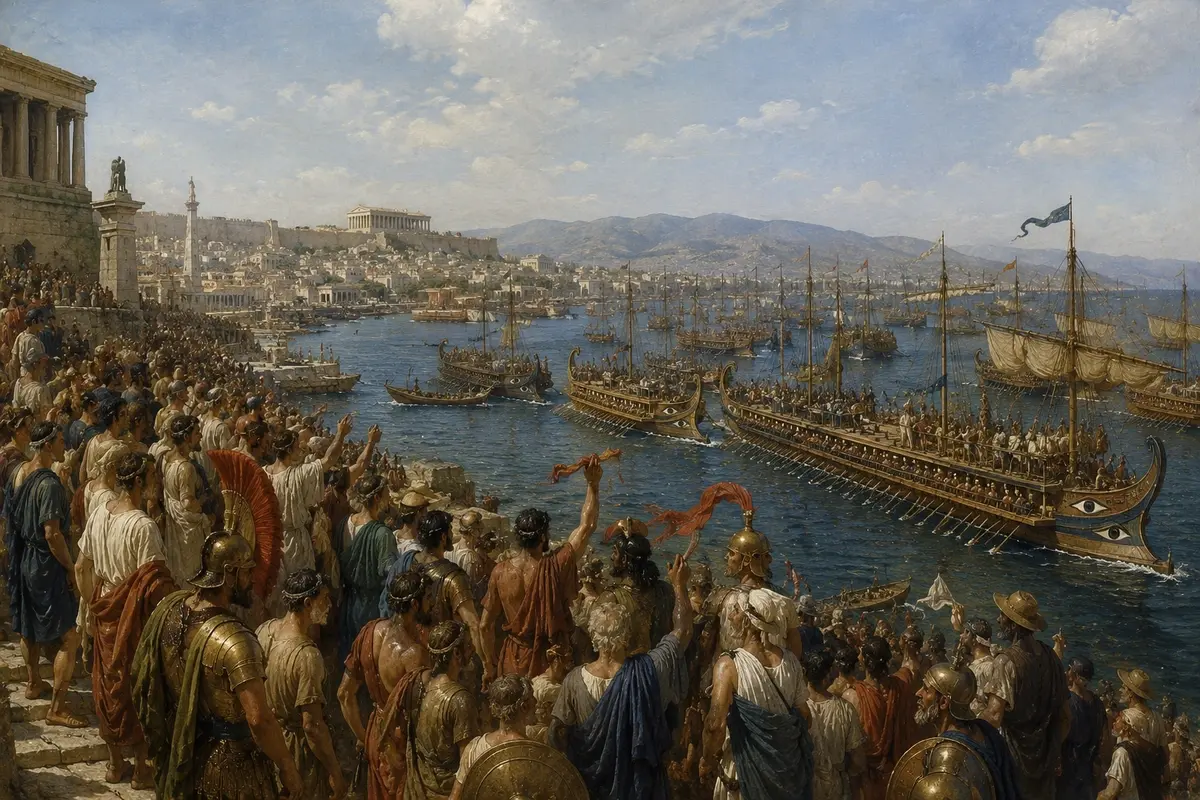
134 triremes, around 5,000 hoplites, and three generals who disagreed about everything. It was the largest force Athens had ever sent abroad, and it would be completely destroyed.
Three Betrayals
He went to Sparta. Not just as a refugee — as an advisor. He told the Spartans to send a general to Syracuse (they sent Gylippus, who was the single most important factor in the Athenian defeat) and to fortify Decelea, a permanent base inside Attic territory. Both pieces of advice were devastating — it meant Athens was under year-round occupation of its own countryside, lost access to its silver mines, and had 20,000 slaves desert. He went to Persia. Fleeing Sparta, he attached himself to the satrap Tissaphernes and advised him to fund neither side fully — letting Athens and Sparta exhaust each other while Persia watched. He came back to Athens. By 411 BCE he was negotiating with the Athenian fleet at Samos, promising Persian money he couldn't deliver. He was made a general, won a string of real naval victories, and in 407 BCE sailed into Piraeus to a hero's welcome with the death sentence annulled. Then a subordinate lost a minor engagement at Notium while Alcibiades was elsewhere, and Athens dismissed him again. He retired to a private fortress in Thrace and never held command again. He was murdered in Phrygia in 404 BCE, with the house burned around him.
The Other Student
There was a second, worse association. Critias had also been in Socrates' circle. In 404 BCE, after Athens surrendered, Sparta installed a junta of thirty men to run the city, and Critias led it. The Thirty Tyrants killed perhaps 1,500 Athenians in eight months — largely wealthy metics and citizens whose property they wanted — and drove thousands into exile. It ended in a civil war and the restoration of democracy in 403 BCE. So the tally, as an Athenian jury would have counted it in 399 BCE: the man who taught Alcibiades, who defected to Sparta and helped destroy the city, also taught Critias, who then ran the terror.
Why They Couldn't Say It
The restored democracy passed an amnesty in 403 BCE covering everything that happened under the Thirty. Prosecuting anyone for political conduct during that period was barred. So Socrates could not be charged with what he was actually resented for. He was charged instead with impiety — not recognising the city's gods, introducing new divinities — and corrupting the young. That last charge is doing all the work. In a courtroom in 399 BCE, everyone knew which young men were meant. And there was more. Aristophanes' comedy The Clouds had put Socrates on stage in 423 BCE in a basket, teaching students to argue the weaker case into the stronger for money. Socrates himself, in Plato's Apology, points at that play as the source of the prejudice against him — an accusation that had been sitting in the public mind for a quarter of a century.
The Trial
Around 500 jurors, chosen by lot. A day. No judge, no appeal. Socrates' defence, in Plato's version, was not really a defence. He declined to plead, refused to bring his wife and children in to weep, and told the jury that he had been given to Athens by the god as a gadfly — the fly that stings a large, sluggish horse to keep it awake — and that killing him would harm them more than him. He was convicted, by a fairly narrow margin. The votes are usually reckoned at roughly 280 to 220. Then came the second phase. The prosecution proposed death; the defendant was expected to counter-propose something serious enough to be accepted — exile would almost certainly have been allowed, and probably wanted. Socrates proposed that he be given free meals for life in the Prytaneum, the honour reserved for Olympic victors and public benefactors, on the grounds that this was what he actually deserved. He then offered a token fine, which his friends increased to a substantial sum. The jury voted for death, and by a wider margin than they'd voted to convict. Some who had thought him innocent were now prepared to kill him.
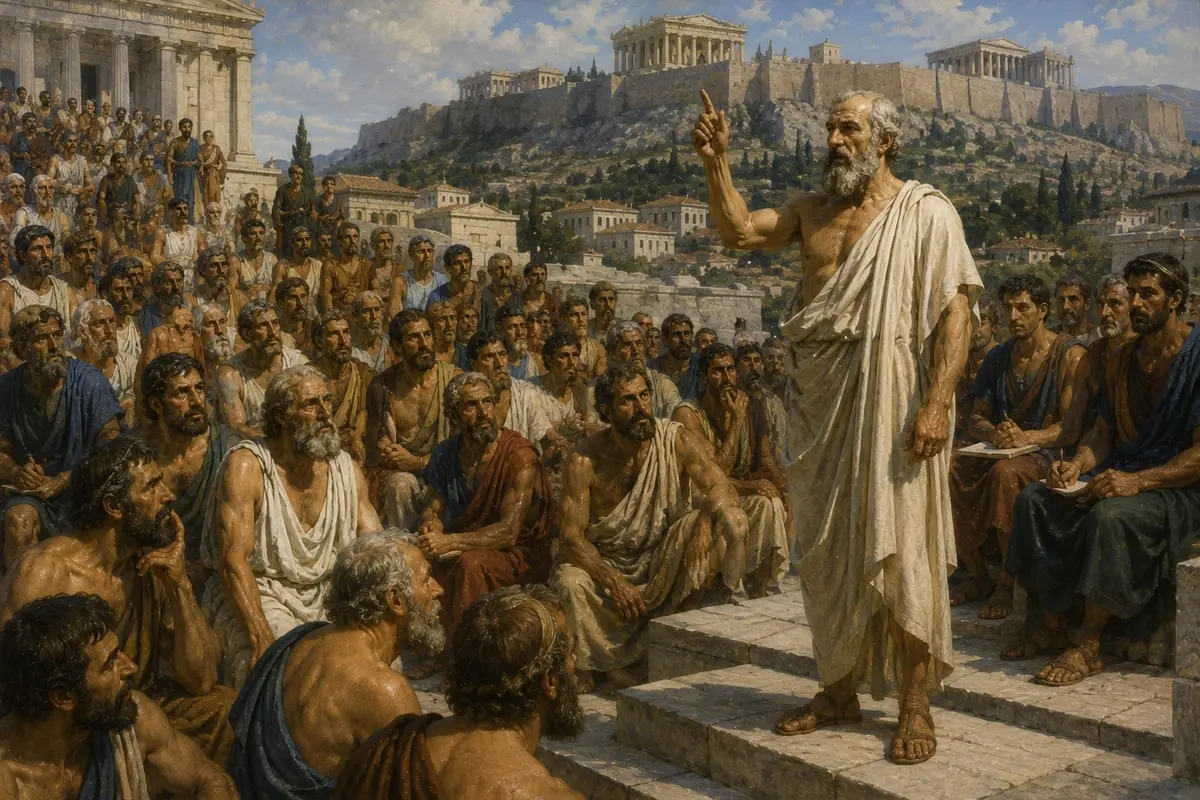
He told them he'd been given to Athens by the god as a gadfly — and that killing him would harm them more than him. The jury voted to convict, roughly 280 to 220.
The End
Execution was delayed about a month by a religious embassy to Delos. His friends arranged an escape and he refused — the argument he gives in the Crito is that having lived his whole life under Athenian law, he had no standing to break it the moment it went against him. He drank the hemlock, walked until his legs grew heavy as instructed, lay down, and talked to his friends until he couldn't. His last recorded words were a reminder that he owed a cock to Asclepius, the god of healing, and that the debt should be paid. The most common reading is that the sacrifice was made on recovering from illness, and that Socrates was calling death a cure.
What Actually Killed Him
Take the pieces together and the trial stops being mysterious. Political fallout, prosecuted through a religious charge. The amnesty blocked the real accusation, so it came in sideways. A genuine religious element too. Socrates talked about a personal daimonion, an inner divine sign. To an Athenian jury this sounded like a private line to a god the city hadn't approved, in a state where religion was a civic function. Twenty-four years of public humiliation. Socrates had spent his life demonstrating to prominent Athenians, in front of audiences, that they didn't know what they were talking about. And a caricature that had been running since 423 BCE, when Aristophanes put him on stage. Socrates himself points at that play in Plato's Apology as the source of the prejudice — an image that had sat in the public mind for a quarter of a century with no way to answer it. Athens regretted it fairly quickly, according to later tradition. It had also, within a few years, produced the philosophical tradition that would define Western thought, largely because a devastated student named Plato spent the rest of his life writing about a man who never wrote anything.