Micronesian peoples are dispersed throughout one of the most desolate regions of the planet. Their homelands consist of thousands of small islands and coral atolls scattered over an area of the Pacific larger than the continental United States, and yet, combined, they would barely cover a single mid-sized American county. Settling this region involved some of the most daring ocean voyages in human history that occurred thousands of years before European ships had ventured this far from shore.
The word "Micronesian" is a misnomer, suggesting that there exists but a single people, when in reality it encompasses more than a dozen distinct ethnic groups possessing their own languages, social systems and histories. The Chamorros of Guam, the Marshallese, the I-Kiribati, the Palauans, the Pohnpeians and the Yapese all fall under the label, and are not all the products of the same ancestors. Some came from the west, some the south and east, and genetic research is still separating exactly who arrived where and when.
What unites them, however, is a shared way of living with the ocean and the land, and a devotion to the family, lineage and ancestral ground that runs through almost every Micronesian society, from the high volcanic islands to the flattest atolls.
What "Micronesian" Actually Means
Micronesians are the Indigenous peoples of Micronesia, one of the three traditional cultural regions of Oceania alongside Polynesia and Melanesia. They are part of the much larger Austronesian family, a group of peoples whose languages and cultures ultimately trace back to Taiwan.
The list of groups classed as Micronesian is long. It includes the Chamorros of Guam and the Northern Mariana Islands, and the Carolinians who also live in the Northern Marianas. In Chuuk you will find the Chuukese along with the Mortlockese, Namonuito, Paafang, Puluwat and Pollapese. Pohnpei is home to the Pohnpeians, Pingelapese, Ngatikese and Mwokilese, while Yap has the Yapese, Ulithians, Woleaians and Satawalese. Palau counts Palauans, Sonsorolese and the people of Hatohobei. There are the Kosraeans, the Marshallese, the Nauruans and the I-Kiribati.
That's a lot of names for a region most people could not find on a map, and it also indicates something important: Micronesia is not one culture stretched out thinly, but a patchwork of societies that developed side by side, sometimes in contact and sometimes in relative isolation.
The Austronesian Expansion Across the Pacific
To understand where Micronesians come from, one must begin with the Austronesians. Linguists, archaeologists and geneticists broadly agree that Micronesians, as do the Polynesians and many of the Melanesians, descend from this great seafaring migration.
The Austronesians were the first people anywhere to develop true ocean-going sailing technology. Outrigger canoes, double-hulled vessels, boats built of lashed planks and the triangular crab claw sail all came out of this tradition. With these they spread faster and farther than any people before them, eventually reaching from Madagascar in the west to Easter Island in the east.
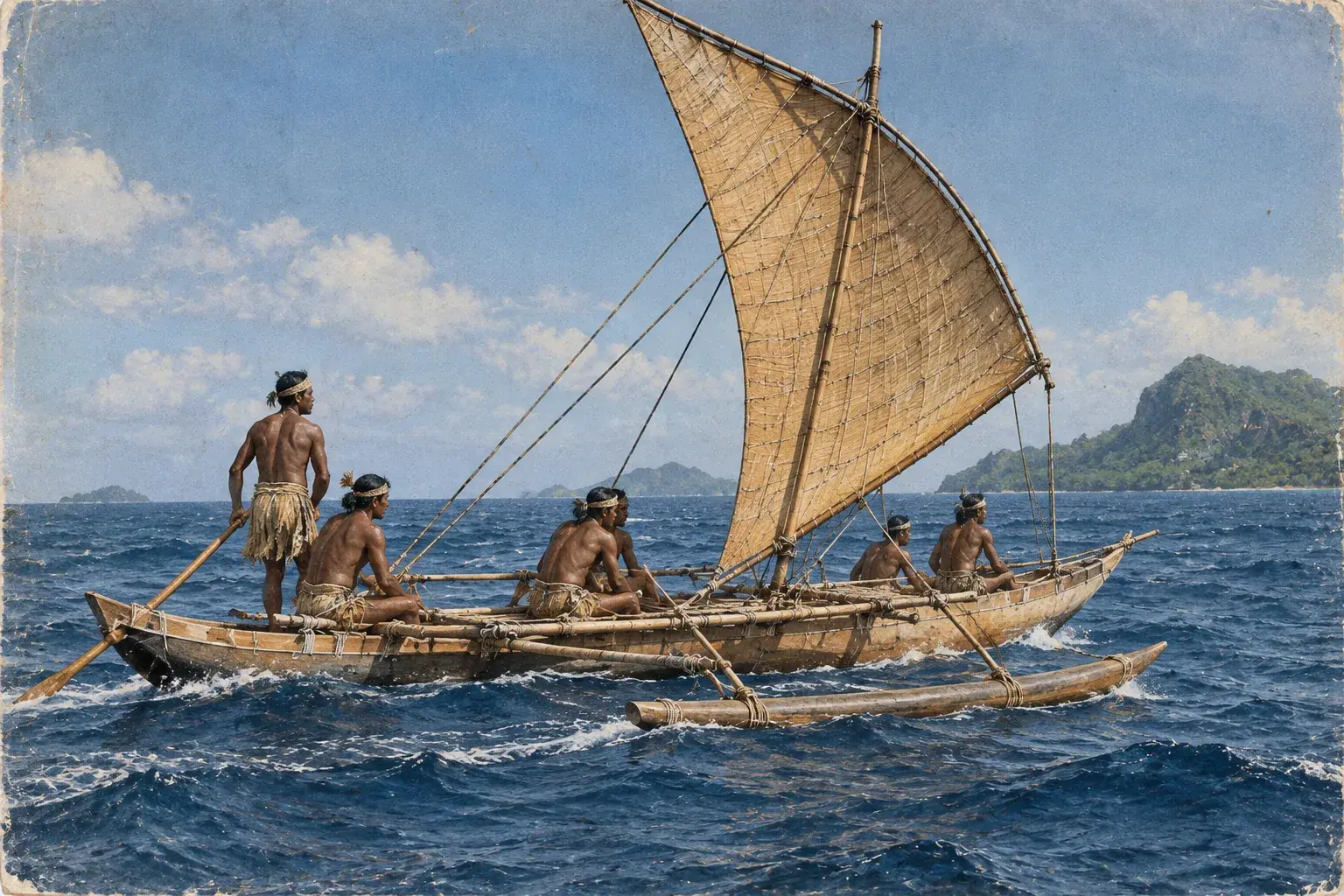
Outrigger hulls and the crab claw sail were the Austronesian inventions that made settling remote Pacific islands possible.
They did not enter empty territory everywhere, however. From around 2000 BCE Austronesian migrants mixed with the older populations already existing on islands along their route, much of that occurring along the northern coast of New Guinea and the islands nearby. These were the approximate places where roughly four thousand years ago the Oceanic languages emerged as their own branch of the Austronesian family, later giving rise to most Micronesian languages.
Two Directions of Migration Into Micronesia
Where the Micronesian story becomes interesting is that people did not enter the region from just one side. They came in from both.
The western settlers came from the Philippines and Indonesia. They reached the Mariana Islands first around 3,500 years ago, followed by Palau roughly five hundred years later. These were early Malayo-Polynesian speakers who had not passed through the Oceanic stage at all, and hence why the Chamorro and Palauan languages still stand apart from their neighbors today.
The eastern settlers took a completely different route. They came up from the eastern Melanesia and belonged to the Lapita culture, a seafaring people most famous for their distinctive stamped pottery. Over several centuries, possibly setting out from somewhere around the Santa Cruz Islands, they spread into the Gilbert Islands, the Marshall Islands, the central and eastern Carolines, and the small islands of Sonsorol, Pulo Anna, Merir and Tobi. Their Oceanic language gradually split off over the following centuries to become the Micronesian branch.
Yap, however, seems to have been settled separately, about 2,000 years ago, by Oceanic speakers from Melanesia. The Admiralty Islands north of New Guinea are a likely source.
Linguist John Lynch has put forward a possible link between the Micronesian languages and those of the Loyalty Islands in Melanesia. He is careful about it, and frames the idea as one of worth further study, even if the only result is its ruling out. This is a virtue to be appreciated in a field where tidy origin stories are tempting.
What Ancient DNA Says About Micronesian Origination
Genetics has added a new layer to this, with a 2022 study finding that Micronesia was not settled by one population but by five distinct streams of migrants, three of which carried what researchers call First Remote Oceanian ancestry, which is East Asian in origin and genetically close to present-day groups such as the Kankanaey of the Philippines and the Amis and Atayal of Taiwan.
According to the study, three separate waves carried that ancestry into the region, with the Mariana Islands coming first, followed by Palau, followed by Central Micronesia. The remaining two streams brought Papuan ancestry related to mainland New Guinea and, much later, Polynesian ancestry. One detail stands out, and that is that people in Palau and Central Micronesia carry some Papuan ancestry picked up somewhere along the way, but the people of the Marianas do not. The study also supports the idea that the Admiralty Islands were the launching point for Central Micronesian peoples and their languages.
It is worth reading the exact dates with some care. The study places these three waves before roughly 2,800, 2,400 and 2,100 years ago, counted in years before present; when those figures are misreported as BCE dates, they sit oddly in the overall timeline of around 3,500 years for the Marianas. Different studies have also landed on different numbers. The general picture of separate, overlapping migrations is solid, and the exact calendar is still being argued over.
High Islanders and Low Islanders in Micronesia
Once people had settled, things began to take divergent turns depending on the geography they found themselves in. Anthropologists often classify Micronesians into two broad cultural groups based on the type of island they called home.
High islanders lived on larger volcanic or raised islands with fertile soil and reliable fresh water. The Palauans, Chamorros, Yapese, Chuukese, Pohnpeians, Kosraeans, Nauruans and Banabans all fall into this camp. With the abundance of things here, they had less reason to travel far, and their islands could support bigger populations.
Low islanders are the people of the atolls, the rings of coral barely rising above sea level. The Marshallese and the I-Kiribati are the main examples, and the cultures they developed were very different from those of the high islanders. Life on an atoll is precarious, with resources running thin and storms being devastating. Survival often depended on getting somewhere else, and put simply, low islanders became the better navigators and canoe builders because they had to.
There is also a small mystery on the northern fringe of the region. Archaeologists have discovered evidence that some of the Bonin Islands, far to the north towards Japan, were once lived in by Micronesians. Nobody knows which group they were.
The Chamorro and Refaluwasch Peoples of the Marianas
The Chamorros are the Indigenous people of the Mariana Islands, a chain split today between the US territory of Guam and the Commonwealth of the Northern Mariana Islands. Their ancestors came from Island Southeast Asia, and they are closely related to Austronesian peoples in the Philippines and Taiwan as well as to the peoples of the Carolines. More than three centuries of Spanish rule left a heavy stamp on their language, which borrowed so many Spanish words that the traditional Chamorro counting system was entirely replaced by their Spanish numbers.
The Marianas are home to the Refaluwasch, or Carolinians, whose name translates to "People of the Deep Sea." In Yap's outer islands, they are known as Remathau. Their ancestors are thought to have reached Micronesia roughly 2,000 years ago, and more than 8,500 now live in the Northern Marianas. Their language, also called Refaluwasch, has around 5,700 speakers.
The Carolinian presence on Saipan has a specific and somewhat grim backstory. In the early nineteenth century, after Spanish colonization had reduced the local Chamorro population to just 3,700 people, Carolinians began to sail to Saipan in small canoes, many of them leaving behind islands wrecked by a typhoon. Their society is matriarchal, built of deep respect for the women who lead families, and most Refaluwasch today are Roman Catholic.
Chuukese, Pohnpeian and Kosraean Peoples
The Chuukese are the single largest group in the Federated States of Micronesia, making up nearly half the country's population. Their home, Chuuk, was once better known to outsiders by its old name, Truk. Traditional Chuukese culture expected men to protect their families fiercely and guard their clan, lineage and property. Walking away from a fight was not considered manly.
Pohnpei, with about 28,000 Pohnpeians, had one of the most strictly organized societies in the region. It was divided into five tribes, made of clans and sub-clans, and each led by two principal chiefs. The arrangement worked much like feudalism, with the idea in principle being that "all land belonged to the chiefs", who collected regular tribute and held absolute power. Chiefs could order death or exile as punishment, and wars between tribes involved looting, burning houses and canoes, and killing prisoners. Pohnpei is also where you will find Nan Madol, the astonishing ruined city of stone buildings that ranks among the most impressive archaeological sites in the Pacific.
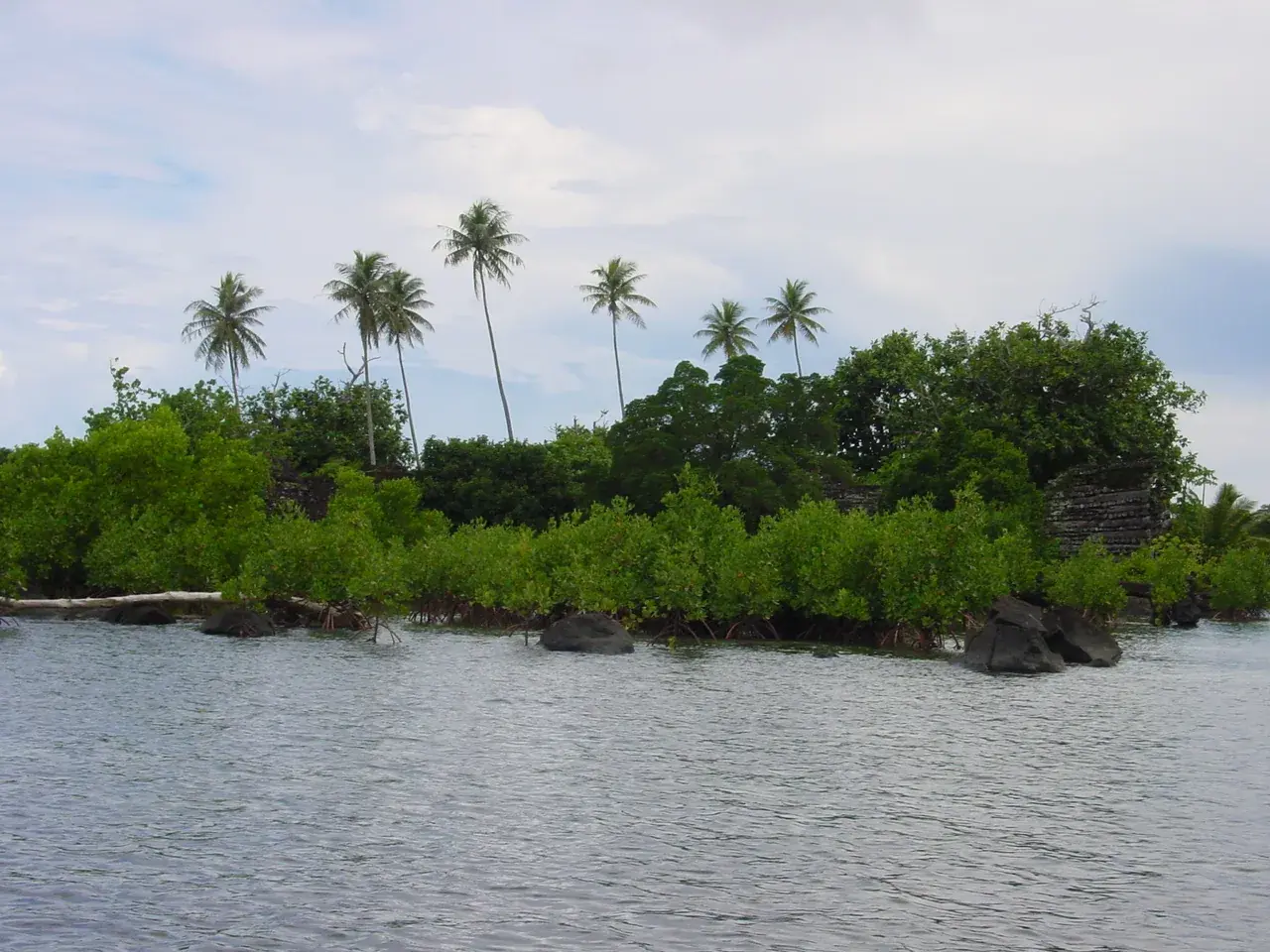
Nan Madol's basalt walls spread across more than 100 artificial islets and served as the ceremonial centre of Pohnpei's Saudeleur dynasty.
Image Credits: CT Snow from Hsinchu, Taiwan, via Wikimedia Commons (CC BY 2.0)
The Kosraeans, from the island of Kosrae, number around 8,400 and speak their own Kosraean language.
Marshallese and I-Kiribati Atoll Cultures
The Marshallese, around 70,000 strong, are the Indigenous people of the Marshall Islands. Their traditional society was built upon three social tiers. At the top was the iroij, a chief and landowner who oversaw several clans. Below that came the alap, who managed an individual clan, and then the rijerbal, the commoners who worked the land. Accounts describe relations between these classes as respectful, though this is probably a thinly-sourced claim painting a rosier picture than life always offered.
The I-Kiribati, also called Gilbertese or Tungaru, are the Indigenous people of Kiribati and speak the Gilbertese language. There were about 103,000 of them in 2008.
The Banaban People and the Phosphate Mining Legacy
Few Micronesian stories are as sad as that of the Banabans. Banaba is a single raised island in Kiribati, and its people are generally grouped with the I-Kiribati. Banaban writer Raobeia Ken Sigrah argues that they are a separate ethnic group in their own right.
Their troubles began in 1900, when phosphate was discovered on the island. Mining tore the land apart, and forced migrations followed. After 1945, British authorities moved most of the population to Rabi Island in Fiji, and more Banabans left in 1977 and again between 1981 and 1983. When mining finally ended in 1979, some returned home. Roughly 300 were living on Banaba in 2001, and the 2010 census counted 295. Around 6,000 people of Banaban descent now live in Fiji and elsewhere.
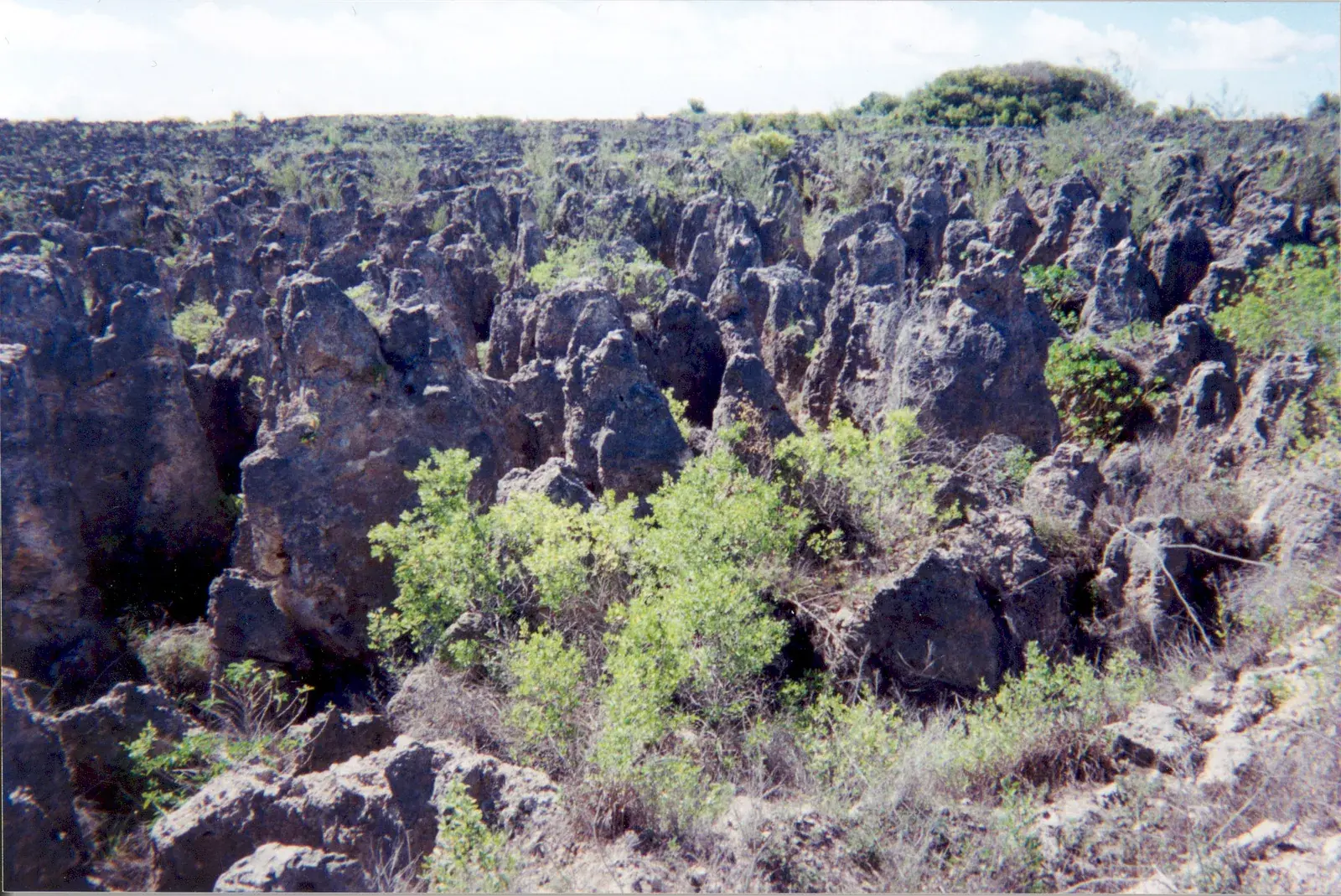
Nearly eight decades of phosphate mining stripped much of Banaba's surface down to bare coral limestone.
Image Credits: Wikimedia Commons (Public domain)
The language also suffered. Christian missionaries translated the Bible into Gilbertese and encouraged Banabans to read it, and the result was that the original Banaban language was abandoned. Only a handful of its words survive today, folded into the Banaban dialect of Gilbertese that people speak today.
Palauan, Sonsorolese and Tobian Peoples
Palauans, or Belauans, number about 26,600 and are the Indigenous people of Palau. Unlike many of their neighbors, they were never especially known as long-distance voyagers. Farming centered on taro, while breadfruit was more of a symbol. The Badrulchau stone monoliths stand in Palau as another reminder of how much monumental building there was in prehistoric Micronesia.
The southwestern islands of Palau have their own story. The Sonsorolese live on Sonsorol, Pulo Anna and Merir, though most now live in the village of Echang near Koror, where they moved for work. A few also live in the Northern Marianas and the Federated States of Micronesia. Linguistically and culturally, they are closest to the Carolinians. Some of the earliest written descriptions of them come from Jose Somera, who sailed with Don Francisco Padilla's expedition when he arrived at the islands in 1710. He described people wearing aprons, cloaks and conical hats, much like the clothing Paul Klein had recorded among Carolinians in 1696.
The Tobians, from the island of Tobi in Hatohobei State, share a similar heritage. Their cultural ties point to the central Caroline Islands more than 1,000 kilometers away, on the far side of Palau. Tobian, closely related to Sonsorolese, is spoken by only about 150 people, on Tobi itself and in Koror.
Yapese and Nauruan Peoples
The Yapese, about 15,000 people on Yap's main island, speak a language that does not fit neatly with its neighbors, a reflection of the island's separate settlement history.
Nauru is even more difficult to pin down. Nauruans are most likely a mixture of several Pacific peoples, but their origins have not been settled. One theory is that seafaring or shipwrecked Polynesians or Melanesians found the island uninhabited and made it their home, possibly during a late wave of migration. It remains an open question.
Micronesian Languages and the Oceanic Family
Micronesians speak around fifteen distinct languages. Most belong to the Micronesian branch of the Oceanic languages, which descend through Proto-Malayo-Polynesian from Proto-Austronesian. This branch includes Marshallese, Gilbertese, Kosraean and Nauruan, as well as a large sub-family known as the Chuukic–Pohnpeic languages, which alone contains eleven languages.
Yapese belongs to the Oceanic family but is outside the Micronesian branch. It is also worth noting that two languages break from the pattern in that they are not Oceanic at all, Chamorro and Palauan are Malayo-Polynesian but not Oceanic, a living trace of those early western migrations from Island Southeast Asia.
Traditional Micronesian Navigation and Wayfinding
If there is one thing Micronesians are rightly famed for, it is navigation. For thousands of years, navigators crossed open ocean between islands without instruments, using the stars, the flight of birds, the shape and direction of ocean swells and the patterns of the wind. They were all encoded in oral tradition passed down from teacher to student.
Some navigators built charts from sticks and shells to represent swells and currents, tools that look deceptively simple and encode an enormous amount of hard-earned knowledge. The tradition has not disappeared, though it is fragile. In the central Caroline Islands, there are only two traditional schools of navigation left: Weriyeng and Fanur.
Family, Land and Elders in Micronesian Society
Micronesian cultures vary widely from island to island, and have assimilated influences from their neighbors. In the east, societies tended to look more Polynesian, with nobles, commoners and sometimes slaves. In the west, the pattern leaned more towards Melanesian and Indonesian models, with tribal chiefs rather than a hereditary nobility and the Marianas being the exception. Micronesians have more in common with each other than the Philippines, Indonesia, Melanesia or Polynesia, however.
The common thread is land, and the relationship with ancestral ground that shaped social organization, the family, the economy and the way people shared food and work across Micronesia.
The Micronesian family is built of four equally weighted parts, the household, the nuclear family, the extended family and the wider lineage. They all shared in fishing, farming, raising children and passing on knowledge, and individuals were expected to mold their behavior around the needs of the community.
Authority came with age, and young people were raised to show a deep respect for elders. This was done in one striking way, where young people would avoid speaking in the presence of elders. It was also the elders who mediated in disputes.
Micronesian Music, Chants and Songs
Most Micronesian societies did not have musical instruments to speak of, and music meant voice: songs and chants. One beautiful tradition stands out, and that is where wives or partners would compose songs about an important man's skills or achievements, and those songs could outlive him, transforming his memory into something close to legend.
Traditional Micronesian Religion and the Spirit World
The traditional religion of the people inhabiting the islands of Micronesia varies significantly from one region to another, with little being known about most of them. However, missionaries came to Micronesia in the sixteenth to eighteenth centuries, and the indigenous beliefs survived only on a few islands.
At the same time, there are certain similarities between different regional cultures of Micronesia. Most societies believed in the existence of various spirits that have different roles and rituals related to them. Creation stories usually trace the first people back to mythical ancestors, most often an ancestral mother. Culture heroes, who were usually skilled sailors and brought many things to the people, play an important role in the legends. The world was viewed as a multi-tiered structure with several levels of land and sea, associated with the four directions. It was further believed that all things and living creatures have a spiritual double that can leave the body during sleep. Many cultures believe in the existence of mana, which is spiritual power that can be transferred to people and natural phenomena by special deeds and ceremonies. Religious beliefs were also expressed in the bas-reliefs on house posts and the interior of the meeting houses.
Ancestral spirits have the most significant role in the beliefs of the people of Micronesia. When a person dies, his spirit either goes to another world or stays in the world of the living, causing either good or bad. Depending on whether it was a natural or violent death, a person’s spirit turns into a good ancestor or a harmful one.
Various spirits are connected to objects, subjects, trades, and events. People connected with the same trades pray to the spirits of their profession and offer them presents. It was believed that a sick person became ill because of the spirits interfering with the normal function of his body, which is why shamans, mediums, fortune-tellers, and witch doctors held a significant position in the society. Before engaging in a demanding activity, people observed certain taboos, most often related to food and sex. Spiritual interference could lead to serious consequences for the whole village.
Why the Micronesian Story Still Matters
Irrespective of the wide range of legends and oral history, it becomes clear that under the multiplicity of names and dates, there is a coherent story of people who have chosen to settle on the smallest and most remote islands of the Pacific Ocean. These people have come to these islands from different directions and ages, and the diversity of their cultural practices reflects this complex history. The significance of the study of Micronesian history and ethnology is that the reader realizes the importance of saving the remains of the cultures that have been destroyed. By preserving the traces left by the ancestors, people save their cultural heritage, which is severely threatened by the current climate and sea level changes.
The Banaban people and their lost island, the few remaining Tobian speakers, and the last two surviving navigational schools in the Carolines are all examples of cultures on the brink of extinction. The study of these peoples’ history shows that the knowledge of the ancestors plays a significant part in understanding how to live in the modern world. The ability to navigate the vast ocean enabled the Micronesians to populate all the islands, which in turn led to the formation of unique tribal cultures. Micronesians relied on their knowledge and experience, as well as the resources provided by nature, such as food and drink, wood and stone, making the maximum use of the available resources. This skill may be critical for the Micronesians in the future, as the rising sea levels threaten the low islands.