Mongol siege warfare is usually remembered for its outcomes rather than its methods, and four sieges from the Khwarazmian campaign of 1219 to 1220 are the best available material for seeing how it actually worked. They are also, unusually, told with the defenders at the centre.
Between them they cover almost every problem a besieging army faced in that country: filling ditches under fire, night sallies that burned the engines, running out of ammunition in a region with no stones in the ground, and an enemy who simply left by river in the dark.
They also cover the other half of the equation, which is that Mongol commanders reduced most towns without fighting at all, by making the consequences of resistance so visible that the next town surrendered on sight.
Otrar: The Siege That Opened the War
The war began at Otrar because Otrar was where it had started. In 1218 the city's governor had arrested a Mongol trade caravan of around four hundred and fifty people, accused them of espionage and had them killed, and the goods were sold in Bukhara.
The governor was Inalchuq, who held the title Ghayir Khan and was the sultan's maternal uncle. He knew exactly what was coming and had no illusions about terms. The sultan had reinforced him heavily, and he spent the interval strengthening the fortifications and laying in stores.
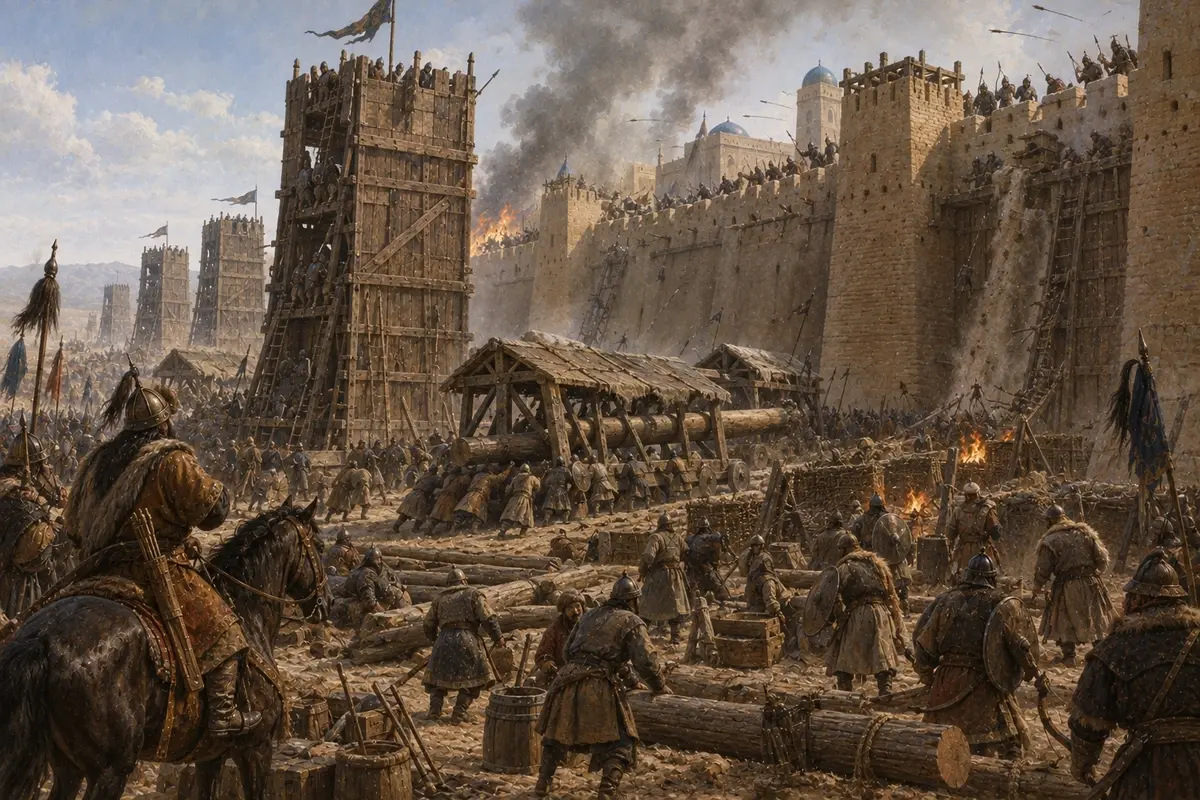
Filling the ditches under fire was the first and costliest task, and night sallies from the garrison kept destroying the engines.
The siege ran from late autumn 1219 into early 1220, roughly five months, and was commanded by two of Genghis Khan's sons, Chagatai and Ogedei. It began with the slow work of filling in the ditches around the outer wall where the battering rams were to go, and the garrison made that as expensive as possible, rushing out at night in numbers and repeatedly destroying or burning the engines before being driven back.
The Blockade That Was Refused
The resistance went on long enough that the princes became discouraged, and they wrote to their father asking permission to convert the siege into a blockade: invest the city closely, let nobody in or out, and wait for the provisions to run out. It would save very large numbers of their own men.
The answer was that they were to do no such thing. They were to fight their way in however many men it cost.
They went back at it, and within a month the outer wall and its supporting works were in ruins, with towers beaten down and breaches open. The garrison abandoned the outer line and fell back inside. The Mongols took the suburbs, plundered and burned them, and moved up against the inner works, where the defenders held for months more.
Qaracha Deserts and Is Executed
The break came from inside. The general commanding the reinforcements, recorded as Qaracha, was in an entirely different position from the governor, having done nothing personally to earn Mongol vengeance, and eventually concluded the killing had gone far enough and the town should surrender.
Inalchuq would not hear it, for the obvious reason that surrender ended with his own head on the ground, and he worked on the garrison and townspeople hard enough that they backed his refusal. That left Qaracha an object of suspicion and no longer safe inside the walls.
In February 1220 he deserted, going out at night with his men and handing the Mongols the gate they had marched out of. His calculation was that this would save his life and perhaps buy him a place in Mongol service.
He had misread them completely. The princes reasoned that a man who would betray his own countrymen would betray them the moment he had a good opportunity. They used the gate, and had him and his officers killed.
The Governor on the Upper Floors
Inalchuq fell back into the inner citadel with what was left of his troops, reportedly about a tenth of the original garrison, and held it for another month, making continual sallies and inflicting heavy casualties.
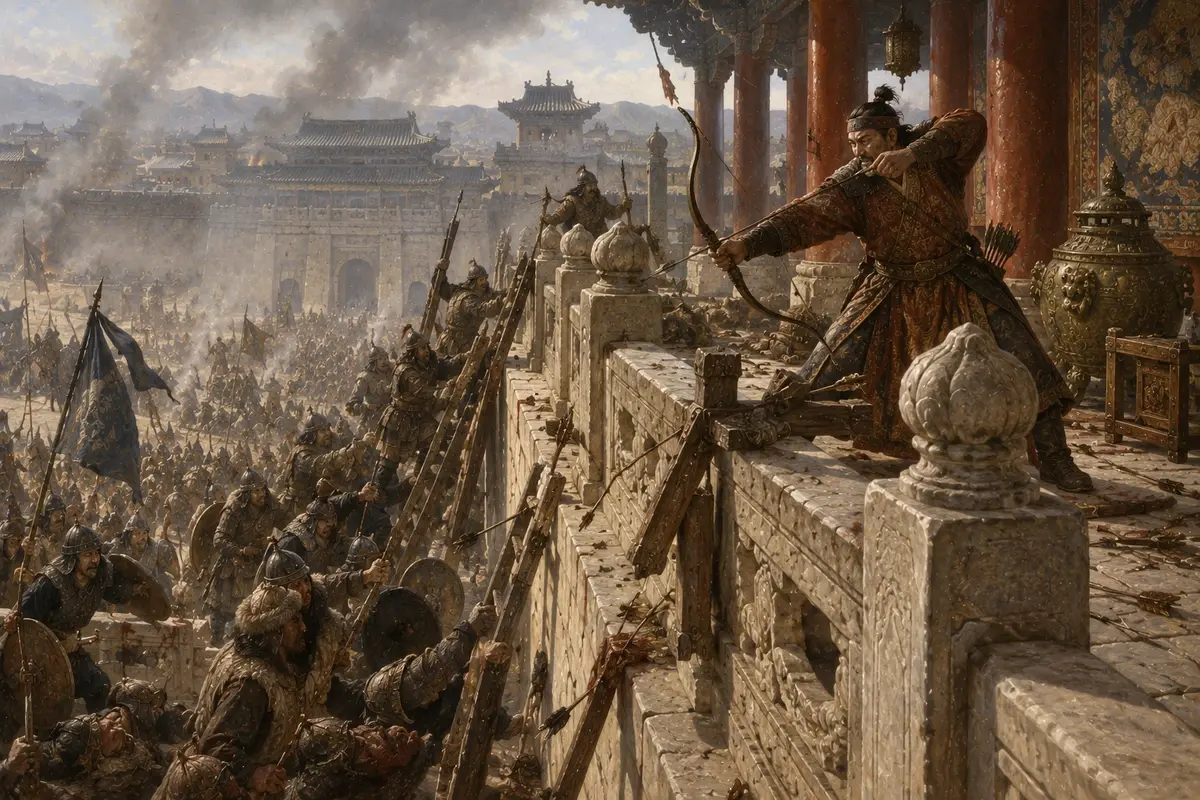
The order to take the governor alive meant the Mongols had to climb toward him without shooting back, at heavy cost to themselves.
Genghis Khan had given orders that the governor was to be taken alive rather than killed, wanting to dispose of him personally, and that instruction cost his own men dearly. The soldiers working toward him had to be careful not to shoot him, and a great many of them were killed while being careful.
The end of it is one of the strangest images in the campaign. Inalchuq was trapped on the upper floors of the citadel with his last two bodyguards. When the arrows ran out they tore up the building and threw bricks down on the men climbing toward them, reportedly killing a considerable number. Eventually the two guards were killed and the governor was taken.
He was executed shortly afterwards. The tradition that molten silver was poured into his eyes and ears is repeated in a good many retellings and is probably apocryphal; it was not a Mongol method, and it looks like a story invented to fit the crime. Some versions of the last stand also place his wife beside him, passing him arrows and then stones, though that detail does not appear in the earlier accounts.
Otrar's fall left the Khwarazmian heartland open. Bukhara, Samarkand and Gurganj would be isolated and taken in turn.
Saganak and the Murder of the Envoy
Jochi meanwhile took a detachment against a town called Saganak, and sent in a flag of truce calling on it to surrender and promising good treatment. The bearer was a Muslim, chosen on the assumption that the message would land better delivered by one of their own.
It was a serious misjudgement. The townspeople regarded him as a renegade, the governor's guarantee of his safety could not be enforced against the size of the crowd, and the man was torn to pieces.
Jochi assaulted immediately, and when he took the place he killed the entire garrison and about half the civilian population in reprisal. He also had a monument raised to the murdered envoy in the principal square, which is a peculiar combination of sentiment and slaughter and entirely characteristic.
The policy underneath it was consistent. Towns that resisted were treated with extreme severity; towns that yielded at once were spared and to some degree protected. Once that pattern was visible, many places surrendered before the Mongols reached them. In one case the magistrates rode out two days' journey to meet the army with the keys and a great quantity of presents.
Bridges, Ladders and a Feigned Attack
One town was taken by engineering rather than weight of numbers.
An engineer sent to reconnoitre reported a water-filled ditch outside the wall on one side, making access there awkward enough that the garrison would not expect an attack from that direction. His proposal was to build light bridges, throw them across at night after drawing the defenders off elsewhere, and go up on ladders.
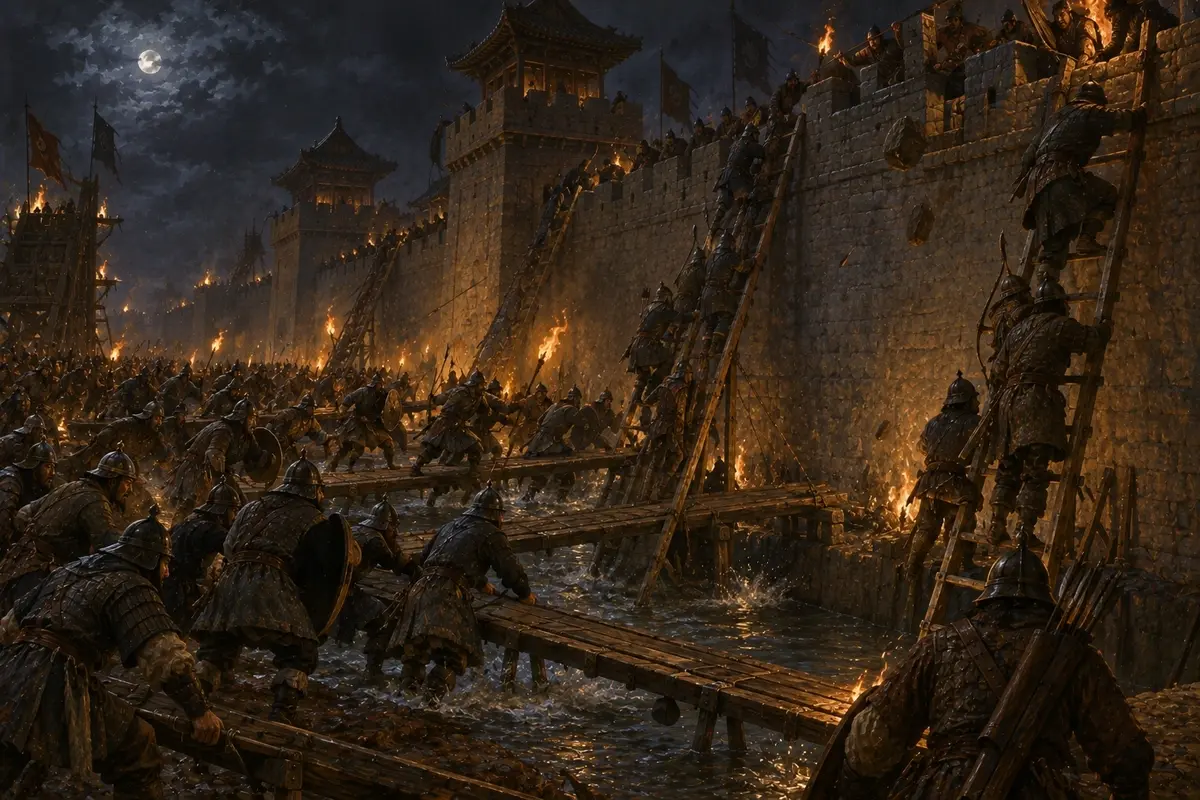
The engineer who designed the plan climbed the first ladder himself, with no way of knowing how many defenders waited at the top.
It worked. A feigned attack went in on the opposite side, the garrison was drawn off to repel it, the bridges went over and the ladders went up, and the attackers were inside and opening a gate before anyone understood what had happened. The engineer went up first, on the first ladder planted, in the dark, with no way of knowing what was waiting at the top.
Toukat Refused Its Terms
The next place was a quiet and beautiful town, a seat of learning full of fountains, gardens and pleasure grounds, whose charm was proverbial across the region. It was built for pleasure rather than defence, but it had a wall and its governor decided to hold it.
The garrison fought well and kept the Mongols off for three days, by which point the engines had opened enough breaches that the governor could see they would be through shortly. He sent to ask what terms were available.
The answer was that there were none now. It was too late; he should have surrendered at the beginning.
The town was stormed and the garrison killed. Then the whole population was ordered out to a spot on the plain, and went in terror, certain they were about to be massacred. They were not. The point was simply to get them away from their houses so the soldiers could loot without the owners in the way. After a while they were allowed back to find their homes stripped.
Timur Malik Prepares Khujand
The most interesting siege of the four was at Khujand, on the Syr Darya, a city that still exists under that name in northern Tajikistan and where its defender is remembered as a national hero.
Timur Malik was a chieftain with a serious reputation who had served the sultan as one of his principal generals, and when he heard the Mongols were coming he prepared properly. He broke up the roads and destroyed the bridges. He laid in heavy stocks of food. And he ordered all the corn, fruit and cattle of the surrounding country that he did not need carried away and hidden at a distance, so that none of it could feed the besiegers.
The Mongol detachment sent against him had first to rebuild a bridge across the river, since the town stood on the far bank. Then it set up engines along the line, some to batter the walls and others to sweep the parapets, reportedly throwing stones the size of millstones.
Floating Batteries and False Deserters
Timur Malik's counter-measures are the most inventive defence in the campaign.
He built flat-bottomed boats that amounted to floating batteries, roofed over to protect the crews and cut with port-holes in the sides in the manner of a warship, though what came out of them was arrows, javelins and stones. He stationed them above and below the town wherever they could reach the Mongol works, and they killed and wounded very large numbers of men and badly disrupted the siege.
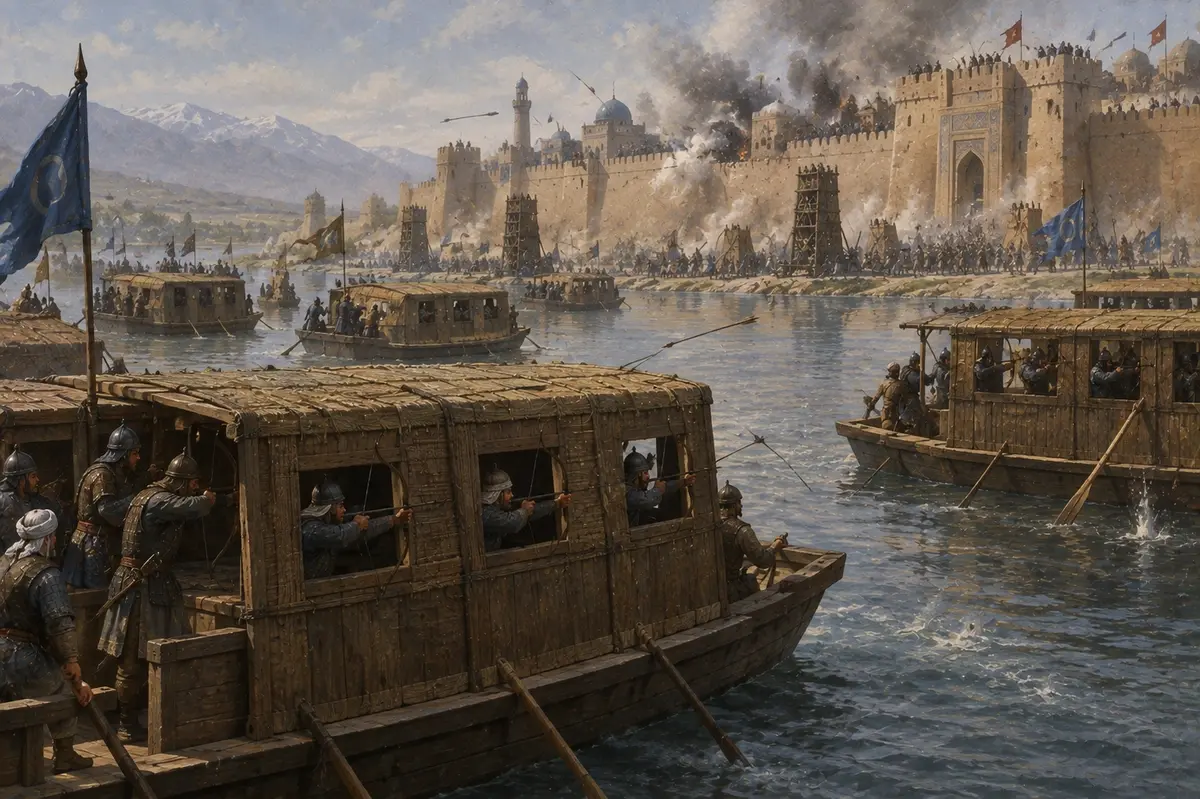
The floating batteries let him strike the Mongol siege works from the water on both sides of the city.
The Mongols could not close the town off completely, because a large morass on one side could not be covered, and reinforcements kept coming through it to replace the men lost on the walls.
Then he tried a deception. There was a small island in the river near the walls on which he had built a fortress before the siege, garrisoned with about a thousand men. He sent out a party posing as deserters, who went to the Mongol camp and, on being questioned about the weak points, advised attacking the island, which they said could be taken easily and which commanded the city entirely.
The Stone Shortage and the River Mole
The Mongol general moved his principal engines opposite the island and threw everything he had at it. The river was too wide and the walls too thick, and he made almost no impression.
Then he ran out of ammunition, and the geography turned against him. Stones served as the projectiles of the era, and the town stood in alluvial country with no stones in the ground at all. He had to send ten or twelve miles to the uplands for more, and operations were largely suspended while the entire available force went back and forth carrying rocks. The garrison used the pause to repair and strengthen everything.
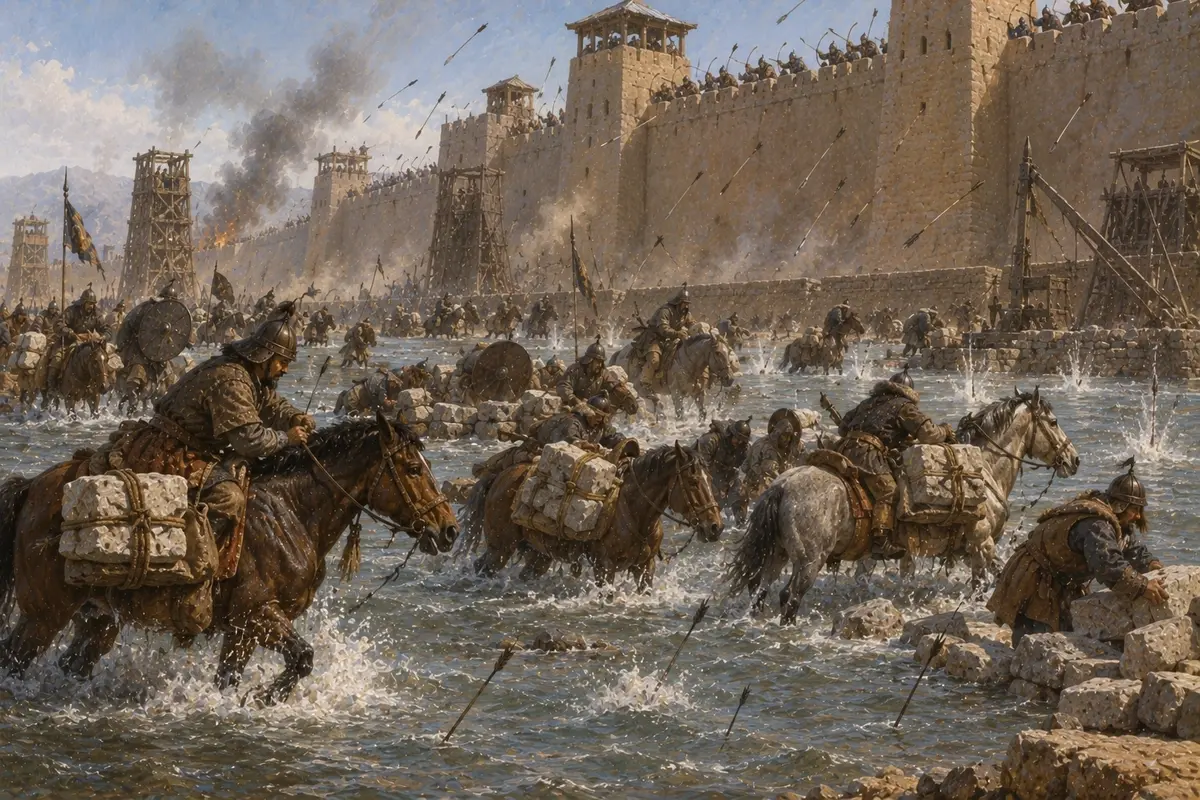
Riders kept sinking into holes in the sandy riverbed while archers on the walls fired down on them as they worked.
When a supply had finally been collected he changed the plan, and decided to build a mole out into the river toward the island to get his engines within range. Labourers carried stones down to the bank; horsemen waiting at the water's edge took them, rested them on the saddle, rode out into the current, dropped them and came back for more. That allowed work at many points at once.
The horsemen's job was appalling. The sandy bottom was full of holes they kept sinking into, and the garrison spent the whole time shooting arrows, javelins and fire-arrows into the workmen, killing very large numbers of men and horses.
Seventy Boats and the Running Battle
When the mole had gone far enough out that the position would shortly become untenable, Timur Malik decided to leave, and had been quietly building for it.
His men had constructed additional boats in hidden stretches of the river until he had more than seventy, each roofed with a heavy awning of wet felt plastered with clay and vinegar, which protected the crews from missiles and the boats from fire.
One obstacle remained, the bridge the Mongols had built below the town. He dealt with it in a night. A sally from one of the gates attacked the guard on the bridge, and at the same time large flat-bottomed boats loaded with combustibles mixed with tar and naphtha were set alight and sent down the current. They drifted into the piers one after another and set them burning while the guard was fully occupied elsewhere, and the bridge went.
With the way clear he embarked his family and most of his army at night and sent the boats downstream one after another. By morning there was no trace of them.
The Mongols found out quickly and sent a strong detachment down the southern bank. What followed was a running battle between horsemen on the bank and men in boats, with the boats hugging the far shore. Where the stream narrowed the fighting became fierce, the Mongols driving their horses far out into the water to shoot, the defenders shooting back through their port-holes.
It ended on a sandbank. The boats grounded on shoals and Timur Malik had to abandon them and get his men ashore, forming them up on rising ground before enough Mongols could cross to attack. He beat off the first attack and then had to keep retreating, his force thinning as he went, until he was almost alone with three Mongols closing on him. He turned in the saddle and shot the leading man through the eye, and while the other two stopped to help him Timur Malik got away.
He reached the sultan's camp with only a handful of men and was received with delight, praised for the spirit he had shown and immediately made governor of another city. One of the abandoned boats, carrying his family, went quietly on down the river and delivered them to safety.
Khujand surrendered the following day. Which is the pattern underneath all four of these sieges. The defences could be brilliant, the commanders could be brave past the point of reason, and the outcome never changed. What varied was only how many people died on the way to it.